Canada’s multiculturalism: A circle, ever edging outwards
JOHN RALSTON SAUL
Special to The Globe and Mail
Published Friday, Apr. 22, 2016 1:15PM EDT
Canada is now the only Western democracy in which there is no serious argument among the citizenry or politicians over the importance of immigration. Canadians understand that immigration is not migration. It must be seen as the first step toward citizenship. And the sooner an immigrant becomes a citizen, the better.
The main complaint after the arrival of the first 25,000 Syrian refugees seems to be that more of them should have been citizen sponsored because it is harder to settle those who are government assisted. So we now need more refugees, but in that first category.
Incidentally, I believe the term should be citizen sponsored, not privately sponsored. Private implies self-interest or commerce. This is all about citizen engagement.
Seen from outside the country, our attitude toward immigration and citizenship often seems to make Canada an outlier – problematic, a contradiction, sleepwalking to disaster, even unacceptable as a real nation-state
.
Over the last month in several European countries, I found that many people, of all backgrounds, educations and beliefs, were quicker than ever to say Of course, you can believe in these things. You have a big country. You’re a new country.
Neither is true. We aren’t big. For the last hundred years most immigrants have gone to a handful of big cities. And we aren’t new. As a settler society we are the product of 400 years, most of it spent going through the same economic, political and social dramas as other Western countries. We are the oldest continuous democratic federation in the world – beating Switzerland by a few months. We are the second- or third-oldest continuous democracy of any sort in the world – 168 years without breaking up, without a civil war, a coup, an absolute monarch, a dictator.
Our cities are built where Indigenous peoples prospered for thousands of years. As I pointed out in A Fair Country, back in 2008, First Nations and Métis peoples far outnumbered settlers into the second half of the 19th century. So Canada at its best is very much the product of the long relationship with Indigenous peoples, their approaches and philosophies; and above all, their concepts of inclusion and belonging, which today we would call immigration and citizenship. If the central characteristic of Canada is its complexity, this also is an outcome of our long relationship with Indigenous peoples. In particular we owe a great deal to the example of the Métis Nation, the very model of living complexity.
None of this lessens the reality that, for more than a century as immigrant power grew, the Indigenous-settler relationship was betrayed and great evil was done. But that in turn cannot erase the Indigenous influence on our society. That Indigenous reality is now reasserting itself. The Supreme Court of Canada’s decision April 14 that re-establishes Métis and non-status Indian rights is yet another example of this.
Today, repairing the relationship with Indigenous peoples is the single most important test for Canadians. We now seem ready to play our part as their allies, but must remind ourselves every day that central to reconciliation is concrete restitution. Many of us keep coming back to the words of Chief John Kelly – “as the years go by, the circle of the Ojibway gets bigger and bigger. Canadians of all colours and religions are entering that circle. You might feel that you have roots somewhere else, but in reality, you are right here with us.”
When I find myself explaining to Europeans why our system of inclusion and diversity more or less works, I inevitably go back to those non-racial Indigenous ideas which leave space for multiple identities and multiple loyalties, for an idea of belonging which is comfortable with contradictions, which shifts humans from their autocratic role as masters of the universe to one more integrated into the place itself. This is an approach to values which is the opposite of the European-U.S. understanding of the monolithic citizen melted into a pot of national uniqueness.
All of which matters today because Canada is out on the cutting edge, doing things other countries are not. We know that the leaders of the three most powerful European countries have declared multiculturalism a failure. Which I suppose is supposed to mean that Canada is or will be a failure. But we should also know that what they mean by multiculturalism has more or less involved the abandonment of what they inaccurately call migrants into ghettos; that they imagine it involves the breaking up of society into unrelated pods, producing in the worst cases police no-go zones and failed schooling. The author of a recent biography of Tony Blair presents the former British prime minster as preferring “multiculturalism” over the “integration of immigrant communities.” We know this is not at all what multiculturalism is supposed to mean. And our opinion should be worth something since we are seen as the inventors and the experimental centre of the concept.
Our great weakness as Canadians is that we have been lazy when it comes to explaining what our experiment consists in. Our excuse could be that it is, after all, an experiment. That is not good enough. The atmosphere out there in most Western countries is one of tired elites, many of them caught up in bourgeoning campaigns of fear. Canadians know all too well how contagious these are. Our last prime minister started down that road, which is one of the reasons he is out of a job. And we know well the confused, divisive atmosphere in the United States – the discourse of walls and security. The current British Prime Minister believes he must get the immigration levels down. The French Prime Minister has just called for the banning of headscarves on students in universities. Even German Chancellor Angela Merkel, having made a great ethical gesture in 2015 to welcome one million Syrian refugees, now finds that, because Germany does not have an overarching immigration-citizenship policy and structure, it is a nightmare to organize their settlement. The result has been a political backlash. And yet we must admire the risk that Germans have taken and their determination to make it work.
What’s more, we must not confuse the massive political and ethical failure of most European governments with the attitudes of large parts of the citizenry. Europe is filled with citizens throwing themselves into the crisis as volunteers. Just as the Macedonians were closing their borders, I was in the transit camp on the Athenian docks in Piraeus. At that point, they were managing a few thousand refugees. The sheds were all well organized and run by amazing volunteers – not NGOs or government. In fact, the Greeks, almost broken by their own crisis, have responded with generosity and care to the refugees’ plight, just as many citizens of Calais have stepped in to support refugees in the awful camp outside their city. In southern Italy, in Germany, there are thousands of such stories. And there are thousands of study groups, professors, NGOs, activists doing whatever they can.
But the problem is so profound that the continent is failing and governments are justifying this failure by blaming others. You could call it a massive mismanagement of the end of empires; less the uncontrollable outcome of geographic proximity and more the result of 50 years of hypocrisy when it comes to Mediterranean relationships. The Brexit movement in Britain can only be seen as a deeply romantic desire to return to another era, which itself never existed. I hear serious individuals talking about a need to recreate an alliance of the English-speaking peoples, as if we have all been sitting around for 40 years, waiting for Britain to come back to us. The most likely outcome of Britain voting to withdraw from the EU would be Scotland separating in order to stay in Europe. This is one of those do-I-laugh-or-do-I-cry moments.
There is a whispered conviction among many around the continent that the real problem is Islam; that it is not absorbable into Judeo-Christian civilization. This is the language which Christians used to use against Jews and Protestants against Catholics and vice versa. This was once the excuse in Canada for excluding Sikhs, Chinese, Japanese. And it was the excuse for trying to destroy Indigenous peoples.
Reactive panic – and crisis
The heart of the crisis lies elsewhere. Every year for seven decades Europe has been taking in large numbers of immigrants from many places. They were called many things – migrants, refugees, guest workers. The delusional assumption was that they would serve their economic purpose or be protected for a while, then go home. They didn’t. And European leaders, off the record, knew they wouldn’t.
And so, 70 years of lying to themselves has resulted in an immigration civilization profoundly unprepared for immigration. No attempt has been made by the EU or by individual European countries to develop an overarching, proactive immigration policy, with the necessary infrastructure both at home and in their embassies. In many cases they are doing better than they think, but their idea of themselves hides this success. The result now is a reactive panic; a crisis of drownings, disgraceful camps, human disorder and suffering. And there is still no hint of any desire to create a dignified, balanced immigration policy with citizenship as an essential celebratory part of the whole. It is precisely now, in the midst of the crisis, that they should be developing a positive, holistic approach. If anything, the latest EU-Turkish agreement crosses basic ethical lines and so in the long run will make matters worse.
The countdown to citizenship
Let me go back for a moment to the failure of Canadians to explain ourselves to ourselves, let alone to others. There are real risks involved in this ham-handed mutism and naive triumphalism. What’s more, it is unnecessary. The patterns of our immigration and citizenship history, at their best and their worst, are clear.
The idea of a broad government-supported immigration/citizenship policy goes back to the Indigenous welcome. That’s how the settlers survived. It was equally central to both the New France settlement strategy and system created for the Loyalist refugees fleeing in the 1780s from the American war against Britain. In February, 1848, the first law passed by the new responsible-government parliament of Canada laid out the beginnings of a modern immigration/citizenship policy. With Confederation in 1867, the government immediately created a department for immigration and citizenship, and sent agents out around the world. Rules guiding the newcomers from immigrant status to citizenship were put in place and, ever since, that process has ranged between three and five years.
By the late 19th century, citizenship ceremonies were growing in popularity. Citizenship was a choice to be celebrated publicly. Since 1900, the annual immigration numbers have ranged between 200,000 and 400,000. In 1995 we set the yearly target at 1 per cent of the population. It usually ends up at around 0.7 per cent – between 250,000 and 300,000. As a point of reference: The one million refugees taken in by Germany last year, had they been shared around the EU, would have represented 0.2 per cent of the population. In many of our embassies, over half the staff looks after immigration. We were able to handle the 25,000 Syrian refugees in a few weeks because we have a large group of public servants expert in immigration, settlement and citizenship. The first thing those refugees received on disembarking in Canada was their permanent-residency status, starting them on the countdown to citizenship.
We all know that these 400 years of policy development were tarnished and regularly knocked off track by multiple insurgencies of racism and exclusion. But each of these was gradually eliminated and the main line re-established.
The philosophical trick in all of this is that immigration and citizenship have always been treated as inseparable steps. Engagement and marriage. This means that each immigrant arrives knowing that she must think of herself as a citizen, because she soon will be a citizen. This is a philosophy which changes radically everyone’s attitude toward inclusion and integration. It means that language training is simply part of the package from the beginning, as is the expectation that new Canadians will get involved in volunteerism and politics – the two keys to an engaged citizenry.
A perpetual experiment
What of the multicultural misunderstanding?
Canadians seem to be moving toward other words – diversity, pluralism, inclusion, interculturalism – as we have sensed a growing confusion elsewhere. But the idea is really not so difficult.
I think of it as rooted in balance – a central Indigenous concept of how societies function. At its best a balance between the place, the group and the individual. You could also describe it as a balanced or positive tension between organized integration and celebrated diversity; a conviction that diversity and fairness are reflections of each other; that this requires a rigorous use of political restraint; an allergy to universal mythologies and ideologies. All of which means that we must be self-confident enough and tough enough to live with the reality of complexity.
This is the opposite of the tired European-U.S. insistence on monolithic identities. The Canadian concept of living in a perpetually incomplete experiment may seem radical to many in the Western world. And yet you could simply see it as a profoundly non-racial approach to civilization – one based on the idea of an inclusive circle that expands and gradually adapts as new people join us.
Showing posts with label Europe. Show all posts
Showing posts with label Europe. Show all posts
Sunday, April 24, 2016


Sunday, July 05, 2015
Fintan O'Toole and the imaginative foundations of political structures
From the Guardian:
Has Europe lost its hold on our collective imagination? Fintan O'Toole When I was a teenager in Dublin in the early 1970s, the phrase “We’re into Europe!” gained a peculiar currency. It was half-jokey but not really sardonic. You used it for good things that promised even better things – when a girl you fancied smiled at you or your team scored the first goal. We were into Europe [the EEC]. ... But what did “Europe” mean in this sense? It was not a physical place. Ireland had, after all, always been part of Europe. And the EEC was not, in any case, Europe – it was a small fraction of the continent. But it wasn’t a mere set of trading and institutional arrangements either. It was a story, an imaginative fiction of the kind that Yuval Noah Harari evokes in his book Sapiens: A Brief History of Humankind. He makes the point that the capacity to believe in fictional constructs is a defining element of what makes us human, because without it we cannot co-operate with people we do not know: “At the heart of our mass co-operation networks, you will always find fictional stories that exist only in people’s collective imagination... There are no gods, no nations, no money and no human rights, except in our collective imagination.” One of these enabling fictions is “Europe”. It is a story that most of the central and western nations of the continent agreed to tell themselves and each other in order to deal with the legacies of the second world war and the cold war. And like all stories, it sustained itself, if not exactly with belief, then at least with a willing suspension of disbelief. The question now is whether it still exists at all, whether “Europe” has lost its hold on our collective imagination. All the evidence suggests that it has. In a remarkable outburst reported last week by the Observer, the Italian prime minister, Matteo Renzi, denounced the failure of his fellow EU leaders to agree on more than a voluntary plan to deal with the thousands of refugees and migrants landing on his country’s shores: “If this is your idea of Europe, keep it for yourself… you do not deserve to call yourself Europe. Either we have solidarity or we waste our time!” In recent weeks, too, the appeals by leaders of Syriza in Greece to “our shared European values” have come to seem not just desperate but naive. It is as if the Greeks were appealing to medieval codes of chivalry or expecting Premier League footballers to respect 19th-century Corinthian values. “Europe” and “European values” seem, even as rhetorical gestures, entirely hollow. They are evoked now only to underline their absence. One by one, the elements of the Europe story have fallen away. Democracy? ... The free movement of people? ... Thresholds of decency? Formulaic expressions of sympathy aside, there is little sense that the European Union as a whole finds it intolerable that hundreds of thousands of Greeks are living without electricity or that millions have no access to public health care. The “ever closer union” envisaged by the EU’s founders has been replaced in effect by a deeply incoherent mixture of one-size-fits-all thinking and double standards. On the one hand, there is the absolute insistence that there can be no challenge to the technocratic formula for solving the eurozone crisis: austerity plus massive bank bailouts plus privatisation and the dismantling of social and labour protections. On the other, there is a sharp moral and political divide between the creditor states and the debtor states, with a supposedly virtuous, prudent and righteous core beset by a feckless, reckless periphery. Or, if viewed from that periphery, between victimised citizens and a European political elite bent on punishing them for sins they did not commit on their own. There is no “collective imagination” of the crisis – in one Europe, it is respectable, hard-working people being exploited by chaotic layabouts from the hot south; in the other, it is hard-pressed and equally hard-working people being sucked dry to feed foreign banks. The stories Europeans are telling themselves about what’s going on around them are not just different but mutually exclusive and mutually antagonistic. ... the generation of leaders with memories of the Second World War – the likes of Helmut Kohl and Helmut Schmidt, François Mitterand and Jacques Delors – passed on. With them has gone the urgency of imagining a European story, not as an abstract fable, but as a necessary alternative to the other European stories of Hitler and Stalin. ... In the technocratic mindset that has filled the vacuum where “Europe” used to be, the old story is just a sentimental romance. But there’s always a story – the old fable of democracy, solidarity and decency hasn’t been replaced by simple dull reality. What has taken its place is a narrative that poses as hard-headed realism but that is actually much more fantastical than the one that was constructed by the postwar generation. It has a wildly improbable plot in which years of austerity magically produce economic growth; mountains of public debt are paid off by shrinking economies; unaccountable experts know more about other countries than their own elected governments; and everyone lives happily ever after. The good are rewarded. The bad are punished but they repent in the end and return to the fold. There’s certainly a lot of imagination in this story. But its ability to sustain a collective enterprise among 28 stubbornly individual nations is negligible. It is not entirely true, of course, that no one at all believes the old story of Europe. The last true believers are on rickety boats in the Mediterranean, trying to make their way to an imagined continent of compassion, solidarity and security. If they ever get to shore, they will find at best a grudging welcome. But those who purport to share their belief in what Europe means badly need some of their desperate optimism.
Sunday, February 22, 2015
More (and more chilling) German folk tales
This Salon article talks about "darker-than-Grimm stories" recently discovered in a German archive and now published in English translation. That cutesy description rang alarm bells for me, but to my surprise the interview with the translator, Maria Tatar, is really substantial. Congrats to the interviewer, Laura Miller, for doing such a good job.
Some excerpts:
[MILLER] I was struck by several themes that came up repeatedly in these tales. There are a few stories where parents turn against their son because he’s too strong. It doesn’t seem that different from the more familiar stories where the stepmother takes against the daughter who’s prettier than her. We’re always hearing about the wicked stepmother and how she hates Snow White for being the fairest of all. That is a real generational rivalry, but the same rivalry happens between fathers and sons, except it’s about virility or strength instead of beauty. I was fascinated to see that there is a male equivalent of the beauty rivalry.
[TATAR] It’s remarkable, in one particular story, how the parents team up against the son. You would think they would make his strength work for them. Instead, they try to do him in! That’s another great difference between Schönwerth and the Grimms. For the Grimms, it is always the evil stepmother. The fathers tend to be exonerated. Sometimes they just go along with the stepmother, and they’re not described as complicit in any way, just overpowered by this demonic wife. Whereas in Schönwerth, there’s the story of Prince Goldilocks, where the father sends the boy into the wilderness and wants to kill him. That is unheard of in the Grimms’ tales.
[MILLER] You point out that we have this one-sided view of the way gender works in fairy tales partly because of how the Grimms edited their collection, but don’t you also feel that partly it’s because over time, as the oral storytellers became overwhelmingly female, they also might have focused on female characters more?
[TATAR] I’m not so sure. The Grimms picked and chose their stories, and I think that they just had some sort of deep reverence for fathers. Fathers could do no wrong for them. For example, take the story of Cinderella, where the villain is the evil stepmother. But there’s another version of Cinderella that circulated in the 19th century that is called “Donkeyskin” or “Thousandfurs,” and in that one it’s a father who loves his daughter too much. When his wife dies, he wants to replace her with his daughter. So you have a father who is totally out of control. Then he disappears in the course of the 19th century. I guess you’re right, I shouldn’t put it all on the Grimms. It could be part of a general trend toward focusing on evil women.
[MILLER] Reading this collection made me realize the degree to which intergenerational conflict in fairy tales is not just about the female characters but is a really pervasive theme. It’s about the child’s awareness that as much as their parents might love them, parents also know that their children will supplant them. Children can be threatening in this weird way, as well as being very much desired at times. The parents will fade as the children come into strength, and so the children also represent the parents’ own deaths. So there’s this ambivalence to the relationship. I didn’t really see that before because it had always been presented in such a gendered way in the more familiar fairy tales, presented as a conflict between women about desirability as opposed to something even more universal than that.
[TATAR] Fairy tales are about the hyper-dysfunctional family. Think of “Jack the Giant-Killer”: The giant is a proxy for the father. There’s always something terrible going on, these domestic dramas that are larger than life and twice as unnatural.
[MILLER] What do you in particular find so compelling about this form?
[TATAR] What I really love about fairy tales is that they get us talking about matters that are just so vital to us. I think about the story of Little Red Riding Hood and how originally it was about the predator-prey relationship, and then it becomes a story about innocence and seduction for us. We use that story again and again to work out these very tough issues that we have to face. My hope is that this volume will get people talking about not just the stories and the plot but the underlying issues. >
Wednesday, January 11, 2012
Europe?
Over at the New York Times blog site, Frank Jacobs has a long article on "Where is Europe?"
This nifty map is the least of it:

This nifty map is the least of it:
Sunday, January 31, 2010
Population crash in Europe?
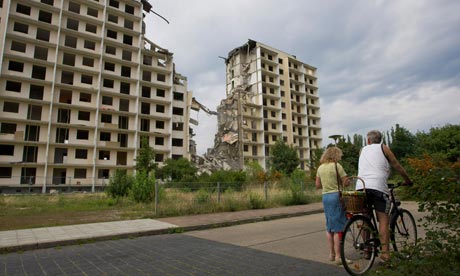
On the windswept roof of the Lausitz Tower, the town's only landmark, I meet Felix Ringel. A young German anthropologist studying at Cambridge University, he has passed up chances taken by his friends to investigate the rituals of Amazon tribes or Mongolian peasants. As we survey the empty plots of fenced scrub below, he explains that the underbelly of his own country seemed weirder and far less studied than those exotic worlds.In its heyday in the 60s, Hoyerswerda was a model community in communist East Germany, a brave new world attracting migrants from all over the country. They dug brown coal from huge open-cast mines on the plain around the town. There was good money and two free bottles of brandy a month. But the fall of the Berlin Wall changed all that.
...
Under communism, East German women worked more, and were often better educated, than the more conservative western hausfrau. But when their jobs disappeared in the early 90s, hundreds of thousands of them, encouraged by their mothers, took their school diplomas and CVs and headed west to cities such as Heidelberg. The boys, however, seeing their fathers out of work, often just gave up. In adulthood, they form a rump of ill-educated, alienated, often unemployable men, most of them unattractive mates – a further factor in the departure of young women.
...
"There has been nothing comparable in world peacetime history," says the French demographer Jean-Claude Chesnais. After the Berlin Wall came down, millions of East Germans who stayed behind decided against producing another generation. Their fertility more than halved. In 1988, 216,000 babies were born in East Germany; in 1994, just 88,000 were born. The fertility rate worked out at 0.8 children per woman. Since then it has struggled up to around 1.2, but that is still only just over half the rate needed to maintain the population. About a million homes have been abandoned, and the government is demolishing them as fast as it can. Left behind are "perforated cities", with huge random chunks of wasteland. Europe hasn't seen cityscapes like this since the bombing of the second world war.
And nowhere has emptied as much as Hoyerswerda. In the 80s, it had a population of 75,000 and the highest birth rate in East Germany. Today, the town's population has halved. It has gone from being Germany's fastest-growing town to its fastest-shrinking one. The biggest age groups are in their 60s and 70s, and the town's former birth clinic is an old people's home. Its population pyramid is upturned – more like a mushroom cloud.
In a school in a partly demolished suburb known simply as Area Nine, I meet Nancy, a tattooed and quietly spoken social worker. Forty years ago, her parents were among the newcomers: her mother was a midwife, her father a train driver. "There were modern flats and services here then. It was a prestige development. When you asked the kids what they wanted to do when they grew up, they had ambitions to drive buses or work in the power station. But now parents find it very difficult to encourage their children when they have no jobs or prospects themselves. My friends have all left. I'd like to stay, but I have a three-year-old daughter and the schools are no good any more. I'll probably go too."
...
Across the rest of Germany, Hoyerswerda is regarded as a feral wasteland – complete with wolves. Slinking in from Poland and the Czech Republic, they are finding empty spaces where once there were apartment blocks and mines. And the wolves, at least, are staying. A few kilometres down the road, near the tiny town of Spreewitz, wolf enthusiast Ilka Reinhardt can't believe his luck: "We have more wolves than we have had in 200 years." The badlands of former East Germany are going "back to nature". And Europeans should be worried, for some fear that eastern Germany is, as it was back in the 1960s, a trailblazer for the demographic future of the continent.
This is definitely an interesting phenomenon, but strangely I am not moved. First, the traditional population of Europe may be falling, or look like it's about to fall, but the population of the world is still going up, with devastating impacts on climate and the rest of the environment. If Europeans don't want to devote their lives to aggravating the problem, who am I to tell them that they should?
Also, there are sizable parts of North America where the population is thinning out pretty drastically, too. Canada and the United States both have growing populations, but the places where people used to support themselves by breaking the sod or digging mines by hand are clearing out and these areas may well end up with populations of the scale that existed before the huge invasion from Europe. Remember that huge invasion from Europe? That took place because Europe could not support its population under decent conditions with technology and institutions of the time. I am not so sure why people get so excited about this stuff, but it may have something do with the fear of slang-speaking kids wearing baseball caps backwards.
Me, my neighborhood has both wolves and kids with baseball caps worn at various angles. So what.
Image: This is Hoyerswerda.
Subscribe to:
Posts (Atom)