Showing posts with label church history. Show all posts
Showing posts with label church history. Show all posts
Friday, April 21, 2023
The Gospel of Thomas
I have been watching Bart Ehrman, author of the book Misquoting Jesus and several others, and his podcasts on the textual criticism of the New Testament. I have more than a little familiarity with textual criticism, which might be defined as the investigation of the history of ancient and medieval texts to answer such questions as who wrote a given text, when, and what sources the author used.
Today I watched his podcast on the Gospel of Thomas, then read a translation. Anyone who can explain why a translator of Charny's Questions might find this interesting gets...my respect? Yes.


Monday, April 03, 2023
Rewriting history
I am tempted to say that Pope Francis' repudiation of the doctrine of discovery is a rewriting of ALL of history; let's just say he has opened the door to a tremendous rewriting of history, ESPECIALLY world history. The repudiation is a data point of great importance, whatever you think of its substance, which will have to be taken into account in any large-scale history.
Some people I know and respect will scoff and probably say something about revisionist history. To which I have to respond, What do historians do if not revise our understanding of history?
Wednesday, April 13, 2022
The good news -- a further note
A few weeks ago I mentioned that I gained insights from the sermons I am hearing at my local Church of England. I approach the readings (Psalms, Epistles of Paul, Gospel) as historical documents. I look for the historical events behind the readings. I try to see the environment that produced a given document. What were the little towns in Palestine where Jesus stopped to tell a story actually like? What is Paul going on about? Since I have not just professional experience studying the Bible but have taught rhe ancient Middle East, it's a whole new book!.
Friday, February 02, 2018
More Irish saving of civilization
I bet I have a lot of friends and readers who are interested in early Ireland who find the subject difficult to understand.
That's because it is a difficult subject. A poorly documented region in a poorly documented region, but also fascinating in that Ireland, never a Roman province, was transformed into a notable part of the new Christian culture of the early Middle Ages. It is undoubtedly more difficult because most modern students and readers can't be expected to have much sympathy for a culture that speaks to us mainly in the voices of monks and missionaries. Most Irish people were neither, but that new minority movement was very influential then and is the most knowable part of early medieval Ireland today. Put on top of that the energetic role remote Ireland played in international (ecclesiastical) affairs and you have a subject that might be really fascinating if you can get a good start.
I don't know what the best way might be to make that start, but Jamie Kreiner of the University of Georgia recommends the recent translation of Irish saints' lives in the Liverpool series. This review, which I have taken from The Medieval Review is not meant for beginners but it may give you an idea of the fascination to be found in the stories of Irish saints, especially those who left Ireland and founded monastic communities elsewhere. The real action in this early era was in the monasteries and networks of monasteries that were popping up all over Europe. If you get just a little feeling for this from Kreiner's review, you are ahead of the game.
O'Hara, Alexander, and Ian Wood, trans. Jonas of Bobbio: Life of Columbanus, Life of John of Réomé, and Life of Vedast. Liverpool Translated Texts for Historians, 64. Liverpool: Liverpool University Press, 2017. Pp. xiv, 348. £85.00 (hbk), £24.95 (pbk). ISBN: 978-1-78138-176-2 (hbk), ISBN: 978-1-78138-177-9 (pbk).
Reviewed by Jamie Kreiner University of Georgia (Institute for Advanced Study) jkreiner@ias.edu
If you've ever used any of the Liverpool Translated Texts for Historians (and for those of us who teach early medieval history, it is hard to imagine a course within them), you have Jonas of Bobbio to thank for it. Ian Wood and Alexander O'Hara tell us that the lack of a complete English translation of Jonas's monumental Life of Columbanus and His Disciples--arguably one of the most important hagiographical texts from early medieval Europe--gave John Davies the idea to start the TTH in the first place, which he co-founded with Margaret Gibson in the 1980s. But it was not Jonas of Bobbio but rather Gregory of Tours who inaugurated the series, with Edward James's translation of his Life of the Fathers. Only now in 2017, sixty-four volumes into the series and fourteen hundred years after Columbanus's death, do we finally have the first full English translation of his Life, along with Jonas's other hagiographical works. But they were worth the wait.
Traditionally Columbanus was viewed as a tenacious Irish emigré who rescued Christianity on the continent from a state of decay in the early seventh century, by founding monasteries in Gaul and northern Italy with a distinctly Irish culture that could be characterized as "Columbanian." That's a testimony to Jonas's forceful portraiture, because it's more or less what his narrative conveyed, and if a translation of his hagiography had come out in the 1980s, its introduction might have imparted a similar wisdom--though Ian Wood had already begun to suspect by that point that Gallic Christianity was more than Jonas had made of it. [1]
But in 2017 things look very different. O'Hara and Wood point out that not only was Gallic Christianity a thriving, dynamic culture well before Columbanus showed up (which is evident in, among other places, its hagiography, its episcopal councils, and its monastic foundations and Rules). It was also already an international culture. There were British and Irish monastic settlements, for instance, that predated Columbanus's arrival. Columbanus's own self-imposed exile may have been even inspired by his personal icon Gildas, the British monk who wrote De excidio Britanniae and who probably immigrated to western Gaul and established a monastery on the mouth of the Loire..
The monasteries that Columbanus founded drew upon the variegated Christian culture that surrounded them, rather than isolating themselves from it, with the result that their monastic models were cultural hybrids rather than exclusively Irish. As Columbanus had done, his acolytes developed partnerships with local landowners, elites with connections to the court, royal officials, and rulers--all of which the translators' notes, along with an appendix of three translated charters, make especially clear. [2] Like Columbanus they also took positions on some of the theological controversies that had arisen among the Christianities of the eastern Mediterranean.
And it didn't take long after Columbanus's death for it to become clear that the monks and nuns who had been inspired by his example had developed very different ideas about what a properly "Columbanian" monasticism should look like. Each institution had its own persona, and even within a single monastery, the disagreements could be brutal. Jonas dedicated the second half of the Life of Columbanus to making sure his readers knew who among the saint's followers were getting it right; and although he was very rarely subtle on this point (unless reveling in the tragic deaths of one's opponents can ever be subtle), it is only recently that historians have begun to see how complex "Columbanian" culture was.
The translators also give us a brief but welcome introduction to Jonas himself: archivist of Bobbio, very likely the abbot of Marchiennes in northern Gaul, and also very likely the author of the Regula cuiusdam patris ad virgines (an identification we owe to the work of Albrecht Diem, which is outlined here in a few appendices). In his role as hagiographer, Jonas is passionate and smart, as many hagiographers in this period were; but what's rarer is the chance to see, over the course of multiple works, how the ideas of an early medieval intellectual morphed over time, in this case through the 640s and 50s. For as O'Hara and Wood point out, Jonas was also a person who changed his mind.
O'Hara and Wood base their translation on Bruno Krusch's 1905 edition in the MGH SRG, but given the difficulties of some its readings they also consult a manuscript that Krusch didn't know about (Metz, Grand Séminaire 1) in addition to making other reasonable adjustments. The English is clear and smooth without obfuscating some of Jonas's stylistic choices, like his vacillation between the historical present and the past, or his love of unusual words ("nitpicking and frivolous blather" for conperendinanti migrologa et fribola garrulanti [198]). Although Merovingian Latin abounds in participial phrases, the translation mercifully favors finite verb constructions when the alternative is bound to be ponderous: so, for example, we read that someone "spat on" a letter and threw it down, instead of throwing down a letter "having been smeared with saliva" (254)
Occasionally the English irons out some of Jonas's more metaphorical concepts, which blunts their sense maybe more than is necessary. Lubrice impulsationis is rendered as an "unreliable impulse" rather than a "slippery" one (261), for example, which makes the psychological theories that are at play here (both Jonas's and Cassian's alike) harder to see. Or the parents of Gibitrudis are said to think of her as their only "offspring" (206), which is more mechanical than the Latin pignora, a word that Merovingian writers liked to use for "relics," "children," and "financial pledges," often simultaneously. The choice to render the unfree dependents mentioned in Burgundofara's will (Appendix 6) as "serfs" with no further commentary is especially surprising, given the range of servile statuses that were masked by seemingly straightforward labels, a subject to which Alice Rio has drawn attention in her work. [3]
These minor criticisms only speak to the richness of the material that O'Hara and Wood have done us a great service in making more accessible. If you're a historian of the Merovingian period the value of this translation will already be obvious to you, but Jonas's vitae will be useful beyond specialist courses. For courses about Christianity, these texts engage some of the major debates of the seventh century: the relationship between political power and sacred space, the simultaneously conflicting and complementary bonds of family and monastery, the cultivation of Christian forms of cognition and behavior, monastic liturgical and regulatory structures, the plausibility of the miraculous, and the control that Christians had over their souls' fates in the afterlife.
Courses on gender could scrutinize how the Life of Columbanus toggles between its protagonistic vir Dei--an epithet that Jonas bestowed on a select few men besides Columbanus--and Jonas's beloved monastery of Faremoutiers, whose nuns seem to have been experts in the art of dying well (though many manuscripts omitted this chunk of the narrative entirely).
All three texts would also suit a course on travel and travelogues. Although Columbanus wins for the most miles traveled, and Jonas peppers his vita with place-specific notes about local bears, buffalo, beer, and butter, journeys drive the narrative arcs and character developments of John's and Vedast's stories, too. As a trio the vitae would provide a nice counterpoint to the more fantastical and long-distance adventures that we are familiar with from the Voyage of Saint Brendan, the Alexander legends, and monstrous cosmographies.
So Jonas, no stranger to royal treatment, has received it again with this translation and commentary, and he'd be thrilled to know that it will bring him many more readers--even though they are increasingly learning to put him in his place.
--------
Notes:
1. E.g. Ian Wood, "A Prelude to Columbanus: The Monastic Achievement in the Burgundian Territories," in Columbanus and Merovingian Monasticism, ed. Howard B. Clarke and Mary Brennan (Oxford: BAR, 1981), 3-32.
2. These charters are the Lombard king Agilulf's donation to Bobbio, Pope Honorius's exemption privilege to Bobbio, and the will of Burgundofara naming Faremoutiers as her heir.
3. E.g., Alice Rio, Legal Practice and the Written Word in the Early Middle Ages: Frankish Formulae, c. 500-1000 (Cambridge: Cambridge University Press, 2008), and postdating O'Hara and Wood's translation, Alice Rio, Slavery after Rome, 500-1000 (Oxford: Oxford University Press, 2017).
Saturday, September 30, 2017
Thoughts upon leaving church
As I walked home from last Sunday's service at my neighborhood Anglican church, I was mulling over three points.
1. The newsletter asked us to pray for the bishop people and clergy of "The Territory of the People. " This reminded me of a scene in the movie Becket where the pope after an interview with Becket marvels over the humility of the exiled archbishop, while an infuriated Italian cardinal condemns Becket for his pride. I know nothing about "the People" but it seems to me that there a variety of ways to interpret that name
.
2. Why does anyone alive today care about King David?
3, Paul's Letter to the Philippians: What is really going on here? (I often feel that way about Paul.) I am very much aware that all of Paul's letters were written before the gospels.
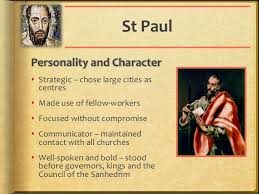
Image: A standard view of Paul.
1. The newsletter asked us to pray for the bishop people and clergy of "The Territory of the People. " This reminded me of a scene in the movie Becket where the pope after an interview with Becket marvels over the humility of the exiled archbishop, while an infuriated Italian cardinal condemns Becket for his pride. I know nothing about "the People" but it seems to me that there a variety of ways to interpret that name
.
2. Why does anyone alive today care about King David?
3, Paul's Letter to the Philippians: What is really going on here? (I often feel that way about Paul.) I am very much aware that all of Paul's letters were written before the gospels.
Image: A standard view of Paul.
Wednesday, September 06, 2017
St. Catherine's monastery delivers again
 At the base of Mount Sinai in Egypt there is a very ancient monastery, St. Catherine's, which may have been patronized by Constantine's mother Helena and was apparently built by the emperor Justinian. The monastery is best known for its collection of manuscripts, which include some of the most important sources for the text of the Bible.
The most famous manuscripts from St. C's were discovered and studied in the 19th century, while other mss (=manuscripts) were found in caves in the 20th. Now scholars are using advanced technology to read the original texts of reused mss. The Independent explains:
The scholars seem to be most excited by finding writings in obscure or dead languages, like the one spoken in Caucasian Albania (not the same as the Albania next to Greece). But I find this mindblowing:Monks originally wrote their texts down on parchments which were later scrubbed off and used to write the Bible by future generations who spoke more modern languages. But a new technique developed by researchers allows them to see the original text hidden from the naked eye in a development hailed as a “new golden age of discovery”.
Researchers took photographs of the material using different parts of the light spectrum and put the electronic images through a computer algorithm.
The method allows them to see the first writing laid down on the parchments, which at the time were highly valuable; before they were re-used in later years.
“I don’t know of any library in the world that parallels it,” said Mr Phelps [from the Early Manuscripts Electronic Library in California]. “The monastery is an institution from the Roman Empire that continues operating according to its original mission.”
“I don’t know of any library in the world that parallels it,” said Mr Phelps [from the Early Manuscripts Electronic Library in California]. “The monastery is an institution from the Roman Empire that continues operating according to its original mission.”
Image: By Berthold Werner - Own work, CC BY-SA 3.0, https://commons.wikimedia.org/w/index.php?curid=12215773
Tuesday, December 06, 2016
Great Events in Religion, edited by Florin Curta and Andrew Holt

A while back I was recruited by Andrew Holt to write some articles for an encyclopedia of the history of religion. I took him up on it, even though he was asking for articles not particularly close to my current research interests. It was an interesting challenge.
Just a couple of hours ago my contributor's copy came to my door. I hadn't thought about the encyclopedia for quite a while, even though Andrew and I correspond fairly frequently, and as a result it was a bit of a shock to see the finished work.
Part of the surprise was the sheer size of the thing, which is a three-volume work. I shouldn't be surprised, of course, because it is after all aiming at describing a whole important aspect of human existence. There are, however, plenty of things calling themselves encyclopedias that have huge holes in their coverage. Now I'm not sure yet that Great Events covers everything that I might think it should cover -- remember I've had it for two hours or so -- but it does have an awful lot of stuff.
Likewise I did know, somewhere in my fallible memory, that it was going to be "an Encyclopedia of Pivotal Events in Religious History," but perhaps I hadn't really thought about what that might mean. What it does mean is that all religious history is treated in chronological order, which gives the whole thing a comparative history emphasis. For me, that's a big plus. I am tempted to just sit down and read it through and see what I learn. (I am unlikely to be able to do that.)
I have to admit that I have always been skeptical of the usefulness of encyclopedias -- something I share with many historians -- but there is a chance that this one might be useful. The rare reader who has the time and access to the whole thing may get a much fuller view of world history than I did l when I read Arnold Toynbee's A Study in History in my high school library.
I am genuinely pleased to see this. As to how well it succeeds, I will get back to you.
Contest: I am not sure this will have a prize, and it has as much intellectual content as clickbait promising to show you how the stars of some shows in the 70s look today. In other words, you will be guessing. Guess what three pivotal events I wrote up for Great Events. To narrow the field a tiny bit, I wrote nothing on chivalry or the crusades. Do it for laughs.
Friday, May 23, 2014
The age of the monks

This fall I will be teaching, for the first time in a very long time, part of our second-year survey of the Middle Ages. I will be teaching the first half of the course, up to about 1100.
I feel very capable when it comes to the period up to about 600, and after 1100 would not be difficult for me either. But I have to say that I am looking at the period in between is a certain amount of trepidation.
My guide for the Carolingian period and the period just before and after is going to be my textbook, Rosenwein's Short History of the Middle Ages. Dr. Rosenwein's first fame was as a student of the prominent Burgundian monastery at Cluny, so of course she emphasizes the monastic aspect of the early Middle Ages. The thing is, both the textbook and her other works convince me that I have to come to grips with this age of monks and somehow get across to my students that the real politics of the era are the ecclesiastical and especially the monastic ones. Her brief but well-written discussion of the iconoclastic movement and how it affected the entire Western world – well, it was convincing. That experience has also made me think that minimizing my discussion of and the investiture controversy would not necessarily be very honest.
I can hear my colleagues who specialize in the Carolingian and post-Carolingian period laughing at my "predicament." Making this era comprehensible is their meat and drink and I have to say I don't envy them.
I am fortunate to have as my partner in this enterprise someone who knows much more about the monks that I do and she can logically take the investiture controversy at the beginning of the second term.
Image: An Armenian monastery.
Tuesday, March 12, 2013
The Papal Election
Somehow the Atlantic got the idea of getting a historian to write up a piece. They picked a good one, David Perry. I especially liked this:
1) Voting is medieval.
Voting is a quintessentially medieval activity. Sure, popular representations of the Middle Ages focus on kings and knights, princesses and peasants, but medieval people, especially in cities, loved to vote. They organized themselves into groups - guilds, religious fraternities, charitable organization, drinking societies - and wrote complicated bylaws governing elections. Many cities embraced various kinds of representative government during the High Middle Ages. Even the army outside the walls of Constantinople in 1204 took time to develop a voting system to elect the next emperor.
It's easy to characterize the Conclave of Cardinals as an authoritarian relic of the past. It's not. It's the same kind of democratic tradition that permeates modern American and European life, from board rooms to union halls to church groups to town councils.
Thursday, July 07, 2011
Goodricke and Constantine without honor in their own city
Today I went on a free guided tour of York, provided by one of the many volunteers who have been providing this service since 1950 (!). Well worth the time and I'm grateful to the organization and our guide.
However, I must say that he had me biting my tounge more than once with his version of York history (and of his weakness for terrible folk etymologies no more will be said). My faith in his knowledge of his home town's history -- and he called himself a local historian -- was given a shock when he called Athelstan a Viking king. I mean, is there a more (Old) English name? If, dear reader, you were a volunteer guide at York, I believe you would not make this mistake.
Nor, I hope, would you try to be relevant by saying that Henry VIII used the loot from the Dissolution of the Monasteries "to found the Oxbridge Consortium." Would you?
It's odd what people include, and don't. Maybe there was no archaeological or architectural hook to bring in the Pilgrimage of Grace, but I bet I could find one. (Just sitting here I now have one.) But how can you say that the late Roman HQ was found under the Minster in the late 1960s, and not mention that Constantine was elevated to the emperorship in York? This has got to be one of the most important things, on a world-historical scale, to ever happen in the city. But it went unmentioned.
And about the same time Constantine was being ignored, we were standing in front of the Treasurer's House in the old ecclesiastical enclave, also ignoring a sign that said John Goodricke worked there in the 1780s on Cepheid variables, the discovery of which eventually provided an astronomical yardstick to estimate the size of the universe. Talk about world-historical.
I should study up and volunteer myself...
Challenge: look up Henrietta Swan Leavitt, who should have got a Nobel Prize. No York connection.
However, I must say that he had me biting my tounge more than once with his version of York history (and of his weakness for terrible folk etymologies no more will be said). My faith in his knowledge of his home town's history -- and he called himself a local historian -- was given a shock when he called Athelstan a Viking king. I mean, is there a more (Old) English name? If, dear reader, you were a volunteer guide at York, I believe you would not make this mistake.
Nor, I hope, would you try to be relevant by saying that Henry VIII used the loot from the Dissolution of the Monasteries "to found the Oxbridge Consortium." Would you?
It's odd what people include, and don't. Maybe there was no archaeological or architectural hook to bring in the Pilgrimage of Grace, but I bet I could find one. (Just sitting here I now have one.) But how can you say that the late Roman HQ was found under the Minster in the late 1960s, and not mention that Constantine was elevated to the emperorship in York? This has got to be one of the most important things, on a world-historical scale, to ever happen in the city. But it went unmentioned.
And about the same time Constantine was being ignored, we were standing in front of the Treasurer's House in the old ecclesiastical enclave, also ignoring a sign that said John Goodricke worked there in the 1780s on Cepheid variables, the discovery of which eventually provided an astronomical yardstick to estimate the size of the universe. Talk about world-historical.
I should study up and volunteer myself...
Challenge: look up Henrietta Swan Leavitt, who should have got a Nobel Prize. No York connection.
Wednesday, July 06, 2011
The churches of York
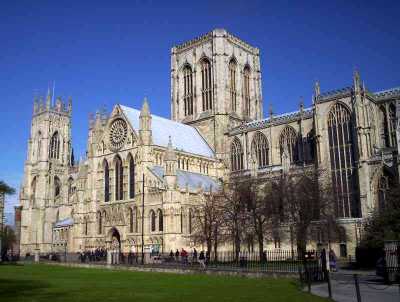
The last time I was in York it was 1972. The town, with its medieval walls and street layout, overpowered me. I was particularly impressed by the cathedral, York Minster, the biggest piece of medieval architecture I had seen yet. But as a budding medieval historian I was seriously taken with the number of other medieval churches there were in the immediate vicinity. It spoke to me of the tangible presence of the church in the city which was the capital of the north. I mused on the revolt against that presence during the Reformation (in an unsophisticated way).
This time what strikes my eye is how the people of York kept doing it -- building churches in medieval style in the vicinity of the Minster and those other real medieval churches. There are an awful lot of churches from, say, the last two centuries crowding into the Minster neighborhood, demanding attention.
Image: the Minster, from which a "clerk in holy orders" told me you can see a distant brewery tower. Ask me in person.
Thursday, March 25, 2010
Benefactors of humanity

More than once in the past I have said that Roger Pearse is a benefactor of humanity. It still seems to be true. Why is he our benefactor? He has taken it upon himself translate or commission translations of a great many early Christian works which have until now been available only to people who could read the original languages. Some people think that's fine -- if you don't know ancient Greek you would not understand these sources anyway -- but that's not my attitude, nor is it Roger's. As someone who has studied late antiquity and read a lot of obscure Christian literature from that era, I am in awe of Roger's generosity. The translations that he posts and otherwise gives away are not a complete substitute for the originals, but they make available part of the cultural and religious legacy of early Christianity to many new people.
I was inspired to say something about Roger by a blog post he published today, just one of the interesting posts of his that I've read since I discovered he had a blog. the Post announces a new translation of Hippolytus's Chronicon, one of the very first world chronicles written by Christian, in this case a third century Roman clergyman who eventually was martyred. (He is sometimes considered the first antipope.) In an earlier incarnation I had to know something about Hippolytus; it would have been nice to have this translation then.
But one of the interesting things about this new translation is that it is not, as far as I can tell, one of Roger's projects! There is another benefactor of humanity out there and this person is named T. C. Schmidt. Thank you very much, T.C.!
Image: Hippolytus being martyred, dragged behind a horse, from the Wikipedia entry on him.
Wednesday, March 03, 2010
Matthew Paris really did not like the papal court
The great English chronicler and illustrator Matthew Paris is famous for his dislike of foreigners. Among the worst of foreigners were the Romans, the term he used primarily to mean members of the papal court, who used their positions to enrich themselves. In the 1250s, King Henry III of England and the Pope made an agreement which obliged Henry to conquer the kingdom of Sicily at his own expense; which would eliminate the Pope's most dangerous enemies. No one in England thought this was a good idea, except perhaps the King and the son that he was going to put on the Sicilian throne. Matthew Paris's reaction is a great example of his scathing anti-foreigner rhetoric.
A few pages later, Paris illustrates "Roman" greed:
At first, Matthew's Chronicle struck me as pretty tedious, but it got better as it went along. There's a rhythm to these things, and it eventually caught me. Paris could write almost as well as he could draw.
In consequence of this [agreement], the Pope's messengers vied with one another, as it were, in coming to England to the king, for the purpose of carrying off his rich presents; for they smelled the sweet savor of his money from afar.
A few pages later, Paris illustrates "Roman" greed:
Master Berard de Nympha, native of the suburbs of Rome, died suddenly about the same time. He was a crafty and wealthy man, had been a clerk of Richard Earl of Cornwall, and had extorted money from the Crusaders on various specious pretexts. Amongst his goods was found in a coffer choose one of blank sheets sealed with the bull [the most important papal seal], which might be filled up at pleasure and applied to any misuse, such as fraudulently extorting money from the poor as if by authority of the Pope.
At first, Matthew's Chronicle struck me as pretty tedious, but it got better as it went along. There's a rhythm to these things, and it eventually caught me. Paris could write almost as well as he could draw.
Tuesday, March 02, 2010
Some of Matthew Paris's favorite words

Extortions, oppressions, legate.
There's always a bad papal legate practicing extortions and oppressions.
Image: A legate at work, drawn by Matthew Paris.
Saturday, November 29, 2008
Visualize this

In 1215, the church council known as the Fourth Lateran Council required all Christians to support the upcoming (5th) Crusade either by going in person or by supporting others to go in their stead. Pope Innocent III threatened those who did neither thus:
If any shall be found so ungrateful to the Lord as to refuse, we warn them that they must answer for it to us before the terrible judge on the last day. Let all such consider with what conscience and what security they will be able to make their confession before the only begotten Son of God, Jesus Christ, into whose hands the Father has given all things, if, in this matter which so peculiarly concerns them, they refuse to obey him who was crucified for sinners, by whose favor and goodness they live and are sustained, nay, more, by whose blood they are redeemed.After you've read enough medieval ecclesiastical documents, it is easy enough to see this statement as formulaic. Stop for a moment and take it literally -- or try to. What did Innocent think would happen, really?
Saturday, November 15, 2008
Jonathan Riley-Smith on the 11th c. reformation
The prominent Crusade historian in a 1993 interview at the Christianity Today Library:
In Europe today, if you drive five miles along any road, you will probably find two churches. Nearly all of those churches are built on eleventh- and twelfth-century foundations. Previously, there might have been one church every twenty miles, from which priests would go out to serve the sacraments. Eleventh-century reformers believed religion should be taken into the villages, and this evangelizing drive resulted in a great building program. This burst of construction ranks with anything the Roman Empire did. Someone in 1032 said, “France is becoming white with churches.”
Friday, June 27, 2008
The not-so-good-old days
Medievalists are constantly being put in the position of responding to the modern connotations of the word "medieval." For many modern people the Middle Ages acts as a dumping ground for every nightmare that can be attributed to humanity. The great witchhunt of European history took place after the Middle Ages; the purges and holocausts of the 20th century put most medieval slaughters, ruthless and cruel as they may have been, in the shade. We often find ourselves pointing out such things to people who carelessly use "medieval" to mean "bad." (Indeed, my dictation software heard that last usage of medieval as "and evil" so we are seemingly in the position of fighting the machines, too.)
But we must face the fact that most of history, including the Middle Ages, were not exactly the good old days. Some scholarly blogging posts of the last week or so underline this.
Jonathan Jarrett, I believe, started the ball rolling with a post on Sex slaves in the early Middle Ages: what’s the evidence? over at his blog A Corner of Tenth-Century Europe. his point was that he didn't know what the evidence for sex slavery might be and he hoped someone would enlighten him. Soon after, he found himself shocked by reflecting on well-known evidence about the prominent monastery of Cluny in eastern France. As he put it, "slaves are all through the material from Cluny [in the tenth century]." that reflection, and chance meeting with another medievalist blogger, Magistra et Mater, went into this post on trading "ancillae [slave women]."
At the same time Magistra et Mater has been writing about some subjects that might excite prurient interest, but deserve serious thought, too. For instance, how exactly were disobedient monks flogged in the time of the Carolingian kings? And somewhat less grim, were families about the same time somewhat reluctant to write off their daughters as ruined if they indulged in a little premarital sexual activity? Maybe for good practical reasons the Carolingian Franks were a little less likely to condemn such girls than some other cultures. These are all isolated points perhaps, but important for visualizing how things actually worked for individual people, like a monk about to be flogged, or the teenager worried about how dad is going to react to her little adventure.
Finally, the subject of slavery (mostly later than medieval) is discussed by Phil Paine in this post, inspired by a book on 18th century Moroccan slavery (item 16305). Conclusion: there is no "nice slavery," ancient, medieval, early modern, or current.
But we must face the fact that most of history, including the Middle Ages, were not exactly the good old days. Some scholarly blogging posts of the last week or so underline this.
Jonathan Jarrett, I believe, started the ball rolling with a post on Sex slaves in the early Middle Ages: what’s the evidence? over at his blog A Corner of Tenth-Century Europe. his point was that he didn't know what the evidence for sex slavery might be and he hoped someone would enlighten him. Soon after, he found himself shocked by reflecting on well-known evidence about the prominent monastery of Cluny in eastern France. As he put it, "slaves are all through the material from Cluny [in the tenth century]." that reflection, and chance meeting with another medievalist blogger, Magistra et Mater, went into this post on trading "ancillae [slave women]."
At the same time Magistra et Mater has been writing about some subjects that might excite prurient interest, but deserve serious thought, too. For instance, how exactly were disobedient monks flogged in the time of the Carolingian kings? And somewhat less grim, were families about the same time somewhat reluctant to write off their daughters as ruined if they indulged in a little premarital sexual activity? Maybe for good practical reasons the Carolingian Franks were a little less likely to condemn such girls than some other cultures. These are all isolated points perhaps, but important for visualizing how things actually worked for individual people, like a monk about to be flogged, or the teenager worried about how dad is going to react to her little adventure.
Finally, the subject of slavery (mostly later than medieval) is discussed by Phil Paine in this post, inspired by a book on 18th century Moroccan slavery (item 16305). Conclusion: there is no "nice slavery," ancient, medieval, early modern, or current.
Sunday, June 15, 2008
Memories of Cornwall
 For those Canadians who think "President's Choice foods" when you hear the phrase "memories
of..." associated with a place name, yes, my memories of my first trip to Cornwall, now two weeks in the past, includes important food and drink elements. Cornish pasties made in Cornwall by people who care and don't want to disgrace themselves in front of their neighbors -- such Cornish pasties are extremely good. Food in restaurants and pubs was generally very good. I drank Zennor Mermaid Ale and the first mild ale that I've had in decades. Cider on tap in a place where they care about cider was excellent.
And unspeakably beyond excellent was the first "cream tea" of my life, in a farmhouse tea shop somewhere near Land's End. There may be better cream teas somewhere, but I cannot imagine them.
But my actual memories of the trip are dominated by a big surprise, which ambushed me despite the fact I had looked at pictures and maps and read about Cornwall in preparation for the trip. The landscape by turns green and rocky and never flat, especially the seascape where we were walking on the coastal path around the entire Duchy, is impossible to catch at second hand. Go ahead, use Google Image search: you will find many fine photographs of dramatic views, but if you've never been to Cornwall I will bet the reality will surprise you as much as it did me. Despite the fact that you can describe the Cornish coast very simply, as a series of coves and headlands and cliffs plunging into the sea, not one of those coves or headlands looks like any other. The colors, too, were constantly shifting and always new.
Walking the coast of Cornwall is something a lot of people do. Indeed, I ran into a fellow medievalist at Kalamazoo in May who has done the entire trip, which takes about seven weeks. But it is not for the faint of heart. Fit-looking pensioners and little kids with their parents tread the path without noticeable unease. Here in North America, there would probably be barriers to keep people away from the cliffs, for fear of lawsuits. In Cornwall, the only dangers marked off and walled or fenced off were old mine shafts; if you fall off a cliff, presumably you knew what you were getting into. The one time I saw a rope barrier by the side of the path, it was to keep people from treading on rare plants. Only at Tintagel, where busloads of people are brought in from all over Europe, were there a couple of signs that said "Danger -- Cliffs." That was our last day of cliff-walking and the sign inspired hilarity. We'd been past a hundred more perilous places by that time.
Did I mention that I'm afraid of heights? Fortunately not terrified of heights, but scared enough that there was an additional psychological challenge on top of a very real physical one. Because of my late illness I am still easily tired, and one 6-mile day's walk rated "severe" was pretty taxing, to the point that I walked a lot less the next two days.
It was however worth it and I hope someday to take a similar walk, just one with fewer precipices. A river walk?
I expect to Cornwall feel different from England, and it did. I could mention many things but as a medievalist and historian the odd names of villages and the saints who founded them, saints unknown outside of Cornwall and known mainly for their names inside it, struck my eye. St. Senara, for instance, founded the fishing/farming village now called "Zennor," which has a famous legend about a mermaid; thus the ale named after said mermaid. The parish associated with Tintagel is dedicated to St. Materiana. These are not big-name international saints, these are Irish immigrants of the dark age who converted the Cornish.
The most famous at the moment, perhaps, is St. Piran whose flag (above) is just about everywhere. To the outsider, St. Piran is a vaguely comical early saint with an odd legend: an Irish king him into the sea with a millstone around his neck, to end his pesky preaching of the Gospel. By a miracle, Piran floated on that millstone all the way to Cornwall, where he found a more receptive audience. We had to wonder, however, whether he brought the snakes from Ireland with him. Anyway his unrecognized-in-the-Union-Jack flag makes him a symbol of Cornish national feeling. (See this article from last year's Guardian.) The Cornish language, effectively dead from about the 18th century, is making a bit of a comeback. We were entertained in one restaurant by musicians who had translated Beatles songs into Cornish. This may seem less peculiar when I say that the translator was young enough that independent Cornwall and Beatlemania were equally part of the distant past.
One of the most impressive things I saw on the trip however besides the millions of flowers was the remains on Cornish tin mining. I think I will reserve that for another post.
Sunday, April 13, 2008
Holy Lance Church in Armenia
 Many people know that the discovery of the Holy Lance in Antioch saved the First Crusade. Today English Russia posted several pictures of an alternate site for the Holy Lance, at a church in Armenia. I've also heard the Lance was at Constantinople (which led some churchmen at Antioch during the crusade to doubt the reality of the just-discovered one).
This rather odd art looks strangely familiar to me. What am I thinking of? Readers?
Saturday, October 13, 2007
Mass Arrest of Templars Day

Yes, indeed, this is the 700th anniversary of the mass arrest of the Knights Templar in the Kingdom of France.
Image: A modern rendition of the execution of the last Grand Master, Jacques de Molay, for recanting the lurid accusations he'd originally admitted to.
Subscribe to:
Posts (Atom)