Showing posts with label Gilgamesh. Show all posts

Monday, February 29, 2016

Humbaba!

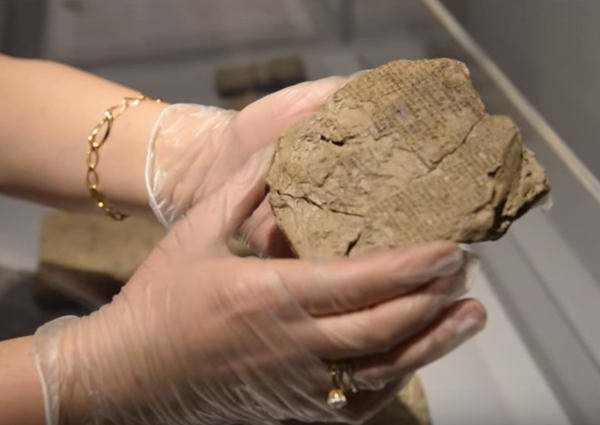
Missing pieces of the Epic of Gilgamesh found! Open Culture says:
That’s a pretty good deal for these extra lines that not only add to the poem’s length, but have now cleared up some of the mysteries in the other chapters. These lines come from Chapter Five of the epic and cast the main characters in a new light. Gilgamesh and his companion Enkidu are shown to feel guilt over killing Humbaba, the guardian of the cedar forest, who is now seen as less a monster and more a king. Just like a good director’s cut, these extra scenes clear up some muddy character motivation, and add an environmental moral to the tale.

Friday, February 26, 2016

The sounds of the past

I stumbled across two interesting blog posts this past week, both concerned with recovering or reconstructing ancient languages. Back in 2010, Open Culture ran a piece on ancient Akkadian (an early Mesopotamian language, one of the first written down anywhere). A short piece of the Epic of Gilgamesh was included. Have a look! And while you are at it, read up on the completion of the Akkadian dictionary produced by the Oriental Institute in Chicago -- over the last 90 years.

Best thing about the dictionary? If you are content to have it in electronic form, it's FREE, FREE, FREE! And if you have a bundle to spend, you can have it in a very nice printed set.

Now there is scholarship for you.

About the same time, I ran across this article on ancient Greek music. Everyone who cares to know it knows that the ancient Greeks were world champions in their time in both painting and in music. But in both cases, just about none of it is left.

Just about!

Back in 2013, the BBC ran (in its business section!?) a detailed piece on how some of that music must have sounded (at least in a minimal "unplugged" form).

Revelation (for me at least): "In ancient Greek the voice went up in pitch on certain syllables and fell on others (the accents of ancient Greek indicate pitch, not stress)."

Wow! Does this mean that speaking ancient Greek was similar to singing?
Saturday, September 22, 2007

Epic (and) history

On Monday in the Medieval England course I will be discussing the Old English epic Beowulf as a source for early English life; on Tuesday I'll be discussing the Sumerian epic Gilgamesh for clues about early Mesopotamian culture. Coincidence? I guess, the courses were devised and first put on years apart. I don't think this conjunction has happened before.

I didn't assign reading for either lecture, but the ambitious among you can look up translations of each work on the Web.

For Gilgamesh, you may want to look at the section of the epic (one version thereof) where Gilgamesh fights Humbaba (Huwawa).

I've linked to the Electronic Text Corpus of Sumerian Literature, which is an attempt to make Sumerian literature, generally available in specialist editions stored in specialist libraries, move widely accessible, both in editions of the Sumerian texts, and in English translation. Since Sumerian is one of the most difficult of historic languages, this is a worthy enterprise.

For Beowulf, I found it harder to make a choice from the variety of on-line translations. So to give you an idea of the challenges of translating this poem, whose audience's expectations were so different from a modern one's, I include three links: to the opening of the poem, on great Danish kings of the past, translated by Tony Romano, to another version of the opening by somebody else (no back link!), and the section on Beowulf's battle with Grendel, translated by Sullivan and Murphy.

There are complete versions on the Web, too, but I'll leave that to the enthusiasts who want to know how the stories come out.

Image: Gilgamesh and Enkidu in superhuman combat.