Of the many myths told about American slavery, one of the
biggest is that it was an archaic practice that only enriched a small
number of men.
The argument has often been used to diminish the scale of
slavery, reducing it to a crime committed by a few Southern planters,
one that did not touch the rest of the United States. Slavery, the
argument goes, was an inefficient system, and the labor of the enslaved
was considered less productive than that of a free worker being paid a
wage. The use of enslaved labor has been presented as premodern, a
practice that had no ties to the capitalism that allowed America to
become — and remain — a leading global economy.
But as with so many stories about slavery, this is untrue.
Slavery, particularly the cotton slavery that existed from the end of
the 18th century to the beginning of the Civil War, was a thoroughly
modern business, one that was continuously changing to maximize profits.
To grow the cotton that would clothe the world and fuel
global industrialization, thousands of young enslaved men and women —
the children of stolen ancestors legally treated as property — were
transported from Maryland and Virginia hundreds of miles south, and
forcibly retrained to become America’s most efficient laborers. As they were pushed into the expanding territories of Mississippi and Louisiana,
sold and bid on at auctions, and resettled onto forced labor camps,
they were given a task: to plant and pick thousands of pounds of cotton.
The bodies of the enslaved served as America’s largest financial asset, and they were forced to maintain America’s most exported commodity. In 60 years, from 1801 to 1862, the amount of cotton picked daily by an enslaved person increased 400 percent. The profits from cotton
propelled the US into a position as one of the leading economies in the
world, and made the South its most prosperous region. The ownership of
enslaved people increased wealth for Southern planters so much that by
the dawn of the Civil War, the Mississippi River Valley had more
millionaires per capita than any other region.
In recent years, a growing field of scholarship has
outlined how America — through the country’s geographic growth after the
American Revolution and enslavers’ desire for increased cotton
production — created a complex system aimed at monetizing and maximizing
the labor of the enslaved. In the cotton fields of the Deep South, this
system rested on the continuous threat of violence and a meticulous use
of record-keeping. The labor of each person was tracked daily, and
those who did not meet their assigned picking goals were beaten. The
best workers were beaten as well, the whip and other assaults coercing
them into doing even more work in even less time.
Read that again:
The
best workers were beaten as well,
As overseers and plantation owners managed a forced-labor
system aimed at maximizing efficiency, they interacted with a network
of bankers and accountants, and took out lines of credit and mortgages,
all to manage America’s empire of cotton. An entire industry, America’s
first big business, revolved around slavery.
“The slavery economy of the US South is deeply tied
financially to the North, to Britain, to the point that we can say that
people who were buying financial products in these other places were in
effect owning slaves, and were extracting money from the labor of
enslaved people,” says Edward E. Baptist, a historian at Cornell
University and the author of The Half Has Never Been Told: Slavery and the Making of American Capitalism.
This makes me want to teach Early Modern History again...
A review (in the Medieval Review) by Sharon Farmer of Daniel Lord Smail's Legal Plunder: Households and Debt Collection in Late Medieval Europe has this interesting fact about the value of clothing in the 14th and 25th centuries:
Smail also concludes that moveable goods constituted a much larger proportion of a household's value than we might have expected. He estimates that in the average household of the period, moveable goods constituted about three fifths of total household wealth. Most surprising of all is the relative value of clothing items vis-à-vis landed wealth. As Smail states, "the median price of a plot of agricultural land in 1350 could be paid off with a dozen fairly nice tablecloths, and a very high-end houppelande [an outer garment] in 1420 was worth more than double the median price of a field" (60). Because small goods stored so much value, because they could be sold off or given away more quickly than a piece of land, and because they enabled their owners to display their prestige on their backs and at their tables, they came to play a major role in personal and household thesaurization.
Image: from the early Dutch oil painter van der Weyden.
Recently, I was at the conference Shifting Frontiers X, a
leading late antiquity conference in North America. At the conference George Benton and Richard
Burgess gave an interesting talk on the changing role of gold in late antiquity.
Here is an excerpt of the abstract reproduced with permission.
From the time of the introduction of the solidus by
Constantine the use and perception of gold were changed radically in the Roman
Empire. Silver, hitherto the dominant metal for the making of high-volume
coinage, was demoted to use in decoration and gifts, while gold, whether as a unit
of account or, increasingly, as bullion minted in solidi, dominated economic
exchange. The massive scale of gold use is amply attested in literary sources
and papyri, as well as archaeologically in the form of hoards. What remains
less clear is whether there was actually more gold circulating… A largely
ignored study that used proton activation analysis (PAA) provides tantalizing
evidence that a new source of gold became available in the 350s.… This new
supply enabled the empire to move to sort of gold standard. With this model in
place of the changing use of gold, we are not a position to revisit the earlier
trace elementanalyses with new hypotheses. At which minted the gold edge of the
empire, was the new goal available in both the East and the West? Where were
the mines?
And much of the actual paper was a discussion of which techniques
might be feasible for testing coins nondestructively for trace elements like
platinum. Best of luck to this project.
For my part, the paper implied that the fall of the Western
Empire might be a sort of Grover Norquist scenario, in which all the new extremely high-value money
accumulated in the hands of the ultra-rich, and the Imperial government became
small enough to be drowned in a bathtub.
If you follow the news at all, you heard about that factory fire in Bangladesh that killed about 100 workers in a textile plant. One of the striking details was the fact that these workers made something like thirty-five dollars a month.
Now the popular wisdom these days on development is that the market will take care of situations like this. Bangladesh is just going through an early phase where it has cheap labor as its main asset. Capital accumulation and so forth will allow Bangladesh to eventually become a more developed country, where people make maybe thirty-five dollars a day.
The problem with this popular wisdom is that it ignores history specifically the history of Bangladesh/Bengal. Back in the days of yore, when the British East India Company was just moving in to the subcontinent, Bengal was the first Indian province that it swallowed whole. At that time Bengal was a country three times the size of Great Britain, and was something of an economic powerhouse, based on the fact that it produced a lot of – textiles. I don't know how much money weavers in Bengal made, I'm sure it wasn't much, but it was more when Bengal had an Indian ruler than after it got a British one. For you see, the East Indian Company used its power in Bengal to favor British cloth over Indian cloth. That policy – and others –had such a devastating that millions of Bengalis died from starvation. Britain, on the other hand, became the workshop of the world, and had a dominant position in the cloth trade for a very long time. Back when people studied economic history, this was a classic topic on the effects of the Industrial Revolution.
You can see why people in Bangladesh might be getting a little impatient waiting for classical economics' predictions that a rising tide lifts all boats to get around to their neck of the woods.
"Did you know that Indians can travel through time? That they invented the wire recorder?"
Those statements may not be true outside the Firesign Theater universe (where it is possible to run for President on the platform "Not Insane"), but equally unlikely things may be.
Matt Gabriele directed me to a long article at Spiegel Online International on the Samaritans, then and now. The Samaritans are the heirs of the Kingdom of Israel which broke away from Judea after the death of Solomon, and which included 10 of the 12 tribes of Israel. That kingdom was the big deal Israelite kingdom until it was defeated by the Assyrians, who deported much of the population ("the ten lost tribes of Israel"). At least, that's the commonly accepted story. This article references research that seems to indicate that up until about 150 BCE, the city of Samaria, or nearby Mount Gezirim, was still the big center of Israelite worship.
Working behind security fences, the archaeologist has been digging on the windswept summit of Mount Gerizim.
His findings, which have only been partially published, are a virtual sensation: As early as 2,500 years ago, the mountain was already crowned with a huge, dazzling shrine, surrounded by a 96 by 98-meter (315 by 321-foot) enclosure. The wall had six-chamber gates with colossal wooden doors.
At the time, the Temple of Jerusalem was, at most, but a simple structure.
Magen has discovered 400,000 bone remains from sacrificial animals. Inscriptions identify the site as the "House of the Lord." A silver ring is adorned with the tetragrammaton YHWH, which stands for Yahweh.
All of this means that a vast, rival place of worship stood only 50 kilometers (31 miles) from Jerusalem.
It is an astonishing discovery. A religious war was raging among the Israelites, and the nation was divided. The Jews had powerful cousins who were competing with them for religious leadership in the Holy Land. The dispute revolved around a central question: Which location deserved the honor of being the hearth and burnt offering site of God Almighty?
Well, we will see. But if it is so, it certainly qualifies as a case of "everything you know is wrong."
Then there is this: early medieval historians have for a very long time considered the 7th century CE to be the bottom of a great post-Roman depression, a period of economic primitiveness, where among other things, coins were few and hardly qualified as money.
For example: we can now identify nine hundred dies used in the striking of the surviving corpus of seventh-century thrymsas. There are various well-established means for multiplying these figures up towards an estimate of the whole coinage, which when applied here reasoned for three million plus coins total, on a multiplier of five thousand coins per total extrapolated dies, and more probably something like a million in circulation at once.7 Of the gold. If we use modern parishes as a guide to how many villages there were (and you see here what I meant by ‘adventurous’), we might then expect there to be 300-odd gold coins in any given village at once! Now, I am pretty dubious about this kind of arithmetic, as you will know, although even if you halve these figures and double the number of ‘villages’ (a thing that didn’t really exist in the seventh century but let’s just assume it means ‘district’ or ‘area’ and that’s fine8—and one point that came up in questions that I’d never considered is that one thing that must be missing from distribution maps of coin finds is settlements, at least where they have continued, because you can’t metal-detect in towns!) that is still quite a lot of gold to spread out. All the same, even if the actual numbers are rubbish, one point is still true: doing the same maths with the same multipliers for later Anglo-Saxon England nets you much much less. Unless there was something specifically weird about the way money was produced in one or other period (and there certainly was about the later period, given how widely and in what small quantities it might be minted, but that ought to exaggerate the later figures, not shrink them), England was more monetised in the seventh century than it was even in the eleventh.
And how is it that everything we knew was wrong? Somebody invented the wire recorder, I mean, the metal detector.
Interesting times.
Image: an early 7th century thrymsa or gold shilling.
Will McLean has a wide and serious interest in late medieval society, especially that of 14th and 15th century England. Currently he is interested in how English noble households worked, and is investigating them through their preserved account books. A number of people I know, and perhaps more readers whom I don't know, may find his explorations worth reading. This looks like a good place to start; from there you might follow the "Economics" tag, backward and forward.
The very validity of the academic tradition(s) of economic thought is being debated, by economists most of all. If at this point you are curious about what university students are actually being taught in introductory economics classes, then you might want to wander over to Brad DeLong's blog and follow the "Econ 1" postings starting, say,here. Brad DeLong (who teaches at Berkeley) is a prominent controversialist and critic of much of what has happened in the United States in the last 10 years, so he is not a neutral voice. He has a lot to say on a lot of subjects, and if you follow him you will be exposed to a lot of material, including the arguments of people he disagrees with. Some of this will be economic arguments that I find rather opaque, but others will be of wider relevance.
Image: loafing -- and working -- around the old manse.
Back in the 1980s, when it was incumbent upon me to come to some understanding of world history (so I could teach it!), Wallerstein was one of the people I read. He had a huge, detailed, Marxist-inspired theory of everything, with emphasis on the expansion of Europe. The main virtue of his work for me was the fact that he did know a great deal about a great deal, and I benefited from exposure to it, even while I was rather wary of the Marxist framework.
So, when so eminent a theorist of the global economy (or the modern world-system) says it's over, I have to be interested:
Virtually everyone everywhere-economists, politicians, pundits -- agrees that the world has been in some kind of economic trouble since at least 2008. And virtually everyone seems to believe that in the next few years the world will somehow "recover" from these difficulties. After all, upturns always occur after downturns. The remedies recommended vary considerably, but the idea that the system shall continue in its essential features is a deeply rooted faith.
But it is wrong. All systems have lives. When their processes move too far from equilibrium, they fluctuate chaotically and bifurcate. Our existing system, what I call a capitalist world-economy, has been in existence for some 500 years and has for at least a century encompassed the entire globe. It has functioned remarkably well. But like all systems, it has moved steadily further and further from equilibrium. For a while now, it has moved too far from equilibrium, such that it is today in structural crisis.
The problem is that the basic costs of all production have risen remarkably. There are the personnel expenses of all kinds -- for unskilled workers, for cadres, for top-level management. There are the costs incurred as producers pass on the costs of their production to the rest of us -- for detoxification, for renewal of resources, for infrastructure. And the democratization of the world has led to demands for more and more education, more and more health provisions, and more and more guarantees of lifetime income. To meet these demands, there has been a significant increase in taxation of all kinds. Together, these costs have risen beyond the point that permits serious capital accumulation. Why not then simply raise prices? Because there are limits beyond which one cannot push their level. It is called the elasticity of demand. The result is a growing profit squeeze, which is reaching a point where the game is not worth the candle.
What we are witnessing as a result is chaotic fluctuations of all kinds -- economic, political, sociocultural. These fluctuations cannot easily be controlled by public policy. The result is ever greater uncertainty about all kinds of short-term decision-making, as well as frantic realignments of every variety. Doubt feeds on itself as we search for ways out of the menacing uncertainty posed by terrorism, climate change, pandemics, and nuclear proliferation.
The only sure thing is that the present system cannot continue. The fundamental political struggle is over what kind of system will replace capitalism, not whether it should survive. The choice is between a new system that replicates some of the present system's essential features of hierarchy and polarization and one that is relatively democratic and egalitarian.
The extraordinary expansion of the world-economy in the postwar years (more or less 1945 to 1970) has been followed by a long period of economic stagnation in which the basic source of gain has been rank speculation sustained by successive indebtednesses. The latest financial crisis didn't bring down this system; it merely exposed it as hollow. Our recent "difficulties" are merely the next-to-last bubble in a process of boom and bust the world-system has been undergoing since around 1970. The last bubble will be state indebtednesses, including in the so-called emerging economies, leading to bankruptcies.
Most people do not recognize -- or refuse to recognize -- these realities. It is wrenching to accept that the historical system in which we are living is in structural crisis and will not survive.
Meanwhile, the system proceeds by its accepted rules. We meet at G-20 sessions and seek a futile consensus. We speculate on the markets. We "develop" our economies in whatever way we can. All this activity simply accentuates the structural crisis. The real action, the struggle over what new system will be created, is elsewhere.
Image: ah, the days when I could just swallow such books whole.
I thought I did not have an hour to listen to Stephen S. Cohen talk about his recent book with Brad DeLong, The End of Influence: What happens when other countries have the money. But I was wrong.
Twenty years ago--with the end of the Cold War--American policy got dammed up:
It was clear we needed to do something to balance the long-term social-insurance spending promises both parties were making with the long-term tax base, and we haven't.
It was clear--first for national-security and domestic-congestion reasons, and then for global-warming reasons as well--that we needed to start imposing Pigovian taxes on coal and oil-driven energy use, and we haven't.
It was clear that we needed to reform America's health care financing system, and we haven't.
It was clear that America, as the globe's sole hyperpower, had a unique opportunity to build a world in which we could live very comfortably and peacefully once we were no longer a hyperpower or even a superpower but instead only one (if we are lucky) of several great powers--and we haven't.
To this in the past three years we have added:
A recognition that the "Greenspanist" bet--deregulate finance, rely on financial company shareholders via corporate control to limit moral hazard, and bet that the Federal Reserve can lean up after any elephants that stampede through--was wrong. We need to restructure financial regulation--and we haven't.
A recognition that the "central problem of macroeconomics" has not in fact been solved. We need to solve it--both in the short run of recovery from this recession, and in the long run of creating a world that is net, whether through global imbalances or other factors, as vulnerable to episodes like this as our world turns out to be.
About these six issues, two questions:
Which of these six policy issues will--as many of them have been doing--continue to drift, and what damage will drifting do?
Which of these six policy issues will the Obama administration actually be able to address--and what will be the consequences for the world of how it addresses them?
...you don't need to go after advanced literary theory. In fact there are juicier and more important targets. From D-squared Digest, via Brad DeLong:
Part Five - How Freaked Is Economics?
Well, I promised myself I'd finish this before the sequel appeared in the shops, and the conclusion has been made, shall we say, somewhat easier by the fact that the burden of my conclusion - that there is something terribly, horribly wrong with the state of modern economics - has become somewhat of an open door to push against. I swear that my notes for this review (begun in 2003!) contain the draft passage:
"When future generations ask the economics profession 'What were you doing while the great bubble built up ahead of the Second Great Depression?', and we have to reply 'Lots and lots of quirky little working papers about sumo wrestling and speed-dating', it is going to be really, really, fucking embarrassing"
And we did, and it was; thank God nobody told the truth to HM The Queen, or the high brows of the economics profession might be decorating a series of pikestaffs outside Traitors' Gate.
The basic problem with the Freakonomics era was that the profession abandoned the study of production, consumption and exchange. I don't wholly agree with Lord Skidelsky, but he is right - economics is the study of the economy, it's not the study of "rational choice" or "behaviour" in the abstract, and the fact that econometricians have invented a huge part of the toolkit of modern statistics doesn't mean that anything you can estimate using an econometrics package is thereby "economics".
We stopped doing economics and started doing awful amateur-hour sociology, basically, because we believed that all the major problems had been solved, that some form of dynamic general equilibrium was all that there was to be said about the economy considered as a system, and that the only interesting things to do were growth theory and finance. It is no coincidence that Freakonomics began in Chicago; for a guy like Levitt who doesn't possess the engineering-maths to be a finance theorist or the empirical skills to do endogenous growth, there was literally nothing to do. The sociology of academia in the USA also played its part, as James Heckman spotted at the time. Because of the unenviable economics of the academic labour market in American universities, graduate students were encouraged to finish their PhDs according to a specific schedule, to write dissertations that were capable of being turned into journal articles in a specific way, and to follow fashion in citation-gathering. Heckman was tearing his hair out over this, obviously, as this made it more or less economically unviable to carry out the kind of economic work that he does (and did) - careful, time-consuming, incremental, often abstruse but always relevant to the very big questions of the economy.
And so we ended up with Freakonomics, the disciplinary equivalent of the battery chicken. The subject matter became more and more cutesy and trivial, methodological corner-cutting in "natural experiments" became the norm, and the idea that there could actually be a subject of macroeconomics became almost quaint. ...
But however things have turned out, my intuition is that Freakonomics has had its moment in the sun. The central selling point was always, basically, academic machismo; the presumption on the part of economists that because they were "smart" in the Larry Summers sense, they could turn their hand to anything and the rest of the world was bound to listen to them. Those days, to put it mildly, are gone.
To be able to put such material before student-age readers (of whom I hope I still have some) was one big reason for starting this blog. Will you find a killer critique like this in a textbook? Unlikely.
Phil Paine and I have been working from a similar set of ideas when we discuss the world history of democracy (or political systems of other kinds). If I were teaching first-year World History, this might be the first thing I would have my students read. Anyone interested in world or comparative history should be exposed to this.
Here are some killer quotes:
So there you go. A century ago, the Japanese were lazy rather than hardworking; excessively independent-minded (even for a British socialist!) rather than loyal “worker ants”; emotional rather than inscrutable; lighthearted rather than serious; living for today instead of considering the future (as manifested in their sky-high savings rates). A century and half ago, the Germans were indolent rather than efficient; individualistic rather than cooperative; emotional rather than rational; stupid rather than clever; dishonest and thieving rather than law-abiding; easy-going rather than disciplined. These characterisations are puzzling for two reasons. First, if the Japanese and the Germans had such “bad” cultures, how have they become so rich? Second, why were the Japanese and the Germans so different from their descendants today? How could they have so completely changed their “habits of national heritage”?
...
Not being able to see this, culture-based explanations for economic development have usually been little more than ex post facto justifications based on a 20/20 hindsight vision. So in the early days of capitalism when most economically successful countries happened to be Protestant Christian, many people argued that Protestantism was uniquely suited to economic development. When Catholic France, Italy, Austria, and Southern Germany developed rapidly, particularly after the Second World War, Christianity, rather than Protestantism, became the magic culture. Until Japan became rich, many people thought East Asia had not develop because of Confucianism. But when Japan succeeded, this thesis was revised to say that Japan was developing so fast because its unique form of Confucianism emphasised cooperation over individual edification, which the Chinese and Korean versions allegedly valued more highly. And then Hong Kong, Singapore, Taiwan, and Korea also started doing well, so this judgment about the different varieties of Confucianism was forgotten. Indeed Confucianism as a whole suddenly became the best culture for development because it emphasised hard work, saving, education, and submission to authority. Today, when we now see Muslim Malaysia and Indonesia, Buddhist Thailand, and even Hindu India doing economically well, we can soon expect to encounter new theories that will trumpet how uniquely all these cultures are suited for economic development (and how their authors have known about it all along).
...
Fortunately, we do not need a cultural revolution before economic development can happen. A lot of behavioural traits that are meant to be good for economic development will follow from, rather than being prerequisites for, economic development. Countries can get development going through means other than a cultural revolution, as I explained in the preceding chapters in this book. Once economic development gets going, it will change people’s behaviour and even the beliefs underlying it (namely, culture) in ways that help economic development. A “virtuous circle” between economic development and cultural values can be created. This is essentially what happened in Japan and Germany. And it is what will happen in all future economic success stories. Given India’s recent economic success, I am sure we will soon see books that say how Hindu culture – once considered the source of sluggish growth in India (recall the once-popular expression, “Hindu rate of growth” 29) – is helping India grow. If my Mozambique fantasy in the Prologue comes true in the 2060s, we will then be reading books discussing how Mozambique has had a culture uniquely suited to economic development all along.
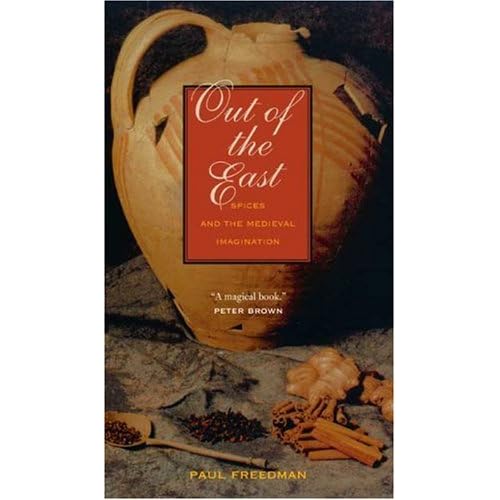
This book was a real treat, and not just because much of it was about food and dining. It's one of the best-written medieval/early modern history books I have read in a long time, and one of the most original.
If you have ever eaten, tried cooking or just read about aristocratic food in the Middle Ages -- and aristocratic food is almost all we know about -- you already are aware that medieval feasts included a lot of highly spiced foods. The spices used in "savory" dishes then are hardly ever used today except perhaps in desserts; some, like grains of paradise and zedoary are hardly known. There has been some good scholarly work in recent years as to why medieval cooking and modern European differ so much; Terence Scully, for instance, has explained the connection between the ancient and medieval medical theories involving the four humours and medieval recipies and feast design. But Paul Freedman's book probably is accessible to more readers while actually covering a great deal of novel material.
One very interesting subject Freedman covers is how the appeal of some of the favorite exotic spices faded dramatically when European merchants gained direct, routine access to them. People still wanted cloves and nutmeg, but they no longer thought of them as powerful, almost spiritual substances. And when it became known that grains of paradise came from the mundane West Africa (precisely, "the Grain Coast") and not the earthly paradise, Europeans slowly lost interest in them.
There is much more in this book -- lots about early European exploration and the role of spices in motivating it -- and I highly recommend it to anyone who finds this review in the least interesting.
Chris [Wickham] has contributed enormously to socio-economic history, and much of the talk was implicitly a call for this to be prioritised, in combination with archaeological expertise. Indeed Chris explicitly contrasted the fruitful relationship of history with archaeology in the 1960s and 1970s (with a historical tendency towards broad-sweep structural analysis, based on socio-economic history) with the historians’ later move away from archaeology with the linguistic turn. This meant that post-processural archaeologists in the late 1980s and 1990s found historical collaborators hard to come by.
It seemed clear to me in the talk that what Chris really wants is the 1970s back, but it’s not just structuralism that now seem as out of date as glam rock (and less likely to be revived). The big problem now is that socio-economic history provides few obvious reasons for studying the Middle Ages, let alone the early Middle Ages. Why should the economic history of the Middle Ages be of interest to anyone but specialists? My sense is that until recently there were two possible broader connections. If you were interested in grand Marxian analyses, then slave and feudal modes of production were an important part of the model to be studied. Meanwhile for an analysis of the roots of industrialisation or capitalism as a whole, late medieval England and its textile trade or late medieval Italy and its banking system were useful places to look.
The problem is that current global capitalism has advanced so far that many of the early steps look entirely irrelevant...
In contrast, other aspects of the early Middle Ages do seem to have more obvious contemporary resonance. Early medieval historians exploring theology, the construction of ethnicity, the development of the state, gender roles or the use of history as propaganda can all show connections between then and now in a way that has become difficult for early medieval socio-economic history. Archaeology can contribute to some aspects of these themes (it’s been very important for looking at ethnicity and culture, for example), but it’s not central to these issues in the same way as it is to socio-economic history.
That doesn’t mean that the study of medieval socio-economic history isn’t valuable or important in its own right, but I can’t see it returning to centre stage again. Chris ended by presenting an analysis of historical change in Palestine and Syria in the period 500-900. It was a good example of how much you can deduce from an area with a well-explored archaeological record without going to written sources. However, I’m not sure that many people apart from Chris are going to feel that the most important fact about seventh-century Islam is that it led to little change in the economy of the Levant. Arguing that archaeology should be an equal partner with history rather than its handmaiden may be a sound position, but it isn’t really going to be effective if what is offered is an attenuated vision of history where structural pattern has replaced story. [Emphasis Muhlberger.]
The bolded passage is the part that really caught my eye. Like M&M, I have tremendous respect for Chris Wickham and his work, but even without a lot of exposure to recent literary theory, my work of the last ten years has focused on why people tell the stories they do, in my case about war and chivalry.
A number of times in the last two years or so I have linked to Phil Paine's blog over at hismultipurpose website. One purpose is to list recent reads and review the best.
I would like to see everyone involved with urban reform and with democratic renewal activism to read this book. There is a powerful undercurrent of change going on in both the United States and Canada, definitely something moving up from the grass roots and ignored by both the media and the elite political drones. It's something far more creative and significant than a mere flaky fashion for "anti-globalism" demonstrations, with which the reader might at first confuse it. It's the fact that people — ordinary people — are starting to question the orthodoxies they have been taught about how things "have to be", and realizing that their self-interest, as well as their future, depends on re-envigorating local economic and political power...
At the heart of his study are the premises that every consumer choice that prefers local sourcing over distant sourcing increases the "multiplier effect" of transactions in an economy, and that import substitution is the engine economic growth. He exposes the disastrous consequences of bribing and luring distant corporate powers into a locality rather than creating conditions for organic local economic creativity...
He also grasps that those same governments will quickly "agree" with rational critics and make a big, but entirely phony, show of following the rational path, while changing nothing. This shows that he has some real-life experience of trying to reform things. But he is at his best when he describes situations where dedicated people have actually made advances in democracy and prosperity, despite all the obstacles. The good news is that those advances are more numerous and vigorous than one would guess. The media have no interest in telling you about them. To describe these successful initiatives, Shuman coins the acronym LOIS ("local ownership and import substitution").
A much briefer comment on another book struck close to home:
This was one of the "children's classics" that I had glanced at as a child, but never actually read. A pity. McCloskey was a gentle humorist with a charming style and great human empathy, who chose to write for children rather than, say, subscribers to the New Yorker. He was also a talented artist, in a style reminiscent of Ernie Pyle. The world he writes about now seems so far away that a contemporary child might have some problems interpret it. It would seem exotic, rather than comfortingly familiar. But if you are an adult with any feeling for American social history, the child-viewpoint stories about pet skunks, donut machines, and giant balls of string will be fascinating.
I read that book as a kid and more or less recognized the environment, even though it was about pre-World War II times and I was born after the war. After all, Homer Price lived near me!
I only skimmed over my blog feeds after returning from my vacation, but I am glad I did so, and didn't just delete wholesale. There was some good reading, a bit of which I am going to share with you.
When I was Chair of Ed Pol I used to joke that we needed "Meeting Dosimeters" similar to those used for people who work with radioactive materials. When your dosimeter has gone above the safety level, you simply can't do any more work with radioactivity that month. It should be the same thing with meetings and other Chair stuff: decide how much you are going to do per week, and stick to that. To quote my friend Bryon Grigsby, who is now a Provost: "Nobody is going to die based on what happens in the English department."
There might be a big market for those "meeting dosimeters."
On a more historical note, here's another brilliant and thoughful post by Jonathan Jarret on medieval agricultural economics and various ways we can understand the relations between practice and records. It's vegetable barter time!
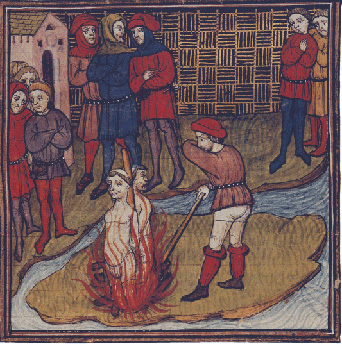
The Association of the Sovereign Order of the Temple of Christ, whose members claim to be descended from the legendary crusaders, have filed a lawsuit against Benedict XVI calling for him to recognise the seizure of assets worth 100 billion euros (£79 billion).
They claim that when the order was dissolved by his predecessor Pope Clement V in 1307, more than 9,000 properties as well as countless pastures, mills and other commercial ventures belonging to the knights were appropriated by the church.
But their motive is not to reclaim damages only to restore the "good name" of the Knights Templar.
"We are not trying to cause the economic collapse of the Roman Catholic Church, but to illustrate to the court the magnitude of the plot against our Order," said a statement issued by the self-proclaimed modern day knights.
The fate and alleged guilt of the Templars is a legitimate subject. One does wonder, however, how this Association can claim "descent" from the 14th century members of the historic Order. Simple answer: The same way everyone else does, more or less by assertion.
For more, see Wikipedia, which I would guess has tons of material on the dubious descendents of the Templars.
Images: Templars being burned for heresy and apostasy.
Phil Paine has argued for a long time that many of the economic activities that we think of as characteristically modern -- especially commercial trade networks -- go back much farther in history and are typical of many cultures. Here is an interesting piece of news from the archaeological front. David Wengrow, an archaeologist at University College London, is now arguing that the well-known Mesopotamian bottle stoppers, which bear stamped-clay symbols, were in some cases used as brand logos. Here's the article from the New Scientist.
Image: One of the bottle stoppers in question, or perhaps a seal that produced bottle stoppers.