Showing posts with label France. Show all posts

Friday, April 20, 2018

When does anyone ever apologize like this?

ETA is the Basque separatist organization, which has been fighting for their independence in the Pyrennees region of Spain and France for many years.  They are well known for their terrorist attacks, which included blowing up a Spanish PM and a grocery in Barcelona.

Recently they have announced their disbandment.    As part of this process they have -- get this --
apologized to all the people they have harmed.

From the Guardian, today:
The Basque terrorist group Eta, which killed more than 800 people during its four-decade armed campaign, has apologised for the suffering it caused and asked for the forgiveness of victims and their families as it prepares to dissolve.
In a statement released on Friday morning, the group made a full and unambiguous apology for its actions, accepting that it bore “direct responsibility” for years of bloodshed and misery.
“We know that we caused a lot of pain during that long period of armed struggle, including damage that can never be put right,” it said. “We wish to show our respect for those who were killed or wounded by Eta and those who were affected by the conflict. We are truly sorry.”
The statement also recognised that Eta’s “mistakes or mistaken decisions” had led to the deaths of people who had nothing to do with the conflict, both in the Basque country and beyond.
“We know that, owing to the necessities of all kinds of armed struggle, our actions have hurt people who bore no responsibility whatsoever. We have also caused damage that can’t be undone.
“We apologise to those people and their families. These words won’t make up for what happened nor will they lessen the pain, but we speak to them respectfully and without wanting to provoke further suffering.”
I am not going to argue with anyone who has a cynical view of this declaration.  But who ever says "WE WERE WRONG?" in such a case?

Maybe this might be a step towards NOT "MISTAKENLY KILLING LARGE GROUPS OF INNOCENTS IN THE FIRST PLACE?"


Saturday, December 09, 2017

The Good Duke now speaks English! Done, sort of (again)

Back on October 13, I announced on this blog that I had (sort of) finished my translation of  the Chronicle of the Good Duke Louis de Bourbon.  Maybe one more  run-through and I'd be able  to start a new project.


Well,  my collaborator Phil Paine and I have done considerably more than that since October.  The problems we faced as we worked on the remaining trouble spots were really difficult -- which only makes sense if you think about it.


So today's announcement should be limited.  What's done is an acceptable translation from Middle French to modern English.  Truth be told there are a very few spots where figuring out what the best equivalent in Modern English is still uncertain.  Also missing are a short glossary of mostly military terms, a map (maybe) and an introduction that will help non-specialists understand the context of the chronicle.


And there is one big thing that remains to be done; I have to retranslate our rather literal English translation into a modern one.


Why is this necessary?  Well, let me tell you of my own experiences.  About ten years ago, I was teaching late medieval history.  I did my best to find accessible, affordable, translations, or translations that were in the public domain.  There were a few century-old public domain works that might have been fun, but as I looked them over, I realized that they would be very difficult for students of the 21st century to read.  Somebody would have to translate the translation first!


That's what I have to do now.  I'm going to treat the text Phil and I have produced and act like it is the base text, and transform it into a modern work, without constantly going back to the Middle French original (though you and I know that I will be looking closely at that original.


It will be a challenge to keep some of the medieval flavor., to avoid too much exoticism or a very dull 21st century presentation.   OTOH, it should be fun to try.


Friday, October 27, 2017

Who does this remind you of?


The French Duke of Bourbon spent much of the 1360s and 70s taking castles back from the English soldiers who had occupied them after defeating the French at Poitiers (1365).  The duke (known to his fans as "the Good Duke") established a reputation for both his warrior skills and his honorable behavior toward friend and foe.
.


In one incident the Good Duke was trying to undermine and capture the castle of Vertreuil (not so far from Poitiers) by challenging the most noble English member of the garrison to fight one-on-one in a mine (a tunnel dug as part of an attack on a strong point).  It turned out that there was no high-ranking Englishman present.  The commander was absent and his second-in-command, a man named Montferrand, did not even rank as a squire.  Montferrand took up the challenge, and found himself facing an impressive man-at-arms, who declined to give his name.  But soon the secret was out: the French, watching the fight in the mine, (which must have been rather short and shallow) cheered on their duke with cries of "Bourbon, Bourbon."  

Montferrand found himself in a quandry.  He was fighting someone who very much outranked him, and who might be inclined to execute him as a brigand once Vertreuil was taken.  ("English" soldiers in the Hundred Years War were often foreigners -- Bretons, Scots, Gascons with little standing in local society. They were hated by the French.)  Montferrand made a daring move by appealing to honor.  Montferrand said he would surrender Vertreuil to the Good Duke, if the duke would knight him.  The duke agreed and everyone was satisfied.  I'll tell the rest of the story another time.
But now that we are here, look at this passage, with the Good Duke
and Montferrand trading compliments:


Reynaud de Montferrand knelt before the duke and said to him, "My very redoubtable lord, I thank you most humbly for the benefits and honors which have come to me from you, to be a knight by the hand of so high and valiant a prince as you are; so it is an honor to me and all my lineage forever." The duke answered, "Sir Reynaud, chivalry is very strong in you for you are a valiant man of good lineage."
What does that bolded phrase remind you of?  And what does that say about the process of translation?

Image:  The castle of Vertrieul, after it was rebuilt in the 15th century.  Older castles in that part of France were rebuilt because they were destroyed in campaigns like the one described here.

Sunday, June 25, 2017

Progress on the Chronicle of the Good Duke

Followers of my work know that I have been translating the 15th-century chivalric bibliography The Chronicle of the Good Duke Louis of Bourbon for a good while now. (Gulp! since 2010!) I just finished my third run-through of the Chronicle this very morning. The next full run-through should be the concluding one!

Image: The French court of Charles VI in the time of Duke Louis!

Sunday, May 21, 2017

Fourteenth-century chivalry, as seen by various military men

People often think that in the later Middle Ages there was such a thing as "chivalric combat." What constituted "chivalric combat is not entirely clear to scholars today; indeed, it may have been unclear to knights and other men at arms in the Middle Ages.
Today I am posting a passage from the Chronicle of the Good Duke (written in 1429, describing here an incident of the 1390s) where some apparent disagreement about one point of "chivalry" is discussed. It is an account of the African crusade led by the Good Duke, in which he, or the author of the chronicle criticizes a famous French knight, Boucicaut the Younger. Boucicaut was known at this time for his strong desire to fight deeds of arms against anyone (of sufficient status) he could. Boucicaut travelled all over Europe while fulfilling this quest, and eventually attained such fame that he was made a marshal of France.
But I've always been rather dubious about Boucicaut's reputation. For one thing, he was the French commander in two of the worst French defeats of the Middle Ages, Nicopolis and Agincourt. Further, there is a lot of somewhat skeptical commentary about Boucicaut in the medieval sources. Have a look at this discussion of how Boucicaut, apparently taking his turn commanding the guards of the Crusaders' siege camp, got distracted from that routine assignment by the endemic skirmishing that took place throughout the siege and tried to arrange a challenge with the opposing Muslim forces.
Boucicaut was a chivalrous man who, through some interpreter, made a request in the skirmish where he was whether there was any Saracen who wished to combat him on foot or horse. They replied no. Then Sir Boucicaut said if they wished to perform arms 10 against 10 or 20 against 20 he and his company would be ready. So the Saracens responded no, not if the kings their lords did not want them to. When Boucicaut saw their refusal he said to them that he would fight them in a secure field, 20 Christians versus 40 of their Saracens.
As long as this conference lasted it was ordained that they should not make war on each other. With difficulties were these negotiators, Christian and Saracens, brought together, which astounded the duke of Bourbon, the Lord of Couci, the count d’Eu, the Souldich of Estrau, and the other barons, for the whole army ran to this assembly so that the Lord of Couci, the count d’Eu and others who saw the army taking leave of its senses said to the duke of Bourbon, “My Lord, the people run like beasts over there with Boucicault and they are not able to keep guard and it seems to us that if you do not order some to retreat, things will turn out badly for us.”
Then replied the duke of Bourbon: “I can’t then send a better message than one from me. I’ll go there myself.” So he asked for a mule he always had and it appeared good to the lords that he was not able to send a better message to make them retreat. So the duke mounted his mule left his tent and went off with the people of his household.
It was not long before more than 300 gentlemen were following him. The Saracens who saw that the duke of Bourbon whom they recognized by his coat of arms, came to join Sir Boucicaut with many men at arms, began strongly to retreat towards their tents, and Boucicaut and those with him to chase them. Boucicaut who saw the duke of Bourbon coming, gave himself over to pride and chased the Saracens more boldly and the duke of Bourbon with his company went after to bring about a retreat. When Boucicaut was at the tents, the Moorish kings and their Saracens put themselves in formation for battle outside their lodgings, and Boucicaut put himself in battle formation with his men, awaiting the duke of Bourbon and those who came with him. The duke of Bourbon caught up with those whom he wished to make retreat, and he very violently spoke to Boucicaut, concerning his great follies.
But the duke of Bourbon seeing that there was with him a good 2000 combatants following him, and seeing also the Saracens who had abandoned their camps and put themselves in battle order all outside, said, “My friends, since we see the lodgings of the Saracens abandoned, let us go by God and charge among their lodges and if the Saracens are worth anything they will come and defend them .” The duke forbade anyone should be so bold as to ignore his order nor think about pillage, but should fight forcefully and at the first sound of the trumpet which he would have sounded, everyone should pull back to his standard.
Then the duke of Bourbon first and the lords and the captains each in his place, with their men at arms and arbalestiers of Genoa charged among the tents of the Saracens, attacked all the lodgings and cut the ropes of the tents and set fire to the lodgings of straw and the duke of Bourbon remained for an hour in the middle of the Saracen lodgings with his standard of the belt of hope. During this the count d’Eu arrived with a good seven score combatants who came from the other side, by the shore, which made those who were already there very happy and joyous.
Because he was late, the count d'Eu said to the duke of Bourbon, “My Lord you see the finest thing one can see, and I thank God that I am found in your company, but for God’s sake, let’s go back, for it is evening and if the Saracens attack the lodgings there’s only the Lord of Couci with a few men, and a bunch of those are ill: so he will be completely lost.” So the duke of Bourbon said to the count d’Eu, “We will go there immediately, please God.”
Now imagine you are sitting at a campfire in a French siege camp in the 1390s. Someone says "Boucicaut is the greatest living knight." What might you say?

Thursday, May 11, 2017

A memorable time in the life of Jean de Chateaumorand

I love the Chronicle of the Good Duke.

The Chronicle is a biography of Duke Louis of Bourbon, who was a close relative of the French kings during the Hundred Years War. In 1429, when bad dukes had prostrated France before the English invaders, it became useful to remember what Good Dukes were like, and this text was commissioned. The writer was no genius, but he had access to an old French soldier, Jean de Chateaumorand, who fifty years earlier (!) had fought as part of Duke Louis' military household, and who remembered well what it was like in the Golden Age of Chivalry, which I have no doubt he thought the wars he fought next to the Good Duke were. I have been translating the Chronicle for a good long time, and I am almost done. As I review my translation, I keep running across passages that remind me of why I like this book. The Chateaumorand sections are particularly evocative. Here are a couple of passages that show the ups and downs of late 14th century warfare. We begin with a short notice of the death of Jean de Chateaumorand, bastard. The brother of the other Chateaumorand? Perhaps. But this tragedy did not overwhelm the memory of Jean the squire, who as banner-bearer for the Good Duke, played an important leadership role in the taking of the strategic castle of La Roche Senadoire, which was held by Englishmen who ravaged the countryside.
Chapter XXXII Then the duke went before Amburs, a very fine place, where there were a good 80 combatants, and on arrival he fought a big skirmish, for those inside came out, and there was a fine skirmish with lances and swords between the two sides; and there Sir Girart de Grantvau, a good man of his body, was wounded and Jean the bastard of Châteaumorand was killed. But in this skirmish there were /(95)taken eight men at arms from those of the fort who had more authority, and four killed; and the duke of Bourbon on the morrow had those eight led before him to have their heads cut off, if they did not surrender the place, and they were quite able to do it, for they had it under guard and preferred to live than to die in such a manner. So they surrendered Amburs to the duke of Bourbon, both their bodies and the place.

Inside of one hour the duke of Bourbon and his men made to leave and go to Tracros; and those men who he sent before encountered the English of Tracros, great adventurers who had come to defeatethem and were overthrown by the duke's men, who came in haste before the place, and it was late when they arrived there. That night the duke of Bourbon, who had come there, set the guard from the men of his household and said to Jean de Châteaumorand: 'Take my pennon, and go all around the place so that no one sallies out." He carried out his order, and that night had many a talk between the dukes people and those of the fort that they should surrender, or when they were taken they would be hanged by the neck because they were men of evil renown.

So they talked until Gourdinot warden of the Place surrendered to Jean de Châteaumorand, squire, who carried the pennon of the duke of Bourbon; and at this hour, which was not the day, it was announced to the duke, so it please him, the treaty which the men of his household had made; and he answered that it pleased him well, because he still had great deeds to do. The one who spoke about this to the duke was Châteaumorand, who asked him to be willing to give the movable goods in the fortress to the people of his household, which the duke did freely and that/(96) Gourdinot, who had surrendered to him, should remain his prisoner and this he granted to him. On the morrow Gourdinot and his men of Tracros, who were not but 16 men at arms, were all prisoners. Inside were 200 marks of silver, of which 100 were in chalices from churches which they had thoroughly robbed. So the duke said that he wished to have the chalices, and he would generously recompense the companions. The duke of Bourbon moved by pity sent the chalices to the city of Clermont and had it announced to all the churches which had lost their chalices, that someone should come to Clermont, and they would be given back, and it was done.

... Chapter XXXIII There the duke of Bourbon seeing his knights and the squires of his household and country, and all the men at arms, who were ready to undertake any risk, destroy the palisade and garrison and proceed in force triumphantly, was overjoyed. During this melee, the pennon of the duke of Bourbon continually carried by Jean de Châteaumorand passed through the breach in the palisade, with those who followed him. Then the English who saw this, did not know what to do, outside of retreating into the fort/(102) and while they retreated the pennon rushed forward with the valiant men; and in this retreat of the English, who ran away, there were killed and taken a good fourscore of the better men at arms from inside, for the captains, of whom in one of the two places Nolimbarbe retreated on the right-hand and the other on the left-hand which was stronger, led to retreat the captain Sir Robert Chennel, Jacques Bardenay, the son Sir Jehan Jouel, Thomelin Maulevrier, Sir Richard Credo, son of the mayor of London. While they retreated from certain lodgings which were high up, to go to their fort, the pennon of the duke of Bourbon and the people of his household charged them so close that as they entered the tower, the pennon of the duke of Bourbon rushed among them very well accompanied, so that those Englishman were not able to close the door of the tower, and so they surrendered to the one who carried the pennon of the duke of Bourbon. The prisoners who surrendered to him were Sir Robert Chennel, captain, and so that very strong place was delivered.

In this way the pennon of the duke of Bourbon with his companions namely Sir le Barrois, Bonnebault, Sir Gaulchier de Passac, the lord of Cordebeuf, the Borgne de Veaulce, Sir Odin de Rollat, Sir Phelippe Choppart, the lord of Billy, Jehan lord of Chaugy, Phelippe Berault, Michaille, the bastard of Glarains and five or six others of the household of the duke of Bourbon, with his pennon, headed over to one of the other /(103) towers where they found already before it a great party of people of Auvergne who were climbing up there, and the Lord of Montmorin who was a valiant knight, and who had a fine company, and Geraud, Lord of Laqueuilhe, accompanied by good people and who was a valiant man, the Lord de Lafayette and others who were advanced by the advice of the lords who had held very close to the English when they had arrived there so that the English could not flee.

But when the English saw the pennon of the duke of Bourbon approach them, the captain Nolimbarbe surrendered with all of his companions to the duke of Bourbon. So was La Roche Senadoire taken without a word of a lie.

Leaving there, the duke of Bourbon sent to Clermont six English captains to hold them as prisoners in the tower of Monnoye, about which the people of Clermont were very happy and joyful and the Duke and his people and those of Auvergne rode to Saint Angel, a place which had done much evil. They remained there a day, thinking to treat with them, but those in the castle did not want to listen. Then it was noticed that the abbey was covered by wooden shingles, thereupon they fired several incendiaries, so that it spread throughout its buildings, and all the English horses were burned up and some of their valets. The men at arms retreated into a tower that was there, where they had nothing to eat. It was impossible to take it by force, for it was very well built; in which attempt a young knight, whom the Duke of Bourbon loved well, was killed: Messire Jean de Digoine, who hailed from Clermont. In the end, those of the Tower surrendered to the Duke of Bourbon on the condition of keeping their lives. So the Duke vouchesafed them, sending Châteaumorand with his pennon to the tower, and each of the English came out with their weapons in hand.
Note how Jean -- who later on became quite an important man -- identifies himself with the Duke and the Duke's pennon. He still is enormously proud of his association with the Good Duke.

Image: This is NOT Jean de Chateaumorand with the Good Duke's pennon.

Thursday, May 04, 2017

Military humor of the 14th century: Robert Knowles

The Chronicle of the Good Duke:

The duke of Bourbon the Constable of France, Sir Bertrand and the marshal Sir Louis de Sancerre remained before Brest for 40 days. In that time it rained continually so hard that no one had ever seen so much rain fall, and in the country of the Breton Brittany there was no provision for horses, from which the lords had a great loss, and the same M Robert Knowles had nothing to eat in Brest except his horses, and spoke to a Constable of France about how he held himself discontent that he was not able to raise the siege which the duke of Bourbon, himself, and the marshal held before Brest where they had besieged him, but he counted it for little, because he knew that the horses and the army were much weakened by the rain and this he was consoled that the lords also had very little to eat; just like him and that he was not at all afraid of their assault. He sent a further message to the Constable: "You have made me eat my horses here this castle of Brest, as I made you eat yours at the siege of Rennes; and so go the changes of fortune and war."

Sunday, April 02, 2017

Richard Watson Gordon parades an amazing ignorance

Gordon is talking up an art exhibit on the subject of 19th century prostitution in Paris:
 It was a subject that interested them. Why? The obvious answer is that they were men, but another reason was that prostitution was linked to the idea of modernity. People had moved to the city, which was in itself a new concept, where the moral strictures of the village had disappeared. 
Gordon is a professor of fine arts.

Saturday, March 25, 2017

Some people you just don't want to fight...

...because some people are just scum.

During the first half of the Hundred Years War, when France was in chaos, disbanded soldiers often struck out on their own to fill their purses and their stomachs by capturing both warriors and civilians and ransoming them back to their lords or families.  These were not nice people, as this story of the Good Duke makes clear. Duke Louis, who had himself been captive in England for seven years, was determined to rout out these outlaws.  Duke Louis' men had if anything a lower opinion of these "English" (who may not have been English in fact).

Duke Louis told them:

They have made a pit at Beauvoir , and when they have taken someone who they do not wish to or cannot ransom, they say " put them in hell" and they are thrown into this pit full of fire, of which everyone was so terrified, so that when anyone became a prisoner, he gave out that he was rich for fear of being thrown in hell. Therefore Duke Louis required, that all of his company should take part in the attack.

They all replied "Most redoubtable Lord, we are ready to go where it pleases you and we desire nothing else. But we pray you humbly, that it please you that you personally should not go there; for it would be too much of an honor to such people as they are, that such a Prince as you are ought to go there. For they are excommunicated by the sentence of the Pope, and are men of the companies, and without absolution; but if you please order us to go there." Therefore the Duke agreed with them and with great pain, as to him who always wished to be with them.
They won...
all those at Beauvoir were killed except the captain, Le Bourg Camus, who was taken to Molins, and the others were thrown into their hell.
Image: This might be a later version of Beauvoir castle.

Friday, February 10, 2017

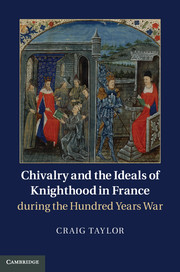
Chivalry and the Ideals of Knighthood in France...by Craig Taylor

By coincidence I am reading this book for the second time, just as this review from the Medieval Review comes out.

I highly recommend the book. Craig Taylor is always good.

Taylor, Craig. Chivalry and the Ideals of Knighthood in France during the Hundred Years' War. Cambridge: Cambridge University Press, 2013. Pp. 345. £82.00(hb); £21.99(pb). ISBN: 978-1-107-04221-6.

Reviewed by Thomas K. Heebøll-Holm

University of Southern Denmark

thee@sdu.dk

The story of French chivalry and its miseries during the Hundred Years' War is an ever fascinating and puzzling one. With this book Craig Taylor breaks important ground by showing how much French knighthood in this period was shaped by and, in turn, shaped developments in the chivalrous ideology as well as by the changing military reality of the fourteenth and fifteenth centuries. While indebted to Maurice Keen's and Richard W. Kaeuper's studies of high and late medieval chivalry, Taylor refines these paragons' more general studies of medieval knighthood by concentrating on a specific time period and region, namely Valois France during the Hundred Years' War. France during this time period is especially fertile ground for such a study. Not only was it the epicenter of chivalry, but during the Hundred Years' War the French knighthood experienced a number of military catastrophes which forced French warriors and writers to critically examine and discuss the causes of these calamities and how one could remedy them. This debate is a treasure trove for historians looking to get a firmer and more nuanced picture of the muddled concept of late medieval chivalry. Indeed this concept is one of those that all think they know and consider to be simple, yet upon closer inspection find confusing, slippery and self-contradictory. It is an immensely demanding task that Taylor has undertaken. It is also one which he resolves splendidly.

Taylor approaches the topic by a combined study of the practice and ideology of knighthood as it appears in various types of late medieval narratives such as chansons de geste, biographies, didactic manuals and political, legal and moral treatises. Through nine chapters (including an introduction, a chapter on the texts and their context and a very brief conclusion) Taylor takes the reader through seven core values of French chivalry during the Hundred Years' War. These were honor, prowess, loyalty, courage, mercy, wisdom and prudence. While these have been separated for pedagogical reasons, Taylor immediately acknowledges that they were not isolated values, but should be seen as part of what I am tempted to call the chivalric kaleidoscope. They were interdependent and inseparable parts of a whole. However the weighing of the relative importance of the values changed with the individual writer's personal convictions and situation as well as his/her specific historical context.

In the introduction, Taylor presents and discusses the guidelines of his study. It is interesting to note that the late Middle Ages presents a new phenomenon in medieval literary production, namely that the knights themselves begin to write down their own experiences of chivalry and war. While this certainly does not remove the classic problem of to what degree medieval writing was dictated by genre conventions and socio-cultural expectations, it at least brings us closer to the military experience of the warriors, and Taylor's take on this problem is both prudent and thought provoking. These texts reflect not only practical changes in late medieval martial culture. They are also a goldmine for the historian as through them we gain access to the combatant's thoughts and recollections (flawed and biased as they may be) instead of having to rely on ecclesiastical middlemen who may have had neither interest in, or knowledge of the practical reality of knighthood. A topic which Taylor pays particular attention to is the medieval debate over chivalry and the right behavior of knights and men-at-arms. Essentially this debate came down to the difficult question of how to reconcile a proud military ethos and aggression with Christian values of humility, piety and salvation. Taylor makes the important remark that texts do not just mirror reality. They also have an influence of their own and thus enter a reciprocal relation with social reality, where texts form men and men write texts.

In the following chapter "Texts and contexts," Taylor concentrates more narrowly on the historical and literary context of the narrative sources analyzed in the book. Contrary to the practical and structural reasons for the French defeats as presented by modern military historians, contemporary writers argued that the reasons for the defeats were cowardice and moral laxity due to the corrupting effects of court life (among others). Consequently, they advocated for a reform of the mores of the knighthood especially by the adoption of the values and discipline of the Romans of antiquity. This emphasis on the Romans was, as Taylor shows, in no small part due to the fact that many writers implicitly or explicitly served royal Valois interests. To these kings, the Roman models of chivalry that focused on self-sacrificing loyal service to the sovereign and the commonweal were echoed in the military reforms from Charles V onwards--and vice-versa.

In chapter 2 Taylor deals with the central issue of chivalric honor. On the basis of philosophical, anthropological and historical theories of honor, Taylor produces a good and nuanced discussion which is firmly grounded in contemporary sources and contexts. In particular, the chapter contains thought provoking discussions of the relationship between masculinity and knightly honor and between honor and reputation. As Taylor shows, there was a continuous and reciprocal interplay between the chivalric values of society and those of writers of chivalric reform. He furthermore refreshingly argues that honor is not merely a societal tyranny of expectations and values. Rather, individuals knights can and do have agency. By their actions they entered a continuous (re-)negotiation of chivalric values with society.

Chapter 3 deals with what Richard W. Kaeuper has termed "the fundamental quality of knighthood," namely prowess. [1] As with honor, prowess is a difficult concept to grasp, not least because it, to a large extent, was propagated by writers with no personal experience of war. Moreover its portrayal of the brutality of war was dominated by genre over reality. Indeed, at the heart of prowess lay violence--just when used in the service of a higher cause (ideally crusades, but increasingly also in service of king and country), but criminal when used by lower orders against their superiors. Unfortunately most medieval war lay in the grey area between these two, and interestingly Taylor combines this discussion of right prowess with the one on loyalty. Here it seems that contemporary Frenchmen drew inspiration from Roman military ideals where the loyalty to commonweal and crown could discourage acts of vainglorious prowess as only actions against the common enemy ought to be considered as "true" honor conferring prowess.

The cousin of prowess, courage, is discussed in chapter 4. While written sources discuss these issues, they are difficult to use in historical analyses and they are very much dependent on conventions and literary stylings. Moreover they serve various practical issues such as encouraging group cohesion, leadership and discipline. In this chapter, Taylor touches upon the possibility of doing emotional history in regards to medieval warriors, but reaches the safe, if somewhat conservative conclusion, that emotions though characterized by universal triggers in their display of emotions are not human constants, but rather wholly shaped by society and culture. To this reviewer, this discussion is a bit lacking as Taylor flirts with but eventually shies away from the possibility of conducting emotional history on the basis of these sources. Though he acknowledges the promising prospects of studying the antonyms of courage, fear and cowardice, Taylor in the end resigns himself to a fleeting treatment of these two.

Chapters 5 and 6 deal with mercy. In chapter 5 the topic is mercy towards other soldiers while chapter 6 concerns mercy towards civilians and non-combatants. In regards to soldiers, Taylor provides an important corrective to the romantic notion that knights spared each other out of feelings of chivalry and nobility. Rather knightly mercy towards peers was the result of the prospect of rich ransom-money. Moreover, more lowly soldiers could not expect spared since they could not pay for their liberation and in fact were reviled by the nobility. In regards to civilians, treatment was also mostly dependent on social status. While theologians and priests celebrated restraint and mercy towards civilians, the fact remained that most medieval knights treated their social inferiors with disdain. Furthermore, structural problems lay behind the more general and continuous pillaging and ravaging of soldiers on civilians. Simply put, lack of pay caused soldiers to prey on civilians. Though the Valois kings repeatedly tried to enforce discipline in the royal armies, by 1450 Charles VII's Compagnies d'ordonnances were still reputed to be mostly manned by ruffians and pillagers.

Chapter 7 deals with the virtues of wisdom and prudence. In the research these virtues have traditionally been seen as the antithesis to knightly ones, yet Taylor admirably proves wrong. Chivalric culture in fact placed great emphasis on age, experience and prudence and many contemporary writers were openly critical of rashness and inexperience. Moreover, during the fourteenth and fifteenth centuries more and more French commanders collected written accounts of the experience of veteran warriors (contemporary as well as Roman) thereby suggesting a greater interest and emphasis amongst them for written advice. In regards to this, Taylor suggests that this rising interest was due to the defeats the French suffered in the Hundred Years' War. Interestingly, Taylor observes the same phenomenon in England in the 1440s when English reversals of fortune in earnest set in. This chapter is followed by a brief concluding chapter that sums up the book's major results.

This is an impressive book. One of its most important contributions is its demonstration of how inspiration from the Roman Empire was by no means an isolated Italian "renaissance" phenomenon. Throughout the book, Taylor demonstrates how these ideas came to the fore in France simultaneously with Italy and how they influenced and indeed pushed chivalric ideals from a more Arthurian, "feudal" model to a "republican" Roman one. Although imperial Rome had long been one of many ideals for the European knighthood (see for instance John of Salisbury's Policraticus), then the roving bands of routiers and self-serving knights in the late middle ages caused a yearning with many writers for this Roman republican ideal of fighting for the commonweal as the highest honor for a warrior. Another feat that Taylor should be lauded for is his insistence on treating the narrative source material in its historical context. This means that Taylor studies chivalry as a dynamic genre responding to current situations instead of a fossilized monolith--as it is all too often treated in research as well as in many popular presentations.

If I were to voice one criticism, it would be that, although Taylor discusses the complicated issue of routiers and their relationship with and role in chivalric ideology, his treatment of this issue is never quite to the satisfaction of this reviewer. While they on the one hand were part of the chivalric elite then at least a number of the English routier captains were indisputably of non-noble background--a fact that profoundly disturbed writers such as Jean le Bel and Geoffroi de Charny. However, this is a really minor issue.

In sum, this is a piece of impressive and lucid scholarship. It is well written and presents a refreshing discussion of chivalry, war, society and literature in late medieval France. Furthermore, it is also pedagogical. This reviewer has used the book with considerable success in his teaching. Thus not only do I recommend it for its research qualities, but also for its approach to a topic that is in fact much harder to grasp for students than they usually anticipate. This book ought to be consulted by anyone interested in late medieval chivalry in ideology as well as in practice.

-------- Note:

1. Richard W. Kaeuper Chivalry and Violence in Medieval Europe (Oxford: Oxford University Press, 1999), 130.

Sunday, January 29, 2017

Trouble in Capital City!


In my years as a university professor, I taught both the English Civil War (=Revolution) and the French Revolutions, and the American one as well, all of them at various levels of detail.  On all of them, I read far more material than ever got into my lectures.


I've always had an interest in constitutional law and constitutional change and so lots of facts and theories continue to rattle around in my head, waiting for a moment of relevance when they will pop out.

Here's today's moment of relevance.

It is a sign of real trouble to come that Trump has managed to alienate a large number judges in his first week in office.  Any political system that has a meaningful constitution (not necessarily a good, or  democratic or even a healthy constitution, just one that more or less functions) needs the support of the judiciary and the senior lawyers to get anything important done.  The collaboration (usually an uncomfortable one) between the elected officials and the judiciary etc. is a well-known feature of the American political system; but this applies to places like Pakistan where more than once a quite corrupt, autocratic and military-based government has been stopped in its tracks (or at least slowed down) by lawyers demonstrating and resisting.  (On at least one occasion I remember hearing that the lawyers brought clubs (which looked a lot like sticks of rattan!), whether for offensive or defensive purposes I don't know.

In both the English and French Revolutions, some of the earliest conflict was between the executive branch and the constitutional courts.  The judges, if I recall correctly, took a "conservative" stand, while the king and his  ministers were trying to introduce innovations (partly to raise money) and justifying their actions on the right of the king, or at least the crown, to tell everybody else what to do.  The argument over what was constitutional soon got out of hand.

I am not saying that we are on the brink of an American revolution.  But the situation has tremendous potential for instability.

Image:  Don't mess with this guy!


Monday, October 10, 2016

The French Revolutionary Calendar

At a certain point, the dominant revolutionary party in France decided that the new Republic needed to be purged of all traditional, Christian and monarchical symbolism. The new calendar went far beyond a mere renaming of the months. The year and the months were given new starting points, and new names based on the seasons, the weather and the agricultural year were devised.

French historians of the Revolution often use the new calendar when discussing the events of the most turbulent period of the Revolution, in part because that is how dates are identified in the documents they study, but also (I think) because using them gives modern people a feeling for how the Revolution seemed to all concerned as a whole new era of the world. If you are not steeped in this stuff, however, you may find it rather difficult to figure out when the Year II was, or the month of Thermidor.

But wait! Brittanica has an attractively illustrated primer on the months of the Calendar. I think lots of people may find this useful.

Image: One of the great Revolutionary celebrations: the Festival of the Supreme Being 20, Prairial Year II (8 June 1794).

Wednesday, March 04, 2015

Buy these books!

I recently got a royalty statement from my main publisher, Freelance Academy Press, and I'm sad to say that sales of been rather anemic the last six months. I know there are more people who are interested in this material than have heard about it. Also FAP does a classy job of printing and binding and illustrating these volumes. Finally, the price is right. The books are about a third the price of some of the other similar works put out by mainstream publishers. So I'm going to do my bit to get the word out, something that everybody who publishes these days is told they have to do. ,

FAP carries three recent books by me. All of them concern "deeds of arms" or chivalric sports and warfare in the late 14th century. All of them include translations of accounts from that period plus my own analysis of the material. I think I am quite a good writer so a lot of people should find my approach easy to understand and even entertaining.

First, there is "Royal Jousts". This book describes famous jousts of the 14th century as described by people who took part in them. This is the time when the kings of France and England competed not just on the battlefield but also in their sponsorship of chivalric sports. The best part of the book is the description of the jousts at St. Inglevert in the 1390s. It's famously described by Froissart, but other people wrote up the event too. I've included those other descriptions. If you are curious about what jousting meant to knights of the time, this is your book.

 Second is "the Combat of the Thirty." This is a famous incident of 1350s in which Breton – French men at arms fought English and mercenary men at arms for the fun of it. Each group controlled a strategic castle, but the war itself had bogged down. Out of boredom or other calculations, the captains of these garrisons decided to fight "30 against 30 with no one running away." Some people at the time thought it was a foolish pointless fight, while others thought it showed a true knightly spirit, unlike for instance the French cavalry who had run away from the battle of Crecy. There may have been some doubt too about whether the winning tactic was a fair one or not. Modern reenactors love to reenact this one. If you have friends who love the Hundred Years War, get them this book.

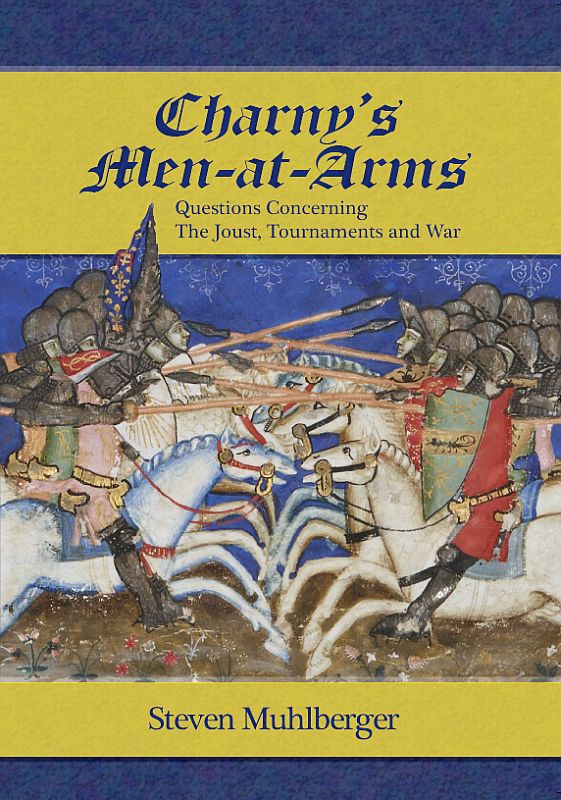
The third book is "Charny's men-at-arms." Geoffroi de Charny is the famous knight of the 1350s, among other things the first owner of the shroud of Turin. He was a trusted advisor of King John II of France and took part in John's efforts to revitalize chivalry in his kingdom. One project that Geoffroi de Charny participated in was an effort to revive knowledge of the "law of arms" that governed the relations between knights and knights (or "men at arms"). With the King's encouragement, Charny put together a list of questions about how the law of arms applied to jousting tournaments and warfare. Interestingly, he did not include or record any answers to those questions. So "Charny's questions"as they are usually called doesn't give us a codified legal document, but rather a list of things that practical warriors worried about – ransoms, who was qualified to fight in tournaments, and various questions of honour.

Let me also urge you to suggest to your local public library or academic library that they buy them books for their collections. These are not just books for scholars. Scholars will like them, but so will people of a variety of back grounds interested in some of the most colourful aspects of the Middle Ages.

Buy these books at Freelance Academy Press.

Saturday, December 13, 2014

Ah, fashion!

In 1388, the Good Duke (Louis of Bourbon) was campaigning on the German frontier. As he besieged a castle, one of the duke's servants, a valet of the wine cellar, offered to arrange an infiltration of the fortress. The valet was from that part of Germany, and he figured that he could talk himself and a small company into the castle. Part of his confidence came from the current fashion:
So everyone in the household Duke of Bourbon said that it was a good strategy of war, seeing that in this time everyone was dressed like a German anyway.
I love the Chronicle of the Good Duke.

Friday, December 12, 2014

The French are feeling their oats

Early in the reign of Charles VI (1380s), the French are feeling a bit more confident about their prospects in facing the English. The Chronicle of the Good Duke shows the Duke of Burgundy trying to wind up his royal nephew:
Then the King sent to the Duke, “You speak well my uncle but what are you saying?”

“Monsiegneur,” said the Duke, “I will tell you: It seems to me that he doesn't do anything who does not do more. These English have made war on Monsiegneur your father for a long time, and on you, and they don’t do anything but often cross over to this side, and they are but a little people. Leave off these all little enterprises, do one that will be remembered forever. You are the greatest living King, and you have more people, and it has often occurred to me that we should undertake to cross to England and to strike down the great pride of these English.
Brave words, sir, brave words!

Saturday, September 20, 2014

Craig Taylor's "Chivalry and the Ideals of Knighthood in France..." -- a short review

I have finally finished this book, and feel I owe Craig Taylor a review, especially since it is a good one.

I began this book with the feeling that Taylor was making a lot of pretty obvious points, nothing that I hadn't heard before. Then I shook myself and said that of course this material was obvious to me; if it wasn't, then my reading on the subject of chivalry over the last 15 years was seriously defective.

As the book progressed, it became filled with material that was not so obvious. Taylor carefully analyzes the different perspectives on chivalry that existed during the Hundred Years War, describing the tensions between various points of view held by various observers of wartime France. This approach is very congenial to me; I find that in the short-term at least social or historical debates do not come to a neat conclusion; tensions between various participants continue to affect social debates for a long time, because they reflect important aspects of the structure of society.

Although this is a good review it will remain short one. I will just list some of the chapter titles to indicate where Taylor thinks the important debates were located.

Honour
Prowess and loyalty
Courage
Mercy (part I):  soldiers
Mercy (part II): civilians and noncombatants
Wisdom and prudence

If you have a serious interest in medieval chivalry, you will not want to miss what Taylor has to say on these subjects. At the very least it will clarify some important issues for you.

Thursday, August 14, 2014

Chivalry and the Ideals of Knighthood in France during the Hundred Years War, by Craig Taylor


I just ran across a reference to this book in the last few days, so this is not a review.  I know Craig Taylor and I consider him a very intelligent historian, so I expect this will be a valuable book. Here is what Cambridge University Press has to say about it:

Craig Taylor's study examines the wide-ranging French debates on the martial ideals of chivalry and knighthood during the period of the Hundred Years War (1337–1453). Faced by stunning military disasters and the collapse of public order, writers and intellectuals carefully scrutinized the martial qualities expected of knights and soldiers. They questioned when knights and men-at-arms could legitimately resort to violence, the true nature of courage, the importance of mercy, and the role of books and scholarly learning in the very practical world of military men. Contributors to these discussions included some of the most famous French medieval writers, led by Jean Froissart, Geoffroi de Charny, Philippe de Mézières, Honorat Bovet, Christine de Pizan, Alain Chartier and Antoine de La Sale. This interdisciplinary study sets their discussions in context, challenging modern, romantic assumptions about chivalry and investigating the historical reality of debates about knighthood and warfare in late medieval France.
And in the grand tradition of overcharging outrageously for academic books, this one even in e-book format goes for $79 US !

I am rather sorry I didn't have a chance to see this before I published Charny's Men at Arms, but in fact my book was essentially finished a year ago. Would it have made a big difference? No. My book is a tightly focused study, Taylor's a much wider one. But if it were a reasonable price I would own this book already.  Note that mine costs only $25.


Monday, April 21, 2014

Continuing with the Chronicle of the Good Duke

Just this morning, I finished the next run through of the Chronicle of the Good Duke, the one where I fix errors created by the dictation software. This is going better than I thought.

The next run through examines grammatical problems which I didn't figure out the first time. It will be harder.

This time it occurred to me that if I eliminate all the phrases that mean "and so" that occur at the beginning of sentences, the book may be a third shorter. That's only a little bit of an exaggeration.

Monday, April 14, 2014

How useful was heavy cavalry in the Late Middle Ages?

According to the Chronicle of the Good Duke, written in 1429 but talking about events about twenty years earlier, Duke of Brittany looked across a battlefield  at the troops led by  the Constable of France, the Lord of Clisson, and reacted as follows:
And the Constable Clisson, who was a valorous knight of bold enterprise, went boldly from his siege with his men arranged to give battle to the Duke if he dared to wait. And the Duke of Brittany seeing the battle order of the Lord of Clisson, told his men “My lords and companions, see Clisson there has arranged his companies and desires nothing but battle? I would not refuse that at all willingly but I see that he has arranged a great wing of his men who are mounted on great coursers of superior quality. Our horses are small; and those who are over there will come charge us and we will not be able to withstand them; and things will be the worse for us.” For this reason the Duke retreated that day with his men ...