Showing posts with label Middle East. Show all posts

Wednesday, December 20, 2017

Omar Muhammed (Mosul Eye) "I am a scholar."

AP has an article  that should make all others who call themselves scholars humble.  It tells the story of an Iraqi historian who time and again blogged from inside the "Islamic State" so that the world should know the truth of life in occupied  Mosul. A long excerpt:
Less than a year into their rule, in March 2015, he nearly cracked. IS beheaded a 14-year-old in front of a crowd; 12 people were arrested for selling and smoking cigarettes, and some of them flogged publicly. Seeing few alternatives, young men from Mosul were joining up by the dozens.
 The sight of a fanatic severing the hand of a child accused of stealing unmoored him. The man told the boy that his hand was a gift of repentance to God before serenely slicing it away.
It was too much. 
Mosul Eye was done. He defied the dress requirements, cut his hair short, shaved his beard and pulled on a bright red crewneck sweater. He persuaded his closest friend to join him. 
“I decided to die.” 
The sun shining, they drove to the banks of the Tigris blasting forbidden music from the car. They spread a scrap of rug over a stone outcropping and shared a carafe of tea. Mosul Eye lit a cigarette, heedless of a handful of other people picnicking nearby. 
“I was so tired of worrying about myself, my family, my brothers. I am not alive to worry, but I am alive to live this life. I thought: I am done.”
 He planned it as a sort of last supper, a final joyful day to end all days. He assumed he would be spotted, arrested, tortured. The tea was the best he had ever tasted. 
Somehow, incredibly, his crimes went unnoticed. 
He went home.
 "At that moment I felt like I was given a new life.” 
He grew out his hair and beard again, put the shortened trousers back on. And, for the remainder of his time in Mosul, smoked and listened to music in his room with the curtains drawn and the lights off. His computer screen and the tip of his cigarette glowed as he wrote in the dark. 
The next month, he slipped up. 
His friend the ex-taxi driver told him about an airstrike that had just killed multiple high-level Islamic State commanders, destroying a giant weapons cache. Elated, Mosul Eye dashed home to post it online. He hit “publish” and then, minutes later, realized his mistake. The information could have come from only one person. He trashed the post and spent a sleepless night. 
“It’s like a death game and one mistake could finish your life.” 
For a week, he went dark. Then he invited his friend to meet at a restaurant. They ate spicy chicken, an unemployed teacher and the gun-toting ex-taxi driver talking again about their city and their lives. His cover was not blown. 
The historian went back online. Alongside the blog, he kept meticulous records — information too dangerous to share. 
His computer hard drive filled with death, filed according to date, cause of death, perpetrator, neighborhood and ethnicity. Accompanying each spreadsheet entry was a separate file with observations from each day.
“IS is forcing abortions and tubal ligation surgeries on Yazidi women,” he wrote in unpublished notes from January 2015. A doctor told him there had been between 50 and 60 forced abortions and a dozen Yazidi girls younger than 15 died of injuries from repeated rapes.
 April 19, 2015: “The forensics department received the bodies of 23 IS militants killed in Baiji. They had no shrapnel, no bullets, no explosives and the cause of death does not seem to be explosion. It is like nothing happened to the bodies. A medical source believes they were exposed to poison gas.”
 July 7, 2015: “43 citizens were executed in different places, this time by gunfire, which is unusual because they were previously beheadings. A source inside IS said that 13 of those who were executed are fighters and they tried to flee.”
He noted a flurry of security on days when the Islamic State leader, Abu Bakr al-Baghdadi, seemed to be in town.
 Many in Iraq, especially those who supported the Shiite-dominated leadership in Baghdad, blamed Mosul for its own fate. Mosul Eye freely acknowledged that some residents at first believed the new conquerors could only be an improvement over the heavy-handed government and the soldiers who fled with hardly a backward glance at the city they were supposed to defend.
 But he also wrote publicly and privately of the suffering among citizens who refused to join the group. He was fighting on two fronts: “One against ISIS, and the other against the rumors. Trying to protect the face of Mosul, the soul of Mosul.” 
He tested out different voices, implying one day that he was Christian, another that he was Muslim. Sometimes he indicated he was gone, other times that he was still in the city. “I couldn’t trust anyone,” he said.
In his mind, he left Mosul a thousand times, but always found reasons to stay: his mother, his nieces and nephews, his mission. 
But finally, he had to go. 
“I had to run away with the proof that will protect Mosul for years to come, and to at least be loyal to the people who were killed in the city.”
And he did not want to become another casualty of the monsters.
“I think I deserve life, deserve to be alive.”
A smuggler, persuaded by $1,000 and the assurances of a mutual acquaintance, agreed to get him out. He was leaving the next day. Mosul Eye had no time to reflect, no time to change his mind.
He returned home and began transferring the contents of his computer to the hard drive. He pulled out the orange notebook with the hand-drawn map of Mosul on the cover and the outlines of what he hoped would one day be his doctoral dissertation. Into the bag went “Father Bombo’s Pilgrimage to Mecca,” an obscure American satirical novel from 1770 that he had ordered from Amazon via a new shop that was the only place in town to order from abroad online.
It was time to leave. 
He wanted to make sure his mother would never have to watch the capture and killing of Mosul Eye.
On Dec. 15, 2015 he left Mosul, driving with the smuggler to the outskirts of Raqqa, a pickup point that alarmed him. From there he and other Iraqis and Syrians were picked up by a second set of smugglers and driven by convoy to Turkey. 
They had no trouble crossing the border.__
In Turkey, Mosul Eye kept at it: via WhatsApp and Viber, from Facebook messages and long conversations with friends and relatives who had contacts within IS. From hundreds of kilometers away, his life remained consumed by events in Mosul.
By mid-2016, deaths were piling up faster than he could document. The IS and airstrikes were taking a bloody toll on residents. His records grew haphazard, and he turned to Twitter to document the atrocities. In February 2017, he received asylum in Europe with the aid of an organization that learned his backstory. He continued to track the airstrikes and Islamic State killings
He mapped the airstrikes as they closed in on his family, pleading with his older brother to leave his home in West Mosul. Ahmed, 36, died days later when shrapnel from a mortar strike pierced his heart, leaving behind four young children.
It was only then that Mosul Eye revealed his secret to a younger brother — who was proud to learn the anonymous historian he had been reading for so long was his brother.
“People in Mosul had lost hope and confidence in politicians, in everything,” his brother said. Mosul Eye “managed to show that it’s possible to change the situation in the city and bring it back to life.”
As the Old City crumbled, Mosul Eye sent coordinates and phone numbers for homes filled with civilians to a BBC journalist who was covering the battle, trying to get the attention of someone in the coalition command. He believes he saved lives.
Then, with his beloved Old City destroyed, Mosul Eye launched a fundraiser to rebuild the city’s libraries because the extremists had burned all the books. None of his volunteers knew his identity.
An activist who helped co-found a “Women of Mosul” Facebook group with Mosul Eye describes him as a “spiritual leader” for the city’s secular-minded.
“He was telling us about the day-to-day events under ISIS and we were following closely with excitement as if we were watching a movie. Sometimes he went through hard times and we used to encourage him. He won the people’s trust and we became very curious to know his real personality,” said the activist, who spoke on condition of anonymity because she believed she was still in danger.
From a distance, finally writing his dissertation on 19th century Mosul history in the safety of a European city, he continued to write as Mosul Eye and organize cultural events and fundraisers from afar — even after Mosul was liberated.
The double life consumed him, sapped energy he’d rather use for the doctoral dissertation and for helping Mosul rebuild. And it hurt when someone asked the young Iraqi why he didn’t do more to help his people. He desperately wanted his mother to know all that he had done. 
He felt barely real, with so many people knowing him by false identities: 293,000 followers on Facebook, 37,000 on WordPress and 23,400 on Twitter. 
In hours of face-to-face conversations with The Associated Press over the course of two months, he agonized over when and how to end the anonymity that plagued him. He did not want to be a virtual character anymore.
On Nov. 15, 2017, Mosul Eye made his decision.
“I can’t be anonymous anymore. This is to say that I defeated ISIS. You can see me now, and you can know me now.”
He is 31 years old. 
His name is Omar Mohammed.

“I am a scholar.”

Wednesday, February 08, 2017

It is not to laugh

Karl Sharro in Politico says, "America, you look like an Arab country right now." Excerpts:
Dear America,
We have been watching the drama of your presidential elections with much interest and curiosity for some time now. It’s hard not to notice the many similarities between our own countries and yours. From fiery inauguration protests and bitter disputes about crowd size, to the intelligence service’s forays into politics and the rise of right-wing extremists, it appears that you are traveling very much in our direction—and at the same time, like us, becoming a curiosity for foreign correspondents trying to explain what’s happening in your region to the world. You might be distraught about where you are headed, but we aren’t! Perhaps this will be an opportunity to put our differences aside and recognize how similar we are.
Let’s start at the beginning. During the campaign we were surprised to learn of the influence that the head of the American mukhabarat (state security, i.e. your FBI) can wield over the election process, simply by choosing to pursue a certain line of investigation. As you may know, this has been a constant feature of our politics since independence. Our surprise turned to astonishment when we started to witness the blossoming feud between the then-president-elect and the American mukhabarat, another important feature of Arab politics.
On top of that, we started to hear reports of foreign meddling in your elections, which some say may have influenced the result. Of course, we are quite familiar with that situation, too, not least because of the efforts of your own administrations over the decades. Yet it came as a surprise to hear talk of “foreign hands” and “secret agendas” in a country like America. We sympathize.
...
The moment at which we felt real solidarity with the American people, though, was when we started hearing BBC reporters talking to your citizens with the patronizing tone they normally reserve for the Middle East. Correspondents were sent to far-flung corners of the United States to talk to farmers and factory workers to try to understand how they feel and to ask condescending questions. I’m from the British Broadcasting Corporation, are you familiar with the BBC? Where do you get your news from? Do you feel angry? Does religion play a role in how you are voting?. (The only thing missing were pictures of people with blue ink on their thumbs; please consider introducing that practice in the future.)

Friday, August 14, 2015

Juan Cole criticizes partitioning as a way of dealing with Iraq's problems

And other conflicts, too:

But partitions are rare in in the post-war era. And the few that have occurred don’t offer encouraging examples. The United States was all enthusiastic to break South Sudan off from Sudan proper, in order to weaken one of Africa’s larger states and given that the Christian and animist population there had long chafed under northern Muslim Arabophone rule.

But no sooner was South Sudan independent than it was largely abandoned by the US and it fell into a vicious and brutal civil war between the Dinka and Nuer ethnic groups. Moreover, its post-independence dispute with Khartoum led the latter to block its oil exports.

So the takeaway is that a partition can often actually lead to more conflict.

Saturday, June 20, 2015

Social revolution in Egypt?

According to Foreign Policy, the generation that revolted against Mubarak hasn't given up on demanding personal liberty.

Tuesday, May 12, 2015

Juan Cole on religious divisions in the Middle East: Sunni vs. Shiite?

From Informed Comment

JUAN COLE: I agree that from 30,000 feet, it looks as though Iran has put together a bloc of countries with significant Shiite populations and is using the Shiite form of Islam as a kind of soft-power wedge to establish a kind of bloc. But if you go down on the ground, then that way of looking at it becomes difficult to maintain. Syria, for example, where Iran is supporting the government of Bashar al-Assad, is a Baathist state, which is irreligious. They actually persecuted religion. It is true that the upper echelons of the Baath Party in Syria are staffed by members of the Alawite minority, who are technically—at least scholars would consider them a form of Shiite Islam. But Alawite Islam is barely Islam. They don’t have mosques. They don’t pray five times a day. They have Neoplatonic and Gnostic philosophies coming from the pre-Islamic Greek world. There is a kind of mythology there that is very important in their thinking.

I went to Antakya one time, which is an Alawite city, and I asked someone—I was eager to meet an Alawite—I asked someone local, “Are you an Alawite?” He said, “No. Praise be to God, I’m a Muslim.”

The idea that Iran is supporting Syria because orthodox Twelver Shiite Islam feels any kind of kinship with the Alawites is crazy. The ayatollahs would issue fatwas of excommunication and heresy and so forth against Alawites.

Then the Alawites are only one part of a coalition of Syrians that involves Christians, Druze, and very substantial numbers of Sunnis. The regime still has about two-thirds of the country, which it cannot have unless a large number of Sunnis in Damascus continue to support it, because the business class has benefited from that regime and so forth.

So, yes, Iran is supporting the Alawites of Syria, but you have to have an extremely narrow lens to make this look as though it’s about Shias.

DAVID SPEEDIE: The other, perhaps even more contemporary context in which this being played out in the minds of some Western commentators, of course, is in Yemen, which is a very, very perilous situation, it seems to many of us. Obviously, al-Qaeda in Yemen claimed responsibility for many terror attacks, including Charlie Hebdo at one point. It is regarded as one of the most virulent and violent of the extremist movements. They, of course, are extremist Sunni. Then this dichotomy, Shia-Sunni, comes into play with, “Oh, Iran is supporting”—now, I read somewhere that they should not technically to be called Houthi, but Ansarullah, the Shia insurgent forces in Yemen.

What’s going on there? What should our response be, for example, to the Saudi-led military action? Is this offering comfort and succor to the extremist elements in Yemen? Or is that again too simplistic? JUAN COLE: In my own view, Yemen is, of course, a complete mess. It is an ecological mess above all. It is running out of water. The capital may go dry within five years. We can expect vast displacement of people just on, surely, ecological grounds. For it to be bombed is the last thing that it needed. This is a humanitarian catastrophe.

The United States has joined in this effort and is giving logistical support, it says, to the Saudis and others who are engaged in this bombing campaign. The bombing campaign is being conducted against a grassroots tribal movement and seems very unsuited to produce a military victory of any sort. I think it can succeed in knocking out electricity and making it difficult to distribute petroleum and, again, making people’s lives miserable. I’m not sure it can succeed in changing the politics simply by bombing from a distance.

I really think the United States is poorly advised to get involved in this thing. I don’t think that the lines are at all clear. The Houthi movement is named for the family that led it. Of course, it is not what it calls itself. (The Quakers don’t call themselves that either. It’s the Society of Friends. People don’t get to choose.) But they have become known as the Houthis. They are a movement of the Zaidi Shiite community in Northern Yemen. The Zaidis are known as a form of Shi’ism, again, very unlike what is in Iran and Iraq what is in Iran and Iraq, what Americans are more used to, as being quite close to the Sunnis. They don’t, for instance, curse the Sunni caliphs. They don’t have that kind of animosity towards Sunnism. And they don’t have ayatollahs. They shade over at some level into Sunnism. They are not that different. People in Yemen, anyway, make alliances by clan and tribe, and not so much by which sect the clan or tribe belongs to. There are substantial Sunni tribes that are allied with the Houthis. Seeing this as Shiite or Iran—maybe it looks like that from a very great distance, but down on the ground, it is a real exaggeration. DAVID SPEEDIE: Again, it is superficial to see this as strictly a religious divide. Many of the tribal entities are probably not that religious at all. JUAN COLE: Many of the tribal entities are not religious at all, and then the ones that are can be united. For instance, most Sunnis in Yemen, in North Yemen at least, are Shafi’i Sunnis, who differ dramatically with the Sunni Wahabi branch of Islam and might well make common cause with Zaidis against the Wahabis.

Friday, February 06, 2015

Fighting the Islamic State

From Foreign Policy:

The war against the Islamic State, and the brand of extremist violence it exemplifies, won’t be won or lost on the battlefield. Defeating the group, U.N. High Commissioner for Human Rights Zeid Ra’ad Al Hussein said Thursday, will instead first require debunking the ideological propaganda the group spews to justify its killing.
Speaking at the U.S. Holocaust Memorial Museum, Hussein lamented the brutal murder of his Jordanian countryman, Moaz al-Kasasbeh, who was burned alive by the Islamic State in a video made public earlier this week. “Just bombing them or choking off their finances has clearly not worked, for these groups have only proliferated and grown in strength,” he said. That meant the fight against the group required “the addition of a different sort of battle-line one waged principally by Muslim leaders and Muslim countries and based on ideas — on a reassertion of traditional Islam in the everyday narrative of Muslims.”
That won’t be easy. Even though the pilot’s burning sparked revulsion and fury across the world, the group still has its defenders. The radical British cleric Anjem Choudary defended the Islamic State’s method of killing the pilot in an interview on NewsmaxTV, claiming it was justified because of the women and children killed by bombing campaigns. “In defensive jihad,” he said, “whatever the Muslims can do within the realms of the acceptable behavior, they are doing. And part of that is terrorizing the enemy.” And an Islamic State admirer on Twitter reportedly wrote, “To any pilot participating in the crusader coalition against the holy warriors — know that your plane might fall in the next mission. Sleep well!”
Hussein, who became the first Arab and Muslim to lead the Office of the High Commissioner for Human Rights when he assumed the role in September, has long been critical of the military-first approach that the United States and governments and international bodies have favored in combatting the Islamic States.
Instead, he’s been pushing for a war of ideas against the group, something that he believes has already started. Last September, in a letter translated into 10 languages, more than 120 Muslim scholars “discredited the cruel, harsh, ideology promoted by the leader of the Takfiris [Muslims who accuse other Muslims of apostasy] in Iraq, Abu Bakr al-Baghdadi. This is a hopeful beginning and deserves support,” he said during his address Thursday at the Holocaust museum, a powerful setting for a speech by a Muslim condemning atrocities ostensibly carried out in the name of his own religion.
It’s not a new argument for Hussein, but in the wake of this week’s gruesome killing he’s been gaining an array of new allies who have lashed out at the Islamic State’s claim that burning the Jordanian pilot was within the bounds of sharia law.
“Burning is an abominable crime rejected by Islamic law regardless of its causes,” tweeted Saudi cleric Salman al-Odah, according to euters. “It is rejected whether it falls on an individual or a group or a people. Only God tortures by fire.” Sheikh Hussein bin Shu’ayb, head of the religious affairs department in southern Yemen, told the news service, “The Prophet, peace be upon him, advised against burning people with fire.” The Grand Sheikh of Egypt’s Al-Azhar university, Ahmed al-Tayeb, expressed disgust with the act and said its perpetrators deserved to be “killed, crucified or to have their limbs amputated.” Hussein is a realist who knows that the fight against the Islamic state — and whatever will come along to replace it — is going to be longer than any bombing campaign.
“Years of tyranny, inequalities, fear, and bad governance are what contribute to the expansion of extremist ideas and violence,” he said in his speech on Thursday. “Few of these crises have erupted without warning.” And quashing extremism before it grows into the next terrorist threat means discrediting the ideas that are used to justify violence before they can take hold.


Friday, January 23, 2015

A critical view of the late King Abdullah of Saudi Arabi

From the Intercept:
It’s not often that the unelected leader of a country which publicly flogs dissidents and beheads people for sorcery wins such glowing praise from American officials. Even more perplexing, perhaps, have been the fawning obituaries in the mainstream press which have faithfully echoed this characterization of Abdullah as a benign and well-intentioned man of peace.
Tiptoeing around his brutal dictatorship, The Washington Post characterized Abdullah as a “wily king” while The New York Times inexplicably referred to him as “a force of moderation”, while also suggesting that evidence of his moderation included having had: “hundreds of militants arrested and some beheaded” (emphasis added).
While granting that Abdullah might be considered a relative moderate within the brazenly anachronistic House of Saud, the fact remains that he presided for two decades over a regime which engaged in wanton human rights abuses, instrumentalized religious chauvinism, and played a hugely counterrevolutionary role in regional politics.
Above all, he was not a leader who shied away from both calling for and engineering more conflict in the Middle East.

More here. 

Friday, December 05, 2014

Believing in the Arab Spring -- "At this point it’s either the Arab Spring or no Arabs."

Iyad el-Baghdadi in Foreign Policy:


Mariam looked up at me. I’ll never forget what she said next. It was as if she poured all of her frustration, all of her betrayal, all of her pain, into this one question: 
“Do you mean to tell me you still believe? After all of this, you still believe in an Arab Spring?”

I’ll never forget how she said that. I said, “Yes.” And she looked at me like I was crazy. I never got to explain. I’ll try to do so now.

There are three reasons why I maintain my confidence despite all the catastrophes. The first reason is that 2011 happened. It wasnot a dream. It was not an illusion. Millions of young Arabs really did take to the streets demanding liberty, and dignity, and justice. Something green and fresh and beautiful appeared and captured the world’s imagination. It wasn’t a mirage. We really do exist.

We’re not a minority, either. We only appear to be a minority because we’re not organized; we’re not on the menu. When the only options presented are black or white, it does not mean that red or green or blue are a minority. When the only options presented are religious authoritarianism or nationalistic fascism, it does not mean that a third option doesn’t exist. It’s just not on the menu. Our historical responsibility right now is to put ourselves on the menu.

The second reason I am confident is that the friendships that arose since 2011 cannot be unmade. The online scene isn’t “virtual,” ladies and gentlemen. No, it’s all too real. The ideas are real, the friendships are real. Many of us activists have never met face to face — but we talk almost daily about things we care very deeply about. We’re a family. These friendships are forever. Martin Luther King once said, “Those who want peace must organize as effectively as those who want war.” I’m going to adapt this gem as follows: “Those who want liberty must organize as effectively as those who want tyranny.” These online friendships can form the nucleus for an intellectual movement as we work together on campaigns, projects, and books.

The third, and perhaps most important reason why I remain confident, is that the old order, the Arab ancien regime, has, for all its cruelty and deep pockets, no vision or hope to offer beyond sectarianism, demagoguery, and jingoism. It lives on borrowed time supported by mass hysteria; it’s unsustainable. It will bring no stability or growth.

More importantly, they have a dirty little secret. They’re afraid of us. They’re not afraid of those with guns; after all, they have bigger guns. But they’re afraid of those with ideas.

Tuesday, June 17, 2014

A great sorting out?

Two experts in the Middle East have been more useful to me than most of the more prominent ones. They are Juan Cole and Joshua Landis. If you are interested in what is going on there and how it will affect us in North America, read this and this.


Here is an example of what Landis has to say:

My advice to Obama would be to lay low. This sectarian-nationalist process has been boiling up for a more than a century. It should be seen as part of the breakdown of the Ottoman order and emergence of nationalism. I compare what is going on in the Levant today to Central Europe during WWII. In Central Europe, the great powers drew national borders after WWI, carving up the lands of the defeated empires without rearranging the peoples to fit them. Thus Poland was only 64% Polish before WWII. Czechoslovakia was made up of close to 25% minorities. WWII was the “great sorting out.” (Read:http://qifanabki.com/2013/12/18/landis-ethnicity/ ) Over the war years, the peoples of central Europe were rearranged according to the WWI borders. By the end of WWII, Poland and Czechoslovakia had been reduced to their core Polish and Czechoslovak peoples. They got rid of their unwanted (Jews) or guilty (think the 12 million Germans of central Europe) minorities, along with many others. It was a nasty and brutal nation-building process.
Of course, in the Middle East, the emergence of national identities is bedeviled by competing religious identities, which seem to be stronger than both “Arabism” or “Iraqism.”
I doubt we will see high degrees of Shiite-Sunni cooperation in the coming months. If the U.S. sticks its long oar into this mess, the U.S. will end up with a broken oar. It seems possible that within the next two years, ISIS will largely be destroyed by the concerted action of both Iraqi and Syrian forces with help from Iran and possibly the U.S.  Sunni Arabs will not be pacified so long as they receive scant justice and minimal political representation in both Syria and Iraq, but ISIS cannot represent their needs. It is an expression of sectarianism run amok.

Wednesday, August 28, 2013

Intervene in Syria?

I have been following Joshua Landis at Syria Comment since before the Civil War broke out in Syria, and I found him to be a sensible guide. Here is what he says now.

Thursday, August 15, 2013

Bad times in Big Egypt -- Arabist.net

Short and not at all sweet: August 14 in Egypt in numbers Ursula Lindsey

Dead (according to Ministry of Health, and still counting): 525

Wounded: 3,500

Churches, monasteries, Christians schools and libraries attacked (Source) : 56

Days that Mohamed ElBaradei lasted as a civilian figure-head of the army-run "second revolution" before resigning in protest: 28

Other resignations: 0

Justifications presented by Egypt's non-Islamist media and political parties for the gratuitous murder of hundreds of their fellow citizens, and commendations of the security forces for their "steadfastness" and "restraint": too many to count

A longer analysis that feels right:

It only gets worse from here

Issandr El Amrani

You could ask a thousand questions about the violence that has shaken Egypt ... But the question that really bothers me is whether this escalation is planned to create a situation that will inevitably trigger more violence – that this is the desired goal.

The fundamental flaw of the July 3 coup, and the reason those demonstrators that came out on June 30 against the Morsi administration were wrong to welcome it, is that it was based on an illusion. That illusion, at least among the liberal camp which is getting so much flak these days, was that even a partial return of the old army-led order could offer a chance to reboot the transition that took such a wrong turn after the fall of Hosni Mubarak on February 11, 2011. This camp believed that gradual reform, even of a much less ambitious nature than they desired in 2011, would be more likely to come by accommodating the old order than by allowing what they perceived as an arrangement between the military and the Islamists to continue. Better to focus on fixing the country, notably its economy, and preventing Morsi from sinking it altogether, and take the risk that part of the old order could come back.

In this vision, a gradual transformation of the country could take place while preserving political stability through the armed forces.

...

Unfortunately, among the broad liberal camp in Egypt, those who entertained such hopes are in a minority. Even among the National Salvation Front, as its obscene statement praising the police today showed, most appear to have relished the opportunity to crush the Muslim Brothers and appeared to believe that other Islamists could simply choose to be crushed alongside it, kowtow to the new order, or be pushed back into quietism. It appears that much of the business and traditional elite – represented politically by the Free Egyptians and the Wafd Party among others – falls into that category. They are joined by the security establishment, or deep state if you prefer.

Over the last week there was much talk of divisions between this segment and those symbolically important liberal members of the government, such as ElBaradei, over whether or not to negotiate with the Brothers or break their sit-ins. The camp that eventually won does not just believe that the Brothers are not worth negotiating with. They want to encourage it in its provocative sectarian discourse, its supporters desire for violence, and the push as much as the Islamist camp as possible into being outlaws.

...

Their thinking is cynical in the extreme, not unlike Bashar al-Assad's push towards militarizing the political conflict he faced in 2011. They are willing to live with the violence, impact on the economy, and other downsides if it strengthens their own power and legitimacy.

...

In their strategy against the July 3 coup, the Brothers and their allies have relied on an implicit threat of violence or social breakdown (and the riling of their camp through sectarian discourse pitting the coup as a war on Islam, conveniently absolving themselves for their responsibility for a disastrous year) , combined with the notion of democratic legitimacy, i.e. that they were after all elected and that, even if popular, it was still a coup. On the latter argument, they may have gained some ground over time both at home and abroad. But on the former, they got things very, very wrong: their opponents will welcome their camp's rhetorical and actual violence, and use it to whitewash their own.

Friday, July 19, 2013

Insight re Crusade and Jihad

There were plenty of religious rivalries before 1096, and a great many were  Christian v Christian and       Muslim v Muslim. Like Syria or Iraq today.

Saturday, July 13, 2013

Michael the Syrian says

Concerning the War of the Birds.
In 1434 of the Syrian Era [A.D. 1123], a great war of the birds took place. Cranes and storks assembled for many days in the country from Amida to Tellakum (T'lxum/T'e"lxam). Then they began sending emissaries back and forth for three days. After a good deal of this traffic, they commenced fighting from the third hour [g411] until the ninth hour, shrieking loudly the while. There was a great slaughter on both sides. The storks were defeated and fled, and the war ended. Only God knows the reason for this. 
More on this important chronicle and its new English translation soon. 

Monday, April 08, 2013

The Big Chill in the Eastern Mediterranean


Brian Ulrich alerted me to this:

The Big Chill and the Eastern Mediterranean

Among the solid contributions to Middle Eastern environmental history which have come out the past couple of years is Ronnie Ellenblum's The Collapse of the Eastern Mediterranean: Climate Change and the Decline of the East, 950-1072.  Its topic is the effects on the eastern Mediterranean of the protracted period of cold spells which Richard Bulliet termed the "Big Chill," and which was part of the global climate shift which also gave rise to the Medieval Warm Period in the North Atlantic which is well known to historians of medieval Europe.  Ellenblum convincingly ties enough major developments into the "Big Chill" that it deserves to be considered a major watershed in the region's history.

What are these developments?  One is the rise of nomadic powers, such as the Seljuqs in the Middle East, the Pechenegs in the Byzantine Empire, and the Banu Hilal in North Africa.  Multiple dynasties fell or were weakened with the collapse of bureaucracies and the agrarian base to sustain organized military power.  Major cities witnessed a decline in their population and infrastructure, marking the sharp final decline of the urban life developed in the region during the Hellenistic period.  Finally, population shifts, both in-migration and out-migration, led to religious change as Muslim nomads took the place of Christian peasants in agriculturally marginal regions.

Some will probably accuse Ellenblum of environmental determinism, but this is not his argument.  In his own words:
Civilizations are altered and transformed by calamities, although they usually succeed in finding, when the crisis is over, ways to reconstruct new stable societal structures and a new equilibrium that resemble, to a certain degree, the pre-calamity social order. Differences between pre- and post-calamity cultures, however, are often discerned.
In other words, in periods of environmental catastrophe, people adapt in a variety of ways, and even when the catastrophe is over, those ways continue to exist and leave their own historical legacies, whether in demographic shifts, institutions, or settlement structures.
Sounds interesting!

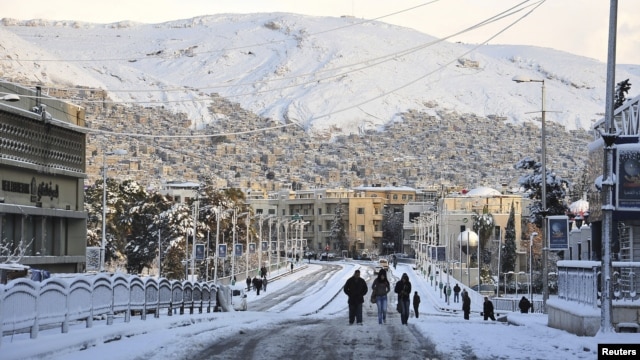
Image:  Snow in Damascus, January 2013

Wednesday, January 16, 2013

Conflict between Islamist movements

Translation provided by Arabist.net:
War against the Muslim Brotherhood Divides the Gulf
Abdel Bari Atwan, al-Quds al-Arabi,
11 January 2013
 Whoever has been following the media in the Gulf – and the Saudi media in particular – has probably gotten a sense of the fierce campaign being waged against the Muslim Brotherhood and Islamist currents more broadly, as well as the major preachers in the Gulf. Their influence has been on the rise recently thanks to social media such as Facebook and Twitter, and yet the dedicated security apparatuses of the various countries in the region have had a harder time controlling and blocking these outlets than they did with newspapers and websites. Dubai’s chief of police Lieut. Gen. Dahi Khalfan Tamim pioneered this campaign against the Muslim Brotherhood and was one of the first to issue vehement warnings about the danger they represented, but many articles appearing in the Saudi and Emirati press have begun to follow in his wake. This is happening in such a way as to suggest that there are bodies high up in the state that would like to open up a front against them, whether in Egypt – where they are sitting at the threshold of power – or within the Gulf itself.
 This war against the Brotherhood, and perhaps later upon the Salafi currents, represents a break with the historical alliance that has existed between conservative Gulf regimes and these figures. This alliance ensured the stability of these regimes and helped combat all the leftist and nationalist ideas that constituted a threat to this stability in the eyes of the rulers. The question that is now on everyone’s mind is why has there been a sudden reversal of opinion in the Gulf against the Muslim Brotherhood ideology, when this ideology was embraced and supported over the past 80 years. In the aim of helping control Gulf youth, Muslim Brotherhood intellectuals and professors were even allowed take over the education sector, set curricula, and establish proselytizing and charitable associations, not just within Gulf countries but throughout the entire world.
 How did this relationship of warm, strategic friendship morph into a bitter fight – at least on one side, for now — between the ruling regimes in the Gulf and the Muslim Brotherhood? The response to these questions can be summed up in the following points:

  • Governments in the Gulf have realized that the Muslim Brotherhood is a “global” movement governed by an international organization. This means that the loyalty of the organization is to the Supreme Guide in Egypt, and not to local authorities, not even to the head of the group in these countries.
  • The Islamist Muslim Brotherhood has taken control of the process of forming the next generations by setting local curricula. This has led it to dominate the armies and security services, which has left it more prepared than ever to overthrow the ruling regimes and seize power. This is the main fear of the Gulf regimes
  • With the liberal and leftist currents in Gulf countries weakened by decades of repression and persecution, the organized Islamist currents have become the leading candidates to launch Arab Spring revolutions for change in the countries of the Gulf.
  • Religious and Brotherhood currents in particular enjoy a financial independence that sets them apart from the other currents, due to their intricate organizational networks and the fact that their backers possess considerable financial resources due to their control of large companies and financial institutions in Gulf countries especially. This has allowed them to combine political and economic power.
  • Islamist movements enjoy significant support in popular milieus because their ideology centers on the Islamic faith. Their control over mosques — whether directly or indirectly — translates into five miniature daily meetings and one large weekly meeting every Friday.
  • Non-jihadist Islamist movements – and the Muslim Brotherhood in particular – practice self-control and avoid any collision with the state. This explains the Brotherhood’s silence in Egypt concerning the attacks in which it has been targeted. It has kept calm and sent delegations to the Emirates to solve the arrests crisis through diplomatic means.It was no surprise that Saudi writers accused the Muslim Brotherhood of employing the "principle of taqiyya”[1] among its organizational practices.

    Gulf countries – to put it briefly – are worried about the MB’s control of Egypt, Tunisia and Sudan, and its attempts to gain power in Jordan, Yemen and Syria. This would leave the countries of the Gulf surrounded on all sides, and at risk of falling into the new orbit of the Muslim Brotherhood, in a sort of political “domino” effect.
More here.

Tuesday, December 11, 2012

Friday, October 26, 2012

Don't blame the Arab Spring

From that radical organization, RAND:

The current unrest in Syria, and elsewhere in the Middle East, is mistakenly being blamed on the Arab Spring. Even before the recent violence, many observers were quick to declare that spring had rapidly turned to winter in the Arab world. Here at home, and just before the presidential debate on foreign policy tonight, a Pew Research Center poll showed that Americans are increasingly skeptical that the Arab Spring will lead to lasting change. The survey, released last week, found that 57% of Americans (up from 43% in April 2011) do not believe that the uprisings will improve the lives of people in those countries.
 But the roots of the unrest are not in the desire to cast off authoritarian regimes that took expression in Arab Spring protests. The roots came before the uprisings, and progress will take longer than we wish.
 Weak and corrupt government institutions, underdeveloped civil society, a lack of means and habits of peaceful expression, repressed resentments, and the absence of free news media are all legacies of the previous regimes, and still characterize those countries where governments remain authoritarian.
 Blame the autocrats, not the Arab Spring.
 What's the implication for U.S. foreign policy of hand-wringing over whether the Arab Spring was a good thing after all? That the U.S. should have worked to suppress the uprisings? Opposing the possibility of democracy — in the face of overwhelming popular support — would have further eroded U.S. influence in the region. The Arab Spring has discredited the idea that the secular authoritarian regimes were fundamentally stable; the turbulent dynamics we now see in play were their creations.
 Disparagement of the Arab Spring has been accompanied by criticism in some quarters of the Obama administration's support for it and in others of the administration's failure to ensure greater progress toward democracy. Some have suggested that unrest in the region is a consequence of U.S. support for political change.

These critics wrongly suggest the U.S. has much more leverage to create democracies than is realistic. Even where U.S. leverage was not compromised by a history of propping up or tolerating dictators, our country's ability to affect the course of post-authoritarian transitions was generally at the margins. Internal forces drive political transitions, not outside ones.
Read the whole thing.

Wednesday, October 24, 2012

Pessimism day, 1: The Arab Middle East

At Arabist.net, a link to and an evaluation  of  a melodramatic piece on  the outcome of the "Arab Spring:"

✚ This Is Not a Revolution by Hussein Agha and Robert Malley | The New York Review of Books
Another almost melodramatically lucid-pessimistic view of the Arab uprisings and their consequences by Hussein Agha and Robert Malley. Much of the phenomena they describe is accurate, but what they object to is history in motion, which they see as more of loop. This is too depressed-romantic a view. There are terrible debts to be paid for the way power was organized in the Arab world over the last 60 years, they will be paid in blood. Let's get on with paying them, and not cry over spilt milk. But the idea that a restoration of the Ottoman model (in terms of a MB caliphate, not Turkish domination) is happening I find dubious.
I liked this bit:
The Islamists propose a bargain. In exchange for economic aid and political support, they will not threaten what they believe are core Western interests: regional stability, Israel, the fight against terror, energy flow. No danger to Western security. No commercial war. The showdown with the Jewish state can wait. The focus will be on the slow, steady shaping of Islamic societies. The US and Europe may voice concern, even indignation at such a domestic makeover. But they’ll get over it. Just as they got over the austere fundamentalism of Saudi Arabia. Bartering—as in, we’ll take care of your needs, let us take care of ours—Islamists feel, will do the trick. Looking at history, who can blame them?
Mubarak was toppled in part because he was viewed as excessively subservient to the West, yet the Islamists who succeed him might offer the West a sweeter because more sustainable deal. They think they can get away with what he could not. Stripped of his nationalist mantle, Mubarak had little to fall back on; he was a naked autocrat. The Muslim Brothers by comparison have a much broader program—moral, social, cultural. Islamists feel they can still follow their convictions, even if they are not faithfully anti-Western. They can moderate, dilute, defer.