Showing posts with label tournaments and jousts. Show all posts

Thursday, November 20, 2025

An excellent review by Ken Mondschein of Pas d’armes and Late Medieval Chivalry: A Casebook.

If you have a general interest in the Middle Ages, you might want to subscribe to the Medieval Review. It is free and includes reviews on all sorts of scholarly subjcts. There are limitations. It is likely that most of the reviews you get will be of limited interest to you (I am not very interested in monographs on theologians and philosophers). The most important reviews of high profile books seem to appear in long-established journals -- but they are not free. The Medieval Review, however, will often provide you with information you didn't know you were interested in.

I am including an excellent review by Ken Mondschein of a book that I and some of my regular readers wll be interested in. I point out that it is reasonably priced! Hooray for the Liverpool University Press

In fact if you look around you'll find an open access version of the book!

The Mondchein review:

Brown-Grant, Rosalind, and Mario Damen, eds. Pas d’armes and Late Medieval Chivalry: A Casebook

Reviewed by Ken Mondschein Massachusetts Historical Swordsmanship ken@kenmondschein.com

Recent writings by Steven Muhlberger and others, as well as public history such as the Met’s 2019 exhibit about Maximillian I, have shown the late medieval tournament is a fertile field for studying elite alliances, politicking, and self-fashioning. Within the tournament, we can find worlds, much as one day historians will no doubt pick apart our own day’s professional sports. The difference is that in the late Middle Ages and early modern period, the ruling class was also the athletic class, making their sports and games of key interest. As the title makes clear, this is a casebook, but it is also the first work, save for a chapter in Barber and Barker’s oft-cited 1989 Tournaments, Jousts, Chivalry, and Pageants in the Late Middle Ages, specifically on this form of tournament. As such, it is a valuable addition to the literature.

The present volume is a study of pas d’armes, a form of late-medieval tournament that originated in Spain in the early fifteenth century. The pas featured a “home team” defending a locale, such as a pillar or stone (a perron), against all comers. Despite its theatrical trappings and rich symbolism, this was still a dangerous affair, and fatalities were not unknown, particularly in the earlier and less-regulated pas. From its birthplace in Iberia, this tournament form spread to France and, especially, Burgundy, where it both took on elements of state theatre and was made safer by being brought firmly under the control of rulers.

The first part of the book presents primary sources detailing fifteen pas spanning approximately 80 years, from 1428 to 1507, as well as one literary antecedent, the Romance of Ponthus and Sidoine. Interestingly for one interested in the study of medievalism, the literary exemplar shows more parallels with modern medieval combat-sport aesthetics--mighty men bashing each other with weighty swords to the point of exhaustion, yet forbidding the thrust--whereas the real-world accounts are both more vaguely described and also more contained--for instance, the pollaxe fight between Jacques de Lalaing and Pierre de Chandio in 1449 is limited to seventeen blows--and do use thrusts.

The primary sources regarding the fifteen pas d’armes, ranging from poetry to financial accounts, similarly have much to offer the reenactor, as well as the historian. Clothing, armor, and horse trappings are meticulously described. The particular forms, rules, and conditions to govern the emprise--in other words, the social structures meant to regulate and contain violence--are also specified, as are the richly symbolic and meaningful theatric trappings and heraldry.

The second part of the book contains some very interesting interpretive essays. Thalia Brero, Mario Damen, and Klaus Oschema detail how the pas d’armes changed over time from its fifteenth-century origins into the nascent state system of the sixteenth century. Anne D. Hedeman and Justin Strugeon look at heraldry and symbolism in the Pas de Samur. Mario Damen and Michelle Szkilnik examine the political and Arthurian literary environment of the 1463 Pas du Perron Fée in held in Bruges. Mariana Viallon discusses the later legacy of the roleplaying from the 1493 Pas des armes de Sandricourt. Alan V. Murray considers the spread of the pas d’armes to early sixteenth century Scotland with the Wild Knight of the Black Lady (as well as the possible racial overtones of the “Black Lady’s” identity). In the sixth and last essay, Rosalind Brown-Grant continues Ruth Mazo Karras’s work in From Boys to Men to extend the notion of the performance of elite masculinity from mere domination to display and conspicuous consumption. Finally, arms and armor expert Ralph Moffat contributes an excellent glossary.

Overall, this is an excellent book, and a much-needed and much-welcomed study of a previously neglected subject.

Wednesday, June 29, 2022

Two books on Charny!

Wilson, Ian; Nigel Bryant, ed. and trans. The Book of Geoffroi de Charny with the Livre Charny. (Woodbridge, UK: Boydell Press, 2021). Reviewed by Steven Muhlberger Nipissing University (retired) Steve.muhlberger@gmail.com

Over the last two generations there has been a boom in the publication of medieval biographies and memoirs of knights and treatises on chivalry written by knights. These works, which have lurked for centuries in their original languages in archives and exclusive libraries, are increasingly being made available in translation. Chivalry, a classic topic in the study of the Middle Age is (again) a hot topic for scholars, and scholars of chivalry are glad to have more accessible versions of these difficult texts. They preserve memoirs (some mildly or extensively fictionalized) or didactic treatises which provide rare insights into the values of active knights.

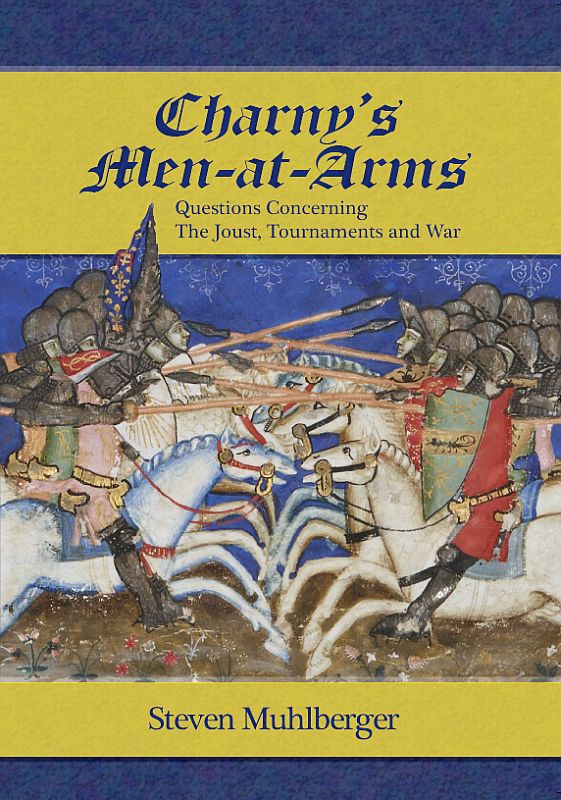
Foremost among these author-knights is the now- famous Geoffroi de Charny, a prominent French knight of the mid-14th century who died at the battle of Poitiers (1356), while defending the Oriflamme and King Jean II. Geoffroi de Charny has long been credited with the authorship of three works on chivalry. The verse Livre Charny (which I call “Charny’s Book”) is an account of the difficulties of adopting and following the ‘Profession of Arms.’ The well-known translator Nigel Bryant has provided both an edition and an English translation of Livre Charny (pp.-53-128). The Demandes -- Questions Concerning the Joust, Tournaments and War -- are a collection of mostly legal case studies which were meant to illustrate problems of the law of arms. A third book is The Book of Chivalry of Geoffroi de Charny a prose treatment which overlaps material in Charny’s Book.

Between the three books we are given some of the most serious thoughts of one of France’s foremost knights of the 14th century.

Charny was a member of the lesser gentry (and a third son at that); nevertheless he rose through the ranks. Early in his career he depended on patrons to provide him with the large sums of money necessary to replace lost equipment and, twice, to pay very large ransoms. But some people seem to have thought him worth it. His appointments to military office speak to how he was rated as a practical man-at-arms. Charny’s rank and his personal influence did not entitle him to any largely patronage-motivated appointments. We can imagine that he had a big and fierce personality much appreciated by his military colleagues. Further, Charny’s success as a diplomat and a royal counselor shows that he had flexibility and charm as well.

In the last years of his life Charny was close to King Jean; both men were concerned with the apparent decline of chivalry in France and they worked together toward fixing it. The king founded a chivalric order, the Order of the Star; Charny was commissioned (6 Jan 1351) to compile the Demandes so that the Order could answer the questions and agree on the standards that should establish chivalry. Charny’s Book must have been finished at least by 14 Aug 1352, when French warriors, many members of the Order of the Star among them, were defeated by the English at Mauron. These men of high rank were slaughtered because they held to the “no retreat” doctrine of King Jean and Charny. The loss of so many knights of the Star took the air out of the king’s project but did not divide the two men; Charny remained the bearer of the Oriflamme until he was killed at Poitiers in 1356.

Perhaps Wilson’s most important goal is offering a “revised understanding” of Charny based on a wider collection of manuscripts which preserve information about Charny’s military career and the chronology of his writings. The relevant manuscripts, regarded by Wilson as “ understudied” are the “Oxford” manuscript (Holkham ms. 43, at the Bodleian) and the “Madrid” manuscript (Biblioteca Nacional de España ms. 9270) . Using these and better-known Brussels, Paris and Swiss manuscripts, Wilson builds an “alternative understanding” of Charny’s career and writing. It is interesting to see how illustrations made The Book of Geoffroi de Charny a heftier text, one of which probably involved Charny working with a prestigious illustrator, Jean le Noir. Wilson shows that the works of Charny constituted a substantial codicological project that caught a moment at the French royal court.

Wilson’s revised understanding includes a rejection of the existing scholarly consensus that the prose Book of Chivalry of was written by the knight we have been discussing, the same author of Charny’s Book and the Demandes, who died at Poitiers. Rather, Wilson contends that the Book of Chivalry of Geoffroi de Charny was written at a later date by another man of the same name, the first Charny’s nephew, who had reason to revive his uncle’s tradition as a pious and determined knight. The Book of Chivalry was an elaborated presentation of ideas first presented in Charny’s Book. Whether Wilson’s reconstruction of the relationship between the two “books” is ultimately accepted will depend on hard work and luck. The evidence is difficult and limited in scope. I found the detailed and careful work done by Wilson impressive but not conclusive.

But this book has more to offer than the complex puzzle surrounding the three works attributed to Charny. What can be said about the excellent translation except that it is excellent? Bryant’s contribution may well attract readers with diverse interests, and give them a lively text with which to examine the concept and practice of chivalry

Later: I have been re-reading Charny and some of the scholarship about him, and I have come to the conclusion that Charny terrified his contempories.

Monday, December 11, 2017

3000, more or less -- and a new book


Blogger tells me that the previous post is number 3000.  That's not quite accurate.  I started blogging on a different platform, and I was very active on the blog back in the pre-twitter days.  Also the 3000 posts that Blogger counts includes drafts saved by the blog.

Still, it seems that a celebratory note is appropriate.  ESPECIALLY since yesterday I started another a new book, an English translation of Le Tournoi de Chauvency.  Le Tournoi is a verse account written in 1285 of a tournament in the north of France.  The poem seems to be a lighthearted celebration of the "noble, beautiful and good people" who took part, either as participants or as audience.  It's one of the few tournament accounts about real people.  Most such descriptions are about tournaments in Arthur's court or at least in Arthur's time.

So have a festive breakfast! I will say more about Chauvency soon.


Tuesday, November 21, 2017

, A Burgundian Death. The tournament in Le Chevalier Délibéré

I have just discovered that the Academia.edu site has a number of publications about the medieval tournament.
For instance, A Burgundian Death. The tournament in Le Chevalier Délibéré
Still slogging away at the Good Duke.

Friday, January 06, 2017

Another review of my book, Deeds of Arms

I just ran across this review on the website of Academie Duello in Vancouver.
Book Review: “Deeds of Arms” by S. Muhlberger

Wes von Papineäu JUNE 19, 2015

CATEGORIES: ADULT SWORDPLAY, PROGRAMS, SWORD NEWS

TAGS: BOOK REVIEW DEEDS OF ARMS HUNDRED YEARS' WAR JOUSTING MEDIEVAL MUHLBERGER

“They are stories about stories.” [1]

It does my heart good when I hear competent people say that they’ve recreated the essence of some medieval martial art event to the best of their ability, because they followed the descriptions of medieval combat “exactly” from period texts.

It’s a good … start.

But what if the reference book is not completely correct about the event it describes? What if the author had written a version of the event he witnessed that was “flavoured” by a political or social leaning? What if he wrote of an event based on his interview of someone who had (allegedly) witnessed the event? And even if the author penned a totally neutral recollection of an event, did he truly understand the nuances of the combat that he was witnessing? (Think of when you as sword scholars see swordplay on television, and your “recollection” of what went on compared to that of your swordless peers).

This is the conundrum that the eminently qualified and respected medieval historian Muhlberger brings to our attention in well-documented and easy-to-read detail.

A Broad Overview

In the first half of the book, Muhlberger focusses on the period of the Hundred Years’ War following the battles of Crécy and Poitiers (1350-1400). Using period recollections of “deeds of arms” (conflicts fought by prearrangement and within agreed upon limits), Muhlberger explains how tales of combat came to be so important for 14th century French literature … and for the medieval man-at-arms’ “sense of self”. [2] More importantly for us, he goes on to describe just how period writings concerning these events were influenced by a great variety of political, social or personal influences on the writers during this period. (Apparently, even back then, authors expected to be paid for their original work. Who knew?) With the aid of this information, Muhlberger guides us to a more careful consideration of how we interpret what really happened in any particular mêlée within the context of medieval politics and culture.

This is not a “fight book”, and it is not a history of historical duels; but it is a description of how period authors wrote about “deeds of arms”, and why the styles they used were fashionable.

The book is divided into sequentially supporting chapters, each of which I found could stand alone as independent studies in their own right.

Chapter-by-Chapter

First we learn of the risks undertaken by men-at-arms when one actually engages in physical combat, both in duels and war. (We do get a nod to select fight books here.) [3] The reader is introduced to the concept of “formal duels”, and extant variations on the theme.

Next, Muhlberger gets into the meat of his proposal with his examination of writings featuring the combat of “Thirty against Thirty” in 1351, examining in detail the confusion and discrepancies in recollection caused by passing time and the use of second hand accounts — and how sometimes the story of an event became more important that the actual event.

The chapter entitled “Will a Frenchman fight?” is most illuminating, demonstrating unequivocally that while the French Royal Army of 1380 was not famous for seeking battle, there were lots of French men-at-arms throughout the land ready to remind Englishmen that (to paraphrase a great film) “[their] mothers were hamsters and [their] fathers smelt of elderberries” … and were willing to back that challenge with one-on-one cold steel.

“Deeds of and Careers in Arms” describes how our protagonists built wealth and reputations during deeds of arms, and how the chroniclers of those deeds became our first “spin doctors”, worthy of employment in any modern PR company.

To finish, we are presented with period impressions of the four royal jousts conducted between the years of 1389 and 1390 during the “good peace” … though the intensity of combat during one tournament appeared to be equal to the combat seen in any war.

In Conclusion

A reading of Deeds of Arms would serve well anyone trying to recreate historical events in modern times. Any historical reference that a modern scholar may wish to use as “canon” is apt to be slanted in its representation of any past event — even if written with the very best of “neutral” intent and desire for accuracy. Read the old manuscripts, yes. But remember that when we are looking for guidance on how things happened in medieval times, a manuscript only tells us of one person’s recollection of “historical truth” and that any manuscript — regardless of its detail and “accuracy” — must be interpreted as part of a greater regional and situational historical record.

Read. Consider. Validate.

Sources

1. Muhlberger, Steven. Deeds of Arms – Formal Combats in the Late Fourteeth Century. (Highland Village Texas: Chivalry Bookshelf, 2005) 4.

2. Muhlberger. Deeds of Arms. 3.

3. Muhlberger. Deeds of Arms. 23.

Friday, December 02, 2016

Death by overexertion, an English duel of 1380


Some of you probably know that I am writing a source reader -- a book that combines medieval documents with modern commentary -- on the subject of judicial duels.  These were considered to be the most dramatic "deeds of arms" by contemporaries and modern re-enactors are very interested in them.  My book in fact was inspired by Will McLean's collection of sources in his blog, and he will be credited as co-author.

This book includes an account of an English duel between as squire,Thomas Katrington, and Sir John de Annesley.  Annesley, the knight accused Katrington, who had commanded a castle in France, of treason, because, said Annesley, he had surrendered it to the French when he had the resources to defend it.  After a certain amount of political back and forth among major players, including Duke John of Gaunt, a duel was arranged.  There was so much public interest that the crowds who attended were said to exceed those at the recent coronation of Richard II.

An interesting point is the way the duel ended.  It was said to be half an hour long, and very strenuous, with the weapons of either man being destroyed so that (I think) they  were fighting on foot with daggers.  They ended up both lying on the ground with Katrington on top.  The question then arose, what next?
Soon after [Annesley, the knight] was raised up, without any support he eagerly went to the king, while the squire [Katrington]who had been raised, was not able to stand nor go anywhere without the support of two men; and therefore, he was put upon a chair,  and he remained there quietly. The knight therefore came to the king and asked him, and his nobles, that he would grant him the grace, he should be put in the same place as before, with the squire on top of him... he realized that the squire was nearly at his last breath from the excess of [labor] and heat, and the weight of arms which had almost taken the vital spirits from him.
 In the meantime the squire, lacking breath, suddenly  fell off the chair, as if dead, among those who stood around him. Many therefore took care of him, pouring wine and water over the man; but nothing helped at all, until his arms and all of his clothing were removed . This being done  it proved that the knight was the victor and the squire defeated. After a long delay, however, the squire's spirit began to revive, and opening  his eyes he began to raise his head, and terribly began to look at all of those standing around ; when this was announced to the armored knight, (for the knight had not taken off his armor from the beginning of the fight) he approached the squire and called him a false traitor, and asked if he dared to repeat the duel. Since [Katrington] indeed had neither sense nor breath to answer, it was announced that the fight was over and that each should return to his own place. The squire therefore was soon carried to his bed, and he began to rave; and persisting  in his madness, the next day, about the ninth hour, he breathed forth his spirit. 
Interesting that an experienced warrior could end up dying of overexertion caused by among other things the weight of his armor.

In addition, a short piece from Froissart (book III, chapter 7; also late 14th century):


A squire of Navarre was there slain, called Ferdinand de Miranda, an expert man at arms. Some who were present say the bourg d'Espaign killed him, others that he was stifled through the heat of his armour. 

Monday, May 23, 2016

Reviews of Royal Jousts and the Combat of the Thirty (De Re Militari)

Muhlberger, Royal Jousts at the End of the Fourteenth Century & The Combat of the Thirty (Sposato) De Re Militari
MAY 23, 2016
Royal Jousts at the End of the Fourteenth Century, Deeds of Arms series 1
The Combat of the Thirty, Deeds of Arms series 2
ed. and trans. by Steven Muhlberger
(Freelance Academy Press, 2012) i- viii, 88 pp., $24.95; ii- viii, 83 pp., $24.95
Over the past fifteen years Steven Muhlberger has established himself as one of the leading authorities on medieval chivalry. His scholarly oeuvre has not only made an important contribution to the larger field, but in many ways has blazed a new trail through his focus on case-studies of particular events, individuals, and texts. [1] The two works reviewed herein, Royal Jousts at the End of the Fourteenth Century and The Combat of the Thirty, fit this mold and are part of a series on formal deeds of arms (faits d’armes) published by Freelance Academy Press, one that has already received the approbation of scholars. [2] These two volumes, and the series as a whole, will be especially attractive to scholar-teachers who can use them to great effect in the classroom, while also offering a useful introduction for graduate students and researchers who wish to study for the first time formal deeds of arms and their important role in the chivalric culture of late medieval Europe.
In the first volume in the series, Royal Jousts, Muhlberger examines four historical jousts held in 1389-1390. Three of the jousts were organized by the French and one by the English: the Joust at St. Denis (May 1389), the Joust accompanying Queen Isabella of Bavaria’s entry into Paris (August 1389), the Joust at St. Inglevert (March-April 1390), and the Joust at Smithfield near London (October 1390). These jousts were meant to celebrate both armes (arms, i.e., prowess, bravery, valor, etc.) and amour (love). In addition, they served the propagandistic purposes of two young kings, Charles VI of France and Richard II of England, who sought to both secure a lasting peace between their kingdoms after decades of war and to encourage and reward the chivalric energy and violence of their knights and men-at-arms. These two seemingly contradictory impulses could be reconciled in such formal combats.
The first part of Royal Jousts consists of an introduction and succinct historical study of the jousts. Muhlberger aptly sets the stage for each and duly notes their larger implications. Indeed, Muhlberger usefully points out that formal deeds of arms, including jousts, “were taken extremely seriously [by contemporaries:] they were war, diplomacy, or domestic politics in a different form”, suggesting that they were far more than simply a means to satisfy the romantic fancy of a small segment of late medieval society. (12) Muhlberger also includes a critical, albeit concise, discussion of the relatively limited available sources, emphasizing caution in their use: “we should not[…] mistake interest and enthusiasm for diligent, accurate reportage”. (3) The limitations of these sources are all the more important because the accounts of these jousts, especially the joust at St. Inglevert, have generally been utilized by scholars to “stand[…] in for every unrecorded jousting match of the later Middle Ages”. (6) Muhlberger’s English translations of the various texts that discuss each of the four jousts and an appendix, which attempts to score the 137 courses run by the French champions at St. Inglevert, complete the volume.
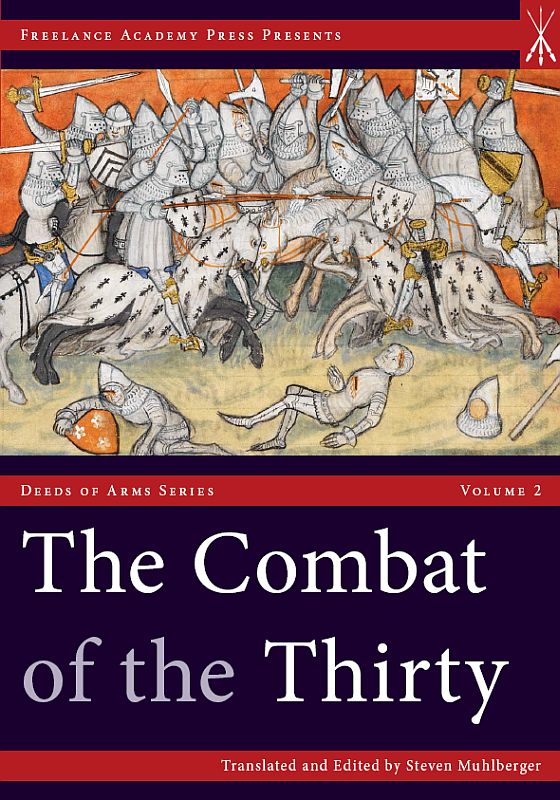
In the second volume, The Combat of the Thirty, Muhlberger examines a different kind of formal deeds of arms, a pre-arranged battle between two groups of strenuous warriors. In this particular battle, generally known as the Combat of the Thirty, two groups of thirty men fought in an open field in Brittany on March 27, 1351. Each group represented one of the garrisons of two nearby castles (Josselin and Ploermel) and the battle was apparently occasioned by the promise of the captain of one of the sides that “we will go to an open field and there we will fight as long as we can endure it”. (1) The Combat of the Thirty was in many ways a decidedly local (i.e., Breton) affair, while at the same time serving as a microcosm of the larger conflict between the French and English during the Hundred Years War, although it was not officially sanctioned by the leadership on either side. Indeed, the Combat of the Thirty divided opinion among contemporaries, while at the same time acquiring a lasting (and contested) legacy that has continued to the present.
The Combat of the Thirty is organized in a fashion similar to Royal Jousts. The first part consists of a brief, but illuminating historical introduction to the Combat of the Thirty and its place in both the history of the Hundred Years War and of Brittany as a region. Muhlberger also attempts to answer several sensible questions: “Why did sixty men risk themselves in a fight to the finish on that spring day in Brittany six and a half centuries ago? Why did it attract attention and praise in its time? Why does it interest us still?”. (2) His answers shed light on some of the nuances of chivalric culture in the mid-fourteenth century and the important role formal deeds of arms played in it. The introduction also includes a useful discussion of the extant and often conflicting sources that treat the Combat of the Thirty. The second part of the volume contains Muhlberger’s translations of these texts. Finally, the volume also contains two appendices. In the first, Muhlberger reconstructs, as much as is possible, a list of the combatants on both sides, as well as their heraldic devices. Historians of the Hundred Years War will no doubt recognize several of the participants, especially Robert Knolles, Hugh Calveley (Calverley), Jean de Beaumanoir, and Yves (Yvain) Charruel. The second appendix, composed by Douglas Strong, offers a short analysis of the armor of the English and Breton combatants.
In summary, Royal Jousts and The Combat of the Thirty will offer researchers, scholar-teachers, and students alike a stimulating and enlightening introduction to two different kinds of formal deeds of arms: jousts and a pre-arranged battle between two groups of chosen combatants. Muhlberger’s historical introductions and analysis in both volumes are succinct and informative. Likewise, the translations in both works are approachable and accurate. These translations will prove especially useful in the classroom, not least because they will allow students to compare different accounts of the same events. They will also serve as an entry point for those interested in investigating these formal deeds of arms in greater detail, even if specialists and non-specialists alike will lament the lack of footnotes and more expansive analysis. These very minor points, however, take nothing away from the overall quality of the volumes. Finally, this reviewer would be remiss to not give credit to both the author and the publisher for producing two books that are beautifully illustrated and, more importantly, eminently affordable.
Peter W. Sposato
Indiana University Kokomo
psposato@iuk.edu
Footnotes:
[1] Prominent among Muhlberger’s other publications on chivalry are: Jousts and Tournaments: Charny and the Rules for Chivalric Sport in Fourteenth-Century France (Chivalry Bookshelf, 2002); Deeds of Arms: Formal Combats in the Late Fourteenth Century (Chivalry Bookshelf, 2005); and Charny’s Men-at-Arms: Questions Concerning the Joust, Tournaments, and War (Freelance Academy Press, 2014).
[2] The series includes: Noel Fallows, The Twelve of England, Deeds of Arms 3 (Freelance Academy Press, 2013) and Steven Muhlberger, Will a Frenchman Fight, Deeds of Arms 4 (Freelance Academy Press, 2015). For the positive reception of The Twelve of England, see the review by Dr. Samuel Claussen on the De Re Militari website- http://deremilitari.org/2016/04/noel-fallows-the-twelve-of-england-claussen/.

Friday, April 24, 2015

Antoine de la Sale, Jean de Saintré. My review of a new translation

From The Medieval Review

De la Sale, Antoine. Jean de Saintré: A Late Medieval Education in Love and Chivalry. Trans. Roberta L. Krueger and Jane H. M. Taylor. Philadelphia: University of Pennsylvania Press, 2014. Pp. 264. $59.95. ISBN: 978-0-8122-4586-8.

Reviewed by Steven Muhlberger

Nipissing University

stevem@nipissingu.ca

Translations are sometimes seen as a lesser form of scholarly endeavor. This is to my mind quite unfair. Medievalists should be among the first to acknowledge that we all bump up against our linguistic limitations and have to turn to translations for help. Translations allow us medievalists to decide, after mastering four or five languages, whether material in a sixth is going to be relevant to our research question. Of course without translations we would have no way of introducing our students to the evidence on which we build our historical reconstructions. The best translations are running commentaries on some historical subject, which provide far more than a literal representation of the original text. The best translators are expert guides to whole past cultures. Finally, translators are literary artists who (in perhaps their most contentious role) create a modern analog of a premodern aesthetic experience.

Jean de Saintré (1456) has long attracted the attention of scholars and ordinary readers. It survives in ten manuscripts and numerous printed editions starting in 1517. Indeed there have been two previous English translations, the most recent being from 1965. Non-specialist readers have been attracted by Jean de Saintré as a portrayal of the chivalric, courtly culture of the fifteenth century--what has been called an early historical novel. Scholars have found and continue to find the book as capturing an important moment in French literary history. Roberta L. Krueger and Jane H. M. Taylor have given this text a new and approachable form.

Jean de Saintré draws much of its value from the fact that it portrays chivalric and courtly culture from the inside. Its author, Antoine de la Sale, is himself a fascinating subject for scholarly investigation. The son of a Gascon mercenary, La Sale spent most of his long life as a courtier in the retinues of the houses of Anjou and Luxemburg, working most of that time as a preceptor or tutor for various young princes. His duties provided him with motivation to write. His three major works, of which Jean de Saintré is one, have a strong pedagogical component, combining moral instruction with discussion of chivalric customs and courtly manners and lighthearted storytelling.

La Sale combined these various elements into Jean de Saintré, which has been called the first historical novel. The eponymous hero was a real warrior of the fourteenth century but little of his actual career found itself into La Sale's book. Jean de Saintré the character is a young nobleman who over the course of the book advances from being a bashful and uncultivated youngster to being a perfect knight, expert in chivalric competition, courtly intercourse, and war. He owes his transformation to the patronage of an older woman, a rich widow whom the author calls the lady of Belles Cousines. This lady spots young Jean in court one day and decides to take him in hand. After teasing him unmercifully about his ignorance of love and his lack of a lover, she begins to train him up to be a knightly figure who attains such courtly grace that by his mid-teens he is wildly popular with all and sundry. Even kings feel privileged to associate with him.

His relationship with the lady of Belles Cousines is more complicated. To judge by her rather cool public interaction with Jean, her fellow courtiers might easily conclude that she of all the ladies is the least impressed with him. While others are full of praise for the wonderboy she has hardly a good word to say to or about him. But she meets him in secret to share pleasure and delight; and perhaps more importantly, she lavishly dresses and equips him and funds his training in chivalric combat. Parts of the book reads like a catalogue of luxuries that most nonfictional noblemen of La Sale's time could hardly hope to obtain. For the modern reader, these passages give an idea of the attractions of the royal court--clothing, weapons, horses as well as good company and good food. Not that this can be taken as reportage. Jean lives a dream-like existence and enjoys the best of everything and the approval of all the best people.

Young Jean, with the encouragement of his lady, matures into an impressive warrior. Much of the book is devoted to describing Jean's tremendous success in the lists and on the battlefield. This is the ultimate test of Jean's worth as a man and of the quality of the secret and intense love affair he enjoys. The lady of Belles Cousines is his silent partner, imperiously telling him when and whom he will fight, praying and weeping for him when he goes out to do her will.

Eventually, however, the partnership breaks down when after many years Jean arranges a deed of arms without consulting the lady. She takes tremendous offense at this and without a word of explanation withdraws to the country where she begins an affair with a rich abbot. The book ends with Jean following her to her rural retreat, where he finds out how the land lies. Unsurprisingly, the two lovers of the lady come to blows and Jean defeats the abbot, though not without difficulty. His revenge on the lady is more subtle; he traps her into betraying herself before the entire court as an unworthy lover.

Roberta L. Krueger and Jane H. M. Taylor have created in Jean de Saintré a work that has many valuable characteristics. First, the translation makes available a rich source for those interested in the culture of chivalry in the later Middle Ages. For me, the depiction of the role of the lady in the education and success of an aspiring knight was particularly interesting, a theme that gave me new material to think about, and one that might well be very useful in a number of different teaching situations.

Second, the translators' apparatus is effectively mustered. The introduction briefly and clearly covers the essential information; it should be understandable and accessible to all potential readers. There is a valuable glossary, and a good discussion of some of the choices the translators made, e.g. their very sensible decision not to translate heraldic terminology.

Third, the style of the translators is neither obviously modern nor obnoxiously archaic. They have not, in other words, produced a new set of barriers that readers must jump over.

Fourth, unlike some earlier translations, the entire text is translated, including two long catalogues, one of the heraldry borne by important families of France, another of families that supposedly accompanied Saintré to Prussia on crusade. These catalogues and other long passages devoted to description of the court, luxurious gifts exchanged between important courtiers, and blow-by-blow coverage of Saintré's deeds of arms, could be and sometimes have been abridged in earlier versions of the book; the result being, however, that what La Sale and his fifteenth-century readers thought was edifying and enjoyable is obscured.

It is too bad that the publishers have decided to charge the same price for the e-book as they do for the hardback. For years I have taught a seminar on the history of chivalry and this book is an obvious candidate for the reading list. At its current price, however, I would probably pass it by the next time I teach it.

Wednesday, March 11, 2015

A twelfth-century description of a judicial duel on horseback

A new site dedicated to the "Song of My Cid" -- the famous Spanish epic -- includes this interesting account of the judicial duel between three of the Carrion clan whose "enfantes" mistreated the Cid's daughters and three of the Cid's chief vassals. Note that the bad guys are unwilling to face the famously sharp swords wielded by the good guys, and bail out by running out of the boundaries. I can't help thinking that structurally this combat may have been like a tournament. Get up and go out to the field, infantes of Carrión,

it is time for you to fight like men,

the Campeador's men will not fail in anything.

If you come off he field well, you will have great honor,

if you are defeated, don't blame us,

for everyone knows that you went looking for it.-

Now the infantes of Carrión are repenting,

for what they did they are filled with regret,

they wouldn't have done it for all there is in Carrión.

All three of the Campeador's men are armed,

King don Alfonso went over to see them,

the Campeador's men said,

-We kiss your hands as king and lord,

that you be field judge for them and for us,

help us fairly, allow no wrongs.

Here the infantes of Carrión have their band,

we know not what they will plan or what they won't,

in your hand our lord placed us,

protect our rights, for the love of the Creator.-

At that moment the king said, -With all my heart and soul.-

They bring them their horses, good ones and swift,

they blessed the saddles and mount confidently,

the shields that are well reinforced at their necks,

in their hands they take the shafts of the sharp lances,

these three lances have their own pennons,

and around them many fine men.

They now went out to the field where the markers were.

All three of the Campeador's men are in agreement

that each one of them should strike his adversary hard.

Behold at the other end the infantes of Carrión,

very well accompanied, for there are many relatives.

The king gave them judges to tell them what's right and what isn't,

that they not dispute with them about who is or isn't right.

When they were in the field King don Alfonso spoke,

-Hear what I say to you, infantes of Carrión,

this combat you might have had in Toledo, but you refused.

These three knights of my Cid the Campeador

I brought them safely to the lands of Carrión,

be in the right, don't commit any wrongs,

for whoever wishes to commit a wrong, I will severely prohibit it,

in all my kingdom he will not be welcome.-

Now it begins to grieve the infantes of Carrión.

The judges and the king point out the markers,

all those around them left the field,

they showed clearly to all six of them how they are laid out,

that there whoever went outside the marker would be defeated.

All the people cleared out around there,

that they not approach the markers by any more than six lance lengths.

They drew lots for field position, now they divided the sun equally,

the judges got out from between them, they are face to face,

then the Cid's men came at the infantes of Carrión

and the infantes of Carrión at the Campeador's men,

each one of them concentrates on his target.

They clasp their shields before their hearts,

they lower their lances along with the pennons,

they lower their faces over the saddlebows,

they struck their horses with their spurs,

the ground shook where they were riding.

Each one of them has his mind on his target,

all three on three have now come together,

those that are nearby think that at that moment they will fall dead.

Pedro Bermúdez, he who challenged first,

met with Fernán González face to face,

they strike each other's shield fearlessly.

Fernán González pierced the shield of Pedro Bermúdez,

he hit only air, he did not strike flesh,

in two places his lance shaft broke cleanly apart.

Pedro Bermúdez remained steady, he did lose his balance from it,

he received one blow, but he dealt another,

he broke the boss of the shield, he split it in two,

he went through it entirely, it didn't protect him at all,

he stuck his lance into his chest, it didn't protect him at all.

Fernando wore three layers of mail, this helped him,

two of them broke on him and the third held up,

the padded tunic with the shirt and with the mail

out from his mouth the blood came, his saddle-girths broke,

not one of them was of any use to him,

over the croup of the horse he was thrown to the ground.

In this way the people thought he is fatally wounded.

The other dropped the lance and the sword he took in hand,

when Fernán González saw it, he recognized Tizón,

rather than wait for the blow he said, -I am defeated.-

The judges granted it, Pedro Bermúdez let him be.

Martín Antolínez and Diego González struck each other with their lances,

the blows were such that both lances broke.

Martín Antolínez took his sword in hand,

it lights up all the field, it is so clean and bright,

he gave him a blow, he hit him a glancing blow,

it broke away the top of the helmet,

it cut away all the helmet straps,

it tore off the mailed hood, and reached the coif,

the coif and the hood all were ripped away,

it cut the hairs on his head, and it reached well into the flesh,

one part fell to the ground and the other remained.

When precious Colada has struck this blow,

Diego González saw that he would not escape with his soul,

he turned his horse to face his opponent.

At that moment Martín Antolínez hit him with his sword,

he struck him broadside, with the cutting edge he did not hit him.

Diego González has sword in hand, but he does not

use it,at that moment the infante began to shout,

-Help me, God, glorious Lord, and protect me from this sword!-

He reined in his horse and, dodging the sword,

rode it outside the marker, Martín Antolínez remained on the field

. Then said the king, -Come join my company,

by all you have done, you have won this battle.-

The judges grant it, that he says the truth.

Both men have won, I'll tell you of Muño Gustioz,

how he fared against Asur González.

They strike each other on their shields with such great blows,

Asur González, rugged and valiant,

struck the shield of don Muño Gustioz,

through the shield he broke his armor,

the lance hit only air, for it did not strike flesh.

This blow struck, Muño Gustioz struck another one,

through the shield he broke his armor,

he broke through the shield's boss,

it could not protect him, he broke through his armor,

he hit him on one side, not near the heart,

he thrust his lance and the pennon right through his flesh,

pushing it through the other side an arm's length,

he gave it a twist, he tipped him from the saddle,

when he pulled back on the lance he threw him to the ground,

the shaft came out red as did the lance-tip and the pennon.

Everyone thinks that he is mortally wounded.

He repositioned his lance and halted over him, said Gonzalo Ansúrez,

-Don't strike him, for God's sake!

He is defeated since this is finished.-

Said the judges, -This we hear.-

The good king don Alfonso ordered the field cleared,

the arms that remained there he took them.

The Campeador's men left fully honored,

they won this combat, thanks to the Creator.

Great is the grief through the lands of Carrión.

The king sent my Cid's men at night,

so that they not be attacked or have fear.

Like prudent men they ride day and night,

behold them in Valencia with my Cid the Campeador,

they left the infantes of Carrión in disgrace,

they have fulfilled their duty that their lord demanded of them,

my Cid the Campeador was pleased by this.

Great is the shame of the infantes of Carrión,

whoever scorns a good lady and then abandons her

may such befall him or even worse.

Wednesday, March 04, 2015

Buy these books!

I recently got a royalty statement from my main publisher, Freelance Academy Press, and I'm sad to say that sales of been rather anemic the last six months. I know there are more people who are interested in this material than have heard about it. Also FAP does a classy job of printing and binding and illustrating these volumes. Finally, the price is right. The books are about a third the price of some of the other similar works put out by mainstream publishers. So I'm going to do my bit to get the word out, something that everybody who publishes these days is told they have to do. ,

FAP carries three recent books by me. All of them concern "deeds of arms" or chivalric sports and warfare in the late 14th century. All of them include translations of accounts from that period plus my own analysis of the material. I think I am quite a good writer so a lot of people should find my approach easy to understand and even entertaining.

First, there is "Royal Jousts". This book describes famous jousts of the 14th century as described by people who took part in them. This is the time when the kings of France and England competed not just on the battlefield but also in their sponsorship of chivalric sports. The best part of the book is the description of the jousts at St. Inglevert in the 1390s. It's famously described by Froissart, but other people wrote up the event too. I've included those other descriptions. If you are curious about what jousting meant to knights of the time, this is your book.

 Second is "the Combat of the Thirty." This is a famous incident of 1350s in which Breton – French men at arms fought English and mercenary men at arms for the fun of it. Each group controlled a strategic castle, but the war itself had bogged down. Out of boredom or other calculations, the captains of these garrisons decided to fight "30 against 30 with no one running away." Some people at the time thought it was a foolish pointless fight, while others thought it showed a true knightly spirit, unlike for instance the French cavalry who had run away from the battle of Crecy. There may have been some doubt too about whether the winning tactic was a fair one or not. Modern reenactors love to reenact this one. If you have friends who love the Hundred Years War, get them this book.

The third book is "Charny's men-at-arms." Geoffroi de Charny is the famous knight of the 1350s, among other things the first owner of the shroud of Turin. He was a trusted advisor of King John II of France and took part in John's efforts to revitalize chivalry in his kingdom. One project that Geoffroi de Charny participated in was an effort to revive knowledge of the "law of arms" that governed the relations between knights and knights (or "men at arms"). With the King's encouragement, Charny put together a list of questions about how the law of arms applied to jousting tournaments and warfare. Interestingly, he did not include or record any answers to those questions. So "Charny's questions"as they are usually called doesn't give us a codified legal document, but rather a list of things that practical warriors worried about – ransoms, who was qualified to fight in tournaments, and various questions of honour.

Let me also urge you to suggest to your local public library or academic library that they buy them books for their collections. These are not just books for scholars. Scholars will like them, but so will people of a variety of back grounds interested in some of the most colourful aspects of the Middle Ages.

Buy these books at Freelance Academy Press.

Sunday, January 18, 2015

"Tournament Culture in the Low Countries and England" by Mario Damen

This article is available in the following book:

Hannah Skoda, Patrick Lantschner and R. L. J. Shaw eds., Contact and Exchange in Later Medieval Europe. Essays in Honour of Malcolm Vale (Woodbridge 2012) 247-266.

And also at:

https://www.academia.edu/1760499/Tournament_Culture_in_the_Low_Countries_and_England.

It is particularly interesting for its discussion of non-noble participation in 15th century tournaments in the Burgundian lands.

Monday, June 02, 2014

Unhelmed

As portrayed in Froissart's Chronicle; and thanks to Raymond Hindle.

Friday, April 04, 2014

The Deeds of Arms series -- don't miss "Royal Jousts."

Soon – very soon indeed – my Charny’s Men at Arms will be available from Freelance Academy Press, complete with a full translation of Charny’s Questions on the Joust Tournaments and War. I’ve explained before that this book is not really part of the Deeds of Arms series (which I edit) from the same press, but it’s about nothing but “deeds of arms”.

In the meantime, it's possible  to  read about deeds of arms in the series. I just got my royalty statement for last year (thank you, readers), and I found it surprising that though many people have bought The Combat of  the Thirty, only a few have bought Royal Jousts at the End of the Fourteenth Century. It’s comparable in interest, for students of chivalry, to the book on the Thirty, and it includes a chivalric festival as famous as the Thirty, the joust at St. Inglevert.

Those of you who want to know what knights of the late 14th century thought was cool, this is a book you should have. Like all the productions of Freelance Academy Press, it’s very pretty. When you finish this volume, you will be ready and anxious to read Charny’s Men at Arms.


Ps. If you don't have any of the series, FAP has a great sale price for all three.

Thursday, September 05, 2013

Le Tournoi de Chauvency

Back around the end of the 13th century, the poet named Jacques Bretel wrote a semi-satirical account of a tournament, Le Tournoi de Chauvency. It was a real event and the poem features real people. Alas for me, the focus was not on the fighting, but on the audience and attendees, and how they contributed to what was a big, expensive and lighthearted celebration. For instance, the poem is hardly started when it begins making fun of people's accents, showing named figures protesting that their French is as good as anybody's. In another section, prominent ladies are shown singing songs appropriate to the occasion. I've always wanted to read the poem, but the language is old enough that I have put off tackling it.

But if you want to read about the poem, there is now this detailed treatment, just recently reviewed in The Medieval Review (but not yet on their website):

Chazan, Mireille, and Nancy Freeman Regalado, eds. Lettres, musique et société en Lorraine médiévale: Autour du Tournoi de Chauvency (Ms. Oxford Bodleian Douce 308). Series: Publications romanes et françaises. Geneva: Droz, 2012.  Pp. 583. Euros 78.00 or $96.00. ISBN-13: 9782600014656.

And if you want to hear a musical composition based on the poem there is this on YouTube.

Friday, February 22, 2013

The remarkable book by Sebastien Nadot, Le spectacle des joustes

Update:  I have not finished yet, but feel I should post my conclusion about Nadot's book.

For the period covered, the 15th century, it is the most thorough book I know.  It compares to Noel Fallows' equally thorough book on Iberian jousting -- though the books are quite different, since they rely on different sources.  Likewise it is quite a bit fuller than my Jousts and Tournaments, though again availability of the sources  accounts for much of that.

What I like about Nadot's treatment is that he is interested in all aspects of the phenomenon:  the fighting, the riding, the symbolism, the facilities built, the role of judges and heralds, the role of politics, everything.

Recommended for serious students of formal deeds of arms. And it doesn't cost the  earth.

Further update:   Nadot has another book from 2010, available at Amazon Canada.  All I know is the title, "Break the Lances:"

ROMPEZ LES LANCES : CHEVALIERS ET TOURNOIS AU MOYEN-ÂGE.


Saturday, February 09, 2013

Deeds of arms and me

Since the late 1990s, I have been studdying  and  writing  about  formal combats -- challenges, tournaments, jousts, trials  by combat -- in the late Middle Ages.  What did the fighters do? Why did they do it?  What did it mean to them?

Over this decade or so, I have generated a lot of material entitled "Deeds of Arms," because, well, it's  all about deeds of arms.   Is there room for confusion?  Yes!  So here's a brief guide to the various works of that name.

I started by reading all of Froissart's Chronicles in the 1805 Thomas Johnes translation, and typing stories that caught  my eye into web pages so I could share them with friends and strangers.  I didn't call  this collection  Deeds of Arms, fortunately -- I called  it Tales from Froissart.

Somewhat later I started collecting and translating chronicle accounts of formal combats.  This was the first Deeds of Arms. Soon after I followed up some footnotes and found archival documents relevant to the history of formal deeds  of arms.  These I collected under the name Deeds of Arms -- from the Archives.

In 2003 my book Jousts and Tournaments:  Charny and the rules for chivalric sport in fourteenth-century France  came out. It included my translation of Geoffroi de Charny's questions on jousting and the  tournament.  At the moment this book -- which avoided the dread phrase in the title, you'll notice -- is out of print, but worry not, a more complete and accurate treatment and translation of Charny's Questions is coming out.

By 2005 I felt  I knew a bit about deeds of arms in general and in that year my book Deeds of  Arms: Formal combats in the late fourteenth century, emerged in print.  It treated the period when Froissart was writing so much about war and chivalry.  Can't get away from that man... The book is still in print.

After that I had another idea -- a series  about...deeds of arms.  It was a kind of an extension of the  first collection, a series of  thematic source collections in print and illustrated.  Factors not under my control  derailed this project for a number of years, but thanks to Freelance Academy Press, that series, Deeds of Arms, is now a reality.      I  am the series editor and the editor/translator of the  first two volumes.  There will be more from me, but we've already lined up other contributors.

And the book design is excellent...a Freelance Academy Press specialty.

Friday, February 08, 2013

Jousting in Frankish Greece, from the Chronicle of Morea


The Chronicle of Morea is an important source for the  history of the Frankish lordships that  grew up in Greece as a result of the Fourth Crusade,  and for  that reason Anne van Arsdall is translating the  French version  for the  Ashgate Crusader texts in translation series.  It includes this interesting story of  a  mid-fourteenth century joust, which was written up in the 1340s, just before Charny compiled his questions on the joust. Thanks to Anne for allowing me to use this.

1016. The prince sent his messengers throughout all Romania and all the islands, ordering them to announce that seven crusaders who had come from the Holy Land were challenging all the knights who wanted to come and joust with them  to win and lose horses. The jousts were to last twenty days and were to be held at the city of Corinth. Then he had armor made as required for seven knights, sewn with a crest of golden shells on precious green silk.  Then he had suitably noble lists constructed . When the jousts began, the local knights jousted, each in turn, with the visitors. 
1017. Then Prince Philip of Savoy came and jousted nobly, as did all the knights of his house. When the Duke of Athens, the most powerful man after the prince and the best rider, saw how noble the jousts were, he said he would lack nothing if he could joust with William Bouchart, because Lord Bouchart was considered one of the best jousters in the West. The duke said to prove himself, he would joust in such a way that he would charge straight on at Lord Bouchart and his horse, even if he should die. 
1018. Then the duke covered himself with good layers of cloth all over his body and underneath that he armed himself with the best furs he could have. But he could not do so secretly enough that the marshal did not know about it. And when the marshal knew about it, he told Lord William Bouchart that he ought to arm and outfit himself exactly like the duke, because the duke was going to charge him head-on.  Lord William replied that God would not be pleased if such dishonor were attributed to him, and he would not arm himself to die other than as simply as he had in jousting with the other knights. 
1019. It happened like this: the duke entered from the visitors' side, nobly accompanied,and Lord William from the locals'.  When they were in the row inside the lists, during the first joust they had, Lord William intended to spare the duke first because of the duke’s nobility and rank, and second because he was not used to jousting like the duke of Athens was doing.  He left him in the list. 
1020. But the duke, who wanted in the worst way to charge him, came galloping so audaciously that Lord William could not avoid him. The duke managed to point his horse's head  straight toward Lord William with the result that the knights fought  body and chest against one another, and their horses too—head to head, so hard that the head of Lord William's horse was  smashed into its body between the two shoulders and collapsed on the ground together with the knight.  
1021. But the lord, who knew the profession, did not want to leave the saddle bow until the judge ruled whether he was without a horse or not. The duke’s horse crashed into the wooden barriers.  As he was about to pummet down with the duke, the knights and other men who were there around the lists in a great crowd, ran there and looked under the duke’s horse, and they forcefully dragged him out by his shoulders and arms.. 
….. 
1022.  . .  . to enter the lists like someone who thinks he will die ignobly. When the marshal saw that the knight did not seem to be coming toward him, he accomplished his four laps and then went back to his tents, very angry because the count would not come joust with him and lost his resolve and the great will he had to fight with him. 
1023. Lord William Bouchart had known for certain that the horse Lord John rode to the jousts was one of the best in the country and that the Lord had acted as though the horse was injured because of how much he feared the marshal. And when it got toward evening, Lord William managed to get the horse, mounted on it completely unarmed and galloped about, going in and out of the lists yelling at the top of his voice: Look here at the horse who is not able to go to the jousts! 
1024. This act caused serious accusations to be made against Lord John of Nivelet. And after this joust, everone who came as a local jousted with all who came as visitors, until the jousts were finished, because there were more than 1000 to joust with the locals. 
Based on:  Jean Longnon, Jean, ed. 1911. Livre de la conquest de la Princée de l'Amorée, Chronique de 
Morée (1204-1305). Paris: Librarie Renouard. 


Monday, February 04, 2013

An interim review of Sebastien Nadot’s Le spectacle des joustes


I read French rather slowly, so I may move on to other books before I properly finish this one.  But Le spectacle des joustes deserves some attention and so I am writing this comment.

Few scholarly books look at all aspects of medieval deeds of arms in detail. This is one of them. 

The book’s title is deceptive in that the book, though it treats jousting very thoroughly, is not restricted to jousting.  The subject is the events called emprises and pas d’armes, which could include a variety of fighting.

Potential readers should also know that the book covers the fifteenth century.  Thus no St. Inglevert and no Charny’s Questions.

However, there is plenty more on deeds of arms as athletics, as spectacles, and as economic and political events.  Particularly interesting is the way Nadot wrestles with the idea of fighting “courteously.”

This book could serve as an index to interesting incidents on the list fields of the fifteenth century.

I think I’m going to need a copy of my own.  Only 30 euro!  But the shipping?

Friday, February 01, 2013

Combat of the Thirty -- my new book


Out today!

I have collected and translated the most important accounts of this famous 14th century deed  of arms, and Doug   Strong has contributed an appendix  on the armor.

A pretty book and a bargain!