Showing posts with label Toronto. Show all posts
Showing posts with label Toronto. Show all posts
Thursday, August 03, 2017


Wednesday, June 28, 2017
Lest we forget
Another in my series of "the best of" my blog.
The Toronto Morality Play
Among other things, proof that all our present problems can't be blamed on one politician or one party.
Saturday, April 28, 2012
Toronto street food -- is there yet hope?
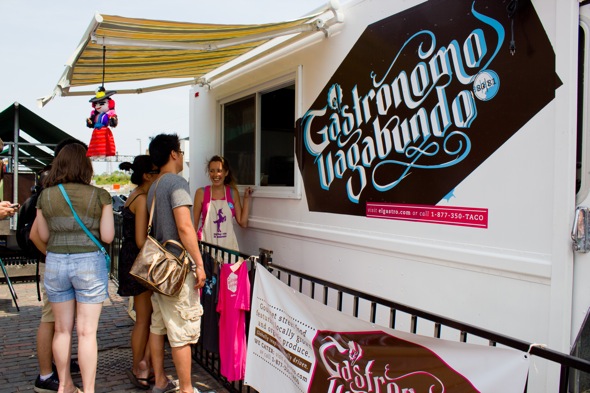
I have lived in Bonfield longer than any other place, but there is part of my soul that is Torontonian -- the result of having been there as a grad student in my 20s. Those were truly formative years. The result of this connection is that I see T.O. as a microcosm, so full of human possibilities, so often falling short. Recently the emphasis has been on falling short, as the city seems to have been infected by the world-wide wave of mean, destructive small-mindedness.
Then I read this article on the movement to bring good street food to the city. A place known for its extraordinary variety of food ought to have a fleet of trucks serving any number of different styles of fast food, but small-mindedness has made it nearly impossible to run such a business.
Then comes Suresh Doss to remind longer-settled Torontonians of a simple truth: more variety is good for everybody. Specifically, good food trucks bring customers to the bricks-and-mortar restaurants they are parked outside. As Doss works to make possible legal food truck havens, support among established restauranters grows.
I get a small laugh from the fact that Doss is an immigrant and yeah, a computer engineer.
Tuesday, December 13, 2011
What is it about Toronto, anyway?
Or Ontario? Or Canada?
Phil Paine recently wrote an essay on the theme, "Nobody [today] is likely to laud Toronto as the exemplar of anything."
He actually won the election (though by making assertions and promises that he must have known were untrue). No one claims that the vote was rigged. Nor is he the first of his kind.
This short-circuits the obvious question, which is where do the creepy leaders we all too often get stuck with come from? and replaces it with the question, where do the people who elect them come from? Canada has many virtues, some large, some small, but it also has within its collective soul a big lump of small-minded, uncharitable hatefulness. Don't believe in a collective Canadian soul? You may be right. Then where do all the people come from who do not value the Canadian virtues that I so admire? The people who, for a small instance, use the comment section of Globe and Mail to unendingly complain that Pierre Trudeau wrecked the country? I am not an admirer of Trudeau, actually, but this is ludicrous. The whole nearly 40 years I've lived in this country, it's been wrecked? What are the values held by such people? What process produces them?
Anyway, Phil's essay reminds us that we can do better, and have. Take a look.
Image: No one would build this today.
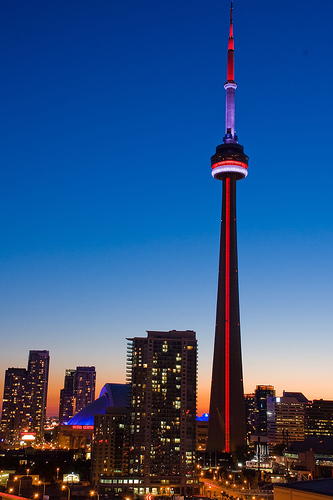
Phil Paine recently wrote an essay on the theme, "Nobody [today] is likely to laud Toronto as the exemplar of anything."
I bumped into a business traveller, recently, from the Indian State of Andhra Pradesh. After discussing Andhra, he asked me, perplexed, why the urban infrastructure in Toronto was so backward. I could only be embarrassed. How could I tell him that there were no Hubbards, Harrises, or Hastingses around, and if there were, they would never be permitted to do anything.He concludes by pointing directly at Toronto's mayor. And he's quite right to do so. Except...
He actually won the election (though by making assertions and promises that he must have known were untrue). No one claims that the vote was rigged. Nor is he the first of his kind.
This short-circuits the obvious question, which is where do the creepy leaders we all too often get stuck with come from? and replaces it with the question, where do the people who elect them come from? Canada has many virtues, some large, some small, but it also has within its collective soul a big lump of small-minded, uncharitable hatefulness. Don't believe in a collective Canadian soul? You may be right. Then where do all the people come from who do not value the Canadian virtues that I so admire? The people who, for a small instance, use the comment section of Globe and Mail to unendingly complain that Pierre Trudeau wrecked the country? I am not an admirer of Trudeau, actually, but this is ludicrous. The whole nearly 40 years I've lived in this country, it's been wrecked? What are the values held by such people? What process produces them?
Anyway, Phil's essay reminds us that we can do better, and have. Take a look.
Image: No one would build this today.
Monday, December 12, 2011
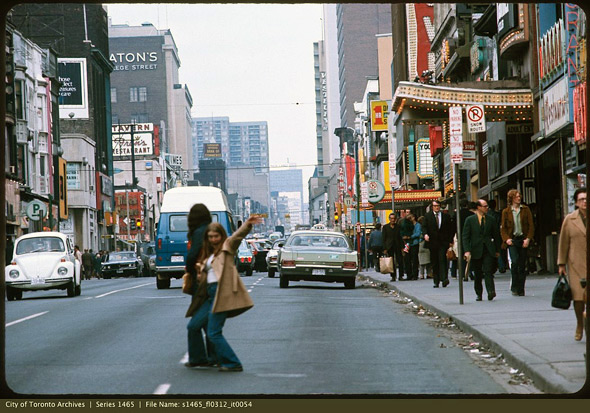
A great site for historical pictures of Toronto
Here's the link, and a couple of samples. Thanks to Andrew.
Yonge Street in the 70s:
Chorley Park, an official residence of the Lieutenant Governor, 1910s:

Sunday, June 27, 2010
The Toronto morality play
 Players:
- the Black Bloc, whoever they are; motives, radicalize the rubes, have some fun at Toronto's expense.
- the current federal government with an assist from Ontario's cabinet; motive, to make Stephen Harper look tough and as an upholder of order against chaos, unlike all those wimps who keep talking about civil liberties. (Ontario government motives: ??)
- the Ontario and Toronto police; motives, to acquire new security toys and a mandate to use them. See "wimps who keep talking about civil liberties," above.
- ordinary protestors who didn't see the trap and their own roles in the play.
- ordinary Torontonians and other Ontarians, including especially those ordinary resident of the university area who are being dragged in entirely for being in the wrong place; they thought they weren't in the play at all, but they are paying for the tickets, the theater, and the cleanup.
- the rest of Canada gets to pay, too.
Update:
Saturday, June 19, 2010
A Torontonian explains why he is supporting Cote d'Ivoire in the World Cup
"My ex-girlfriend lived there for a few months."
Neither Canada nor Trinidad (his personal heritage choice) is in it, you see.
Thanks to CBC Radio news for that one..
Neither Canada nor Trinidad (his personal heritage choice) is in it, you see.
Thanks to CBC Radio news for that one..
Saturday, December 26, 2009
Jeff Burke as Black Santa: a phenom
It's been a mixed bag of a holiday for my family, but this holiday blog post helped push my mood towards the good side.
Jeff Burke is a friend of mine whom I not only like but have always respected as an original. His steadiest musical gig is as a busker in the Toronto subway system. He's now popped up in a TTC Busker Profile at BlogTO. I must congratulate interviewer Jennifer Tse for letting Jeff be himself. Here's my favorite part of an excellent article:
Take it away, Jeff!
Jeff Burke is a friend of mine whom I not only like but have always respected as an original. His steadiest musical gig is as a busker in the Toronto subway system. He's now popped up in a TTC Busker Profile at BlogTO. I must congratulate interviewer Jennifer Tse for letting Jeff be himself. Here's my favorite part of an excellent article:
This applies to more than music.Any final thoughts you would like to share?
While I'm playing, people who used to play the bassoon will run into me, telling me they stopped because they had other things to do with their lives. Other people will give me this wistful look and tell me they miss making music. Someone once said to me they weren't good enough, and that they weren't going to be a professional so they thought they shouldn't waste their time.
It's always sad to hear about people letting music go because they think they aren't going to be good enough. To me, doing creative things with music doesn't have to be about being the virtuoso or the expert. It's something you have fun with that opens up your heart and your spirit, and you can share it with people one way or another.
I want people to give their spirit a chance to breathe, and do some of those things. While they may not make you money, they can make you happy, and you have to find some way in your life to squeeze those things in. It enriches your life.
Take it away, Jeff!
Friday, May 15, 2009
Phil Paine finds his own memorial to genius and heroism in Toronto
He describes a rare moment:
Read the whole thing.
When I first began to read seriously in history, as a boy, my instincts led me to avoid looking for heroes. Trying to find people in the past to admire and respect can be a trap. One is bound to be disappointed. The sad truth is that scoundrels and monsters routinely find their way into history books, but good people do not. The very fact that one is a decent human being virtually guarantees that one will be forgotten. Historical figures propped up as models or champions of this and that usually turn out to be outright frauds, or at the very least to have genuine accomplishments marred by major flaws. But there was one historical figure that I could not help admiring, and that was Frederick Douglass, whose Autobiography inspired me from childhood. And I did not know until recently that I could walk on the very floor where Douglass walked and spoke, right near my own home.
At the corner of King and Jarvis stands St. Lawrence Hall. This fine structure was built in 1850 to provide a venue for public meetings, concerts, balls, and other cultural events of the little city that was then maturing out of its crude frontier beginnings. Over the next century, the hall would be used to echo the voice of Jenny Lind, display the curios of P.T. Barnum, and be used as a practice dance hall by Rudolf Nureyev and Margot Fonteyn. The structure is well preserved, and an excellent example of the Renaissance Revival style of the mid-nineteenth century. Unlike most such structures, it has maintained its intended function throughout its existence.
The timing of its construction was propitious, for there was an important issue for public discussion: the recently enacted Fugitive Slave Law in the United States. This law allowed agents from the southern slave states to conduct a reign of terror in northern states, kidnapping runaway slaves, and many free blacks, and dragging them back to the slave pens of the south. It effectively unleashed the tentacles of the monstrously evil institution of slavery throughout the United States, canceling out existing abolitionist reforms. This hideous injustice would soon lead the United States into a bloody civil war. The activities of the Underground Railway, the organized resistance movement which smuggled escaped slaves to freedom in Canada, were now much more dangerous. Upper Canada had enacted legislation for the abolition of slavery in 1793. On the issue of slavery, Canadians were consistently and adamantly on the side of the angels. The underground railway terminated in Toronto. Escaped American slaves formed free agricultural communities scattered around rural Ontario, and much of the resistance was organized here.
So it's not surprising that Frederick Douglas came to Toronto, and spoke at the newly-built St. Lawrence Hall to a cheering crowd of 1,200 on April 3, 1851[1]. Yesterday, I entered the building, and walked through the empty hall, which has not much changed in general appearance.
Since I acknowledge so few heroes from the annals of history, I rarely get that special thrill that historians can enjoy... the pleasure of planting one's feet on a spot trod by a paladin. I once stood rapt with pleasure in front of Mozart's house, listening to one of his arias being sung. But Mozart's is an example of a tragic life, transcended by genius, and can hardly serve as an example to follow. I have no transcendent genius of my own, so his example is useless to me, personally.
But the work of Frederick Douglass has long been, for me, a kind of guidebook in the quest for freedom and human dignity. The man was a genius, no doubt about it, but it was a real-world genius.
Read the whole thing.
Wednesday, November 26, 2008
Sports fans in Toronto, Russia
 Russian immigrants celebrate a sporting win in Hogtown. Hey, at least they have a winning team! From English Russia.
Saturday, March 08, 2008
Inner Norwegian? Nay, real Canadian!

A brilliant little report from Toronto, which ten years ago had a mayor disgrace the city by panicking over snow.
If you are wondering, it's a lot less snowy up here in the Near North.
Subscribe to:
Posts (Atom)