The Migration Age is still envisioned as an onrush of expansionary Germans pouring unwanted into the Roman Empire and subjecting it to pressures so great that its western parts collapsed under the weight. Further developing the themes set forth in his classic Barbarians and Romans, Walter Goffart dismantles this grand narrative, shaking the barbarians of late antiquity out of this Germanic setting and reimagining the role of foreigners in the Later Roman Empire. The Empire was not swamped by a migratory Germanic flood for the simple reason that there was no single ancient Germanic civilization to be transplanted onto ex-Roman soil. Since the sixteenth century, the belief that purposeful Germans existed in parallel with the Romans has been a fixed point in European history. Goffart uncovers the origins of this historical untruth and argues that any projection of a modern Germany out of an ancient one is illusory. Rather, the multiplicity of northern peoples once living on the edges of the Empire participated with the Romans in the larger stirrings of late antiquity. Most relevant among these was the long militarization that gripped late Roman society concurrently with its Christianization. If the fragmented foreign peoples with which the Empire dealt gave Rome an advantage in maintaining its ascendancy, the readiness to admit military talents of any social origin to positions of leadership opened the door of imperial service to immigrants from beyond its frontiers. Many barbarians were settled in the provinces without dislodging the Roman residents or destabilizing landownership; some were even incorporated into the ruling families of the Empire. The outcome of this process, Goffart argues, was a society headed by elites of soldiers and Christian clergy--one we have come to call medieval.
Showing posts with label late antiquity. Show all posts
Showing posts with label late antiquity. Show all posts
Thursday, October 06, 2022
A good summary of Walter Goffart's contribution to the history of Late Antiquity and the Middle Ages
I was Walter Goffart's student and believe me it was a challenging experience. I learned a tremendous amount from informal discussions in his office and from his comments in the margins of drafts of my thesis.
I found a good summary of some of his work on a bookseller's site and I put it here for the benefit of readers who might be interested in a period that fascinated him and me.


Wednesday, March 22, 2017
La fin de l'Empire romain d'Occident. Rome et les Wisigoths de 382 à 531, by Christine Delaplace,
I return to my old interest in Late Antiquity today, thanks to Michael Kulikowski, who has written an illuminating review of Christine Delaplace's La fin de l'Empire romain d'Occident for the Medieval Review. A boring title, says Michael, and one would not be surprised if the interpretation offered was a hundred years out of date.
Ah, but it's not. Says Michael:
Perhaps the single most important thing here is the authorial willingness to define terms and exercise a realistic parsimony of interpretation with the evidence. For instance, her exhaustive treatment of treaties and their related vocabulary (pax, foedus, deditio, amicitia) usefully demonstrates that the frequent scholarly attempts to normalize the semantic content of that vocabulary are completely untenable; so too is reading back a normative definition from Procopius and Jordanes into the fourth and earlier fifth century. Such observations are not wholly new, but actually applying their analytical insight to the narrative evidence exposes the role that fixed definitions of Roman treaties/foedera play in traditional narratives of Gothic history--thus producing a spurious aura of inevitability stretching from 382 to the settlement of some Goths in Aquitaine forty years later and on into the sixth century. In a similar vein, Delaplace correctly notes that Alaric and all the barbarian generals and condottieri of the late fourth and fifth centuries were primarily leaders of armies; their royal status was secondary, indeed often quite notional, and rarely a meaningful factor in their power. In this approach she strengthens Guy Halsall's demonstration that only Roman military office and magisteria constituted success for such people. To fall back on claims to royalty signified failure. Perhaps the most insightful part of Delaplace's account of the early fifth century follows from the recognition that--whether or not you read Alaric's following, or those of other barbarian leaders of the time, in ethnic terms or instead as relatively heterogeneous mercenary armies--you cannot read them in terms of external diplomacy, or foreign foes. The more precise historical analogy is the late Roman Republic, when the Senate had to deal with rival armies loyal primarily to their generals rather than the state. Mutatis mutandis (for "Senate," read "imperial court"), the endless back and forth of 395 to 418 operated according to the same dynamic. Ethnic difference, still less "foreignness," are not what was at issue. The book's systematic successes are in a similar vein. A ruthless refusal to retroject later evidence means that the Gothic settlement in Gaul is judged at its correct worth: there was nothing new about 418 that had not been at least implicit in the treaty of the king Wallia and the magister militum Constantius in 416. Wallia's (and then Theoderic I's) Goths were in effect a mercenary army, contracted by the Roman state because they were less likely to slip into the usurpation to which rebellious Gallic armies had long been prone. The Gothic zone of action effectively displaced the western Rhine limes south to the Loire, where, from Aquitaine, the Gothic army could operate in any direction necessary, against barbarians and potential usurpers alike. Thus, there was no kingdom of Toulouse for the better part of a century. There was a Gothic rex (who very rarely used that title) and there were sortes Gothicae, but there was no regnum till the fifth century had run its course. Again, Delaplace has a firm grip on later fifth-century events. In particular she rejects the lionisation of the general Aëtius as "the last of the Romans," a sort of incomparable bulwark against the encroaching barbarian tides. Aëtius, she demonstrates, fundamentally weakened the Roman state, perpetuating constant rivalries in Gaul and Italy that militated against coherent policy. She shows how the "Gothic wars" of the 430s and 440s should not be read as a Roman defence against aggressive barbarian expansion, but rather as an extension of the civil war that brought Aëtius to power, the initial rivalry of Boniface and Aëtius, allied respectively with Theoderic and the Amal Berimond, was perpetuated in the next generation by Sebastianus (son of Boniface) and Witteric (son of Berimond), supported respectively by Theoderic and Aëtius. The peace of 439 is not a Romano-Gothic peace, nor a taming of the unruly federates by Rome, but rather a final settlement of two decades of rivalry: Sebastian was expelled by Theoderic, Witteric disappears from the pages of history (murdered, one imagines), and Aëtius married a daughter of Theoderic, having repudiated his second wife Pelagia, herself the sister of Berimond and widow of Boniface. ... The book concludes with a more cursory survey of the period from 477-531, but here too, the guiding principles are correct. In particular, Delaplace considers the battle of Vouillé as a stage in the sorting out of post-imperial factions that characterizes the earlier sixth century, rather than as a caesura in Gothic history. Greater detail in this section would have been welcome, but that was not the author's primary goal. One would not have thought it possible to write a strikingly novel history of the last century of the western empire, but that is precisely what Delaplace has done. It is a grand accomplishment.Think of Attila as John Hawkwood!
Sunday, April 10, 2016
"Two Worlds Become One: A 'Counter-Intuitive' View of the Roman Empire and 'Germanic' Migration" by Guy Halsall
This is an interesting re-interpretation of the "migration" period, part of a debate that has contemporary resonances and which has been going on for decades now.
Here is the abstract:
Abstract
The Roman Empire and barbaricum were inextricably linked throughout the Roman Iron Age. By late antiquity, Germanic-speaking trans-Rhenan areas were inundated with imperial influence. Migration was two-way and in various forms, all of which, including large-scale ‘folk movement’, were normal: part and parcel of the imperial frontier’s dynamics. The counter-intuitive conclusion is drawn from this that the relationship between the existence of a formal frontier and significant migration is quite the opposite of the one we have grown used to imagining. The collapse of the frontier took with it the mechanisms for migration. Therefore I have to modify my 2007 epigram that ‘the end of the Roman Empire produced the Barbarian Invasions and not vice versa’. The end of the Roman Empire put an end to the barbarian migrations. This conclusion helps us contribute more responsibly to modern debate on migration. It also contributes to a discussion of the formation of Germany. The end of migration changed the political dynamics of the regions between Rhine and Baltic. The latter became more inward-facing and from these, eventually, emerged ‘Germany.’
Here is the complete text
Friday, November 20, 2015
Who reads this stuff?
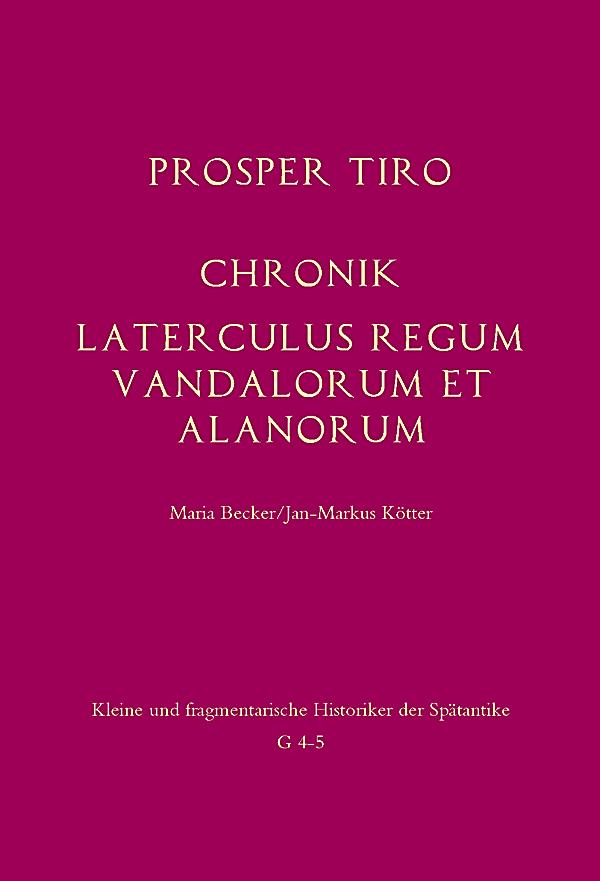
Back in the mid-1980s, I spun an article off my dissertation, The Fifth-century Chroniclers. The article was entitled "Prosper's Epitoma Chronicon: Was There An Edition of 443?" and was a brief discussion about...whether the 5th-century chronicler Prosper wrote an edition in A.D. 443! (As you may have guessed!) It could be taken as a fine example of scholarly nit-pickery, but it was worth doing because close scrutiny of ancient and medieval sources is and has been one of the methods we reconstruct the distant past. I thought it might help some readers somewhere while assuring potential employers that I was still at work.
But how many such readers could there be?
Well, this week I got a note from the Academia.edu site telling me that a Russian scholar was interested in having a look at the old article. I brushed it off and sent it off to the site. She saw it and thanked me.
Two days later the site has recorded 27!!!views. Good grief!
If any of you readers is really interested in the historiography of the Later Roman Empire and the origins of the medieval Latin chronicle tradition, the book version of The Fifth-century Chroniclers is still in print.
But if you are just vaguely curious about the answer to the question in the article's title: I said, probably not.
Image below: Somebody else's book on Prosper.
But how many such readers could there be?
Well, this week I got a note from the Academia.edu site telling me that a Russian scholar was interested in having a look at the old article. I brushed it off and sent it off to the site. She saw it and thanked me.
Two days later the site has recorded 27!!!views. Good grief!
If any of you readers is really interested in the historiography of the Later Roman Empire and the origins of the medieval Latin chronicle tradition, the book version of The Fifth-century Chroniclers is still in print.
But if you are just vaguely curious about the answer to the question in the article's title: I said, probably not.
Image below: Somebody else's book on Prosper.
Tuesday, April 28, 2015
The new Avengers movie: How your studies in Late Antiquity helped you understand Joss Whedon's plight
This is wonderful, wonderful. Thanks, Salon and Mr. O'Hehir:
It might be accurate to say instead that superhero cinema has reached a decadent plateau, a long-term steady state of self-nourishing bigness and reverberant meaninglessness. Whedon moves on from the Marvel empire not as its Augustus or its Spartacus, but more like one of the later, non-terrible Christian emperors who won some battles, made some reforms and convinced everybody that the glory of Rome would endure forever. Was it worth doing? That depends on what you think of Rome.
Monday, December 01, 2014
Review of Burgess and Kulikowski, Mosaics of Time
This is the kind of work I was doing at the beginning of my academic career. It's good to see this coming out.
From the Medieval Review:
Burgess, R. W., and Michael Kulikowski. Mosaics of Time: The Latin Chronicle Traditions from the First Century BC to the Sixth Century AD. Volume I: A Historical Introduction to the Chronicle Genre from Its Origins to the High Middle Ages. Studies in the Early Middle Ages, 33. Turnhout: Brepols, 2013. Pp. xiv, 444. €100.00. ISBN: 978-2503531403.
Reviewed by William Adler
North Carolina State University
William_adler@ncsu.edu
This impressive volume, the first of a planned four-volume series on the Latin chronographic tradition, represents a robust challenge to the widely-held and largely unchallenged assumption that the medieval annals derived from notices embedded in the margins of Easter tables of the seventh and eighth centuries. To make their case that so-called "annals" are part of a continuous and ancient pre-Christian tradition extending back long before the development of Easter tables, Burgess and Kulikowski (hereafter B. and K.) trace the development of the chronicle genre from its beginnings in ancient Egypt and the Near East, concluding with the twelfth-century universal chronicle of Sigebert of Gembloux.
Underlying the communis opinion about the medieval origins of annals is a putative distinction between "chronicles" and "annals." More sophisticated in structure and style, the former are traditionally thought to originate, either directly or indirectly, in the great Christian universal chronicles of the third and fourth centuries. The terse annotations and tabular listing of years that make up the content of annals reveal their more humble roots in medieval Easter tables. Insofar as it misleadingly reinforces an artificial disjunction between annals and the older chronicle tradition, the authors discard the category of "annals" altogether, subsuming it instead under the broader category of "chronicle." In their usage, the term chronicle encompasses works marked by a year-by-year annalistic structure, wide scope, paratactic style, and brevity in the narrative of events. Subsets of this genre would include consularia (annotated consular lists) and Paschal chronicles (chronicles written within the framework of an Easter table).
In their systematic dismantling of the received wisdom about the origins of medieval annals (or, more properly, medieval chronicles), B. and K. first demonstrate that the chronicle genre was neither uniquely nor even primarily Christian in character. Nor did the Christian adoption of the chronicle, at least initially, have anything to do with the Easter computus. For Julius Africanus (early third century), the study of chronology was at least in part a matter of providing an empirical foundation for Christian apocalyptic speculation. Following the precedent set by Hellenistic Jewish authors and representatives of other peoples of the Near East, Christian apologists also found comparative chronology a highly effective means of confirming both the antiquity of their religion and the derivative character of Greek civilization. Early Christian experiments in comparative Greco-Jewish chronology contained the seeds for more ambitious undertakings, including the great universal chronicle of Eusebius of Caesarea.
Eusebius's chronicle plays a justifiably outsized role in the authors' exposition of the antecedents of the medieval Latin chronicle. His incorporation of material from Hellenistic olympiad chronicles, his fresh approach to long-standing chronological problems, and the inventive tabular structure of the second book of his chronicle (the so-called Chronici Canones) show it to be a truly original piece of scholarship. Thanks to the translation and continuation of the Canons by Jerome, the work became well-known in the Latin-speaking world, offering Christian writers in the West a vision of the past that securely integrated Christianity and Rome into the panorama of the rise and fall of nations and kingdoms. Under its influence, the chronicle soon became the dominant form of historical writing throughout the Middle Ages. At the same time, however, medieval chroniclers found it difficult to take over Eusebius's system of reckoning time without modification. In place of olympiads, regnal years and the Abrahamic era, medieval chroniclers found other systems more to their liking, including consular dating, universal years, and most significantly, the Dionysian anni domini familiar from the Easter Tables of the seventh and eighth centuries. While the so-called medieval "annals" may have introduced some new wrinkles into the genre, they have closer links with the ancient chronicle tradition than do the fuller narrative "chronicles" of the Latin West. Aside from the name, the latter have nothing in common with the chronicles of Late Antiquity.
Apart from its value as a corrective to--indeed, a complete inversion of--the conventional explanation of the origins of medieval "annals," the wide scope of this volume (and a thorough index) will make it an excellent, albeit occasionally demanding, introduction to the chronicle in Antiquity and the Middle Age. To avoid taxing readers with potentially distracting details, eight appendixes (as well as appendixes to the footnotes) elaborate at greater length topics treated in the body of the narrative. While a single thesis informs the treatment of the evidence, the authors never lose sight of the sources themselves, the analysis of which is painstaking and nuanced. In anticipation of Burgess's planned monograph on the textual relations and origins of the Irish chronicles, B. and K. set forth an original argument identifying hitherto overlooked ties between Irish chronicles and the medieval and late antique chronicle tradition. Although the overall orientation is in a westerly direction, the authors also include a brief but instructive account of the development of Byzantine chronicles. If interest in chronology is defining of the genre, many Byzantine works termed "universal chronicles" are better classified as breviaria, no more deserving of the designation "chronicle" than their medieval Latin counterparts. Why the annalistic style of recording the past virtually disappears after Theophanes in the ninth would require a study of its own. But the authors' decision to extend the scope of their analysis eastward helps to bring their findings about the Western tradition into sharper focus. To keep the study within a reasonable length and to avoid digging into subjects with which they are less familiar, the authors limit their discussion of Eastern chronicles to Byzantium (227). But as they rightly recognize, sources from the non-Greek speaking Eastern churches can offer another perspective on the survival and transmission of the ancient chronicle tradition. Because they preserve closer ties with Eusebius and Alexandrian chronography, Syriac and Ethiopic chronicles are in some ways better witnesses to this older tradition than their Byzantine counterparts.
The authors are also to be commended for their exemplary exposition of the durability of a genre often caricatured as an inferior and sub-literary form of historiography, amounting to little more than an uncritical accumulation of disjointed events. In response to the charge that they lacked any unifying narrative thread, the authors compare the structure of the ancient chronicle to a mosaic (hence the title of the book). Like the tiles of a mosaic, "the meaning of history...lay not in the details, but in the overall picture offered by the complete work" (33). Claims about the inferior literary quality of the chronicle are both true and irrelevant. As a branch of technical and scientific literature, chronicles, unlike narrative histories, were meant to be used, not to be read as self-standing literary monuments. The practical applications of the chronicle, its underlying "macro-narrative," and its treatment of the past uno in conspectus also explain the survival of the ancient chronicle tradition well into the Middle Ages. In this new setting, the genre proved flexible enough to accommodate various styles and content, ranging from brief notices inserted into Easter tables to more discursive annalistic records. The decentralization of power brought about by the collapse of the Carolingian empire had its own role to play in the spread of the genre to remote parts of the former Frankish kingdom and beyond. Historians involved in the work of fashioning national identities found the long reach and open-ended tabular structure of chronicles like Eusebius' Canons an ideal way to fuse local events with the broader sweep of world history. And because rhetorical skills or even extensive research were not mandatory, the composition of a chronicle was within the reach of writers of only modest literary aptitude. The accessibility of the genre in the Middle Ages resulted in what B. and K. call a "democratization of history": "anyone could be a historian and many took up the task" (129). At the end of their discussion, one thing is unmistakably clear: whether it served as a tool for antiquarian research, apologetic, apocalyptic speculation, or Easter reckoning, the chronicle was a highly functional instrument, in constant evolution and reinvention.
Occasional lapses and questionable claims are virtually inescapable in a work of dense technical content, ranging over more than 1300 years, and traversing so many regions and cultures. It is an overstatement to say that Philo's voluminous allegorical commentaries on the Pentateuch were intended mainly to establish the dependence of Greek philosophers and lawgivers on Moses (108). While it is true that the foundational principle of Africanus's chronicle was millennialist his interpretation of Daniel was, interestingly, non-eschatological. The terms of Daniel's apocalypse of seventy weeks were in his view completely satisfied in Jesus's ministry (cf. p. 117). In their discussion of the reception of Eusebius's chronicle, the authors state that Syncellus criticized Eusebius' Alexandrian critics Panodorus and Annianus (fifth century) for misdating the Incarnation by following pagan wisdom (i.e. Claudius Ptolemy). Syncellus actually faults only Panodorus for this failing (229).
In some cases, the authors also overplay the influence of apologetic on ancient Jewish and Christian chronicles. The two were not necessarily inseparable. From the admittedly little that survives from Demetrius the Jewish chronographer, there is little reason to suppose that he was at all interested in establishing the superior antiquity of Moses and the Jews. Sorting out chronological and exegetical problems in the biblical text, not comparative chronology, seems to have been uppermost in his mind. In their discussion of Christian chronicles, B. and K. state that "apologetic was the essential purpose of Christian chronography" (120). That observation would probably apply better to Tatian, Theophilus, and Clement of Alexandria than to Africanus and Eusebius. While the latter writers were undoubtedly influenced to some extent by apologetic, they were hardly beholden to it. At a certain point, the scientific requirements of the discipline required them to direct their energies elsewhere. For Africanus, the comparative dating of Moses is more a question of historical method than fodder for anti-Greek polemic. From reading the preface to Eusebius's Canons, one might reasonably draw the conclusion that "even had he wanted to," Eusebius "could hardly have dissociated himself from the apologetic tradition" (120). But his handling of conventional topoi of Christian apologetic chronology invites a different conclusion. In the first book of his chronicle, Eusebius allows that in the pursuit of chronological accuracy, no sources from the past should be exempt from scrutiny and doubt, not even the biblical record. Although initially making the de rigueur case for the overall superiority of Septuagint chronology to competing versions of the Bible, Eusebius (unlike his predecessors) does not adhere dogmatically to its testimony. And after determining that his predecessors had drastically inflated the length of time from the Exodus to the building of the temple under Solomon, Eusebius arrives at a date for Moses much later than the one sanctified by tradition. What all of this suggests is that even a writer as committed to the defense of the Church as Eusebius could dissociate himself from time-worn clichés of Jewish and Christian apologetic when he found them at odds with his own independent judgments.
To the extent that nomenclature lies at the heart of their thesis about the origins of medieval chronicles, the authors' lengthy exposition of the essential features of the chronicle genre is bound to elicit the most interest and criticism. B. and K. recognize that ancient writers are not nearly as scrupulous as they are in their terminology. They also allow that their fine-grained distinctions between "chronicles," "chronicle epitomes," "chronographs," "breviaria" and "epitomes" are unlikely to fine wide acceptance among medievalists (62). But they do make a compelling case both that the differences are substantive, and that any progress in reconstructing the development of the chronicle will require a more descriptive taxonomy than the one currently in scholarly use. There are places in the narrative, however, where the strict terminology becomes unwieldy, especially when it comes to describing hybrid works. To remain true to their own exacting standards, many works ordinarily classified as universal chronicles now have to be categorized as something else, either as "chronographs" (Africanus and Syncellus), or as history "tricked out with the clothing of the chronicle" (Dexippus, p. 285). The more fundamental question is whether their claims about a connection between medieval "annals" and the ancient chronicle tradition are true by definition. That is, do compositional and structural similarities based on their own definition of the chronicle genre establish historical continuity? The authors have not ignored the question. As their painstaking analysis of the textual history of the Latin chronicle shows, the similarities between "annals" and ancient chronicle are not purely generic; there are also direct and traceable genealogical links.
From the Medieval Review:
Burgess, R. W., and Michael Kulikowski. Mosaics of Time: The Latin Chronicle Traditions from the First Century BC to the Sixth Century AD. Volume I: A Historical Introduction to the Chronicle Genre from Its Origins to the High Middle Ages. Studies in the Early Middle Ages, 33. Turnhout: Brepols, 2013. Pp. xiv, 444. €100.00. ISBN: 978-2503531403.
Reviewed by William Adler
North Carolina State University
William_adler@ncsu.edu
This impressive volume, the first of a planned four-volume series on the Latin chronographic tradition, represents a robust challenge to the widely-held and largely unchallenged assumption that the medieval annals derived from notices embedded in the margins of Easter tables of the seventh and eighth centuries. To make their case that so-called "annals" are part of a continuous and ancient pre-Christian tradition extending back long before the development of Easter tables, Burgess and Kulikowski (hereafter B. and K.) trace the development of the chronicle genre from its beginnings in ancient Egypt and the Near East, concluding with the twelfth-century universal chronicle of Sigebert of Gembloux.
Underlying the communis opinion about the medieval origins of annals is a putative distinction between "chronicles" and "annals." More sophisticated in structure and style, the former are traditionally thought to originate, either directly or indirectly, in the great Christian universal chronicles of the third and fourth centuries. The terse annotations and tabular listing of years that make up the content of annals reveal their more humble roots in medieval Easter tables. Insofar as it misleadingly reinforces an artificial disjunction between annals and the older chronicle tradition, the authors discard the category of "annals" altogether, subsuming it instead under the broader category of "chronicle." In their usage, the term chronicle encompasses works marked by a year-by-year annalistic structure, wide scope, paratactic style, and brevity in the narrative of events. Subsets of this genre would include consularia (annotated consular lists) and Paschal chronicles (chronicles written within the framework of an Easter table).
In their systematic dismantling of the received wisdom about the origins of medieval annals (or, more properly, medieval chronicles), B. and K. first demonstrate that the chronicle genre was neither uniquely nor even primarily Christian in character. Nor did the Christian adoption of the chronicle, at least initially, have anything to do with the Easter computus. For Julius Africanus (early third century), the study of chronology was at least in part a matter of providing an empirical foundation for Christian apocalyptic speculation. Following the precedent set by Hellenistic Jewish authors and representatives of other peoples of the Near East, Christian apologists also found comparative chronology a highly effective means of confirming both the antiquity of their religion and the derivative character of Greek civilization. Early Christian experiments in comparative Greco-Jewish chronology contained the seeds for more ambitious undertakings, including the great universal chronicle of Eusebius of Caesarea.
Eusebius's chronicle plays a justifiably outsized role in the authors' exposition of the antecedents of the medieval Latin chronicle. His incorporation of material from Hellenistic olympiad chronicles, his fresh approach to long-standing chronological problems, and the inventive tabular structure of the second book of his chronicle (the so-called Chronici Canones) show it to be a truly original piece of scholarship. Thanks to the translation and continuation of the Canons by Jerome, the work became well-known in the Latin-speaking world, offering Christian writers in the West a vision of the past that securely integrated Christianity and Rome into the panorama of the rise and fall of nations and kingdoms. Under its influence, the chronicle soon became the dominant form of historical writing throughout the Middle Ages. At the same time, however, medieval chroniclers found it difficult to take over Eusebius's system of reckoning time without modification. In place of olympiads, regnal years and the Abrahamic era, medieval chroniclers found other systems more to their liking, including consular dating, universal years, and most significantly, the Dionysian anni domini familiar from the Easter Tables of the seventh and eighth centuries. While the so-called medieval "annals" may have introduced some new wrinkles into the genre, they have closer links with the ancient chronicle tradition than do the fuller narrative "chronicles" of the Latin West. Aside from the name, the latter have nothing in common with the chronicles of Late Antiquity.
Apart from its value as a corrective to--indeed, a complete inversion of--the conventional explanation of the origins of medieval "annals," the wide scope of this volume (and a thorough index) will make it an excellent, albeit occasionally demanding, introduction to the chronicle in Antiquity and the Middle Age. To avoid taxing readers with potentially distracting details, eight appendixes (as well as appendixes to the footnotes) elaborate at greater length topics treated in the body of the narrative. While a single thesis informs the treatment of the evidence, the authors never lose sight of the sources themselves, the analysis of which is painstaking and nuanced. In anticipation of Burgess's planned monograph on the textual relations and origins of the Irish chronicles, B. and K. set forth an original argument identifying hitherto overlooked ties between Irish chronicles and the medieval and late antique chronicle tradition. Although the overall orientation is in a westerly direction, the authors also include a brief but instructive account of the development of Byzantine chronicles. If interest in chronology is defining of the genre, many Byzantine works termed "universal chronicles" are better classified as breviaria, no more deserving of the designation "chronicle" than their medieval Latin counterparts. Why the annalistic style of recording the past virtually disappears after Theophanes in the ninth would require a study of its own. But the authors' decision to extend the scope of their analysis eastward helps to bring their findings about the Western tradition into sharper focus. To keep the study within a reasonable length and to avoid digging into subjects with which they are less familiar, the authors limit their discussion of Eastern chronicles to Byzantium (227). But as they rightly recognize, sources from the non-Greek speaking Eastern churches can offer another perspective on the survival and transmission of the ancient chronicle tradition. Because they preserve closer ties with Eusebius and Alexandrian chronography, Syriac and Ethiopic chronicles are in some ways better witnesses to this older tradition than their Byzantine counterparts.
The authors are also to be commended for their exemplary exposition of the durability of a genre often caricatured as an inferior and sub-literary form of historiography, amounting to little more than an uncritical accumulation of disjointed events. In response to the charge that they lacked any unifying narrative thread, the authors compare the structure of the ancient chronicle to a mosaic (hence the title of the book). Like the tiles of a mosaic, "the meaning of history...lay not in the details, but in the overall picture offered by the complete work" (33). Claims about the inferior literary quality of the chronicle are both true and irrelevant. As a branch of technical and scientific literature, chronicles, unlike narrative histories, were meant to be used, not to be read as self-standing literary monuments. The practical applications of the chronicle, its underlying "macro-narrative," and its treatment of the past uno in conspectus also explain the survival of the ancient chronicle tradition well into the Middle Ages. In this new setting, the genre proved flexible enough to accommodate various styles and content, ranging from brief notices inserted into Easter tables to more discursive annalistic records. The decentralization of power brought about by the collapse of the Carolingian empire had its own role to play in the spread of the genre to remote parts of the former Frankish kingdom and beyond. Historians involved in the work of fashioning national identities found the long reach and open-ended tabular structure of chronicles like Eusebius' Canons an ideal way to fuse local events with the broader sweep of world history. And because rhetorical skills or even extensive research were not mandatory, the composition of a chronicle was within the reach of writers of only modest literary aptitude. The accessibility of the genre in the Middle Ages resulted in what B. and K. call a "democratization of history": "anyone could be a historian and many took up the task" (129). At the end of their discussion, one thing is unmistakably clear: whether it served as a tool for antiquarian research, apologetic, apocalyptic speculation, or Easter reckoning, the chronicle was a highly functional instrument, in constant evolution and reinvention.
Occasional lapses and questionable claims are virtually inescapable in a work of dense technical content, ranging over more than 1300 years, and traversing so many regions and cultures. It is an overstatement to say that Philo's voluminous allegorical commentaries on the Pentateuch were intended mainly to establish the dependence of Greek philosophers and lawgivers on Moses (108). While it is true that the foundational principle of Africanus's chronicle was millennialist his interpretation of Daniel was, interestingly, non-eschatological. The terms of Daniel's apocalypse of seventy weeks were in his view completely satisfied in Jesus's ministry (cf. p. 117). In their discussion of the reception of Eusebius's chronicle, the authors state that Syncellus criticized Eusebius' Alexandrian critics Panodorus and Annianus (fifth century) for misdating the Incarnation by following pagan wisdom (i.e. Claudius Ptolemy). Syncellus actually faults only Panodorus for this failing (229).
In some cases, the authors also overplay the influence of apologetic on ancient Jewish and Christian chronicles. The two were not necessarily inseparable. From the admittedly little that survives from Demetrius the Jewish chronographer, there is little reason to suppose that he was at all interested in establishing the superior antiquity of Moses and the Jews. Sorting out chronological and exegetical problems in the biblical text, not comparative chronology, seems to have been uppermost in his mind. In their discussion of Christian chronicles, B. and K. state that "apologetic was the essential purpose of Christian chronography" (120). That observation would probably apply better to Tatian, Theophilus, and Clement of Alexandria than to Africanus and Eusebius. While the latter writers were undoubtedly influenced to some extent by apologetic, they were hardly beholden to it. At a certain point, the scientific requirements of the discipline required them to direct their energies elsewhere. For Africanus, the comparative dating of Moses is more a question of historical method than fodder for anti-Greek polemic. From reading the preface to Eusebius's Canons, one might reasonably draw the conclusion that "even had he wanted to," Eusebius "could hardly have dissociated himself from the apologetic tradition" (120). But his handling of conventional topoi of Christian apologetic chronology invites a different conclusion. In the first book of his chronicle, Eusebius allows that in the pursuit of chronological accuracy, no sources from the past should be exempt from scrutiny and doubt, not even the biblical record. Although initially making the de rigueur case for the overall superiority of Septuagint chronology to competing versions of the Bible, Eusebius (unlike his predecessors) does not adhere dogmatically to its testimony. And after determining that his predecessors had drastically inflated the length of time from the Exodus to the building of the temple under Solomon, Eusebius arrives at a date for Moses much later than the one sanctified by tradition. What all of this suggests is that even a writer as committed to the defense of the Church as Eusebius could dissociate himself from time-worn clichés of Jewish and Christian apologetic when he found them at odds with his own independent judgments.
To the extent that nomenclature lies at the heart of their thesis about the origins of medieval chronicles, the authors' lengthy exposition of the essential features of the chronicle genre is bound to elicit the most interest and criticism. B. and K. recognize that ancient writers are not nearly as scrupulous as they are in their terminology. They also allow that their fine-grained distinctions between "chronicles," "chronicle epitomes," "chronographs," "breviaria" and "epitomes" are unlikely to fine wide acceptance among medievalists (62). But they do make a compelling case both that the differences are substantive, and that any progress in reconstructing the development of the chronicle will require a more descriptive taxonomy than the one currently in scholarly use. There are places in the narrative, however, where the strict terminology becomes unwieldy, especially when it comes to describing hybrid works. To remain true to their own exacting standards, many works ordinarily classified as universal chronicles now have to be categorized as something else, either as "chronographs" (Africanus and Syncellus), or as history "tricked out with the clothing of the chronicle" (Dexippus, p. 285). The more fundamental question is whether their claims about a connection between medieval "annals" and the ancient chronicle tradition are true by definition. That is, do compositional and structural similarities based on their own definition of the chronicle genre establish historical continuity? The authors have not ignored the question. As their painstaking analysis of the textual history of the Latin chronicle shows, the similarities between "annals" and ancient chronicle are not purely generic; there are also direct and traceable genealogical links.
Friday, February 17, 2012
Resurrected! Two articles from Florilegium by S. Muhlberger

Way back when -- in 1984 -- Florilegium, the journal of the Canadian Society of Medievalists, was looking for content, and I, a newish Ph.D., was looking for an opportunity to publish. I was still mining my dissertation research on Latin chronicles of Late Antiquity, so what I had was not one but two pieces on the "Copenhagen" Continuation of Prosper, a seventh-century chronicle which preserves some interesting fifth-century and at the same time gives us access to a seventh-century point of view on the "fall of Rome." One piece was an article-length appreciation and analysis of the Continuation; the other was a translation of the text, which despite being edited by Theodor Mommsen in the Chronica Minora, was hardly accessible in an easily readable form in any language.
Florilegium took them both, and I was very grateful.
Earlier this month I was thinking about these articles, considering whether I should perhaps turn them into an e-book. The very next day I got a letter from the current editor of Florilegium asking for permission to reissue them electronically as part of a general reprinting of past issues of the journal!
So there it is: and here are links to the grand reprinting project, the article "Heroic Kings and Unruly Generals: The 'Copenhagen' Continuation of Prosper Reconsidered" and the translation, "The Copenhagen Continuation of Prosper: A Translation."

Saturday, January 21, 2012
How one gained entree into the highest circles in 6th-century Europe

This year I returned to the early Middle Ages or late Antiquity to teach a fourth-year seminar on Gregory of Tours. Gregory was a sixth century bishop of what is now western France and who wrote a massive history of his times, the Histories, or more commonly the History of the Franks. Gregory is a lot of fun to study because he is interested in lots of things and wrote with a great deal of personality (though how much of that personality is literary artefact is hard to say).
Gregory begins his history with this statement: "I wish first of all to explain my faith, so that whoever reads me may not doubt that I am a Catholic." This is followed by about two pages of a detailed creed or declaration of faith. Fair warning about his priorities, admittedly not very surprising from a bishop who is justifying his role as a teacher to his audience, which undoubtedly included his fellow bishops and would include in the future his successors in the church at Tours. For some people, this declaration was an essential preamble to anything else Gregory might say.. Gregory was completely in sympathy with that point of view.
Yesterday, I was reading the letters of St. Radegund in preparation for a class discussion of this famous nun who lived at the same time Gregory did. Radegund is a very interesting figure. Born as a Thuringian princess, she was carted off to Gaul while still a child, after the Franks had destroyed most of her family. On reaching adulthood, she was married to King Lothar of the Franks, presumably to strengthen the Frankish claim to overlordship of Thuringia. Radegund and Lothar never got along very well, and eventually she insisted on becoming a nun and establishing a convent where she could live the ascetic life surrounded by other like minded women – and some women who were also high-ranking refugees from court life. Radegund became the foremost female religious figure in Frankish Gaul, but never completely lost her royal status. One example of her working the system through her dual status was her acquisition of a piece or pieces of the True Cross from the Byzantine emperor. We can guess that if a random, distant nun had asked for such a fantastic gift, she would not have gotten it. Her request would never have gotten to the Emperor.
We dod not have Radegund's request for a relic, we do have something that looks like a thank you letter that she set off to Emperor Justin (II) and Empress Sophia once she had it. And a curious letter it is.
Here's the beginning of her letter:
To the August Justin and Sophia
The highest glory of the father, son, and nourishing spirit,
one god to be adored in this trinity,
majesty, triple person, simple substance,
equal consort and coeval with itself,
one force remaining the same, one power in three
(which the father begetting , the spirit enables),
indeed distinct in persons, joined in vigor,
of one nature, equal in strength, light, throne,
the trinity was always with him, ruling without time,
lacking no use nor capable by seizing. 10
Highest glory to you, creator of things and redeemer,
who, just, gives Justin headship in the world.
He claims, properly, the dominant fortress over kings,
who pleases the heavenly king by serving.
How deservedly he rules Rome and the Roman world
who follows what the dogma says from the cathedra of Peter,
what Paul sang far and wide, with one trumpet to thousands,
to heathens and the senseless he poured out salt from his mouth,
whose four-sided axle the wheel of his tongue circled,
cold hearts are warm from the faith of his eloquence. 20
Highest glory to you, creator of things and redeemer,
who, just, gives Justin headship in the world.
Strengthened, the disturbed faith of the church shines again
and venerable law returns to its former place.
Give back your vows to God, since the new purple holds whatever
the council of Chalcedon established.
Gaul sings this to your merits, Augustus,
the Rhone, the Rhine, the Danube, the Elbe do.
Beneath the western axle Galicia heard the deed,
Biscayne brought it to the nearby Basques. 30
The pious fable runs to the farthest people of the faith
and the British land across the ocean is favorable.
How well, lover, do you share the care with the lord!
You make his causes yours, he makes yours his.
Christ gives you the power, you give Christ the honor:
he gives the summit, you give back the faith.
There was nothing more on earth that he might give to be ruled,
nor more that you could give back than nourishing faith is strong.
Fathers sent into exile for the name of Christ
then came back, with the diadem to you. 40
Released from prison, residing in the former seat,
hold you to be one general good.
Curing so many sorrows of the confessors,
you come as a healing to innumerable people.
Presumably Radegund had in a previous communication established that she was the kind of person who was worthy of Imperial attention -- holy woman and influential Frankish queen. But just in case Justin and Sophia might have second thoughts, and be tempted to think that Radegund was only a barbarian they mistakenly had been overgenerous to, Radegund spends line after line of poetry buttering them up, showing that she is quite aware of current religious conflicts, is on the right side of them, and appreciates (weak word) Justin's role in establishing theological truth and restoring unjustly persecuted bishops to their sees. The man is a universal hero and his wife is not far behind him.
That's the way, or one way, that one established one's right to a place in the Big Time in sixth-century Christian Europe. Radegund may have been a Thuringian or a Frank, she was determined to show that she was no hick. One wonders if the letter had the desired effect.
Image: Radegund imagined by the illustrator of the Nuremberg Chronicle, 15th century.
Friday, December 16, 2011
6th century names that start with G
Gallomagnus, Galswinth, Garachar, Gararic, Garivald, Germanus, Godigisel, Godomar, Gogo, Goiswinth, Grindio, Grippo, Gundegisel, Gunthar.
Not to mention Gregory.
In other letters, let's not forget Chramn, Chundo, and Chuppa.
Not to mention Gregory.
In other letters, let's not forget Chramn, Chundo, and Chuppa.
Thursday, December 15, 2011
A delicious passage from Gregory of Tours -- or rather translator Lewis Thorpe
Here's the Latin from Histories (or The History of the Franks) 7.2:
Image: the same action, same country, somewhat later.

Quibus discedentibus, coniuncti Dunenses cum reliquis Carnotenis, de vestigio subsecuntur, simile sorte eos adficientes, qua ipsi adfecti fuerant, nihil in domibus vel extra domus vel de domibus relinquentes.Thorpe's English:
[Raiders from Chateaudun wreaking reprisals on attackers from Blois and Orleans] meted out to them the same treatment which they themselves had received: they left nothing inside the houses and nothing outside the houses, and they knocked the houses down.With apologies to the long-ago victims of this violent episode, that's pretty amazing.
Image: the same action, same country, somewhat later.
Friday, September 16, 2011
Not to be missed: conjuring up Rome in AD 600

Dr. Beachcombing imagines the near-ghost town it must have been:
Let’s take the lowest sensible estimate for classical Rome – half a million – and the highest for Rome c. 600, about 50,000. That means that the population has not only been decimated, but that it had been decimated nine times over. And what is more these heirs of Rome (as fashionable ‘late antique’ historians call them) were resident in an echo box; a city that they no longer had the technology to repair, let alone recreate, where nine out of every ten residences were empty, where three and four story buildings gradually keeled over into the streets and where the Parthenon and the Coliseum looked down mockingly on the little people below, not so much dwarfs on giants’ shoulders, as blue-bottles buzzing around a cow’s backside.
Then, remember, perhaps the actual population of Imperial Rome was more like a million and the population of Rome c. 600 was more like ten thousand, a hundredth of what it had been. The psychopathic Anglo-Saxon guard, the tourist from Scythia and the Pope and his tiny administration could shout as loud as they wanted and no one would have heard them in their ghost town. No one was listening, not even the red baked tiles made in a happier age.I have recently lived across the river from Detroit...so this is evocative. Detroit is not, however, quite so echoic.
Parthenon presumably should be Pantheon (above).
More on ancient population estimates in a later post.
Tuesday, August 30, 2011
Battle in the Early Middle Ages: Expertise and controversy

"Historian on the Edge" provides us with an expert summary of his views on early medieval warfare.
I say "expert" rather than "authoritative" because as he points out, there are no authorities on this subject, only controversialists.
Highly recommended for students in my upcoming fourth-year seminar.
Image: Conan as barbaric warrior.
Thursday, July 07, 2011
Goodricke and Constantine without honor in their own city
Today I went on a free guided tour of York, provided by one of the many volunteers who have been providing this service since 1950 (!). Well worth the time and I'm grateful to the organization and our guide.
However, I must say that he had me biting my tounge more than once with his version of York history (and of his weakness for terrible folk etymologies no more will be said). My faith in his knowledge of his home town's history -- and he called himself a local historian -- was given a shock when he called Athelstan a Viking king. I mean, is there a more (Old) English name? If, dear reader, you were a volunteer guide at York, I believe you would not make this mistake.
Nor, I hope, would you try to be relevant by saying that Henry VIII used the loot from the Dissolution of the Monasteries "to found the Oxbridge Consortium." Would you?
It's odd what people include, and don't. Maybe there was no archaeological or architectural hook to bring in the Pilgrimage of Grace, but I bet I could find one. (Just sitting here I now have one.) But how can you say that the late Roman HQ was found under the Minster in the late 1960s, and not mention that Constantine was elevated to the emperorship in York? This has got to be one of the most important things, on a world-historical scale, to ever happen in the city. But it went unmentioned.
And about the same time Constantine was being ignored, we were standing in front of the Treasurer's House in the old ecclesiastical enclave, also ignoring a sign that said John Goodricke worked there in the 1780s on Cepheid variables, the discovery of which eventually provided an astronomical yardstick to estimate the size of the universe. Talk about world-historical.
I should study up and volunteer myself...
Challenge: look up Henrietta Swan Leavitt, who should have got a Nobel Prize. No York connection.
However, I must say that he had me biting my tounge more than once with his version of York history (and of his weakness for terrible folk etymologies no more will be said). My faith in his knowledge of his home town's history -- and he called himself a local historian -- was given a shock when he called Athelstan a Viking king. I mean, is there a more (Old) English name? If, dear reader, you were a volunteer guide at York, I believe you would not make this mistake.
Nor, I hope, would you try to be relevant by saying that Henry VIII used the loot from the Dissolution of the Monasteries "to found the Oxbridge Consortium." Would you?
It's odd what people include, and don't. Maybe there was no archaeological or architectural hook to bring in the Pilgrimage of Grace, but I bet I could find one. (Just sitting here I now have one.) But how can you say that the late Roman HQ was found under the Minster in the late 1960s, and not mention that Constantine was elevated to the emperorship in York? This has got to be one of the most important things, on a world-historical scale, to ever happen in the city. But it went unmentioned.
And about the same time Constantine was being ignored, we were standing in front of the Treasurer's House in the old ecclesiastical enclave, also ignoring a sign that said John Goodricke worked there in the 1780s on Cepheid variables, the discovery of which eventually provided an astronomical yardstick to estimate the size of the universe. Talk about world-historical.
I should study up and volunteer myself...
Challenge: look up Henrietta Swan Leavitt, who should have got a Nobel Prize. No York connection.
Wednesday, June 01, 2011
Radegund's brother

As I prepare course materials for my course on Gregory of Tours, I am blessed with a blog post that relates to him and 6th century Gaul (an earlier name for France).
Medieval History Geek asks -- did the famous 6th century queen and nun Radegund, wife of the Frankish king Clothar, actually have a brother?
Here's an excerpt:
As I've read accounts of Radegund, one item has begun to trouble me. Radegund left Clothar because he murdered her brother. 1 I’ve read a theory that he was a threat because he was last of a royal Thuringian line and that he may have been active in a revolt against Clothar.
Here’s my problem with the brother. He has no name. Gregory and Fortunatus both mention him, but he’s an anonymous figure. A substantial poem, "The Thuringian War," was written either by Radegund or by Fortunatus with Radegund's input. A large portion of this poem, written from Radegund's point of view, laments her dead brother, yet he remains nameless. 2 As I've read more books on the Merovingians, Radegund is consistently mentioned and each time I've read, "left Chlothar after he murdered her brother," I asked myself, "And who was this brother, exactly?" For some time I've been wondering; Did he really exist?
I have two reasons for questioning this. First and what really stands out for me is the simple fact of his namelessness. Gregory and Fortunatus wrote after Radegund’s death, roughly 40 years after she left Clothar. They were both well acquainted with Radegund. Gregory was bishop of Tours, just down the road from The Convent of the Holy Cross and conducted her funeral, even though he wasn't her bishop. Fortunatus corresponded with her regularly and wrote poems for her. In the decades the two of them knew her, with this being the trigger; the single key, life-altering incident by which she entered into a religious life, she never mentioned him by name to either of them? If her brother's murder bothered her enough to drive her from her husband, you'd think he would be important enough to be named.
...
It puzzles me that I’ve not run across this argument before. If someone knows of anyone discussing this, please let me know. 9 The historicity of Radegund's brother seems to be unquestioned by modern historians.Image: Radegund entering her convent, despite the pleas of many.
Tuesday, May 31, 2011
Migration and ethnicity and why the 5th century matters today
Guy Halsall gave this paper --Archaeology and Migration: Rethinking the Debate -- at the conference on The Very Beginnings of Europe? Cultural and Social Dimensions of early Medieval Migration and Settlement (5th-8th centuries) that took place in Brussels on 17-19 May.
Obscure? Irrelevant? See what Halsall has to say:
Obscure? Irrelevant? See what Halsall has to say:
Moving from the demonstration of migration to the explanation of the downfall of the Roman Empire through appeal to migration can be highly irresponsible, at best. Southern German newspapers have, for example, reviewed a museum exhibition set out in the traditional migrationist paradigm as showing how ‘the Roman Empire fell because it could not keep out the immigrants’ and that we can learn from this. When a British historian places an argument that the Roman Empire fell because of the immigration of large numbers of barbarians next to arguments that the end of Rome was the end of civilisation and that we need to take care to preserve our own civilisation, when another British historian writes sentences saying ‘the connection between immigrant violence and the collapse of the western Empire could not be more direct’, and especially when the arguments of both involve considerable distortions of the evidence to fit their theories, one cannot help but wonder whether these authors are wicked, irresponsible or merely stupid. Are they setting themselves up as ideologues of the xenophobic Right or have they simply not realised the uses to which such careless thinking and phrasing can be put? I have already drawn attention to the worrying implications of the use of genetic data to study this period, and they do not stop with implications about monolithic ethnic identities based upon genetics.You do want to read the rest now, don't you?
If we accept that it is fundamentally misguided to start looking at the archaeological record primarily in terms of whether or not it demonstrates migration, broad new interpretative horizons are opened up for us. In particular, new horizons are presented and, simultaneously, ways of contributing in more humane fashion to current debates about immigration, if we break down the set of binary oppositions that bedevil the study of the period: Romans against barbarians; Saxons against Britons; (especially importantly) the Roman empire against barbaricum; the Roman period against the Migration period; Britain versus the mainland of Europe; the Saxon migration moving simply from east to west.
Thursday, January 27, 2011
Fourth Annual Coptic Studies Symposium: Ottawa, February 26, 2011
I don't know if anyone who reads this blog will be interested, but just in case here's a message from Prof Greatrex. Note that this mostly about old-time Copts (late antiquity).
I would like to draw your attention to the Fourth Annual Coptic Studies Symposium: Coptic Heritage – Dynamics and Diversity, organized by the Canadian Society for Coptic Studies (CSCS), which will take place at the University of Ottawa on 26 February 2011. The programme is as follows:
9.00-9.45 registration
9.45-10.00 welcome
Ramez Boutros, President, Canadian Society for Coptic Studies
His Excellency Wael Aboulmagd, Ambassador, Arab Republic of Egypt
Antoni Lewkowicz, Dean, Faculty of Arts, University of Ottawa
10.00-10.45 Keynote lecture by Jacques van der Vliet (University of
Leiden/Radboud University Nijmegen), ‘Pesynthios of Koptos/Qift (569–632) and the Rise of the Egyptian Miaphysite Church’
10.45-11.00 discussion
11.00-11.30 Robert Edwards (University of Ottawa), ‘A Case for Martyrdom? Editorial Intention and the First Apocalypse of James (NHC V,3//AM 2)’
11.30-12.00 Timothy Pettipiece (Carleton University), ‘Towards a Manichaean Reading of the Nag Hammadi Codices’
12.00-1.30 lunch break
1.30-2.00 Anne Moore (University of Calgary), ‘Syncretism and Confrontation in Besa’s Life of Shenoute’
2.00-2.30 Theodore de Bruyn (University of Ottawa), ‘The Intercessory Function of Mary in Egyptian Amulets
and Anaphoras in Late Antiquity’
2.30-3.00 coffee break
3.00-3.30 Sabrina Higgins (University of Ottawa), ‘Divine Mothers: The Influence of Isis on the Virgin Mary in Egyptian Monastic Iconographic Programs’
3.30-4.00 Ramez Boutros (University of Toronto), ‘The Architectural Stone Carvings in the Christian Basilica of Dendara: Style and Workmanship’
4.00-4.30 stretch break
4.30-5.00 Helene Moussa (St. Mark’s Coptic Museum, Scarborough), ‘Museums as Cultural Institutions: The Experience of St. Mark’s Coptic Museum’
5.00-5.30 May Telmissany (University of Ottawa), ‘Coptic Films and Copts in Egyptian Films: Intersections and Discrepancies’
In case you would like to attend the event and for more information, please get in touch with the organizer, my colleague Jitse Dijkstra (jdijkstr@uottawa.ca).
Geoffrey Greatrex
Geoffrey Greatrex
Département d'études anciennes et de sciences des religions
Department of Classics and Religious Studies
Université d'Ottawa/University of Ottawa
70 av. Laurier est/Laurier Ave. East
Ottawa, ON, CANADA K1N 6N5
tél. (613)-562-5808
fax. (613)-562-5991
Tuesday, June 08, 2010
Any of my grad students out there?
I will be teaching a seminar in Nipissing University's Masters program in history this year. I believe that it is called HIST 5216, Topics in European History, but what it really will be is a seminar nicknamed "Medieval Historians." I do not expect that any of my students who come into this course knowing a lot about medieval historians or even the Middle Ages.
If by any chance, any of students in the fall come across this post, and has a little time on the hands, let me suggest you go here to read something I wrote back in the 90s that will help you with at least the first third of the course. It is The Overview of Late Antiquity, a brief summary of what I learned about the earliest Middle Ages, also called Late Antiquity, during the time I was a graduate student and a young professor digesting a tremendous amount of material thrown at me during my education. It is specifically aimed at an audience that needs some basic concepts and terms spelled out for it. Even though we all have to start at a pretty basic level in any subject, there are too many good short guides in any field. This was my attempt to write one.okay
If anyone else wants to read it, you're surely welcome.
If by any chance, any of students in the fall come across this post, and has a little time on the hands, let me suggest you go here to read something I wrote back in the 90s that will help you with at least the first third of the course. It is The Overview of Late Antiquity, a brief summary of what I learned about the earliest Middle Ages, also called Late Antiquity, during the time I was a graduate student and a young professor digesting a tremendous amount of material thrown at me during my education. It is specifically aimed at an audience that needs some basic concepts and terms spelled out for it. Even though we all have to start at a pretty basic level in any subject, there are too many good short guides in any field. This was my attempt to write one.okay
If anyone else wants to read it, you're surely welcome.
Thursday, March 25, 2010
Benefactors of humanity

More than once in the past I have said that Roger Pearse is a benefactor of humanity. It still seems to be true. Why is he our benefactor? He has taken it upon himself translate or commission translations of a great many early Christian works which have until now been available only to people who could read the original languages. Some people think that's fine -- if you don't know ancient Greek you would not understand these sources anyway -- but that's not my attitude, nor is it Roger's. As someone who has studied late antiquity and read a lot of obscure Christian literature from that era, I am in awe of Roger's generosity. The translations that he posts and otherwise gives away are not a complete substitute for the originals, but they make available part of the cultural and religious legacy of early Christianity to many new people.
I was inspired to say something about Roger by a blog post he published today, just one of the interesting posts of his that I've read since I discovered he had a blog. the Post announces a new translation of Hippolytus's Chronicon, one of the very first world chronicles written by Christian, in this case a third century Roman clergyman who eventually was martyred. (He is sometimes considered the first antipope.) In an earlier incarnation I had to know something about Hippolytus; it would have been nice to have this translation then.
But one of the interesting things about this new translation is that it is not, as far as I can tell, one of Roger's projects! There is another benefactor of humanity out there and this person is named T. C. Schmidt. Thank you very much, T.C.!
Image: Hippolytus being martyred, dragged behind a horse, from the Wikipedia entry on him.
Monday, October 19, 2009
Le Siècle de Libanios : littérature, culture et société du IVe siècle après J.-C. dans l'Orient méditerranéen
 On the off chance one of my readers has both a reading command of French and an interest in the cultural, political, and intellectual life of the late 4th century AD, I include this link. Have fun, o lucky reader.
Tuesday, September 22, 2009
Gregory of Tours and Obama
A fine little essay from Magistra et Mater. An excerpt:
I have wrestled with this question before, in regards specifically to Gregory of Tours, but I increasingly find my own contemporaries at least as mysterious as people of the 6th century. Can people really believe such things (you name it)? And if they don't believe it...but perhaps that's what M&M means.
Historians once largely believed what Gregory of Tours wrote in his ‘Ten Books of History’ (which is how the History of the Franks is now more accurately referred to). Gregory might be naive (all that reporting of miracles), but his artlessly gory portrayals of Merovingian life told us all we needed to know about the horrors of Merovingian society.
A more recent view of Gregory, along with many other medieval historians, is that his history reflects his own prejudices or that he is writing propaganda. Nevertheless, even though his text is not transparent, we can read through it to get useful material. We can see the outlines of particular actions by his enemies through his distorted stories about them. Alternatively, for social/cultural historians, even if his stories are not true at all, but purely propaganda, they reflect what a king or a queen or a bishop could feasibly do. Propaganda, after all, needs to be plausible.
I would have adhered to such views once, but recent events have made me less certain. If you look at many of the claims circulating in the US about Barack Obama, (such as the claim that he is not a citizen) they’re not remotely plausible, and yet they’re widely accepted. One answer is that this is simply because such stories have been pushed so hard by particular powerful interest groups. But there are implausible stories which have achieved wide circulation and belief without such long term propaganda efforts: Slacktivist has an interesting example of one.
And some claims go beyond the merely deeply implausible to a different level. Take the claim that Obama’s plan for health care involves ‘death panels’, for example. You could see this as an extreme distortion of some possible plans for living wills or not paying for heroic treatment of the terminally ill, but it’s probably better to see these statements as symbolic. Obama is an evil ruler and therefore of course he is planning death panels, because that’s what evil rulers do. And, in glorious circularity, he is planning death panels and so that is ‘proof’ that he must be an evil ruler.
I’ve just been reading Martin Heinzelmann,Gregory of Tours: History and Society in the Sixth Century (CUP, 2001) who argues convincingly and in great detail that Gregory is using symbolic figures in the Ten Books of History: the Good King, the Bad King, the Good Bishop etc. What he doesn’t really get into is looking at how that might affect historians who actually want to know something about the sixth century (as opposed to those wanting to understand how Gregory’s mind works). If Gregory’s stories are largely symbolic, can we take anything factual from them beyond a few names and events? Or are we faced not just with a distorted mirror on the Merovingian past, but a fantasy view of it?
I have wrestled with this question before, in regards specifically to Gregory of Tours, but I increasingly find my own contemporaries at least as mysterious as people of the 6th century. Can people really believe such things (you name it)? And if they don't believe it...but perhaps that's what M&M means.
Subscribe to:
Posts (Atom)