Showing posts with label monuments. Show all posts

Tuesday, May 25, 2010

Caveat lector!


"Let the reader beware!"

Jonathon Jarrett over at A Corner of Tenth-Century Europe critiques a supposed breakthrough in our knowledge of the Pictish language. This excerpt explains why such a critique should be of interest to people who don't care much about Pictish, but might care about some other obscure, pre-modern historical problem:

Okay, here’s another thing I wanted to write up before I went to Kalamazoo. You may have seen, if you are following Archaeology in Europe as you all should be, that there was a recent paper in Proceedings of the Royal Society A that apparently decodes the Pictish language or something similar. I confess to initial scepticism, not least because they inexplicably persist in using the term `Iron Age’ for a people only attested under the name ‘Picts’ from the Roman period onwards, and whose glory days are most definitely early medieval, but I am interested in the Picts, I am in favour of Science! in history and so I thought I’d better have a look. After all, I am developing a blog-tradition of critiquing scientific papers on matters historical, and I’d hate to pass up another opportunity. Now, if those instances have taught me anything, it is these things:

1. articles based on the press release usually massively exaggerate the impact, and indeed the intent, of the actual research;
2. the actual research is usually more interested in proving a method than in its applications, otherwise it would have been published in a historical forum not a scientific one; and,
3. it is unfortunately rare for the authors of that research to have read enough in the field to which they’re supposedly contributing to have an accurate sense of whether or not they really are.

And this particular case ticks all three boxes, which is to say it’s interesting, appears scientifically rigorous at first glance, but sadly isn’t going to add much to the historical or linguistic debates, even though the news coverage would have you believe it’s a revolution in the field.


Like I said, let the reader beware.

One of the problems with work done by "scientists" in historical fields is that they tend to think that one simple procedure or test will cut through all the problems that have puzzled scholars for decades or centuries. But scientific evidence is usually as incomplete as any other kind.

Image: The Pictish symbols.

Sunday, June 07, 2009

Footnote people


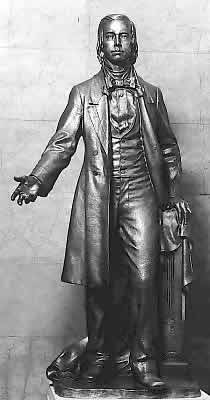
There is a Statuary Hall in the US Capitol, and Thomas Starr King's statue has been removed to make room for another Californian. The New York Times reflects on the moment:

Stop a moment, please, to say goodbye to Thomas Starr King. After more than 75 years of quiet and unwavering government service, he has lost his job of representing California in Statuary Hall in the United States Capitol. He has ceded his spot to Ronald Reagan, whose statue was unveiled on Wednesday.

Each state gets to honor two citizens in Statuary Hall. For California, first and second prize now belong to the Gipper and Junípero Serra, the Spanish friar who founded all those missions. Third prize is you’re fired, which for King means a one-way ticket to Sacramento.

He wasn’t a powerful politician or businessman. He was sickly and funny-looking. ...

He was a Unitarian preacher, and an amazing one at that; spellbinding, said people who heard him. He spoke up for slaves, for the poor, for union members and the Chinese. Most memorably, he spoke up for the Union, roaming the state on exhausting lecture tours, campaigning for Abraham Lincoln and a Republican State Legislature, imploring California not to join the Confederacy. He succeeded, but he did not live to see the Union victory. He died of diphtheria in 1864, age 39.

“He saved California to the Union,” this paper wrote, quoting Gen. Winfield Scott.

Statuary Hall is an exclusive club, but its members are not all well remembered. ...it would be hard to fill a schoolbus with New Yorkers who know Robert Livingston, one of the lesser founding fathers, and George Clinton, not the guy with Parliament Funkadelic, but the other one who was Thomas Jefferson’s vice president.

And that’s as it should be. Boldface names get all the attention. The Capitol needs a place for footnote-face names. Isn’t that what bronze and marble are for, to affix dimming reputations and outlast frail memories?

Here, then, a final toast to the worthy but obscure. To the frail patriot Thomas Starr King. And to Gov. George Washington Glick, bumped by Kansas in 2003 for Dwight D. Eisenhower.
Of course, in the long view even Eisenhower will be forgotten, unlikely as that might seem this week.

Image: today's footnote person.

Saturday, August 25, 2007

What dictatorship produces: the Death Star of Minsk

In Belarus, the one undoubted personal dictatorship in Europe, the dictator has built "the Death Star of Minsk," a new national library financed in part by funds extorted from schoolchildren.

What I wonder is what those schoolchildren will think when they look at this building in later years: a certain amount of pride? resentment? Some of each, I guess.

That presumes of course that the library won't have fallen down because of shortcuts taken by crooked contractors, or been abandoned because the books are rotting from improper ventilation.

Students in the upcoming HIST 2055, if any are reading this yet, might want to think about this issue. Much of the evidence we have for ancient and even not so ancient history is based on the survival of impressive monuments, and cultures and regimes have often been given positive ratings by academics and ordinary people on the basis that if you can produce something really neat, you must be basically OK.

Here we have Lukashenko's monument (pretty lights!), and Lukashenko's record is easily available. Is he basically OK? Do immigrants, legal and illegal, stream into Belarus?

Thanks for the image and the information to the always surprising English Russia. More stills and a video are available there.