Showing posts with label United Kingdom. Show all posts

Monday, September 19, 2022

(Queen Invisible)

 I've been following the death of the Queen fairly closely, somewhat to my own surprise.  I shouldn't have been. I'm a historian with an interest in the celebration of power..I have been fascinated by the efforts of commentators to put Elizabeth in historical perspective.  And what have they been saying?

Next to nothing!

Well, more specifically (my own summary, not entirely fair):

  • Elizabeth was the longest reigning monarch ever 
  • None of us can remember when she wasn't Queen (actually an interesting point)
  • She was Head of the world-wide Commonwealth (which people aren't entirely unhappy with)

What struck me first was the total absence of comparisons to (Queen Invisible).(Queen Invisible) is such an obvious comparison point. 
  • She sat on the same throne as Elizabeth did.  
  •  Her reign was very close to being as long as Elizabeth's. 
  •  She was also head of a world-wide organization, though it had a different name 
I only have only heard one commentator refer to the most obvious point:  If you bundle the last few years of her father's reign with Elizabeth's, you see the disappearance of the (world wide organization which (Queen Invisible) was head of , which we will not name.)

Now I can see that in the celebration of  a monarch's life you might not want to discuss at length such an embarrassing  fact.  But the complete disappearance of (Queen Invisible)'s very name! A woman whose very name is stamped on every continent, on islands, waterfalls, provinces, major cities, and country crossroads.  (Queen Invisible) is gone because she is a background for everything.

A whole era was named after (Queen Invisible) in recognition of her symbolic place in world culture.  Will there be a Second Elizabethan era? a Carolean era? Ah, here I may surprise you by plumping for EII.  People my age woke up one day (1973) to find that  the clunky old furniture that their parents hid in the attic were now valuable antiques.  Other things were already named after (Queen Invisible), who receded farther into the past. needed a symbol for the new historical awareness they gained.  Elizabeth filled the bill. She was after all old enough to be an historical figure based on the idealized Great-Grandmother. In the near term, this excludes the more controversial public record of  Elizabeth as an institution.  

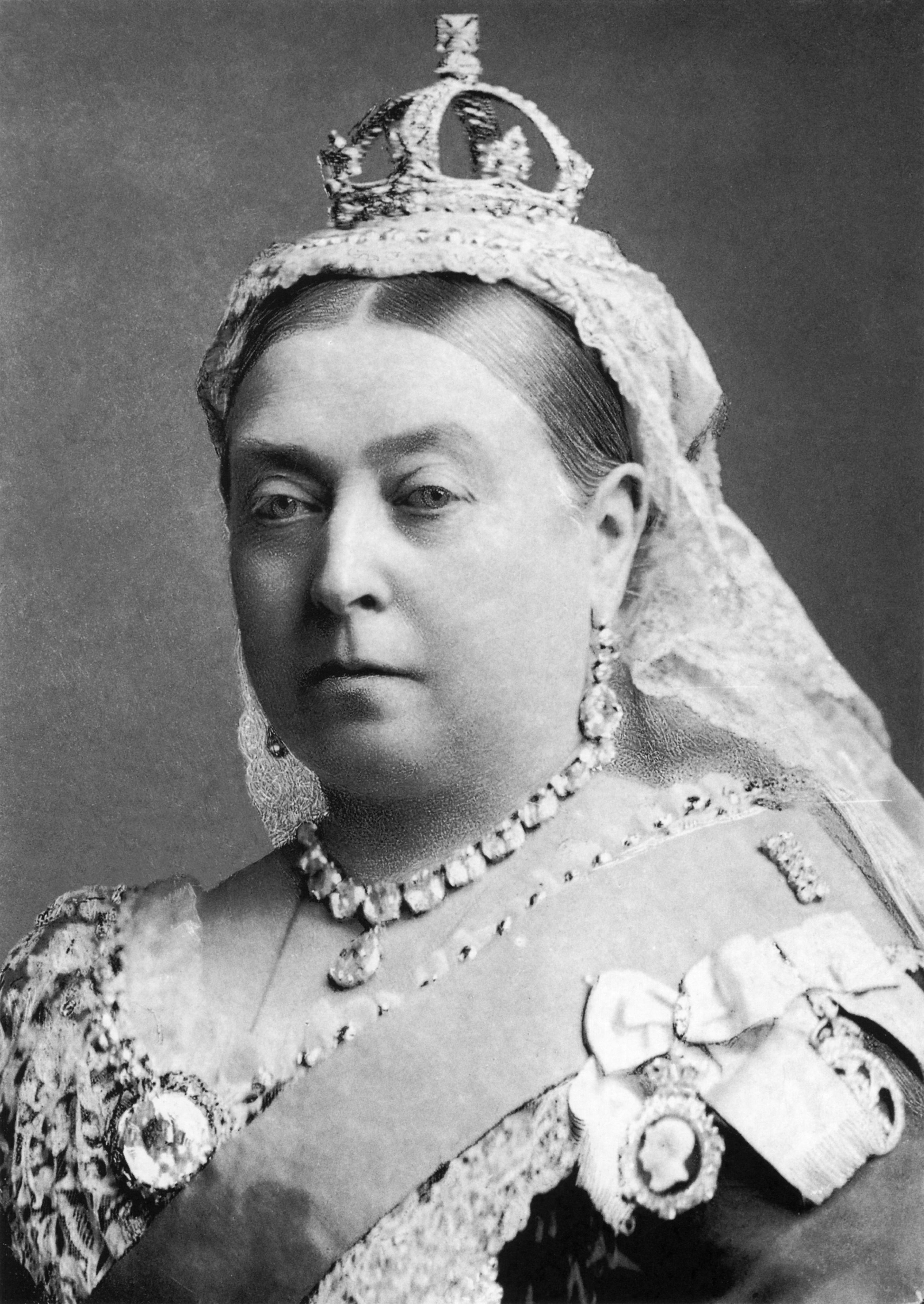
Image:  > Who is this woman? 


Sunday, August 11, 2019

Swimming wild in Britain

One of the best articles I've ever seen in the Guardian.  Extraordinary writers describe their love of swimming in wild locations.

A sample (from Rachel Edwards):
I love our river. It is ours not because we live on it (we don’t), or because we covet ownership of a beauty spot, but because this water flows through our family life. Our stretch of river lies between London and Oxford; it is technically the Thames and not quite the Isis; it is a gentle roar, a rushing calm, a city-country icon that feels deeply personal.

 When I first moved to our south Oxfordshire hamlet, 16 years ago, the river’s appeal was clear: every yard of it is picture perfect. Cross the weir, past the mill house and over the lock, past the weeping willow. Walk on with fields to your right and the river to your left, fringed by greenery that is mature yet exuberant (like many of the locals) and tiny beaches where anglers sit, nodding away the dogs who come sniffing at their bait.

I go in the water whenever the mood takes me: I have dunked myself to chill out a fraught afternoon and to commune with the dawn. I have been in with boat-weary friends, my husband, and – ill-advised, of course – alone (usually an angler is within shouting distance). To have a regular routine would kill the magic for me. The impulse, like the water, must be wild and free. When I do go in, it is always in summer – I marvel at those with hardy, moon-white bodies who smear themselves in goose fat and launch into wintry seas. I will never be one of their number. Even in a heatwave I mince in, arms bent and aloft, waiting for the cold water to stun my broiling core. Waist depth is optimum; I feel freed but embraced; I think about dipping my head under for a while. No earrings, no watch, offline. I’m ready.

I emerge each time alive but more so, skin teased and tingling, braids dripping, my mind washed of dark clutter; I am, if not quite reborn, then absolved by unseen river gods for as long as the water drips down my calves. Our river restores, rewarding even the most timid dip with cool inspiration. And so, in I go.

Wednesday, August 02, 2017

Joan, the Fair Maid of Kent A Fourteenth-Century Princess and her World, by Anthony Goodman

I would like to read this book, maybe even own it. The publishers describe it this way.

"Anthony Goodman's brilliant yet accessible scholarship draws in the reader in the most entertaining and vibrant way. He was one of our greatest historians of the later medieval period, whose warm humanity shines forth in his writing. He has given us, as a parting gift, the definitive biography of an exceptional, intriguing woman. I cannot recommend it highly enough." ALISON WEIR

Joan Plantagenet (1328-1385), acclaimed in her youth as the "Fair Maid of Kent", became notorious for making both a clandestine and a bigamous marriage in her teens and, in her thirties, a scandalous marriage to her kinsman, Edward III's son and heir, Edward of Woodstock, the Black Prince. Despite these transgressions, she later became one of the most influential people in the realm and a highly respected source of stability. Her life provides a distinctive perspective of a noblewoman at the heart of affairs in fourteenth-century England, a period when the Crown, despite enjoying some striking triumphs, also faced a series of political and social crises which shook conventional expectations. Furthermore, her life adds depth to our understanding of a time when marriage began to be regarded not just as a dynastic arrangement but a contract freely entered into by a couple.

This accessibly written account of her life sets her in the full context of her world, and vividly portrays a spirited medieval woman who was determined to be mistress of her fate and to make a mark in challenging times.

Sunday, March 26, 2017

If walls could talk: A BBC history of the home

My friend Nick Russon alerted me to the existence of a BBC 4 History of the Home now showing on Youtube. I have just watched the first of four episodes and I really like it. Part of it of course is the entertaining Lucy Worsley, who was made to be a TV presenter, but there's also the fact that the production quality is very high and we get to see a wide variety of (in this case) living rooms from many different angles. I don't doubt that other experts than Worsley and those who actually appear might disagree with some of the interpretations offered here, but at least you get a good detailed look at what they are talking about.

Fun!

Friday, March 24, 2017

A flash of truth cuts through the overheated rhetoric

A Guardian column on "alt-right" celebrity Katie Hopkins' carpetbagging critiques of London stumbles into an important truth. Marina Hyde:
For now, it falls to her [Hopkins] to explain London to the Americans. “Londoners can’t even be honest about these attacks,” she told Fox News. “Because it would mean everything they believed in was false.” >Ah, the false idols of the decadent metropolis! Had Katie spent more than 10 minutes in the World History aisle of Wikipedia, she would know there have always been people who hated cities for what they stood for. The metropolis has at many times served as shorthand for a kind of moral decay and wicked permissiveness that requires (usually forcible) regression.

“This place where monsters lurk and steal lives away in an instant,” thunders Katie of the capital’s wickedness. “For nothing.” Dear, dear – it does all seem rather terminal. I wonder what Katie would do with the failed, corruptive experiment that is London? The Khmer Rouge decided that the only solution was to empty the cities, and send their suspiciously educated denizens to the countryside. Come Katie’s revolution, perhaps Londoners will be forcibly migrated too.
Quite right, Marina. Don't forget that anyone wearing glasses will be labeled as a dangerous intellectual and eliminated.

Friday, March 17, 2017

The Guardian tells us what will happen when Queen Elizabeth dies

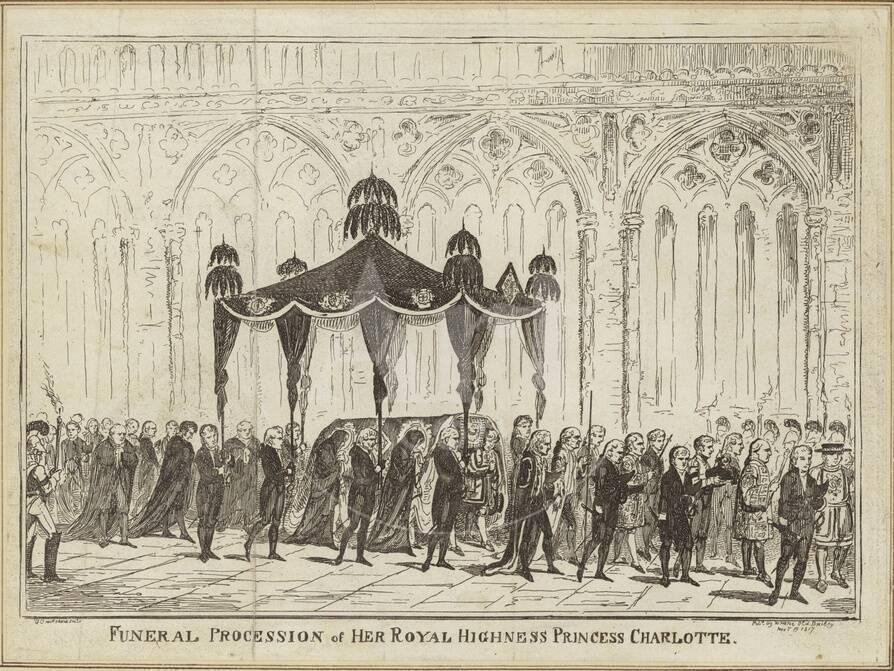
For a long time, the art of royal spectacle was for other, weaker peoples: Italians, Russians, and Habsburgs. British ritual occasions were a mess. At the funeral of Princess Charlotte, in 1817, the undertakers were drunk. Ten years later, St George’s Chapel was so cold during the burial of the Duke of York that George Canning, the foreign secretary, contracted rheumatic fever and the bishop of London died. “We never saw so motley, so rude, so ill-managed a body of persons,” reported the Times on the funeral of George IV, in 1830. Victoria’s coronation a few years later was nothing to write home about. The clergy got lost in the words; the singing was awful; and the royal jewellers made the coronation ring for the wrong finger. “Some nations have a gift for ceremonial,” the Marquess of Salisbury wrote in 1860. “In England the case is exactly the reverse.”

What we think of as the ancient rituals of the monarchy were mainly crafted in the late 19th century, towards the end of Victoria’s reign. Courtiers, politicians and constitutional theorists such as Walter Bagehot worried about the dismal sight of the Empress of India trooping around Windsor in her donkey cart. If the crown was going to give up its executive authority, it would have to inspire loyalty and awe by other means – and theatre was part of the answer. “The more democratic we get,” wrote Bagehot in 1867, “the more we shall get to like state and show.”

Obsessed by death, Victoria planned her own funeral with some style. But it was her son, Edward VII, who is largely responsible for reviving royal display. One courtier praised his “curious power of visualising a pageant”. He turned the state opening of parliament and military drills, like the Trooping of the Colour, into full fancy-dress occasions, and at his own passing, resurrected the medieval ritual of lying in state. Hundreds of thousands of subjects filed past his coffin in Westminster Hall in 1910, granting a new sense of intimacy to the body of the sovereign. By 1932, George V was a national father figure, giving the first royal Christmas speech to the nation – a tradition that persists today – in a radio address written for him by Rudyard Kipling.

The shambles and the remoteness of the 19th-century monarchy were replaced by an idealised family and historic pageantry invented in the 20th. In 1909, Kaiser Wilhelm II boasted about the quality of German martial processions: “The English cannot come up to us in this sort of thing.” Now we all know that no one else quite does it like the British.

The Queen, by all accounts a practical and unsentimental person, understands the theatrical power of the crown. “I have to be seen to be believed,” is said to be one of her catchphrases. And there is no reason to doubt that her funeral rites will evoke a rush of collective feeling. “I think there will be a huge and very genuine outpouring of deep emotion,” said Andrew Roberts, the historian. It will be all about her, and it will really be about us. There will be an urge to stand in the street, to see it with your own eyes, to be part of a multitude. The cumulative effect will be conservative. “I suspect the Queen’s death will intensify patriotic feelings,” one constitutional thinker told me, “and therefore fit the Brexit mood, if you like, and intensify the feeling that there is nothing to learn from foreigners.”

Thursday, March 02, 2017

Britain is also earning a new reputation

Brexit threatens the welfare of 3 million EU citizens resident in Britain, and the government refuses to protect them from disruption. Polly Toynbee in the Guardian:

The Lords debate exposed the prime minister’s contradictory and deceitful arguments against protecting EU citizens living here. If, on this most popular and painfully human question, she will give no inch, that’s a terrible augury for how she intends to conduct these negotiations, opening with a war cry to all 27 countries: we hold your people hostage.

The Mail says: “It’s the bloody-minded Brussels bureaucracy, not her, that is bargaining with family lives and happiness.” Because, of course, she is “pushing hard for a deal that upholds the rights of all expats”. This is just a “remoaner” wrecking tactic, “a naked bid to sabotage Brexit by creating difficulties for Mrs May”.

As the Guardian reports heart-rending cases of threats to longtime EU residents with British spouses and children born here, Helena Kennedy gave the shocking statistic that a third of all their applications for residency are being turned down by the Home Office. Whoever knew that if they hadn’t had private health insurance in the past they could be cast out for all time?


Yet one Brexit peer after another rose to swear there was never any question of expelling them. Ministers, including the foreign secretary, have assured the TV cameras it will never happen. But if so, why not accept this amendment with good grace when it returns to the Commons?


No, they say: these 3 million people must be used as hostages – though representatives of the 1.2 million Britons in the EU say they want this amendment passed, as an act of goodwill. You can’t bargain unless you sincerely mean to carry out the threat. So which is it?


Mass expulsions would be unthinkable – May as the new Idi Amin? Besides, for a depleted police, border force and administrators, it would be a crippling near-impossibility. Are we really to say goodbye to 55,000 doctors and nurses, a million care workers and prized university students while devastating industries from agriculture to car-washing, hi-tech IT to finance, catering and tourism? Forget tourism entirely – we would become pariahs.


So which is it: they can definitely stay – in which case just accept that amendment and tell the world – or rattle a sabre you may then be forced to use, whatever the self-harm?

Sunday, October 09, 2016

Purge those evil foreigners

From the Guardian:
Leading foreign academics from the LSE acting as expert advisers to the UK government were told they would not be asked to contribute to government work and analysis on Brexit because they are not British nationals.
The news was met with outrage by many academics, while legal experts questioned whether it could be legal under anti-discrimination laws and senior politicians criticised it as bewildering.
“It is utterly baffling that the government is turning down expert, independent advice on Brexit simply because someone is from another country,” said Nick Clegg, the Liberal Democrats’ EU spokesman.
“This is yet more evidence of the Conservatives’ alarming embrace of petty chauvinism over rational policymaking.”
Sara Hagemann, an assistant professor at the London School of Economics who specialises in EU policymaking processes, EU treaty matters, the role of national parliaments and the consequences of EU enlargements, said she had been told her services would not be required.
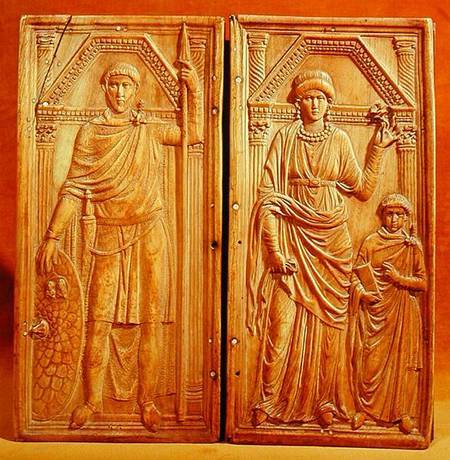
It's the end of the British Empire, at the hands of its own people. Late Roman historians, think of this.
Image: Stilicho, an obvious evil foreigner.

Monday, January 05, 2015

Sunday, September 29, 2013

Rant: digging up Richard III

It's not my rant but Howard Williams' of the University of Chester, referred to me by Guy Halsall.  Here is part of it:

Worshipping Dead RoyalsThe third objectionable aspect of the excavation of Richard III is the royal cult of personality that surrounded the excavation and the respect shown to his remains. I personally don’t have time for those that fawn over present-day living royals and their sprogs, but it seems somehow cut-rate and sordid to be fawning over long-dead royals in the hope of ‘rewriting the history books’ or getting to know their true person through their bodies. I can imagine the same sensitive facial reconstructions done for the butchers of the 20th century and imagine cult followers shedding tears over their sensitive small moustaches and their kind eyes.
Now I am sure Will, Kate and little baby George are all lovely. Even the Duke of Edinburgh makes me laugh. However, this royal necrophilia gets right up my archaeonose. Rather than the scientific study of human remains to understand life and death, this becomes a faux-forensic investigation into the individual’s life and death. Whether hero or villain, it is ironic that our obsession with the remains of the individual cadaver of Richard III flies in the face of the aspirations we have as a discipline for writing about the past in a social and humanising way.  Implicated in this view is that only rich and powerful people in the past matter today. In other words; the bones of toffs are venerated today as sacred, the bones of plebs are trowel fodder.
There is a strong case for Leicester cathedral to create a medieval equivalent to Westminster Abbey’s ‘tomb of the unknown soldier’. If you want to spend a million, select one of the many thousands of medieval graves we archaeologists have dug up – an old woman who died of leprosy, an infant who died in childbirth – and create a monument for them that makes us reflect on present-day poverty in the rest of the world and how many millions live in poverty today and die in agony from curable diseases. Don’t honour a warmongering royal, honour humanity.

Monday, November 05, 2012

Empire -- Lest we forget

Thanks to Nick Russon, this piece from the Telegraph:

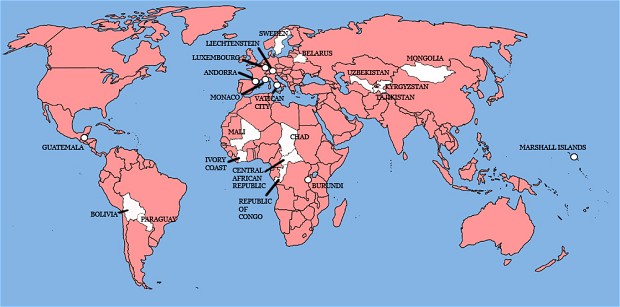
Every schoolboy used to know that at the height of the empire, almost a quarter of the atlas was coloured pink, showing the extent of British rule. But that oft recited fact dramatically understates the remarkable global reach achieved by this country.

A new study has found that at various times the British have invaded almost 90 per cent of the countries around the globe.The analysis of the histories of the almost 200 countries in the world found only 22 which have never experienced an invasion by the British.Among this select group of nations are far-off destinations such as Guatemala, Tajikistan and the Marshall Islands, as well some slightly closer to home, such as Luxembourg.

The analysis is contained in a new book, All the Countries We’ve Ever Invaded: And the Few We Never Got Round To. Stuart Laycock, the author, has worked his way around the globe, through each country alphabetically, researching its history to establish whether, at any point, they have experienced an incursion by Britain.