Showing posts with label Gaza. Show all posts

Wednesday, June 02, 2010

More on the high seas incident


The Israeli attack on the aid flotilla to Gaza remains the big story. The consequences of this action will roll on for a long time. The are some pieces that casts some light on the situation.

At Brian's Coffeehouse, Brian insists that the interpretation of events not get lost in irrelevant details:
In the wake of yesterday's assault on the Gaza aid flotilla, the most important tactic of Israel's defenders, including the American government, has been to focus on the details of the events which transpired aboard the Mavi Marmara in the early stages of the confrontation. The Israelis argue that their military was pursuing something like peaceful crowd control until they were attacked by activists aboard the ship, and pointing to the two seriously and eight lightly injured soldiers, insist they fired in self-defense.

The Israeli preference, in other words, is to have a discussion about rules of engagement. In attempting to focus the international discussion there, they are also implicitly asking their critics to somewhat carelessly accept the premise that the flotilla represented a force which required a military assault in international waters....

Despite half-baked claims to the contrary, this was not, as Israeli Prime Minister Benjamin Netanyahu claimed today, "a violent force", and the Israelis have apparently found no weapons to trumpet before the cameras. Instead, they have found a bunch of humanitarian aid which they are allegedly transferring to Gaza themselves. I would love for someone to examine that situation, and determine how much of it was in violation of Israel's draconian blockade of the territory, and consequently how dangerous it can really be if Israel's now just passing it on.

For the real story here is not about a military confrontation at sea, but about an ongoing siege the consequences of which for the Gaza Strip have been well documented elsewhere. If Israel were just checking ships and convoys for weapons and then waving them on, this flotilla would not have existed. The violence yesterday was but an extension of the ongoing violence of siege which does not protect Israel, but makes Gaza into a giant internment camp in which conditions are becoming increasingly desperate. In this context, who did what to whom once the Israeli assault was in progress simply doesn't matter.
Yesterday I saw an American make the point that even Egypt is involved in the blockade of Gaza. As if he saw the same footage, Juan Cole illuminates the difficult position the Egyptian government finds itself in. This is a good introduction to the anomalous position that Palestinians hold in the Arab world:
Although Egypt is widely criticized for mainly keeping the Rafah crossing closed or open only for short periods, Cairo is forced into this arrangement by its peace treaty with Israel and its dependence on the US for $2 billion a year in various sorts of aid.

Were Egypt to defy Israel’s blockade for a long period of time or let in forbidden materials, the Israelis would almost certainly just bomb the entrance. Egypt’s government deeply dislikes having to remain silent in the face of Israeli provocations, as Khalid al-Shami pointed out in Tuesday’s al-Quds al-Arabi. But in fact Egypt could do nothing in the face of such an Israeli military action, being constrained by its treaty obligations and by its close alliance with the USA.

But keeping the border this open holds dangers for Egypt itself. Cairo fears that at some point Israeli foreign minister and leader of the far rightwing Yisrael Beitenu party Avigdor Lieberman will make good on his threats of ‘transferring’ the Palestinians. Egypt is determined that Israel will not resolve its Palestinian problem by expelling them to Egypt as refugees in the Sinai Peninsula. (Likely the Israeli shooting-fish-in-the-barrel war on Gaza in winter 2008-2009 was in part intended to provoke a panicked exodus of Palestinians into the Sinai, but Egyptian military forces prevented any such thing from occurring).

Egypt deeply dislikes the Hamas party/ militia and would not want to be in the position of allowing its influence to spread among bedouin and others in the Sinai region. Such Hamas influences are already blamed for terrorist bombings at Red Sea resorts earlier in this decade.

More to come, undoubtedly.

Image: the Rafah crossing between Gaza and Egypt, 2008?

Tuesday, June 01, 2010

On the high seas


The Israeli attack on the aid flotilla to Gaza has the potential to revolutionize the politics of the Middle East. This is such a big topic that I am tempted to leave it to the experts, advocates and agitators. But keeping in mind past and future students in my Islamic Civilization class, I have decided that I should reproduce here a few posts that touch on points I think are important, notably the relationship/alliance between officially secular Turkey and Israel, and the legality and consequences of the Israeli action.

Craig Murray, a former British diplomat, disagrees that the attack was piracy. The legal position, unless you strongly support the legality of the Israeli blockade of Gaza, is more complicated:


A word on the legal position, which is very plain. To attack a foreign flagged vessel in international waters is illegal. It is not piracy, as the Israeli vessels carried a military commission. It is rather an act of illegal warfare.

Because the incident took place on the high seas does not mean however that international law is the only applicable law. The Law of the Sea is quite plain that, when an incident takes place
on a ship on the high seas (outside anybody's territorial waters) the applicable law is that of the flag state of the ship on which the incident occurred. In legal terms, the Turkish ship was Turkish territory.

There are therefore two clear legal possibilities.

Possibility one is that the Israeli commandos were acting on behalf of the government of Israel in killing the activists on the ships. In that case Israel is in a position of war with Turkey, and the act falls under international jurisdiction as a war crime.

Possibility two is that, if the killings were not authorised Israeli military action, they were acts of murder under Turkish jurisdiction. If Israel does not consider itself in a position of war with Turkey, then it must hand over the commandos involved for trial in Turkey under Turkish law.

In brief, if Israel and Turkey are not at war, then it is Turkish law which is applicable to what happened on the ship. It is for Turkey, not Israel, to carry out any inquiry or investigation into events and to initiate any prosecutions. Israel is obliged to hand over indicted personnel for prosecution.
Over at the US political news site Talkingpointsmemo.com is this comment on relations between Turkey and Israel:

Allies can make up after almost any coming to blows if they want to. But that's the key. This isn't the first blow up in Israel-Turkey relations. Turkish opposition to the Gaza War (Operation Cast Lead) has been at the center of the dispute going back to 2008. But even that doesn't really fully explain the decline in relations.

The Israelis, under the foreign ministry headed by the far-right Avigdor Lieberman, have on their side managed to repeatedly snub the Turks over recent months. Sometimes in response to deteriorating relations that both sides played a part in. But other cases seemed like gratuitous and self-destructive provocations by the Israelis. With the political vision of someone like Lieberman, who embodies the ugliest trends in Israeli politics, the alliance with Turkey isn't so much a bridge toward an opening to other Arab or Islamic countries but a distraction or an impediment.

On the other side of the equation though, it's not clear that the AKP government of Turkey, which is probably more accurate to call Islamic-rooted rather than 'Islamist', really wants the alliance with Israel in the first place -- quite apart from the Gaza War or the Flotilla incident. Their roots as a party and their diplomacy have all seemed directed at deepening ties with nearby Islamic countries who in most cases have either cool or downright hostile relations with Israel. And in that context the Turkey-Israel alliance, which has historically run very deep, seems like a liability.

More or less as an American VP said a while ago, this is a big deal. I'll pass on discussing the effects on US foreign and domestic politics; you will soon be able to find an infinity of commentary on those subjects.

Image: The USS Liberty, attacked on the high seas in 1967. A lot of people are bringing that incident up today. Look it up.

Monday, March 23, 2009

One sentence that says so much about the Middle East


Concluding an article published by the Washington Institute for Near East Policy:
Given current regional trends, the fight to reconstruct Gaza is a contest that Israel, Fatah and Washington cannot afford to lose.
In other words, on the issue of who controls reconstruction funds, these three are allies against Hamas.

Image: Gaza damage.

Saturday, March 21, 2009

Even smaller wars wreck lots of things

Two discouraging stories from McClatchy news service:

The first is a video report on the lack of services in Iraq, with show and tell. Highly recommended. You will learn a lot about the modern world, and life on the Planet of Slums.

Then there is this:
Israeli soldiers say army rabbis framed Gaza as religious war.

Rabbis affiliated with the Israeli army urged troops heading into Gaza to reclaim what they said was God-given land and "get rid of the gentiles" — effectively turning the 22-day Israeli intervention into a religious war, according to the testimony of a soldier who fought in Gaza.

Literature passed out to soldiers by the army's rabbinate "had a clear message — we are the people of Israel, we came by a miracle to the land of Israel, God returned us to the land, now we need to struggle to get rid of the gentiles that are interfering with our conquest of the land," the soldier told a forum of Gaza veterans in mid-February, just weeks after the conflict ended.

A transcript of the testimony given at an Israeli military academy at the Oranim college on Feb. 13 was obtained on Friday by McClatchy and also published in Haaretz, one of Israel's leading dailies. The soldier, identified as "Ram," a pseudonym to protect his identity, gave a scathing description of the atmosphere as the Israeli army went to war.

Just what we needed, more holy warriors.

Image: work on a sewage treatment plant in Falluja, October 2008, not going well.
Among many other reasons: ""The project file lacked any documentation to support that the provisional Iraqi government wanted this project in the first place," [instead of even more pressing needs]. Rather, it appears that occupation authorities conceived of this project "for the Iraqis."

Thursday, January 15, 2009

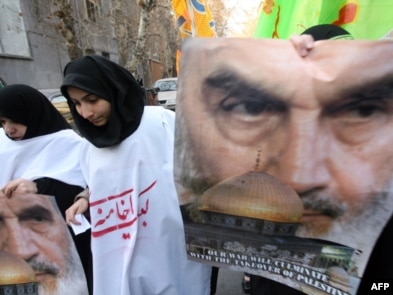
Gaza as a domestic Iranian issue


From Radio Free Europe/Radio Liberty's Iran Report:
One man who telephoned RFE/RL's Radio Farda from Isfahan said that authorities "are really killing us" with their efforts to drive home the Gaza crisis and express solidarity with Hamas. "All the programs on Iran's television channels, from channel one to channel seven, it's all about the people of Gaza and support for Hamas," the man said. "Why is it like this in Iran? Why are we caring so much about Gaza? Why we don't care about ourselves?"

A Tehran-based journalist, who spoke anonymously due to what he described as the "sensitivity" of the issue, told RFE/RL that people in Iran are far from indifferent to the deaths of civilians in conflicts. Many people think the international response in the Gaza crisis has been insufficient, he noted.

But, he said, some also believe the government is exploiting the crisis to divert domestic attention from Iran's worsening economic situation, including spiraling inflation and growing unemployment.

Another recent caller to Radio Farda claimed "the mullahs" use Palestine and other Middle East flashpoints for their own political ends.

"They've created a stick out of Palestine to give a response to all of the people's questions and demands -- whoever says something will be [silenced]," the caller said. "Otherwise we're a country like other countries, we should mind our own business and solve our own problems. Has there ever been a president who has asked, 'How's our country doing regarding issues like health, electricity, unemployment, poverty?'.... All they speak about is Palestine and Lebanon."

See also the comments to the story.

Image: Anti-Israel demo in Tehran.

Saturday, January 10, 2009

Everybody's losing in Gaza

Excerpts from an opinion piece at TPMCafe, by M.J. Rosenberg:

It is obvious who is losing the Gaza war. But who is winning?

First the losers. Hamas is losing. It made the mistake of believing its own propaganda about Israelis having lost the determination to fight for their state....

But the biggest loser of all is not Hamas (I wish it was), but the people of Gaza. The conservative Israeli daily Ma'ariv quotes "Israeli sources" who say that "of the approximately 550 fatalities in the operation," only 200 "are linked to the warfare by affiliation or by the manner in which they were killed." This means, Ma'ariv reports, that "that the harm to Hamas members . . . is apparently much smaller than the number of unarmed people who were killed."...

The Israelis have also lost. The people of southern Israel have been living in terror for years. Anyone who knows small children understands how little it takes to startle and terrify them. Imagine how they react to the endless crashing of incoming Kassams, which reduce adults to quivering and tears.

Israel has also lost politically. ...

Even among those who think there was no alternative to war, few are remotely happy about it. They may believe that the war is justifiable, but they hate the idea that Gaza's kids are the victims. On the other hand, they argue, the war could destroy Hamas. Wouldn't that be a good thing? Maybe.

Bringing Hamas to power is one of the most horrific legacies of the Bush administration. In retrospect, the decision to oust Arafat (who had demonstrated the ability to thwart terrorism, and had reduced it to almost zero between 1997 and 2000) was a blunder. The administration's subsequent stingy support for Mahmoud Abbas was incomprehensible and its decision to force the Palestinian elections that brought Hamas to power--and which Israel and Abbas opposed--was about as benighted a foreign policy move as any in history.

Nonetheless, Hamas' possible successors as rulers of Gaza would likely be worse. Forget about the idea of Abu Mazen riding in triumph back into Gaza following the Israeli troops. One, he wouldn't do it. Two, if he did, he would be viewed as an Israeli stooge.

No, Hamas' likely successors would be Al Qaeda--and its allies--which already have cells in Gaza. Hamas and Al Qaeda hate each other for many reasons, most of which are of interest only to students of Islam. The one that matters to us is that Hamas is willing to compromise with its enemies.

Al Qaeda and its ilk are at permanent war with the West, a war which cannot end until either AQ or the infidels are destroyed. Al Qaeda is not fighting for political goals but to create a pan-national Islamic State that would supplant not only Israel but all the Arab states.

Hamas, an offshoot of the Muslim brotherhood, limits its ambitions to achieving a state in Palestine. It believes in compromise, if only as a stop gap. That is why it could sign a ceasefire agreement with Israel and, according to even Israeli sources, observe it until it decided that Israel was not living up to its end of the deal. It has even raised the idea of a 15 or 20 year ceasefire with the Jewish state.

All this is anathema to groups like Al Qaeda, for whom the destruction of the World Trade Center was a triumph--although it advanced no political goals. AQ has none, just as the terrorists in Mumbai killed for killing's sake.

And these are the people who could make Gaza--a few miles from Tel Aviv--its ultimate base of operations.

Writing in the London Jewish Chronicle, reporter Jonathan Freedland predicts, "Gaza could become a vacuum, rapidly descending into Somalia, a lawless badland of warlords and clans. . . . And from the rubble of Gaza, the attacks on Israel will surely resume."

He then quotes Mideast expert Rashid Khalidi, "There would be no Hamas leadership--with undeniable discipline over its forces and the pragmatism to see the benefits of a ceasefire--to rein in these new, angry fighters. The great irony is that Israel may well decapitate Hamas--only to regret the passing of a Palestinian administration with sufficient stature to bring order."

That is another reason for a ceasefire now. The first is to stop the killing. The second is to ensure that a year or two from now we are not all wishing that Hamas was still in charge.

After all, who would think that we would miss Arafat?

Friday, January 09, 2009

The Gaza War in a wider context

In our last Islamic Civilization class we talked about French colonialism in Algeria. Today Juan Cole refers to that history in connection with events in Gaza. This is a long quote, but I urge you to go to Informed Comment and read the whole thing (especially the remarks of an American veteran of the Iraq war that precede this section):

The difference between Israeli military action in Gaza and most US operations in Iraq is not a matter of national character or some other essentialist attribute. It is the difference between imperial occupation for specific purposes and settler colonialism. The Israelis are both an army and a settler movement. The US never considered flooding Iraq with colonists from Alabama and Mississippi.

When threatened by an indigenous population trying to expel it, settler colonialism is vicious. It is after all facing an existential threat. The US can withdraw from Iraq with no dire consequences to the US. In 1954-1962, the French killed at least half a million, and maybe as much as 800,000 Algerians, out of a population of 11 million. That is between nearly 5 percent and nearly 10 percent! The French military had been enlisted to fight for the interests of the colonists, who were in danger of losing everything. (In the end they did lose almost everything, being forced to return to Europe, or choosing to do so rather than face the prospect of living under independent Algerian rule).

The brutality with which the British put down the Mau-Mau revolt in Kenya in the 1950s is another example of massive human rights violations on behalf of a settler population.

This latest sanguinary episode is a further manifestation of Israel's insecure brand of settler colonialism, in which the lives of the indigenous population are viewed as worthless before the interests of the colonists. The Israelis have not killed on the French scale, but I would argue that they kill, and disregard civilian life, for much the same reasons as the French did in Algeria.

Settler colonialism is unstable in the contemporary world because of the facilities subject populations have for mobilization and resistance. Conflict between colonizer and colonized has only ended in one of three ways: 1) The expulsion of the colonists, as in Algeria; 2) the integration of the colonists into a nation that includes the indigenous population, as happened in South Africa; or 3) the expulsion of the indigenous population, as with the Trail of Tears in the nineteenth-century United States.

Bob Simon told Charlie Rose that the 'two-state solution' in Israel-Palestine is dead, which is likely correct. He suggested that the most likely outcome is Apartheid. However, I would argue that Apartheid is a phase and its itself an unstable situation, and that only one of the above three outcomes is actually permanent. Given that the Arabs are becoming more technologically sophisticated and wealthier over time, and given their demographic advantage, I do not expect a transferist or trail of tears policy to be implemented or succeed. In the long term, over several decades, I think either there will be a gradual outflow of Israeli emigrants that leaves Jews a plurality in Israel. Or there will eventually be a single state. The other possibilities, of either a century-long Apartheid or another expulsion of Palestinians a la 1948 seem to me less likely. The Gaza operation is intended to extend the life of an incipient Apartheid. But that is sort of like giving a heart transplant to a man diagnosed with terminal cancer.

Thursday, January 01, 2009

Bombs over Israel and Gaza...


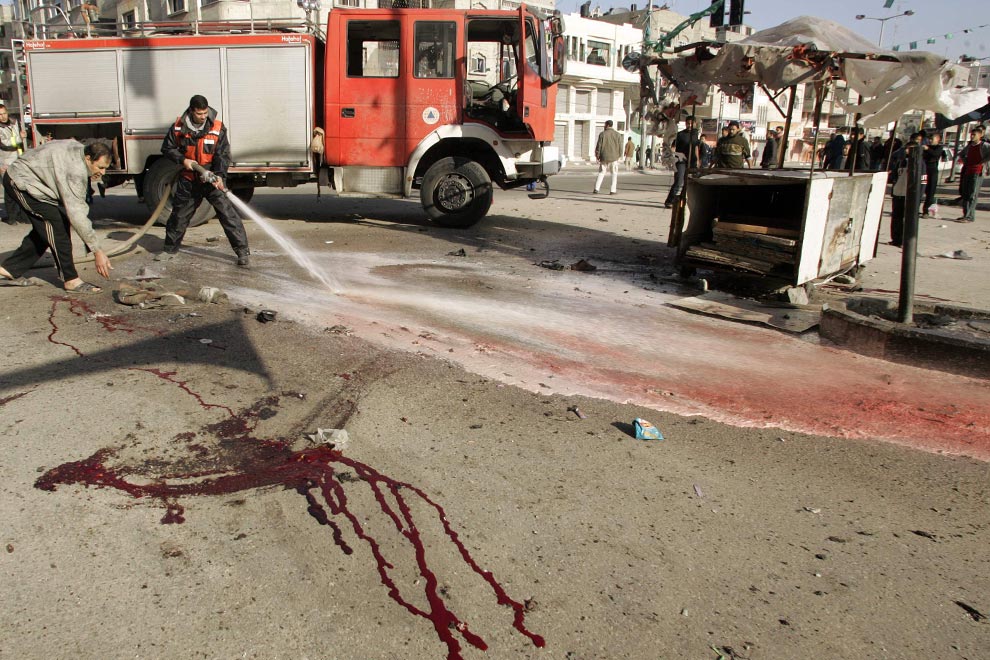
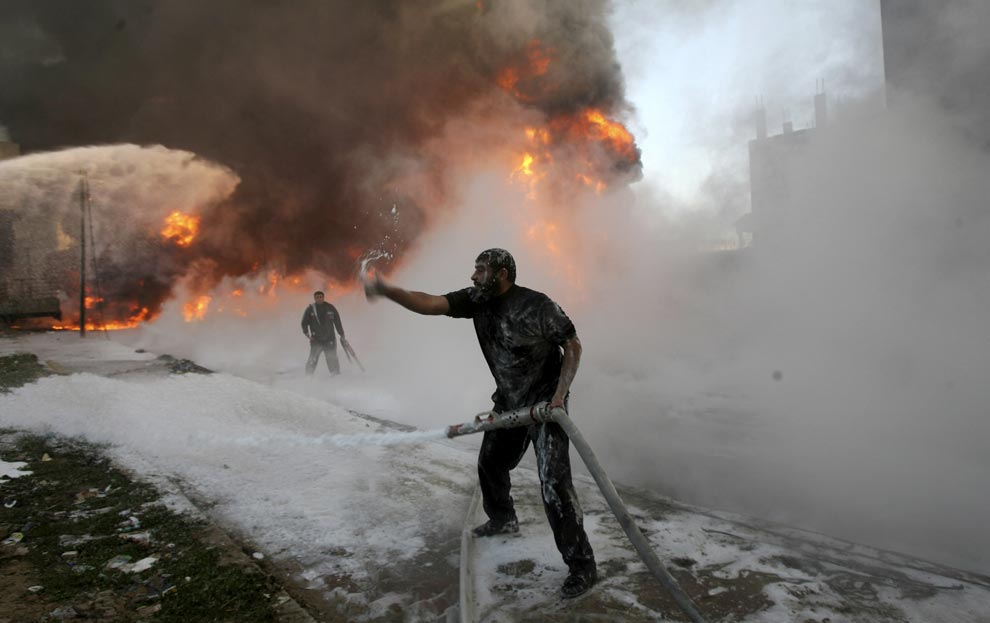
...and the people they hit. The Big Picture shows us the weapons, the explosions, the blood and the terror.

To leaven this with some good news, see Juan Cole's New Year's article, Top Ten Good News Stories in the Muslim World, 2008 (That Nobody Noticed).

Image: a firefighter tries to douse a medical warehouse (!).

Tuesday, December 30, 2008

Gaza: Like casino chips

An Arab-American analyst gives Laura Rozen at War and Piece an anonymous interpretation of what is behind the Gaza situation (my word, which shocks me with its bloodlessness):

There are two domestic agendas here. The Israeli one is very familiar... But what people are not asking and is at least as important: what are the f**** rocket firers hoping to do? ... If you look at what people are saying, there is a disconnect between what Haniyah and people in Gaza are saying, and what Nasrallah and Meshal and regional actors say. ... The Hamas leadership in Gaza is saying, we want a ceasefire on our terms. What Nasrallah and Meshal and Iran are saying: Egyptians, rise up ... What’s missing in every analysis I see is that Egypt is the prize, the low hanging fruit ...

Sketch out the regional scenario: two unsympathetic forces hinged by Hamas. You have the Iran, Syria, Hezbollah, Iraqi Islamist parties on the one hand, on one side of the hinge. ... And you’ve got the Muslim Brotherhood regional project for overthrowing [moderate Arab regime] governments on the other.

The hinge is Hamas. Because Hamas is a core member of Leninist-style collection of national Muslim Brotherhood parties. It is also the only Sunni member of the pro Iranian alliance because of the money it gets through Khaled Meshal. Hamas is a hinge, Syria is a hinge. You've got Meshal in Damascus who gets lots of money from Iran. Hamas is not neutral in the moderate Arab regimes vs. Iranian alliance rivalry.

Both stand to benefit here. One project advances [unrest] in Egypt to the benefit of the Muslim Brotherhood. And while that is not something to be overjoyed for for Nasrallah, it's very helpful if it advances the Islamist agenda to destabilize your enemies.

It's limited ultimately. It's very unlikely to result in direct destabilization of Egypt. But they shoot for it, and hope that it contributes to the discreditation of all the [moderate, pro American] Arab regimes [egypt, jordan, saudi arabia] and in that sense, shows that there is an authentic movement in the region that has two manifestations, the Iranians and the Muslim Brotherhood, who are resistant to the regional order and the status quo. ...

What you end up with here are two groups of political actors with domestic and internal motivations that largely don’t have to do with Gaza. And they are using the lives of these people like casino chips...

More from the Globe and Mail.