Showing posts with label Iraq. Show all posts

Tuesday, June 30, 2026

Dancing for death -- a repellant story

 Another story from the Guardian: the murder of Kawthar Bashar al-Husayjawi, an Iraqi teenager (15 y.o.) who was killed by her family for refusing  a marriage they had arranged  for her.  She had been forced into an earlier marriage at 13! She seems to have been denied any practical education or any form of autonomy, but after a year of mistreatment she was able to get a divorce. But her family insisted that Kathwar marry a man  of their choice who  was a drug- and alcohol dealer.

It wasn't long before a group of family members emptied a gun in Kwathar and buried an axe  in her skull,

Here she is. She looks like a kid, but she obviously had a strong backbone.


Monday, February 29, 2016

Humbaba!

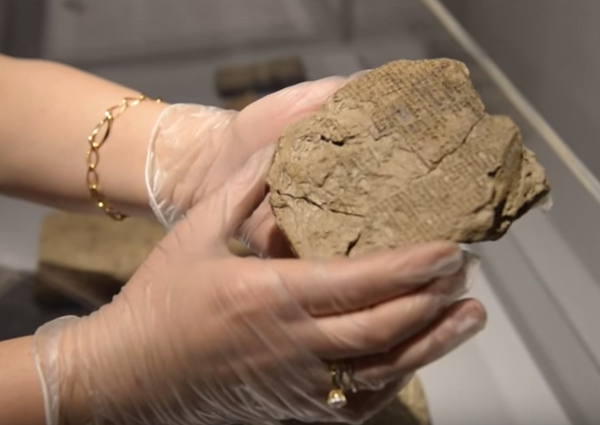
Missing pieces of the Epic of Gilgamesh found! Open Culture says:
That’s a pretty good deal for these extra lines that not only add to the poem’s length, but have now cleared up some of the mysteries in the other chapters. These lines come from Chapter Five of the epic and cast the main characters in a new light. Gilgamesh and his companion Enkidu are shown to feel guilt over killing Humbaba, the guardian of the cedar forest, who is now seen as less a monster and more a king. Just like a good director’s cut, these extra scenes clear up some muddy character motivation, and add an environmental moral to the tale.

Friday, February 26, 2016

The sounds of the past

I stumbled across two interesting blog posts this past week, both concerned with recovering or reconstructing ancient languages. Back in 2010, Open Culture ran a piece on ancient Akkadian (an early Mesopotamian language, one of the first written down anywhere). A short piece of the Epic of Gilgamesh was included. Have a look! And while you are at it, read up on the completion of the Akkadian dictionary produced by the Oriental Institute in Chicago -- over the last 90 years.

Best thing about the dictionary? If you are content to have it in electronic form, it's FREE, FREE, FREE! And if you have a bundle to spend, you can have it in a very nice printed set.

Now there is scholarship for you.

About the same time, I ran across this article on ancient Greek music. Everyone who cares to know it knows that the ancient Greeks were world champions in their time in both painting and in music. But in both cases, just about none of it is left.

Just about!

Back in 2013, the BBC ran (in its business section!?) a detailed piece on how some of that music must have sounded (at least in a minimal "unplugged" form).

Revelation (for me at least): "In ancient Greek the voice went up in pitch on certain syllables and fell on others (the accents of ancient Greek indicate pitch, not stress)."

Wow! Does this mean that speaking ancient Greek was similar to singing?

Sunday, June 02, 2013

Good news from Iraq

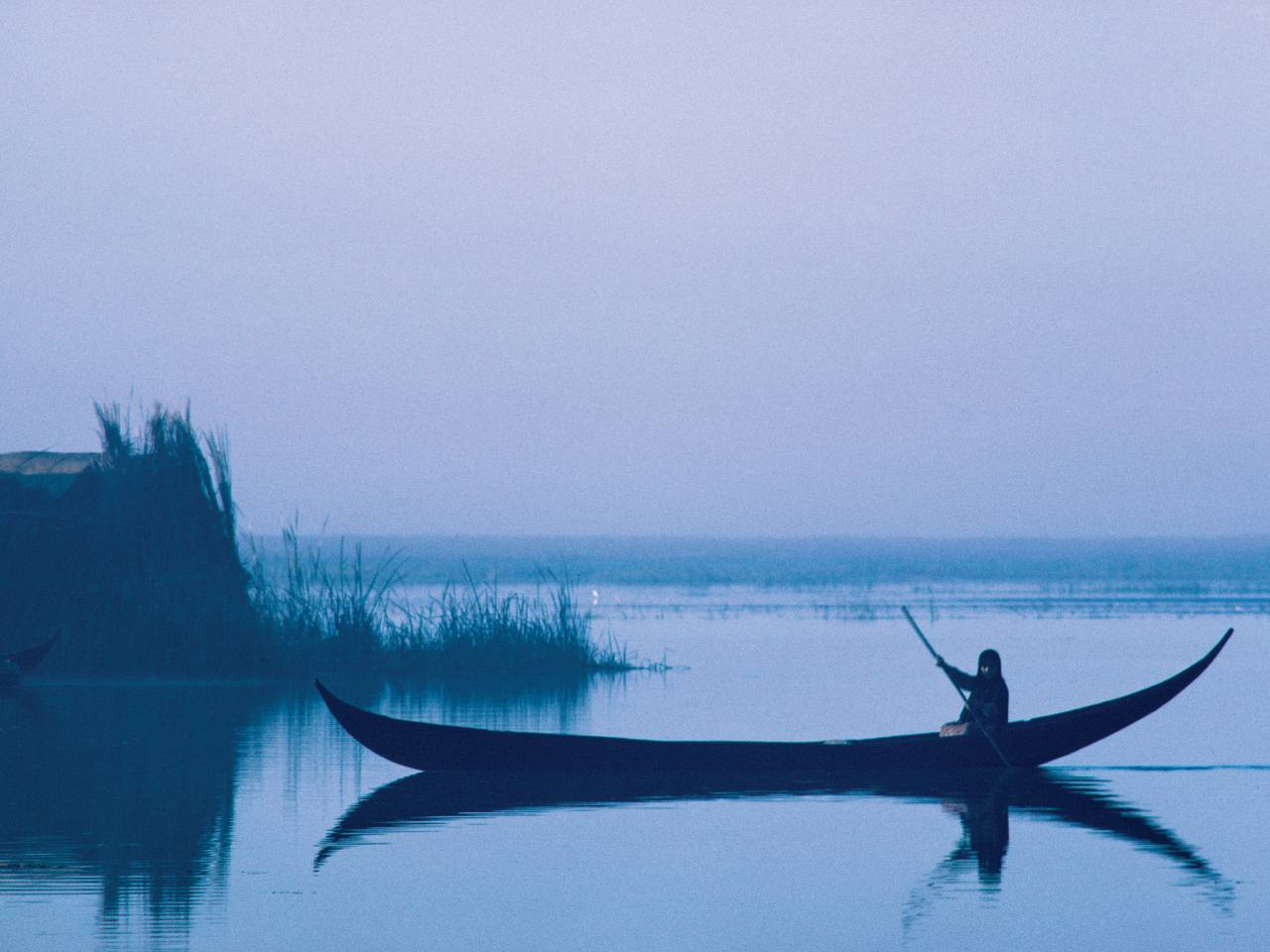
The marshes are coming  back!

http://www.bbc.co.uk/news/magazine-22706024

The BBC article shows a town hall made of reeds, just like in the old, old days. 

Monday, March 18, 2013

Juan Cole on the damage done by the Iraq War

Cole has ten points of the harm done to the USA; this is part of the introduction and the first point:

Coming into 2003, the US enjoyed a great deal of sympathy and solidarity from the rest of the world (including Iran) over the al-Qaeda strikes of September 11, 2001. In the aftermath of the invasion and occupation of Iraq, the US was widely seen as an international bully. The hard-nosed realists of Washington, of course, don’t care how the country is perceived. But the poor opinion translated into an unwillingness to help out with the Iraq project, a project far too large for the United States to handle on its own. And no, El Salvador wasn’t able to help that much. Moreover, in the wake of the Civil Rights movement, public discourse in the US moved toward greater decency. Some of that achievement was lost because of war propaganda against Arabs and Muslims.

1. The US invasion and occupation of Iraq harmed the US in bringing into question its basic competency as a world leader. Almost everything the US did in Iraq was a disaster. It could not even get the stated reason for the invasion right, as it turned out there was no nuclear, biological or chemical weapons program. It looked dishonest, bumbling. It went into the war having no plans, and the plans the Bush administration made on the fly were mostly poorly thought-out and doomed to fail. It fell into search and destroy as a tactic for counter-insurgency, with the same results as it had had in Vietnam– it caused resistance to swell. Billions were wasted on reconstruction projects that assumed Iraqi know-how and equipment that they did not have, and which could not therefore be maintained even if they were completed. The US tried to run in English an Arabic-speaking country that had been deliberately isolated and cut off from the world by sanctions, without any basic understanding of Iraqi culture, customs, beliefs or ways of life. The pro-Israel Neoconservatives high in the administration blackballed (as insufficiently pro-Israel) Arabists who volunteered to go help and left the Coalition Provisional Authority blind.

Basically, the world is always looking around for a team leader and a consulting group that is known for competence and for getting good results. After World War II, the US was for the most part that country. Being the world’s team leader turns into respect, cooperation and, ultimately, confidence and investment. If the US came to most of the world today with a group project, it likely couldn’t get the time of day from them. The United States is deeply diminished in world counsels.
Lots more here.

Image:  Abandoned Camp Cooke.

Thursday, August 16, 2012

A stunning pair of images

Over at TomDispatch.com:
How Not to Reconstruct Iraq, Afghanistan -- or America A Guide to Disaster at Home and Abroad By Peter Van Buren

Some images remain like scars on my memory. One of the last things I saw in Iraq, where I spent a year with the Department of State helping squander some of the $44 billion American taxpayers put up to “reconstruct” that country, were horses living semi-wild among the muck and garbage of Baghdad. Those horses had once raced for Iraqi autocrat Saddam Hussein and seven years after their “liberation” by the American invasion of 2003, they were still wandering that unraveling, unreconstructed urban landscape looking, like many other Iraqis, for food.

I flew home that same day, a too-rapid change of worlds, to a country in which the schools of my hometown in Ohio could not afford to pay teachers a decent wage. Once great cities were rotting away as certainly as if they were in Iraq, where those horses were scrabbling to get by. To this day I’m left pondering these questions: Why has the United States spent so much money and time so disastrously trying to rebuild occupied nations abroad, while allowing its own infrastructure to crumble untended? Why do we even think of that as “policy”?

Monday, April 02, 2012

WMD Lies -- for the record


Just in case anyone has any doubts yet, see this article from the Independent. 
A man whose lies helped to make the case for invading Iraq – starting a nine-year war costing more than 100,000 lives and hundreds of billions of pounds – will come clean in his first British television interview tomorrow.
"Curveball", the Iraqi defector who fabricated claims about Iraq's weapons of mass destruction, smiles as he confirms how he made the whole thing up. It was a confidence trick that changed the course of history, with Rafid Ahmed Alwan al-Janabi's lies used to justify the Iraq war.
He tries to defend his actions: "My main purpose was to topple the tyrant in Iraq because the longer this dictator remains in power, the more the Iraqi people will suffer from this regime's oppression."
The chemical engineer claimed to have overseen the building of a mobile biological laboratory when he sought political asylum in Germany in 1999. His lies were presented as "facts and conclusions based on solid intelligence" by Colin Powell, US Secretary of State, when making the case for war at the UN Security Council in February 2003.
But Mr Janabi, speaking in a two-part series, Modern Spies, starting tomorrow on BBC2, says none of it was true. When it is put to him "we went to war in Iraq on a lie. And that lie was your lie", he simply replies: "Yes."
US officials "sexed up" Mr Janabi's drawings of mobile biological weapons labs to make them more presentable, admits Colonel Lawrence Wilkerson, General Powell's former chief of staff. "I brought the White House team in to do the graphics," he says, adding how "intelligence was being worked to fit around the policy".
As for his former boss: "I don't see any way on this earth that Secretary Powell doesn't feel almost a rage about Curveball and the way he was used in regards to that intelligence."
Image:  I'd run one of Janabi, but that would distract us from the big fish, Bush, Blair, Cheney and, yes, Powell.

Friday, February 03, 2012

"Losing" Iraq


Some of Obama's political opponents are peddling the idea that his administration "lost" Iraq.  An article in Salon by Matt Duss refutes this charge:

 Brett McGurk, who served as a senior advisor to three U.S. ambassadors in Baghdad, helped negotiate the 2008 withdrawal agreement with the Iraqi government. He also attempted to negotiate a new agreement in 2011 that would’ve allowed a residual U.S. force to stay.
It wasn’t possible, as he explained in a Washington Post Op-Ed. “The decision to complete our withdrawal was not the result of a failed negotiation,” McGurk wrote, “but rather the byproduct of an independent Iraq that has an open political system and a 325-member parliament.”
Trying to force an agreement through that parliament would have been “self-destructive,” he wrote. “That had nothing to do with Iran and everything to do with Iraqi pride, history and nationalism. Even the most staunchly anti-Iranian Iraqi officials refused to publicly back a residual U.S. force — and in the end, they supported our withdrawal.”
As for the claims that Iran would benefit from the U.S. withdrawal, the fact of the matter is that Iraq became “exposed” to Iranian influence the moment the Bush administration removed Saddam Hussein.  For years Saddam had served as the biggest check on Iranian power in the region. It was the Bush administration, supported by the likes of Krauthammer and Ajami, that created an Iraqi government largely run by Iran’s partners and clients. Paradoxically, removing the U.S. presence from Iraq could actually serve to diminish Iranian influence there, by removing one of the drivers of resentment that Iran has exploited in recent years to its advantage.
Actually this whole theory of a "lost Iraq" makes me wonder when it was "unlost."

Image:   The Iraqi parliament, whose deliberations you can read about here. 

Sunday, January 01, 2012

Pictures of Iraq from the Big Picture

Another excellent photo collection from the Boston.com site.
Image:  Ihab Najam, an unemployed security guard pessimistic about the future.

Thursday, December 15, 2011

Muhlberger covers the war in Iraq, 2006-2011

The war in Iraq is over, at least the American part.  Who knows what turmoil, even civil wars may follow?  But almost all the American forces are gone.

This is practically a non-story in the American and international media. [Or so I thought.  See the first comment below.] Therefore I am posting a link to blog posts labelled "Iraq," which gives you access to the corpus of the renown foreign correspondent, Steve Muhlberger.

I am quite aware that the war began in 2003; that was before I started to blog. I freely admit that the closest I got to Iraq was when I flew over Turkey and Iran on my way to New Delhi in 2005.  Some of the posts with Iraq have nothing to do with the just-past war.  The very best stuff was from the Iraqi staff of Inside Iraq.  But I thought somebody should reflect back on the war, and since I am the person I have the most influence over, I am doing it myself.

Apologies for the inevitable broken links.  I am particularly sorry that so many pictures have disappeared.

My brief summing up:  this is what you got instead of Mars.  Mars, in fact, would have been cheaper.

Thursday, June 30, 2011

Thought for the 4th

From TomDispatch.com, on the non-withdrawal from Afghanistan:

"It’s increasingly apparent that our disastrous wars are, as Chairman of the Senate Foreign Relations Committee John Kerry recently admitted, “unsustainable.”  After all, just the cost of providing air conditioning to U.S. personnel in Iraq and Afghanistan -- $20 billion a year -- is more than NASA’s total budget."

Update: The more I think about this the more I realize that what I said once is literally true: the USA could have built a new world on Mars but settled instead for blowing up Iraq.

Tuesday, June 07, 2011

Talking about that other place


Peter Van Buren was a Provincial Reconstruction Team leader for the U.S. Department of State in Iraq, and he speaks with some authority when he says that the "diplomatic" presence in Iraq after the military withdrawal at the end of the year -- if that indeed happens -- will be in effect a continuing, and expensive, occupation.  An excerpt from TomDispatch:

... the [State] Department has requested $6.3 billion for Iraq. Congress has yet to decide what to do. To put these figures in perspective, the State Department total operating budget for this year is only about $14 billion (the cost of running the place, absent the foreign aid money), so $6.3 billion for one more year in Iraq is a genuine chunk of change.
How Does It End?
Which only leaves the question of why.
Pick your forum -- TomDispatch readers at a kegger, Fox news pundits following the Palin bus, high school students preparing to take SATs, unemployed factory workers in a food-stamp line -- and ask if any group of Americans (not living in official Washington) would conclude that Iraq was our most important foreign policy priority, and so deserving of our largest embassy with the largest staff and largest budget on the planet.
Does Iraq threaten U.S. security? Does it control a resource we demand? (Yes, it’s got lots of oil underground, but produces remarkably little of the stuff.)  Is Iraq enmeshed in some international coalition we need to butter up? Any evil dictators or WMDs around? Does Iraq hold trillions in U.S. debt? Anything? Anyone? Bueller?
Eight disastrous years after we invaded, it is sad but altogether true that Iraq does not matter much in the end. It is a terrible thing that we poured 4,459 American lives and trillions of dollars into the war, and without irony oversaw the deaths of at least a hundred thousand, and probably hundreds of thousands, of Iraqis in the name of freedom. Yet we are left with only one argument for transferring our occupation duties from the Department of Defense to the Department of State: something vague about our “investment in blood and treasure.”
Think of this as the Vegas model of foreign policy: keep the suckers at the table throwing good money after bad. Leaving aside the idea that “blood and treasure” sounds like a line from Pirates of the Caribbean, one must ask: What accomplishment are we protecting?
The war’s initial aim was to stop those weapons of mass destruction from being used against us. There were none, so check that off the list. Then it was to get rid of Saddam. He was hanged in 2006, so cross off that one. A little late in the game we became preoccupied with ensuring an Iraq that was “free.” And we’ve had a bunch of elections and there is a government of sorts in place to prove it, so that one’s gotta go, too.
What follows won’t be “investment,” just more waste. The occupation of Iraq, centered around that engorged embassy, is now the equivalent of a self-licking ice cream cone, useful only to itself.
Changing the occupying force from an exhausted U.S. Army that labored away for years at a low-grade version of diplomacy (drinking endless cups of Iraqi tea) to a newly militarized Department of State will not free us from the cul-de-sac we find ourselves in. While nothing will erase the stain of the invasion, were we to really leave when we promised to leave, the U.S. might have a passing shot at launching a new narrative in a Middle East already on edge over the Arab Spring.
Makes you think about the sheer role of inertia in human affairs...

Image:  The Baghdad embassy under construction.  It is strikingly like an Abbasid palace.

Saturday, April 09, 2011

And what about Iraq?

They want their share of Arab Spring.

Juan Cole:

In Iraq, masses began converging from the south and from Diyala province in the east on Baghdad, heeding the call of Shiite cleric Muqtada al-Sadr for a million-person demonstration to mark what the Sadrists and many Sunnis see as 8 years of American military occupation. April 9 is commemorated by the pro-American politicians as the day Saddam fell, but the Sadrists and Sunni oppositionists see it as a black day on which Iraq lost its independence to Washington. Small Sunni crowds in Falluja and in Adhamiya in Baghdad got a head start by rallying on Friday, chanting against the United States and saying it had imposed Iranian rule on Iraq (yes). Among the demands of the largely Shiite demonstrators planning to come out on Saturday is that no US troops remain in Iraq after Dec. 31, 2011, and that there be no US bases in that country. Despite falling out of the news in the United States only 6 years after this country was electrified by the parliamentary elections that brought the Shiite Supreme Council for Islamic Revolution to power, Iraq has continued to be a hot news story. Just a few days ago, Sunni Arab guerrillas set off a bomb that killed 55 persons in front of the provincial government building in Salahuddin Province, north of Baghdad in the Sunni Arab belt.

Monday, February 07, 2011

This is what it costs


New York Magazine:

The Prozac, Paxil, Zoloft, Wellbutrin, Celexa, Effexor, Valium, Klonopin, Ativan, Restoril, Xanax, Adderall, Ritalin, Haldol, Risperdal, Seroquel, Ambien, Lunesta, Elavil, Trazodone War

The first time I meet David Booth, a 39-year-old former medic and surgeon’s assistant who retired this past spring after nineteen years in the active Army Reserve, I make the awkward mistake of proposing we go out to lunch. It seems a natural suggestion. The weather is still warm, and he has told me to meet him in the lobby of his office downtown, so I assume he wants to go out, not back to his desk, when I show up around noon. But it turns out that in the six months he has been at his job, Booth has never left his office in the middle of the day, except to run across the street, and he is simply too polite to say so. From the moment we step outside, it’s clear how unusual this excursion is for him. As we walk, he hews close to the buildings on his right (“If a building’s to my right, no one is going to walk by me on my right”), and when we arrive at the restaurant, he quietly takes a seat at the table closest to the door, his back against the wall. His large brown eyes immediately start darting around.

“How’s your sleep?” I ask him.

“I don’t,” he answers.

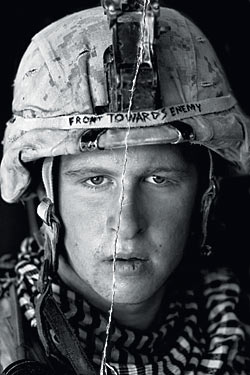
Image: A portrait by Louis Palu.

Thursday, September 09, 2010

An American in Baghdad

I spend a lot of time including links and quotations to material that will give my students, one of my most important audiences, some idea of what is happening in the Middle East, and what people who live there think. But of course, I am probably wrong to assume that Canadian readers of student age necessarily understand American attitudes towards the current involvement of the United States in that region.   This is especially true since, as current controversies show, there is no single American attitude.


So here I am posting a poem written by a friend of mine from the United States, a National Guardsman who served a tour in Iraq:
Catharsis by CJ Roberts

(This was written by me...rather, it just came to me,  in the middle of a Route Clearance Mission in Baghdad)

The tattered armor of a thousand fights
hangs ragged on a tired frame.
Spinning sails and crumbling towers
stand silent against the skyline,
Their barren skeletons a grim reminder of the draconian rage that once invested them.
Each shattered lance a choice unmade,
unseen,
or unacknowledged.
Yet one remains, arrow-straight,
its bright pennon fluttering in the wind,
straining for battle.
A charge?  One last chance to slay those demons who illuminate the path?
Or, without rancor,
furl the pennon,
hand down the lance.
Dismount the faithful steed habit,
and walk away,
at peace.

Some -- a little -- maybe -- better news from Iraq, thanks to McClatchy and Christian Science Monitor

Gold earrings made for an Assyrian queen, a sacred 4,000-year-old statue and 540 other looted pieces of Iraq's ancient history went on display in Iraq on Tuesday in what was billed as a triumph of justice and international cooperation.
"This is a very happy day -- we are making progress in the very important field of returning Iraqi history to its rightful home," said Iraq's ambassador to Washington, Samir Sumaidaie, who said the objects had been found through a combination of Iraqi and American efforts. "Iraq cannot be summarized by 30 years of problems and wars -- it can stand and it can reclaim its history."
But... 
...He noted, however, that a previous shipment of 632 stolen pieces recovered in the U.S. had gone missing after being delivered to Prime Minister Nouri al Maliki's office last year.

Read more: http://www.mcclatchydc.com/2010/09/07/100218/looted-treasures-returned-to-iraq.html#ixzz0yteP8y49

Wednesday, September 08, 2010

What Iraqis think of the pullout

I am indebted to the Iraqi journalists who report for McClatchy, an American news service, from Baghdad. In recent days they have been interviewing a number of their fellow citizens about the significance of the American pullout.  Here is a part of one of those interviews, by Sahar IIS:


Widad Hameed – retired high school teacher - over 70 - proud grandmother of seven:

(Are the Iraqi security forces capable of keeping the peace - or not?) "No, I do not believe that the Iraqi security forces are capable of handling the security. Over and over again they have proved that they are incapable, and violence is on the rise. I believe they lack the knowledge, the training and the will to stand up to the challenge.

(Will violence escalate when the USF pull out??) (Long pause..) "I am torn between two considerations answering this question. Firstly – I am strongly opposed to the presence of foreign troops on Iraqi sovereign soil – and therefore hope to see them leave as quickly as possible – This is on principle. But on the other hand, I am afraid of what might happen after they leave. I have no great faith in the abilities of the ISF and feel that the chaos in our political situation will be reflected upon the security scene as the politicians slug it out and violence will rise and the people will pay. As for the Americans – The chaos we are witnessing is a result of their failed plans, and I don't think there is anything they could do at this late date to make a difference. Had they wanted to achieve better results, they should have been more serious about training and arming the ISF – commanders and ranks alike – Seven years should have been long enough".
There is more at the Inside Iraq site.