I didn't do a lot of blogging this past year because (1) I spent a lot of time translating the
Good Duke and other medieval sources and (2) I didn't want to spend a lot of time discussing the most obvious subject that people were blogging, since I don't believe I had anything amazingly original to say. Nonetheless, there were posts that did stand out.
Showing posts with label favorites 2017. Show all posts
Showing posts with label favorites 2017. Show all posts
Sunday, January 14, 2018


Wednesday, December 20, 2017
Omar Muhammed (Mosul Eye) "I am a scholar."
AP has an article that should make all others who call themselves scholars humble. It tells the story of an Iraqi historian who time and again blogged from inside the "Islamic State" so that the world should know the truth of life in occupied Mosul. A long excerpt:
Less than a year into their rule, in March 2015, he nearly cracked. IS beheaded a 14-year-old in front of a crowd; 12 people were arrested for selling and smoking cigarettes, and some of them flogged publicly. Seeing few alternatives, young men from Mosul were joining up by the dozens.
The sight of a fanatic severing the hand of a child accused of stealing unmoored him. The man told the boy that his hand was a gift of repentance to God before serenely slicing it away.
It was too much.
Mosul Eye was done. He defied the dress requirements, cut his hair short, shaved his beard and pulled on a bright red crewneck sweater. He persuaded his closest friend to join him.
“I decided to die.”
The sun shining, they drove to the banks of the Tigris blasting forbidden music from the car. They spread a scrap of rug over a stone outcropping and shared a carafe of tea. Mosul Eye lit a cigarette, heedless of a handful of other people picnicking nearby.
“I was so tired of worrying about myself, my family, my brothers. I am not alive to worry, but I am alive to live this life. I thought: I am done.”
He planned it as a sort of last supper, a final joyful day to end all days. He assumed he would be spotted, arrested, tortured. The tea was the best he had ever tasted.
Somehow, incredibly, his crimes went unnoticed.
He went home.
"At that moment I felt like I was given a new life.”
He grew out his hair and beard again, put the shortened trousers back on. And, for the remainder of his time in Mosul, smoked and listened to music in his room with the curtains drawn and the lights off. His computer screen and the tip of his cigarette glowed as he wrote in the dark.
The next month, he slipped up.
His friend the ex-taxi driver told him about an airstrike that had just killed multiple high-level Islamic State commanders, destroying a giant weapons cache. Elated, Mosul Eye dashed home to post it online. He hit “publish” and then, minutes later, realized his mistake. The information could have come from only one person. He trashed the post and spent a sleepless night.
“It’s like a death game and one mistake could finish your life.”
For a week, he went dark. Then he invited his friend to meet at a restaurant. They ate spicy chicken, an unemployed teacher and the gun-toting ex-taxi driver talking again about their city and their lives. His cover was not blown.
The historian went back online. Alongside the blog, he kept meticulous records — information too dangerous to share.
His computer hard drive filled with death, filed according to date, cause of death, perpetrator, neighborhood and ethnicity. Accompanying each spreadsheet entry was a separate file with observations from each day.
“IS is forcing abortions and tubal ligation surgeries on Yazidi women,” he wrote in unpublished notes from January 2015. A doctor told him there had been between 50 and 60 forced abortions and a dozen Yazidi girls younger than 15 died of injuries from repeated rapes.
April 19, 2015: “The forensics department received the bodies of 23 IS militants killed in Baiji. They had no shrapnel, no bullets, no explosives and the cause of death does not seem to be explosion. It is like nothing happened to the bodies. A medical source believes they were exposed to poison gas.”
July 7, 2015: “43 citizens were executed in different places, this time by gunfire, which is unusual because they were previously beheadings. A source inside IS said that 13 of those who were executed are fighters and they tried to flee.”
He noted a flurry of security on days when the Islamic State leader, Abu Bakr al-Baghdadi, seemed to be in town.
Many in Iraq, especially those who supported the Shiite-dominated leadership in Baghdad, blamed Mosul for its own fate. Mosul Eye freely acknowledged that some residents at first believed the new conquerors could only be an improvement over the heavy-handed government and the soldiers who fled with hardly a backward glance at the city they were supposed to defend.
But he also wrote publicly and privately of the suffering among citizens who refused to join the group. He was fighting on two fronts: “One against ISIS, and the other against the rumors. Trying to protect the face of Mosul, the soul of Mosul.”
He tested out different voices, implying one day that he was Christian, another that he was Muslim. Sometimes he indicated he was gone, other times that he was still in the city. “I couldn’t trust anyone,” he said.
In his mind, he left Mosul a thousand times, but always found reasons to stay: his mother, his nieces and nephews, his mission.
But finally, he had to go.
“I had to run away with the proof that will protect Mosul for years to come, and to at least be loyal to the people who were killed in the city.”
And he did not want to become another casualty of the monsters.
“I think I deserve life, deserve to be alive.”
A smuggler, persuaded by $1,000 and the assurances of a mutual acquaintance, agreed to get him out. He was leaving the next day. Mosul Eye had no time to reflect, no time to change his mind.
He returned home and began transferring the contents of his computer to the hard drive. He pulled out the orange notebook with the hand-drawn map of Mosul on the cover and the outlines of what he hoped would one day be his doctoral dissertation. Into the bag went “Father Bombo’s Pilgrimage to Mecca,” an obscure American satirical novel from 1770 that he had ordered from Amazon via a new shop that was the only place in town to order from abroad online.
It was time to leave.
He wanted to make sure his mother would never have to watch the capture and killing of Mosul Eye.
On Dec. 15, 2015 he left Mosul, driving with the smuggler to the outskirts of Raqqa, a pickup point that alarmed him. From there he and other Iraqis and Syrians were picked up by a second set of smugglers and driven by convoy to Turkey.
They had no trouble crossing the border.__
In Turkey, Mosul Eye kept at it: via WhatsApp and Viber, from Facebook messages and long conversations with friends and relatives who had contacts within IS. From hundreds of kilometers away, his life remained consumed by events in Mosul.
By mid-2016, deaths were piling up faster than he could document. The IS and airstrikes were taking a bloody toll on residents. His records grew haphazard, and he turned to Twitter to document the atrocities. In February 2017, he received asylum in Europe with the aid of an organization that learned his backstory. He continued to track the airstrikes and Islamic State killings
He mapped the airstrikes as they closed in on his family, pleading with his older brother to leave his home in West Mosul. Ahmed, 36, died days later when shrapnel from a mortar strike pierced his heart, leaving behind four young children.
It was only then that Mosul Eye revealed his secret to a younger brother — who was proud to learn the anonymous historian he had been reading for so long was his brother.
“People in Mosul had lost hope and confidence in politicians, in everything,” his brother said. Mosul Eye “managed to show that it’s possible to change the situation in the city and bring it back to life.”
As the Old City crumbled, Mosul Eye sent coordinates and phone numbers for homes filled with civilians to a BBC journalist who was covering the battle, trying to get the attention of someone in the coalition command. He believes he saved lives.
Then, with his beloved Old City destroyed, Mosul Eye launched a fundraiser to rebuild the city’s libraries because the extremists had burned all the books. None of his volunteers knew his identity.
An activist who helped co-found a “Women of Mosul” Facebook group with Mosul Eye describes him as a “spiritual leader” for the city’s secular-minded.
“He was telling us about the day-to-day events under ISIS and we were following closely with excitement as if we were watching a movie. Sometimes he went through hard times and we used to encourage him. He won the people’s trust and we became very curious to know his real personality,” said the activist, who spoke on condition of anonymity because she believed she was still in danger.
From a distance, finally writing his dissertation on 19th century Mosul history in the safety of a European city, he continued to write as Mosul Eye and organize cultural events and fundraisers from afar — even after Mosul was liberated.
The double life consumed him, sapped energy he’d rather use for the doctoral dissertation and for helping Mosul rebuild. And it hurt when someone asked the young Iraqi why he didn’t do more to help his people. He desperately wanted his mother to know all that he had done.
He felt barely real, with so many people knowing him by false identities: 293,000 followers on Facebook, 37,000 on WordPress and 23,400 on Twitter.
In hours of face-to-face conversations with The Associated Press over the course of two months, he agonized over when and how to end the anonymity that plagued him. He did not want to be a virtual character anymore.
On Nov. 15, 2017, Mosul Eye made his decision.
“I can’t be anonymous anymore. This is to say that I defeated ISIS. You can see me now, and you can know me now.”
He is 31 years old.
His name is Omar Mohammed.
“I am a scholar.”
Friday, December 15, 2017
The Robot Wars begin -- report from the San Francisco front
The very fine radio show As it Happens (CBC) has this report from the Robot Wars.
The area around the San Francisco HQ of the SPCA is very popular for homeless people who camp out on the sidewalks. The other people who use the area are not enthusiastic about this.
Solution? The SPCA fired its security guard who used to harass the campers ($14/hr) and replaced him/her with a robot ($7/hr). This 400 pound patrol robot goes around flashing lights, making noise and scaring pets.
This "solution" has some people noting that if you lose that $14/hr job you are not likely to find SF's hot real estate market any more affordable and you may end up living in... Others say what's with an organization that is dedicated to reducing cruelty adopting such a tactic in a self-satsfied way: E.g.
I hardly tink it will stop there.

The area around the San Francisco HQ of the SPCA is very popular for homeless people who camp out on the sidewalks. The other people who use the area are not enthusiastic about this.
Solution? The SPCA fired its security guard who used to harass the campers ($14/hr) and replaced him/her with a robot ($7/hr). This 400 pound patrol robot goes around flashing lights, making noise and scaring pets.
This "solution" has some people noting that if you lose that $14/hr job you are not likely to find SF's hot real estate market any more affordable and you may end up living in... Others say what's with an organization that is dedicated to reducing cruelty adopting such a tactic in a self-satsfied way: E.g.
"Although we had already limited the use of the robot to our parking lot, we think a more fully informed, consensus-oriented, local approach on the appropriate use of these new devices will benefit everyone —whether it's on public space or in private parking lots...Reports say that opponents of robot harassment have already smeared BBQ sauce on the robot's sensors.
I hardly tink it will stop there.
Thursday, September 07, 2017
Trump: white president
 White people knew, back in the 19th century: if you wanted a high-quality black clown at your entertainment, it better be a white guy in blackface. Everybody knew that whites could do even blackness better than black people.
At the Atlantic, Ta-Nehisi Coates explains the American blindness to American racism.
This transfiguration is not novel. It is a return to form. The tightly intertwined stories of the white working class and black Americans go back to the prehistory of the United States—and the use of one as a cudgel to silence the claims of the other goes back nearly as far. Like the black working class, the white working class originated in bondage—the former in the lifelong bondage of slavery, the latter in the temporary bondage of indenture. In the early 17th century, these two classes were remarkably, though not totally, free of racist enmity. But by the 18th century, the country’s master class had begun etching race into law while phasing out indentured servitude in favor of a more enduring labor solution. From these and other changes of law and economy, a bargain emerged: The descendants of indenture would enjoy the full benefits of whiteness, the most definitional benefit being that they would never sink to the level of the slave. But if the bargain protected white workers from slavery, it did not protect them from near-slave wages or backbreaking labor to attain them, and always there lurked a fear of having their benefits revoked. This early white working class “expressed soaring desires to be rid of the age-old inequalities of Europe and of any hint of slavery,” according to David R. Roediger, a professor of American studies at the University of Kansas. “They also expressed the rather more pedestrian goal of simply not being mistaken for slaves, or ‘negers’ or ‘negurs.’ ”
Roediger relates the experience, around 1807, of a British investor who made the mistake of asking a white maid in New England whether her “master” was home. The maid admonished the investor, not merely for implying that she had a “master” and thus was a “sarvant” but for his basic ignorance of American hierarchy. “None but negers are sarvants,” the maid is reported to have said. In law and economics and then in custom, a racist distinction not limited to the household emerged between the “help” (or the “freemen,” or the white workers) and the “servants” (the “negers,” the slaves). The former were virtuous and just, worthy of citizenship, progeny of Jefferson and, later, Jackson. The latter were servile and parasitic, dim-witted and lazy, the children of African savagery. But the dignity accorded to white labor was situational, dependent on the scorn heaped upon black labor—much as the honor accorded a “virtuous lady” was dependent on the derision directed at a “loose woman.” And like chivalrous gentlemen who claim to honor the lady while raping the “whore,” planters and their apologists could claim to honor white labor while driving the enslaved.
And so George Fitzhugh, a prominent 19th-century Southern pro-slavery intellectual, could in a single stroke deplore the exploitation of free whites’ labor while defending the exploitation of enslaved blacks’ labor. Fitzhugh attacked white capitalists as “cannibals,” feeding off the labor of their fellow whites. The white workers were “ ‘slaves without masters;’ the little fish, who were food for all the larger.” Fitzhugh inveighed against a “professional man” who’d “amassed a fortune” by exploiting his fellow whites. But whereas Fitzhugh imagined white workers as devoured by capital, he imagined black workers as elevated by enslavement...
Speaking in 1848, Senator John C. Calhoun saw slavery as the explicit foundation for a democratic union among whites, working and not:
With us the two great divisions of society are not the rich and poor, but white and black; and all the former, the poor as well as the rich, belong to the upper class, and are respected and treated as equals.
Tuesday, September 05, 2017
Bad good men at arms and a Good Duke
The phrase "good men-at-arms" was a military cliche in the Hundred Years War. It identified the notional standard for well-equipped, capable cavalrymen. Most of us would look at a man-at-arms and think, "knight."
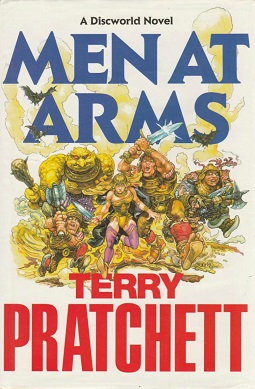
As time went on, the adjective "good" merged with the rest of the phrase so that the "goodness" of the good man-at-arms was simply a matter of definition. Some years back I noticed this while reading the chronicler Froissart, who had one of his characters scornfully tell their opponents, "You are not good good men-at-arms." I'll bet that stung!
https://upload.wikimedia.org/wikipedia/en/9/95/Men-at-arms-cover.jpg
So were there any bad good men-at-arms?
Well, if there were, they are probably in the book I just sent off to the publisher, Murder, Rape and Treason, volume 5 of the Deeds of Arms Series. Like other books in this series,it combines a short history of one kind of "deed" with translated accounts of medieval examples; in this case, descriptions of some of the flashiest judicial combats, in which one warrior accused another of a treacherous, secret crime and the other said the first lied. Under some circumstances, this led to the two men fighting to death.
One of them had to be a bad liar, right?
Murder etc. being done, I get to move on to the Chronicle of the Good Duke, whom I have discussed before. The question now is, if Louis of Bourbon was good, were his contemporaries bad? He lived in the generation before the Maid (=Jeanne Darc) so maybe so, even though no one gets the label "bad."
Here's the Good Duke, coming to a book-seller near you, if not immediately:

As time went on, the adjective "good" merged with the rest of the phrase so that the "goodness" of the good man-at-arms was simply a matter of definition. Some years back I noticed this while reading the chronicler Froissart, who had one of his characters scornfully tell their opponents, "You are not good good men-at-arms." I'll bet that stung!
https://upload.wikimedia.org/wikipedia/en/9/95/Men-at-arms-cover.jpg
So were there any bad good men-at-arms?
Well, if there were, they are probably in the book I just sent off to the publisher, Murder, Rape and Treason, volume 5 of the Deeds of Arms Series. Like other books in this series,it combines a short history of one kind of "deed" with translated accounts of medieval examples; in this case, descriptions of some of the flashiest judicial combats, in which one warrior accused another of a treacherous, secret crime and the other said the first lied. Under some circumstances, this led to the two men fighting to death.
One of them had to be a bad liar, right?
Murder etc. being done, I get to move on to the Chronicle of the Good Duke, whom I have discussed before. The question now is, if Louis of Bourbon was good, were his contemporaries bad? He lived in the generation before the Maid (=Jeanne Darc) so maybe so, even though no one gets the label "bad."
Here's the Good Duke, coming to a book-seller near you, if not immediately:
Thursday, August 03, 2017
Sunday, July 23, 2017
Life in the incomprehensible future -- a classic scenario

It is a scene in many a time-travel novel. Boy genius, who works in his secret lab, creates a device that will take him to the future (he's not interested in Julius Caesar or even Cleopatra).
So he goes to the near future and finds that it's pretty much what you'd expect, with a few inventions more or less.
Except...
It occurred to me a little while ago that we have -- many of us -- crossed over such a line, and would deeply shock time travelers from the near past.
Why so? Same-sex marriage. We are the weird ones, no matter who we are married to and the b.g. can't get over us.
Sunday, June 25, 2017
Rape in Game of Thrones and ISIS -- realistic medievalism?
 Jeff Sypec examines in his blog the idea that rape in Game of Thrones is a positive element in George R.R. Martin's fictional version of the Middle Ages -- more realistic because more brutal. At the same time some ISIS supporters claim Islamic authenticity for their mistreatment of non-ISIS women and girls. Is there any truth to this?
Jeff, who is quite an intelligent guy, looks at this question from a number of different angles. For instance:
Even though [Amy S.]Kaufman [author of "Muscular Medievalism" in the 2016 issue of The Year’s Work in Medievalism,] isn’t blaming Game of Thrones viewers for ISIS, her article won’t sit easily with many fantasy fans. I appreciate that she isn’t just sniping on Twitter; she’s drawing a sober, thought-provoking analogy. I like her strident contrarianism, and I think she’s right to wonder what the pop-culture ubiquity of Game of Thrones actually means. Even if you’re certain the answer is “not much,” why not ponder it further anyway? As I write this, my TV is advertising “Game of Thrones Night” at Nationals Park in D.C., complete with t-shirts and a chance to “visit an authentic Iron Throne.” If someone mugs for a selfie with a TV-show prop on a fun night at the ballpark, what is it they’re trying to be a part of? Why do they need to believe so badly that fictional violence gets us closer to the “real” Middle Ages?It might be worth reminding both Jeff and Amy that the idea of the Middle Ages was invented specifically to serve as a background for recent progress. A very large number (if not all) the depictions of the Middle Ages will always be negative in many respects.
“The medieval era is the dumping ground of the contemporary imagination,” Kaufman writes, “rife with torture, refuse in the streets, rape, slavery, superstition, casual slaughter, and every other human vice we supposedly stopped indulging in once we became ‘enlightened.'” It’s worth asking what we miss seeing in the Middle Ages if we’re invested in only this view. Despite what George R. R. Martin believes, his dark, despairing fantasy isn’t any more “authentic” than the Disney-princess version, nor is it less harmful. Observations like Kaufman’s always bring me back around to a blunt conclusion by medievalist and Tolkien scholar Tom Shippey: “There are . . . many medievalisms in the world, and some of them are as safe as William Morris wallpaper: but not all of them.”
I am pleased by the excellence of Jeff's blog post. He's a survivor of what us (habitual classifiers) will probably call the Golden Age of Blogging. (There is no Golden Age of Twitter, sorry.) Nice to have such a meaty discussion.
Image: Jeff's from Maryland, and the state flag is a welcome reminder of an earlier age of medievalism. Jousting is, or has been, the state sport.
Friday, March 31, 2017
Another oddball medieval name from the Chronicle of the Good Duke
During my years with the Good Duke I have run across a number of surprising and amusing personal names: Bliomberis Loup and his brother, for instance (follow the "names" label to find him).
I don't recall this classic name of an English knight involved in the Duke of Lancaster's chevauche in 1373:
Sir Jean Bulle.
I don't recall this classic name of an English knight involved in the Duke of Lancaster's chevauche in 1373:
Sir Jean Bulle.
Tuesday, March 21, 2017

Monday, January 02, 2017
The evolution of the Canadian character
The Sesquicentennial of Canadian Confederation is being celebrated by the Globe and Mail with a number of special features. The first one is a long thought-piece by Doug Saunders, who was born on the Centennial year. He's got a lot to say about the many changes that took place before 1967 and emerged into public consciousness in the year of his birth.
Highly recommended even if you don't find the argument persuasive.
Me, I am very interested in how Canada stopped being British, so this was an excellent read for me.
Excerpts:
Highly recommended even if you don't find the argument persuasive.
Me, I am very interested in how Canada stopped being British, so this was an excellent read for me.
Excerpts:
Eight hours after I was born, the directors of the Canadian National Exhibition filed into a banquet hall for their annual luncheon. The exhibition’s president, W.H. Evans, asked them to remain standing to sing the national anthem – and then chaos ensued, as half the audience broke into God Save the Queen before the pianist had struck the first note of O Canada. A debate over Canada’s true national anthem, begun in 1964, had been winding its way through a special House of Commons-Senate joint committee all year and filling the media with debate. It wouldn’t fully be resolved until a law was passed in 1980, and many people (especially in Toronto) still considered the British national anthem “official.”
In that light, 1967 can only be seen as the apex of Canada’s postcolonial moment. The wars over symbols were one small manifestation of a larger shift. It’s worth remembering how new this all was. We still remained, in important ways, a colony. In 1967, Canadian citizenship had only existed for 20 years – before January 1, 1947, everyone in Canada was a British subject and had to travel with a United Kingdom passport. But it still didn’t quite exist: That 1947 law creating Canadian citizenship declared in its main clause that “a Canadian citizen is a British subject” (this would remain in place until 1977). That idea was still hotly defended by many in the Ottawa of 1967: The Progressive Conservative leadership still opposed Canadian citizenship, and the flag, and the anthem. There was still a sizable political faction in Canada who supported the idea that all Canadians were simply a slightly different, less important flavour of British people. But the great majority of Canadians had moved on – or moved in – and you could see the centennial struggling to catch up with them.Back in the 1980s, I told my history class that the disappearance of "the Romans" from Britain was less like an invasion and more like the elimination of "a Canadian citizen is a British subject" from the passport. This passed right over their heads, since they'd never seen such a passport.
Subscribe to:
Posts (Atom)