Showing posts with label law of arms. Show all posts

Thursday, October 31, 2019

Gillingham on surrender and mercy in medieval warfare

 I just came across an article by John Gillingham, one of the best medieval military historians, where he argues that the laws and practices of war were not the same over the whole Middle Ages.  Note what he says about surrender and ransom:

But it is important to bear in mind the  exact title of  [Maurice]Keen’s book – The Laws of War in the Late Middle Ages – and   note that when he used phrases such as ‘in the middle ages,’ he was not in fact  thinking of  the whole period, only of its last two centuries  [i.e. the14th and 15th; Phase 2].The neglect of Phase One [up to about 1300] by historians of medieval war has not unnaturally led  to them taking a cynical view of chivalry.. [since many people, during Phase One including women and children, were not allowed to surrender, but were killed or enslaved].

But had they measured the treatment of women, children and the poor by soldiers in the so-called ‘age of chivalry’[ Phase  2] against    some  ideal  standard, but against the standards that  had been  regarded as acceptable and  honourable in all previous ages, they might have taken a different view.

Monday, May 25, 2015

A review of my book Charny's Men-at-Arms: Questions Concerning the Joust, Tournaments, and War. Wheaton, IL: Freelance Academy Press, 2014. Pp. viii, 111. $24.95. ISBN: 978-1-9374390-5-7

From The Medieval Review

Muhlberger, Steven. Charny's Men-at-Arms: Questions Concerning the Joust, Tournaments, and War. Wheaton, IL: Freelance Academy Press, 2014. Pp. viii, 111. $24.95. ISBN: 978-1-9374390-5-7.

Reviewed by Peter W. Sposato

Indiana University Kokomo

psposato@iuk.edu

Charny's Men-at-Arms: Questions Concerning the Joust, Tournaments and War is the latest in a series of important contributions made by Steven Muhlberger to the historical study of medieval chivalry. Muhlberger's previous publications have focused generally on "deeds of arms" (faits d'armes), whether in the guise of "chivalric sports," such as tournaments and jousts, or the bloody business of war. [1] In Charny's Men-at-Arms, Muhlberger continues his investigation of these major chivalric themes by focusing on a series of questions composed in the early 1350s by Geoffroi de Charny, a famous fourteenth century French knight. Charny's intended audience for his Questions were the members of the French royal chivalric Order of the Star: all strenuous, professional practitioners of chivalry. [2] Charny was himself a strenuous knight, who through his personal prowess and honorable conduct both on and off the battlefield climbed, during the course of a long and distinguished career, to the upper echelons of the chivalric hierarchy in France. As Muhlberger powerfully argues, however, Charny should be seen not only as a practitioner, but also as a "theorist of the life of chivalry," a "professor and follower of chivalry...[who] set out first and foremost to praise, to define, and to teach chivalry" (9, 14). Indeed, in addition to composing The Questions Concerning the Joust, Tournaments, and War, he also wrote the Livre de chevalerie (Book of Chivalry) and the Livre Charny (Charny's Book). [3] Thus, unlike many contemporary writers on chivalry, he not only talked the talk, he decidedly walked the walk: participating in tournaments; commanding soldiers in battle; and fighting with distinction in numerous engagements during the Hundred Years War, including at the battle of Poitiers (1356) where he was killed defending the Oriflamme (the sacred battle banner of France).

Charny's Questions are therefore crucially important to our understanding of chivalric mentality and the practical application of chivalric ideas in Late Medieval France in particular, and Europe in general. Muhlberger successfully makes the case for the importance of Charny's Questions in the very first line of his introduction, writing "The Questions Concerning the Joust, Tournaments, and War is a lost classic work of European chivalry. It is the only record we have of a dramatic occasion when crucial questions on the nature of war and the proper conduct of the warrior's life--one definition of chivalry--were posed to an audience of experts, professional men-at-arms of rank and influence" (1). Indeed, Charny's Questions deal with major issues that arose in the three main contexts in which strenuous men-at-arms (i.e. men of rank and status who lived the "life of arms") operated: jousts, tournaments, and war. (14) The Questions, one hundred and thirty four in number and divided into three categories (jousts, tournaments, and war), range from the practical ("Charny asks: Knights joust with steel lances in an emprise. One knocks the other to the ground with a stroke of his lance. Will the one who has knocked the other to the ground and out of the saddle win the horse? How will it be judged by the law of arms?" [88]) to the abstract ("Charny asks: When should a battle be called a battle and why that rather than something else?" [90]). By offering such a broad array of questions, Charny highlights both the formal and the informal rules that governed chivalric conduct, while also providing historians with a sense of the motivations, ideals, and behaviors that underpinned the chivalric lifestyle.

Equally important is the reformative nature of Charny's Questions, which Muhlberger highlights and deftly places into the larger historical context, namely the efforts of King Jean II of France to restore order in his kingdom and to turn the tide of the Hundred Years War. Muhlberger argues the ultimate purpose of Charny's Questions, given the strong reform currents found therein and the timing of their composition, was to buttress such royal initiatives and, importantly, future royal legislation "on matters of arms" (22). No doubt Charny envisioned the Questions as a means to reform and reinvigorate his fellow men-at-arms who had thus far failed to fulfill the sacred function associated with their divine ordo: to protect the French people through their prowess and bravery. Given the clear importance of this work, it is striking that Muhlberger provides in Charny's Men-at-Arms the first and only complete translation of the Questions into English. [4]

Muhlberger has done both scholars and students a great service by adeptly translating the Questions, but Charny's Men-at-Arms is much more than a simple translation: it is also an informed and insightful historical study of the Questions, of the values and attitudes that underpinned them, of the larger historical context in which they were composed, and of their intended audience. Indeed, Muhlberger's study penetrates far beneath the surface of these questions to shed considerable light on the author, the cultural milieu that shaped him, and the social circles in which he operated. Muhlberger's analysis is concise and intelligent, providing insight into Charny's Questions as they relate to a multitude of significant topics, including the nature of chivalry, the laws of war, royal ordinances on war (like King Jean II's Reglement pour le gens de guerre [issued April 30, 1351]), and theoretical treatises on war (like those of Giovanni Legnano and Honore Bouvet). Similarly insightful is Muhlberger's analysis of Charny's Questions relating to "chivalric sport" (Chapter 3: "Charny's Jousters and Tourneyers"), the practical and legal concerns about chivalric conduct in war (Chapter 5: "What Men-at-Arms Worried About"), and honor (Chapter 6: "Honor and the Lore of Chivalry"). Considering the complexity of these topics and the quagmire of scholarship associated with them, Muhlberger deserves praise for adding a great deal to the discussion. Finally, readers, especially students, will also appreciate Muhlberger's efforts to make sense of Charny's tricky terminology (Chapter 4).

There can be little doubt that Charny was a prominent practitioner and theorist of chivalry in his own time and that his writings are crucial to our modern understanding of the dominant ideology that shaped the mentality and lifestyle of the medieval warrior elite. Therefore, it is all the more remarkable that Charny's Questions, which "can be read as a reflection of the priorities and opinions of one of the most experienced and renowned warriors of his time," has been largely neglected by other scholars (23). Fortunately, such an important work on medieval chivalry has been very well served by Muhlberger's translation and study. Indeed, Charny's Men-at-Arms makes an important contribution to the historical study of medieval chivalry, chivalric sports, and warfare. Muhlberger's analysis is succinct and approachable, making it accessible to students, while still providing enough scholarly rigor and insight to earn the approbation of seasoned historians. Charny's Men-at-Arms will undoubtedly facilitate considerable discussion and future research.

------ Notes: 1. Prominent among Muhlberger's other publications on chivalry are: Jousts and Tournaments: Charny and the Rules for Chivalric Sport in Fourteenth-Century France (Union City, CA: Chivalry Bookshelf, 2002); Deeds of Arms: Formal Combats in the Late Fourteenth Century (Union City, CA: Chivalry Bookshelf, 2005); Royal Jousts at the End of the Fourteenth Century (Wheaton, IL: Freelance Academy Press, 2012); The Combat of the Thirty (Wheaton, IL: Freelance Academy Press, 2013); The Twelve of England (Wheaton, IL: Freelance Academy Press, 2013).

2. Other important studies of Charny include: Craig Taylor, Chivalry and the Ideals of Knighthood in France during the Hundred Years War (Cambridge University Press, 2013); Richard Kaeuper, Chivalry and Violence in Medieval Europe (Oxford University Press, 1999); idem, Holy Warriors: The Religious Ideology of Chivalry (University of Pennsylvania Press, 2009); idem and Elspeth Kennedy, The Book of Chivalry of Geoffroi de Charny: Text, Context, and Translation (University of Pennsylvania Press, 1996).

3. In addition to the facing page translation listed above (op. cit., n. 2), see also the slimmed down version: Kaeuper and Kennedy, A Knight's Own Book of Chivalry: Geoffroi de Charny (University of Pennsylvania, 2005).

4. The questions concerning tournaments and jousts were translated and studied in Muhlberger's Jousts and Tournaments: Charny and the Rules for Chivalric Sport in Fourteenth-Century France (op. cit., n. 1).

Tuesday, February 03, 2015

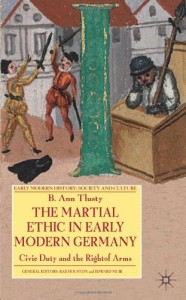
The Martial Ethic in Early Modern Germany, by B. Ann Tlusty

Ken Mondschein's review will tell you whether you can live without this book:
B. Ann Tlusty’s The Martial Ethic in Early Modern Germany is one of those books that simultaneously delights and frustrates the reviewer: Delight, for the immense wealth of valuable material it contains, coupled with admiration for the author; frustration, because of the sure knowledge that one is unlikely to ever write a work as good. Then again, few scholars do: Tlusty bases her argument on an intimate knowledge of city archives, especially those of Augsburg and with an emphasis on judicial records, but incorporates a wide number of other sources, both archival and published. These are masterfully synthesized into a nuanced and far-reaching argument that addresses core questions in the historiography of early modern Europe. Martial Ethic, in other words, a definitive work of history, one that deserves to stand beside works on the history of violence and arms in Europe such as those of Ute Frevert and Kevin McAleer for modern Germany and François Billacois, Peter Blastenbrei, Trevor Dean, Robert Nye, and Pieter Spirenberg for the rest of Europe (1) and which ought to be on comprehensive exam reading lists and incorporated into survey courses on later medieval and early modern Europe. It has already achieved well-merited renown amongst the Historical European Martial Arts crowd, but seen from the perspective of Martial Ethic, the Fechtbücher (records of fencing teaching) seem like footnotes to the greater trends and ideas brought out by Tlusty.

However, like all great history, Martial Ethic is not an apolitical work. By this I do not mean that Tlusty’s objectives or arguments are in any way directed towards making a modern political argument, but rather that they resonate with an important contemporary concern—namely the American debate over firearms. This is unavoidable for two reasons: the fact that (as Tlusty points out) American gun culture owes some of its genetic material to Germany, and the fact that the historian’s ever-present obligation to make the past relevant to the present naturally guides us towards subjects of broader interest. While Tlusty’s main aim is to make a contribution to the literature of violence and the growth of the state in premodern Europe, she is certainly cognizant of contemporary resonance. In the same way, it is the reviewer’s obligation to tease out the broader implications of the work under consideration. Therefore, I will first discuss the structure and arguments of Tlusty’s book and what they mean for the historical discipline, and then editorialize on their relevance to modern society.

And there is lots more...

Wednesday, July 18, 2012

The Duel in Early Modern England: Civility, Politeness, and Honour, by Markku Peltonen

As someone who works on deeds of arms in the Middle Ages – deeds of arms including things like individual challenges, trials by combat, jousts, and tournaments – this is a very useful book. I have always thought there was a big difference between the duels of the early modern era and the the medieval deeds of arms we see in things like Froissart's Chronicles. Peltonen thoroughly documents that this was indeed the case. Early modern duels were part of a great debate about civility and politeness, as well as debates about Royal power and liberty. This was not what medieval deeds of arms were usually about.

 There are a few things I didn't like about this book, and one of them is a common feeling I have these days about academic work in general. This author, like others, is so intent on citing as much evidence as possible that the reader can get overwhelmed. Critics of dueling in England made such and such an argument against the practice – and then we see every single time the point was made by every single author made it. This may not be literally true but it sure feels that way. I think that this book was far too encyclopedic for its own good. But then this may just be me; I used to be, and probably still am, the kind of person who reads big serious books word by word. Even though I can after many years in academe follow many arguments without doing that, I still feel a bit guilty about skipping over material. On the other hand, might it not be worth considering a change in academic practice? This book, which focuses on the written debate about dueling, could have been a lot zippier and still met the intellectual needs of most of its audience.

 A final small gripe is that Peltonen doesn't seem to be very interested in what came before and what came after his period. Where early modern attitudes came from and why they dispersed are things I would like to know more about. Perhaps the author was smart to leave these aside; the book might have been truly vast if he had tried to master all the relevant sources and modern debates about them. Anyway, if you have a serious interest in dueling, this is well worth looking at. I'm glad it showed up in our library, where it sits next to my recent Royal Jousts.

Friday, June 15, 2012

So much for the laws of arms

The Chronicle of the Good Duke reporting on the English siege of Nantes, 1380-1:
And some of those in the [French] garrison were wounded but none of them died and none was taken except Robert Guy of Riom and when he was disarmed the English were bemoaning their loss and did not put a guard on him so Robert Guy left them and went to the ditches where he rejoined the companions who began to laugh about it. And the English were very discomfited by the deaths of their barons and their loss of their people in skirmishes so they did not know what to do. Things went from bad to worse as they caught dysentery.

Sunday, February 05, 2012

Charny as arbitrator under the "droit d'armes"

Back in 1992, the renowned military historian Philippe Contamine wrote an article of Geoffroi de Charny for the festschrift (celebratory collection) dedicated to Georges Duby.  I just found this little nugget in the article (my rough translation):
At that time [Charny] was recognized as an expert in the conflicts that can arise between people in arms about ransom and loot: an act of Philippe de Valois in April 1347 sets out how Aimery de Rochechouart, chevalier , was retained, he and the men of his company having "all costs and expenses and everything which appertained to their profession" from Savary de Vivonne, Lord of Tours. However, during the taking and plundering of Poitiers by the English of the Earl of Derby in October 1345, Aimery and his people were captured. He himself was ransomed for  4000 crowns of gold, a sum to which were added expenses of 2000 crowns. He  thought he should be able to demand the 6000 crowns from Savary de Vivonne, who refused. The King with the consent of both parties, appointed arbitrators  for  the dispute concerning the "droit d’armes," namely Guillaume Flote, seigneur de Revel, and Geoffroy de Charny. They discharged Savary de Vivonne any fault, however, requiring him to pay to pay 2000 crowns (the costs) to Aimery de Rochechouart.
I also found out today that if you type enough French into MS Word, it starts giving you French spellings, French quotation marks, etc.

Saturday, May 28, 2011

The quest for answers to Charny's Questions

I  have just posted the current draft of my  translation of Geoffroi de Charny’s Questions concerning the joust, tournaments, and war.  It is in the form of a blog entitled Charny’s Questions and it is located at http://charnyqs.blogspot.com/.

I have made the questions available in hopes that other scholars will know of parallels to individual questions or even solutions to some of the legal problems raised by Charny.   Indeed, I have found or been sent a few already, and will be putting them in the comment section of the appropriate question.  If you have something relevant, please do likewise.

I must say that I am only interested in material that originates in primary sources or in a detailed discussion in secondary treatments (few and far between!).  I learned a long time ago that it is quite easy to come up with a plausible answer to most of these questions, indeed more than one.  As Charny said repeatedly, “there are many good reasons offered on either side.”  It’s a fun game to spin your own answers, especially around a campfire at a medieval re-creation, drink in hand, but that’s not  what the blog is for.

Anyone is welcome to read the translation -- which, I warn you, is not quite done and has a few irresolvable problems -- but it is copyrighted.  Please do not publish; if you are a scholar you might even hesitate to quote what is still a working document.

I should end this by thanking the various people who have helped with the most intractable problems of translation.  I am very grateful, and you will all be thanked by name when I publish the final version. 

Sunday, May 02, 2010

Laws of arms: a contribution from Will McLean

Will McLean, author of the blog A Commonplace Book, has suggested that anyone interested in Charny's questions on war should take a serious look at the army ordinances issued by Richard II in 1385 in connection with campaign against Scotland. Instead of questions, these are answers: if I raise the banner of St. George and try to start a mutiny in the army, what punishment can I expect?

Will has posted the translated ordinances here.

I have corrected my initial attribution of the translation, which properly belongs to Francis Grose (1801), but we still have reason to be grateful to Will for hunting it out.

Tuesday, November 10, 2009

Another Charny question?

In my research and translation of Charny questions, I have been working mainly from the Michael Taylor (Chapel Hill) edition. Recently I've been looking more closely at the Belgian edition by Rossbach. Not only does the Rossbach edition have an answer to one of the questions, it has a question unknown to Taylor! If it were in the Taylor edition it would be war question 80A, and if Rossbach had included it in his edition as a confirmed part of the text, it would be question 121A. The fact that Rossbach did not include this question in his main text makes me think he doubted that it was genuine Charny. And after all only appears in one manuscript.

Here is my translation of the question:

Charny asks:

Men at arms fight in the field against their enemies and it happens that one of the men at arms of those who have the upper hand takes another man at arms and he who is taken surrenders to the one who is taken him and gives faith as his prisoner. But very soon the party of the prisoner has the better of it and defeats the others and takes the field, and the prisoner, who sees his party get the upper hand attacks his enemies and takes two or three of them and makes them swear to be prisoners and gives them a day [on which to pay ransom]. Those come on their day and demand of the captain of the one to whom they had sworn by the law of arms saying that they should not be held to be prisoners to him who on that day had [been?] a prisoner, notwithstanding that he is able dispute that because of the rescue he ought to be free; and the first one taken says that they are his prisoners, for he was rescued. And many good arguments are given on one side or the other. How will it be judged by the law of arms?
Note that this is the only Charny question where a captain or other authority figure is identified as presiding over a case by the law of arms.

Wednesday, September 09, 2009

Froissart lives!

Will McLean says:
Eric Jager's The Last Duel (New York, 2004) is written in the spirit of Froissart. And I don't mean it in a good way. I mean that just like Froissart, Jager likes to present a vivid and compelling narrative full of convincing detail, and he doesn't mind making stuff up to do it.

And then Will goes on, correctly, to critique Jager's account of "the big fight scene" as a modern, uninformed fantasy.

Now I thought the book was OK in general, but I think that representatives of the (major) publisher had a lot of input into its shape. Note the long list of such reps at the head of the book. It's a simple enough story that I don't think it needed so much massaging by people with no particular historical expertise.

Saturday, July 11, 2009

Problems and disasters -- and a piece on India's democratic achievement

Sometime in the last few years I came to the conclusion that one's life may usefully be divided into two parts, one where you're beset with a few or many problems which just seemed to soak up all of your time. This is most of your life. Then something really bad happens and that's it.

If this is a useful insight, it means you better enjoy the times when you have lots of problems.

Right now is one of those times for me. Not including family commitments that right now are taking up a certain amount of time and energy -- e.g., a trip to the Big Smoke (Toronto) and back in one day--I have got a lot on my plate. Just this week on the scholarly front, I wrote and had an abstract accepted for a major conference (the creative energy for one day used up, admittedly to good purpose), and then got an acceptance of a chapter I proposed for a book on the history of democracy, just as I was finally writing about, rather than reading and rereading material about, 14th century men at arms for my book on Charny's questions. That acceptance qualifies as a problem because the chapter, on ancient India's democracies, must be done by September 30th.

These are problems, you say? Stop whining, Muhlberger, you say; better yet, stop showing off! You have (you might rightly say) three good projects on the burner. And you are on sabbatical.

All too true. I am just concerned that something might get burned, or undercooked, on that stove. From where I sit, there don't seem to be too many working days before September 30th.

Problems, problems. But at the moment, no disasters.

I have to admit that I'm very pleased to be included in this book, which is entitled The Secret History of Democracy. Anyone who has read this blog for a while knows that I am interested in current democratic movements. It may be less obvious that I have tried, generally working with Phil Paine, to see democracy as not something restricted to just a few countries in the modern era. I have a World History of Democracy website, which you are welcome to visit; to get a taste of my particular perspective on world history and democratic history, see the short excerpt of a paper I gave in Delhi in April 2005 that I've put it at the end of this post. There is plenty of room to disagree with me or ask for clarification. That is what the comment section is for.

Imagine the world in 1900.

Informed observers examine the prospects of four important regions over the upcoming century: Germany, China, Russia, and India. Which would be picked as the most likely to succeed? And which has, in retrospect? Restrict the criterion of success to “lowest casualty count,” to my mind a more sensible criterion than per capita GDP. Who comes out ahead?

I think it is inarguable that, even keeping in mind the tragedies of Partition, the consequent wars on the subcontinent, and many other incidents of violence and disorder, that the casualty count has been much lower in India than in the other three. This alone is a significant fact of 20th century world history. But of equal importance is the explanation for that fact. Indian aspirations for democracy, and Indian implementation of democratic institutions deserve the credit. Again, do the thought experiment. Take away the aspiration, take away the implementation, what would the subcontinent look like today?

Friday, September 14, 2007

The Coutumes De Beauvaisis of Philippe De Beaumanoir, trans. by Akehurst

Last month I decided that I needed to see what this book, a summary of legal doctrine and procedure in one north French province, said about warfare. When I got hold of this translation of Beaumanoir's Customs of the Beauvaisis I found that I couldn't put it down. Legal texts of any era are not usually my favorite reading, but this had so much personality. I probably ended up reading two thirds of this heavy tome, without complaint.

One warning: given the scholarly debates around the terms vassal and fief I found it rather unfortunate that the translator was not absolutely clear what Old French terms he was translating when he used these English words.

Friday, July 20, 2007

Combat of the Thirty against Thirty: Cheaters?

I have just finished reading for the second or third time Maurice Keen's first book, The Laws of War in the Late Middle Ages (1965). It is a testament to what a brilliant, well-trained scholar with access to the most important archives and libraries can do. Forty years later, I am unaware of any comparable book on the subject. (I'd be glad to hear of another.)

The book's title, as Keen might admit if asked, is a bit of a misnomer, at least if one is interested in the later Middle Ages themselves. The Laws of War has quite a bit to say about medieval theory and practice as a prelude to the more modern era, from Grotius on, when a recognizable "law of war" developed. The emphasis, however, is on the law of arms, which in some respects was quite a different beast. The law of arms visualized a world where Christian warriors of noble background were the protagonists in war -- not just sovereigns as later on, and the focus of the law of arms was the rights of those warriors. I've discussed this myself in the books Jousts and Tournaments (an analysis of Charny's questions about the law of arms concerning those two "sports") and Deeds of Arms (on late 14th century formal combats); see the sidebar on the home page of this blog if you are interested in the books.

Reading Keen's book again reawoke a couple of question about the famous Combat of the Thirty (against Thirty) in Brittany in the early 1350s. Two garrisons, one pro-English, one pro-French (the majority of the 60 being Bretons in any case) challenged each other to a straight-up fight in which there would be 30 on a side, no more, and no one would run away, but rather stay to be captured (for ransom) or killed. The pro-French side won, and writers in Brittany and around Europe praised them for their fortitude (in contrast for instance with the French who ran away at Poitiers a few years later).

It's a famous episode of chivalry, which many people take to mean war pursued fairly and honorably.

I've always had my doubts that the combat was as fair as modern observers would like to think. First there is the matter of the guy on horseback. The pro-French side won, when things looked grim, when one of their members mounted a horse and broke up the tight infantry formation the English had adopted and which seemed impenetrable to their opponents. It seems to me that bringing in a horse late in the game would not be "best practice" today; and indeed, as I showed in Deeds of Arms even at the time fans of the event may have thought that this was a bit dicey.

Another thing that has bothered me for a while is the return of some of the pro-French captives to the fight when the man who captured them, the opposing captain Brandebourch, was killed. This is noted without comment in a Breton account of the episode as if nothing were more natural -- the man was dead, those who had surrendered to him were free of any obligation.

The problem is that as Keen shows, that was not standard practice. If you had surrendered, even if you were rescued, you were obliged to satisfy your captor. If your captor died, his heirs inherited his rights in you.

So were these captives cheating?

It's possible that in this earlier stage of the development of the law of arms, ransom law worked differently than later, or it worked differently in Brittany, something of a wild frontier.

But I don't believe it.

The other possibility that occurs to me is that the captives were exploiting a loophole. The usual thing that happened after the immediate surrender was that a written contract setting terms for ransom was drawn up at the next opportunity. Here, that had not taken place yet. Perhaps the captives used that circumstance to justify in their own minds that a real capture hadn't been consummated. Their friends and their Breton neighbors didn't object, and we actually have no idea what anyone in England thought.

Finally, it should be said that there was a lot of room for sharp practice in medieval chivalry; your own view of what your honor (= reputation) required might give you more or less room to play with the rules -- and the men at the Combat were mostly pretty modest men.