Showing posts with label love. Show all posts

Sunday, March 30, 2014

End of winter troubadour poetry

Very happily, I begin to love
a joy from which I will have more pleasure;
and, since I want to be back to joy
I well ought to, if I can, aim for the best;
since I love the best, without doubt,
that one could see or hear.

I (you know as much) should not brag
nor dare I praise myself much;
but if ever could one joy blossom,
this one should above all take roots
and shine above all others
just as the day turns brighter.

And never could anyone portray it
for in want nor wish
nor in though nor in imagination
such a joy can't find an equivalent;
and if one wanted to praise it properly,
he couldn't do it in a year.

Every joy must lower itself
and all royalty obey
my lady, because of her kindness
and of her sweet pleasant visage;
and he will live a hundred times longer
who can partake of her love.

Because of her joy can the sick turn healthy
and because of her displeasure can a healthy man die
and a wise man turn mad
and a handsome man lose his beauty
and the most courteous turn into a lout
and the most churlish turn into a courtier.

Since nobody can find a worthier woman
nor eyes see one, nor mouth describe one,
I want to keep her all for me,
to bring freshness to my heart
and to renew my flesh,
so that it cannot grow old.

If my lady wants to grant me her love,
I am ready to receive it and to reciprocate
I am ready to discretion and cajoling
and to say and do what she pleases,
and to keep her worth into account
and to further her reputation

I don't dare communicate by proxy,
so much I am afraid to anger her;
nor I myself, so much I am afraid to fail,
dare declare my love precisely;
But she ought to choose what is best for me
because she knows that I shall be saved through her.

Guilhen de Peiteus

Wednesday, February 12, 2014

A classic courtly love sentiment from Cadenet


Provided that her great virtue increases,
and is heard about,
it doesn't matter to her if I find myself afflicted,
nor how my affairs go.
For it is good for her that I bear all the suffering,
and I like when I can put her forth;
it is good for her when she can make me languish
and I like when I can advance her;
she doesn't care that I feel bad,
and I like it when she feels good.

Sunday, February 02, 2014

Laura Kendrick on courtly love


From The Game of Love:


For Guillaume IX and his facetious troubadour followers, the stakes in the game of love were not the sexual favors of living ladies; Guillaume IX did not have to write poetry to get what he wanted from women, nor did other nobleman and courtiers. The object of the twelfth – century game of love was to win with words, just as the objective of medieval wargames was to win with weapons. The player's goal was not to win the lady, but to win the game, to conquer the masculine opponents. The secular domna  presided as a figurehead (abstract, distant, absent) over the troubadours' vernacular language games in secular courts– much as her religious counterpart, the domina of Mary/Ecclesia, presided over the scholarly Latin language games of ecclesiastical schools and courts. To win the lady's favor, to rise in her esteem, to be desired by her: these are the nominal objects of most of the troubadours' verbal contests in the arenas of the secular courts. With nearly all games, however, the "material" prize of winning the game is, of itself, not worth the players' efforts; it is merely a symbol of the more intangible prize or pretz. Everyone knows the prize of the Olympics is not the gold– or the stamped gold medals. The real object of the troubadours' game of love was to assert personal prowess by wielding words to attack and destroy opponents' words, reversing or modifying their meaning by dismembering or "cutting them up" or by reframing and reinterpreting them in one's own new context.
...
Marcabru played the facetious troubadours' debasing game on their terms, going them one "down," which only heightened the contest. Other ascetics – some of them monks, canons, and clergy – took a different, and ultimately more promising, tactic; they cleaned up the facetious troubadours' lyrics by interpreting them in a deliberately "good" way; they found sincere adoration of a lady or the Virgin to be the "true" object of the lyrics, however ambiguously expressed, and wove the facetious troubadours' phrases into the new context of their own "sincere" love lyrics. It's not at all inconceivable that Cercamon's lady in "Assatz es or' oimai qu'eu chan" was as Jeanroy once suggested, the Virgin. In all these cases, however, a contest is implicit in the language of the lyric, a debate between points of view that we sense, if at all, as ambiguity or equivocation.


Saturday, February 01, 2014

Love from afar?

Laura Kendrick in her book The Game of Love: Troubadour wordplay, makes the point that medieval readers in  paying more attention to the sound of words than their spelling could create compositions with multiple meanings. For instance, here is a translation of a poem by Jaufre Rudel that acknowledges an ambiguity in the interpretation of de loing/ del oing.
He speaks the truth who calls me covetous
And  desirous of love from afar [and, of the ointment],
For no other joy pleases me so much
As enjoyment of love from afar [and, of the ointment];
But what I want is so hateful to me,
For thus did my godfather fix as my fate
That I should love and not be loved

Thursday, November 21, 2013

A mere ripple

C.S. Lewis, from his classic essay, "Courtly Love:"

Compared to this revolution [the invention of the "romantic species of passion" by medieval poets] the Renaissance is a mere ripple on the surface of literature.
Now that was a real, take-no-prisoners medievalist!

Friday, November 12, 2010

One scholar's view on love, beauty and courtliness in the Middle Ages

From James A. Schultz's 2006 book, Courtly Love, the Love of Courtliness, and the History of Sexuality, page 80-1:

In what follows, I will show that nobility is an attribute of bodies, that it is visible, and that visible nobility provokes love.…

The heroes and heroines Middle High German romance can hide their individual identity, but it is impossible for them to hide their noble identity. Their bodies give them away...

When Oringles comes across Enite,... [he] has no idea who she is. This much, however, he can tell "she is in truth a noble woman: that is proved by her most beautiful body."...

Just as the beauty of bodies incites love, so does the nobility of bodies, of which their beauty is an unmistakable index. Meinloh is devoted to a woman he has not even spoken with because "my eyes saw the absolute truth: she is noble and beautiful."
Page 91:
Courtly lovers do not respond to a sexy body or to an engaging personality or to a mere display of wealth. They fall in love with an ideal of courtly nobility. This ideal presents itself as a single image that combines a noble body, courtly virtue, splendid clothing, and the visible mastery of courtly skills. When someone susceptible to these qualities sees them realized in the highest form, that person is taken aback, is captivated, and falls in love.
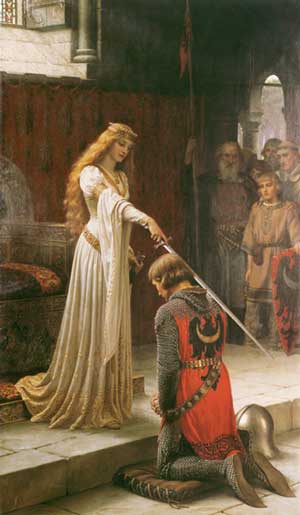
 Image:   The Accolade, by EdmundBlair Leighton.