Monday, May 01, 2006

Surviving Garments Database

Faithful readers will remember me mentioning my lecture on medieval re-enactment and re-creation in NU's HIST 2105 at the beginning of April. In that lecture I talked about how re-creation and re-enactment is often inspired by a desire to re-create "stuff," clothing for instance, or armor, or food.

Sometimes serious re-enactors end up with an unusual amount of expertise, because they are motivated to find out things (St. Augustine's underwear) that few serious scholars are interested in.

When you get someone who is both re-enactor and scholar, you sometimes end up with a great synergy.

One such person is the linguist Heather Rose Jones, who has also been sewing medieval clothing for about 30 years. Long ago she figured out that there are a surprising number of surviving garments from medieval and ancient times, but that there is no central reference work to help interested parties find them. So now she has created the Surviving Garments Database. No pictures, but for the serious researcher, a goldmine.

My picture? This is the coronation robe of King Roger II of Sicily, who ruled in the 12th century. He was of Norman background, but his new kingdom (which included much of the "boot" of Italy) had a significant Islamic population. Islamic influence is given credit for the use of symbols here: a palm tree showing prosperity, and lions savagely pulling down camels, which might also mean prosperity to some people at the time. Click on the image to get a really good view.

Sunday, April 30, 2006

Cosmopolitanism

A meditation by Phil Paine.

Those moments in history we keep returning to

There are some times and places in history where the drama is so palpable, and the issues so compelling, that serious people return to them again and again, hoping to learn something vital from them.

One of those times is democratic Athens in antiquity. The great crisis of the Peloponnesian War is a favorite in any time of crisis where issues of war and democracy occur together. In yesterday's Guardian the historian Mary Beard opines that "the glorious myth of ancient Athens is a poor model for re-creating the virtues of government in the 21st century."

On the other hand, I'm sure that she would agree that just about anyone seriously interested in war, democracy, or history would benefit from reading Thucydides' near contemporary account of the Peloponnesian War. And throw in some plays by Aristophanes while you are at it.

Another classic subject is the French Revolution. The number of books written about it is uncountable. Two are worth mentioning: Simon Schama's Citizens (original cover above), which you can easily order from your favorite bookseller; and the much older but still compelling two-volume set by R.R. Palmer, The Age of the Democratic Revolution. Both of these are incredibly well-written, and both were produced by great historians in command of a vast amount of material. Palmer's book is about more than the French Revolution, in fact. Its whole point is that the revolutionary movement swept the entire Atlantic world.

Both are in the NU collection.

Saturday, April 29, 2006

For students in HIST 4505 (2006-7): Chivalry seminar

Starting in September, I will be teaching Nipissing University's HIST 4505, which our calendar calls "Topics in Medieval History." Not a very helpful description, is it?

For the benefit of any of my students who stop by here: the subject will be "Chivalry." It's a big subject, especially if you bring in all the various points of view: what poets, chroniclers, preachers, and knights themselves said chivalry was, or should be.

I am in the process of putting together a course outline, a course reader, and a web-page. In the meantime, here's a pre-course reading list for any of you who might be really enthusiastic. It's taken right off the NU library catalogue, and it's just a sample; there is plenty more where that came from. Read one of these, and you have a good head-start; read a second one and you are really off to the races.

Students often associate History with the D section of the Library of Congress classification (or E or F if they study the Western Hemisphere). Note how few of these books are in "D." Lots of fabulous books lurk in B, C, J, H, and U.

CR4529.E85 K33 1999
Chivalry and violence in medieval Europe / Richard W. Kaeuper.


DC33.2 .B59 1998
Strong of body, brave and noble : chivalry and society in medieval France / Constance Brittain Bouchard.

CR4513 .K44 1984
Chivalry / Maurice Keen.

CR4529.F8 P3
French chivalry : chivalric ideas and practices in mediaeval France / by Sidney Painter.

CR4509 .B37 1974
Knight and chivalry / Richard Barber.

CR4553 .H84 2005
Deeds of arms : formal combats in the late fourteenth century / Steven Muhlberger.

DC96.5 .W75 2000
Knights and peasants : the Hundred Years War in the French countryside / Nicholas Wright.

HN11 .D7813 1980
The chivalrous society / Georges Duby ; translated by Cynthia Postan.

DA185 .C64 1996
The knight in medieval England, 1000-1400 / Peter Coss.

Wednesday, April 26, 2006

Continuing into the summer

All sorts of things have prevented me from blogging since the 22nd, including my computer blowing up. But I do intend to keep this up over the spring and summer.

Today's snippet comes via Explorator from the usually rather shallow USA Today. It's about the use of computer animation and other infotech to study ancient civilization. Somebody will say, "wow, ironic," but scholars of the past have often been on the cutting edge this way. It's practically the price of doing business. After all, if you can only see or analyze as well as the ordinary person on the street, you are -- in the case of archaeology -- going to be reduced to saying, "yeah, looks like a hill, looks like a dusty plain."

The article links to an upcoming game Discover Babylon created by real archaeologists, but I can't make it work. Maybe you will have better luck.

Thursday, April 20, 2006

Egypt the treasure house

Grading papers for Ancient Civilization today, I read a lot of short descriptions of Cleopatra and the Second Triumvirate, and it occurred to me that maybe I should have said a bit more about the importance of the competition between Antony and Octavian for the great prize of Egypt, about how much Octavian/Augustus relied on it for funding his regime, and how right up till the end of the period we studied Egypt continued to be a treasure house, feeding for instance Constantine's New Rome.

Since I can't go back and say those things, I say them here. Looking over all those short identification "gobbets" (as they say in England) reminded me of those things.

Tuesday, April 18, 2006

Unknown to readers of Arabic

There is a lot of facile blather about the globalization of culture, but real divisions remain. Juan Cole, a professor of Middle Eastern studies at the University of Michigan, is concerned that many American classic writers -- like Benjamin Franklin, above -- are simply unavailable in Arabic. Few translations have been made, and those few are extremely difficult to find. Sure, speakers of Arabic who know English or French have more options -- though one wonders how available texts are even for them. Millions of educated Arabs who know only their own language have no access to what many people would think are essential works.

Cole thinks this is appalling, and it is even more appalling that official American efforts to promote the best of American culture have been cut back over the past decade or so. He's trying to do something about it.

This leads me to reflect more generally on the notion of access to classic writings in other cultures, or classic writings in the more-familiar past. How much better off than these mono-lingual Arabs are most of us who read English? Read any Ben Franklin lately?

Think about English-speaking Canadians, who live right next door to the USA and have near-instant access to American material. Wouldn't you guess that the most influential material on our view of the USA is in video form? Movies, music videos, TV shows, TV news? The last being a particularly inadequate representation of reality?

It's worth thinking about what people really know, but it's not easy to come up with conclusions.

In the meantime, you might yourself consider reading some good Arabic, Japanese, French, Brazilian or American material. Small as Nipissing University's library looks in comparison to bigger scholarly collections, it contains more good stuff than any one person is likely to read. This, for instance.

Sunday, April 16, 2006

Richard Cromwell

One person who often showed up on the Early Modern Europe exam was Richard Cromwell; he logically was cited by people who were writing on the Declaration of Breda. Richard. was the son and successor of Oliver Cromwell as Lord Protector of England. He had no particular qualifications for the job and was soon forced out and/or quit. I always thought he was just realistic enough to know when to go, but this BBC site rather emphasizes that he tried holding onto power for quite a while against serious opposition.

I always wondered what an ex-Lord Protector did with himself. The answer: he ran off to Paris dodging his debtors and any further political trouble. He lived there and in Geneva until 1680 and then returned to England to "live quietly" for another 32 years.

Olympe de Gouges

On the final exam for Early Modern Europe, I misspelled the name of Olympe de Gouges, the feminist writer at the time of the French Revolution. So I thought I'd take this opportunity to spell it right.

The picture above is from a poster for a 2002 conference about her in Taipei.

There is no single really good site about Olympe de Gouges. This one at Middlesex University has both French text and English translation of The Declaration of the Rights of Woman and the Female Citizen. The Wikipedia article states that de Gouges was executed for writing a critique of revolutionary France from the point of view of an "aerial voyager," presumably a balloonist. Hot-air balloons were then symbols of the utmost modernity and they were a French invention.

Gospel of Judas --- this is what it looks like

This is from the National Geographic "Lost Gospel" site. Thanks to Al-Ahram (Egypt) for the alert.

Saturday, April 15, 2006

Further adventures in electoral democracy

Here's a picture of the swing district in the recent Italian election.


In recent years, the government of outgoing Italian PM Sylvio Berlusconi introduced a measure allowing people of Italian descent to vote in Italian elections. The theory behind it, if you can call it that, was that anyone who could prove descent from Italians in the male line should be represented in parliament.

The election turned out to be so close that the electors in "North and Central America," many of whom have a rather tenuous connection with Italy, helped determine the result; which went against the people who introduced the measure.

Bet they didn't expect that!

It will be interesting to see whether overseas representation of people who are Italians by male descent survives this event. Or whether there is a big push for Italians by female or mixed descent to get equivalent privilege.

More on this from Toronto's Globe and Mail.

War of Jenkins' Ear

Thanks to the students in Early Modern Europe who have taught me the fact that Robert Jenkins' ship was named the Rebecca. (No, that's not really the Rebecca above.)

For those of you who don't know the War of Jenkins' Ear, the Web is open for business, even on Easter Weekend. Here's a cartoon of the shocking moment when Walpole, the PM, was confronted with the fabled ear.

Thursday, April 13, 2006

Bosnian pyramids?

In various places around the Web you can read about this hill, which may or may not be the first ancient pyramid found in Europe. Here's a post from Dino Avdibeg's blog Unjournaled with some older links.

Ever notice how once people figure out how to make tall buildings with straight sides, they stop making fake hills?

Tuesday, April 11, 2006

Proclamation of the "General Command of the Armed Forces"

This is current, but in a little less than a year, I'll want to use this proclamation in my History of Islamic Civilization course as an illustration of Arab nationalism in Iraq (English translation below the Arabic).

It will be interesting, to say the least, to look back on this from that unknown future situation.

It's quite possible that this proclamation is a complete fantasy, but the language is interesting nonetheless.

Monday, April 10, 2006

More baloney on the Knights Templar

I'm on a scholarly mailing list of medieval historians and enthusiasts, and they've already been outraged or saddened by a Daily Telegraph article entitled "First Knights Templar are discovered," which seems to imply that there has never before this archaeological discovery in Israel been any real evidence, or perhaps physical proof, that the Knights Templar ever existed.

There have been a lot of bizarre stories told about the Knights Templar since the French King Philip IV ("the Fair") set out to destroy them in the 1310s. But the order is perfectly historical, whatever myths have grown up since.

There are so many amateur sites on the KT on the web that it's hard to sort through them. The old (early 20th c.) Catholic Encyclopedia entry seems to be OK.

Update: The scholar leading this dig, Dr Thomas Asbridge (Senior Lecturer in Medieval History Queen Mary, University of London) responds to another blog, making clear that whatever the Daily Telegraph may have done, he's a legitimate scholar. This was always my impression and nothing in this weblog should be taken as a criticism of Dr. Asbridge, who was only trying to make his work available to the public.

Sunday, April 09, 2006

Stitch-counting and sacred history at Selma

Last Friday I talked about historical re-creation and re-enactment in HIST 2105. I discussed the elusive concept of "authenticity," which can mean different things to different people.

One kind of "authenticity" concerns getting the artifacts -- clothes, weapons, accessories -- just right. How "right" is "right enough?" That's where the arguments begin.

According to an article in today's LA Times
arguments of this sort may have killed off Alabama's most prominent Civil War re-enactment, in Selma. In 1995, they had 2,000 re-enactors on the field. This year, fewer than 200 were interested, and the battle's been cancelled. Why no interest?

"It was getting to the point where we weren't exactly welcomed with open arms," said Roger Brothers, captain of the 62nd Alabama unit, who decided to skip this year's battle for the first time in 18 years. He will travel more than 200 miles to another reenactment, in Kennesaw, Ga.

"The stitch-counters had taken over," he said. "If you didn't have what they considered to be the sufficient authentic kit, they looked down their noses at you."
But there's another factor as well. I said in class that US Civil War re-enactment is a kind of celebration of sacred history. Large-scale events of this sort are inspired by the most important turning point in a community's history -- that's why people put their energy and creativity into them.

In Selma, the most important battle for the community probably isn't the battle of April 2, 1865. The town is now 69% African-American and they remember more keenly the attack of state troopers on a civil rights march that took place on March 7, 1965 (above).

They don't do re-enactments, but they are getting a $500,000+ interpretive center.

Saturday, April 08, 2006

Knighthood in flower in Spilsby, Lincolnshire

Here I am, writing an article on 14th century chivalry, thinking about the seminar on chivalry I will be teaching next fall, and I run across an article in the Times of London about Spilsby (above) and its successful (so far) program to reduce youth crime by teaching a class on chivalry to 6 to 8 year-olds. More details here.

Friday, April 07, 2006

NU Students: International Mentors wanted

Nipissing University is interested in recruiting mentors for international students during the upcoming academic year. If you are interested, more information and an application (due the 14th) are here.

Democracy's Place in World History

My friend and sometime collaborator Phil Paine and I published an article with this title in the Journal of World History (1993) v. 4, pages 23-45. Phil just discovered that it's now got enough currency to be quoted by politicians: specifically Richard Gephardt, former Democratic Leader in the US House of Representatives in a speech of March, 2005 (PDF). (Also here in a HTML version.) As Phil says, though, Mr. Gephardt seems to have missed the point of the article. Have a look at Phil's comments in his blog at April 4, 2006.

If you are interested in what Phil and I have said about democracy, have a look at the various essays at our site, World History of Democracy. The book referred to at the site has stalled, as both of us have significant responsibilities distracting us. Nevertheless, some of that material may be of use. Anyone who wants a thought-provoking summary of the history of democracy that doesn't start or end with either the American or French Revolutions should have a look at John Markoff's Waves of Democracy: Social Movements and Political Change. Pine Forge Press, 1996. I'm also fond of Robert A. Dahl's Democracy and Its Critics. New Haven and London: Yale University Press, 1989.


Thursday, April 06, 2006

Significance of the Gospel of Judas

Now I am not an expert on early Christian literature, but as a former expert on another aspect of Late Antiquity, I've read far more about early Christianity than most people.

Coming from that standpoint, I find that most of today's news items on the Gospel of Judas to be very deceptive.

I don't think this tells us a thing about Judas.

It is a 2nd century text, written long after the four better-known Gospels, that is useful primarily to illuminate debates among 2nd century Christians about the nature of Jesus and the meaning of his message.

More on the Gospel of Judas

If you read the news, you may already have seen this: the National Geographic Society has "unveiled" the text of the recovered Gospel of Judas. There is a long piece, with an interview with the writer of a book on the text and its discovery, at National Public Radio's site.

Also, some useful links at the tertullian.org site.

Here is what Irenaeus, bishop of Lyon, said around 180 AD about the beliefs of the Cainites who supposedly originated the Gospel (Against all Heresies, Book 1, chapter 31, section 1) :

Others again declare that Cain derived his being from the Power above, and acknowledge that Esau, Korah, the Sodomites, and all such persons, are related to themselves. On this account, they add, they have been assailed by the Creator, yet no one of them has suffered injury. For Sophia was in the habit of carrying off that which belonged to her from them to herself. They declare that Judas the traitor was thoroughly acquainted with these things, and that he alone, knowing the truth as no others did, accomplished the mystery of the betrayal; by him all things, both earthly and heavenly, were thus thrown into confusion. They produce a fictitious history of this kind, which they style the Gospel of Judas.
I got this translation from the Gnostic Society Library, who have posted this translation, presumably from the Ante-Nicene Fathers collection (now public domain).

Irenaeus was a great ideological warrior and there's no obligation on us to believe everything he said about the "Cainites," but what he says about the Gospel of Judas seems to be consistent with the newly discovered text (which is a Coptic or Egyptian version of a Greek original).

P.S. The hostility to the Creator evident in the excerpt above could use some explanation. Some early Christian groups saw the Creator of the physical world as the enemy of everything spiritual, including Jesus and His true followers.

Wednesday, April 05, 2006

Your occasional off-topic comment

Deep in the heart of Texas, somebody speaks sense:

"We have a lot of different points of view on the University of Texas at Austin campus. And we certainly support our faculty in saying what they think," said Don Hale, a spokesman for the University of Texas.

"They have the right to express their point of view," he said. "But they're expressing their personal point of view."

If you are curious as to what this is about see this article at the CBC news site.

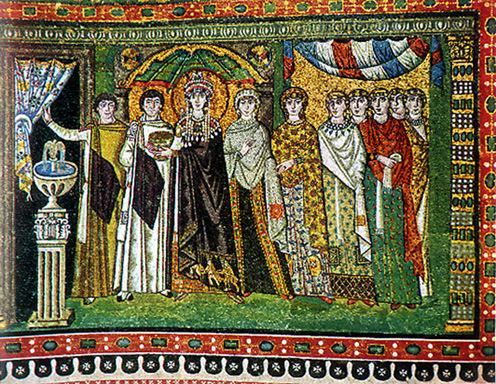
Christian emperor and Christian empress


Following up from today's lecture in Ancient Civilizations, here are both Justinian and Theodora from the mosaics in Ravenna, Italy. Click on the images for larger, clearer versions.

A David portrait of 1799

What does this tell us about the French Revolution? (1799 is the year Napoleon became effectively dictator.)

Saturday, April 01, 2006

Ancient Civilizations -- the last two lectures

There are no online lecture notes for the last two lectures in Ancient Civilizations. That's because I have written an entire Overview of Late Antiquity, which has been published on the web for the last decade. Class members who want to prepare for lecture should have a look here. The relevant chapters for the upcoming class meetings are chapters 2 and 3, but there's more if you get interested.

The silly illustration is the label of beer made by the Milton Brewery, a British company that makes an "Imperator" range of beers. They claim that this particular beer won a big prize in 2002:

Considering who it's named after, perhaps we should be skeptical. After all, the picture they use is of a broken colossal statue of Constantine made at C's own orders, a statue 8 feet tall. Big talk of being "supreme champion" has always been part of the imperial bag of tricks.

On the other hand if Milton wants to send me a sample, I'm more than willing to give it a fair try.

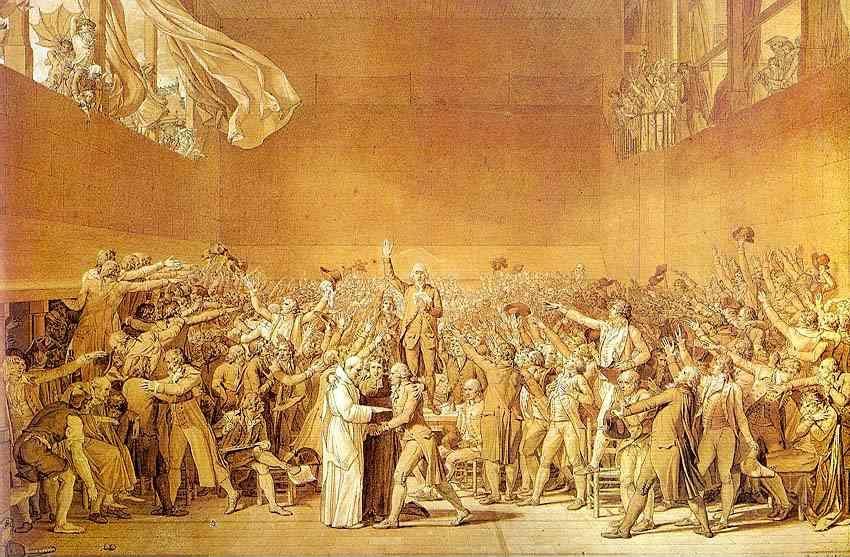
David's Oath of the Tennis Court

A student in the Early Modern Europe class knows more about this painting than I do , having studied it in Art History, and kindly corrects some of the statements I made about it (click it to see it larger).

For the benefit of the rest of the class I post part of her e-mail, with permission.
The central figure in the drawing is in fact the Assembly President Jean-Sylvestre Bailly, not Sieyes as you thought. You are correct in saying that the men below represent the creation of a new order. These men are three ecclesiastics, and members of the Third Estate, who joined the revolution. From left to right they are: A Carthusian Monk named Dom Gerle, who was not present at the original gathering, Abbe Gregorie and Rabaut Saint-Etienne. They stand for the regular and secular clergy and the Protestant Church. In addition, right of Bailly is Robespierre.

The people above the assembly are the witnesses of this event. As well, the drawing is littered with Freemasonry symbols, of which David was a member. As you may know Freemasonry helped spread the liberal ideas fueled by the revolution. Common imagery used in revolutionary art was the all-seeing eye (representing vigilance) and the square or level (representing equality).

You mentioned how this drawing is reminiscent of David's Oath of the Horatii, yes this is true, he saw this drawing as an expansion on ideas expressed in the Horatii; the heroes in the Horatii are represented in a modern context as the deputies present at the assembly.
Thanks, the correction is very much appreciated! Further reading, from the same correspondent:
Lee, Simon. David. London, England: Phaidon Press Ltd., 1999.
I'm fascinated by David and am glad to have the reference.

Histories of the Near North Conference continues

Today I was at the first session of the community history conference and enjoyed myself immensely. Tomorrow (Sunday April 2) the conference continues @discoverynorthbay, the old CPR station at the foot of Ferguson Street. Parking's free on the weekend, as is the conference itself. Remember that the clock "springs forward" tonight. Here's a link to the schedule.

Thursday, March 30, 2006

NU History students --- money going begging

NU History students who are in their final year of full-time study, who plan to pursue a Bachelor of Education degree in the following year, either at Nipissing University or at another university, may be eligible for the Smith Award. Check with the Student Awards Office (F218) for the process and eligibility.

See this link.

The secret chocolate recipe of the later Medicis

Thanks to the student who sent me a link to a really interesting piece from Discovery.com on the efforts of Cosimo III (above), Grand Duke of Tuscany, to counter Spanish domination of "chocolate culture."

In the 17th century, chocolate was a hot, usually bitter drink. The Spanish, who had conquered the Central American originators of chocolate, set the standard for the substance. Cosimo III, whose state of Tuscany was pretty much a Spanish satellite, decided to fight back by having a superior jasmine chocolate blend created so that Florence, not Madrid, would dominate the world of chocolate cuisine.

A museum display in the Civic Museum of Monsummano Terme reveals Cosimo's secret and if the Discovery.com version is indicative, gushes over the brilliance of Cosimo's gastronomic coup.

However, there is another way of looking at it: the site from which I borrowed the portrait, paradoxplace.com characterizes Cosimo as one of the worst of the generally worthless later Medicis: "a disaster or the State of Tuscany, and the penultimate nail in the coffin of the Medici dynasty."

I'm generally a Tom Paine man: "the palaces of kings are built upon the ruins of the bowers of paradise;" but occasionally, I must admit, that some benefits trickle down to us unwashed masses. Paradoxplace attributes the invention of the pianoforte to Bartolemeo Cristofori, an instrument maker of Cosimo's time.

Here's the jasmine chocolate recipe from Discovery.com:

10 librae of roasted cocoa, cleaned and coarsely minced (1 libra = 12 oz.)
fresh jasmine petals
8 librae white sugar
3 ounces vanilla flowers
6 ounces cinnamon
2 scruples (7.76 grams)ambergris

Put layers of cocoa and jasmine flowers in a box, one layer over the other. Let it rest for 24 hours, then change the jasmine flowers with fresh ones. Repeat 12 times. Add the other ingredients and combine them on a warmed marble surface until the chocolate dough forms.

Have fun, and let us know how it turns out. Especially the ambergris part.

Monday, March 27, 2006

The war continues


World War I is not over yet.

In October of 1916, Private Harry Farr, after two years of fighting in the trenches, refused to return to the front. He was tried for cowardice and on conviction was executed. He refused a blindfold before the firing squad.

His 92-year-old daughter, Gertrude Harris, has been trying for the past 13 years to get Harry a posthumous pardon. She has evidence that he suffered from shell shock, or in today's terminology, post-traumatic stress disorder. The British defense minister, who refused Gertrude's request in February, has decided to reconsider.

Good luck, Gertrude.

This is not a unique case. According to The Times, to which I am indebted for this information, "17 alleged cowards in the British Army [were executed] during the First World War [and] a further 289 soldiers were shot for desertion and disobeying orders."

Here's Harry. Remember him when you think of "the Great War."

Update: Harry may get his pardon.

Sunday, March 26, 2006

A whole new world of knowledge

Something very interesting happened on the Internet this past week.

The Washington Post web site hired a young right-wing blogger to comment on news and policy. A lot of readers were outraged that he was hired, considering him to be a shallow, dishonest bigot.

But that's not the interesting part. Within a couple of days other bloggers, using only Google, dug up numerous examples of this young blogger's repeated plagiarism, and he was forced to resign.

All sorts of questions arise from this, like why was he hired in the first place, but the really crucial aspects are this: 1. It took next to no time for the young blogger's critics to nail him to the wall; and 2. the Washington Post web site seems to have made no effort to check out his past commentary.

The second point indicates that we are in a whole new world of knowledge. Supposedly authoritative institutions and individuals as well are going to be under constant scrutiny by thousands if not millions of people who were not long ago forced to be a passive audience.

And authoritative institutions are having a hard time facing this fact. See the reader commentary directed at the editor of the online version of the Post here.

Friday, March 24, 2006

A national custom

I disavow the common Anglophone attitude -- at least in North America -- of baiting the French, as though they were some uniquely risible nation. Start looking for risible nations and you'll have a long list and rankings on it will be hard-fought-for.

However, I don't consider it ridiculing the French to point out that when they -- or at least enough of them -- get upset with their government, demonstrators and rioters pour out in the street. As the Early Modern Europe course approaches the Fall of the Bastille (above, and see a contemporary account here) it's worth knowing that urban riots and peasant uprisings -- both features of France in 1789 and the years that followed -- were pretty common parts of early modern society. There's an interesting description of a French bread riot in 1725 here, for instance. Note that the women of the town were usually the ones who led bread riots, which will be relevant to those of us in class when we reach "the October Days."

Burke, some of you will remember, thought that the October Days, because of the unprovoked killing of certain royal retainers at Versailles and the insult to the Queen, was the realization of a totally evil human impulse. Whether or not he was right about that, the spectre of widespread disorder was frightening to respectable people like Burke, and not necessarily a remote threat. (The British upper class energetically hung and "transported" many thousands of its poor and unruly lower class.)

One of the issues surrounding the French Revolution is that it was a riot -- and a peasant revolt t00 -- that got out of hand. Perhaps other people in France thought, "just another Parisian riot." Once they got the idea that this riot wasn't going to stop, it's easy to imagine that some of them were even more frightened and angry than they were initially, and that others who had welcomed the downfall a corrupt and disfunctional royal government got profoundly uneasy.

I'm not going to make the shallow claim that the current French urban riots are just like those of 1789, 1648, or 1356, but it is interesting that these things happen in France more often than in other rich countries.

For those interested in more, here's what appears to be an Anarchist account of May 1968. Last fall's riots are discussed by the Christian Science Monitor here, and the current ones are discussed in several articles listed in the Guardian here.

UPDATE: The Guardian has alerted me to an Unrest in France blog.

Thursday, March 23, 2006

Not a lynx?

There is some evidence that the big cat at NU may have been a cougar. It's not impossible.

Tuesday, March 21, 2006

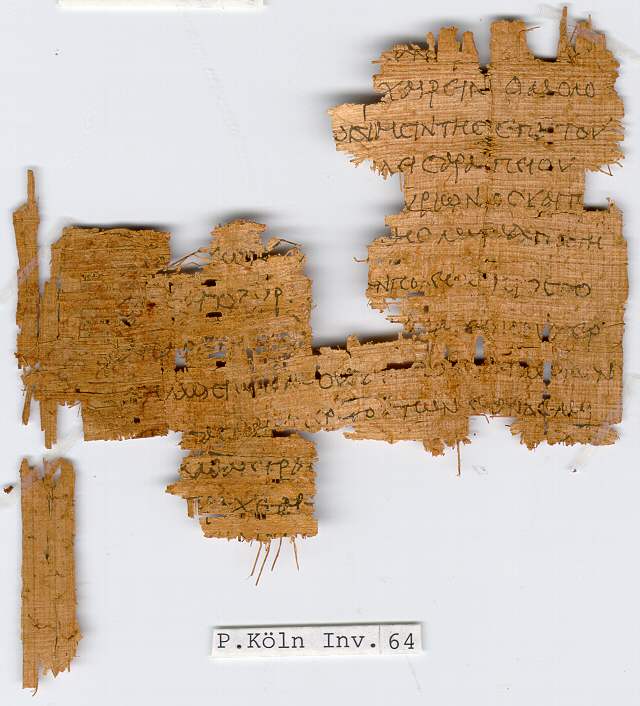
Treasures from an Egyptian dump

As has been noted before, Egypt is a very dry place, unless you are on the old Nile flood plain. Unfortunately nearly every inhabited place is on the flood plain, and most perishible remains of normal life have rotted away, just like they have in most other countries.

But the old town of Oxyrhynchos (now el-Bahnasa), located as it is on dried up canal, is different. And because it has been unaffected by flooding since the 7th century CE (AD), its dump has preserved unparalleled treasures: a huge selection of the documents, public and private, of a Hellenistic and Roman-era town in Egypt. We can read all sorts of literary, legal, and personal writings, and so for us, Oxyrhynchos is one of the best-known cities of the Roman empire.

According to Wikipedia, which has the most extensive discussion of the site and its importance that I could find, excavation of the dump for documents began in the late 19th century, during the British occupation of Egypt, under the supervision of some Oxford scholars. They hoped to find the lost works of antiquity, and eventually some were in fact found. But perhaps more important than the literary works are the personal records and correspondence of ordinary Egyptian townspeople of the Roman era. We'll be discussing some of these in class tomorrow. For distant readers, have a look here (following the excerpt from Strabo).

The most interesting thing I found out while writing the post is that 100,000 papyrus fragments have been found, and 4,700 have been published. And this with an energetic publishing program of about a volume a year. Clearly a project without end.

Update: For more material, see the Papyrology site at Oxford.

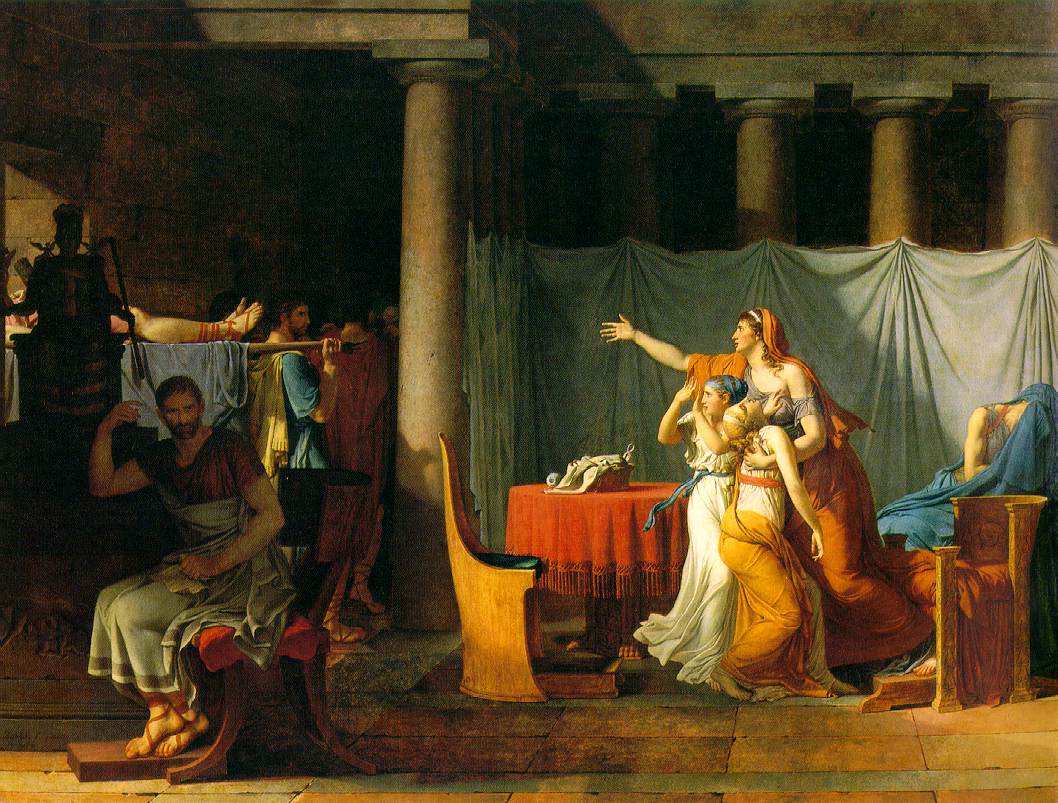
Greuze and David

Today's lecture in Early Modern European history discussed how Simon Schama in his 1989 book on the French Revolution, Citizens, used the artists Greuze and David as indicators of dissatisfaction that existed in France with Old Regime culture just before the Revolution.

I looked around for good site and this is what I found:

For Greuze, World Wide Art Archive has a long list of links to on-line paintings and on-line museum exhibits featuring the artist.

For David, Artchive has an introduction, a list of links to other articles on the artist, and a link to images of his work.

Above you will see one of those images: his grim portrayal of 1789 of the original Brutus of early Roman times, receiving the bodies of his sons, whom he'd had executed to save the early Roman Republic. Clicking on it may get you a larger version of the painting.

Monday, March 20, 2006

NU: Lynx spotted near Chancellor's House Mar 20

For those of you out-of-town, this is an unusual sighting. More often, it's bears.

Roman villas

In the book I referred to in today's lecture, Bryan Ward-Perkins' The Fall of Rome, the author argues that the Romans at their height created a level of physical comfort not attained in many later centuries. Some of what Ward-Perkins says is controversial, but certainly the Romans knew a great deal about comfort.

One symbol of Roman comfort is the villa. One meaning of "villa" is a rural mansion which was the center of an extensive aristocratic estate. Such villas brought urban comfort into the countryside.

Using Google Images I found one particularly nice site, a Virtual Visit to Torre Llauder, a villa of the late 2nd or early 3rd century in Catalonia, Spain.

The picture above is a Roman villa in Norfolk, England, as seen by aerial photography. The complex was revealed by the contrast between crops growing on the old walls and those growing elsewhere. We owe much of our modern archaeological knowledge to quite recent technological advances such as this.

Study sheets for final examinations

These are available at my office, H 312.

Sunday, March 19, 2006

More seriously now...

We've passed the third anniversary of the invasion of Iraq and there is no sign that peace will return any time soon.

Since I teach the History of Islamic Civilization in 2006-7 I follow developments in the Middle East and elsewhere in the Islamic world pretty closely. For those of you who want to know more than the very little that appears in the average media outlet, try Today in Iraq. You quickly will find that it has an editorial point of view -- anti-war -- but there is no other site that will give you as much access to reports on Iraq as this one. If there is a better one, I'd like to know about it.

I cited some links to Iraqi-written weblogs in an earlier post.

Mary Queen of Scots' football?

If the Scotsman is not putting us on, this football may actually be connected with Scotland's most popular queen. This charming story came to me via the Archaeology in Europe blog, which I learned of from Explorator, an ancient history newsletter you can sign up for via Yahoogroups.

Saturday, March 18, 2006

Friends of the Mediaeval Studies Society Symposium


The Royal Ontario Museum in Toronto is sponsoring a symposium next weekend -- specifically on Saturday, March 25 -- on behalf of its Friends of the Mediaeval Studies Society, a new special interest group. I will be speaking on the text illustrated above -- the chronicler Froissart's account of a chivalric deed of arms with political implications.

What you see above is a joust between the French lord of Clary and Sir Peter Courtenay, an Englishman, over whether Courtenay had "spoken too freely" about French courage, or the lack thereof. Since the French and English had just finished campaigning against each other and the French had won, you'd think that such a private confrontation would have been beside the point. But then, explaining why the deed made sense at the time is what the paper is all about.

More information about the symposium is here.

Friday, March 17, 2006

St. Patrick was a Briton

Most of the pictures of St. Patrick I could find on the web are for some reason done in a Byzantine style -- there seems to be a modern artistic/devotional movement inspired by the traditional icons of the eastern churches.

So I decided to celebrate St. Patrick's Day with a different kind of popular image.

Something I like to point out to people who feel more Irish than me is that even though Patrick was the apostle of the Irish and is now their patron saint, he was a Briton, or a Roman, or both. In any case, he came from the other big island next door. Don't be deceived by the possibility (see the old Catholic Encyclopedia) that he was born in present-day Scotland. Patrick was not a Scot. In his time, the 5th century, "Scotia" was a name for Ireland. The name has migrated.

And to be quite clear, Britons in the 5th century were not English. The English (Angles, Saxons, and Jutes) back then mostly lived in present-day Germany and Denmark, in the Angle, though a few pesky immigrants were showing up in Roman Britain.

Missed the Ides of March -- the Roman Calendar


I was too busy this week to remark in class on the Ides of March, the day on which Julius Caesar was assassinated in 44 BCE. (Above is a reproduction of a coin issued by his assassins, which shows the daggers and displays a freed slaves cap, as a symbol of the liberation of the Roman people from Caesar's tyrrany.)

Before 44 BCE, the "ides of March" was just the name of a day on the Roman calendar. The Romans had a very peculiar way of keeping track of the days and those who want to study them seriously have to wrestle with that calendar at some point. To be brief, there were three days in the month that acted as reference points: the ides (1st) , the nones (5th or 7th, depending on the month), and the ides (13th or 15th). Other days were designated by counting backward to the next reference point. What we call the 2nd of March was identified as the "6th of (or before) the nones of March," while the next day was the 5th of the nones.

One result is that "days of the kalends of March" are all (except for the kalends itself) are in the month of February!

There are plenty more complexities in the Roman calendar. An attractive and detailed site, Calendars through the Ages, is here.

Next, I guess, I'll be looking for an excuse to explain the not-quite-so-arcane "pounds-shillings-pence (Lsd)" currency system used by the English and many other Europeans in the past.

Wednesday, March 15, 2006

Nipissing Students: Job on Parliament Hill

This just came in the mail and has a deadline of March 20. "The Parliament Hill Players" -- AKA your government -- are hiring "first-person historical costumed interpreters at Parliament." If you are bilingual and have the talent, you can play Sir John A, Lady Agnes Macdonald, Maria Lipinska, Sir Georges Etienne Cartier, and others, for money!

There is a poster outside my office, H 312, with details.

You must be available for auditions sometime between March 25 and April 2, and for the whole program period of June 5 to September 4.

We might call this a variant on public history...

Tuesday, March 14, 2006

More ancient manuscripts

There is a new Carnivalesque, a collection of historical items found in various blogs and news sources, posted at Archaeoastronomy. This one is Carnivalesque XIII and is dedicated to ancient and medieval history.

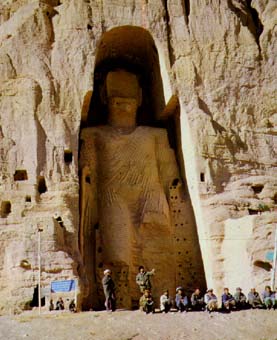
Included in this collection is my previous entry here on the Gospel of Judas. It's been interestingly paired with a post at Varnam about the oldest Buddhist manuscripts known, which have also been a subject of controversy, explored in more detail at the site for the Buddhist Channel. These manuscripts, you see, were smuggled out of Afghanistan from their former home, Bamiyan, the location of a historic early monastery. Smuggling antiquities out of their country of origin is widely disapproved, but given the destruction of Buddhist monuments at Bamiyan (above) by the former Taliban regime, which may not be out for the count yet, their sale may have saved them.

Sunday, March 12, 2006

The Gnostic Gospel of Judas

Just as interesting and significant as the Dead Sea Scrolls are the Gnostic Gospels, known mainly through manuscripts discovered in Nag Hammadi in Egypt in 1948 (about the same time as the Dead Sea Scrolls were found). Like the DSS (briefly described here and here), the Nag Hammadi collection includes a lot of non-canonical religious literature from later antiquity. "Non-canonical" means that these are writings that did not get on "the list" of approved or authoritative works drawn up by "Church Fathers." In other words, there are surviving gospels that are not included in the standard New Testament, including for instance the Gospel of Thomas (a page is pictured above). Most theologians do not believe that these non-canonical writings go back to the times of the apostles, or necessarily represent the views of the people after whom they are sometimes named, but that they were written later to promote "gnostic" interpretations of Jesus's message. (Here is one view of gnosticism by people who take it pretty seriously.)

Mainstream scholars see these works as a gateway into the rich religious world of the 2nd and 3rd centuries C.E. (A.D.); however, you can understand that lots of people get excited when the word goes out that the Gospel of Judas may become available, published by the National Geographic Society next month.

As important as what the text may actually say -- given that it is probably a 2nd century creation -- is the ethical question posed by the NGS publication. This manuscript has been known to exist since at least 1983, and it hasn't surfaced yet because it can be regarded as stolen property -- it was dug up and taken from Egypt without authorization, as in the case of so many finds before. The current owners (holders?) have been trying to sell it for millions ever since.

Scholars have been torn. Pony up the money and get the text into the public forum? Indeed, save what may be a very brittle manuscript by making sure it's being cared for properly? Or will paying the holders legitimize their activities and make sales of illegally obtained manuscripts more likely and more lucrative in the future?

A tough question indeed.

Curiously, I was unable to find a copy of the National Geographic Society's official statement on their site. The best treatment is the Christian Science Monitor's story.

UPDATE on April 6, from National Public Radio. Also see my more recent post.

Thursday, March 09, 2006

Voice of America Pronunciation Guide

Just came across this site, which contains many difficult names of people and place who are or might be in the news.

Warning: It loaded very slowly when I visited it.

Edmund Burke

Edmund Burke has come up in Early Modern Europe more than once. Here's a portrait and a link to the Stanford Encyclopedia of Philosophy.

NUSU's trip to "Medieval Times" Friday March 31

NUSU, the student government here at Nipissing University, has arranged a trip to the medieval dinner-theater presentation, "Medieval Times."

For more details see the NUSU events page.

Wednesday, March 08, 2006

End of "feudal" government on Sark

Above you should see "La Seigneurie," the home of the hereditary lord of the English Channel Island of Sark. In my Early Modern Europe course I've often talked about how the big-name countries of Europe are really made up of little enclaves with distinct histories, customs, and laws. Sark's a great case of this: very close indeed to the coast of England (but closer yet to Normandy), it is neither part of England nor part of the United Kingdom. It is a lordship founded in the 16th century and dependent directly on Her Majesty Elizabeth II. There is a seigneur or lord and a mostly hereditary parliament (the "Chief Pleas"), whose seats are chiefly allocated to the holders of the original 40 tenements into which the island was divided on settlement.
At least, that's how it worked until recently, when the petty lords of Sark decided, following the advice of human rights lawyers, to bring in universal suffrage. A good portion of the 600 people who live on Sark will now have some say in how things are run. This is being ballyhooed in the media as the end of "feudalism" (see this Telegraph article) but as a medievalist I have to say I admit the term only under protest. (Ask me about my reluctance if you are interested.)

Sark's own website is here.

Tuesday, March 07, 2006

Nipissing University Conference on the Near North

On April 1 and 2, Nipissing University faculty and students will join community members for a conference entitled "Histories of the Near North: Discovering our Community's Past. See this PDF of the program. The conference grows out of the commitment of NU's History Department to the community history of North Bay and its region, and our desire to work with community-based historians and our own undergraduate students to document and disseminate that history.

If you are interested, write historyn AT nipissingu.ca. (AT=@)

And while you are at it, visit the home page of NU's Institute for Community Studies and Oral History, ICSOH.

Saturday, March 04, 2006

Ancient Civilizations will not meet on Monday

There will be no class on Monday, March 6. See you on Wednesday!

The cinematic time machine

Seventy years after her movies were originally released, Shirley Temple is once again receiving huge amounts of fan mail from kids who are seeing her on DVD. For more on this unusual life, see the LA Times.

Empire of the Sun -- telling the truth about history

In today's Guardian J.G. Ballard, who I always think of first as a science fiction writer, reflects on his boyhood in a Japanese prisoner of war camp, the novel he wrote about it, and the movie that was eventually made about it.

Wednesday, March 01, 2006

How deadly was gladiatorial combat?

Next Wednesday I'll be lecturing in Ancient Civilizations on the gladiatorial games, so I was very interested to hear an archaeologist commenting on the subject on CBC Radio's As It Happens. The occasion was the analysis of gladiatorial remains found in Ephesus, now in Turkey. It seems that the wounds found were limited in number and type, suggesting that the combat was limited by certain rules and perhaps was not fought to the death. The Austrian archaeologists have found a number of fighters who seem to have been killed by a "squarish hammer-like injury to the side of the head," which they speculate may have been administered to wounded gladiators backstage.

Earlier research by a friend of mine, Prof Steve Tuck of Miami University of Ohio, research based on comparing ancient depictions of gladiatorial combat with medieval treatises of arms, suggested that the fighters were highly trained and supervised by referees. He and others have argued that most of the time gladiators did not die, or even suffer incapacitating wounds. They were too expensive and popular for that.

I'd be very interested to hear what Prof. Tuck has to say about the new archaeological evidence.

A new era of knowledge?

Toronto's Globe and Mail has this interesting article on how you can tap into the collective wisdom of interconnected humanity.