Thursday, February 28, 2008

Mead-evil witticism of the week


David Myers of Redstone Meadery sez:

"Mead is something that comes around like clockwork every 2,000 to 3,000 years," Myers said. "I saw the wave coming and decided to get on."
Slate evaluates the possibilities of such a wave, and is skeptical. Despite extensive and mostly pleasant interaction with the SCA, I've never really liked mead. Its ancient popularity, I think, came from the fact that really sweet foods were hard to come by. Now they aren't.

Thanks again to Dr. Nokes of Unlocked Wordhoard.
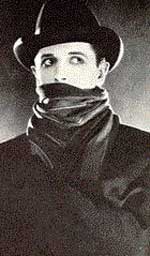
Image: Slate stereotypes mead-drinkers.

Wednesday, February 27, 2008

A druid grave?


A friend sent me this very sensible article from Spiegel Online International about what might be the grave of a druid. The archaeological site, in Essex, sounds very interesting, but what might be the best thing about the article is how the author explains why archaeologists have to be careful in using labels like "Druid."

Image: Some of the utensils found in the grave.

Tuesday, February 26, 2008

Terror victim's body found


Just as my course on Medieval England got up to the reign of Edward II, what should come out in the news but the identification of a medieval corpse at Hulton Abbey, Staffordshire as that of Sir Hugh Despenser the Younger, a great favorite of Edward II, who was executed by "drawing and quartering" in 1326. "Drawing and quartering" was a horrible process which involved disembowlling the victim while still alive, and it was reserved for notable traitors.

The news articles are emphasizing that Edward II was possibly gay and Sir Hugh may have been his lover. In yesterday's lecture I emphasized that Edward was a man constitutionally addicted to listening to and favoring a small number of intimate friends while ignoring everyone else in the kingdom, including his wife and his "natural advisors," the earls and great lords. Sir Hugh and his father of the same name used their position to make themselves rich by plundering the heritages of others' families. This as much as any sexual transgressions made them hated, to the point that Queen Isabelle was able to use their behavior as a reason to overthrow the king in favor of his teenaged son, Edward III.

So why am I calling the greedy and vicious Hugh the Younger a "terror victim?" Note that I didn't say he was an innocent victim of terror. His execution, however, was meant as an object lesson: Lords and gentlemen, don't try to duplicate his illegitimate power! The Telegraph article I linked to above tells readers that he was executed before a "mob," to teach a lesson to the "masses." Well, I think however many people were present, and whatever their station in life, the main lesson was meant for the very restricted political class of England; mere disrespectful nobodies might get in trouble but they would not be given Sir Hugh's elaborate treatment.

Also, I have a problem with the word "mob." Its use implies that the members of it are the scum of the earth. Possibly true, but often not the scum you are thinking of. Many mobs are led by people with big political ambitions, or their direct henchmen, or henchmen of henchmen.

I remember about 20 years ago reading about the Toronto mob that destroyed the print shop of the reform newspaper of William Lyon Mackenzie in the 1830s. That mob was made up of members of the colonial governor's council, or their hangers-on. A zillion similar examples can be found in other eras and places, once one puts away the illusion that "mobs" are made up of opportunistic ordinary criminals.

I'll bet the mob of 1326 was, on average, a really well-dressed group.

Image: A 15th-century depiction of this execution from a ms. of Froissart's Chronicles.

Promoted from comments:


Phil Paine adds:

I recently read a half dozen books on the phenomenon of lynching. It's foundation in political culture rather than "human nature" seemed pretty obvious. During a period in which there were more than 3,000 lynchings recorded in the U.S., there were zero in Canada, and thorough efforts have been made to find them. The only known event was a case where an American probably murdered his wife, then organized a lynch mob to pursue a 14-year-old boy across the border into Canada, where he was tortured and then hanged. Subsequent evidence makes it clear that the boy was a diversionary scapegoat.

What leaps out of the evidence, but seems to escape the notice of the historians, is that time after time it is clear that the "lynch mob" was planned, organized, and lead by a local bigwig --- a wealthy landowner, merchant, or politician. For example, in the case cited above, the leader of the mob was a wealthy local citizen who later became a State Senator. In the west, the typical "classic lynchings" were lead by wealthy cattlemen seeking to dispose of farmers or small ranchers who wouldn't sell their land. The great wave of lynchings in the South, starting in the 1830's, were aimed at shutting down newspapers that might be sympathetic to abolitionism. Lynchings were organized by prominent southerners, and included elaborate expeditions, going hundreds of miles into Northern states to kill free blacks or the editors of abolitionist newspapers. In one case, the "mob" organized an excursion train with reservations, and printed instructions.
Southern pro-slavery newspaper editorials created a systematic myth that these events were spontaneous expressions of "grass-roots democracy" or at least understandable excesses of human nature outraged by fear of crime. Many northern papers accepted this propaganda and echoed it. Few now realize that the Civil War was preceded by decades of terrorist raids on the North, organized by the wealthy elite of the South. That alone made the war inevitable.

Yet in most of the books I read, the authors seemed to ignore their own evidence, and clung to the notion that lynching expressed a spontaneous aspect of human nature, or was a sociological side-effect of the "frontier" and its supposed absence of legal infrastructure.

This delusion ignores the facts that 1) Canada, which was far more of a frontier society than the U.S. during the lynching era, had no lynchings 2) most cases of lynching involved an organized mob breaking into a jail, removing a someone who was in the hands of the law, and killing them, usually after extended torture (burning alive, etc) 3)people who had been found guilty and were going to be executed were lynched just as often as those where the case was not concluded. 4) the heaviest concentration of lynchings was in areas that were far from the frontier, often areas settled for centuries.

Sunday, February 24, 2008

Anglo-Norman Dictionary online


A kind contributor to the Mediev-L list just told me about this handy dictionary!

Image: Edward II in Langtoft's late 14th century chronicle, written in Angl0-Norman.

Smiley's avatars

Secret agents have always worked through alternate identities. Now they are doing it in Second Life. Match made in heaven.

A Genie for "That Beautiful Somewhere"?

The Genies are the Canadian film awards. The film That Beautiful Somewhere, which I discussed in a few posts last year, is perhaps the most noteworthy cultural production associated with Nipissing University, being like the novel Loon from which it is derived the brainchild of Professor William Plumstead.

Further good news: TBS has been nominated for a Genie -- specifically for the Original Score by Steve London (site includes music clips). He and the rest of us will find out if he wins on March 3.


Saturday, February 23, 2008

Inside Iraq still publishing


I'd like to direct my readers' attention to the Inside Iraq blog written by Iraqi employees of the US wire service McClatchy. It's always in my sidebar, but it's been a while since I've said anything about it. If you want to have some idea of what Iraqis, especially Baghdadis, are experiencing, this is a good place to go.

Image: Part of the port of Basra.

Phil Paine's Meditations

Phil Paine's multi-purpose web site has been reorganized, and now includes a page giving easier access to his Meditations on Democracy and Dictatorship.

Google makes us give up our dreams of uniqueness

A family member, intelligent and witty, floated the idea that many people who loudly claim to have this personality syndrome or that may well have Attention Seeking Syndrome. We thought that was clever and apt, and rather hoped the idea would spread.

Imagine my dismay, followed by fatalism, when another family member dug up (guess how) this post by an inhabitant of Dubai who back in 2006 had a very similar idea.

Peawanuck and the rest of the wide world

By some people's standards I live in a remote location, but face it, I've got a paved road in front of my property and high-speed internet service over my phone line (and it works real good). But I get the feeling of remoteness sometimes: the occasional wolf-howl in the distance, the fact that I can see hills in the distance that are in a roadless part of Quebec, my inclusion, on CBC Radio, in a broadcast area that includes the James Bay coast. Sometimes I hear about conditions Peawanuck near Hudson's Bay.

Phil Paine knows Peawanuck better than I do
and uses it as an example to make a point, much more effectively than I did sometime ago on this blog: we think pre-modern people were immobile when in fact many of them saw the opportunities and even the pleasures of long-distance trade and travel, and were perfectly capable and willing to make long journeys. My examples were kings and generals and warriors. His are "ordinary working people," people who live in the same province as Phil and I. His example is the stronger one, because these people do, and have, covered vast distances to do ordinary things, like buy tobacco. Says Phil:

The people of Peawanuck, the Weenusk, form part of the Nishnawbe-Aski Nation and are governed by the Mushkegowuk Tribal Council. Most people there live by hunting, fishing, and trapping, or by guiding the occasional adventurous tourist to see the polar bears and other wildlife, or to fish in the Winisk river system. It’s a fine little place. It has some social problems, and young people must leave to find work, but culturally, it is strong, and traditional language and customs thrive.

The reason I bring up Peawanuck is that, until the 1950’s, there wasn’t much about life in the village that would have been out of place in Mesolithic Europe. Certainly, in the 19th century, life in Peawanuck would have been almost indistinguishable from a settlement in the far north of Europe in 6000 BC. When I look over the maps and site reconstructions in archaeological reports from, say, the Ertebølle culture of ancient Scandinavia, everything about them looks familiar. Everything is comprehensible. I have no trouble visualizing the lifestyle. That’s why, when I read discussions among archaeologists about prehistoric Europe, sometimes they ring true to me, and sometimes they don’t.

What rings the most false to me are the assumptions that prehistorians make about mobility, travel, and trade. There is no question that there was extensive trade across prehistoric Europe. The distribution of artifacts shows this. But it is still customary for archaeologists to assume that people didn’t travel any significant distance, and that trade was "not really" trade. ... [T]his image of a pre-modern, or a prehistoric person existing in a tiny cocoon of ignorance, unable to move or think outside of a few acres, simply doesn’t accord with what I know about a hunting and gathering lifestyle that still exists, and existed in relatively pristine form, only a short time ago.

We know exactly how much Peawanuck's people traveled, traditionally, and how far. Normal connections of trade, family visits, friendship, and political contacts on a personal level extended from the Winisk river (the “homeland”) as far east as western Quebec, as far west as Norway House in Manitoba, all along the Hudson’s Bay coast as far as the Chippewyan territories in the northwest and the Innuit settlements in the northeast, and as far south as the height-of land in Algoma, and the shores of Lake Superior. This is still the rough area within which people are likely to have some relatives, or other personal connections. This area is larger than France.
There's more detail at Phil's blog under February 20.

Image: A map of Northern Ontario. I live very near the bottom right corner, near but not in the North (as Ontarians reckon it).

Wednesday, February 20, 2008

Guantanamo terror trials fixed

The former chief prosecutor for the Guantanamo terror "tribunals" has gone public with the information that his eventual superior in the chain of command reacted this way to the idea that acquittals might make the process look better:

'Wait a minute, we can't have acquittals. If we've been holding these guys for so long, how can we explain letting them get off? We can't have acquittals, we've got to have convictions.'"


This from the Nation, via Talkingpointsmemo.com.

I wonder if this will get out into the press generally, especially in Canada. One of the six detainees is Canadian, imprisoned and by some accounts tortured since he was 15. Our government has done nothing to get him fair treatment.

Update: The AP reports that the prosecutor in question, Col. Morris Davis, may testify for the defense in one of these "trials." Imagine how angry, or ashamed, he must be. Thanks again to Talkingpointsmemo.com.

HIST 3425 -- research paper assignment

HIST 3425
Medieval England

Second term research paper based on PROME

The last written assignment for this course is easy to describe. You will write an 8-10 page research paper based primarily on material from PROME.

The two easier choices of topic are these:

1) Using the Parliamentary Roll (PR) you investigated earlier, you will explain the historical and political context of the roll, and how the roll sheds light on the English politics of the time.

2) Using some topic raised in your PR, investigate that topic across the PROME collection, using more than one PR and by means of the built in search engine, plus secondary sources. Write a research paper based on your work. Note: you
can legitimately restrict your time range to one century or one or two reigns. When I graded your previous PROME assignment I wrote on it suggested topics that I found in your summaries. You can certainly come up with your own.

Another possibility:

3) Investigate a new PR or topic that did not come up in your chosen PR. There are a number of good PRs that no one read. Also some major events did not get touched on. For instance, numerous 14th and 15th century monarchs were deposed, and parliament was usually involved. Some good topics could come out of those PR accounts.

My apologies for not being able to post this on the NU web site: tech problems.

Monday, February 18, 2008

Fishing and history


Phil Paine thinks that people who fish have had a key role in the development of humanity. His argument is here.

I'm happy to say that Nipissing University will have a historian interested in fishing next year.

Life in the Snowy South


It's been a snowy year in Toronto and southern Ontario generally, much snowier than in my area. A family member sent me this spooky photo of emergency snow removal on the Toronto streets. His camera just gives a hint -- there was a huge line of trucks being filled.

Thursday, February 14, 2008

Laughing along with Cornelius Tacitus

The Roman historian Tacitus (wrote circa AD 100) is not usually associated with humor -- and no wonder, since he chronicled the bloody intrigues of the Julio-Claudian emperors. Mordant, or bleak might be better words. However, I was recently reading Michael Grant's lively Penguin translation, and it occurred to me that he sometimes might have been going for laughs, and not just a sour little chuckle.

Read these two passages and see what you think:

Pharasmanes [leading a group of Iberian mountaineers against the Parthians] reminded his troops that they had never submitted to Parthia -- the loftier their aspirations, he said, the greater the honour of victory, and the disgrace and peril of defeat. Contrasting his own formidable warriors with the enemy in their gold-embroidered robes, he cried: "Men on one side -- on the other, loot!"

OK, maybe that's a doubtful case (though whether you laugh or not, it does sound like something out of 300), but consider this:

[An honorary triumph was awarded to Curtius Rufus, a commander in Upper Germany:] He had sunk a mine in the territory of the Mattiaci to find silver. Its products were scanty and short-lived, though the troops suffered and toiled, digging channels and doing underground work which would have been laborious enough in the open. This forced labour covered several provinces. Worn out by it, the men secretly appealed to the emperor, in the name of all the armies, begging him to award honorary triumphs to commanders before giving them their armies.
What do you think now? (NB: no blood was shed in either anecdote.)

Closing out Valentine's Day with NGC 2237

The Rosette Nebula, via Astronomy Picture of the Day.

Sunday, February 10, 2008

Shakespeare the Lodger


Here's a review of a book that sounds like it might be a lot of fun: The Lodger Shakespeare

Image: Another London lodger as seen by Hitchcock.

Abell 2218: A Galaxy Cluster Lens


From Astronomy Picture of the Day.

People like us

Phil Paine, in reviewing an otherwise excellent book, notes:

There is only one embarrassing passage, where he talks about the "emergence" in the fourth millenium BC, of "literally self-conscious people, people like us, self-contained and self-aware". The notion that human beings in some period or culture were not self-conscious or self-aware, and suddenly became so because of some sudden transformation, is, as far as I can tell, nonsense. Yet it constantly pops up in historical, anthropological writing, based on the flimsiest reasoning. One might as well claim that people became "self-aware" in 1950, because then they began to make individual purchases with credit cards.

I further note that this sudden transformation always seems to have taken place in the period which the scholar is studying; kind of like "the rise of the middle class" did in a different era of scholarship.

Update: Oops, just read a current article which talked a lot about the "bourgeois public sphere." Sigh.

Saturday, February 09, 2008

Well, I was wrong -- the children of Lidice


After the last post I read Phil Paine's First Meditation on Dictatorship. Those of you who were tracking Phil's European journey may have wondered why his reports (see tag at the end of the post) abruptly ended. Read the Meditation and find out.

You should know, if you don't already, that Lidice is a Czech village that the Nazis destroyed down to the last house-pet and corpse in the graveyard. And, of course, the last child.

Some excerpts:

Nearly half the world still lives under the boots of dictators. ...You have to keep reminding yourself of the most important and essential fact about these criminals: every one of them has a Lidice. Every one of them. They are all murderers of children. Some of them are responsible for dozens of Lidices, or hundreds of Lidices, or thousands of Lidices. But there is always a Lidice for any dictator.

...
Dictators only rule because we allow them to. They cannot rule unless they are given legitimacy by the world’s financial and political institutions, and all the world’s political and financial institutions conspire to do exactly that. They are given the power by us to buy the weapons with which they murder, torture, and make war. They are given the power by us to spend the riches that they extort from their victims, and they are allowed by us to bank their stolen goods in banks, and they are allowed by us to flounce around the globe, bragging of their crimes, without fear of ever being arrested, tried, or punished.


Read the rest here.

Image: Monument at Lidice, via Phil Paine.