Thursday, September 30, 2010

Peace at last -- officially speaking

Thanks to Paul Halsall and the Telegraph:

The First World War will officially end on Sunday, 92 years after the guns fell silent, when Germany pays off the last chunk of reparations imposed on it by the Allies.
The final payment of £59.5 million, writes off the crippling debt that was the price for one world war and laid the foundations for another.
Germany was forced to pay the reparations at the Treaty of Versailles in 1919 as compensation to the war-ravaged nations of Belgium and France and to pay the Allies some of the costs of waging what was then the bloodiest conflict in history, leaving nearly ten million soldiers dead. The initial sum agreed upon for war damages in 1919 was 226 billion Reichsmarks, a sum later reduced to 132 billion, £22 billion at the time.
The bill would have been settled much earlier had Adolf Hitler not reneged on reparations during his reign.
Hatred of the settlement agreed at Versailles, which crippled Germany as it tried to shape itself into a democracy following armistice, was of significant importance in propelling the Nazis to power.
"On Sunday the last bill is due and the First World War finally, financially at least, terminates for Germany," said Bild, the country's biggest selling newspaper.

Afghanada

CBC Radio has been broadcasting a series called Afghanada for about four years now.  It concerns the experiences of a Canadian forces section  fighting in the vicinity of Kandahar.  In all that time  I have caught very few episodes.  But today I was driving to work in exactly the right time.  When I got to the university I parked my truck and listened to the last 10 minutes of the show riveted and open-mouthed.  I highly recommend that you listen in.  And if you get hooked, you can buy the complete seasons from iTunes for about $12.00 Canadian each.

Image:  Real Canadians in  real Kandahar.

Monday, September 27, 2010

A forgotten slavery

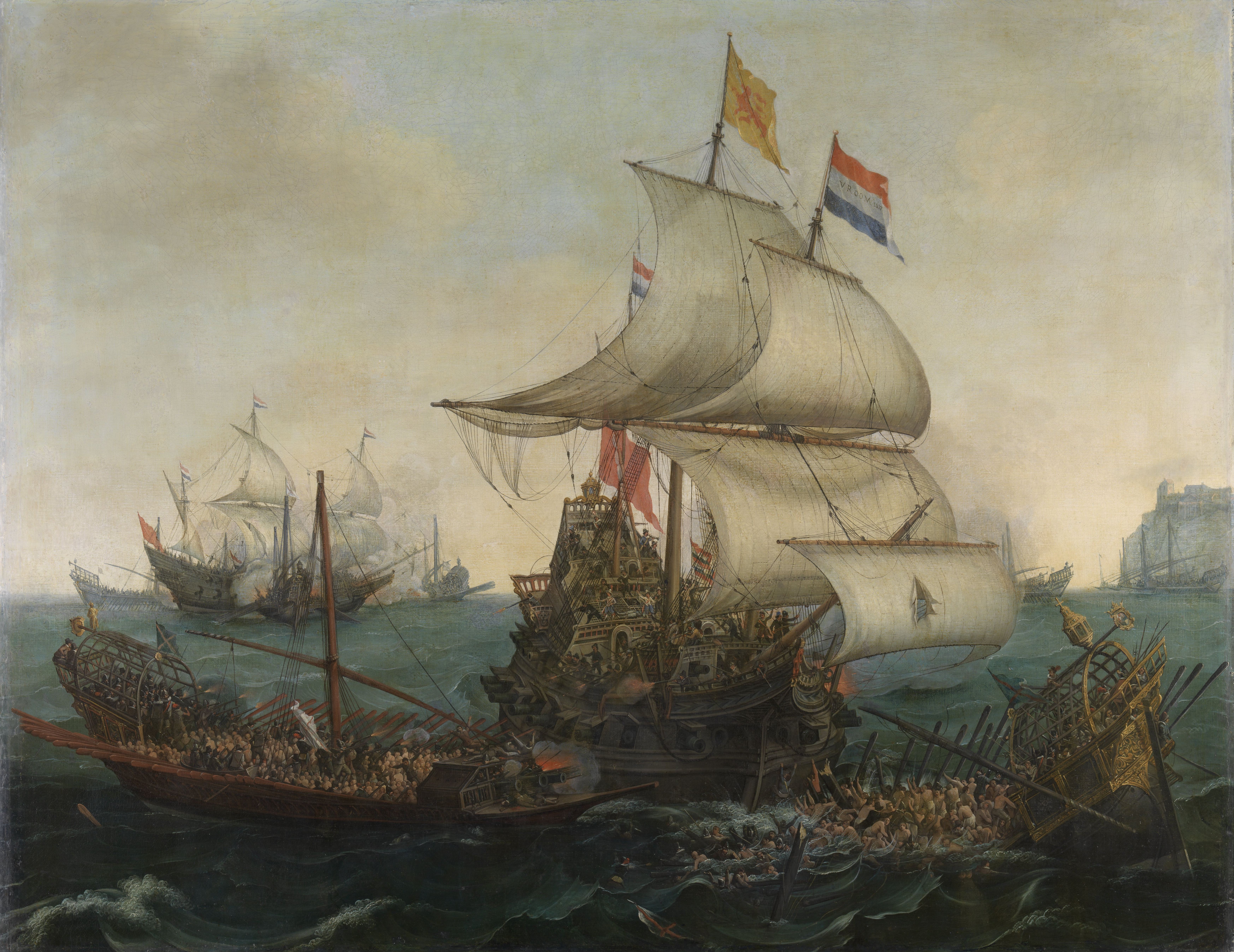
The galleys, evoked by Dr. Beachcombing.

Image:  Spanish galleys fighting the Dutch, 1602.

Sunday, September 26, 2010

First assignment in Islamic Civilization, HIST 3805: countries already claimed

Countries already claimed (as of 7/10)
Algeria, Bosnia, Canada,Chad,China, Egypt, France, India, Iran, Israel, Jordan, Kuwait, Kyrgyzstan, Lebanon, Libya, Mali, Morocco, Nigeria, Russia, Saudi Arabia, Somalia, Spain, Syria, Tunisia, Turkey, Turkmenistan, UAE, UK, USA, Uzbekistan,  Yemen

Stephen Colbert, step aside for the Jihadi Gangster


Times may be tough in Afghanistan, but they've got comedians.  If this is comedy.

Hope?

For a story about hope in America, this is extraordinarily discouraging:

Mr. Fetterman’s solace is that Braddock has likely fallen as far as it can: the town’s only remaining large employer, the University of Pittsburgh Medical Center, closed its hospital here earlier this year, taking more than 600 jobs with it. (One woman noted sourly that UPMC even yanked its shrubbery out of the landscaping.)
This recent article takes the most optomistic view it  can (after years of well-based pessimism at  the same site):
So take some pleasure in this: our troops are coming home and you’re going to see it happen.  And in the not so very distant future it won’t be our job to “police” the world or be the “global sheriff.” And won’t that be a relief?  We can form actual coalitions of equals to do things worth doing globally and never have to organize another “coalition of the billing,” twisting arms and bribing others to do our military bidding.
Since by the time we get anywhere near such a world, our leaders will have run this country into the ground, it’s hard to offer the traditional three cheers for such a future.  But how about at least one-and-a-half prospective cheers for the possible return of perspective to our American world, for a significant lessening, even if not the decisive ending, of an American imperial role and of the massive military “footprint” that goes with it.

It’s going to happen.  Put your money on it.

And thank you, George W. Bush (though I never thought I’d say that), you’ve given an old guy a shot at seeing the fruits of American decline myself.  I’m looking forward.

Saturday, September 25, 2010

A friend suggests the Proclaimers

Why not?

Research tips for students in HIST 3805 -- Report on an Islamic country

Some tips as to how to research your report on an Islamic country.

The purpose of your report is to inform you and your readers on the basic social, economic, and political facts about a given country with an Islamic past or present. To do this assignment well, you have to become well informed on your chosen country, and present those basic facts in a comprehensible way to your fellow students (who will not actually been reading your report). You will also want to inform yourself and your readers about the place Islam has in your chosen country today.

I do not want to discourage you from looking in the library and printed reference works that live there, but in many cases we will not have good up to date material on your country in the stacks. (I have put a few good books on reserve there.) For a short report, much of the good stuff is available online.

Two important sources are news sites and NGO reports. Identifying good news sites takes patience because most news stories are aimed at explaining a single incident. The good news sites sometimes provide a lot of background material, either in a normal story or in a special report. One problem is that the web is dominated by American news coverage, and American news organizations tend to be obsessed at the moment with the war on terror and its connection with Islam. What Islam means in Syria, Iraq, or Somalia, does not come up.

One good source of information is a Middle Eastern site, Al-Jazeera, originally aimed at an Arabic audience, or the Guardian (UK), while the Daily Star in Lebanon or Al-Ahram in Egypt may have material that will be useful to you. Israeli sources are worth a look but they tend to be very narrowly on Israeli politics.

To search these sites I simply combine the name of the newspaper or journal with the name of the country: for instance, “GlobalPost Yemen,” or “McClatchy Yemen.” (GlobalPost is a reasonably good internationally oriented source; McClatchy is one of the better American news services.)

The same method works well when searching NGO sites such as those belonging to Amnesty International, Freedom House and Human Rights Watch. Organizations like these which keep track of human rights violations are interested in what governments to and not what they say, and also are pretty good at explaining the current (un)satisfactory situation in a medium term historical perspective. I was pleasantly surprised by how much basic information there was about Yemeni society in the report in Freedom House.

You may want to poke around in other specialized sources such as the journal Foreign Policy. Use your imagination.

And remember, the war on terror is not your primary subject, so don’t let journalists and politicians drag you in that direction.

The 10th century nun diet

A lot of intelligent people know more about diet and nutrition than I do, so I will merely comment on the following information from Jonathan Jarrett's blog.  It seems there is a forged charter that gives the total amount of food supposedly consumed by nuns in  a monastery with a certain number of nuns in it.  Divide one dicey number by another dicey number and you get what supposedly was the daily intake of the ninth or 10th century nun:

  • 1,440 g of bread
  • 1.38 l of wine
  • 70 g of cheese
  • 133 g of dry vegetables
  • 16 g of salt
  • 0.6 g of honey (which I guess was used in accumulated dollops)
Verdon (or perhaps Rouche) [scholars Jarrett has consulted]  calculates that this is 4,727 calories and says that the required daily intake is 2,400. That was France in 1975, and a rapid websearch suggests that UK women are advised by the National Health Service to keep calories down to 2000 a day. Of course, there is a big difference in how many calories the nuns were burning in just not freezing for at least half the year, but Verdon is presumably still right when he observes that this diet was seriously lacking in protein and vitamins.
So what do you say, informed eaters?

PS:  Historians of earlier eras are often forced to look at documents that were forged by institution trying to nail down what they thought were their historic rights.

Image:  Escapee nuns eating fast food.

Sand dune and spring temple in China


And a flood for good measure.

Thursday, September 23, 2010

Dr. Beachcombing reflects on supercentenarians in Roman imperial times

So good:
How reliable are these Roman figures? Well the census in question will have been made in good faith. Whether it was answered in good faith is, of course, though another question. Yes, each respondent took an oath and was expected to give age, residence, name of father or patron and a valuation of their property. But given the teeth of the Imperium a Roman Beachcombing would have crossed his fingers and lied about everything, especially how much he had paid for his villa and his Syrian dancing girls.

As to these excessive ages the most comfortable explanation is that we have frequent cases of confused memory and a culture where modern obsessions with birthdays and age was quite unlike our own. Note how many round numbers there are – possibly Pliny rounding up and down, a telling act in itself.

But if true what lives they would have led! Marcus Aponius, for example, would have been born in 66 BC when Roman armies were devastating Asia Minor. He would have been eleven when the news arrived that the legionaries had done the impossible and crossed to mythical Britain. He would have been twenty two when Caesar was stabbed to death in Rome. He would have been thirty three when Augustus made himself the first Roman Emperor and the news came that Mark Anthony and Cleopatra had chosen suicide over dishonour. He would have been a mere whippersnapper at 80 when Augustus finally kicked the bucket. He would have been over a hundred when mad, bad and sensuous Caligula became Emperor…. And a hundred and thirty odd in the year of the Four Emperors when Rome almost tore himself apart.

Oh what stories he would have told!

Or perhaps not…

Beachcombing has always been struck by the fact that super-centenarians tend not to remember the ‘big’ events but rather stick to the minutiae of their own lives – the birth of a child, the death of a husband, the sale of a house, being short-changed by the green-grocer… Forget honey and vitamin pills, this is probably why they live so long. Certainly, Beachcombing suspects that when he is celebrating 140 it will be first kisses and Mrs B announcing a pregnancy that will stand out, while exploding skyscrapers and invasions and counter-invasions in the Middle East fade deservedly into the ether.

Wednesday, September 22, 2010

Opuscula -- an interesting experiment in scholarly publishing

My colleague Mark Crane have offices across the hall from each other and we sometimes talk face to face and voice to voice (!) .  Sometimes we talk about the present and future of scholarly publishing.  So today Mark crossed the hall and told me about the following project:


Opuscula: Short Texts of the Middle Ages and Renaissance is a peer-reviewed, on-line journal/text series published by Classical, Medieval and Renaissance Studies at the University of Saskatchewan, specializing in short texts of the Middle Ages and Renaissance. We seek single-witness editions of a broad range of pre-modern texts including but not limited to literary and philosophical works, letters, charters, court documents, and notebooks.

The goal of the journal is to establish open access to a substantial body of small but complete texts in scholarly editions to researchers and educators. Our first issue will be published in 2011.

I look forward to it!

Monday, September 20, 2010

Jethro Tull's "The Clasp," again

I have posted this song before, but I don't care.  Fifteenth century outfits, flute, tall ships, battle horses, the synthetic chiefs of history.  Truth speaks:

Sunday, September 19, 2010

More perspective -- and compassion -- needed


 New York Times columnist Nicholas D. Kristof, alarmed by American Islamophobia, has apologized on behalf of Americans for the excesses of some of them.  My readers will not be surprised that I agree with much of what he says.  Rather than repeat anything from his column, I suggest that you readers, if interested, go have a look at the hundreds of comments, just to get a feeling for the conflict is going on in America at the moment.  I thought the comment on apologizing for the Ku Klux Klan was particularly a propos; it is within  living memory that this terrorist organization claimed to be the essence of American Christian values.  Senator Byrd, a Klan member in his youth, just recently died.  He had the decency to apologize for his involvement in that movement.  I can’t recall anyone standing up in the comments section and either defending the Klan  or agreeing that an apology was appropriate.  It always looks different when someone wants to associate us with something pretty loathsome, on the basis of a label.

Now might be a good time to have a look, or maybe a second look, at this.

Let's have some of that tough-minded compassion, yeah.


Saturday, September 18, 2010

Compassion, understanding, and history


Ta-Nehisi Coates (above) works towards  understanding the slave holders and  turns to compassion to do so:
I've been quoting quite a bit from Drew Gilpin Faust's Mothers Of Invention, a history of women in slaveholding families during the Civil War...
For an African-American like me, the upshot of all this gorgeous writing is bracing--one is forced to behold beauty in those who saw no such beauty in us. Worse, the partisans of Confederate history are quite often necromancers who would defile that beauty with denialism, and Lost Cause hokum. The impulse is toward rage, toward justified fury. The impulse is to view any deft use of the English language, as hypocrisy, as devil-worship concealed beneath garland prose. 

It's an impulse I've felt, myself. I love this picture (it's from the cover of Mothers) because, all at once, I find it beautiful and rage-inducing. The problem with rage is that it's a conversation-stopper, it forecloses all other questions. I am resolved on the nature of the Confederate cause. I would no sooner now debate the primary cause of the Civil War, then I would debate roundness of the Earth. And still in all, I am filled with questions. Chief among them, how does any human being in the 19th century come to endorse mass slaughter for the cause of raising a republic built on slavery?

To answer such a question, it is not enough to understand cause of the Civil War. A debate over the meaning of the Confederate Flag is almost beside the point. You have to remove the cloak of the partisan, and assume the garb of the thespian. Instead of  prosecuting the Confederate perspective, you have to interrogate it, and ultimately assume it. In no small measure, to understand them, you must become them. For me to seriously consider the words of the slave-holder, which is to say the mind of the slave-holder, for me to see them as human beings, as full and as complicated as anyone else I know, a strange transcendence is requested. I am losing my earned, righteous skin. I know that beef is our birthright, that all our grievance is just.  But for want of seeing more, I am compelled to let it go.
...

In this society, we view compassion as a favor, something along the lines of forgiveness extended to the humble and deserving. No. My compassion is utterly selfish, and is rooted in a craving for power. It is compelled by my curiosity, itself, just another name for hunger, for desire, for want of the great power of knowing. It is not enough for me to sit around scoring morality points on dead people, all the while blind to the living morality of this troubled time. There's no power in that. I need to know more.
 
Read it all. And the comments.


Friday, September 17, 2010

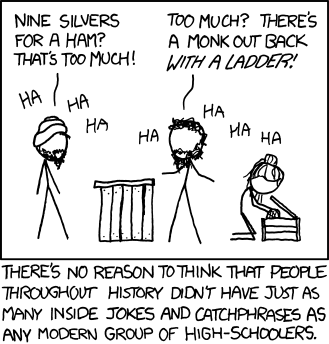
xkcd hits it right out of the park on the "Inside Joke"

Natalie Zemon Davis!

The Department of History welcomes Professor Natalie Zemon Davis to campus on Friday, September 24, to speak in F210 (the Fedeli Room) at 5 p.m. 

Professor Davis' talk is titled Decentering History: Local Storytelling and Cultural Crossing in a Global World.
Speaking partly from her own experience, Professor Davis will explore ways that the practice of history has changed, examining historical comparison through local figures (a male and female writer from different parts of the world in 1400) and through cultural crossing (how techniques in healing and justice transferred from Africa to a slave colony).

Natalie Zemon Davis is among the most widely known and influential historians in the academy. Her work on the social and cultural history of early modern Europe has reached readers far outside the university setting, perhaps most famously with The Return of Martin Guerre (1983) and most recently with Trickster Travels: a Sixteenth-Century Muslim between Worlds (2008). Earlier this year she received the Holberg International Memorial Prize in recognition of her lifetime achievement.

The lecture is free of charge and all are welcome.

For further information, please contact Dr. Derek Neal in the Department of History at derekn@nipissingu.ca .

Thursday, September 16, 2010

Lost again!

Every time I go on sabbatical, some major changes are made to the university complex I work in.  This time, a whole new research and office wing was added and the third floor of A wing was connected to the third floor of  H wing.  Result: when trying to return from my first graduate seminar meeting, I got completely and absolutely lost.  I know more or less  what the complex looks like from the air (= on a map), but  I found it impossible to integrate that knowledge so that I could go to my office or to an outside door so I could find a way to a parking lot.

Nipissing University continues to grow...

Monday, September 13, 2010

Two Americas on September 11, 2010

Anyone who reads this blog is probably aware of the outburst of Islamophobia in the USA recently, with intemperate denunciations of plans to build a Muslim community center a few blocks from the WTC site in Manhattan, threats to burn the Quran (exactly why I am not sure) and rabble-rousing about how (American!) Muslims might not deserve the full measure of 1st amendment protections.  Alarming and in some instances rather hysterical.  It's like the return of Millard Fillmore, in whose time it was the Irish who might not deserve the 1st amendment, because they were the wrong kind of Christian.

But bad as the active promotion of this stuff, by agitators obscure and prominent alike, may be, all may not as it seems.    Let me tell you what I saw this September 11.

I was invited to take part in an SCA medieval re-creation in Northern Illinois.   Despite the distance I decided to go.   Despite some early rain, the weather was mostly beautiful and there were probably 400 people there, dressed in a variety of medieval-style clothing and some very sharp-looking armor.  Among this crowd were some people playing the part of medieval Muslims, including a handful of ordinary black and white Americans wearing niqabs.

And no one said boo.

On September 11.

That evening I was at dinner with another participant, talking about a favorite SCA subject, one's upcoming artistic projects.  The lady in question expressed a more-than-idle desire to extend her knowledge of medieval culture by learning a foreign language. 

Arabic. 

About this point I began to feel that there must be two different USAs, on two different planets, one considerably less hysterical than the other.

Thank heaven.

I will remember this when the big-name agitators start thumping their drums, or start promoting some lunatic preacher or politician because they are steadfast against unAmerican Islam.

BTW, I did indeed see a remembrance ceremony of the 9-11 attacks, too.  The participants were very dignified and appropriate and had nothing to do with denouncing any religious tradition.

Image:  an attendee at the event in question.