Monday, January 21, 2013

The threat to Malian music – and everything else worthwhile

From the Independent:

The image of Mali has long been a gentle one. It is a land of magical music and mouth-watering mangoes, of mud mosques and medieval manuscripts. A country dripping with history and culture that was slowly forcing its way on to the tourist map for Western visitors. Now, following the intervention of French warplanes nine days ago, it will be more associated in most people's minds with Islamic militancy.

This is a tragic twist for a people whose faith revolves around the more tolerant strands of Sufism. For all its poverty, Mali has traditionally been open to outsiders. It is a nation where women are prominent and musicians more closely entwined with everyday life than perhaps any other place on earth. Music has long been part of the social and political fabric, from praise singers who, for centuries, passed on the oral history to the state-funded bands used to bond the nation after independence.

When I first went there almost a decade ago, it was for the famous Festival in the Desert, some 50 miles from Timbuktu and a symbol of reconciliation after a previous Tuareg uprising. It took three days to get there; Westerners reaching the event were treated like old friends. Days were spent sheltering from fierce sun in tents, chatting over cups of sweet tea and biscuits. At night, those amazing musicians who have taken Malian music around the globe performed in front of turbaned tribesmen on camels while burning braziers lit up the desert. An unforgettable experience.
Where once there was music and dancing, today there is misery and deprivation
More here.

Thursday, January 17, 2013

Tuareg music

The group Tinariwen performing in 2006.


Fun with old alphabets


Up on the old Roman frontier, roughly on the English – Scottish border, there used to be a fort called Vindolanda. Way back when, its military significance was its most important feature, but today it is known as the site of the biggest cache of Roman correspondence, written on pieces of wood and wax tablets by a variety of soldiers and others.

There is a website where you can have a look at the handwriting typical of the first century A.D. and even play around with deciphering it. Not easy even if you know Latin!

Elsewhere, there is an article on the web about letters that never made it into the English alphabet, or were there briefly and then faded away. Fun!

Image: insular g.

Wednesday, January 16, 2013

Conflict between Islamist movements

Translation provided by Arabist.net:
War against the Muslim Brotherhood Divides the Gulf
Abdel Bari Atwan, al-Quds al-Arabi,
11 January 2013
 Whoever has been following the media in the Gulf – and the Saudi media in particular – has probably gotten a sense of the fierce campaign being waged against the Muslim Brotherhood and Islamist currents more broadly, as well as the major preachers in the Gulf. Their influence has been on the rise recently thanks to social media such as Facebook and Twitter, and yet the dedicated security apparatuses of the various countries in the region have had a harder time controlling and blocking these outlets than they did with newspapers and websites. Dubai’s chief of police Lieut. Gen. Dahi Khalfan Tamim pioneered this campaign against the Muslim Brotherhood and was one of the first to issue vehement warnings about the danger they represented, but many articles appearing in the Saudi and Emirati press have begun to follow in his wake. This is happening in such a way as to suggest that there are bodies high up in the state that would like to open up a front against them, whether in Egypt – where they are sitting at the threshold of power – or within the Gulf itself.
 This war against the Brotherhood, and perhaps later upon the Salafi currents, represents a break with the historical alliance that has existed between conservative Gulf regimes and these figures. This alliance ensured the stability of these regimes and helped combat all the leftist and nationalist ideas that constituted a threat to this stability in the eyes of the rulers. The question that is now on everyone’s mind is why has there been a sudden reversal of opinion in the Gulf against the Muslim Brotherhood ideology, when this ideology was embraced and supported over the past 80 years. In the aim of helping control Gulf youth, Muslim Brotherhood intellectuals and professors were even allowed take over the education sector, set curricula, and establish proselytizing and charitable associations, not just within Gulf countries but throughout the entire world.
 How did this relationship of warm, strategic friendship morph into a bitter fight – at least on one side, for now — between the ruling regimes in the Gulf and the Muslim Brotherhood? The response to these questions can be summed up in the following points:

  • Governments in the Gulf have realized that the Muslim Brotherhood is a “global” movement governed by an international organization. This means that the loyalty of the organization is to the Supreme Guide in Egypt, and not to local authorities, not even to the head of the group in these countries.
  • The Islamist Muslim Brotherhood has taken control of the process of forming the next generations by setting local curricula. This has led it to dominate the armies and security services, which has left it more prepared than ever to overthrow the ruling regimes and seize power. This is the main fear of the Gulf regimes
  • With the liberal and leftist currents in Gulf countries weakened by decades of repression and persecution, the organized Islamist currents have become the leading candidates to launch Arab Spring revolutions for change in the countries of the Gulf.
  • Religious and Brotherhood currents in particular enjoy a financial independence that sets them apart from the other currents, due to their intricate organizational networks and the fact that their backers possess considerable financial resources due to their control of large companies and financial institutions in Gulf countries especially. This has allowed them to combine political and economic power.
  • Islamist movements enjoy significant support in popular milieus because their ideology centers on the Islamic faith. Their control over mosques — whether directly or indirectly — translates into five miniature daily meetings and one large weekly meeting every Friday.
  • Non-jihadist Islamist movements – and the Muslim Brotherhood in particular – practice self-control and avoid any collision with the state. This explains the Brotherhood’s silence in Egypt concerning the attacks in which it has been targeted. It has kept calm and sent delegations to the Emirates to solve the arrests crisis through diplomatic means.It was no surprise that Saudi writers accused the Muslim Brotherhood of employing the "principle of taqiyya”[1] among its organizational practices.

    Gulf countries – to put it briefly – are worried about the MB’s control of Egypt, Tunisia and Sudan, and its attempts to gain power in Jordan, Yemen and Syria. This would leave the countries of the Gulf surrounded on all sides, and at risk of falling into the new orbit of the Muslim Brotherhood, in a sort of political “domino” effect.
More here.

Friday, January 11, 2013

Linda Greenhouse on Robert Bork

If you have access to the New York Times, you may want to read about Robert Bork, one of the most controversial failed nominees to the Supreme Court of the United States; he recently died. I have included an excerpt, but you should read the whole thing and the very interesting comments that follow. It will teach you a lot about the ideological development of American politics.
No one who actually lived through the Senate Judiciary Committee hearing in September 1987 is without views on the subject, and I have previously offered mine. I think that the televised hearing, which held the country spellbound, provided a rare and valuable public seminar on the meaning of the Constitution, the methods of constitutional interpretation, and the different answers that competing methods offer to the most profound questions of individual autonomy and equality.... [What] “borking” really amounted to was holding the nominee’s vigorously expressed views up to the light for public inspection. In five days of testimony, then-Judge Bork – a former professor of mine whom I liked and respected – had every opportunity to make his case. His ideas were fully aired and considered. By a vote of 58 to 42, the senators, having heard from their constituents, concluded that his constricted constitutional vision, locked into the supposed “original intention” of the framers, was not what the country needed or wanted.... I [later] asked [Bork] whether, at any time during the hearing, he had felt that a member of the Judiciary Committee had met him on his own level in serious constitutional conversation.
“No,” he answered. “Not even Arlen Specter?” I asked. “Specter had his mind made up from the beginning,” he snapped. I knew that wasn’t true.... Specter, a Pennsylvania Republican, had in fact agonized over his vote, as I knew from having talked with him almost daily. A Yale Law School graduate and former prosecutor, the senator went head to head with the nominee through several rounds of questioning, hours of mesmerizing constitutional debate in which he probed for any sign of flexibility in Judge Bork’s view that the entire course of modern constitutional law was profoundly mistaken. Finding none, Senator Specter, who had assumed at the start of the hearing that he would vote for confirmation, decided to vote No.... Five other Republicans followed....

Bork couldn’t accept the legitimacy of his defeat.... Bork was hardly unique in his sense of entitlement, but it ran so deep that it prevented him from understanding the obvious dynamic of what happened....
Senator Hatch served up what sounded like a concluding, softball question: “In your lengthy constitutional studies, is there any Supreme Court decision that has stirred more controversy or criticism amongst scholars and citizens than that particular case [Roe v. Wade]?” Then came the unexpected answer: “I suppose the only candidate for that, Senator, would be Brown v. Board of Education.”... As Senator Hatch immediately grasped, the nominee had violated a cardinal rule of modern judicial confirmation hearings, which is that Brown v. Board of Education is beyond debate. The 1954 school desegregation ruling was in fact the subject of substantial criticism within the legal academy in the 1950s and well into the 1960s; some eminent professors, while endorsing the outcome, took strong issue with the court’s analytical method. Awareness of the rich critical literature from that period had faded away by 1987, effaced by the decision’s celebrated unanimity and moral weight. So while Judge Bork’s answer to Senator Hatch was historically accurate, it was an obtuse accuracy. More to the point was how the moral dimension seemed to elude him as he tossed Brown into the same box with the abortion decision of which he had been so scathingly dismissive....

I see him as a tragic figure: not because he was dealt an unjust hand – he wasn’t – but because of his inability to understand what happened. He spent his final decades surrounded by acolytes who stoked his sense of victimhood, and there seemed to be no one around him to provide a reality check as his rants about the Supreme Court’s depredations and the collapse of Western civilization (he portrayed the two as inextricably linked) became ever more extravagant.... By 1996, in “Slouching Towards Gomorrah: Modern Liberalism and American Decline,” he was taking aim at Darwinian evolution and embracing “intelligent design,” evidence for which he later called “overwhelming.” “A Country I Do Not Recognize,” a book he edited in 2005, found him plunging ever deeper into the culture wars

Thursday, January 10, 2013

It's time again for the Harbin Ice and Snow Festival!

Harbin is in northeastern China (Manchuria). It is so cold there that the only logical thing is to make situation an advantage. Every year, too, the Big Picture showcases the best of the festival. Here are two photos to motivate you have a look.


Click on the pics for a good view.

Monday, January 07, 2013

Phil Paine reflects on Iceland and democracy, 1


An excerpt:
But, to begin with, I’ll call up the mem­ory of my ear­li­est expe­ri­ence of democracy.

When I was a small child, in North­ern Ontario, there was a game played by the local chil­dren. It was a com­pli­cated ver­sion of “hide-and-go-seek”. Two teams of chil­dren would form up, one of which would leave a cen­tral gath­er­ing point on a com­pli­cated trail, and select a hid­ing place, leav­ing team mem­bers at strate­gic points, also hid­den. One of their num­ber would then return to the cen­tral point, meet­ing up with the other team. He or she (while the game mostly appealed to boys, girls were not excluded) would then draw a map on the ground, hon­estly rep­re­sent­ing the hiders’ route to their points of con­ceal­ment, but omit­ting the cru­cial infor­ma­tion of com­pass direc­tion. With this par­tial infor­ma­tion, the other team would set out in search, under the direc­tion of a leader. The the leader of the hid­ing team would accom­pany the search­ing team. He or she would shout out coded words and phrases, which had been agreed upon by his or her team mates. These would con­vey infor­ma­tion such as “the searchers are near but headed away from you” or “they are search­ing too far to the south of you”, etc. Some of the sig­nals were mean­ing­less, meant to mis­lead or con­fuse the searchers. The search­ing team also made use of coded sig­nals to co-ordinate their search. One sig­nal, how­ever, was cru­cial, as it would trig­ger a mad scram­ble to reach the map and erase it. This was com­pli­cated by the abil­ity of any scout to tag another, mak­ing him “freeze” on the spot, and the abil­ity of any other scout to “unfreeze” the frozen ones. Nei­ther team knew who was leader of the other team, since each had been selected after they had sep­a­rated. Each team made use of var­i­ous ruses, with scouts and lead­ers act­ing in var­i­ous ways to con­fuse their oppo­site num­bers.


It was an amaz­ingly com­plex game for small chil­dren to play. I don’t know if it is still played. Later, as an adult, inves­ti­ga­tion led me to con­clude that the game was of Native Cana­dian ori­gin. This came as no sur­prise to me, as its ele­ments are par­tic­u­larly suited to the Cana­dian phys­i­cal envi­ron­ment and to its Native cul­tural envi­ron­ment. The hunt­ing and track­ing ele­ment, and the reliance on grasp­ing the “high view” of a land­scape are both significant.

But what is rel­e­vant here is that the game was as much a train­ing for democ­racy as it was for hunt­ing and track­ing. Each stage of the game was char­ac­ter­ized by a for­mal elec­toral process. Each team leader was elected by major­ity vote in each cycle of the game, and no leader could serve more than one con­sec­u­tive “term”. Nom­i­na­tion and vot­ing were car­ried out by spe­cific pro­ce­dures which, in later life, as a his­to­rian, I found doc­u­mented among Native and Métis peo­ples in the Cana­dian north. It was to no team’s advan­tage to keep choos­ing the same peo­ple for the same tasks — the pat­tern would soon be use­ful to the oppo­si­tion. But at the same time, a com­pe­tent or expe­ri­enced per­son was the opti­mal choice. Wildly com­pet­i­tive as the game was, it was also char­ac­ter­ized by a con­sis­tent demand for fair­ness and equity. It is sig­nif­i­cant that nobody doubted that the map drawn in the ground would be an hon­est representation. 

I grew up with this game as part of my men­tal fur­ni­ture, and it came as a sur­prise to me when I found whole pop­u­la­tions of peo­ple who had no child­hood expe­ri­ence with any kind of demo­c­ra­tic com­po­nent. Their child­hoods, I came to real­ize, were dom­i­nated by the expe­ri­ence of tyranny: par­ents lay­ing down the law at home; teach­ers lay­ing down the law in school; bul­lies lay­ing down the law every­where else. It is no won­der that many peo­ple have great dif­fi­culty deal­ing with the con­cept of democ­racy. It is no won­der that many peo­ple today can­not imag­ine democ­racy as any­thing more than some incom­pre­hen­si­ble riga­ma­role pre­ced­ing the appoint­ment of a tyrant, who will then tell them what to do.

More on Phil's blog and more to come.

Image:  the old meeting site  of  Iceland's thing.

Favorite blog posts of 2012 fixed.

Go here.

Sunday, January 06, 2013

Stalemate in Syria

NYT:

A multilingual former military officer, he says he is among many friends and colleagues who feel trapped: disenchanted with President Bashar al-Assad, disgusted by the violence engulfing Syria and equally afraid of the government and the rebels, with both sides, as he puts it, ready to sacrifice “the innocents.”
 Mr. Assad remains in power in part because two years into the uprising, a critical bloc of Syrians remains on the fence. Among them are business owners who drive the economy, bankers who finance it, and the security officials and government employees who hold the keys to the mundane but crucial business of maintaining an authoritarian state. If they abandoned the government or embraced the rebels en masse, they might change the tide. Instead, their uncertainty contributes to the stalemate.
 The Egyptian and Tunisian rebellions that inspired Syria’s initially peaceful uprising reached tipping points within weeks, with far less bloodshed. In those cases, widespread desire for change overwhelmed the fear of the unknown, and toppled governments — or rather, the dictatorial cliques that headed them. But in Syria, each side has bloodied the other while many stay on the sidelines, and a core contingent of supporters feels obligated to stick with the government even as their doubts grow. That is in part because the government’s ruthless crackdown has made protest far more risky than in other uprisings. But it is also because of doubts, among the urban elite and others, about the direction of the revolution and how a rebel-ruled Syria would look.
 “Me and my neighbors, we were the first to go down to the street and scream that we want a country, a real country, not a plantation,” said Samar Haddad, who runs a Syrian publishing house. “But this armed revolution, I refuse it as much as I refuse the regime.”
Ms. Haddad, who is in her late 40s and now spends much of her time outside Damascus, said that she and her circle of intellectuals and professionals embrace unarmed Syrian protesters as heroes, but believe that the armed rebellion is creating warlords and cycles of revenge that will be hard to uproot.
 The fence sitters include government employees, security forces, intellectuals and wealthy Syrians. Some, including members of Mr. Assad’s minority Alawite sect, say they fear the rule of Islamists, or the calls for vengeance from some factions of the Sunni Muslim-dominated uprising.

Some are former soldiers who say they defected only to be disappointed by rebels who lack discipline or obsess about religious ideology. One young man, Nour, said he gave up on revolution when he tried to join an Islamist brigade, Al Tawhid, but was rejected for wearing skinny jeans.
Joshua Landis at Syria Comment has long  been putting out this kind  of analysis.

Saturday, January 05, 2013

The Bonfire of the Vanities


Most people who know the phrase “bonfire of the vanities” do so in connection with a Tom Wolfe novel of the 80s or the movie that was made from it. I haven’t read the book or seen the movie but I do know the historical reference that Wolfe used. Vanities, said Christian teachers, were unworthy things that distracted believers from what was ultimately important, eternal salvation. Vanities could be any kind of luxury which absorbed the believer's attention. On occasion revivalist preachers would call upon their congregations to collect those vanities, bring them to a central location and burn them. The most famous of these preachers is the friar Savonarola who at the beginning of the sixteenth century preached in Renaissance Florence against her wealth and art and luxury that characterized Florentine life at the time. He is not my favorite historical figure by any means, but the phrase bonfire of the vanities I primarily associate with him has suggested the following line of thought about the gun crisis in the United States.

I won’t argue the point that there is a gun crisis. That’s my starting point and if you disagree, you might as well stop reading now. But the large-scale arming of America, and the development of an ideology sees mass ownership of heavy-duty weaponry as an essential guarantee of American freedom have attracted my attention for a long time. I remember some time in the 80s I was talking with my friend Phil Paine about this phenomenon and its effects on Canada. I made some observation about regulation, and he responded that when you have a large-scale popular movement like this it is difficult to do anything about it through legislation.

As we look at the situation in the United States today, the truth of that statement is evident. I think it would be quite possible to create legislation and regulations that might have a positive effect, make it more difficult for angry or crazy people from working out their dreams of mass murder. But the fact remains that there are hundreds of millions of guns in the United States and it simply would not be possible to take those guns away from their owners, short of civil war.

Indeed there is only one way that a large reduction in the availability of truly dangerous guns could be, and only one group of people who can make it happen.

That group of people is gun owners. A significant reduction in the supply of guns can only be accomplished by burning them on the bonfire of the vanities. The popular movement that has armed or over armed America can only be counteracted by another popular movement.

Two groups will have only a marginal role in the creation of such a popular movement if indeed it ever takes place. People who are opposed to private gun ownership have no influence on their gun owning fellow countrymen. People on the other hand who believe that gun ownership is a practical and necessary guarantee  against government tyranny, an essential element of their identity as Americans are certainly not going to take any initiatives to reduce the number of guns in circulation. Both of these groups have fundamentalist convictions not shared by the majority of Americans, and because those convictions are absolute they are unlikely to become the majority position.

But there are many people in the United States who think that gun ownership, practiced responsibly, has a place in their lives. I live in the country and although I don’t have a gun, I understand why some farmers might want to have one. In fact, I think it’s a good idea that some of my neighbors have them; I might someday need to find somebody with a gun to, say, kill a rabid animal. I think arming yourself at least in Canadian conditions probably leads to a net loss in personal safety, but I can understand that people might disagree. And long ago, I shot guns for fun in the context of a Boy Scout camp, and learned gun safety in a program sponsored by the NRA. I didn’t follow up on this, but I can see it.

I think that such people very seldom have tremendous numbers of guns and ammunition, and seldom foresee shooting down the agents of their own elected government in defense of their freedom; not as a real possibility. If this large group of people who share the majority opinion that guns by themselves are not an intolerable menace, but things that can be useful in certain circumstances turns against the over arming of America, they will have an influence on the culture of guns that the out and out opponents of gun ownership will never have. But they will only have that positive influence if they abjure the other fundamentalist position, which justifies heavy armament, rather than any other political principle, as the source of political liberty.

If many gun owners look around one day and conclude that some armaments are vanities, unnecessary and even dangerous to good old-fashioned American liberty, and decide that some of what they personally own should go on the bonfire, and begin to urge their fellow gun owners to take that perspective, then the overarming of America may be rolled back.

And if not, not.


Afghanistan's Jewish community a thousand years ago


A trove of Jewish writings in various languages indicates how big a Jewish community once existed in Afghanistan. From CBS/AP:

A trove of ancient manuscripts in Hebrew characters rescued from caves in a Taliban stronghold in northern Afghanistan is providing the first physical evidence of a Jewish community that thrived there a thousand years ago.


On Thursday Israel's National Library unveiled the cache of recently purchased documents that run the gamut of life experiences, including biblical commentaries, personal letters and financial records.

Researchers say the "Afghan Genizah" marks the greatest such archive found since the "Cairo Genizah" was discovered in an Egyptian synagogue more than 100 years ago, a vast depository of medieval manuscripts considered to be among the most valuable collections of historical documents ever found.

Genizah, a Hebrew term that loosely translates as "storage," refers to a storeroom adjacent to a synagogue or Jewish cemetery where Hebrew-language books and papers are kept. Under Jewish law, it is forbidden to throw away writings containing the formal names of God, so they are either buried or stashed away.

The Afghan collection gives an unprecedented look into the lives of Jews in ancient Persia in the 11th century. The paper manuscripts, preserved over the centuries by the dry, shady conditions of the caves, include writings in Hebrew, Aramaic, Judeo-Arabic and the unique Judeo-Persian language from that era, which was written in Hebrew letters.

"It was the Yiddish of Persian Jews," said Haggai Ben-Shammai, the library's academic director.

Friday, January 04, 2013

Favorite blog posts of 2012

This is a rather haphazard selection, rather than rigorous listing of the best I was able to put together this year. I was struck that despite the fact I'm working very hard on the Middle Ages, not much of it leaked through into blogging. Also, I included far fewer Arab spring/Arab uprising posts than I might have, but I felt that only a few had lasting value on their own.

Le spectacle des joutes Sport et courtoisie à la fin du Moyen Âge, by Sebastien Nadot

A friend sends news of this French academic book on jousting. I haven't seen the book so will just copy the description off its publisher's webpage:

Le spectacle des joutes

Sport et courtoisie à la fin du Moyen Âge

Les pas d’armes sont des jeux corporels où la dépense physique, les accidents, l’esprit compétitif, les tricheries et le chauvinisme font rage, dans un cadre réglementé. Spectacles pour un public nombreux en partie féminin, les pas d’armes ont aussi une réalité financière et politique. Les plus grands princes de Castille, de Bourgogne ou de France côtoient les champions les plus réputés. Avec ce regard sur les pratiques physiques médiévales, la comparaison entre sport et pas d’armes devient possible. Elle s’oppose aux « penseurs du muscle » qui ont communément admis que le sport est né au XIXe siècle en Angleterre sur des bases antiques…
Avec une préface d’Adeline Rucquoi.
2012
filet
Collection : Histoire
filet
Format : 15,5 x 24 cm
Nombre de pages : 354 p.
Illustrations : Couleurs
ISBN : 978-2-7535-2148-3
Disponibilité : en librairie
Prix : 18,00 €


And is it another $100 book?  NO! Color pictures and all, a mere 18 euro!

Tuesday, January 01, 2013

Modern nomads in Mongolia

Using a solar panel to run a flat-screen TV.

Thanks to the Big Picture at boston.com.


Thursday, December 27, 2012

British women at war, 1942


http://ww2today.com/27th-december-1942-the-life-of-an-ats-ack-ack-girl

Wednesday, December 26, 2012

Made up stuff

Ta-Nehisi Coates:

I don't celebrate Kwanzaa. I only celebrate Christmas because of my wife and son. I generally don't like holidays. And while I come from a family of black radicals, my Dad generally derided Kwanzaa as "fake Christmas." The holiday season in the Coates house generally meant more time for work. (Sadly it's becoming that in my household too.) 

With that said, Kwanzaa-hating has always struck me as the most bougie and snobbish of holiday traditions. It's that cool that Jonathan Safran Foer thinks that "no one is quite sure what Kwanzaa is,"  but I'm not sure "what Hanukkah is." And for most of my life, no one I knew was quite sure either.  I'm only barely sure "what Christmas is." (Celebrating the birth of your savoir with an orgy of consumption?) 

It's just seems bizarre in America, of all places, to stand on vintage. Has there ever been a more mongrel, more made-up, country that this one? Have there ever been two more "made up people" then the "white race" and the "black race?" This country is a mongrel mess--and its traditions are too. That's the whole charm of the thing. No one who takes the Easter Bunny seriously should mock Kwanzaa. This is about equality. Black people have right to make shit up, just as white people have the right to make shit up. 

Sunday, December 23, 2012

Tolkien's prose

In preparation for seeing the Hobbit movie -- which I have now seen -- I have reread the book. I am now reading The Children of Hurin, one of his posthumous works. This leads me to reflect on how good Tolkien could be as a writer when he wasn't trying too hard.

But first a story about beer.

Twenty years ago and more, soon after we had moved to the Near North, some friends came to visit. When I came home from work, there they were sitting in my living room. "There is something in the refrigerator for you." I looked, and there was some Creemore beer, then a new brand I had never had; and in fact this was Creemore fresh from the brewery that very day. I opened a bottle and had a drink and it was like all the bad lager I had ever drunk was stripped off my tongue and I could taste beer again.

Not too long after that I read the Hobbit to my son. He liked it so much that I ended up reading the entire Lord of the Rings aloud. And I had a similar experience. I thought I knew the book well, but reading it aloud -- the big book, not the one I knew was meant to be read that way -- was a revelation.

It was like all the bad prose I had ever spoken was stripped off my tongue and I could taste English again.

The pseudo-archaic language of the Children of Hurin does not have that effect. It is a barrier between me and the First Age, when it should be a bridge. It is Tolkien trying too hard.

A quarter of a century later, he knew better, and he used the ordinary language of the mid-20th century to work his magic.

If you care about the second amendment, do you also care about the fourth?

http://www.guardian.co.uk/commentisfree/2012/dec/21/coming-drone-attack-america

Friday, December 21, 2012

Tony Horwitz on the "Gun Power" -- an excerpt


In the 1840s and 50s, abolitionists often spoke of a menace they called "The Slave Power." This pejorative wasn't aimed at Southern slavery, per se. It referred to the vast reach of proslavery money and influence in Washington and beyond. If unchecked, abolitionists warned, the Slave Power would poison every corner of American life and territory. I'm wary of historical analogies. But in the wake of the Newtown massacre, I'm struck by parallels between the Slave Power and a force haunting us today: call it The Gun Power.

For decades we've appeased and abetted this monster, as Americans once did slavery. Now, like then, we may have finally reached a breaking point. I don't mean to equate owning slaves with owning guns. But I do mean to equate the tactics and rhetoric of the NRA with those of proslavery "Fire-Eaters." The NRA casts itself as a champion of the Constitution. So did slaveholders, citing the safeguards accorded owners of human "property." Few Americans questioned slavery's legality, though they debated the Founders' intent, just as we do with the Second Amendment.

But as the nation spread, slaveowners turned the defense of a right into an expansionist crusade. Slavery wasn't just a right that nonslaveholders had to recognize and uphold. It must extend wherever slaveholders traveled and settled. So, too, has the N.R.A. demanded the right to carry guns into every conceivable place, including schools, churches and hospitals. The N.R.A. does so in the name not only of rights but of "safety" and "self-defense." Guns, you see, aren't a danger to be regulated; they're a source of peace and security that everyone should enjoy.

Proslavery zealots had their own version of this. While 18th century slaveowners like Jefferson had treated the institution as a necessary evil, John C. Calhoun lauded slavery as a "positive good," a source of freedom even, because it liberated whites from drudgery and class conflict and blacks from African "savagery." It followed that all should enjoy its benefits. "I would spread the blessings of slavery, like the religion of our Divine Master, to the uttermost ends of the earth,' declared Mississippi Senator Albert Brown.

More at:

http://www.theatlantic.com/national/archive/2012/12/the-nra-and-the-positive-good-of-maximum-guns/266571/

A merry medlar medieval Christmas


From Quid plura? As always, a different take on thinking about the Middle Ages.

http://www.quidplura.com/?p=4642

Wednesday, December 19, 2012

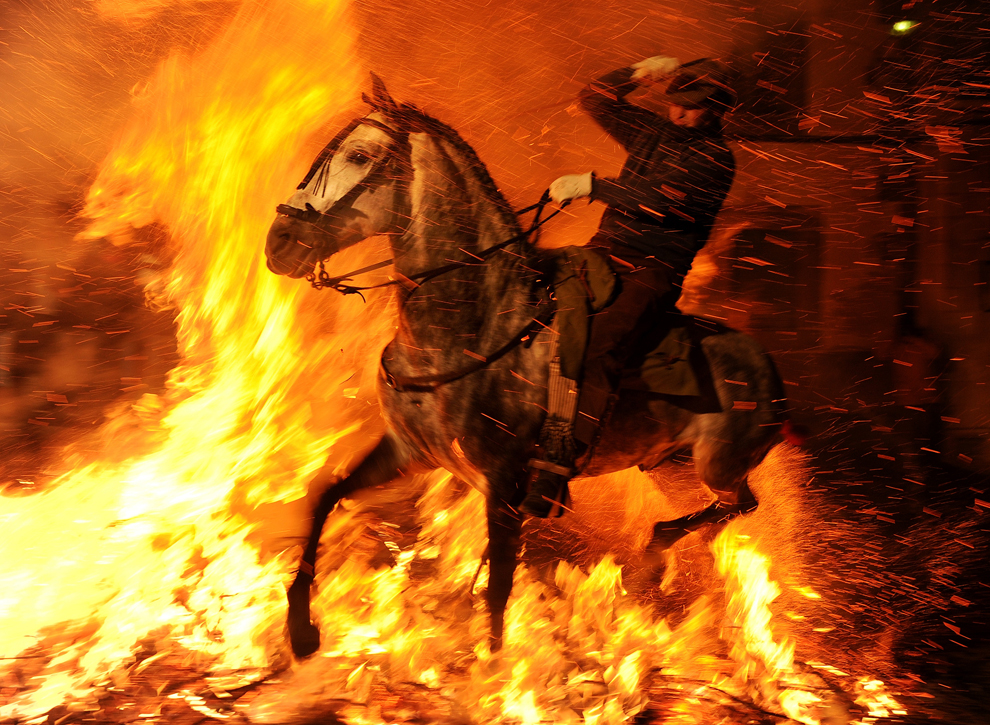
Honoring the animals?


From the Big Picture:

"A man rides a horse through a bonfire, Jan. 16, 2012 in the small village of San Bartolome de Pinares, Spain. In honor of San Anton, the patron saint of animals, horses are ridden through the bonfires on the night before the official day of honoring animals in Spain." 

Translation: some nut did this centuries ago and now it's a tradition.

New Books in History – an interesting resource

New Books in History highlights new studies and their authors. One feature I really like is the long interview that often? always? accompanies listing. For instance, if you want to hear an hour's worth of discussion of an interesting book on the Holocaust, you can!

Reflections on Crusade and Jihad, 2012


Every time I teach the Crusade and Jihad course, I have a few new insights. Here are my insights for this year’s iteration.

The main one is the realization of a pretty obvious point. Christians and Muslims alike could go for centuries not worrying about who controlled the holy city of Jerusalem. Then they would go through phases where for some people at least that was the A#1 priority for a whole community. Thinking about this, I conclude that the crusading fervor or the jihadist fervor requires a whole new understanding of the present the past and the future. Someone wakes up one day and realizes that the world is going to hell in a handbasket, that things are uniquely bad right now, and that extreme measures are necessary to correct that bad trend. Or to put it another way, there is a unique opportunity to clean up the mess that this world currently finds itself in. There is no crusade or no jihad without that realization that normal time has come to an end and that the moment we are living in is somehow special.

Of course, not everybody in a given community goes along with the fervor when it catches hold. Some very good and influential scholarship has focused on the fact that unauthorized preaching of Crusades was seen as a danger to the social order – and of course if it was going to amount to anything, it would be a danger to the social order. It is easy to find oneself taking sides in this ancient debate. We have sources that praise jihadist leaders as being good Muslims, and we are sometimes too quick to grant them that status, and see the people who oppose them, other Muslim rulers who worried more about jihadists than Christians, as being selfish. Well, yes, but they were selfish because they were looking out for their own interests in normal times, and were quite skeptical of those who claimed that normal times and normal politics had come to an end. And I think most of us in the same situation would probably be equally selfish. Similarly Shepherd’s Crusades and Children’s Crusades and Peter the Hermit’s crusade were looked at with a great deal of skepticism. The claims made in connection with these movements were so sweeping that even people who in principle were in favor of reforming the Christian community and achieving great things as a result (who could be against that?) felt threatened.

Understanding the idea that some time, now, is a special time when different standards apply, is a key factor in understanding the Crusades or for that matter jihad.

On a related matter, I noticed when students commented on Ralph of Caen’s account of the discovery of the Holy Lance at Antioch, they tended to take Ralph’s side, in other words they believed that Peter who found the Lance was a phony, just like Ralph did. But Ralph was no neutral observer, and there is no reason to think that he didn’t believe in miraculous interventions that made the crusade possible. His argument is that Peter falsely claimed powers and heavenly connections that he didn’t have. He is not arguing for skepticism in general, he’s just – many years later – rubbishing Peter’s reputation to build up to Bohemond’s claim to be the great hero of the first crusade. In case anyone had forgotten. Yes indeed, God did make possible the taking of Jerusalem. But the special moment was not that moment where Peter found the Lance. It was some other moment, and the characteristic prudence and calculation of a good leader in normal times probably had a lot to do with it. Or so I guess, not having read all of Ralph’s work.

So I conclude with the thought that in some circumstances, there is the argument going on between various interested parties as to what kind of standards apply to the questions of the present. Are we in normal time, or are we in an exceptional moment with exceptional dangers and exceptional opportunities?

Monday, December 17, 2012

"It is a bizarre fantasy, I believe of comparatively new vintage, and one that holds pretty much the entire actual history of a free people in some combination of ignorance and contempt."

A historian should have said this. But Josh Marshall at Talkingpointsmemo.com did:

There are a lot of folks who believe we’re free in the US because of guns.

It’s worth stepping back for a moment and thinking about what that means.

It is a bizarre, weirdly narcissistic notion that is totally unhinged from any of our history. It is also comparatively new. Since the close of the 18th century, there is only one time that Americans rose up in any organized fashion against the government of the United States — during the Civil War. This is obviously a significant exception and one I’ll return to. But it is not one that speaks very well about the need for guns to protect our freedoms. And in any case, since it was done by treasonous state governments that appropriated US Army forts and Navy facilities, the whole issue of private arms wasn’t a driving factor.

But back to the point — the Jacksonian drive for universal manhood suffrage, the fight against the bank of the United States, abolitionism, the women’s rights movement, progressivism, the various religious awakenings, westward expansion, industrialization, the New Deal, the Civil Rights Era. Obviously you could come up with a very different list. But we’ve been a country now for well over two centuries and we have the longest period of unbroken republican, constitutional rule of any country in the world.

We’ve expanded our freedoms, sometimes let it recede. We’ve had major blots on in our history like the post-Reconstruction era in the South or the internment of Japanese-Americans in World War II. It’s a rich and complex, sometimes tragic, but generally incredibly powerful and inspiring story. And yet in really not a single one of these cases has any government — state or federal — been pushed back in some moment of overreach by armed citizens or even affected in its decision-making by the knowledge of an armed citizenry.

You could imagine a very different history in which various strong men had taken power and been deposed by violent uprisings. That just hasn’t been our history.

You could certainly make the argument that all sorts of awful things might have happened if we didn’t have hobbyists at gun shows buying military grade weapons and body armor and stuff. But that’s akin to magical thinking.

Maybe my mobile devices are keeping the government in bounds too. I might say water skiing or rock music have stemmed the tide against tyranny. But you’d probably say I was crazy.

It is a bizarre fantasy, I believe of comparatively new vintage, and one that holds pretty much the entire actual history of a free people in some combination of ignorance and contempt. It’s the crazy black helicopter nonsense from the 1990s just slightly updated.

The Second Amendment really is rooted in a worldview in which gun ownership, always in a civic, if not always a formal militia context, was seen as a bulwark of liberties. I’d like to get into in a separate post just what that history is about and how it relates to today. But for the moment let’s look not at concepts but an actual lived history. Has private gun ownership helped keep us free? We’ve had two centuries to look at this one. And the results make the very idea laughable.

And yet many people now believe this. And it imparts an aura of self-righteousness to their desire to stock up private arsenals, fire off semi-automatic weapons and blow shit up. That sort of ignorance is dangerous.

Sunday, December 16, 2012

Oh happy land!

At least this week.

Bored, we  were  watching Saskatoon's Sunday evening news on  our satellite TV.

First up, reaction to the  Connecticut school massacre.

Second, and the top local story, an auto accident in which nobody got hurt.

Third, a coyote had to be shot on Avenue U.  Everybody was very sad, even the cop who shot it.

You see what I mean.  That's this week. 

Friday, December 14, 2012

A good old-fashioned book

Think you just might be interested in 14th-century political thought?

This review  by Koziol in The Medieval Review caught my eye:


Canning, Joseph. Ideas of Power in the Late Middle Ages, 1296-1417. Cambridge: Cambridge University Press, 2011. Pp. xii, 219. $99.00. ISBN: 978-1-107-01141-0. . .


https://scholarworks.iu.edu/dspace/bitstream/handle/2022/15202/12.12.09.html?sequence=1

A trip to exotic 1972


Yes, Close to the Edge, live.


Thursday, December 13, 2012

Life in those United States -- Medicare edition

From the Washington Post --

In the drone of numbers that often accompanies discussion of the fiscal cliff talks, it’s easy to forget that the decisions made in them could directly impact the lives of hundreds of thousand of people — in some cases profoundly. Raising the Medicare age is one area where this is particularly true — and Merkley [a US senator] spelled out the human dimensions of such a decision in a particularly vivid way.
“I do a lot of town halls,” Merkley said. “I can’t tell you how many times someone will come up to me and say, ‘Here’s the thing. I’m 61, and I have these major health problems. I don’t have insurance. I’m praying I make it to 65.’ The idea that we’re going to take all these folks with diseases setting in as they get older, and move them two years later? Absolutely unacceptable.”

Tuesday, December 11, 2012

Monday, December 10, 2012

A modern take on chivalry from the Atlantic

Chivalry is seen here as entirely about relations between men and women.

A story from the life of Samuel Proctor (d. 1997) comes to mind here. Proctor was the beloved pastor of Harlem's Abyssinian Baptist Church. Apparently, he was in the elevator one day when a young woman came in. Proctor tipped his hat at her. She was offended and said, "What is that supposed to mean?"
The pastor's response was: "Madame, by tipping my hat I was telling you several things. That I would not harm you in any way. That if someone came into this elevator and threatened you, I would defend you. That if you fell ill, I would tend to you and if necessary carry you to safety. I was telling you that even though I am a man and physically stronger than you, I will treat you with both respect and solicitude. But frankly, Madame, it would have taken too much time to tell you all of that; so, instead, I just tipped my hat."

I would welcome comment from my readers who are familiar with recent scholarship on chivalry.  Does the heroic behavior at Aurora bridge the gap between this author's definition of chivalry and historic notions of chivalry ?

Friday, December 07, 2012

Book for sale -- Deeds of Arms by Steven Muhlberger

Following an agreement with my former publisher, I am now selling my 2005 study Deeds of Arms through Freelance Academy Press.  Here is the address:

http://www.freelanceacademypress.com/chivalrybookshelftitles.aspx


Tuesday, December 04, 2012

Dr. Sheila Cote-Meek speaks on the impact of ongoing colonialism --Thursday, December 6th, 1:30pm.

The History Department and the Office of Aboriginal Initiatives are pleased to welcome Dr. Sheila Cote-Meek, Associated Vice-President, Academic & Indigenous Programs, Laurentian University.

Dr. Cote-Meek will be presenting on "Exploring the Impact of Ongoing Colonialism on Aboriginal Students in Post-Secondary Education" please join us in the Treaty Learning Centre on Thursday, December 6th from 1:30-3:30pm.

Monday, December 03, 2012

Autumn in Queenstown, New Zealand

From the Big Picture; click for a better view.

This is part of the annual the National Geographic photo contest.

Another slice of Siberian life

Enjoying spring break up on the Yenisei River.

From the Big Picture; click for a better view.

Sunday, December 02, 2012

Bangladesh: still waiting for the tide to raise all boats


If you follow the news at all, you heard about that factory fire in Bangladesh that killed about 100 workers in a textile plant. One of the striking details was the fact that these workers made something like thirty-five dollars a month.

Now the popular wisdom these days on development is that the market will take care of situations like this. Bangladesh is just going through an early phase where it has cheap labor as its main asset. Capital accumulation and so forth will allow Bangladesh to eventually become a more developed country, where people make maybe thirty-five dollars a day.

The problem with this popular wisdom is that it ignores history specifically the history of Bangladesh/Bengal. Back in the days of  yore, when the British East India Company was just moving in to the subcontinent,  Bengal was the first Indian province that it swallowed whole. At that time Bengal was a country three times the size of Great Britain, and was something of an economic powerhouse, based on the fact that it produced  a lot of – textiles. I don't know how much money weavers in Bengal made, I'm sure it wasn't much, but it was more when Bengal had an Indian ruler than after it got a British one. For you see, the East Indian Company used its power in Bengal  to favor British cloth over Indian cloth. That policy – and others –had such a devastating that millions of Bengalis died from starvation. Britain, on the other hand, became the workshop of the world, and had a dominant position in the cloth trade for a very long time. Back when people studied economic history, this was a classic topic on the effects of the Industrial Revolution.

You can see why people in Bangladesh might be getting a little impatient waiting for classical economics' predictions that a rising tide lifts all boats to get around to their neck of the woods.

Sign of the times

Business Week has an article on Ronald Coase, an eminent economist, and his latest project, an attempt to get economists down-to-earth again.

In typical journalistic style, BusinessWeek gives his age thus:
Coase, 101, began working with Wang in the 1990s at the University of Chicago.
Made me look twice or three times, I'll tell you.

Seems he did his seminal work seventy-five years ago.

This article is worth reading for other reasons than the subject's age.

Saturday, December 01, 2012

Comment to a student in my Crusade and Jihad course

Me:
One other similarity between Christian crusaders and Muslim jihadists is that sometimes one or both of them were interested in Jerusalem and the holy land, and sometimes they were not. People could go for hundreds of years ignoring the fate of Jerusalem.