Saturday, June 22, 2013

You are history

A friend of mine wrote this perceptive piece.  An excerpt:
“I want to make sure we get everything back to where it belongs,” [An institutional librarian] said.
I nodded. “You know, you should get some deacidification spray and treat each page. Also, make a note as to when you drew them, and sign them.”
He looked at me like I was nuts. Deacidification spray is expensive. “Why, they’re just sketches for my own use.”
I smiled. “No, they are wonderful documentation of exactly how each of these rooms was arranged in early 2013.”
“So?”
“So now you use them, treat them, and then file them away in one of your flat files. They’ve just become part of the history of this place, and in a couple hundred years some researcher will delight in holding these simple drawings of yours.”
He looked down at the sketches in his hand. “Huh.”
"Yeah, you’re history.”

Friday, June 21, 2013

A Tribe Called Red

Contemporary Native Canadian music out of Ottawa as broadcast on CBC's Q.

Who has the heavy horses?

In the last generation, many medieval military historians have applied and adapted the idea of a military revolution to the era of the Hundred Years War. One element of that supposed revolution was the deemphasis of cavalry and new emphasis on infantry, especially infantry using projectile weapons. A few years back at the Kalamazoo conference there was a rather humorous session in which a well-known scholar felt it necessary to argue the cavalry was not completely useless, and he received a rather jocular reception.

Exactly how cavalry was used in the high Middle Ages, how useful it was, and how its role changed in the later Middle Ages and the early modern period is a difficult question, or series of questions. However, I feel on very solid ground to assert that horsemanship and fighting on horse back were considered by contemporaries to be an essential element of noble identity. A man at arms, a warrior of high standing, was a cavalryman, and – here's a practical note – was paid more than men on foot, gens de pie, were.

Here's another interesting story relevant to this matter. It comes of course from my favorite text, the Chronicle of the Good Duke, written in 1429 but in this case claiming to report an incident of 1388. Once again the Duke of Brittany and the Constable of France were fighting. The Duke had brought up a substantial army and the Constable was outnumbered. Here's what happened next, according (probably) to a survivor of this campaign, Jean de Chastelmorand.

The Duke of Brittany seeing the battle order of the Lord of Clisson told his men, "My lords and companions, see Clisson there, who has arranged his companies and desires nothing but battle. I would not refuse it at all. willingly but I see that he has put together a great wing of his men who are mounted on great coursers of superior quality. Our horses are small; those over there will come charge us and we will not be able to withstand them; and things will be the worse for us."
Some of my readers will know the catchphrase "who gets the horse?" that came out of recent discussions of Charny's questions. Here we have "who has the heavy horses?"

Update: somewhat later, the Lord of Clisson says something of this sort:

Beaumanoir will lead the remaining men of my household and I don't want you to have more than about 150 men at arms for you are plenty for 600 horses of Bretons. And I swear to God that the horse of the Bretons are worth nothing and it seems to me that you will not fail to find your adventure and you will be able to take it looking good and complete it.
 Further update:

When it came to the middle of the day, the Lord of Clisson said to his men, “My good Lords, you are well mounted, the horses of those over there are small; charge into these Bretons and push them into the battalion of the Duke.” And they did it just so and in this melee both a good 100 Bretons of the Duke’s party were killed and a good 100 horses gained; 

Thursday, June 20, 2013

Secret History of the Bill of Rights

This Salon article reveals the messiness of early American constitutional history:
http://www.salon.com/2013/06/20/the_secret_history_of_the_bill_of_rights/

An excerpt:

Ironically, it is to the pressure of the slave-holding oligarchy on Virginia’s federal representatives that we owe the Bill of Rights. To be specific, in running for the first Congress in 1788 James Madison beat his rival James Monroe by only 336 votes out of 2,280. This near-death experience led Madison to do a classic political flip-flop, trying to co-opt his opponents by embracing their cause, the addition of a bill of rights to the Constitution. Pennsylvania’s Sen. Robert Morris sneered that Madison “got frightened in Virginia and wrote a book” — the amendments that became the Bill of Rights.
...
In introducing his proposed amendments to Congress, Madison acknowledged that his bill of rights was an incoherent philosophical and legal mess:
...
Madison’s bill of rights was a hodgepodge slapped together hastily to try to conciliate former opponents of the newly ratified federal Constitution.  This was a typical case of damage control by a reluctant politician trying to head off a more radical alternative by enacting a watered-down substitute. Madison would have been proud to be remembered as “the Father of the Constitution.” But he would have been appalled to be told that without his Bill of Rights the U.S. would be a tyranny. That was the rhetoric of the Anti-Federalists whom he reluctantly sought to appease.
History has vindicated the skepticism about bills of rights shared by Hamilton and Madison and a majority of the drafters and ratifiers of the U.S. Constitution. Mere paper guarantees of rights have never been enough to secure liberty, in periods when the public is panicked — think of Lincoln’s excessive suspension of habeas corpus during the Civil War, or FDR’s wartime internment of Japanese-Americans. And the American system of checks and balances has repeatedly, if belatedly, worked to check imbalances of power, as it did when Congress reined in “the imperial presidency” in the 1970s.
In the contemporary debate about civil liberties and government surveillance, absolutist civil libertarians routinely claim that “the Founders” viewed the Bill of Rights as essential to American liberty. But paranoid rhetoric about our allegedly tyrannical government is closer to the rhetoric of the Anti-Federalists who denounced the U.S. Constitution than to the thinking of the Constitution’s drafters, ratifiers and supporters. The real Founders thought little of lists of abstract rights, putting their faith instead in checks and balances and accountability through elections. In the spirit of the real Founders, we should be debating what kind of system of congressional and judicial oversight of executive intelligence activity can best balance individual liberty with national security — and we should leave anti-government paranoia to today’s Anti-Federalists.
Years ago when I was reading on the revolutionary movements in the late 18th-century, I also noticed that practically the only Americans to use the word democracy in a positive sense during the constitutional debates of the 1780s were white South Carolinans who saw their brand of local autonomy as a laudable democracy. These people were a tiny minority of slavers who controlled a large slave population.

Given the world's experience of political democracy up to that date – think the Greek polis – you can see why they thought that was a reasonable label.

Wednesday, June 19, 2013

Foreign Policy on democratic transitions

I have been reading the magazine Foreign Policy recently, and despite the fact that is understandably American-centric, it does tend to take a broader than usual view of world events.


2. On elections, "Fake it till you make it."
A clear lesson from our case studies is that elections -- even sham elections -- lead to greater success in the transition to substantive democracy. International observers often denounce flawed elections as meaningless attempts to dress authoritarian rule in the trappings of democracy, but elections can also sow the seeds of public expectations that over time blossom into democratic demands that cannot be ignored.
Mexico offers a great example of the unintended consequences of controlled elections. In the 1970s, the ruling Institutional Revolutionary Party took its quest for electoral legitimacy so far that when the loyal opposition failed to field a presidential candidate in 1976, the government revised the election laws to make it easier for the opposition to gain a few seats. To the party's surprise, when the economic crisis of the early 1980s hit, the opposition was able was able to use this opening to marshal civil society organizations in a campaign for more transparent elections.
In Brazil, the military regime likewise tolerated an opposition it believed it could control. But as economic crisis led to widespread discontent in the early 1980s, the military began to lose its grip on the political situation. Having won their place in the political arena, the opposition was now poised to win a surprisingly large victory in the 1982 elections for Congress and state governors. The earlier "rigged" election had set the stage for the military's downfall in the presidential election of 1986.
Other quantitative evidence confirms that authoritarian regimes with partial political openness are the likeliest to become more democratic, especially if they provide for multiparty electoral competition. So go ahead, support the vote, even if it's not perfect.
Of course, I am still waiting for the article that talks about the problems (!!!) in the United States and elsewhere, where democratic institutions are clearly failing. I have my own theory on this, which I hope to talk about soon.ff

One of many walls in the world

Cosmo Sarson's mural of Jesus breakdancing on the wall beside The Canteen, Bristol, England.One of many great walls on this edition of The Big Picture.

Wednesday, June 12, 2013

The Good Duke speaks

Duke Louis of Bourbon proposes a plan when he hears that the English army, besieging a Spanish city, is dying of disease:

Since they are dying, it would be a good thing to go help them to die some more.

Monday, June 03, 2013

A hillside settlement in Sichuan


George RR Martin, master storyteller

This blog post is dedicated to the proposition that George RR Martin is objectively a major figure in the literature of the early third millennium.

I speak as someone who has read the Ice and Fire books, some of them more than once, but has not been following the TV series week by week. I like many others have criticized Martin in the past for brutalizing his readers and for letting his story grow uncontrollably as he follows many many characters at greater length. I like others have before me the terrible example of Robert Jordan, another author wrote a huge fantasy series but died before he finished it. Pictures of George RR Martin made me think he doesn't follow the healthiest of lifestyles.

Nevertheless, George RR Martin has become a major force in contemporary storytelling. Four times now he has made thousands, indeed millions, scream.

Some years ago, the book version of the death of Ned Stark shocked thousands of fans, many of whom rushed to log on to fan forums and express their passionate response.

Some years later, readers had a similar reaction to the Red Wedding in its original written form.

The TV version of these events have motivated millions to express themselves, to the point that some people said that last night the reaction to the video version of the Red Wedding "broke the Internet."

Anyone who can do that is a master storyteller.

(This may seem to undervalue the contribution of screenwriters, directors and others in the TV version of Game of Thrones, but my reading of interviews with the actors convinces me that they see themselves as following Martin's vision.)

Now this may all be a flash in the pan. There are other TV series that are making a big impact, getting serious discussion in other media, being lauded as cultural touchstones of our era. But I feel it necessary to admit, publicly, that Martin is really something.

Sunday, June 02, 2013

Good news from Iraq

The marshes are coming  back!

http://www.bbc.co.uk/news/magazine-22706024

The BBC article shows a town hall made of reeds, just like in the old, old days. 

Wednesday, May 29, 2013

Jack Vance, fantasist extraordinaire, is dead.


 Will McLean sends me sad but not unexpected news: One of my favorite writers, Jack Vance, is dead. He was nearly 100 years old. Here's an article that talks about his work.

My own take on Vance: when I was a kid and read his stuff, I thought it was intriguing exotic. And indeed many people will say even today that he was great at creating exotic situations and characters. But as I got older and more well-read in history, I came to the conclusion that Vance's characters in particular were much more realistic than I supposed.

 Vance's characters often had seemingly irrational beliefs and practices; these were generally observed by commonsensical characters, sometimes from Earth, and one could easily identify with the observer and feel superior to the others, the exotics. I remember well the day when my own exoticism rose up and took control of me and I realized I could never feel superior to a Jack Vance character again. In other words, Vance's work was reportage more than it was invention. He just had a keen eye and a talent for recording what he saw.

Update: a much more substantial appreciation of Jack Vance.

Thursday, May 23, 2013

Freelance Academy Press and La Belle Companie demos at Kalamazoo, May 2013

Freelance Academy Press, which publishes the Deeds of Arms series that I edit, sponsored two sessions on Western medieval martial arts and historical combat at Kalamazoo's Congress of medieval studies earlier this month. One of them, a reenactment of a judicial duel in the Italian tradition was videoed and can be seen here. Likewise, La Belle Companie, which re-creates a late medieval retinue, presented a show and tell on how 14th and 15th century English men at arms armed themselves – or rather, were armed by other people. It too is here. I mentioned the prominent place that high-quality reenactment had at this year's conference, and now you can see what I meant.

Wednesday, May 22, 2013

The Battle Hymn of the First Crusade


People often have a hard time seeing how the ethos of the Crusades can be justified in the light of certain seemingly pacifistic statements attributed to Jesus Christ in the Gospels.

Why not think about this in a different way by looking at a religiously inspired song of a more recent time?

Comments welcome. Do you find this strange, exotic, and if so why? Is this part of your personal cultural heritage? If you thought it was before you read all of the stanzas, what do you think now?

Mine eyes have seen the glory of the coming of the Lord;
He is trampling out the vintage where the grapes of wrath are stored;
He hath loosed the fateful lightning of His terrible swift sword:
His truth is marching on.
(Chorus)
Glory, glory, hallelujah!
Glory, glory, hallelujah!
His truth is marching on.
I have seen Him in the watch-fires of a hundred circling camps,
They have builded Him an altar in the evening dews and damps;
I can read His righteous sentence by the dim and flaring lamps:
His day is marching on.
(Chorus)
Glory, glory, hallelujah!
His day is marching on.
I have read a fiery gospel writ in burnished rows of steel:
"As ye deal with my contemners, so with you my grace shall deal;
Let the Hero, born of woman, crush the serpent with his heel,
Since God is marching on.
(Chorus)
Glory, glory, hallelujah!
Since God is marching on.
He has sounded forth the trumpet that shall never call retreat;
He is sifting out the hearts of men before His judgment-seat:
Oh, be swift, my soul, to answer Him! be jubilant, my feet!
Our God is marching on.
(Chorus)
Glory, glory, hallelujah!
Our God is marching on.
In the beauty of the lilies Christ was born across the sea,
With a glory in His bosom that transfigures you and me.
As He died to make men holy, let us die to make men free,
While God is marching on.
(Chorus)
Glory, glory, hallelujah!
While God is marching on.
He is coming like the glory of the morning on the wave,
He is Wisdom to the mighty, He is Succour to the brave,
So the world shall be His footstool, and the soul of Time His slave,
Our God is marching on.
(Chorus)
Glory, glory, hallelujah!
Our God is marching on.

What does it mean that the soul of time will be His slave?

Tuesday, May 21, 2013

Beautiful place names in the northern seas

I was away from home for a while, and restricted to using mobile devices. I find it rather aggravating to write a blog post of any substantial nature using the mobiles. Back at home again, I can now conveniently share with you a great entry in a blog goes back to my early days of reading blogs, Strange Maps


The maps show the very peculiar place names of the two island groups north of Scotland, Shetland and Orkney. Frank Jacobs, the maintainer and compiler of Strange Maps, says much of what anyone might say about these wonderful names, but he does not address something that I would like to know. How is it that all of these names seem to be English, even if it's a rather peculiar kind of English? When exactly did people in these islands stop speaking some Norse dialect and not only take up English but Anglicize the whole landscape? Of course you could say that the language language of the map is Scots, but then the same question applies with a very minor change in terminology. At what point in Shetland history did somebody look at that rather centrally located site and decide that it was now going to be called Pund of Grutin? If that doesn't mean a pound of something or other, it does a good job of faking it. And what, oh what, was it called before?

Monday, May 13, 2013

Kalamazoo Medieval Congress, 2013

I really enjoyed myself.

What was most remarkable was the number of sessions based on re-enactment or experimental archaeology.

Activities  on site included:

Smelting
Drinking ale and mead brewed with historic methods
Dressing a person in armor starting with the underwear
A late medieval armor  fashion show

This doesn't include discussions of activities off site.

Peak moment: watching a re-enacted trial by combat while in the next room a pick-up choir learned plainchant -- and sang it very well indeed.

Italy!


Sunday, May 05, 2013

What's wrong with Niall Ferguson

I have had a low opinion of Niall Ferguson ever since 2003, when he was academic hitman for the pro-Iraqi invasion interests. Following his most recent creepy outburst, Juan Cole has explained just what's wrong with the man better than I could:
Harvard historian Niall Ferguson apologized Saturday for having said that economist John Maynard Keyes did not care about future generations because he was gay and had no children.
The question I want to raise here is the over-all logic of Ferguson’s underlying reasoning. What makes him continually make embarrassing and simple errors of fact, as with his attack on Obama last summer, which Newsweek did not bother to fact-check before publication.
I would argue that the reason that conservatives like Ferguson hate Keynes is that Keynes demonstrated conclusively that when the economy goes into a deep recession or depression, the only way to get back out of it is for the government to increase spending. ... Paul Krugman once wondered, after the 2008 meltdown, why so many academic and professional economists are so anti-Keynesian, given the impressive record of correct prediction attendant on the Keynsian enterprise. I am more cynical. I don’t have to guess. I think some, or many, are corrupted by the big money that flows from upholding the independent role of capital and from belittling government efforts.
Ferguson’s outrageous polemic is an example of the ad hominem fallacy. Instead of demonstrating that Keynes’s theory is faulty (which no one has yet done), Ferguson attempted to smear Keynes and deprive him of standing in intellectual debate by calling him a deviant...
Why does conservatism even have the implicit category of the deviant lurking in the back of its collective mind?
Contemporary Conservatism erects a social hierarchy, with wealthy heterosexual Westerners (and their compradors) at the top, and other groups queuing behind them from below. The wealthy Western heterosexuals are autonomous wealth-creators, constantly dragged down by the foolish impulse to regulate inherent in the government, which in any case represents the unwashed hoi polloi.
Ferguson’s remarks come on top of another conservative Harvard scandal, as a 2010 paper by economists Carmen Reinhart and Kenneth Rogoff , which argued that deficit spending by governments hurt growth. ...
Ferguson is so tied to the demonstrably false Reinhart-Rogoff paper that he continues to defend it even after its own authors are backpedaling furiously, and continues to attack Paul Krugman, whose papers won him a Nobel prize; they noticeably lack glaring excel spreadsheet errors. (Excel? Seriously?)
The hierarchies are not only economic or rooted in style of life. Ferguson’s Western triumphalism is well-known. I was at a conference where his comments about the (perfectly nice) Oxford Islamic Center was brought up, and he shouted, “They’re in Oxford!” Ferguson thinks it was a good thing for Oxford graduates to run, and loot, Muslim countries at gunpoint during the past two centuries, but is appalled that Muslim intellectuals might turn up for peaceful academic discussions in the old college town. [emphasis SM] He was all for the Iraq War and only carped that it couldn’t be successful unless the US committed to run Iraq for decades. Presumably this is because Iraqis (Muslims after all) are juveniles that need the firm adult Western hand. The Conservative fascination with reviving a long dead and impracticable Empire is just one more manifestation of a desire for social hierarchy. The imperial masters are on top.
The creation of social hierarchies, with people with ‘good’ attributes on top and others seen as somehow incomplete or deformed, is central to contemporary conservative social thought. Christians (or, in some versions, Christians and/or secularists)? Good. Heterosexuals? Good. Muslims and gays? distinctly inferior. Moreover, the government is the mechanism whereby the second-class citizens can engineer changes in regulations that rein in the alleged money-makers, and so it is intrinsically problematic and should be crippled as much as possible.
Ferguson is a smart guy and may have done some good work along the line. But he can't be trusted.

Shiraz Timelapse

Over at Juan Cole's Informed Comment, this portrait of Shiraz in Iran. What gorgeous gardens and monumental buildings!

Thursday, May 02, 2013

This was segregation, 2

One of the great racist lies that has distorted North American politics since 1865 is that African-Americans, once they got there formal freedom from exploitation by the masters, suddenly turned into welfare bums, exploiting in their turn the story of past injustices to get handouts from the government. But it would be a brave person who could honestly say that the injustices have even stopped yet. Who got talked into subprime mortgages and then got punished for the crimes of the people who lent them the money? (Before you object read story of contract buying below.) Ta-Nehisi Coates spells out the systematic economic exploitation of the black population by both official and unofficial white actors, in areas where segregation was the law of the land, and areas where it was not on the books. It's one more part of a continuous story reaching back to the first slave sales in Jamestown Virginia.
Coates:
I spent the last week interviewing men and women, and the children of men and women, who bought their homes on contract in Chicago during the 1950s. Contract buying sprang up in Chicago after the federal government effectively refused to insure mortgages for the vast majority of black homeowners, even as it was insuring the mortgages of white homeowners, and encouraged banks to redline black and integrated neighborhoods. The import of mid-20th century housing policy -- along with private actions (riots, block-busting, contract lending, covenants) -- has been devastating for African Americans. 
Buying on contract meant that you made a down-payment to a speculator. The speculator kept the deed and only turned it over to you after you'd paid the full value of the house -- a value determined by the speculator. In the meantime, you were responsible for monthly payments, keeping the house up, and taking care of any problems springing from inspection. If you missed one payment, the speculator could move to evict you and keep all the payments you'd made. Building up equity was impossible, unless -- through some Herculean effort -- you managed to pay off the entire contract. Very few people did this. The system was set up to keep them from doing it, and allow speculators to get rich through a cycle of evicting and flipping.
I spent some time talking to a 90-year-old man who'd come up from Mississippi. His family had been reduced to sharecropping after the county government took their land. "In Mississippi, there was no law," he told me. There was no law in Chicago either. The gentleman purchased his home for $26,000. He later found out that the deed-holder had purchased the same home -- only weeks before -- for $9,000.
...
Jim Crow -- Northern or Southern -- is usually rendered to us as an archaic system in which people irrationally decide to separate from each other just based on skin color. There's a reason that so many of us remember Martin Luther King's line about little white boys and little black boys holding hands. It's comforting to us. Less comforting is that fact that Jim Crow amounted to the legal pilfering of resources from the black communities to advantage white people across generations. In Mississippi, it meant the right to reduce someone to sharecropping, or to benefit politically from their census numbers while not giving them any representation, or to tax them for services they did not enjoy equal access to. In Chicago, it meant the legalized theft of black wealth by white agents.
It is very hard to accept this -- the wealth gap is not a mistake. It is the logical outcome of policy and democratic will. From the streets of Cicero on up, the point was to imprison black people in the black belt and then exploit them. The goal was pursued through public policy, private action, and open terrorism. The goal was accomplished.
If you want to know more, see the reading list here, specifically Beryl Satter's Family Properties.
In Canada, we have a similar situation in regard to native peoples, who are treated as outsiders (sovereign nations) only insofar as it benefits everybody else. The vast benefits that we immigrants have gotten in our dealings with native communities are undeniable; benefits for the natives are generally inadequate and hedged around with exceptions and limitations that leave northern communities swimming in sewage. I can American treatment of African-Americans, the impoverishment of native communities is no accident.

The mysterious slash


Anne Curzan in the Chronicle of Higher Education:

Two weeks ago, one student brought up the word slash as an example of new slang, and it quickly became clear to me that many students are using slash in ways unfamiliar to me. In the classes since then, I have come to the students with follow-up questions about the new use of slash. Finally, a student asked, “Why are you so interested in this?” I answered, “Slang creates a lot of new nouns, verbs, adjectives, and adverbs. It isn’t that often that slang creates a new conjunction.”
Let me explain. Lots of us use the slash (/) in writing to capture two or more descriptions of the same thing, with a meaning something like “or,” “and,” or “and/or”—e.g., “my sister/best friend” or “request/require.” The slash typically separates two things that are the same part of speech or parallel grammatically; and we can say that slash out loud if needed: “my sister slash best friend.”
Now I wouldn’t write that phrase down that way, with the slash spelled out, but students tell me they now often do. A student kindly sent me some real examples from her Facebook chat (shared with her permission):
1. Does anyone care if my cousin comes and visits slash stays with us Friday night?
2. I have been asking everyone I know in the Chicago area if they’re going slash if they’d willing [sic] to let me tag along slash show me around because frankly I’d have no idea how to get around Chicago on my own....
If the story of slash ended there, with a perfectly logical semantic extension of slash from its more conventional use, I wouldn’t be writing about it here on Lingua Franca. But for at least a good number of students, the conjunctive use of slash has extended to link a second related thought or clause to the first with a meaning that is often not quite “and” or “and/or” or “as well as.” It means something more like “following up.” Here are some real examples from students:
7. I really love that hot dog place on Liberty Street. Slash can we go there tomorrow?
8. Has anyone seen my moccasins anywhere? Slash were they given to someone to wear home ever?
9. I’ll let you know though. Slash I don’t know when I’m going to be home tonight
10. so what’ve you been up to? slash should we be skyping?
11. finishing them right now. slash if i don’t finish them now they’ll be done in first hour tomorrow
The student who searched her Facebook chat records found instances of this use of slash as far back as 2010....
 The innovative uses of slash don’t stop there either: some students are also using slash to introduce an afterthought that is also a topic shift, captured in this sample text from a student:
12. JUST SAW ALEX! Slash I just chubbed on oatmeal raisin cookies at north quad and i miss you
This innovative conjunction (or conjunctive adverb, depending on how you want to interpret it) occurs, students tell me, even more commonly in speech than in writing. And in writing, it is often getting written out as slash, even in electronically mediated communication, where one might expect the quicker punctuation mark (/) rather than the five-letter word slash.
Slash is clearly a word to watch. Slash I do mean word, not punctuation mark. The emergence of a new conjunction/conjunctive adverb (let alone one stemming from a punctuation mark) is like a rare-bird sighting in the world of linguistics: an innovation in the slang of young people embedding itself as a function word in the language. This use of slash is so commonplace for students in my class that they almost forgot to mention it as a new slang word this term. That young people have integrated innovative slash into their language while barely noticing its presence is all the more reason that conjunctive slash might have staying power.

Wednesday, May 01, 2013

Green paint and other good things

Here in the Near North April and even early May can be pretty dry.The huge overlay of winter snow melts off, but that is not enough to start things growing. For that you need rain, and we often don't get rain for weeks at a time. April showers, forsooth! "April showers bring May flowers" is like a cruel joke imported from a different climactic zone.

Eventually, the rain does come, and in dramatic fashion the first really good rain turns things green *immediately.*   It is like green paint is falling from the sky.

Today, May 1, the green paint has fallen.

Yesterday, I had another pleasant experience, a surprise. You should know that North Bay does not have a Starbucks. The coffee market is absolutely dominated by Tim Horton's, a coffee/donut/sandwich chain that makes reasonable but hardly inspiring coffee. We do, however, have a good coffee shop called Twiggs. I discovered yesterday that I had missed the opening of the second Twiggs near the University. My wife and I sat around there and it was very pleasant. For one thing, there were young people, maybe even university students, not just old-timers like us. (North Bay has a rather elderly population these days.) And they were not dressed like they were just back from hockey practice. In other words, it looked like we were in a university town. Which in fact North Bay is.

I should be fair and mentioned that the wearing of hockey arena clothing that is so common in North Bay is not just a matter of a deficient fashion sense. Given what the weather is like here during most of the school year, hockey arena clothing is a sensible choice. But it's nice to see something else when the good weather finally rolls in. See my remarks on green paint.

Monday, April 29, 2013

Men at arms' hostility to archers – more from the Chronicle of the Good Duke


Have you ever heard a cliché so often that you begin to doubt that it could possibly be true?

One such cliché for me is the hostility of men at arms in the late Middle Ages to archers and crossbowmen. Men at arms being of course mounted well armored soldiers who in a different era would be called knights.

Today I was reading the Chronicle of the Good Duke Louis of Bourbon, a fascinating account written in the 15th century about one of the best French war leaders of the late 14th century, and his retinue. While doing so I ran across this story which tends to lend credence to the cliché:


They [Duke Louis and his men]went before a place called le Faon, which...was strongly assailed, and it was not taken that day, besides only the low court, where there were many good men wounded; for there was  a Cordelier [A Franciscan friar]  who did marvels of shooting from a rock thrower, to the point that he killed four gentlemen, and one said that he was the strongest arbalester in Poitou. And the next morning the Poitevins and Bourbonnois assailed the donjon, and there was a fierce assault and strong one, and those of the tower defended themselves, and the Cordelier was shooting but they [Louis's men] fought in the manner so that it was taken by good assault and they killed so many of the men inside, with the exception of the Cordelier-arbalester who had taken his habit and had fled to the monastery. And then everyone in the army demanded to know where the Cordelier was: and it was said that he was in the church on his knees before the altar. And so Messire Jean de Roye ran there because the Cordelier had killed in shooting one of his squires, and Jean took the Cordelier with his habit and went to hang him from a tree, concealing himself well so that the Duke of Bourbon should not know of it.

It is left as an exercise for the reader to figure out what Duke Louis's men thought was most offensive about this archer.

Sunday, April 28, 2013

Mahdis! Mahdis! Mahdis!

Brian Ulrich forwards this from the Economist:

Earlier this year Iran’s authorities arrested a score of men who, in separate incidents, claimed to be the Mahdi, a sacred figure of Shia Islam, who was “hidden” by God just over a millennium ago and will return some time to conquer evil on earth. A website based in Qom, Iran’s holiest city, deemed the men “deviants”, “fortune-tellers” and “petty criminals”, who were exploiting credulous Iranians for alms during the Persian new-year holiday, which fell in mid-March. Many of the fake messiahs were picked up by security men in the courtyard to the mosque in Jamkaran, a village near Qom, whose reputation as the place of the awaited Mahdi’s advent has been popularised nationwide by President Mahmoud Ahmadinejad...
Last year a seminary expert, Mehdi Ghafari, said that more than 3,000 fake Mahdis were in prison. Mahdi-complexes are common, says a Tehran psychiatrist. “Every month we get someone coming in, convinced he is the Mahdi,” she says. 
I've heard that Jerusalem has a similar problem with its Messiahs.

Image: The Mahdi hangout in Jamkaran.

Thursday, April 25, 2013

Painting world religions in broad strokes


Just about every day my first read is Juan Cole's blog Informed Comment. Cole is a historian of the Middle East and has taken it on as his personal duty to comment every day on important issues. When it comes to the Middle East and Islam, you can hardly have a better source.

Today Cole posted one of the best things he has ever written, a response to another blog in which the claim is made that Islam is uniquely violent, and that there is a big difference between the Christian approach to worldly power and the Islamic one.

What Cole says here corresponds to my own understanding of the relationship between the formal doctrines of religion, what the founding documents say about it, and what people actually do in the context of their religion. My own understanding results from reading about 20 years ago a short world history of Buddhism, in which it was sufficiently demonstrated to me that just about any thing that could be called Buddhism had been called Buddhism, including the interesting notion that no one should be a monk and everybody should be married and that was true Buddhism. I concluded from that experience that if a religion wants to be more than just a local cult in an isolated village, it will have to diversify and eventually become a single religion in name only.Further, that if you really want to understand what a given religion means in a given context studying Scripture and theology will not do the trick.

Cole provides us today with a detailed discussion of Christianity and Islam in regards to their promotion of violence or their relationship to political power. I am giving an extensive excerpt here but there is quite a bit more and all of it good.

Jesus and Muhammad and the Question of the State
Posted on 04/25/2013 by Juan Cole
I’ve always liked Andrew Sullivan even when I disagree with him. I’m going to disagree with him, or more specifically Alexis de Tocqueville and one of his readers who quotes him:
“Muhammad brought down from heaven and put into the Koran not religious doctrines only, but political maxims, criminal and civil laws, and scientific theories. The Gospels, on the other hand, deal only with the general relations between man and God and between man and man. Beyond that, they teach nothing and do not oblige people to believe anything. That alone, among a thousand reasons, is enough to show that Islam will not be able to hold its power long in ages of enlightenment and democracy, while Christianity is destined to reign in such ages, as in all others.”...
You can’t compare Christianity and Islam on the basis of this kind of characterization of the founders of the two religions. The characterization is in any case unfair (the New Testament texts imply just as many ‘scientific principles’ as does the Qur’an, e.g. They think the world has three levels, that there are demons and angels, etc. etc.)
First of all, we know very little about the lives of Jesus (d. circa 30-33 CE) or Muhammad (d. 632 CE). ...
 The idea that, as de Tocqueville alleged, very early Christianity made no doctrinal demands about the relationship of the believer to power is not clearly in evidence. Take St. Peter (2 peter 2:1-2:17: “But false prophets also arose among the people, just as there will be false teachers among you, who will secretly bring in destructive opinions.”) Wouldn’t that be a community problem that would have to be dealt with collectively? Also very surprised by this allegation would have been the masses of Christians killed by Christian states for being heretics. And, just for instance, Charlemagne had 4500 Saxon followers of Woden (you’ve all seen the movie Thor) beheaded in 782 because they wouldn’t accept Christianity. That is a lot of heads to be lost to a religion that makes no power demands. Not to mention that modern Christian fundamentalism has cleverly found ways of re-importing selective legal injunctions from the Hebrew Bible into Christianity.
...
The Qur’an, contrary to what some researchers such as John Wansbrough suggested, seems to be pretty well attested as an integral text fairly early on, maybe even better attested than the entire New Testament in the first century after its composition. The sayings attributed to Muhammad were not collected and written down for some 200 years after the Prophet’s death, and I personally don’t consider many of them historically reliable.
The New Testament picture of Jesus is full of contradictions. At some points he says to turn the other cheek and forgive enemies. At other points he says, “I come not to bring peace but a sword” (Matthew 10:34). Scholars have wondered if Jesus was a Zealot, a highly political and revolutionary movement. Or was he a mystic similar to those who wrote the Dead Sea Scrolls? Frankly we have no idea whether he intended to build a state or not... No two academic books I’ve ever read on the life of Jesus and early Christianity have agreed about these issues.
 Even if Jesus really was an apolitical pacifist, only a tiny number of Christians in history has ever agreed with him about that. Even if his statement about rendering to Caesar implied a separation of religion and state (unlikely), most Christians in history haven’t been willing to do that....
So these ideas in very early Christianity are anyway irrelevant to practical politics in later Christianity, which saw all kinds of political arrangements...
As for Muhammad, it is not entirely clear what his position was in Medina. He is often depicted as a theocrat. But it appears from the Qur’an that when he first went there in 622 he was more like a community organizer, balancing the needs of the Muslim, Christian, pagan and Jewish communities in the area. The stories of how he allegedly fell out with the Jews there are very late and have been questioned by some scholars. The view of him as a kind of king could well be a projection back on him by later writers of the Umayyad and Abbasid dynasties, after forms of Muslim kingship and empire had emerged. Common assertions that the Qur’an disallowed paganism or allowed aggressive war on pagans are not borne out by the Qur’an. There is, contrary to de Tocqueville, very little law or politics in the Qur’an.
Much of fundamentalist Muslims’ ideas about religion-state relations are shaped by the Hadith literature, the oral sayings and doings attributed to the Prophet, which, as I said, were collected centuries after his death and I doubt most academic historians would consider them reliable. (I know saying so will offend some of my readers, but, well, I’m a historian.) ...
As with Christianity, there are almost no forms of political organization Muslims haven’t tried out, from monarchy to republic, from anarchism to democracy. So all those laws and political principles in the Hadith haven’t actually been determinative. Contemporary Muslim fundamentalism does dream of using them as a blueprint, but since that enterprise isn’t actually practical, they don’t get very far. Even Iran and Saudi Arabia are mostly governed by modern bureaucratic rationalism of a sort Max Weber would readily recognize.
...
Contrary to what de Tocqueville imagined, the Muslims have been just as adaptable as Christians to the main forms of social organization that came out of the Enlightenment. He was writing at a time when many Muslims lived under the Ottoman Empire, which seems to have shaped his image of the religion. Somehow Islam has handily survived the Ottoman demise. And what de Tocqueville rather dishonestly did not bother to mention was that Christianity has had just as much trouble with those principles as Islam has. There was that little Syllabus of Errors when the then Pope condemned democracy, popular sovereignty, separation of religion and state, scientific rationalism, etc. Later Popes even tried to prevent Catholics from voting in elections because democracy was considered a modernist heresy. As late as Franco’s Spain, the Spanish church was a pillar of dictatorship. Eventually the church made its peace with democracy (partly through Vatican II, which largely repealed the Syllabus of Errors). Islam is likewise coming to terms with democracy, however contentious and uncertain that process has been (Indonesia, Turkey, Tunisia, etc. etc.)
Many 19th century Christians imagined that Islam was on its last legs and that all the Muslims would convert to Christianity. They thought the same of Hinduism and Buddhism. They mostly were very wrong. De Tocqueville’s arrogance and simplistic view of the original ‘essence’ of the founders of the two religions was a profound set of errors. In fact, by the end of this century, some 30% of the world could well be Muslim, whereas Christianity will likely be a shrinking proportion of humankind, just for demographic reasons. Not to mention that most “Christian” countries contain pluralities of non-religious people. Many, such as Sweden or Eastern Europe, have non-religious majorities. Significant proportions of Turks, Tunisians, Uzbeks, etc. in the Muslim world also report that they aren’t interested in religion.
It is not impossible that modern consumerism, individualism and technology might gradually undermine religion, so that 200 years from now neither Christianity nor Islam will be central to most peoples’ lives.
So, a) Muslims aren’t more prone to violence or terrorism than members of other religious communities because of the character of very early Islam and b) you can’t read off the differences between Christians and Muslims from a superficial depiction of the two founders.   

Tuesday, April 23, 2013

Headline of the day

From Human Rights Watch:

"New Campaign to Stop Killer Robots"

Life in the future, indeed.

Saturday, April 20, 2013

Teenagers

It is easy to classify today's teenagers, if you are older, as disappointing, irresponsible, and even crazy. This is true enough in some ways but give those teenagers a good script, maybe a good set of music and see them shine. I saw a student production of Les Miserables last night and if  it was far from perfect it was extremely stirring. One thing that really struck me is that the streetwalkers and the revolutionary students about to be gunned down were played by people of the same age as the characters they were portraying. And that's what really struck me of course. In some sense I was looking at reality.

Update: I've talked about this before.

Wednesday, April 17, 2013

This was segregation


David Frum reviews Crespino's book on arch-segregationist Strom Thurmond :
The old Democratic South was not a very democratic place. In 1932, South Carolina gave 98.03% of its vote to Franklin Roosevelt. Roosevelt gained a further half point in 1936. Yet that astonishing percentage was produced by an equally astonishingly tiny electorate: in a state of 1.7 million souls, only 105,000 cast a ballot in 1932 and only 115,000 in 1936. The one-party landslide was produced by one-party methods: I learned from Crespino that South Carolina did not adopt the secret ballot until the year 1950.The all-white electorate of South Carolina enthusiastically welcomed government intervention in the economy, so long as that intervention concentrated its benefits on whites. Crespino:Southern congressmen were among the most devoted supporters of New Deal largesse, yet they never failed to safeguard the prerogatives of Jim Crow. Categories of work in which African Americans were heavily represented, notably farmworkers and maids, were excluded in the 1930s from laws that created modern unions, set minimum wages and maximum work hours, and instituted Social Security. Southern congressmen ensured that local officials administered New Deal programs, and they defeated efforts to include anti- discrimination provisions in New Deal legislation.(p. 36.)As a state senator in the 1930s, Strom Thurmond aligned himself with this program of energetic government for white benefit. He supported federal job creation programs like the Civilian Conservation Corps and the National Youth Administration, so long as participation was restricted to whites. He supported New Deal farm programs on the same condition.

Monday, April 15, 2013

Creating enemies


 Tom Englehardt at Tomdispatch.com has long offered an analysis of the post-9/11 world emphasizes the need of the American security establishment for enemies to fight in the post-Cold War world. In his most recent essay, he discusses how elites who want to manipulate the public through fear must first manipulate themselves into believing their fear-based analysis.  This strikes me as of interest to historians of any era, for instance the Albigensian crusade of the 13th century. Some very good historians think there never was a Cathar heresy until heresy hunters invented it. For a long time, the origins of the great witch hunt have also been ascribed to a fear of Satan's ever-growing influence on earth, a fear of satanic power seen first in intellectual treatises, and only later in the actions of actual witch hunters. See what Tom Englehardt has to say on the subject.
So when the new Pearl Harbor arrived out of the blue, with many PNAC members (from Vice President Dick Cheney on down) already in office, they naturally saw their chance.  They created an al-Qaeda on steroids and launched their “global war” to establish a Pax Americana, in the Middle East and then perhaps globally.  They were aware that they lacked opponents of the stature of those of the previous century and, in their documents, they made it clear that they were planning to ensure no future great-power-style enemy or bloc of enemy-like nations would arise. Ever.
For this, they needed an American public anxious, frightened, and ready to pay.  It was, in other words, in their interest to manipulate us.  And if that were all there were to it, our world would be a grim, but simple enough place.  As it happens, it’s not.  Ruling elites, no matter what power they have, don’t work that way.  Before they manipulate us, they almost invariably manipulate themselves.
I was convinced of this years ago by a friend who had spent a lot of time reading early Cold War documents from the National Security Council -- from, that is, a small group of powerful governmental figures writing to and for each other in the utmost secrecy.  As he told me then and wrote in Washington’s China, the smart book he did on the early U.S. response to the establishment of the People’s Republic of China, what struck him in the documents was the crudely anti-communist language those men used in private with each other.  It was the sort of anti-communism you might otherwise have assumed Washington’s ruling elite would only have wielded to manipulate ordinary Americans with fears of Communist subversion, the “enemy within,” and Soviet plans to take over the world.  (In fact, they and others like them would use just such language to inject fear into the body politic in those early Cold War years, that era of McCarthyism.)
They were indeed manipulative men, but before they influenced other Americans they assumedly underwent something like a process of collective auto-hypnotism in which they convinced one another of the dangers they needed the American people to believe in.  There is evidence that a similar process took place in the aftermath of 9/11.  From the flustered look on George W. Bush’s face as his plane took him not toward but away from Washington on September 11, 2001, to the image of Dick Cheney, in those early months, being chauffeured around Washington in an armored motorcade with a “gas mask and a biochemical survival suit" in the backseat, you could sense that the enemy loomed large and omnipresent for them.  They were, that is, genuinely scared, even if they were also ready to make use of that fear for their own ends.
Or consider the issue of Saddam Hussein’s supposed weapons of mass destruction, that excuse for the invasion of Iraq.  Critics of the invasion are generally quick to point out how that bogus issue was used by the top officials of the Bush administration to gain public support for a course that they had already chosen.  After all, Cheney and his men cherry-picked the evidence to make their case, even formed their own secret intel outfit to give them what they needed, and ignored facts at hand that brought their version of events into question.  They publicly claimed in an orchestrated way that Saddam had active nuclear and WMD programs.  They spoke in the most open ways of potentialmushroom clouds from (nonexistent) Iraqi nuclear weapons rising over American cities, or of those same cities being sprayed with (nonexistent) chemical or biological weapons from (nonexistent) Iraqi drones.  They certainly had to know that some of this information was useful but bogus.  Still, they had clearly also convinced themselves that, on taking Iraq, they would indeed find some Iraqi WMD to justify their claims.
In his soon-to-be-published book, Dirty Wars, Jeremy Scahill cites the conservative journalist Rowan Scarborough on Secretary of Defense Donald Rumsfeld’s growing post-invasion irritation over the search for Iraqi WMD sites.  “Each morning,” wrote Scarborough, “the crisis action team had to report that another location was a bust.  Rumsfeld grew angrier and angrier.  One officer quoted him as saying, ‘They must be there!’  At one briefing, he picked up the briefing slides and tossed them back at the briefers.”
In other words, those top officials hustling us into their global war and their long-desired invasion of Iraq had also hustled themselves into the same world with a similar set of fears.  This may seem odd, but given the workings of the human mind, its ability to comfortably hold potentially contradictory thoughts most of the time without disturbing itself greatly, it’s not.
A similar phenomenon undoubtedly took place in the larger national security establishment where self-interest combined easily enough with fear.  After all, in the post-9/11 era, they were promising us one thing: something close to 100% “safety” when it came to one small danger in our world -- terrorism.  The fear that the next underwear bomber might get through surely had the American public -- but also the American security state -- in its grips.  After all, who loses the most if another shoe bomber strikes, another ambassador goes down, another 9/11 actually happens?  Whose job, whose world, will be at stake then?
They may indeed be a crew of Machiavellis, but they are also acolytes in the cult of terror and global war.  They live in the Cathedral of the Enemy.  They were the first believers and they will undoubtedly be the last ones as well.  They are invested in the importance of the enemy.  It’s their religion.  They are, after all, the enemy-industrial complex and if we are in their grip, so are they.

Sunday, April 14, 2013

The brother of Bliomberis Loup


...was named Blain Loup. Both men fought on the French side in the campaign of 1380-1.

Just so's you know that Bliomberis was not an isolated Wolf.

Friday, April 12, 2013

A beehive cell

Darrell Markewitz, historically inspired metalworker par excellence, starts thinking about sacred enclosures and monastic beehive cells. Have a look!

Corey Robin on that Thatcher quotation

As the heat around Margaret Thatcher's death begins to cool a bit, I thought I would post something that addresses some larger questions around her career. Here is what Corey Robin had to say about the famous quotation about the nature of society.
Left critics of neoliberalism—or just plain old unregulated capitalism—often cite Margaret Thatcher’s famous declaration “There is no such thing as society” as evidence of neoliberalism’s hostility to all things collective. Neoliberalism, the story goes, unleashes the individual to fend for herself, denying her the supports of society (government, neighborhood solidarity, etc.) so that she can prove her mettle in the marketplace.
But these critics often ignore the fine print of what Thatcher actually said in that famous 1987 interview with, of all things, Woman’s Own.  Here’s the buildup to that infamous quote:

Who is society? There is no such thing! There are individual men and women and there are families…
It’s that last phrase (“and there are families”) that’s crucial.  Contrary to popular (or at least leftist) myth, neoliberals are not untrammeled individualists. In many ways, they’re not that different from traditional conservatives: that is, they see individuals embedded in social institutions like the church or the family or schools—all institutions, it should be said, that are hierarchical and undemocratic.
Thatcher isn’t alone in this.  For all their individualist bluster, libertarians—particularly those market-oriented libertarians who are rightly viewed as the leading theoreticians of neoliberalism—often make the same claim.  When these libertarians look out at society, they don’t always see isolated or autonomous individuals; they’re just as likely to see private hierarchies like the family or the workplace, where a father governs his family and an owner his employees.  And that, I suspect (though further research is certainly necessary), is what they think of and like about society: that it’s an archipelago of private governments.
To my eyes, the connection between this and Ron and Rand Paul is pretty clear.
Image:  ...as in "A man's home is his…"  That's "a MAN'S home!"

Thursday, April 11, 2013

Condemned out of his own mouth – Rand Paul


A few days ago Sen. Rand Paul of Kentucky, the great hope of the new libertarianism, went to Howard University and spoke to mostly African-American students in an attempt to show them that it was the Democrats back in the 1850s who showed themselves to be hostile to African-American interests, and one should never forget that, while nothing the Republicans have done since 1964 should be held against them.

When challenged on this, Sen. Paul said, according to Salon

 “The argument that I’m trying to make is that we haven’t changed — there are some of us that haven’t changed,” Paul said. “We don’t see an abrupt difference” between the party of Lincoln and the party of Richard Nixon.

Anyone who can't tell the difference between those two parties, or says he can't, should not be trusted as far as you can throw him.

Monday, April 08, 2013

The Big Chill in the Eastern Mediterranean


Brian Ulrich alerted me to this:

The Big Chill and the Eastern Mediterranean

Among the solid contributions to Middle Eastern environmental history which have come out the past couple of years is Ronnie Ellenblum's The Collapse of the Eastern Mediterranean: Climate Change and the Decline of the East, 950-1072.  Its topic is the effects on the eastern Mediterranean of the protracted period of cold spells which Richard Bulliet termed the "Big Chill," and which was part of the global climate shift which also gave rise to the Medieval Warm Period in the North Atlantic which is well known to historians of medieval Europe.  Ellenblum convincingly ties enough major developments into the "Big Chill" that it deserves to be considered a major watershed in the region's history.

What are these developments?  One is the rise of nomadic powers, such as the Seljuqs in the Middle East, the Pechenegs in the Byzantine Empire, and the Banu Hilal in North Africa.  Multiple dynasties fell or were weakened with the collapse of bureaucracies and the agrarian base to sustain organized military power.  Major cities witnessed a decline in their population and infrastructure, marking the sharp final decline of the urban life developed in the region during the Hellenistic period.  Finally, population shifts, both in-migration and out-migration, led to religious change as Muslim nomads took the place of Christian peasants in agriculturally marginal regions.

Some will probably accuse Ellenblum of environmental determinism, but this is not his argument.  In his own words:
Civilizations are altered and transformed by calamities, although they usually succeed in finding, when the crisis is over, ways to reconstruct new stable societal structures and a new equilibrium that resemble, to a certain degree, the pre-calamity social order. Differences between pre- and post-calamity cultures, however, are often discerned.
In other words, in periods of environmental catastrophe, people adapt in a variety of ways, and even when the catastrophe is over, those ways continue to exist and leave their own historical legacies, whether in demographic shifts, institutions, or settlement structures.
Sounds interesting!

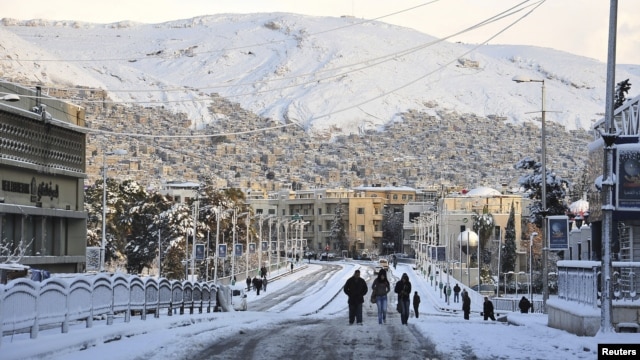
Image:  Snow in Damascus, January 2013

Just about...

I passed 2500 published posts on this blog sometime in the last month. Imagine!

Saturday, April 06, 2013

"Spring" in the Near North, 2013

Morning temp:  -14 C
Snow: 6-9 inches on the ground
Trees: barely any budding
In the air:  a bug.

Yakutia laughs.

Thursday, April 04, 2013

Oddball 14th century herald's name of the day

Moniquot, an "honorable" herald (is there any other kind?) who brought a message from King Henry of Spain (= Castile) to the Good Duke.
.
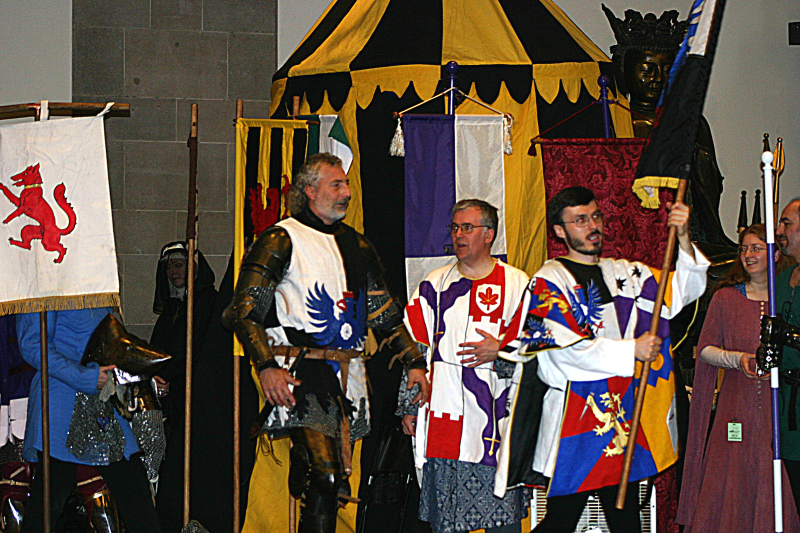
Image: More AEMMA.