Wednesday, August 31, 2011

A young Syrian rebel speaks


Anthony Shadid was there
:

As we prepared to leave, Iyad turned to me and said: “We’ve already won. We’re victorious now. I lived a life of terror, fear and killing, and now I’m free.”

Before the uprising, Iyad said, his life had been boring, even suffocating. He had a degree in business and economics, but jobs were scarce. The incentive to revolt was more ambiguous, though; he’d had enough of the humiliations, the propaganda, the hypocrisy, and now, finally, he could do something about it. No one encouraged him to go down to the first protest in Homs in March at the Khalid bin Walid mosque. No one had to. “I’m a person now,” he said. “I can say what I want. I love you if I want to love you, I hate you if I want to hate you. I can denounce your beliefs, or I can support them. I can agree with your position or disagree with it.” We shed the last of our belongings for another ride. “We’re not waiting to live our lives until after the fall of the regime,” he went on. “We started living them the first day of the protests. We began our lives.”

Book alert for students in HIST 4505

Issue resolved: Gregory of Tours:  Glory of the Martyrs will be available at a reasonable price.

Tuesday, August 30, 2011

Young supernova

From Astronomy Picture of the Day.

Battle in the Early Middle Ages: Expertise and controversy


"Historian on the Edge" provides us with an expert summary of his views on early medieval warfare.

I say "expert" rather than "authoritative" because as he points out, there are no authorities on this subject, only controversialists.

Highly recommended for students in my upcoming fourth-year seminar.

Image:  Conan as barbaric warrior.

Monday, August 29, 2011

Qs and Ks and other ways of transliterating Arabic

The Arabist explains:
 I was meeting with a bunch of business people who know no Arabic and little about the Middle East. The conversation turned to Libya and one of them turned to me and asked why there were so many spellings of Qadhafi's name. What follows is what I said, which is very much what Kal of TMND argues, except I put it in laymen's terms, without the phonetics.
In Arabic, Qadhafi's name is spelled القذافي which if you drop the article, means
ق - ذ - ا - ف - ي or q - dh - a - f - i. The "q" letter is almost unique to Arabic (sometimes called "the language of the qaf" — sorry, it's the language of the dhad, not qaf!) and often transliterated as a "k", since its pronounciation can be difficult for non-Arabic speakers. It is standard in classical Arabic and places like Fes in northern Morocco, but northern Egyptians, urban Syrians and others often pronounce this letter as a glottal stop, while southern Egyptians and Bedouins most often pronounce as a "g", as in "go". (This is why in Syria upscale Damascenes call the regime "the government of the Qaf", because pronouncing the letter is a country bumpkin thing to do, and Eastern Sunnis and Alawites — long dominant in the regime — often do it). Hence you see Qadhafi, Kadhafi or Gadhafi. The "dh" sound also has no equivalent in many languages as a standalone letter, and to top it off is made emphatic by a shedda — a kind of accent that indicates the letter should be doubled, which is why academics use the unwieldy "Qadhdhafi." And the "dh" is often not pronounced as such — in most colloquial Arabics, it is pronounced "d". I'm not sure why it might be pronounced "th", but perhaps this was used in Qadhafi's passport because it is close to the English sound in "the", which sounds very much like "dh".
I always write Qadhafi because it's simple and faithful enough without being completely anal, like Qadhdhafi. 


Sunday, August 28, 2011

The falls turn orange


There was a time in this fair land when surveyors were national heroes


Not to  mention engineers.

I'm talking Colonel By, children.

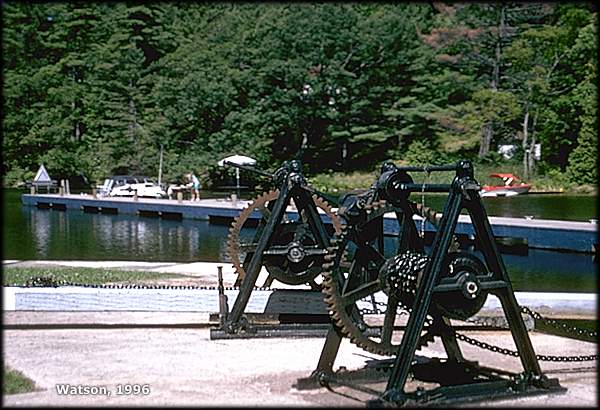
There is a World Heritage site in the province of Eastern Ontario that most Canadians are oblivious to -- the Rideau Canal that connects Kingston on Lake Ontario to Ottawa on the Ottawa River.  It was built in the 1820s and 30s as a military route that would be less vulnerable to American attack.  The job was entrusted to an English army engineer who accomplished the task of connecting lakes and rivers with canals and dams, thanks to the efforts of many navvies (= "navigators"), in short order (only to find himself being investigated for overspending).

And it is still all there in all its 19th century glory!

All but three of the locks are worked by human beings turning iron cranks by hand.  One of the explanatory signs canal-side calls this "brute force," but really there is nothing  brute about it.  The locks are so well-engineered that they move quite elegantly, and it really doesn't look like that much work -- though I am sure that it builds core strength in the university-age people who are there for the summer season.

In lovely contrast to the iron, timber and stone tech is the landscape that it goes through.  Parts of the canal system goes through intensively cultivated areas, but lots goes through what almost looks like wilderness.  Only very occasionally do roads cross the canal, and so if you are on a boat you feel like you are in a world apart from busy 21st century Canada.

Image:  Crabs or hand winches at Davis Lock; photo thanks to Paul Watson.

The legend of Jack Layton


People outside of Canada will probably not be aware that Jack Layton, leader of the federal New  Democratic Party (social democrats, pro-labor) and since the recent federal election Leader of the Official  Opposition in Parliament, died this week of prostate cancer.

Layton and his NDP made unprecedented gains in  the election, pushing past the Liberals and nearly destroying the Bloc Quebecois in Quebec.  A lot of the credit seemed to go to Layton, who seemed to appeal to those who could stomach neither Harper's Tories, Ignatieff's Liberals nor the separatist BQ.   The NDP oddly ended up, after decades of near-exclusion from Quebec, with most of its seats in that province.


How much could really  be expected of Layton in these circumstances?  Hard to say, given the Tory majority, the  difficulties of any national party in representing both Quebec and the rest of the country, and other factors.  But Layton and his party were not contemptuous of the grass roots, and that quality inspired an outpouring of grief and celebration.  Including a state funeral that was by normal rules not strictly something he was entitled to.    (I think the PM saw which way the wind was blowing and quickly put himself ahead of it.  More striking in some ways is the fact that the CN Tower and Niagara Falls will be lighted up NDP orange for a limited time.  All I can say about this is "!"

Other people besides me have realized that Jack Layton is now legend.  Struck down at his time of greatest triumph, we'll never know what he might have done or how he might have failed.  This, however, will not prevent some of them from answering those questions with great certainty and even in mythic language.

Thursday, August 18, 2011

Iranian absurdity: "Islamic" ban on waterfights

It appears that water fighting and water guns are becoming sensitive issues in Iran.

Earlier this month, a number of young people were arrested in Tehran after taking part in a water fight in public. They were accused of violating Islamic principles and norms.

A few days later, 17 people were reportedly arrested in Bandar Abbas for splashing water at each other. The young people in Tehran and Bandar Abbas used water guns and bottles.

Following the two incidents, General Ahmad Rouzbahani, head of Iran's morality police, warned that police "will act forcefully" against similar behavior and would not allow such events to happen in public places, or anywhere across the country."

Meanwhile, a woman in the Iranian capital who didn't want to be named told "Persian Letters" that last week in a shopping center in Shahrak Gharb, a shop owner refused to sell her a plastic water gun her 5-year-old daughter had seen in the shop window.

More at RFE/RL

The woman said the shop owner said that they had been ordered not to sell water guns. When she insisted that her daughter would not carry it in public and that no one would know she got it from his shop, the toy-shop owner said, "I don't want my shop to be closed for selling a water pistol.

He added that "the police have got the number of these pistols I have in stock and I am not allowed to take a single one for any of my relatives. They said they would check me every now and then."

"There are bikinis for your daughter and yourself, there are no bans on them but water pistols are another story," the woman quoted the shop owner as saying.

It's not clear why the shop owner had the pistol displayed in the shop window if he didn't want to sell it. It could be that he hadn't had time to remove it.

And as usual, Iranians are using humor to cope with the sometimes absurd situations they find themselves in. Here is a joke that is circulating about the recent incidents:

"A man walks into a shop and asks for a bottle of water. The shop owner wraps it in a newspaper and gives it to him. The man asks: 'Why did you wrap it in newspaper? It's only water, not alcohol or anything. (Alcohol is banned in Iran and when people buy it from dealers on the black market, it's often wrapped in newspaper and put in a dark bag.) The shop owner says: 'I know, but it's becoming very dangerous. You could end up in prison and your sentence could be heavier than for carrying alcohol."

-- Golnaz Esfandiari, Mehrdad Mirdamadi

RFE/RL

Mark Twain, the Middle Ages, and Baton Rouge

A brilliant little essay from Jeff Sypeck.


Wednesday, August 17, 2011

Go away and just see what happens

Often enough when I go away camping in August, and am paying no attention, something dramatic happens.  In 1989, I re-entered the world of news to hear that Hungary was taking down its stretch of the Iron Curtain.  In 1991, the coup against Gorbachev took place, followed quickly by the collapse of  the Soviet Union.

A lot of stuff happened this August, but for all the import of British riots and American Russian roulette with the economy, I think the beginning of the trial of Hosni Mubarak in Cairo wins the prize.

Cairo is the place, it is Paris in 1791.  Mubarak is Louis XVI and his judges are...?

When Louis fled France in rejection of the new constitutional monarchy, and was captured doing so, Thomas Paine told the revolutionaries  that how they treated the ex-king would determine the course of the new  republican regime.  He particularly warned against blood vengeance against the traitor-king, which would lead to more blood, and even more.  He was emphatically right.

Hosni Mubarak deserves to answer to a court for his actions, but the trial has its dangers.  The course and meaning and the consequences of the Egyptian revolution may well be determined in that courtroom.  Whether the Arab Spring keeps its potential for humane progress or descends into vengeance -- we shall see.

For a less hopeful set of developments, see these reports and reflections in Syria Comment.

Tuesday, August 16, 2011

Steve Muhlberger on the Combat of the Thirty -- a Chivalry Today podcast

Earlier this summer Scott Farrell of Chivalry Today interviewed me on the Combat of the Thirty against Thirty of 1351 and the contemporary re-enactments by members of the SCA at its Pennsic War.

Here is that interview.

This year I did not take part, but I did get the T-shirt. Really.

Friday, July 29, 2011

Are you ready for the country?

...cause it's time to go!

I will not be blogging for the next two weeks, unless I post some more today.

Thursday, July 28, 2011

Lowry in Berwick

Long ago, Berwick-on-Tweed was a prize in the Anglo-Scottish wars over old Northumbria. For centuries now it has been English, but the casual visitor (me) has a hard time telling which kingdom it belongs in (Northumbria?). The big social issue seems to be whether dogs should be welcome in pubs.

It is not a flashy place and may never have been, but Berwick had its artistic champion in the mid-20th century, when one L.S. Lowry did many striking paintings of the streets and the people. There is now a downtown "trail" on which you can visit sites he made famous, and which are pretty much the same.


A genealogy site has a good selection of Berwick neighborhoods and the paintings they inspired.

Another review of Noel Fallows' book on jousting in Iberia

This reviewer, writing for the online Medieval Review, also has a high opinion of it.

Fallows, Noel. Jousting in Medieval and Renaissance Iberia.
Woodbridge: Boydell and Brewer, 2010.  Pp. xix, 541.  $99.00.  ISBN:
9781843835943.

  Teofilo F. Ruiz
       University of California, Los Angeles
       tfruiz@history.ucla.edu


In this handsomely-produced and beautifully-illustrated book, Noel
Fallows offers, for the benefit of scholars and general readers alike,
four engaging, valuable, and interrelated contributions to our
understanding of jousting in late medieval and early modern Spain.
More importantly, the author, through a thoughtful deployment of texts
and images, takes us into the complex social and cultural world of
late medieval and early modern chivalry. Having just completed a book
on festive traditions (at the copy-editing stage presently), I can
only bemoan not having read this book earlier. And although I have
tried to incorporate many of Fallows' valuable insights and
information into my own work, his insights into these questions and
capacious treatment of the subject deserve more than just a passing
reference.

Anchored on the close reading of four seminal texts on jousting (plus
a series of other ancillary texts)--Pero Rodríguez de Lena's El
passo honroso de Suero de Quiñones
(1434), Ponç de Menaguerra's
Lo cavaller (1493), Juan Quijada de Reayo's Doctrina del
arte de la caballería
(1548), Luis Zapata de Chaves' "Del justador
(in his Miscelánea, 1589-93), plus short excerpts from Hernán
Chacón's Tractado de la cavallería de la gineta (1551)--Fallows
brings to life the chivalric world of jousting, connecting these texts
to their particular historical contexts. His four distinct and signal
contributions to the scholarship on jousting and other martial games
rest on his careful edition and translation of the above mentioned
works. His edition of the texts of Menaguerra, Quijada de Reayo,
Zapata de Chaves, and short excerpts from Chacón are the first modern
grouping of these works into one book. Although closely related to
each other thematically, they have never been examined as an almost
century and a half long discussion on jousting, warfare, and knightly
values. As such, his editions of these texts--also translated into
English for the first time--allow us to trace changes over time in the
rules, character, and equipment employed in Spanish jousts and
elsewhere in the West in the transition from the Middle Ages to the
early modern period.

Moreover, his new edition of significant portions--the most salient
ones--of Rodríguez de Lena's El passo honroso (the ur-text of
jousting in the Iberian peninsula) offers, once again through his up-
to-date edition and translation, an important source for the study of
fictional warfare in late medieval and early modern Spain, and,
because of the international nature of jousting in this period in
general and of the passo honroso in particular, the rest of
western Europe. His edited and translated short excerpts of Chacón's
Tractado is similarly the first version in English of a very
significant treatise on Spanish equestrian skills.

Second, although the edition and translation of the texts are found in
the second part of the book--almost as a stand-alone monograph--the
introductory study, found in Part One of Jousting in Medieval and
Renaissance Iberia
, expands on the textual evidence, offering to
the reader four diverse perspectives on Spanish chivalrous culture.
His introduction and chapter 1 provides a typology of knightly armed
encounters: mêlée tournaments, tournaments, jousts, and other such
martial games. The introduction also places Fallows' edition of the
texts within a judiciously drawn map of methodological and
historiographical approaches to the topic. His opinions are measured
and sound, dealing as he does with diverse and, often times,
contradictory interpretations. And he does this in a civil fashion,
assessing the worth of each approach, while presenting his own point
of view. Moreover, he allows the texts to guide us through these
discussions, and what can be better than his command of these primary
sources in guiding his readers to a new understanding of the evidence.

While noting the cultural importance of printing in the diffusion of
the new culture and technologies of jousting, Fallows, by deploying
Pedro Cátedra's ideas about "paper chivalry," Martín de Riquer and,
most famously, Huizinga's arguments about late medieval chivalry,
explores the links between literature and armed combat and the
circularity of writing about chivalrous deeds, fictional combat, and
the reality of lived lives. In chapter 1, Fallows turns to a careful
analysis of the three main treatises on jousting, examining how these
texts intersect with the authors' personal experiences, as well as the
different contexts from which they wrote. These brilliant mini-
biographies and case studies allow us to place the three main writers
of treatises on jousting within a long tradition of martial games,
warfare, and court life. For me in particular, the information on two
of these authors, Quijada de Reayo and Zapata de Chaves, and their
role at the great pageantry held at Binche in 1549 and at Philip II's
court is a most welcome revelation.

Although his introduction and chapter one are also in themselves a
small monograph, chapters 2 and 3 offer us a different and as equally
valuable contribution. These two chapters,  erudite and technically
complex, discuss types of armor, helms, saddles, weapons, and every
other piece of equipment used by knights during jousts and
tournaments. Profusely illustrated, technically precise, and with a
myriad of examples and images from the sources, they are a veritable
mine of information and a source for tracing the evolution of armor
and other equipment associated with these martial games from the late
fifteenth century into the sixteenth.

Chapters 4 and 5 shift the inquiry from armors and knightly equipment
to the nature of combat, its rules, and expectations. Fallows notes
the principles or ideals that governed the joust, how scores were
kept, excessive harm prevented, and wounds tended to. In chapter 6, he
turns his attention to war or, far more accurately, to the
relationship between jousting and actual warfare. Fallows, once again,
places his inquiry within the historiographical debate on whether
tournaments were a form of preparation for war or simply a form of
theater and display. Yet, his somber reflections on the actual carnage
found in sixteenth century warfare, the increasing toll taken by
firearms, and by the emphasis (for the sake of victory over the enemy)
on infantry and well disciplined formations over heroic single combat
clearly show the disconnect between the world of jousting and that of
the battlefield. Chapter 7 focuses on other forms of martial
spectacle, with the game of canes and the running of bulls featured
most prominently. These two semi-martial activities came to parallel
the medieval joust, marking a transition that the author describes as
"from sport to spectacle."

Early in his introduction Fallows notes that "chivalry must be seen in
order to be understood."(p. 27) This he has done as best as it could
be done by his vivid textual examples, case studies, and vivid
descriptions, creating a textual portrait of the joust. This he has
done superbly well by his choice of images and by the abundant amount
of visual material included in the book and keyed to the text. When
Spanish images have been lacking, he has borrowed from Italian,
German, French, and English visual evidence to provide us with a clear
idea of what was like to be in a joust. Technical at times, highly
engaging at most other times, this is a book that does many different
things, and it does all of them well. While examining the diverse
social and cultural aspects of fictitious and chivalrous warfare, the
texts that he has so carefully edited and translated remain a thread
that links the book's varied themes into a comprehensive and
compelling vision. I would have liked to see a more careful discussion
of the game of canes and of the role of bulls. I, for one, think that
they occupied an important place in the festive imaginary of early
modern Spain, but this is a very small quibble on what is an
impressive and important achievement. Fallows' super book, beyond
bringing these important treatises to the attention of scholars and
other readers, reintegrates Spain--often neglected in Huizinga's
masterpiece or in Roy Strong's discussions of festivals--into the
general late medieval and early modern European culture of jousting
and chivalric culture.  That in itself is a worthy achievement.

Monday, July 25, 2011

Modern Medieval: (inflammatory) language has consequences

Crusading rhetoric, then and now.

Ideology

Boris Johnson in the Telegraph, on the Norwegian "Templar:"

It is not enough to say he is mad. Anders Breivik is patently mad: no one in their right mind would behave as he has done. Nor is it enough to say that he is evil. If the word evil has any meaning at all, then it must obviously apply to a man who can go to a lake island summer camp, call innocent young people to run towards him – and then shoot 85 of them with an automatic rifle.
We will never be satisfied with simple words like “mad” or “evil”, and for the days and weeks ahead we can expect exhaustive psychoanalysis of this dreary and supercilious 32-year-old sicko. We will summon and interview all the potential hobgoblins of his mind. With the help of the Norwegian investigators, we will try to understand how these demons persuaded him to engage in an act of such premeditated cruelty; and as our guide we will use the 1,500-page manifesto of hate that he (and possibly his accomplices) have posted on the internet.
It is in many ways a preposterous document, with its plan to revive the ancient order of the Knights Templar, with Breivik as “Justiciar Knight”. The idea is to mobilise an army of similar loathsome berks and to liberate Europe of immigrants by 2083. It seems that this is the 200th anniversary of the death of Karl Marx, whom Breivik blames for egalitarianism, feminism, multiculturalism and all manner of other things he dislikes. Breivik’s attempt at Mein Kampf is awash with Wikipedia-generated teenage ruminations about Gramsci, Adorno and Islam, and I must confess I have not slogged all the way through to the end.
But I have read enough to grasp the gist – and there is something both curious and troubling in his obsessions. He goes on and on about the EUSSR and “Eurabia”. He attacks multiculturalism as a “big lie”, and asserts that “political correctness now looms over Western European society like a colossus”. “Can the European Union be reformed?” he asks. “I doubt it. The EU is bound together by a self-serving class of bureaucrats who want to expand their budgets and power, despite the harm they do.” He claims that Europe has been systematically betrayed by mass immigration from Muslim countries, and that the method of this immigration has been concealed from the electorate. He cites a great many British commentators to make his points. Indeed, it is fascinating to see how rooted is this Norwegian extremist in the political discourse of the Anglosphere.
My friends, there is no easy way of saying this: a lot of what this evil nutcase says could be drawn from the blog-post threads that you will find in the media, especially the “conservative” media, in Britain. Some people will read his dismal expectorations and conclude that this inflammatory guff is what really drove him on. They will say that his barbarism was spurred by fury at the EUSSR and immigration, just as the murders of 9/11 were triggered by the various tenets of Islamic extremism.
It is certainly true that on the face of it he has much in common with some recent Islamic suicide bombers. He is disturbed by female emancipation, and thinks women would be better off in the home. He seems to be pretty down on homosexuality. Above all – and in this he strongly resembles an Islamist – he believes that his own religious leaders are deeply decadent and have deviated from orthodoxy. He is repelled, like so many Muslim terrorists, by anything that resembles the mingling of cultures.
People will say that we are looking at the mirror image, in fact, of an Islamic terrorist – a man driven by an identical but opposite ideological mania. There is certainly a symmetry here, and yet in both cases, Breivik and the Muslim bomber, I don’t think that ideology is really at the heart of the problem. Yesterday the television reporters found an acquaintance of his from Norway, a fellow called Ulav Andersson, who said that he had known Breivik pretty well. He was surprised by all the Knights of Templar stuff, because he had never really been religious, and he wasn’t aware that he had been interested in politics.
“He didn’t seem opinionated at all,” he said. He just became chippy and irritable, said Ulav Andersson, when some girl he had a crush on jilted him in favour of a man of Pakistani origin.
It wasn’t about immigration, or Eurabia, or the hadith, or the Eurocrats’ plot against the people. It wasn’t really about ideology or religion. It was all about him, and his feeling of inadequacy in relation to the female sex. The same point can be made (and has been made) about so many of the young Muslim terrorists. The fundamental reasons for their callous behaviour lie deep in their own sense of rejection and alienation. It is the ideology that gives them the ostensible cause, that potentiates the poison in their bloodstream, that gives them an excuse to dramatise the resentment that they feel in the most powerful way – and to kill.
There is an important lesson, therefore, in the case of Anders Breivik. He killed in the name of Christianity – and yet of course we don’t blame Christians or “Christendom”. Nor, by the same token, should we blame “Islam” for all acts of terror committed by young Muslim males. Sometimes there come along pathetic young men who have a sense of powerlessness and rejection, and take a terrible revenge on the world. Sometimes there are people who feel so weak that they need to kill in order to feel strong. They don’t need an ideology to behave as they do.
Michael Ryan had no ideology in Hungerford; Thomas Hamilton had no ideology in Dunblane. To try to advance any other explanation for their actions – to try to advance complicated “social” factors, or to examine the impact of multiculturalism in Scandinavia – is simply to play their self-important game. Anders Breivik may have constructed a portentous 1,500 page manifesto, but like so many others of his type he was essentially a narcissist and egomaniac who could not cope with being snubbed. We should spend less time thinking about him, and much more on the victims and their families.

But then read the comments...