Showing posts with label Arab Spring. Show all posts

Wednesday, February 08, 2017

It is not to laugh

Karl Sharro in Politico says, "America, you look like an Arab country right now." Excerpts:
Dear America,
We have been watching the drama of your presidential elections with much interest and curiosity for some time now. It’s hard not to notice the many similarities between our own countries and yours. From fiery inauguration protests and bitter disputes about crowd size, to the intelligence service’s forays into politics and the rise of right-wing extremists, it appears that you are traveling very much in our direction—and at the same time, like us, becoming a curiosity for foreign correspondents trying to explain what’s happening in your region to the world. You might be distraught about where you are headed, but we aren’t! Perhaps this will be an opportunity to put our differences aside and recognize how similar we are.
Let’s start at the beginning. During the campaign we were surprised to learn of the influence that the head of the American mukhabarat (state security, i.e. your FBI) can wield over the election process, simply by choosing to pursue a certain line of investigation. As you may know, this has been a constant feature of our politics since independence. Our surprise turned to astonishment when we started to witness the blossoming feud between the then-president-elect and the American mukhabarat, another important feature of Arab politics.
On top of that, we started to hear reports of foreign meddling in your elections, which some say may have influenced the result. Of course, we are quite familiar with that situation, too, not least because of the efforts of your own administrations over the decades. Yet it came as a surprise to hear talk of “foreign hands” and “secret agendas” in a country like America. We sympathize.
...
The moment at which we felt real solidarity with the American people, though, was when we started hearing BBC reporters talking to your citizens with the patronizing tone they normally reserve for the Middle East. Correspondents were sent to far-flung corners of the United States to talk to farmers and factory workers to try to understand how they feel and to ask condescending questions. I’m from the British Broadcasting Corporation, are you familiar with the BBC? Where do you get your news from? Do you feel angry? Does religion play a role in how you are voting?. (The only thing missing were pictures of people with blue ink on their thumbs; please consider introducing that practice in the future.)

Saturday, June 20, 2015

Social revolution in Egypt?

According to Foreign Policy, the generation that revolted against Mubarak hasn't given up on demanding personal liberty.

Friday, December 05, 2014

Believing in the Arab Spring -- "At this point it’s either the Arab Spring or no Arabs."

Iyad el-Baghdadi in Foreign Policy:


Mariam looked up at me. I’ll never forget what she said next. It was as if she poured all of her frustration, all of her betrayal, all of her pain, into this one question: 
“Do you mean to tell me you still believe? After all of this, you still believe in an Arab Spring?”

I’ll never forget how she said that. I said, “Yes.” And she looked at me like I was crazy. I never got to explain. I’ll try to do so now.

There are three reasons why I maintain my confidence despite all the catastrophes. The first reason is that 2011 happened. It wasnot a dream. It was not an illusion. Millions of young Arabs really did take to the streets demanding liberty, and dignity, and justice. Something green and fresh and beautiful appeared and captured the world’s imagination. It wasn’t a mirage. We really do exist.

We’re not a minority, either. We only appear to be a minority because we’re not organized; we’re not on the menu. When the only options presented are black or white, it does not mean that red or green or blue are a minority. When the only options presented are religious authoritarianism or nationalistic fascism, it does not mean that a third option doesn’t exist. It’s just not on the menu. Our historical responsibility right now is to put ourselves on the menu.

The second reason I am confident is that the friendships that arose since 2011 cannot be unmade. The online scene isn’t “virtual,” ladies and gentlemen. No, it’s all too real. The ideas are real, the friendships are real. Many of us activists have never met face to face — but we talk almost daily about things we care very deeply about. We’re a family. These friendships are forever. Martin Luther King once said, “Those who want peace must organize as effectively as those who want war.” I’m going to adapt this gem as follows: “Those who want liberty must organize as effectively as those who want tyranny.” These online friendships can form the nucleus for an intellectual movement as we work together on campaigns, projects, and books.

The third, and perhaps most important reason why I remain confident, is that the old order, the Arab ancien regime, has, for all its cruelty and deep pockets, no vision or hope to offer beyond sectarianism, demagoguery, and jingoism. It lives on borrowed time supported by mass hysteria; it’s unsustainable. It will bring no stability or growth.

More importantly, they have a dirty little secret. They’re afraid of us. They’re not afraid of those with guns; after all, they have bigger guns. But they’re afraid of those with ideas.

Monday, March 24, 2014

The Square (2013) – an intense look at the Egyptian revolution


The Square (meaning, Tahrir Square) is an Egyptian movie that follows several people from Cairo through their political journey through the  recent upheavals in their country. The filmmakers caught several eloquent and serious people to be their subjects, to show through their debates and ruminations what kind of different ideals have been present in this remarkable historical moment.

I have been thinking recently that nobody knows what's going on in Egypt, and I feel that more strongly now, if a bit more hopefully. All the possibilities are there, good and bad. And if you ever thought that people outside of "the West" could not possibly understand democracy and human rights, here's your refutation.

Of course there are no guarantees that they will achieve a worthwhile democracy, but many of them know that they want it and it's not so different from what many people in Canada and elsewhere want.

As of today The Square is available on Netflix and I highly recommend it.

Thursday, August 15, 2013

Bad times in Big Egypt -- Arabist.net

Short and not at all sweet: August 14 in Egypt in numbers Ursula Lindsey

Dead (according to Ministry of Health, and still counting): 525

Wounded: 3,500

Churches, monasteries, Christians schools and libraries attacked (Source) : 56

Days that Mohamed ElBaradei lasted as a civilian figure-head of the army-run "second revolution" before resigning in protest: 28

Other resignations: 0

Justifications presented by Egypt's non-Islamist media and political parties for the gratuitous murder of hundreds of their fellow citizens, and commendations of the security forces for their "steadfastness" and "restraint": too many to count

A longer analysis that feels right:

It only gets worse from here

Issandr El Amrani

You could ask a thousand questions about the violence that has shaken Egypt ... But the question that really bothers me is whether this escalation is planned to create a situation that will inevitably trigger more violence – that this is the desired goal.

The fundamental flaw of the July 3 coup, and the reason those demonstrators that came out on June 30 against the Morsi administration were wrong to welcome it, is that it was based on an illusion. That illusion, at least among the liberal camp which is getting so much flak these days, was that even a partial return of the old army-led order could offer a chance to reboot the transition that took such a wrong turn after the fall of Hosni Mubarak on February 11, 2011. This camp believed that gradual reform, even of a much less ambitious nature than they desired in 2011, would be more likely to come by accommodating the old order than by allowing what they perceived as an arrangement between the military and the Islamists to continue. Better to focus on fixing the country, notably its economy, and preventing Morsi from sinking it altogether, and take the risk that part of the old order could come back.

In this vision, a gradual transformation of the country could take place while preserving political stability through the armed forces.

...

Unfortunately, among the broad liberal camp in Egypt, those who entertained such hopes are in a minority. Even among the National Salvation Front, as its obscene statement praising the police today showed, most appear to have relished the opportunity to crush the Muslim Brothers and appeared to believe that other Islamists could simply choose to be crushed alongside it, kowtow to the new order, or be pushed back into quietism. It appears that much of the business and traditional elite – represented politically by the Free Egyptians and the Wafd Party among others – falls into that category. They are joined by the security establishment, or deep state if you prefer.

Over the last week there was much talk of divisions between this segment and those symbolically important liberal members of the government, such as ElBaradei, over whether or not to negotiate with the Brothers or break their sit-ins. The camp that eventually won does not just believe that the Brothers are not worth negotiating with. They want to encourage it in its provocative sectarian discourse, its supporters desire for violence, and the push as much as the Islamist camp as possible into being outlaws.

...

Their thinking is cynical in the extreme, not unlike Bashar al-Assad's push towards militarizing the political conflict he faced in 2011. They are willing to live with the violence, impact on the economy, and other downsides if it strengthens their own power and legitimacy.

...

In their strategy against the July 3 coup, the Brothers and their allies have relied on an implicit threat of violence or social breakdown (and the riling of their camp through sectarian discourse pitting the coup as a war on Islam, conveniently absolving themselves for their responsibility for a disastrous year) , combined with the notion of democratic legitimacy, i.e. that they were after all elected and that, even if popular, it was still a coup. On the latter argument, they may have gained some ground over time both at home and abroad. But on the former, they got things very, very wrong: their opponents will welcome their camp's rhetorical and actual violence, and use it to whitewash their own.

Friday, July 12, 2013

It's not the Arab Spring, it's the French Revolution (1789-99)

 From Foreign Policy:

This massive financial support follows on, and replaces, billions of dollars given by Qatar to the previous Muslim Brotherhood government. It is likely to prove equally ineffectual in delivering the desired payoffs, though. As Doha discovered to its dismay, money will buy only temporary love and symbolic returns. Whatever Gulf paymasters might hope, the new Egyptian government will be forced to respond to its own intensely turbulent, polarized, and dysfunctional domestic political arena. No outside player -- not Washington, Riyadh, Doha, or Tehran -- can really hope to effectively shape the new Egyptian politics for long.

Wednesday, January 16, 2013

Conflict between Islamist movements

Translation provided by Arabist.net:
War against the Muslim Brotherhood Divides the Gulf
Abdel Bari Atwan, al-Quds al-Arabi,
11 January 2013
 Whoever has been following the media in the Gulf – and the Saudi media in particular – has probably gotten a sense of the fierce campaign being waged against the Muslim Brotherhood and Islamist currents more broadly, as well as the major preachers in the Gulf. Their influence has been on the rise recently thanks to social media such as Facebook and Twitter, and yet the dedicated security apparatuses of the various countries in the region have had a harder time controlling and blocking these outlets than they did with newspapers and websites. Dubai’s chief of police Lieut. Gen. Dahi Khalfan Tamim pioneered this campaign against the Muslim Brotherhood and was one of the first to issue vehement warnings about the danger they represented, but many articles appearing in the Saudi and Emirati press have begun to follow in his wake. This is happening in such a way as to suggest that there are bodies high up in the state that would like to open up a front against them, whether in Egypt – where they are sitting at the threshold of power – or within the Gulf itself.
 This war against the Brotherhood, and perhaps later upon the Salafi currents, represents a break with the historical alliance that has existed between conservative Gulf regimes and these figures. This alliance ensured the stability of these regimes and helped combat all the leftist and nationalist ideas that constituted a threat to this stability in the eyes of the rulers. The question that is now on everyone’s mind is why has there been a sudden reversal of opinion in the Gulf against the Muslim Brotherhood ideology, when this ideology was embraced and supported over the past 80 years. In the aim of helping control Gulf youth, Muslim Brotherhood intellectuals and professors were even allowed take over the education sector, set curricula, and establish proselytizing and charitable associations, not just within Gulf countries but throughout the entire world.
 How did this relationship of warm, strategic friendship morph into a bitter fight – at least on one side, for now — between the ruling regimes in the Gulf and the Muslim Brotherhood? The response to these questions can be summed up in the following points:

  • Governments in the Gulf have realized that the Muslim Brotherhood is a “global” movement governed by an international organization. This means that the loyalty of the organization is to the Supreme Guide in Egypt, and not to local authorities, not even to the head of the group in these countries.
  • The Islamist Muslim Brotherhood has taken control of the process of forming the next generations by setting local curricula. This has led it to dominate the armies and security services, which has left it more prepared than ever to overthrow the ruling regimes and seize power. This is the main fear of the Gulf regimes
  • With the liberal and leftist currents in Gulf countries weakened by decades of repression and persecution, the organized Islamist currents have become the leading candidates to launch Arab Spring revolutions for change in the countries of the Gulf.
  • Religious and Brotherhood currents in particular enjoy a financial independence that sets them apart from the other currents, due to their intricate organizational networks and the fact that their backers possess considerable financial resources due to their control of large companies and financial institutions in Gulf countries especially. This has allowed them to combine political and economic power.
  • Islamist movements enjoy significant support in popular milieus because their ideology centers on the Islamic faith. Their control over mosques — whether directly or indirectly — translates into five miniature daily meetings and one large weekly meeting every Friday.
  • Non-jihadist Islamist movements – and the Muslim Brotherhood in particular – practice self-control and avoid any collision with the state. This explains the Brotherhood’s silence in Egypt concerning the attacks in which it has been targeted. It has kept calm and sent delegations to the Emirates to solve the arrests crisis through diplomatic means.It was no surprise that Saudi writers accused the Muslim Brotherhood of employing the "principle of taqiyya”[1] among its organizational practices.

    Gulf countries – to put it briefly – are worried about the MB’s control of Egypt, Tunisia and Sudan, and its attempts to gain power in Jordan, Yemen and Syria. This would leave the countries of the Gulf surrounded on all sides, and at risk of falling into the new orbit of the Muslim Brotherhood, in a sort of political “domino” effect.
More here.

Sunday, January 06, 2013

Stalemate in Syria

NYT:

A multilingual former military officer, he says he is among many friends and colleagues who feel trapped: disenchanted with President Bashar al-Assad, disgusted by the violence engulfing Syria and equally afraid of the government and the rebels, with both sides, as he puts it, ready to sacrifice “the innocents.”
 Mr. Assad remains in power in part because two years into the uprising, a critical bloc of Syrians remains on the fence. Among them are business owners who drive the economy, bankers who finance it, and the security officials and government employees who hold the keys to the mundane but crucial business of maintaining an authoritarian state. If they abandoned the government or embraced the rebels en masse, they might change the tide. Instead, their uncertainty contributes to the stalemate.
 The Egyptian and Tunisian rebellions that inspired Syria’s initially peaceful uprising reached tipping points within weeks, with far less bloodshed. In those cases, widespread desire for change overwhelmed the fear of the unknown, and toppled governments — or rather, the dictatorial cliques that headed them. But in Syria, each side has bloodied the other while many stay on the sidelines, and a core contingent of supporters feels obligated to stick with the government even as their doubts grow. That is in part because the government’s ruthless crackdown has made protest far more risky than in other uprisings. But it is also because of doubts, among the urban elite and others, about the direction of the revolution and how a rebel-ruled Syria would look.
 “Me and my neighbors, we were the first to go down to the street and scream that we want a country, a real country, not a plantation,” said Samar Haddad, who runs a Syrian publishing house. “But this armed revolution, I refuse it as much as I refuse the regime.”
Ms. Haddad, who is in her late 40s and now spends much of her time outside Damascus, said that she and her circle of intellectuals and professionals embrace unarmed Syrian protesters as heroes, but believe that the armed rebellion is creating warlords and cycles of revenge that will be hard to uproot.
 The fence sitters include government employees, security forces, intellectuals and wealthy Syrians. Some, including members of Mr. Assad’s minority Alawite sect, say they fear the rule of Islamists, or the calls for vengeance from some factions of the Sunni Muslim-dominated uprising.

Some are former soldiers who say they defected only to be disappointed by rebels who lack discipline or obsess about religious ideology. One young man, Nour, said he gave up on revolution when he tried to join an Islamist brigade, Al Tawhid, but was rejected for wearing skinny jeans.
Joshua Landis at Syria Comment has long  been putting out this kind  of analysis.

Tuesday, December 11, 2012

Sunday, November 25, 2012

James Gelvin on Islamist politics and the Arab uprisings


A podcast by the author of the excellent textbook I use for Islamic Civilization.

Friday, October 26, 2012

Don't blame the Arab Spring

From that radical organization, RAND:

The current unrest in Syria, and elsewhere in the Middle East, is mistakenly being blamed on the Arab Spring. Even before the recent violence, many observers were quick to declare that spring had rapidly turned to winter in the Arab world. Here at home, and just before the presidential debate on foreign policy tonight, a Pew Research Center poll showed that Americans are increasingly skeptical that the Arab Spring will lead to lasting change. The survey, released last week, found that 57% of Americans (up from 43% in April 2011) do not believe that the uprisings will improve the lives of people in those countries.
 But the roots of the unrest are not in the desire to cast off authoritarian regimes that took expression in Arab Spring protests. The roots came before the uprisings, and progress will take longer than we wish.
 Weak and corrupt government institutions, underdeveloped civil society, a lack of means and habits of peaceful expression, repressed resentments, and the absence of free news media are all legacies of the previous regimes, and still characterize those countries where governments remain authoritarian.
 Blame the autocrats, not the Arab Spring.
 What's the implication for U.S. foreign policy of hand-wringing over whether the Arab Spring was a good thing after all? That the U.S. should have worked to suppress the uprisings? Opposing the possibility of democracy — in the face of overwhelming popular support — would have further eroded U.S. influence in the region. The Arab Spring has discredited the idea that the secular authoritarian regimes were fundamentally stable; the turbulent dynamics we now see in play were their creations.
 Disparagement of the Arab Spring has been accompanied by criticism in some quarters of the Obama administration's support for it and in others of the administration's failure to ensure greater progress toward democracy. Some have suggested that unrest in the region is a consequence of U.S. support for political change.

These critics wrongly suggest the U.S. has much more leverage to create democracies than is realistic. Even where U.S. leverage was not compromised by a history of propping up or tolerating dictators, our country's ability to affect the course of post-authoritarian transitions was generally at the margins. Internal forces drive political transitions, not outside ones.
Read the whole thing.

Wednesday, October 24, 2012

Pessimism day, 1: The Arab Middle East

At Arabist.net, a link to and an evaluation  of  a melodramatic piece on  the outcome of the "Arab Spring:"

This Is Not a Revolution by Hussein Agha and Robert Malley | The New York Review of Books
Another almost melodramatically lucid-pessimistic view of the Arab uprisings and their consequences by Hussein Agha and Robert Malley. Much of the phenomena they describe is accurate, but what they object to is history in motion, which they see as more of loop. This is too depressed-romantic a view. There are terrible debts to be paid for the way power was organized in the Arab world over the last 60 years, they will be paid in blood. Let's get on with paying them, and not cry over spilt milk. But the idea that a restoration of the Ottoman model (in terms of a MB caliphate, not Turkish domination) is happening I find dubious.
I liked this bit:
The Islamists propose a bargain. In exchange for economic aid and political support, they will not threaten what they believe are core Western interests: regional stability, Israel, the fight against terror, energy flow. No danger to Western security. No commercial war. The showdown with the Jewish state can wait. The focus will be on the slow, steady shaping of Islamic societies. The US and Europe may voice concern, even indignation at such a domestic makeover. But they’ll get over it. Just as they got over the austere fundamentalism of Saudi Arabia. Bartering—as in, we’ll take care of your needs, let us take care of ours—Islamists feel, will do the trick. Looking at history, who can blame them?
Mubarak was toppled in part because he was viewed as excessively subservient to the West, yet the Islamists who succeed him might offer the West a sweeter because more sustainable deal. They think they can get away with what he could not. Stripped of his nationalist mantle, Mubarak had little to fall back on; he was a naked autocrat. The Muslim Brothers by comparison have a much broader program—moral, social, cultural. Islamists feel they can still follow their convictions, even if they are not faithfully anti-Western. They can moderate, dilute, defer.

Sunday, September 16, 2012

Provocative films, angry riots: the downside of new media

Doug Saunders at the Globe and Mail has been writing some really good stuff on the Middle East for a while now.  See this for clear-eyed clear thinking, clearly expressed  (my emphases):
After this week’s violence in the Middle East, two things are apparent. First, a lot of Arabs in the region believe that “the United States” created a video mocking the Prophet Mohammed. And second, a lot of people in North America believe that “Egypt” and “Libya” attacked U.S. diplomatic outposts and killed an American ambassador.

Few protesters in Cairo or Benghazi believed that the video Innocence of Muslims could have been created by a largely unknown group of anti-Muslim activists in California, a group so obscure that it took U.S. reporters more than a day to identify them – or that this network of bigots could be allowed to exist simply because American laws protect freedom of speech. This could only be a direct product of Washington.
After all, this was, until recently, how things worked in their own countries. If something was allowed to exist in Egypt or Libya, the authoritarian government must have encouraged it to exist. Ergo, this wasn’t some fringe oddball in California offending them; it could only have been the United States assaulting them.

Likewise, many Americans, including prominent ones, simply could not believe that a consulate or embassy could be stormed by anti-American protesters without the active consent, and likely direct involvement, of the country’s government. These attacks prove that America has “lost Egypt” or “been betrayed by Libya,” commentators wrote, likening this week’s relatively small-scope protests to Iran’s 1979 revolution

We need to take three lessons from this week’s events.

The first is that both Arab and Western citizens – and sometimes politicians – are failing to appreciate the polyphonic nature of democratic nations. This has always been a problem for the U.S. and its neighbours: One-note nations such as Russia and Iran have never really believed that every political statement, protest march and YouTube video emerging from a diverse Western country isn’t orchestrated by the national government.
But now it’s also a problem for the new Arab democracies. Suddenly, they are large, and contain multitudes. They have become polyphonic. We should not mistake the signal from the noise, even when things become very noisy, indeed.

The second is to realize that the new freedoms – both political and electronic – allow the most obscure and marginal figures to dominate the agenda. ...

The third is to realize that, as a result of this, these fringe movements are increasingly threatening, far out of proportion of their actual numbers, not just within their small sphere of action but on a larger stage. The past decade has seen a largely unnoticed ascent of the circle of xenophobic activists behind the short film that triggered this violence, their rise into mainstream politics, and the failure of mainstream conservatives to confront and denounce them...

This is a new, wide-open world – one whose freedoms, if we aren’t careful, can easily be seized and abused.

Wednesday, July 04, 2012

Some perspective on the Arab Spring

Juan Cole takes a positive view:
Americans forget that in the 1780s the Articles of Confederation did not work very well, and there were problems of too little federal government. They forget the Rhode Island farmers’ strike, Shays’ Rebellion, the Whiskey Rebellion, the various slave revolts, the continued conflicts with Native Americans, etc., etc. Thomas Jefferson, less timid than our contemporary pundits, remarked after Shays’ revolt that ‘a little rebellion now and then is a good thing.’ You have a sense he wouldn’t be that alarmed by contemporary Libya.


They forget that 15 years after the constitution was written, the vice president of the United States killed the first secretary of the treasury in a duel.

So give the Arabs some time to sort out their new situation. Let them craft their new constitutions, hold their further elections, and begin their transition in earnest. It is early days. What had the United States accomplished by 1785?

The slogan at Tahrir Square was “Bread, dignity and social justice.” That sounds a lot like their version of “life, liberty and the pursuit of happiness.” Liberty and democracy have been a central demand of contentious politics in the contemporary Arab world. Let us wish them well instead of always putting them down. After all, we’ve been at this for over 200 years and we still don’t have it down.

The whole thing is worth reading.

Thursday, April 12, 2012

Grassroots democracy in Egypt's villages


Why do Egyptian villagers vote for the people they do? How do they choose, in particular, between the Muslim Brotherhood (the oldest and best organized Islamist party) and the Salafists (who have a reputation as fundamentalists and extremists)?

Yasmine Moataz Ahmed at the Egypt Independent web site has a detailed answer.  Highly recommended.  Some excerpts:
Despite the common perception that Salafis are strict followers of Sharia compared to the Muslim Brotherhood, many of my research participants often talked about Salafis as religiously less strict than the Ikhwan. From the work of Ikwani leaders in the village, the villagers have noticed the strict hierarchy that informs the work of the Brotherhood members on the ground. In other words, the villagers understood the Brotherhood’s adherence to the dictates of the Guidance Bureau, or the Murshid, as an orthodoxy that made the Brotherhood stricter than the Salafis. They often said to me: “How come Ikhwan grassroot leaders all agree on the same things?” An incident that they often referred to is the insistence of Muslim Brotherhood members to force people to pray outside of a mosque, not build by the Brotherhood, during the Eid al-Fitr prayer last September.

Salafis, on the other hand, are seen as religiously flexible. “Aren’t we all Salafis?” many Nour supporters often repeated to me. For them, Salafis represent a religious understanding that seeks to closely follow the times of the Prophet and his followers — the Prophet was married to a Coptic woman, his neighbors were Jews, he dealt with each situation on a case-by-case basis, hence the perception that Salafis are, believe it or not, lenient. This was reflected on the ground; Salafis, at least in the village where I worked, appear to be more laid-back compared to the Ikhwan, and hence, more sensitive and open to the local context.Class was also a factor that often worked against the Brotherhood’s candidates. Due to being the most educated cluster, Ikhwani leaders are strongly present in professional occupations in village-level bureaucracies; they are the teachers, the lawyers, the engineers, and more importantly the personnel of the most funded NGO: Al-Jam’eya al-Shar’eya. Ikhwan leaders often use their positions, particularly in the NGO, to promote the Freedom and Justice party through coercing the poorest of the village into long-term charity and debt relations; they fund kidney dialysis operations, pay monthly stipends for orphan children, and distribute money and goods for ad-hoc lists that they prepare once they get orders from their leaders in Cairo.

Although these services seem necessary in the absence of a state-service provider, many rural dwellers (even ones who receive support from the NGO) see this relationship of indebtedness to the NGO as unhealthy. This informs why many villagers are weary of voting for the Ikhwan’s party. “We need a government that recognizes our rights as citizens, not as recipients of aid! We need people that would help us get our stolen rights. If the Muslim Brotherhood come to power, they will be both the mediators and the government.”
As Ahmed says, these are not gullible people. They have their own issues.

Image:  an Egyptian village, copyrighted by Historylink101.com & found at Egyptian Picture Gallery.

Thursday, December 29, 2011

Reflections on 2011

Brian Ulrich reflects and analyzes developments in the Arab countries over at Brian's Coffeehouse.  This particularly caught my attention:
One framework we have seen the past year is that "the nation," meaning the people, is rising up against internal oppressors so as to establish a new government on its own behalf. One question now is how the "nations" will be defined, or what identities will be on people's minds as they act politically. In Iraq, probably moreso than under Saddam Hussein, loyalty to a community of Sunnis, Shi'ites, or Kurds competes with that to Iraq as a whole. Those "Arab Spring" countries with religious differences will face the question of deciding if those differences preclude national unity. This issue might be most explosive in Syria, but for the moment, it is also a subject for discussion in Egypt, where salafis see Christians not as equal citizens, but as a subject population under Muslim rule.
More good stuff here.

Friday, December 23, 2011

Crushing the revolution--but at what price?

From Arabist.net, an essay by an Egyptian novelist, who argues that the Army's efforts to preserve its position in the Egyptian state is destroying the Egyptian state.


Goodbye to Military Rule

By Ezzedine Choukri-Fishere, al-Tahrir, 20 December 2011

...

What the Military Council has not realized is that the explosion in January was the outcome of a blockage in the regime’s arteries, and not just Mubarak’s. What the Military Council has not understood is that the state’s solid structure – the security regime – is the real problem, and not Mubarak.

If the Military Council realized this, they would strive to change the political equation for society to enter the state as a partner. If they realized this, they would have reached an understanding with civilians in February over a joint form of rule that would close the curtain on the past and protect the independence of the military establishment in the future. It seems, however, that they haven’t realized this, they didn’t believe it when they were told, and they didn’t listen.

Instead of this, they listen to the ones staging a coup against the revolution, who portrayed to them that violence, terrorizing the people, and control of the state media would put an end to mass support for the revolution and to the revolutionary forces themselves, one after the other.

What is the result of this? The result is that these coup-makers are tearing down with their own hands the structure they’re trying to protect. They’re sullying the image of the army in the eyes of society and are placing it in the same category as the Interior Ministry cronies involved in murder, torture and abuse. The result is that these coup-makers are provoking the people’s ire and resentment against the army. In the past, these feelings of outrage, resentment, and fear would lead to submissiveness and surrender. Now, however, they will motivate society to gain control of the army, open up its files, hold it accountable, and to do other things the coup-makers were trying to prevent.

Coup-makers go home. You’re bringing down the structure on top of all of our heads.


I'd say this same dynamic applies to more than just Egypt.

Monday, November 28, 2011

Monday, November 07, 2011

The situation of Arab Christians


Daniel Philpott:
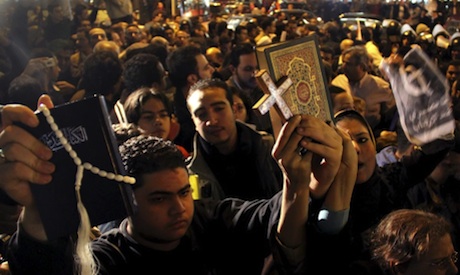
A tense subplot of the Arab Spring is the increasing endangerment of the region’s Christians. In Egypt, Coptic Christians, 10% of the population, have been attacked repeatedly by Salafist Muslims unleashed – many literally released from prison -- by the fall of President Hosni Mubarak. No wonder that Christians in Syria now fear their fate at the hands of the country’s Sunni Muslim majority should President Bashar al-Assad’s government fall.
The experience of Christians in Iraq is hardly encouraging, either. The kidnapping and murder of Chaldean Catholic Archbishop Paulos Faraj Rahho by Muslim militants in early 2008 is emblematic of what Iraq’s Christian community has suffered since the fall of Saddam Hussein. The population of Iraqi Christians has declined from around two million to around 400,000 since the Gulf War of 1991, which weakened Hussein’s rule. Under the dictatorships of Mubarak, Assad, and even Hussein and Qaddafi, all of them unsavory to be sure, Christians enjoyed relative security, though it was sometimes bloodily interrupted and usually attended by pervasive social discrimination. Arab authoritarianism was a leaky shelter but it was nevertheless a roof over their heads.

But however dangerous Arab Christians’ fate now may be, going back to the good old days of dictatorships is not an option. The surge of democracy-demanding youth, popular impatience with corruption and economic stagnation, and a religious reawakening over the past generation all serve to block such a backslide. Of course, for other minorities and for Muslims at odds with their regimes, the good old days were not good at all. They were not good for the residents of Hama, Syria, 10,000 of whose inhabitants were murdered by the current president’s father, Hafez al-Assad; and they are not good for protesters of the son’s dictatorship, over 2900 of whom the regime has killed by now. They were not good for democracy activists or traditional Muslims in Egypt, over 20,000 of whom Mubarak held in his jails. Arab authoritarianism was a model that could not last. Apart from suppressing the dynamism of democracy and the free market, such regimes were repressively secular, creating legions of religious discontents and radicalizing traditional Muslims, often in the direction of violence. Ultimately this shelter for Christians proved to be not only leaky but rotten at its foundations.

The position of today’s Arab Christians is indeed precarious. Among the possible outcomes, Islamist regimes that afford Christians little freedom to practice their faith or participate in politics are entirely plausible. But this outcome is far from inevitable, no more inevitable than was the persistence of dictatorship. Only this past week, elections in Tunisia, the country that ignited the Arab Spring, gave a plurality of votes to an Islamic party, but one that is relatively liberal and that will rule in coalition with non-religious liberal parties. In Egypt, too, the possibilities are more complex than secularist safety and Salafist violence. When Christians are attacked it is not always at the hands of Muslims. The shooting of Christian demonstrators in Cairo this past October 9th was carried out by the army. When Muslims have attacked Christians, far more have defended them. Just after Muslim terrorists slaughtered 25 Coptic worshippers and injured some 100 others in Alexandria on New Year’s Day of this year, thousands of Muslims across the country gathered in candlelight vigils and formed human chains around Coptic churches during worship. Today, Egyptian Muslim office-seekers are divided among proponents of a strongly Islamic state and supporters of liberal rights, including religious freedom for Christians. The scenario of religious freedom, then, is plausible, too.
He goes on to discuss what outsiders might do to help.

Image: Egyptian Christians celebrating Easter.