From Jack Vance's sf novel The Book of Dreams. ...Gersen sauntered along Corrib Place, looking into shops, which here affected a special eclat and offered only goods of eclat and distinction and elegance...Gersen paused ten minutes to watch a pair of puppets at a game of chess. Thhe puppets were Maholibus and Cascadine, characters from the Comic Masque. Each had captured several pieces; each in turn, after deliberation, made his move. When one captured a piece the other made gestures of rage and agitation. Maholibus made a move and spoke in a creaking voice:"Checkmate!" Cascadine cried out in anguish.He struck himself on the forehead and toppled backward off his chair. A moment later he picked himself up; the two arranged the pieces and started a new game....
Showing posts with label science fiction. Show all posts
Showing posts with label science fiction. Show all posts
Tuesday, March 17, 2026
A small piece of the "real" Jack Vance
Here's what I meant t0 include:


Monday, November 10, 2025
Kirth Gersen goes shopping
From Jack Vance's sf novel The Book of Dreams.
...Gersen sauntered along Corrib Place, looking into shops, which here affected a special eclat and offered only goods of eclat and distinction and elegance...Gersen paused ten minutes to watch a pair of puppets at a game of chess. Thhe puppets were Maholibus and Cascadine, characters from the Comic Masque. Each had captured several pieces; each in turn, after deliberation, made his move. When one captured a piece the other made gestures of rage and agitation. Maholibus made a move and spoke in a creaking voice:"Checkmate!" Cascadine cried out in anguish.He struck himself on the forehead and toppled backward off his chair. A moment later he picked himself up; the two arranged the pieces and started a new game....
Tuesday, August 08, 2023
Salman Rushdie, Jack Vance, and magic realism
I finally finished Salman Rushdie's novel The Enchantress of Florence and boy, what a read it is. The Scotsman quite accurately says
this book would do instead of food and drink.Everything you need is in there.In fact, I found it extraordinarily rich. As in the case of a very few books I have read, I often stopped in amazement at how much story Rushdie crammed into a paragraph, a half-paragraph, or a bit more. The Enchantress was sometimes (too?) rich. At least, I often stopped, put the book down and did not pick it up again. Was The Enchantress a too rich dessert? Rather, I think that it was made up of so many threads that it was hard to find my place. Is this a flaw in the book? I would point instead to another feature of the book, its vast scope. The tale stretches from Medici Florence to Delhi in the time of Akbar, the Mughal emperor who tried to an established, tolerant religion in his huge empire. Rushdie describes Akbar's line of thought in great detail. More: he does much the same for Akbar's male friends. And he does as much for the ladies -- several of whom wield mighty influence behind and before the throne, even though some of them are dead. Geography (this is the age of discovery) likewise is as important as character. Rushdie clearly was fascinated by the era, the cultures, the debates, and he wants his readers to be fascinated, too. He may have thought, if anyone asked, "Mr. Rushdie, is this a novel or a history?" that he could hardly answer. (Would he have better luck answering if he and his interlocitur were discussing Greek literature of the 2nd century CE?) His desire to have his reflections on the history of Hindustan and Renaissance Italy taken seriously shows up in his four-page bibliography (a good one) and his concluding offer to correct any errors in citation. As I was finishing up the book I was beginning to think how embarrasing my comparison of Rushdie to Jack Vance was. But then I picked up Vance's Showboat World and immediately saw why I had made the comparison and why it was not ridiculous after all. Vance and Rushdie have written magic realism (or science fiction and fantasy, let's be honest). Their novels often involve long journeys through exotic and mundane landscapes. Their characters often sadly reflect on the peculiar customs of the people they meet. The big difference between the two is that Rushdie anchors his tales in reality (you could call The Enchantress history)while Vance just makes things up (his glory). Yes, Rushdie is the better writer, but Vance is his cousin.
Monday, June 26, 2023
Mars is Heaven: an interesting discussion
Matt Taibbi and Walter Kirn start by talking about Ray Bradbury's classic story "Mars is Heaven" and go off in all sorts of interesting directions. A sample:
Walter Kirn: Here’s the reason why witch trials, panics and spy hunts are perpetually amusing, especially to the Puritan who has traditionally repressed his sexual drive and needs other forms of entertainment: they are fun. Let’s think back to the experience of a little kid at the time of the Salem witch hunts. You got to peek through people’s windows. You got to gossip about their liaisons in the woods. You got to run around. You were a junior detective, and everybody turns into a junior detective in a witch hunt or a moral panic. Everybody gets to turn somebody in, find a clue, overhear a damaging conversation. And then there are the punishments and the hangings that ensue. There are the trials themselves. And that general air of intrigue and excitement that replaces maybe an inadequate sexual life, or a lack of accomplishment, or even maybe failure of other ambitions.
So witch hunts are fun and Puritans know that, and they’re especially fun for them. And so why not have a permanent ongoing top to bottom all the time, completely justified in the name of anti-racism or anti anti-feminism – it’s not fair that they should be these periodic things that happened only in the 1950s, and then again now. They should happen every day from morning till night. There should be the opportunity to turn somebody in, discover guilt, sneak around, get concealed information, and also then watch on a sort of lag the people who got turned in last week get their punishment. And so witch hunt nation is fun nation. They call it a panic because it’s named after the god Pan, and what’s the god Pan? The god of fun.
Some quick reflections: That this discussion of a 1948 story is taken so seriously in 2023 underlines something I've often thought, that sf, even if it is overrun by stories of superheroes and supervillains blowing up planets and time-travel paradoxes, is often more relevant than "realistic," mainstream fiction, even the stories of superheroes etc. Are there superheroes? Well, noone can doubt that there are supervillains. </p>
Taibbi and Kirn are fascinated by the power of the image of Puritan New England. I find it a bit much. I wonder if they have read Kim Stanley Robinson's three books, Red Mars, Green Mars, and Blue Mars. I consider them taken together to be the masterpiece of the American Utopian tradition in science fiction, the grown-up, updated version of Robert Heinlein's juvenile novel Red Planet. Which was written about the same time as "Mars is Heaven." Heinlein has been scarily prescient more than once: His Starship Troopers inspired the excellent response, Joe Haldeman's Forever War, whose title has long ago become part of ordinary discourse. And Heinlein back in the 40s wrote, in Revolt in 2100 a picture of a successful Trumpist/Fundamentalist regime (and the revolution that overthrows it).
I've picked some nits but I recommend Taibbi/Kern nonetheless.
Sunday, November 03, 2019
Alien anarchy -- a golden oldie
I promised to repost some of my favorite essays from this blog, and this is certainly worth rereading. It's from Ursula K. Leguin,The Dispossessed.
Shevek, the anarchist from another planet, speaks to the dissatisfied people of the homeworld:
It is our suffering that brings us together. It is not love. Love does not obey the mind, and turns to hate when it is forced. The bond that binds us is beyond choice. We are brothers. We are brothers and what we share. In pain, which each of us must suffer alone, in hunger, in poverty, in hope, we know our brotherhood. We know it, because we have had to learn it. We know that there is no help for us but from one another, that no hand will save us if we do not reach out our hand. And
the hand that you reach out is empty, as mine is. You have nothing. You possess nothing. You own nothing. You are free. All you have is what you are, and what you give.
I am here because you see in me the promise, the promise that we made 200 years ago in this city – the promise kept. We have kept it, on Anarres. We have nothing but our freedom. We have nothing to give you but your own freedom. We have no law but the single principle of mutual aid between individuals. We have no government but the single principle of free association. We have no states, no nations, no presidents, no premiers, no chiefs, no generals, no bosses, no bankers, no landlords, no wages, no charity, no police, no soldiers, no wars. Nor do we have much else. We are sharers, not owners. We are not prosperous. None of us is rich. None of us is powerful. If it is Anarres you want, if it is the future you seek, then I tell you that you must come to it with empty hands. You must come to it alone, and naked, as the child comes into the world, into his future, without any past, without any property, wholly dependent on other people for his life. You cannot take what you have not given, and you must give yourself. You cannot buy the Revolution. You cannot make the Revolution. You can only be the Revolution. It is in your spirit, or it is nowhere.
Sunday, July 07, 2019
A Memory Called Empire, by Arkady Martine
Last month I was talking about fanfic, Byzantium, Byzantine literature and such. I was inspired by an the Tor.com site article related to Arkady Martine's A Memory Called Empire, where the author talked in a very interesting way about the relationship between fan fiction and Byzantine literature.
Well, I got the book from my local library and I am reading it now. Is it good?
Yes. Yes, indeed.
More about Martine here.
Thursday, November 15, 2018
Fandom
Back in the late 1960s and 70s, I self-identified as a science fiction fan. Back then, fandom meant books and magazine fiction and amateur "zines" which played some of the role of social media today, though for a much smaller audience.
For some years now both Phil Paine and I have marvelled how this very fringy sub-culture has evolved into a very central part of contemporary culture. It's much more associated with movies and comics -- cons are largely comic oriented-- than with science fiction, at least more serious "sf"based on ideas that come out of an appreciation of real science. It feels odd to us that so much that originated in that tiny hobby is now a common currency.
I don't know how much of this has been discussed and analyzed but the recent Hollywood Reporter has a meaty article about one aspect of fandom today. Have a look at What Happens When Fandom Doesn't Grow Up?
For some years now both Phil Paine and I have marvelled how this very fringy sub-culture has evolved into a very central part of contemporary culture. It's much more associated with movies and comics -- cons are largely comic oriented-- than with science fiction, at least more serious "sf"based on ideas that come out of an appreciation of real science. It feels odd to us that so much that originated in that tiny hobby is now a common currency.
I don't know how much of this has been discussed and analyzed but the recent Hollywood Reporter has a meaty article about one aspect of fandom today. Have a look at What Happens When Fandom Doesn't Grow Up?
Friday, August 31, 2018
Space Chantey by R.A.Lafferty
When I moved from the North Bay area to Windsor, Ontario I got rid of a lot of books, especially old science fiction. But I kept some that I might well reread some day. Among them was R.A. Lafferty's Space Chantey ("the Odyssey of Space Captain Roadstrum.") One reason I kept it, no doubt is that it had a very attractive cover by Vaughn Bode, a fan and professional artist who was a rising star in the late 60s, when I was becoming serious about keeping current with science fiction. I liked Bode as did many of my fannish friends.
But my appreciation of Lafferty was much more serious, so that even decades later there was something in my mind saying, "No, don't let a Lafferty book go." So I didn't, and last week I picked Space Chantey up, and had the pleasure of reading his whimsical Irish-American prose and remembering that time in the history of science fiction when just about any thing could happen.
But my appreciation of Lafferty was much more serious, so that even decades later there was something in my mind saying, "No, don't let a Lafferty book go." So I didn't, and last week I picked Space Chantey up, and had the pleasure of reading his whimsical Irish-American prose and remembering that time in the history of science fiction when just about any thing could happen.
Tuesday, March 20, 2018
El Minesterio del Tiempo and the Frankenstein Chronicles -- treats for history fans
Recently I have run across on Netflix two series which I found particularly satisfying because they were clearly created by people who like history as much as I do, and who have taken care to do it right.
One of them is the Frankenstein Chronicles, which might qualify as a good historical movie simply because it stars Sean Bean, but which has so much more. The story depicts what might have happened in intellectual circles in London after the publication of the novel Frankenstein. The movie shows as talented scientists being inspired by the book to attempt not just to understand the nature of life and death, but to find the the secret of immortality.
Of course, this doesn't work out very well for them.
What I liked best about the Frankenstein Chronicles was the convincing and detailed depiction of this pre-Victorian era. Lots of real people show up to add depth to the story: Mary Shelley, Sir Robert Peel (creating the "bobbies," the London police force), King William IV, William Blake (on his death bed) and several more. I can't swear to the absolute accuracy of any of these individual portraits, but the nuanced portrayal of the environment as a whole is very pleasing to this retired history professor. It reminds me of the care put into those prize historical movies of the early 70s, the Three Musketeers and the Four Musketeers.
Also on Facebook is a Spanish series, El Minesterio del Tiempo. The Ministry of Time is a branch of the Spanish government devoted to preventing unauthorized time travelers from changing essential elelments of the past -- specifically the Spanish past. I have screened only about a quarter of the series, but most of it so far shows the ministry agents most concerned that famous artists and writers are able to produce the works that they contributed to Spanish culture.
There are other entertaining features of the story. You probably wouldn't think of Spain as the most likely country to have a monopoly on time travel technology. If so, know that the characters agree with you! Anyway, the Spanish time travel technique is not obviously technology. It was invented by a 15th century rabbi, and ever since his time, the Ministry has been secretly using doors that go from one time and place to another. If there is an explanation for this. or for the creation of the Ministry itself, it is not clear to me.
But perhaps the best part of the series is the way the characters deal with a power that potentially makes them omnipotent. All the agents have been plucked out of the normal time stream, sometimes after some family tragedy. The agents can go back to their original environment any time they want, but they risk damaging their (our) timeline and their own mental health if thety do so.
El Ministerio del Tiempo is getting better as it goes along. The actors are great. Are they top-ranked stars in Spain?
Later: The portrayal of Goya discussing his theory of art is stunning.
One of them is the Frankenstein Chronicles, which might qualify as a good historical movie simply because it stars Sean Bean, but which has so much more. The story depicts what might have happened in intellectual circles in London after the publication of the novel Frankenstein. The movie shows as talented scientists being inspired by the book to attempt not just to understand the nature of life and death, but to find the the secret of immortality.
Of course, this doesn't work out very well for them.
What I liked best about the Frankenstein Chronicles was the convincing and detailed depiction of this pre-Victorian era. Lots of real people show up to add depth to the story: Mary Shelley, Sir Robert Peel (creating the "bobbies," the London police force), King William IV, William Blake (on his death bed) and several more. I can't swear to the absolute accuracy of any of these individual portraits, but the nuanced portrayal of the environment as a whole is very pleasing to this retired history professor. It reminds me of the care put into those prize historical movies of the early 70s, the Three Musketeers and the Four Musketeers.
Also on Facebook is a Spanish series, El Minesterio del Tiempo. The Ministry of Time is a branch of the Spanish government devoted to preventing unauthorized time travelers from changing essential elelments of the past -- specifically the Spanish past. I have screened only about a quarter of the series, but most of it so far shows the ministry agents most concerned that famous artists and writers are able to produce the works that they contributed to Spanish culture.
There are other entertaining features of the story. You probably wouldn't think of Spain as the most likely country to have a monopoly on time travel technology. If so, know that the characters agree with you! Anyway, the Spanish time travel technique is not obviously technology. It was invented by a 15th century rabbi, and ever since his time, the Ministry has been secretly using doors that go from one time and place to another. If there is an explanation for this. or for the creation of the Ministry itself, it is not clear to me.
But perhaps the best part of the series is the way the characters deal with a power that potentially makes them omnipotent. All the agents have been plucked out of the normal time stream, sometimes after some family tragedy. The agents can go back to their original environment any time they want, but they risk damaging their (our) timeline and their own mental health if thety do so.
El Ministerio del Tiempo is getting better as it goes along. The actors are great. Are they top-ranked stars in Spain?
Later: The portrayal of Goya discussing his theory of art is stunning.
Sunday, July 06, 2014
Another answer -- Shevek speaks
Shevek the anarchist from another planet speaks to the dissatisfied people of the homeworld:
It is our suffering that brings us together. It is not love. Love does not obey the mind, and turns to hate when it is forced. The bond that binds us is beyond choice. We are brothers. We are brothers and what we share. In pain, which each of us must suffer alone, in hunger, in poverty, in hope, we know our brotherhood. We know it, because we have had to learn it. We know that there is no help for us but from one another, that no hand will save us if we do not reach out our hand. And
the hand that you reach out is empty, as mine is. You have nothing. You possess nothing. You own nothing. You are free. All you have is what you are, and what you give.
I am here because you see in me the promise, the promise that we made 200 years ago in this city – the promise kept. We have kept it, on Anarres. We have nothing but our freedom. We have nothing to give you but your own freedom. We have no law but the single principle of mutual aid between individuals. We have no government but the single principle of free association. We have no states, no nations, no presidents, no premiers, no chiefs, no generals, no bosses, no bankers, no landlords, no wages, no charity, no police, no soldiers, no wars. Nor do we have much else. We are sharers, not owners. We are not prosperous. None of us is rich. None of us is powerful. If it is Anarres you want, if it is the future you seek, then I tell you that you must come to it with empty hands. You must come to it alone, and naked, as the child comes into the world, into his future, without any past, without any property, wholly dependent on other people for his life. You cannot take what you can have not given, and you must give yourself. You cannot buy the Revolution. You cannot make the Revolution. You can only be the Revolution. It is in your spirit, or it is nowhere.Ursula K. LeGuin, The Dispossessed
Saturday, July 13, 2013
Wit and wisdom from Deep Space 9
Quark, a merchant and a predatory capitalist criticizes the chivalry of his time:
Do you know what I like about Klingon stories?… Nothing! Lots of people die and nobody makes any profit!
Wednesday, May 29, 2013
Jack Vance, fantasist extraordinaire, is dead.

Will McLean sends me sad but not unexpected news: One of my favorite writers, Jack Vance, is dead. He was nearly 100 years old. Here's an article that talks about his work.
My own take on Vance: when I was a kid and read his stuff, I thought it was intriguing exotic. And indeed many people will say even today that he was great at creating exotic situations and characters. But as I got older and more well-read in history, I came to the conclusion that Vance's characters in particular were much more realistic than I supposed.
Vance's characters often had seemingly irrational beliefs and practices; these were generally observed by commonsensical characters, sometimes from Earth, and one could easily identify with the observer and feel superior to the others, the exotics. I remember well the day when my own exoticism rose up and took control of me and I realized I could never feel superior to a Jack Vance character again. In other words, Vance's work was reportage more than it was invention. He just had a keen eye and a talent for recording what he saw.
Update: a much more substantial appreciation of Jack Vance.
Thursday, January 31, 2013
The Stars My Destination!
Gully Foyle
talks to a loquacious robot addled by radiation:
“Why? Why reach out to the stars and galaxies? What for?”
“Because you’re alive, sir. You might as well ask, why is life? Don’t ask about it. Live it!”
“There’s got to be more to life than just living.”
“Then find it yourself, sir. Don’t ask the world to stop because you have doubts.”
“Why can’t we all move forward together?”
“Because you’re all different. You’re not lemmings. Some must lead and hope that the rest will follow.”
“Who leads?”
“The men who must…driven men, compelled men.”
“Freak men.”
“You’re all freaks, sir. But you always have been freaks. Life is a freak. That’s its hope and glory.”
“Thank you very much.”
“My pleasure, sir.”
“You’ve saved the day.”
“Always a lovely day somewhere, sir.”
Tuesday, August 28, 2012
More wisdom from Babylon 5

Naïve assistant: "But they are a very spiritual people!"
Londo: "Leave that in. That always scares them!"
Wednesday, July 18, 2012
It's too late for the pebbles to vote

"The avalanche has already begun, it's too late for the pebbles to vote."
Sunday, March 25, 2012
Panem Spring

I have become more sensitive to the difference between acceptable and extraordinary editing of video, and how much it affects the final work, and this film was clearly going to be first rate in that department.
And as the film went on, it had acting that was so good that it wasn't like acting at all.
And it was full of references, obscure but coherent, to the history of the future, that made it seem real.
(For instance: the representative from the Capitol wants the assembled people of District 12 to applaud the Tributes, but the people give a silent salute that surely, surely goes back to the original rebellion. This, people, is why you have the original author involved in the making of the film.)
One theme that really hit the mark for me was the attention paid to the back-room deals that had as much affect on the outcome as the actions of the contestants or the outright manipulations of the people who ran the Games.
I've read lots and lots of SF dystopias not amazingly different in principle from this story, but this was really fresh and artistically successful nonetheless.
Side note: Did anyone else find it rather pathetic that one of the chief technological wonders hogged by the Capitol ruling class are trains that are no faster than ones that already exist on other continents? Not to mention the dependence on coal...Clean Coal, no doubt.
Monday, December 20, 2010
Word
On speaking Klingon, or for that matter redoing A Christmas Carol in that language:
"Outsiders think it's weird," says Lawrence Schoen, founder and director of the K[lingon] L[anguage] I[nstitute]. "But it's no different than walking into a sports bar where everyone knows the score of the third game of the 1982 World Series."
Sunday, November 07, 2010
"Whatever happened to the great novel of ideas?"
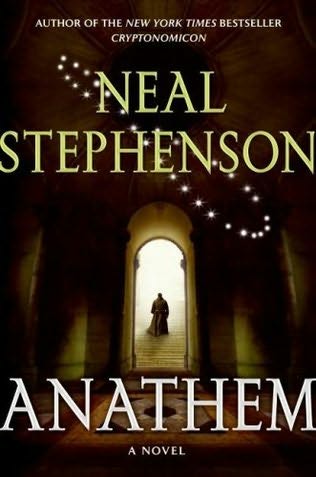
...asks an unnamed Time reviewer on the back of Neal Stephenson's Anathem. The reviewer continues:
Please."It has morphed into science fiction, and Stephenson is its foremost practitioner."
Count on Time to miss, for decades, the fact that science fiction has been the literature of ideas for more than a century, and then suddenly discover it and proclaim it to the nations. (And yes, there have been great novels written in the genre, and a great many with interesting ideas but less literary merit.)
But said reviewer is right about Stephenson. The man is amazing. He latches onto interesting scientific ideas and historical phenomena, absorbs vast amounts relevant information, transforms it into exciting literary conflicts and characterizations, and spits out 1000 page books of great merit. On a routine basis. Hugo Gernsback, the early 20th century pulp magazine editor who tirelessly beat the drum for science fiction as the only suitable literature for the modern age, might not have been thinking of Stephenson, but in some ways Stephenson is a perfect science fiction writer, if you are willing to take on the challenge of wrestling with real ideas and how people deal with them. Stephenson's people are real enough to keep you engaged, and the ideas are cosmic.
A friend on Facebook was lamenting that there isn't much of a market for "stimulating religious and philosophical cliff-hangers." I was pleased to be able to tell her that she was wrong. You could hardly come up with a better description of Anathem; and since my correspondent has picked up the book just by coincidence, she is in for a treat. Alien monks, cloistered so that they can safely pursue the philosophical nature of the universe without blowing up their planet; then called forth to prevent somebody else (a group that includes us!) from blowing up the planet; with all the action framed by and motivated by millennia of debates about the nature of reality. And they are real debates that have actually taken place in our real intellectual history, which continue today as philosophers and scientists play for the highest stakes. There is nothing fake about this story. You can see our present and our past on practically every page.
I have to admit a certain jealousy of Neal Stephenson, based on a series of novels he has written about 17th century Europe. Having taught that era more than a few times, I reflect on the contrast between studying up on a fascinating time in history and creating fascinating novels about it, and studying up and producing a year-long course for undergraduates. Well, we all do what we can. And I'm glad that Neal Stephenson can do what he can do, and that he can get his stuff, eccentric as it is, published and appreciated by reviewers. That way, I get to read it.
Update: If you know the book, go see this. Or even if you don't.
Tuesday, May 04, 2010
Frederik Pohl on Jack Vance
One classic SF writer (and editor) reminisces about another: one of my favorite writers, Jack Vance.
Tuesday, March 02, 2010
Steampunk

Here is a nifty article at the Smart Set, via the League of Ordinary Gentlemen (how appropriate!).
Image: Extraordinary gentlemen/woman.
The aesthetic movement Steampunk wants to bring the wonder back into our relationship with machines. Its tack is to fully embrace (and affect) an Edwardian orientation to the world. Though Steampunk has been a growing cultural trend for a few decades, it really came into its own in the aughts and is now a full-fledged phenomenon. Steampunks dress like the Wright Brothers and Arctic explorers. They write alternate history fantasies in which alien clones ride around in dirigibles by the light of gas lamps. Steampunks are fascinated by mechanics, and Steampunk art, jewelry, and fashion often involve gears, wheels, pulleys, and, of course, steam: a laptop computer fused with a rickety typewriter; an arcade game redesigned to look like a mini-submarine. What most defines Steampunk as a culture, however, is attitude. The “punk” in Steampunk confronts technology's alienating qualities with messy DIY defiance. The “steam” (besides its literal connotations) is almost like another word for magic: brute, utilitarian contraptions powered by clouds, and breath — ephemeral energy.
Steampunk tries to capture that Edwardian moment when steam power still ruled and the romance of technology lay precisely in the line it toed between destruction and possibility. Equally fascinated by flying machines and trench warfare, Steampunk is both optimistic and nihilistic. I like to think of this attitude as Gleehilism. It's this Gleehilism that makes Steampunk one of the defining aesthetic movements of the early 21st century.
Subscribe to:
Posts (Atom)