Showing posts with label favorites 2014. Show all posts
Showing posts with label favorites 2014. Show all posts
Tuesday, December 30, 2014


Sunday, August 17, 2014
A human kaleidoscope
People who wish to introduce medieval dancing into the SCA have a real problem – almost all of our documentation for dances done in the medieval period actually come from late in the Renaissance. Some people who want to dance often use other styles as inspiration, in particular in English country dancing. Once you get past the anachronism here, there's a lot of fun to be had doing known country dances or choreographing new ones.
One member of the SCA, known in it as James Blackcloak has created several new country dance inspired choreographies. Some of them are on YouTube. For your enjoyment, I direct you to this one, entitled St. Paul's Cathedral:
One member of the SCA, known in it as James Blackcloak has created several new country dance inspired choreographies. Some of them are on YouTube. For your enjoyment, I direct you to this one, entitled St. Paul's Cathedral:
Sunday, July 06, 2014
Another answer -- Shevek speaks
Shevek the anarchist from another planet speaks to the dissatisfied people of the homeworld:
It is our suffering that brings us together. It is not love. Love does not obey the mind, and turns to hate when it is forced. The bond that binds us is beyond choice. We are brothers. We are brothers and what we share. In pain, which each of us must suffer alone, in hunger, in poverty, in hope, we know our brotherhood. We know it, because we have had to learn it. We know that there is no help for us but from one another, that no hand will save us if we do not reach out our hand. And
the hand that you reach out is empty, as mine is. You have nothing. You possess nothing. You own nothing. You are free. All you have is what you are, and what you give.
I am here because you see in me the promise, the promise that we made 200 years ago in this city – the promise kept. We have kept it, on Anarres. We have nothing but our freedom. We have nothing to give you but your own freedom. We have no law but the single principle of mutual aid between individuals. We have no government but the single principle of free association. We have no states, no nations, no presidents, no premiers, no chiefs, no generals, no bosses, no bankers, no landlords, no wages, no charity, no police, no soldiers, no wars. Nor do we have much else. We are sharers, not owners. We are not prosperous. None of us is rich. None of us is powerful. If it is Anarres you want, if it is the future you seek, then I tell you that you must come to it with empty hands. You must come to it alone, and naked, as the child comes into the world, into his future, without any past, without any property, wholly dependent on other people for his life. You cannot take what you can have not given, and you must give yourself. You cannot buy the Revolution. You cannot make the Revolution. You can only be the Revolution. It is in your spirit, or it is nowhere.Ursula K. LeGuin, The Dispossessed
Saturday, July 05, 2014
Charny's answer
People who know my scholarly work on the writings of Geoffroi de Charny, a fourteenth century knight, may associate me with "Charny's questions," a set of hypothetical problems related to "the law of arms" meant to be analyzed by knights, squires and "men at arms" so that they would be better prepared to relate with other aristocratic warriors.
Charny's questions are unanswered.
But if you want his answer to the problems of the life of arms, consider this from Charny's Book of Chivalry:
Charny's answer?
Charny's questions are unanswered.
But if you want his answer to the problems of the life of arms, consider this from Charny's Book of Chivalry:
[T]hose who have the will to achieve great worth [who] because of their great desire to reach and attain that high honor … do not care what suffering they have to endure, but turn everything into great enjoyment. Indeed, it is a fine thing to perform great deeds, for those who rise to great achievement cannot rightly grow tired or sated with it; so the more they achieve, the less they feel they have achieved; this stems from the delight they take in striving constantly to reach greater heights. And great good comes from performing these deeds, for the more one does, the less one is proud of oneself, and it always seems that there is so much left to do.
Charny's answer?
Monday, June 02, 2014
Monday, April 14, 2014
How useful was heavy cavalry in the Late Middle Ages?
According to the Chronicle of the Good Duke, written in 1429 but talking about events about twenty years earlier, Duke of Brittany looked across a battlefield at the troops led by the Constable of France, the Lord of Clisson, and reacted as follows:
And the Constable Clisson, who was a valorous knight of bold enterprise, went boldly from his siege with his men arranged to give battle to the Duke if he dared to wait. And the Duke of Brittany seeing the battle order of the Lord of Clisson, told his men “My lords and companions, see Clisson there has arranged his companies and desires nothing but battle? I would not refuse that at all willingly but I see that he has arranged a great wing of his men who are mounted on great coursers of superior quality. Our horses are small; and those who are over there will come charge us and we will not be able to withstand them; and things will be the worse for us.” For this reason the Duke retreated that day with his men ...
Sunday, March 30, 2014
End of winter troubadour poetry
| Very happily, I begin to love a joy from which I will have more pleasure; and, since I want to be back to joy I well ought to, if I can, aim for the best; since I love the best, without doubt, that one could see or hear. I (you know as much) should not brag nor dare I praise myself much; but if ever could one joy blossom, this one should above all take roots and shine above all others just as the day turns brighter. And never could anyone portray it for in want nor wish nor in though nor in imagination such a joy can't find an equivalent; and if one wanted to praise it properly, he couldn't do it in a year. Every joy must lower itself and all royalty obey my lady, because of her kindness and of her sweet pleasant visage; and he will live a hundred times longer who can partake of her love. Because of her joy can the sick turn healthy and because of her displeasure can a healthy man die and a wise man turn mad and a handsome man lose his beauty and the most courteous turn into a lout and the most churlish turn into a courtier. Since nobody can find a worthier woman nor eyes see one, nor mouth describe one, I want to keep her all for me, to bring freshness to my heart and to renew my flesh, so that it cannot grow old. If my lady wants to grant me her love, I am ready to receive it and to reciprocate I am ready to discretion and cajoling and to say and do what she pleases, and to keep her worth into account and to further her reputation I don't dare communicate by proxy, so much I am afraid to anger her; nor I myself, so much I am afraid to fail, dare declare my love precisely; But she ought to choose what is best for me because she knows that I shall be saved through her. |
Guilhen de Peiteus
Sunday, March 23, 2014
Wrapping up a seminar on chivalry

This year I once again taught a fourth-year undergraduate seminar on chivalry. Since it is quite possible that I may never teach it again, I am glad to say that it was a particularly satisfying iteration of the course. Below you will find one student's concluding thoughts. It may give you an idea of how happy I am, and why.
Chivalry
Culmination
by Elisia Evans
by Elisia Evans
Throughout
this course my understanding of chivalry has developed and changed regarding
the new information that was introduced to our class. As new material was introduced I asked myself
new questions about the topic and eventually landed on a conclusion that
encompasses a variety of sources that were studied in class. I have come to see
chivalry as a combination of the ideas I developed on the subject throughout
the course.
At
the beginning of the course I presented my ideas of chivalry as relating to the
daring hero of Hyrule, Link, and the steadfast honour and sense of duty of
Brienne of Tarth. To my understanding of the time chivalry was a term used to
describe the traits of these two characters: dutiful, honourable, reliable, and
brave. To pledge fealty and keep it, or
to embark on quests at great personal risk, were examples of chivalrous
behaviour. As far as I was concerned at this stage of my understanding of
chivalry, this was the extent of the meaning of the word.
After
reading Charny and Lull at the beginning of the course I was introduced to the
true complexity of the idea of ‘chivalry’. Charny’s A Knight’s Own Book of Chivalry was one of the most valuable
sources we explored in this course because it provided a decent foundation for
an accurate understanding of this elusive concept. Charny introduces a much
more serious and professional definition of chivalry. He outlines the different
types of knights and the different methods they might use to gain prestige in
their knightly tasks. He often declares that “he who does best is most worthy
(Charny 52)” and constantly asks these men to do more. This is extremely
demanding considering how difficult being a mediocre knight would be, let alone
one that meets Charny’s crazy standards. There is also an entire section
devoted to the discouragement of physical pleasure entitled “A Good Man-at-Arms
Should not Pamper his Body (68)”. This passage denies knightly men even soft
sheets on their beds. The message I took away from Charny was that being a good
knight sucked but was apparently worth it for the reputation and honour with
which it is associated. Lull’s book The
Book of the Order of Chivalry explained to me that these self-torturing men
at arms were part of an ‘order’. This was important to my understanding of
chivalry because it introduced the idea of chivalry being a type of legitimate
profession or club. At this stage in my understanding of chivalry I was not
sure who would ever in a million years want to attempt to meet Charny’s
standards and enter into the world of ‘chivalry’.
The
identity of these men was soon illuminated by Duby’s article, “Youth in
Aristocratic Society”. This was one of the most valuable sources for my
academic understanding of knights, as well as a personal favourite. This article
explained that knights were often the second sons of wealthier families and
could not inherit land and thus had to make their own way in the world. For
entertainment and a chance at a future they wandered around getting into
trouble and fighting one another. These men developed into professional
warriors, embarked on crusades and fought in tournaments. This article explains
the origins of the men who are expected to dedicate themselves to the ideas
proposed by Charny. My ponderings concerning the employment of these men was
answered by our studies of jousts, challenges, and warfare. The literature
concerning knights, such as the stories of Lancelot and Erec, gave me an
impression of how the public viewed these men at arms because this was the
media representation of chivalry to the literate populace. From these sources I
was able to gather the origins of knights and that they were typically
romanticized and respected because of their valiant deeds of arms and reputed
honour.
After
learning about the relationship between knights and civilians I was completely
surprised. During the 100 years war, on which I found Knights and Peasants to have been a valuable read, men at arms were
reported to have taken part in some bad behaviour. Fields were burned, cities
were sacked, and non-combatants were forced to participate as a means of
survival. This blurred the idea of chivalry in my eyes. In his book Wright points out that only a
small number of the men at arms participating were actually members of the order
of chivalry. This does not ease my mind because in Gillingham’s article on
William the Marshal he describes the role of chivalry in warfare as being
selected and somewhat diluted. There does not seem to be much room for an
honour code when one is fighting for his life. However, I have deduced that
Chivalry’s role in warfare was to ensure safe ransoms. Knight’s would only
willingly surrender to other gentlemen and would then be ransomed back to their
king. It seems to be that at this moment
men at arms remembered the rules with which they so strongly abide during
peace. My overall conclusion, although incomplete at this time, was that
Chivalry was a pipedream; people saw its value much more in theory than in
practice.
The
final development of my idea of chivalry brought all of this together. I
settled on the idea that knights had unrealistic expectations put on them by
men like Charny and their adoring public. I now see chivalry as the equivalent
of a gentlemen’s club; select members, large egos, a great deal of games
played, and not much accomplished. I also believe that chivalry is swept under
the rug during war, especially a war as frustrating and confusing as the 100
years war. However I would like to point out that in the document on jousts
during a peace period there was a great deal of tournaments hosting chivalrous
behaviour which shows the drive to remember chivalry as soon as the fighting
subsides. In modern day warfare there is not much difference, soldiers forget
their restraint and sometimes their morality while they are at war. In
conclusion knights were real men who sometimes did not match up to the idea
presented by Charny and the authors of the Epics read in class. I think this is
why the idea of chivalry is so hard to place.
Friday, March 21, 2014
The meaning of chivalry
If you are a serious student of history, paid or unpaid, it sometimes comes as a shock to realize how little other people know about the problems and eras that you find fascinating, or the amazing misconceptions they sometimes have.
This school year I have been teaching a fourth year seminar on chivalry, and I started out the course by asking the students to characterize or define chivalry, not so much in a formal definition sense, but by relating the concept to stories, symbols, or analogies. At the end of last month I asked them as the seminar started winding down, to tell me what they had learned about chivalry, and what sources in particular had shaped their current view.
I wasn't really surprised to see three of the students talk about chivalry as courtesy as the view that they started out with. But still, look at this:
This school year I have been teaching a fourth year seminar on chivalry, and I started out the course by asking the students to characterize or define chivalry, not so much in a formal definition sense, but by relating the concept to stories, symbols, or analogies. At the end of last month I asked them as the seminar started winding down, to tell me what they had learned about chivalry, and what sources in particular had shaped their current view.
I wasn't really surprised to see three of the students talk about chivalry as courtesy as the view that they started out with. But still, look at this:
Prior to taking this class, it would suffice to say, I knew next to nothing about the concept of chivalry, except for within the context is used today.… My understanding of chivalry was limited to the concept of acting in a polite fashion, holding doors, surrendering the shotgun seat of a vehicle etc. I wondered how an entire class could be devoted to the study of "being polite."There you are.
Wednesday, March 12, 2014
Lawrence Martin on the history of Canadian democracy
Canada’s forgotten independence day
March 11, 1848, was the day when Canada’s united colonies got responsible government. You might go so far as to call it our independence day – the day real democracy arrived.
It followed decades of struggle against British rule, the rebellions of 1837 and 1838 being foremost examples. Power passed from colonial elites to citizens when a Reform government headed by Louis-Hippolyte LaFontaine and Robert Baldwin was sworn in that day by governor-general Lord Elgin. The Reformers had won an election over conservative forces aligned to the monarchy.
Baldwin and LaFontaine, leaders of the territories now known as Ontario and Quebec, convinced their colonial masters that allowing power to reside with an elected assembly instead of a governor’s appointed executive council was the only way to stave off anarchy.
In the context of times, of so many countries seeking and failing to establish democratic systems, it was a remarkable achievement. We were “almost first out of the modern democracy gate,” writes John Ralston Saul in his book on LaFontaine and Baldwin. While you probably wouldn’t want to high-five our democracy today, given what it has become, we were trailblazers back then.
Europe-wide democratic revolutions marked 1848. Counterrevolutions followed shortly thereafter, and one was ignited in Canada. In 1849, reactionary mobs burned down the parliament buildings, then located in Montreal. But LaFontaine and Baldwin handled the crisis in a spirit of conciliation and compromise, as they had in bringing their culturally divergent provinces into union years earlier.
No such spirit prevailed in the United States, which was on the road to civil war, or in European jurisdictions where upheaval would mark the road to democratic legitimacy and world wars would be triggered.
The model put in place in our colonies was sound enough to endure through time with minimal politically inspired violence and bloodshed. The Baldwin and LaFontaine ministry decentralized power, establishing municipal governments. It brought in a modern legal and jury system and established secular public universities.
John A. Macdonald became our nation maker, as biographer Richard Gwyn calls him, but these men put in place the foundation. Lawyers by profession, they were not your typical win-at-all-costs politicians. Baldwin was a soft-spoken man who went about his work with a sunken heart. The pain at the loss of his adored wife at a young age never escaped him. But inescapable too was his devotion to the principles of democracy, social equity and justice. LaFontaine had that same commitment. He overcame strident opposition from francophone leaders in realizing his vision of a democratic union of the two cultures.
Not to be overlooked is Nova Scotia’s Joseph Howe, who secured responsible government for Nova Scotia two months earlier than Ontario and Quebec. His philosophy of governance paralleled that of Baldwin and LaFontaine. “The only questions I ask myself are, What is right? What is just? What is for the public good?” he said.
That’s a credo today’s political leaders would do well to heed. The responsible government fashioned in 1848 was primitive in many ways, but the form of democracy, in which the executive was controlled by the elected assembly, was a purer one than now. Now, the system is more akin to what existed prior to March 11, 1848, when the governor had all the power.
It’s all the more reason to remember that date, but we don’t. Academic David E. Smith notes in his book, Across the Aisle, that Canada’s contribution to responsible government used to be “a venerable theme in Canadian high school classes.” Sadly, he notes, that’s no longer the case.
Thursday, February 06, 2014
How time flies…
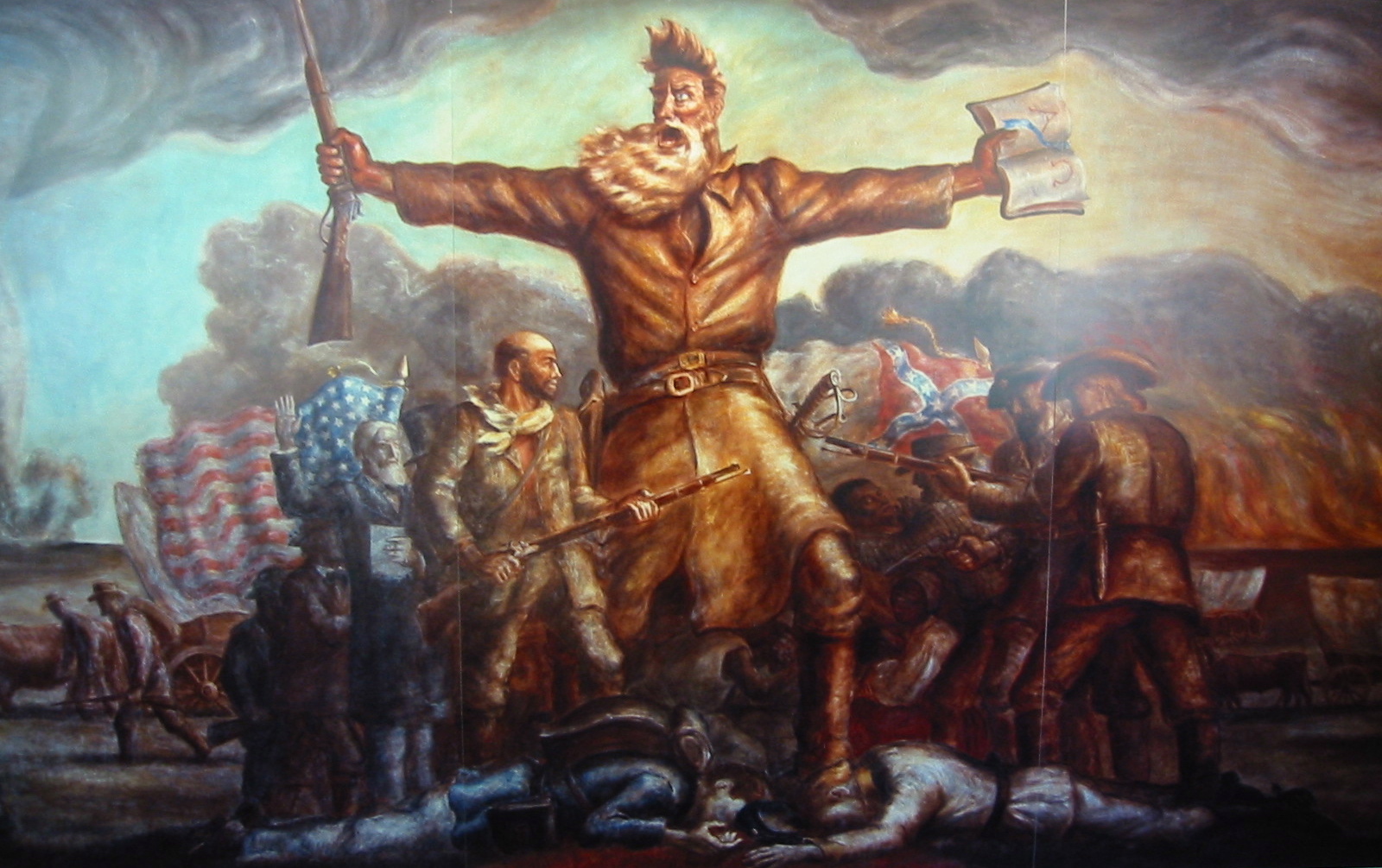
Our history grad students were presenting historiographical surveys of their major research papers to the members of the history graduate faculty. One paper was about the representation of the Vietnam War in comic books of the time. It turned out that I was the only person in the room who remembered the Vietnam War. Man, that was fast!
A student working on that project made the statement that it was one of the most important events in American history. I said, "Really? I was around back then and I don't think so. Yes it was important, but it was no Compromise of 1850."
Much mirth resulted.
You will wait in vain for a historian of modern times to make such a good witticism about the Middle Ages.
Image: John Brown at Harpers Ferry.
Sunday, February 02, 2014
Laura Kendrick on courtly love

From The Game of Love:
For Guillaume IX and his facetious troubadour followers, the stakes in the game of love were not the sexual favors of living ladies; Guillaume IX did not have to write poetry to get what he wanted from women, nor did other nobleman and courtiers. The object of the twelfth – century game of love was to win with words, just as the objective of medieval wargames was to win with weapons. The player's goal was not to win the lady, but to win the game, to conquer the masculine opponents. The secular domna presided as a figurehead (abstract, distant, absent) over the troubadours' vernacular language games in secular courts– much as her religious counterpart, the domina of Mary/Ecclesia, presided over the scholarly Latin language games of ecclesiastical schools and courts. To win the lady's favor, to rise in her esteem, to be desired by her: these are the nominal objects of most of the troubadours' verbal contests in the arenas of the secular courts. With nearly all games, however, the "material" prize of winning the game is, of itself, not worth the players' efforts; it is merely a symbol of the more intangible prize or pretz. Everyone knows the prize of the Olympics is not the gold– or the stamped gold medals. The real object of the troubadours' game of love was to assert personal prowess by wielding words to attack and destroy opponents' words, reversing or modifying their meaning by dismembering or "cutting them up" or by reframing and reinterpreting them in one's own new context....Marcabru played the facetious troubadours' debasing game on their terms, going them one "down," which only heightened the contest. Other ascetics – some of them monks, canons, and clergy – took a different, and ultimately more promising, tactic; they cleaned up the facetious troubadours' lyrics by interpreting them in a deliberately "good" way; they found sincere adoration of a lady or the Virgin to be the "true" object of the lyrics, however ambiguously expressed, and wove the facetious troubadours' phrases into the new context of their own "sincere" love lyrics. It's not at all inconceivable that Cercamon's lady in "Assatz es or' oimai qu'eu chan" was as Jeanroy once suggested, the Virgin. In all these cases, however, a contest is implicit in the language of the lyric, a debate between points of view that we sense, if at all, as ambiguity or equivocation.
Friday, January 31, 2014
Chivalry: the Combat of the 30 and an odd story from the Arabian tradition
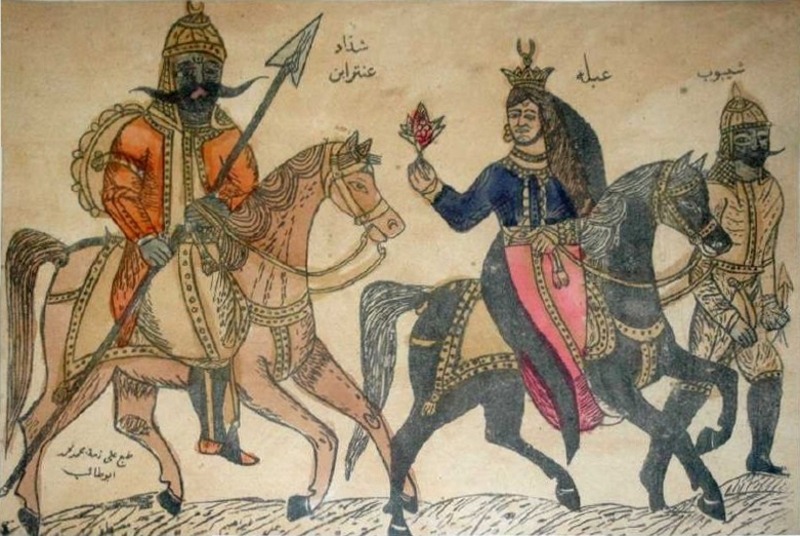
Today in my chivalry seminar we discussed the three most important accounts the Combat of 30 as found in my book of the same name. I started out by asking a general question about whether this was a chivalric deed of arms. One of my students launched into an enthusiastic affirmation. And you know what? He was taken by exactly the features of the deed that I think people of the mid-14th century most appreciated, in other words that it was a fair fight and no one ran away.
Just goes to show you.
A few days back another chivalric story swam into my ken, thanks to Phil Paine.
It is the Romance of Antar, derived from the poet Antar of the time of the Prophet, whose original poems were among the hanged poems in the Kaaba at Mecca. Students in my Islamic civilization course know Antar. Here's what Phil has to say about the later Romance of Antar and its significance.
Early Arabic literature is not well-known in the English-speaking world, and some elements of it might surprise someone who is only familiar with the stuff from later periods. Among the earliest works in Classical Arabic are a number of tales that can only be called “chivalric romances”, which strongly resemble the sort of thing you would expect in Malory or Chrétien de Troyes. What would most surprise a modern reader is the treatment of female characters.And what is that treatment, Mr. Bones?
There is much more and Phil gives an extensive summary.Here are some remarkable passages:Zahir continued his journey, until he reached the Saad tribe, when he dismounted from his horse. He was cordially received and was pressed to take up his abode with them. His wife was at that time soon to become a mother, and he said to her: “If a son is given to us, he will be right welcome ; but if it be a daughter, conceal her sex and let people think we have a male child, so that my brother may have no reason to crow over us.” When her time came Zahir’s wife brought into the world a daughter. They agreed that her name should be actually Djaida, but that publicly she should be known as Djonder, that people might take her for a boy. In order to promote this belief, they kept up feasting and entertainment early and late for many days.
About the same time Moharib, the other brother, had a son born to him, whom he named Khaled (The Eternal). He chose this name in gratitude to God, because, since his brother’s departure, his affairs had prospered well.
The two children eventually reached full age, and their renown was widespread among the Arabs. Zahir had taught his daughter to ride on horseback, and had trained her in all the accomplishments fitting to a warrior bold and daring. He accustomed her to the severest toils, and the most perilous enterprises. When he went to war, he put her among the other Arabs of the tribe, and in the midst of these horsemen she soon took her rank as one of the most valiant of them. Thus it came to pass that she eclipsed all her comrades, and would even attack the lions in their dens. At last her name became an object of terror; when she had overcome a champion she never failed to cry out : “I am Djonder, son of Zahir, horseman of the tribes.”
Thursday, January 09, 2014
"Oh, Sherlock, neither of us was the first."
I am astonished by the achievement that is the recent remake of the Sherlock Holmes stories set in 21st century London.
Arthur Conan Doyle's stories always were more than a simple recounting of the accomplishments of the scientific detective who is also, because of his great gifts, a complete social misfit. I am pretty sure that Doyle did not invent that figure. The stories gave almost equal prominence to John Watson, the normal and cheerful friend – normal and cheerful, that is, if you ignore his rather odd devotion to his apparently indifferent friend (?).
The current re-envisioning gives much more prominence to the theme of intimacy and the difficulties of achieving it – not just between Holmes and Watson, but between others as well. 21st century London is ostensibly much freer or at least more freewheeling than Victorian London. But despite social and sexual liberation, the characters in the series struggle to reach out to each other without exposing themselves too much. They are terrified of rejection, and this keeps them just as much on edge as we imagine their 19th century counterparts were.
There must be Holmes fans out there who are raging at this series and its betrayal of some aspect of the canon. But though I'm not entirely satisfied with the stories as told, my basic attitude is one of astonishment at the chances taken by the creators and their rather amazing degree of success. In the last quarter hour of the Sign of Three episode, I sat with my mouth hanging open and my breath bated waiting to see what would come next. And it was the emotional and social struggles of the characters that surprised and yes, ensorcelled me.
Subscribe to:
Posts (Atom)