Showing posts with label Christianity. Show all posts

Monday, September 12, 2016

Acts of the Apostles and the riots of the Roman Peace


I am currently reading the New Testament more or less in the order that it was written. I began with the Acts of the Apostles, which discusses the missionary efforts of Jesus's followers after his ascension to heaven. Taking the Acts as a historical document, I am very impressed by how chaotic social religious and political scene was in this era of "Roman peace." Many of you know that during this apostolic era was characterized by strong opposition to the new Christian movement by a variety of better established Jewish and Greek/Roman parties. It is remarkable how nervous the established powers seem to have been – how quickly they ran to the Roman authorities to denounce the new religious movement. There is a lot of actual fighting described or implied, and of course sometimes the opponents of the Christians got them imprisoned, beaten up, and murdered.

We have to wonder-- at least I do – whether the reaction by the established religious authorities was justified or completely out of proportion. Is there a big difference between these two alternatives? Either way it's not exactly happy days in the Eastern Mediterranean in the first century A.D.

You might well come away with a much more sympathetic understanding of Pontius Pilate, the Roman governor who did his best to stay out of the conflict between the established Jewish authorities in Jerusalem and Jesus's movement. It may have been commonplace to credit the Romans and their representatives with peace and reform, but if you were one of the governors mentioned in Acts, you probably felt that your office was like a wild horse, and you would be lucky to stay on it.

Sunday, June 28, 2015

What would Thomas Jefferson have said?

Today I took the time to watch Pres. Obama's eulogy all the way through. It certainly will go down as one of the great American speeches.

On the other hand, it felt odd to have the Emperor lecturing us on theology of Grace. If he had been talking about the evils of icons, just at the time when a caliphate is being established, we might have to wonder if we were on our way back to the 7th century.

Image: Paine, not Jefferson -- Mr. Age of Reason

Wednesday, February 18, 2015

The Crusades: defensive wars?

Recently experts on the Crusades have got a reasonable amount of press on whether the Crusades should be condemned or not. One statement made by several of them is that the Crusades were justifiable as defensive wars against Muslim aggression.

Iff you look at maps illustrating the course the Crusades, you usually will see a fairly clear back-and-forth boundary between Christian ruled countries and Muslim ruled countries.

Yet I have a hard time taking this argument all that seriously because I have my strong doubts that warriors in the 11th century, whatever the ethnic or religious background, cared whether or not a war was “offensive” or “defensive”.

If you look at the 11th century, the century that ended with the First Crusade, and you will find a large number of major wars that resulted in new rulers being imposed on the previous population, which sometimes practiced a different religion from the conquerors. Here is an incomplete list straight out of my head, done without referring to any reference works so there might be some mistakes. It is in roughly chronological order.


  • Conquest of England by Knut (Canute)
  •  Conquest of Norway by Canute
  •  Conquest of England by William
  •  Conquest of southern Italy and Sicily by various Normans
  • Conquest of Anatolia by the Seljuk Turks
  • Conquest of Central Spain by Castile
  • First Crusade


Similarities

  • It is extremely unlikely that any of the conquering armies saw themselves as ethnically or nationally unified. In some cases it is quite clear that they were ethnically heterogenous.
  • People were willing to travel long distances to take part in wars that might result in conquest. 
  • Also, it is pretty clear that warriors believed that if they were successful in their war they were entitled to all the wealth that they could confiscate, whether that might be lordship over wide territories for the highest ranking and most successful or whether it might be plunder, which just about everybody expected and hoped for.


Using this perspective, The First Crusade doesn’t seem to be all that different from the other wars listed here.

That doesn’t mean other reasons for wars were not present. William the Conqueror seems have considered himself to have been legitimately named as Edward the Confessor’s heir for the kingdom of England. Some of his followers may have gotten a bit of a thrill from fighting for the right of William to be King. But they did not go home after Hastings to sit around talking about how they had done the right thing. No, they got as much territory and profit out of William’s successful war as they possibly could. Also, the Pope did give William a papal banner to take to England as a sign of ecclesiastical support and a certain amount of religious justification was present in some of these other wars as well. Some people did go home after the first crusade and talk about how they done the right thing. But what plunder could be acquired was always part of the picture. It was a rare warrior – were there any? – who did not think that plunder was a legitimate source of profit in any war.

Visualizing these large groups of armed men roaming the countryside stealing stuff and conquering countries makes me sceptical that the big movements on the historical maps of the Crusades can be explained as “defensive wars.” Looking back over the larger sweep of history I wonder whether “defensive wars” were an important phenomenon in most people’s view of the world before the 20th century. Certainly professional warriors have tended to look at war as a normal part of life, not some terrible breakdown of society as many people feel today. Perhaps a dislike for war was stronger among non-warrior groups such as the peasantry or the clergy (especially monks) and of course large numbers of women. But among the people who led wars and fought wars, did they really think about offense or defence as an important category affecting their decision-making?


Wednesday, May 22, 2013

The Battle Hymn of the First Crusade


People often have a hard time seeing how the ethos of the Crusades can be justified in the light of certain seemingly pacifistic statements attributed to Jesus Christ in the Gospels.

Why not think about this in a different way by looking at a religiously inspired song of a more recent time?

Comments welcome. Do you find this strange, exotic, and if so why? Is this part of your personal cultural heritage? If you thought it was before you read all of the stanzas, what do you think now?

Mine eyes have seen the glory of the coming of the Lord;
He is trampling out the vintage where the grapes of wrath are stored;
He hath loosed the fateful lightning of His terrible swift sword:
His truth is marching on.
(Chorus)
Glory, glory, hallelujah!
Glory, glory, hallelujah!
His truth is marching on.
I have seen Him in the watch-fires of a hundred circling camps,
They have builded Him an altar in the evening dews and damps;
I can read His righteous sentence by the dim and flaring lamps:
His day is marching on.
(Chorus)
Glory, glory, hallelujah!
His day is marching on.
I have read a fiery gospel writ in burnished rows of steel:
"As ye deal with my contemners, so with you my grace shall deal;
Let the Hero, born of woman, crush the serpent with his heel,
Since God is marching on.
(Chorus)
Glory, glory, hallelujah!
Since God is marching on.
He has sounded forth the trumpet that shall never call retreat;
He is sifting out the hearts of men before His judgment-seat:
Oh, be swift, my soul, to answer Him! be jubilant, my feet!
Our God is marching on.
(Chorus)
Glory, glory, hallelujah!
Our God is marching on.
In the beauty of the lilies Christ was born across the sea,
With a glory in His bosom that transfigures you and me.
As He died to make men holy, let us die to make men free,
While God is marching on.
(Chorus)
Glory, glory, hallelujah!
While God is marching on.
He is coming like the glory of the morning on the wave,
He is Wisdom to the mighty, He is Succour to the brave,
So the world shall be His footstool, and the soul of Time His slave,
Our God is marching on.
(Chorus)
Glory, glory, hallelujah!
Our God is marching on.

What does it mean that the soul of time will be His slave?

Thursday, April 25, 2013

Painting world religions in broad strokes


Just about every day my first read is Juan Cole's blog Informed Comment. Cole is a historian of the Middle East and has taken it on as his personal duty to comment every day on important issues. When it comes to the Middle East and Islam, you can hardly have a better source.

Today Cole posted one of the best things he has ever written, a response to another blog in which the claim is made that Islam is uniquely violent, and that there is a big difference between the Christian approach to worldly power and the Islamic one.

What Cole says here corresponds to my own understanding of the relationship between the formal doctrines of religion, what the founding documents say about it, and what people actually do in the context of their religion. My own understanding results from reading about 20 years ago a short world history of Buddhism, in which it was sufficiently demonstrated to me that just about any thing that could be called Buddhism had been called Buddhism, including the interesting notion that no one should be a monk and everybody should be married and that was true Buddhism. I concluded from that experience that if a religion wants to be more than just a local cult in an isolated village, it will have to diversify and eventually become a single religion in name only.Further, that if you really want to understand what a given religion means in a given context studying Scripture and theology will not do the trick.

Cole provides us today with a detailed discussion of Christianity and Islam in regards to their promotion of violence or their relationship to political power. I am giving an extensive excerpt here but there is quite a bit more and all of it good.

Jesus and Muhammad and the Question of the State
Posted on 04/25/2013 by Juan Cole
I’ve always liked Andrew Sullivan even when I disagree with him. I’m going to disagree with him, or more specifically Alexis de Tocqueville and one of his readers who quotes him:
“Muhammad brought down from heaven and put into the Koran not religious doctrines only, but political maxims, criminal and civil laws, and scientific theories. The Gospels, on the other hand, deal only with the general relations between man and God and between man and man. Beyond that, they teach nothing and do not oblige people to believe anything. That alone, among a thousand reasons, is enough to show that Islam will not be able to hold its power long in ages of enlightenment and democracy, while Christianity is destined to reign in such ages, as in all others.”...
You can’t compare Christianity and Islam on the basis of this kind of characterization of the founders of the two religions. The characterization is in any case unfair (the New Testament texts imply just as many ‘scientific principles’ as does the Qur’an, e.g. They think the world has three levels, that there are demons and angels, etc. etc.)
First of all, we know very little about the lives of Jesus (d. circa 30-33 CE) or Muhammad (d. 632 CE). ...
 The idea that, as de Tocqueville alleged, very early Christianity made no doctrinal demands about the relationship of the believer to power is not clearly in evidence. Take St. Peter (2 peter 2:1-2:17: “But false prophets also arose among the people, just as there will be false teachers among you, who will secretly bring in destructive opinions.”) Wouldn’t that be a community problem that would have to be dealt with collectively? Also very surprised by this allegation would have been the masses of Christians killed by Christian states for being heretics. And, just for instance, Charlemagne had 4500 Saxon followers of Woden (you’ve all seen the movie Thor) beheaded in 782 because they wouldn’t accept Christianity. That is a lot of heads to be lost to a religion that makes no power demands. Not to mention that modern Christian fundamentalism has cleverly found ways of re-importing selective legal injunctions from the Hebrew Bible into Christianity.
...
The Qur’an, contrary to what some researchers such as John Wansbrough suggested, seems to be pretty well attested as an integral text fairly early on, maybe even better attested than the entire New Testament in the first century after its composition. The sayings attributed to Muhammad were not collected and written down for some 200 years after the Prophet’s death, and I personally don’t consider many of them historically reliable.
The New Testament picture of Jesus is full of contradictions. At some points he says to turn the other cheek and forgive enemies. At other points he says, “I come not to bring peace but a sword” (Matthew 10:34). Scholars have wondered if Jesus was a Zealot, a highly political and revolutionary movement. Or was he a mystic similar to those who wrote the Dead Sea Scrolls? Frankly we have no idea whether he intended to build a state or not... No two academic books I’ve ever read on the life of Jesus and early Christianity have agreed about these issues.
 Even if Jesus really was an apolitical pacifist, only a tiny number of Christians in history has ever agreed with him about that. Even if his statement about rendering to Caesar implied a separation of religion and state (unlikely), most Christians in history haven’t been willing to do that....
So these ideas in very early Christianity are anyway irrelevant to practical politics in later Christianity, which saw all kinds of political arrangements...
As for Muhammad, it is not entirely clear what his position was in Medina. He is often depicted as a theocrat. But it appears from the Qur’an that when he first went there in 622 he was more like a community organizer, balancing the needs of the Muslim, Christian, pagan and Jewish communities in the area. The stories of how he allegedly fell out with the Jews there are very late and have been questioned by some scholars. The view of him as a kind of king could well be a projection back on him by later writers of the Umayyad and Abbasid dynasties, after forms of Muslim kingship and empire had emerged. Common assertions that the Qur’an disallowed paganism or allowed aggressive war on pagans are not borne out by the Qur’an. There is, contrary to de Tocqueville, very little law or politics in the Qur’an.
Much of fundamentalist Muslims’ ideas about religion-state relations are shaped by the Hadith literature, the oral sayings and doings attributed to the Prophet, which, as I said, were collected centuries after his death and I doubt most academic historians would consider them reliable. (I know saying so will offend some of my readers, but, well, I’m a historian.) ...
As with Christianity, there are almost no forms of political organization Muslims haven’t tried out, from monarchy to republic, from anarchism to democracy. So all those laws and political principles in the Hadith haven’t actually been determinative. Contemporary Muslim fundamentalism does dream of using them as a blueprint, but since that enterprise isn’t actually practical, they don’t get very far. Even Iran and Saudi Arabia are mostly governed by modern bureaucratic rationalism of a sort Max Weber would readily recognize.
...
Contrary to what de Tocqueville imagined, the Muslims have been just as adaptable as Christians to the main forms of social organization that came out of the Enlightenment. He was writing at a time when many Muslims lived under the Ottoman Empire, which seems to have shaped his image of the religion. Somehow Islam has handily survived the Ottoman demise. And what de Tocqueville rather dishonestly did not bother to mention was that Christianity has had just as much trouble with those principles as Islam has. There was that little Syllabus of Errors when the then Pope condemned democracy, popular sovereignty, separation of religion and state, scientific rationalism, etc. Later Popes even tried to prevent Catholics from voting in elections because democracy was considered a modernist heresy. As late as Franco’s Spain, the Spanish church was a pillar of dictatorship. Eventually the church made its peace with democracy (partly through Vatican II, which largely repealed the Syllabus of Errors). Islam is likewise coming to terms with democracy, however contentious and uncertain that process has been (Indonesia, Turkey, Tunisia, etc. etc.)
Many 19th century Christians imagined that Islam was on its last legs and that all the Muslims would convert to Christianity. They thought the same of Hinduism and Buddhism. They mostly were very wrong. De Tocqueville’s arrogance and simplistic view of the original ‘essence’ of the founders of the two religions was a profound set of errors. In fact, by the end of this century, some 30% of the world could well be Muslim, whereas Christianity will likely be a shrinking proportion of humankind, just for demographic reasons. Not to mention that most “Christian” countries contain pluralities of non-religious people. Many, such as Sweden or Eastern Europe, have non-religious majorities. Significant proportions of Turks, Tunisians, Uzbeks, etc. in the Muslim world also report that they aren’t interested in religion.
It is not impossible that modern consumerism, individualism and technology might gradually undermine religion, so that 200 years from now neither Christianity nor Islam will be central to most peoples’ lives.
So, a) Muslims aren’t more prone to violence or terrorism than members of other religious communities because of the character of very early Islam and b) you can’t read off the differences between Christians and Muslims from a superficial depiction of the two founders.   

Sunday, May 27, 2012

The Crusades and the Christian World of the East: Rough Tolerance, by Christopher MacEvitt. Another good one

Christopher MacEvitt's book has a certain resemblance to Giancarlo Casale's book on Ottoman exploration. It's about an important, difficult subject; it goes against the prevailing wisdom; and it is based on difficult research in fragmentary sources.

MacEvitt presents  the prevailing wisdom  about relations between Western Christians settling in the holy land and the Eastern Christians who already lived there, thus:  as a case of colonial segregation. There are not a lot of sources that discuss the legal situation, how legal doctrines actually worked, or how Eastern and Western Christians interacted in daily life. The sources we do have come from the 13th century, after the restoration of the kingdom of Jerusalem following its destruction in the 1180s. MacEvitt has returned to the 12th century, and done his best to find the real story of daily life in charters and, in the north where Armenian documents exist in some numbers, chronicles, to see whether different Christian groups actually lived strictly segregated.

Well of course, he concludes that 13th century evidence gives a false picture of the earlier era. In contrast to the effort by churchmen and legislators to classify people by ecclesiastical and even Christological criteria, the early crusader states were characterized by an effort to obscure the dividing lines. Although there was a strong argument for giving priority to the person's ecclesiastical allegiance in legal and status matters, MacEvitt portrays a society where most people did not want to live in religiously-defined silos. They wanted to have a certain degree of freedom of association, and there was a consistent effort by documented individuals to make sure that they were not pinned down against their will. That does not mean that everybody loved everyone else or that some groups were not more important than others. That's the rough in "rough tolerance."

 Over the last year the situation in Syria has made me realize how very diverse the country is even now. Sometimes the divisions– religious divisions – between Syrians don't matter very much, and other times you are forced to pick a side, generally one chosen for you by unsympathetic neighbors.  And then you fight till everybody's tired of fighting, or one group establishes a short or long-term supremacy. It looks to me like during the crusading times, things were not that different.  Except in the 12th and 13th century, there was always some Frank or Turk or Egyptian or Byzantine showing up to claim the land and the holy places. But if you look back a century or so and realize that Syria not so long ago included Lebanon, Jordan, and Israel, then maybe that difference disappears, too.

Update:  can sectarianism be discussed in today's Syria?  Should it?  From Ehsani at Syria Comment:

This is what a Syrian commentator wrote on one of the social media outlets this morning:
“Anyone that mentions the name of sect or religion in Syria, in any context, and all those who incite sect or religion in Syria, in any context and all those who try to show a range as a victim and a look executioner in any context is a traitor to Syria and Syria is innocent of it. All intolerance for other than Syria is betrayal. Martyrs have one religion and one sect and that is Syria. Blood flowing on the soil of Syria have a single identity and that is the identity of Syria.”
كل من يذكر اسم طائفة أو دين في سوريا بأي سياق و كل من يحرض على طائفة أو دين في سوريا بأي سياق وكل من يحاول أن يظهر طائفة بمظهر الضحية و طائفة بمظهر الجلاد بأي سياق هو خائن لسوريا و سوريا بريئة منه فكل تعصب لغير سوريا قدس الأقداس خيانة.
للشهداء دين واحد و طائفة واحدة هي سوريا فالدماء التي تسيل على تراب سوريا لها هوية واحدة هي الهوية السورية
While it is hard to argue with pleas to ignore religious and sectarian tendencies that may incite more killings and hatred, ignoring the obvious demons we face does not strike me as a credible solution.
It should be obvious to all of us by now that fake stability is an unsustainable model that is unlikely to last for long. Societies cannot advance and prosper unless they openly face their demons and discuss their long held taboos.
I, for one, want every Syrian to openly discuss everything that ails our society. This covers the role of religion and sectarianism.

Image:  Not St. George; St. Sergios.

Monday, November 07, 2011

The situation of Arab Christians


Daniel Philpott:
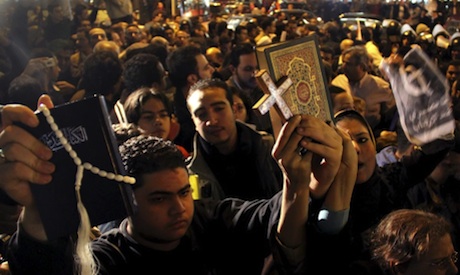
A tense subplot of the Arab Spring is the increasing endangerment of the region’s Christians. In Egypt, Coptic Christians, 10% of the population, have been attacked repeatedly by Salafist Muslims unleashed – many literally released from prison -- by the fall of President Hosni Mubarak. No wonder that Christians in Syria now fear their fate at the hands of the country’s Sunni Muslim majority should President Bashar al-Assad’s government fall.
The experience of Christians in Iraq is hardly encouraging, either. The kidnapping and murder of Chaldean Catholic Archbishop Paulos Faraj Rahho by Muslim militants in early 2008 is emblematic of what Iraq’s Christian community has suffered since the fall of Saddam Hussein. The population of Iraqi Christians has declined from around two million to around 400,000 since the Gulf War of 1991, which weakened Hussein’s rule. Under the dictatorships of Mubarak, Assad, and even Hussein and Qaddafi, all of them unsavory to be sure, Christians enjoyed relative security, though it was sometimes bloodily interrupted and usually attended by pervasive social discrimination. Arab authoritarianism was a leaky shelter but it was nevertheless a roof over their heads.

But however dangerous Arab Christians’ fate now may be, going back to the good old days of dictatorships is not an option. The surge of democracy-demanding youth, popular impatience with corruption and economic stagnation, and a religious reawakening over the past generation all serve to block such a backslide. Of course, for other minorities and for Muslims at odds with their regimes, the good old days were not good at all. They were not good for the residents of Hama, Syria, 10,000 of whose inhabitants were murdered by the current president’s father, Hafez al-Assad; and they are not good for protesters of the son’s dictatorship, over 2900 of whom the regime has killed by now. They were not good for democracy activists or traditional Muslims in Egypt, over 20,000 of whom Mubarak held in his jails. Arab authoritarianism was a model that could not last. Apart from suppressing the dynamism of democracy and the free market, such regimes were repressively secular, creating legions of religious discontents and radicalizing traditional Muslims, often in the direction of violence. Ultimately this shelter for Christians proved to be not only leaky but rotten at its foundations.

The position of today’s Arab Christians is indeed precarious. Among the possible outcomes, Islamist regimes that afford Christians little freedom to practice their faith or participate in politics are entirely plausible. But this outcome is far from inevitable, no more inevitable than was the persistence of dictatorship. Only this past week, elections in Tunisia, the country that ignited the Arab Spring, gave a plurality of votes to an Islamic party, but one that is relatively liberal and that will rule in coalition with non-religious liberal parties. In Egypt, too, the possibilities are more complex than secularist safety and Salafist violence. When Christians are attacked it is not always at the hands of Muslims. The shooting of Christian demonstrators in Cairo this past October 9th was carried out by the army. When Muslims have attacked Christians, far more have defended them. Just after Muslim terrorists slaughtered 25 Coptic worshippers and injured some 100 others in Alexandria on New Year’s Day of this year, thousands of Muslims across the country gathered in candlelight vigils and formed human chains around Coptic churches during worship. Today, Egyptian Muslim office-seekers are divided among proponents of a strongly Islamic state and supporters of liberal rights, including religious freedom for Christians. The scenario of religious freedom, then, is plausible, too.
He goes on to discuss what outsiders might do to help.

Image: Egyptian Christians celebrating Easter.

Friday, March 18, 2011

Do we still want to be fighting the Crusades?


CHAPEL HILL -- During a visit to the Oakbrook Preparatory School in South Carolina last month, Rick Santorum, the former U.S. senator from Pennsylvania and a 2012 Republican presidential hopeful, fired a salvo against "the American left," this time for its failure to understand the crusades and its hatred of Christendom.
"The idea that the crusades and the fight of Christendom against Islam is somehow an aggression on our part is absolutely anti-historical," Santorum is quoted as saying. "And that is what the perception is by the American left who hates Christendom. They hate Christendom. They hate Western civilization at the core. That's the problem."
The ridiculousness of playing the blame game for the crusades more than 1,000 years after the fact should speak for itself. Santorum, however, is not the first person to evoke medieval holy wars as part of a "Clash of Civilizations" between Islam and the West. Especially since 9/11, fear-mongers have darkly proclaimed that the crusades provide a history lesson about the age-old and inevitable struggle between Christians and Muslims.
Santorum's defense of the crusades echoes others who insist that Muslim aggression, including the seizure of Jerusalem in the seventh century, demanded an armed Christian response. By calling for the First Crusade in 1095, Pope Urban II declared a Just War for the protection of Christians and the recovery of what rightfully belonged to them. (Never mind the fact that Muslims had ruled over the Holy Land for more than 400 years by that point, longer than the United States has been in existence.)
It is hardly "anti-historical" to see that both Christians and Muslims perpetrated horrible acts of violence in God's name during the era of the crusades. Ironically, Santorum himself sounds like medieval popes who described the world as one of "Christendom versus Islam" to rally their supporters.
In his sermon that launched the crusades, Urban roused listeners to action by describing alleged crimes against Christians by Muslims, including the slaughter of pilgrims, the rape of virgins, the defilement of churches and other unspeakable acts - many of which were exaggerated or fabricated. One can almost hear him saying "you're either for us or against us."
Yet other popes maintained diplomatic relations with Muslim rulers. European merchants traded with Muslims in luxury goods and even weapons. Christian clerics engaged in religious debates with their Muslims counterparts. Crusaders negotiated truces with the so-called infidels, forging alliances with certain Muslim kingdoms against other ones.
Upon closer inspection, the world of the crusades, much like our own, breaks down into a constellation of individual and collective actions, political decisions and moral choices - relating to how people define themselves through their religious faith, as well as how they treat others who believe differently from them.
By accusing the American left of hating Christendom, moreover, Santorum identifies his real enemy, a fifth column who despise Christianity and Western civilization so much that they will even stoop to blaming Christian aggression for the crusades. In the same address, he also declared that the separation of church and state in the United States has had "disastrous consequences" for our nation.
Apparently, "the left" needs to realize that they are not living in a modern civil democracy, but in Christendom, facing the same enemies as the crusaders!
Here, we might draw a history lesson from the crusades. Despite their reputation for fighting Muslims, crusaders also turned their swords against other Christians, whom they defined as heretics. Santorum echoes these sentiments with his comments about the American left being the problem.
As the crusades teach us, when religion infuses politics, defining "us" and "them," swords (or in this case dangerous words) are invariably turned inward toward the enemy within.
Not to mention, implicit in Santorum's defense of the Christendom and the crusades is the sense that the crusaders left unfinished business for America to complete, a disturbing proposition that recalls the polemical language of the past that less responsible Christians and Muslims labored to create. That, Mr. Santorum, is "the problem."
In the light of recent developments, Santorum's priorities are (once again, he's done this before) amazingly misdirected.  Misdirected?  Rather, on target for a medieval holy warrior.

Image:  Pope Innocent III, who declared crusades on everyone he could think of, including Markward of Anweiler, "another Saladin" and "an infidel worse than the infidels."

Sunday, March 06, 2011

Bizarre news from the modern religion front

From the New York Times, news of an edition of the Bible annotated solely with C.S. Lewis quotations:
The Lewis Bible, available in cloth (18,000 copies sold since its November debut) or leather (6,000), shares a recycling genre with “A Year with C. S. Lewis,” a collection of 365 Lewis readings, which since 2003 has sold 200,000 copies.

The new Bible splices in quotations from Lewis’s books and unpublished papers. For example, in Genesis, next to the story of Noah’s drunkenness, appears an excerpt from a 1955 letter to one Mrs. Johnson. “One can understand,” it reads in part, “the bitterness of some ‘temperance’ fanatics if one has ever lived with a drunkard.” But, Lewis suggests, teetotalers are wrong if they write alcohol out of the Bible.

To the Book of Matthew, where Jesus denounces the outwardly but not truly religious, there is added a quotation from “Mere Christianity”: “How is it that people who are quite obviously eaten up with pride can say they believe in God and appear to themselves very religious?” They are “worshiping an imaginary God.”

Mr. Maudlin became an evangelical Protestant after reading Lewis in college. “But you meet Mormons or Catholics, and their favorite author might be C. S. Lewis,” he said.

One can understand Mr. Maudlin’s worries about marketing Lewis, who habitually overshadows books he loved, like the Bible. The problem will only grow in May, when Lewis’s unfinished translation of the “Aeneid” appears, or in 2012, when C.S. Lewis College opens in Northfield, Mass.
“He would be uncomfortable if it were sold as a personality cult, or him as mentor or guru,” Mr. Maudlin said of Lewis, whose name looms larger than the word “Bible” on the book’s cover. “So we had to make it dignified.”

Sunday, February 27, 2011

Religion and politics in the Middle East: the case of Egypt

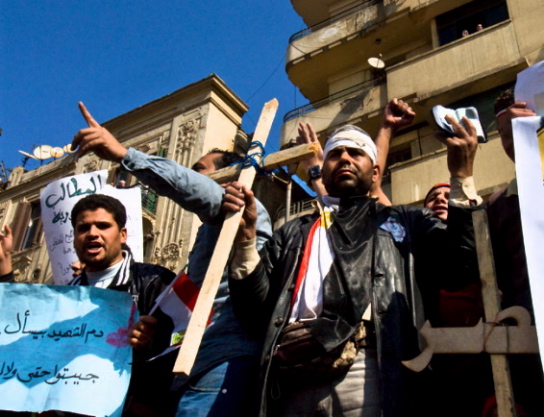
It certainly is easy enough to believe that people in the Middle East, especially Muslims, are unusually religious, and that there political and social ideas are completely dominated by religious values. Up until January, the previous 30 years might seem to have taught that lesson. Well, now we have had another lesson. Religious organizations and religious values did not drive the Egyptian revolution (outcome still uncertain). Here is a good article from a source I have not used before, Religioscope, that discusses the complexities of the issue. In Egypt at least, the various prominent religious voices spoke out again and again against disorder and the protest movement. One result is that those religious leaders, Christian as well as Muslim, have lost a lot of standing in the eyes of the younger population of Egypt. We can also guess that the civic and nationalistic values proclaimed by the protesters have gained prestige, and not just in Egypt.

Here are some excerpts:
The Salafist movement condemned the protests; the Muslim Brothers first retreated, then got sucked in by the dynamism of the dispute, then tried to open up a negotiation process which the demonstrators, bolder in their demands, didn't want. Though that was not necessarily the position of all Egyptians, many of whom would have settled for a compromise, with Mubarak running the transition and the demand for democracy postponed until the next elections: the voice of the street isn't necessarily the will of the people. The Islamist groups were without doubt the most detached. Among these, various parts of the Salafist movement condemned the demonstrators very clearly from the time of the first appeals.

The official religious institutions, both Muslim (al-Azhar and Dar al-Fatwa) and Christian (the Coptic Church), had ties of allegiance to the regime, and were even further from grasping the new revolutionary spirit.

The grand sheikh of al-Azhar, Ahmed al-Tayyeb, first supported the regime, then with some difficulty changed course, talking of the demands of the uprising in words that were less aligned to the regime, but extremely late. At the height of the dispute, in early February, the sheikh of al-Azhar called for calm and condemned the deaths of Egyptians – but without saying clearly that the deaths had been part of the confrontation between a regime which had resorted to violence through its usual outlets (the civilian police, the party-state) and young thugs from the poor parts of town. Pope Shenouda, for his part, called on the Christian population throughout the uprising not to join the protests.

The political dependence of the leadership of the clerical institutions – both Christian (the Coptic Church) and Muslim (al-Azhar) – was very badly received by the people, and risked jeopardising their relations with their bases over the long term. This was seen in the anger of young Copts in Tahrir Square at the position taken by Pope Shenouda; the resignation of al-Azhar's vice-spokesman, Mohamed Rifai al-Tahtawi (who then joined the demonstrators on the streets); and the number of al-Azhar preachers and imams who joined the protest movement, wearing their official clothes. The huge numbers who abandoned the official mosques on the Fridays to join the demonstrators showed the crisis of communication between religious establishment and people. Fatwas calling for calm went disregarded. On the Coptic side, many joined the protests, too. Their praying side by side with Muslims in the streets showed a double rejection: a rejection of the regime, but also of the Church's political support for a regime which many Copts feel has done nothing for them; they complain it has been responsible both for growing Islamisation and separation of identities along confessional lines....

The Salafist nebula of groups found itself deeply at odds with the dynamic of the street. From the start, and up to now, its position has been unequivocal: the protest movement must be boycotted because protest means chaos. Better to choose the iniquity of the regime than the void which opposing it might open up (the Salafists base themselves on a fatwa by the medieval Islamic thinker Ibn Taimiyya, affirming that 70 years of iniquitous rule are worth more that one day without rule).

The influential Salafist sheikhs in Egypt, especially those who have established strong positions of influence through the religious satellite television channels (al-Nas, al-Rahma etc), have, however, slightly scaled down their overall objection. As the movement grew, they stopped opposing it and tried to contain it, making do with reminders of the importance of protecting public goods and underlining the need to oppose thugs and gangs.
...
The Muslim Brothers' position evolved under pressure from the street (and not the reverse).

At the start, with the first demonstration on 25 January, the Brothers joined in but only in a symbolic way, sending some very restrained groups from their youth movement. Then, with the “Day of Rage” on 28 January, the Brothers concentrated their efforts on Cairo and mobilized about 100,000 people, according to one of their cadres.

As events unfolded (continued confrontation, massive repression, deaths, resignation of the police, the regime's strategy of chaos), positions radicalized. Mubarak blamed the Brothers for the disturbances. The Brothers in turn, through their supreme guide, Mohamed Badi'a, accused Mubarak of “state terrorism” (the Brothers, according to one of its officials, had suffered nearly 40 deaths). There was a feeling of no return among the Brothers, aware that they would be the main victims of the restoration of order if the protest movement did not succeed. “Our only card is the mobilization in Tahrir Square,” said a Brotherhood cadre who was present in the square. “It has become our life insurance against the swing of the pendulum which awaits us if the regime gets back on its feet.”

The Brothers in Tahrir Square, truly mobilized and strongly influenced by the other groups who started the protest movement, continued to call for Mubarak's departure ahead of any negotiation. But on 5 February, their leadership began talks with then vice president Omar Suleiman, former head of Egyptian intelligence. According to a close observer, the Brotherhood's leadership thought it could not pass up such a chance of winning some sort of recognition, even a legitimate presence. This exasperated the young Brothers out on the streets.
...
The Muslim Brothers did not lead the revolution; and they definitely do not appear as the guardians of its “spirit”. Though its concept may be floating, between Tunis and Cairo we are clearly seeing a revolutionary spirit take shape which could hardly be further from the political culture of the Brothers: it is not programmatic; it does not prefer one ideology over another but demands a transparent framework for political competition; it is anti-authoritarianism; it is democratic and not religious; it functions in a loose logic of networks, spirit of Facebook, transparency (the reverse of a pyramid structure, of secrecy and submission). It bypasses the existing political players in their entirety, including the Muslim Brothers, but recruits among the young of these parties and pushes them beyond their training (the Facebook experience has given birth to a movement, modest but real, of self-criticism and demobilisation of young people who have rejoined a network of existing mobilisations). Revealing, as so much else at Tahrir Square, was the enthusiasm of one young militant working for an Islamist site who rejoiced because the first demos had been led by secular Christians in disagreement with their own Church.
  ...
Through all this, the dynamic of opposition is showing the exhaustion of the authoritarian models of the regimes in place, but also the exhaustion of the traditional forms of opposition to them. What is happening in Egypt is not just the contesting of a regime, but the calling into question of a political culture.
Image:  Perhaps, "the old guys don't speak for us?"


Sunday, January 02, 2011

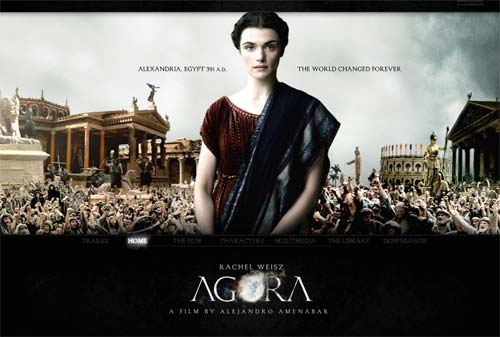
Agora (2009)


This is a seriously good movie.

I haven't heard much unmixed praise for this film, not a lot of commentary at all, and I think it deserves better. So here are my observations.

You should know that the story concerns the 4th century Alexandrian philosopher Hypatia. As a woman philosopher she was an oddity, as an educated pagan she lived in an increasingly hostile environment. Alexandria was a major center for both Christians and pagans, and the two groups were competing for control of the city. The Christians were winning -- they had the support of Theodosius, the eastern emperor who eventually banned pagan observances. The conflict in Alexandria was quite violent at times. This is one of the times that the Library of Alexandria, a pagan institution, is supposed to have been destroyed. More certain is that Hypatia attracted the hostility of the Christian party, and was killed by a mob. It's a depressing story, and one that could easily be butchered.

There are three important aspects to the movie. One is its degree of success in evoking late fourth-century Alexandria. I give Agora very high marks indeed on this. Visually, the evocation of the city, with its mixture of Greek and Egyptian elements, is stunning and flawless. The dialogue likewise does nothing to throw the viewer back into the 21st century, while avoiding pseudo-historical cuteness. That is a harder trick than the mere statement might indicate.

Second is the depiction of the religious conflict between Christians on one hand and Jews and pagans on the other. This is certainly what has made distributors very reluctant to show Agora in most of North America, because the Christians don't come out of it looking good. I, however, have read a lot of late ancient ecclesiastical history, some fair amount of it on the turbulent Alexandrian developments of the era, and I found this account believable. Rioting monks were a staple of Alexandrian religious life, even in purely intra-Christian disputes.

Third is the scientific story. The film proposes that Hypatia came to reject the Ptolemaic view of an earth-centered universe, with the complex series of epicycles to make planetary movements correspond to the predictions of Ptolemy's theory. Instead, says the movie, she became convinced that a more elegant solution was possible, a heliocentric one. Because predictions based on circular orbits won't work, she, like Kepler, comes up with the notion that planets moved on elliptical orbits.

I don't think that there is any evidence that Hypatia did any of this, but that doesn't bother me. But I was sure before I saw Agora that the filmmakers would do a terrible job of this part of the film.

They didn't. Indeed, that part of the plot works very well indeed. Hats off to them. And particularly to the bright guy or gal who suggested intercutting images of the Earth from space in a few appropriate places.

This is a serious, good movie.

Saturday, December 25, 2010

Christmas in Egypt (not exactly "Christmas in Killarney")

  Juan Cole has the story:
Some 500,000 Christmas trees were sold this year in Egypt, an extremely mysterious statistic. The country’s Orthodox Coptic Church celebrates Christmas on January 7, considers the day distinctly less important than Easter, and does not have a tradition of Christmas trees or Santa Claus. The roughly 8 million Copts are the largest national community of Christians in the Middle East. Admittedly, there are 200,000 uniate Catholics who follow the Pope in Rome but retain their Coptic liturgy (Coptic is a late, Christian-influenced form of the old Pharaonic language of Egypt). But 200,000 is only some 40,000 families or so.


So who is buying the other 460,000 Christmas trees? Well, some are going into the country’s malls (there are now lots of malls, some of them just enormous. I was in the 5-block-long City Stars Mall in Nasr City, Cairo last May, and I swear I got lost. The modern malls put up banners saying Merry Christmas and Happy New Year for their mostly Muslim clientele! And there are a lot of resident Western expatriates in the country working for NGOs, who would buy Christmas trees (last I knew there were 17,000 contractors for US AID). And there are Christian refugees from southern Sudan (about 1 million Sudanese refugees altogether, though the Christians must be a small proportion of them).

Perhaps middle class Copts are going in for the trees in greater numbers. But the Egyptian Muslim middle and upper classes have begun celebrating Christmas, which must account for most of the rest of the Christmas trees. Mohammad El Meshed writes that Osama Abdelshafy told him, ‘ “I have been invited to at least four Christmas parties this year, and three of them are being held by Muslims. This is the first time I’ve felt such a huge emphasis on Christmas.” The Egyptian Muslim middle classes are having Christmas parties and giving gifts.

One of the things Westerners who have only swiftly gone through Egypt as tourists will not appreciate is that Egyptians have the best sense of humor in the Middle East and they love throwing parties.

True, the conservative Muslim clerics advise against commemorating Christmas, and it sends the radicals ballistic for Muslims to do so, but while many Egyptians are pious, they don’t seem to let the puritans get in the way of a good time. And, the radicals were largely repressed and defeated in the Nile Valley by the secular Egyptian state.

More here!

Friday, November 12, 2010

My thought was ---

"How Carolingian!"

A giant Jesus in Poznan, Poland.  Thanks to MSNBC.com

Thursday, October 28, 2010

Christians leaving the Middle East

 Robert Fisk in the Independent:

Across the Middle East, it is the same story of despairing – sometimes frightened – Christian minorities, and of an exodus that reaches almost Biblical proportions. Almost half of Iraq's Christians have fled their country since the first Gulf War in 1991, most of them after the 2004 invasion – a weird tribute to the self-proclaimed Christian faith of the two Bush presidents who went to war with Iraq – and stand now at 550,000, scarcely 3 per cent of the population. More than half of Lebanon's Christians now live outside their country. Once a majority, the nation's one and a half million Christians, most of them Maronite Catholics, comprise perhaps 35 per cent of the Lebanese. Egypt's Coptic Christians – there are at most around eight million – now represent less than 10 per cent of the population.
This is, however, not so much a flight of fear, more a chronicle of a death foretold. Christians are being outbred by the majority Muslim populations in their countries and they are almost hopelessly divided. In Jerusalem, there are 13 different Christian churches and three patriarchs. A Muslim holds the keys to the Church of the Holy Sepulchre to prevent Armenian and Orthodox priests fighting each other at Easter.
When more than 200 members of 14 different churches – some of them divided – gathered in Rome last week for a papal synod on the loss of Christian populations in the lands where Christianity began, it was greeted with boredom or ignored altogether by most of the West's press.
 Yet nowhere is the Christian fate sadder than in the territories around Jerusalem. As Monsignor Fouad Twal, the ninth Latin patriarch of Jerusalem [counting from when? -- SM] and the second to be an Arab, put it bleakly, "the Israelis regard us as 100 per cent Palestinian Arabs and we are oppressed in the same way as the Muslims. But Muslim fundamentalists identify us with the Christian West – which is not always true – and want us to pay the price." With Christian Palestinians in Bethlehem cut off from Jerusalem by the same Israeli wall which imprisons their Muslim brothers, there is now, Twal says, "a young generation of Christians who do not know or visit the Holy Sepulchre".
 The Jordanian royal family have always protected their Christian population – at 350,000, it is around 6 per cent of the population – but this is perhaps the only flame of hope in the region. The divisions within Christianity proved even more dangerous to their community than the great Sunni-Shia divide did to the Muslims of the Middle East. Even the Crusaders were divided in their 100-year occupation of Palestine, or "Outremer", as they called it. The Lebanese journalist Fady Noun, a Christian, wrote a profound article from Rome last week in which he spoke of the Christian loss as "a great wound haemorrhaging blood", and bemoaned both Christian division and "egoism" for what he saw as a spiritual as well as a physical emigration. "There are those Christians who reach a kind of indifference... in Western countries who, swayed by the culture of these countries and the media, persuade eastern Christians to forget their identity," he wrote.
 Pope Benedict, whose mournful visit to the Holy Land last year prompted him to call the special synod which ended in the Vatican at the weekend, has adopted his usual perspective – that, despite their difficulties, Christians of the "Holy Land" must reinvigorate their feelings as "living stones" of the Middle Eastern Church. "To live in dignity in your own nation is before everything a fundamental human right," he said. "That is why you must support conditions of peace and justice, which are indispensable for the harmonious development of all the inhabitants of the region." But the Pope's words sometimes suggested that real peace and justice lay in salvation rather than historical renewal.

Saturday, October 02, 2010

Convivencia?

Have, historically, Jews and Muslims got along better than Jews and Christians?  Marc Cohen argues for the "yes" side:


The idea that modern Arab antisemitism comes from a medieval, irrational hatred
of the Jews, similar to the antisemitism of Christianity, with its medieval origins, cannot be sustained. Understood as a religiously-based complex of irrational, mythical, and
stereotypical beliefs about the diabolical, malevolent, and all-powerful Jew, infused in its
modern, secular form with racism and belief in a Jewish conspiracy against mankind--
antisemitism is not an indigenous or inherent phenomenon in Islam.11 It was first
encountered by Muslims at the time of the Ottoman expansion into Europe, which
resulted in the absorption of large numbers of Greek Orthodox Christians.12 This
Christian antisemitism became more firmly implanted in the Muslim Middle East in the
nineteenth century as part of the discourse of nationalism. Seeking greater acceptance in
a fledgling pan-Arab nation constituted by a majority of Muslims, Christians in the Arab
world, aided, among other things, by European Christian missionaries, began to use
western-style antisemitism to focus Arab/Muslim enmity away from themselves and onto
a new and, to them, familiar enemy. This Christian antisemitism has since become
absorbed into the fabric of Islam as if it were there from the start, when it was never there
from the start at all. The widely read Arabic translations of the late-nineteenth century
Russian-Christian forgery, "The Protocols of the Elders of Zion," seems to many
Muslims almost an Islamic text, echoing old themes in the Qur'ān and elsewhere of
Jewish treachery toward Muhammad and his biblical prophetic predecessors. The
"Protocols" seem all the more credible in the light of the political, economic and military
success of Israel. Sadly, the pluralism and largely non-violent attitude towards the Jews
that existed in early and classical Islam seems to have lost its public face. Equally sad,
age-old Jewish empathy with Islamic society among Jews from Muslim lands, and
memory of decent relations with Muslim neighbors in Muslim lands in relatively recent
times, have similarly receded. Comparative study of Jewish-gentile relations in
Christendom and in Islam explains the difference between the two societies, though it
does not make present-day Arab antisemitism any less unfortunate than its Christian
roots. One can only hope for a time when a just and peaceful solution to the Arab-Israeli
conflict will allow a correct memory of the past to play a role in attitudes of the present.

Thanks to Medievalists.net and Al-Biruni.

Sunday, September 19, 2010

More perspective -- and compassion -- needed


 New York Times columnist Nicholas D. Kristof, alarmed by American Islamophobia, has apologized on behalf of Americans for the excesses of some of them.  My readers will not be surprised that I agree with much of what he says.  Rather than repeat anything from his column, I suggest that you readers, if interested, go have a look at the hundreds of comments, just to get a feeling for the conflict is going on in America at the moment.  I thought the comment on apologizing for the Ku Klux Klan was particularly a propos; it is within  living memory that this terrorist organization claimed to be the essence of American Christian values.  Senator Byrd, a Klan member in his youth, just recently died.  He had the decency to apologize for his involvement in that movement.  I can’t recall anyone standing up in the comments section and either defending the Klan  or agreeing that an apology was appropriate.  It always looks different when someone wants to associate us with something pretty loathsome, on the basis of a label.

Now might be a good time to have a look, or maybe a second look, at this.

Let's have some of that tough-minded compassion, yeah.


Sunday, August 29, 2010

Egypt's Coptic church

Al-Biruni sends a link to a CNN video report on Egypt's native Christian church.
An earlier post is worth a look, too.

Insufficiently pessimistic

Karl Steel shares a quick ("flash") review of Jonathan Elukin, Living Together, Living Apart: Rethinking Jewish-Christian Relations in the Middle Ages:
By trying to write as though the Holocaust were not the inevitable future of European Jews, Elukin aims to shift our attention away from lachrymose history to quotidian survival. In the early middle ages, at least, we shouldn't confuse clerical antijudaism with general attitudes: how much power did Church councils really have, he asks, and what could an antisemitic king do when he could barely hold onto his (Visigothic) throne? Moreover, he argues, violence was not typical for Jews, or, at least, not particular for Jews: in polities without much in the way of infrastructure, standing armies, or police forces, in a public rhetorical tradition devoted not to calm description but to evaluation--praise and blame, violence was endemic. What the Jews suffered was not all that unusual. Violence should be understood as only occasionally afflicting the Jews, who, despite it all, almost always came back to the cities or regions that expelled or massacred them. Sometimes this took a generation, as in the Rhine valley following 1096; sometimes this took centuries, as in England following 1290. But it always happened. Elukin implies, in brief, that we should not believe we know better than the Jews: if they thought it was safe to move back, why shouldn't we?

...with Elukin in hand, we should read more carefully, read in the heterogeneous present of medieval Jews without having their future, our present, so clearly in mind. We read with a hope at once retroactive and future-oriented, knowing that what we think of as the past tied singly to the future could have gone another way and indeed went other ways in its own present, where we have York 1190 but also the York before that, where Jews made a community among Christians, where I imagine not every Jew and not every Christian was recognizable, primarily, as such. In a society in which Jews hired Christian nursemaids, we have to rethink the primacy of religious divisions.

That said, that Jews returned to their various particular homelands--England, France, Germany--and that they therefore did not feel themselves to be in danger does not mean that they were not in danger. We can see patterns they couldn't. Yes, Jews held on to Spain even after 1391; they moved back to the Rhine valley after 1096; they petitioned to return to England in 1320. These were mistakes. I think Elukin takes Jews as rational actors. But people aren't rational, or not only rational. Or, better, home and habits have reasons of their own. A comparison, mutatis mutandis to avoid any sense that I'm blaming the Jews for what they suffered: in 2010, in this time of climate change, Americans continue hyperconsuming. There's no indication that this will stop. This doesn't mean I'm not in danger (nor does it mean, once more, that systemic antisemitism and antisemites are identical to climate). It just means that, like people generally, I'm insufficiently pessimistic, unable to do what I should to abandon my home, my habits, and therefore myself, though I need to if I'm ever going to escape this coming doom.