...full of archaeological goodies. Thanks, David Meadows!
One of the nice things about this e-mail news compilation is that it supplies me with links to the little stories.
For instance, I don't get excited about the power, wealth and claims to divinity of Greco-Egyptian queens, but who would not want to see this amazing coin/medallion on Sunday morning?
And I find it pleasant to have nonsense about "Roman Chinese" systematically dealt with.
I'm grateful both to David and the originating sources.
Ancient, medieval, Islamic and world history -- comments, resources and discussion.
Showing posts with label Explorator. Show all posts
Sunday, December 05, 2010
Sunday morning, and Explorator comes to my mailbox...
Labels:
archaeology,
China,
Egypt,
Explorator,
Greeks,
Rome,
Uighurs
Tuesday, July 06, 2010
Amerigo, Amerigo
A cool, detailed article on the naming of America. Thanks to Boston.com and Explorator for this one.
The expanding horizons began with Vespucci. In his letter, he reported sailing west across the Atlantic, like Columbus. After making landfall, however, he had turned south, in an attempt to sail under China and into the Indian Ocean — and had ended up following a coastline that took him thousands of miles almost due south, well below the equator, into a region of the globe where most European geographers assumed there could only be ocean.
When Ringmann read this news, he was thrilled. As a good classicist, he knew that the poet Virgil had prophesied the existence of a vast southern land across the ocean to the west, destined to be ruled by Rome. And he drew what he felt was the obvious conclusion: Vespucci had reached this legendary place. He had discovered the fourth part of the world. At last, Europe’s Christians, the heirs of ancient Rome, could begin their long-prophesied imperial expansion to the west.
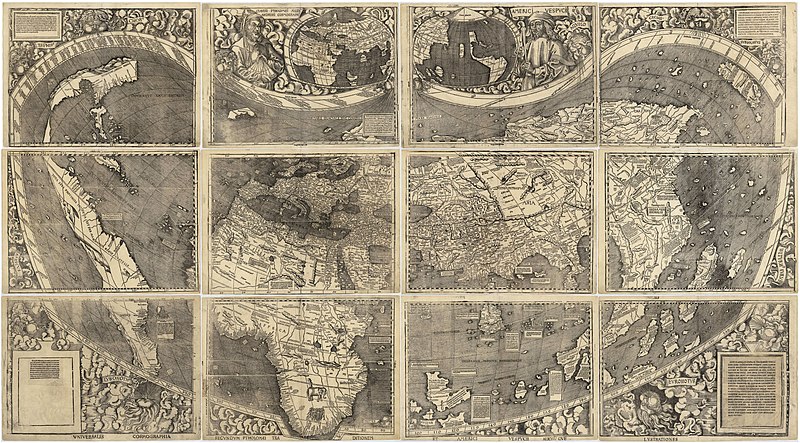
Ringmann may well have been the first European to entertain this idea, and he acted on it quickly. Soon he had teamed up with a local German mapmaker named Martin Waldseemüller, and the two men printed 1,000 copies of a giant world map designed to broadcast the news: the famous Waldseemüller map of 1507. One copy of the map still survives, and it’s recognized as one of the most important geographical documents of all time. That’s because it’s the first to depict the New World as surrounded by water; the first to suggest the existence of the Pacific Ocean; the first to portray the world’s continents and oceans roughly as we know them today; and, of course, the first to use a strange new name: America, which Ringmann and Waldseemüller printed in block letters across what today we would call Brazil.
Why America? Ringmann and Waldseemüller explained their choice in a small companion volume to the map, called “Introduction to Cosmography.” “These parts,” they wrote, referring to Europe, Asia, and Africa, “have in fact now been more widely explored, and a fourth part has been discovered by Amerigo Vespucci....Since both Asia and Africa received their names from women, I do not see why anyone should rightly prevent this from being called Amerigen — the land of Amerigo, as it were — or America, after its discoverer, Americus."
Labels:
Americas,
Explorator
Sunday, January 27, 2008
Irbil as tourist attraction
Alas, Irbil, at least the old central part of the city, is crumbling and few of the buildings there are still occupied. Bet that's happened before! The municipal authorities, according to this Associated Press/MSNBC story, see an opportunity here. Given a certain amount of investment and peace and quiet, this could be a unique tourist attraction!
I'd go in a heartbeat.
Thanks to Explorator for bringing this to my attention.
Labels:
Ancient Civilizations 2055,
archaeology,
Explorator,
favorites 2008,
Iraq,
Irbil
Tuesday, May 22, 2007
From Explorator, May 2007
This past weekend had two topics that amazed me. One was out of Norway, where someone last August, high in the mountains, found a leather shoe in a snowdrift. First opinions were that it was a thousand years old!
Wrong!
They now think it is 3400 years old!
More searching of the ground led to finding arrows and a wooden spade.
Fallout from global warming?
Explorator also pointed me to a story from Britain, where the A-level exam in Ancient History was on the chopping block. That would mean that what North Americans call high school students could no longer specialize in that topic. Fans of ancient history fought back and won the day. One thing that helped is that they won the sympathy of the cabinet minister in charge of schools, who sits in the Lords. His title is Lord Adonis.
How could they lose with divinity intervening for the cause?
Image: A terra-cotta "Dying Adonis" from the second or third century BC.
Labels:
ancient history,
archaeology,
education,
Explorator
Subscribe to:
Posts (Atom)