I think we’ve gone beyond reductionist paradigms that saw all such interactions as conquest, imitation, or appropriation, or that were alwaylot s defined by the unequal relationship between cores and peripheries. I like the synthesis proposed recently by David Graeber and David Wengrow in The Dawn of Everything where they argue that societies within some kind of contact zone sometimes reshape themselves as an answer to another society they’ve encountered, that they amplify or rework their systems and practices as a kind of commentary upon and contrast to a neighbor. For example, in the book, they argue that indigenous societies in Eastern North America intensified their own ideas about economic behavior, political freedom, and social cohesion as a response to their encounter with Western Europeans and their dislike of some aspects of Western European institutions and behavior.It’s an approach that has some problems. It seems to put us back in the space of a “Tylorian” idea of relatively fixed and separable cultures that are a single coherent text that can be read for a few core ideas that shape everything else (or the Geertzian revision of that concept in looking for ‘thick descriptions’ that read into those opaque underlying cores), rather than think of cultures as having fuzzy boundaries, internal pluralism and contradiction, and considerable dynamism over time. But Graeber and Wengrow do point out that as societies reshape themselves as commentaries upon contrasting neighbors, they push some of their members who don’t care for the redefinition into those fuzzy boundaries and provoke forms of internal pluralism and dissent against such reshaping. There’s also the challenge of how to “read” the text of past societies, especially ones we know so little about: I love the idea of seeing practices, movements, material signs as embodied, experienced forms of political and social philosophy that are as sophisticated or complex as the written texts we normally fall back on, but there’s an inescapable hubris involved in doing that reading from the perspective of our present moment and the ways we read towards a kind of simplistic universalism.
What worries me in the context of thinking about Trump through Graeber and Wengrow’s perspective, however, is that they have a strong tendency to read away from domination, tyranny, violence and empire. That is, they want to restore contingency and variety to premodern human history, and to unshackle it from any form of teleology whatsoever. I’m with them on that goal: centralized states, agriculture, empires and a whole host of other political, economic and social forms have not been one-way inventions that automatically remake societies forever once they first appear. There’s a tremendous amount of evidence that societies switch in and out of sedentary agriculture, foraging, and pastoralism, between urbanism that is not controlled by a central state, centralized administrative states that are not empires or kingdoms, highly hierarchical societies that have no single head or ruler, and so on—that these are not fixed or linear sorts of choices. They also point out that none of these systems are necessarily applicable to whole “societies”—that there are communities where one part of the population lives within one kind of system and the other lives a different way, that are distinct while still living right alongside one another. But Graeber and Wengrow consequently take little interest in past societies which have developed highly regimented agriculture, brutal forms of labor servility, economies and social systems predicated on raiding and conquest, or are ruled by kings and emperors. They are so driven to show that none of this is inevitable or as common as many established perceptions might have it that they don’t really say much about the cases where it absolutely does happen. centralized monarchy next door or disdain the harsh servility of people forced to grow crops, there might also be societies (or at least some portion of societies) that dislike what they take to be the disorder, openness or pluralism of their neighbors and shape themselves to communicate that antipathy.
And here’s where I find myself on the edge of a thought that is a bit outside the comfort zone of a lot of contemporary history and anthropology. It’s pretty common in premodern world history to find that people living in one region who see themselves as the enemies—and victims—of some neighboring society tend to develop exaggeratedly negative caricatures of their antagonists, to see them as the opposite of everything that is good and right. The difference between that and modern forms of alterity is about power and totalization—the people If there are societies that decide that they really don’t like the who have been made into Europe’s “others” have been forced in various ways to live with that remaking. Whereas in a premodern context, it didn’t matter very much to the Scythians if the Greeks imagined them to be barbarians: the Greeks had no power to force that on the Scythians in their home territories and neither group let it get in the way of the practical business they wanted to conduct in the northern Black Sea.
So far, so good. The thought that is outside the comfort zone is that if we follow Graeber and Wengrow into thinking that some societies embed a critique of their neighbors within their own embodied institutions and practices, in an almost-dialectical kind of relationship, then perhaps sometimes some societies embrace and incorporate the negative “othering” of their neighbors to become more fearful enemies.
Contemporary historians are usually dedicated to rescuing past societies that have been depicted in negative ways by sedentary, literate neighbors from the stereotypes contained in the texts that the 19th Century imperial scholars of Western universities read as they learned more languages and developed a more universal perspective on global history. So historians look again at Scandinavian societies in the era of “Viking” raids, at waves of pastoralists moving out of central and east-central Asia up to and beyond the Mongols, at histories characterized as episodes of conquest and imperialism like the formation of the Zulu state under Shaka, and they’ve tried to shake them loose from a lot of preconceptions, to detail the complexity and heterogeneity of those societies and to offer more nuanced explanations of their raids, their conquests, their movements.
But I do wonder whether in some of those histories, there are also episodes of groups—not whole societies, sometimes just military units or raiding bands—who acquired a fairly sophisticated understanding of what their targets and enemies thought about them and decided to play it up to the hilt, to become the goblins and ghouls of a neighboring imaginary. And this maybe goes in more ways than the Western histories of the 19th Century often wrote it—say, various Crusades sacking Jerusalem, Constantinople, Zadar, Ma’aara and Nicaea with grotesque brutality, or more potently, in the savagery of European imperial conquest at precisely that moment. (Clifton Crais’ forthcoming The Killing Age I think will put that front and center of its account.)
So not so much “negative dialectics” in any sense but “negative emulation”, a decision to become the monsters that others believe you to be, to get the better of them.
I’m sure you see where I’m going with this thought when I loop back to Trump. If it’s correct to imagine that at times, some groups or societies in conflict with others elect to embody the worst ways they are imagined, the question is whether that’s a short-term or limited performance or whether it gets incorporated into the deepest reservoirs of personhood and consciousness, whether it suffuses everything. That is often what we see as the violence of alterity, that the people who are forcibly made “other” find they can never get away from what the dominant group or people think of them. But if my outside-the-conventional thought has anything to it, and it’s true that sometimes groups and societies agentively “otherize” themselves, choose to inhabit some aspect of their enemies’ negative vision, what happens if that choice becomes so fully inhabited that it is no longer remembered as a positional gambit or situational performance?
I think there are two basic answers. One I’d take from the Muslim scholar and philosopher ibn Khaldun, who described a historical cycle in which pastoralists raid strong sedentary societies and as those societies fall pray to indolence, corruption and internal conflicts, the raiders overwhelm them and become their new ruling elite. At which point they begin to transform towards the institutional and cultural world that they defeated and the cycle starts over. It doesn’t do to take the most simplistic version of this vision at face value but there’s certainly a number of examples in premodern world history that have some resemblance to this dynamic. And in some of those cases, you could also say that the new rulers imported some of their own ideas and culture into the societies they now ruled—but the important thing is that inasmuch as they had internalized ideas of themselves as the fearsome enemy prowling in the wilderness, those ideas melted away once they came in from the cold.
The other answer is that negative emulation, if it exists at all as I’ve described it here, is a disfiguring trap, that it chains the aspiring monsters to a cycle of outrages and violations that don’t even come from them in the first place, that it makes the emulator into nothing more than that imaginative space that’s been reserved for them by enemies, hopelessly inauthentic and perpetually reactive. The monsters might even exterminate their enemies but they’ll be forced to resurrect them over and over again because they’re nothing except the nightmare of another culture, another society, another group now. I think a little about what the journalist George Anastasia has written about the decline of Italian organized crime, the “Mafia”, in part because as the oldest generation of mobsters went to jail, the younger Mafia members found themselves increasingly imitating the characters they saw up on screen in The Godfather, Goodfellas and The Sopranos. Many younger mobsters weren’t anything any more but “The Mafia” and as such, they had no autonomy or authenticity, no direction but to live into that representation, and were for that reason increasingly easy for law enforcement to deal with.
If Trump and Trumpism are negative emulators in this sense, people who’ve elected to become the terrors of people they have hated, I suspect their future is going to be more consistent with the latter of these two scenarios. Which means, unfortunately, we will be stuck in here with our monsters, who no longer have any sense of who they were or what they wanted before they chose to be what we most feared, until they exhaust themselves in some fashion. I hope if so that that the air can just go out of their bubble rather than the monsters chasing the full horror of their persona to its most nightmarish ends.
Wednesday, September 03, 2025
Timothy Burke summarizes one aspect of Graeber and Wengrow's "The Dawn of Everything"


Tuesday, March 04, 2025
Trump will die
Further, March 16: Another discussion by experts on CBC 1's excellent The House with no reference to Trump's physical and mental health. In fact, the experts didn't know what to say on any aspect of the current crisis. This is where we are.
Monday, June 26, 2023
Mars is Heaven: an interesting discussion
Matt Taibbi and Walter Kirn start by talking about Ray Bradbury's classic story "Mars is Heaven" and go off in all sorts of interesting directions. A sample:
Walter Kirn: Here’s the reason why witch trials, panics and spy hunts are perpetually amusing, especially to the Puritan who has traditionally repressed his sexual drive and needs other forms of entertainment: they are fun. Let’s think back to the experience of a little kid at the time of the Salem witch hunts. You got to peek through people’s windows. You got to gossip about their liaisons in the woods. You got to run around. You were a junior detective, and everybody turns into a junior detective in a witch hunt or a moral panic. Everybody gets to turn somebody in, find a clue, overhear a damaging conversation. And then there are the punishments and the hangings that ensue. There are the trials themselves. And that general air of intrigue and excitement that replaces maybe an inadequate sexual life, or a lack of accomplishment, or even maybe failure of other ambitions.
So witch hunts are fun and Puritans know that, and they’re especially fun for them. And so why not have a permanent ongoing top to bottom all the time, completely justified in the name of anti-racism or anti anti-feminism – it’s not fair that they should be these periodic things that happened only in the 1950s, and then again now. They should happen every day from morning till night. There should be the opportunity to turn somebody in, discover guilt, sneak around, get concealed information, and also then watch on a sort of lag the people who got turned in last week get their punishment. And so witch hunt nation is fun nation. They call it a panic because it’s named after the god Pan, and what’s the god Pan? The god of fun.
Some quick reflections: That this discussion of a 1948 story is taken so seriously in 2023 underlines something I've often thought, that sf, even if it is overrun by stories of superheroes and supervillains blowing up planets and time-travel paradoxes, is often more relevant than "realistic," mainstream fiction, even the stories of superheroes etc. Are there superheroes? Well, noone can doubt that there are supervillains. </p>
Taibbi and Kirn are fascinated by the power of the image of Puritan New England. I find it a bit much. I wonder if they have read Kim Stanley Robinson's three books, Red Mars, Green Mars, and Blue Mars. I consider them taken together to be the masterpiece of the American Utopian tradition in science fiction, the grown-up, updated version of Robert Heinlein's juvenile novel Red Planet. Which was written about the same time as "Mars is Heaven." Heinlein has been scarily prescient more than once: His Starship Troopers inspired the excellent response, Joe Haldeman's Forever War, whose title has long ago become part of ordinary discourse. And Heinlein back in the 40s wrote, in Revolt in 2100 a picture of a successful Trumpist/Fundamentalist regime (and the revolution that overthrows it).
I've picked some nits but I recommend Taibbi/Kern nonetheless.
Tuesday, January 07, 2020
Monday, December 04, 2017
Trump and Russia: It was that close
Since this rapid settling of accounts with Russia is no longer the focus or at least at the forefront of coverage, we need to refresh our memories of exactly what was intended. The Trump transition planned to move rapidly in its first days and weeks in office to engineer a dramatic reshuffling of policy toward Russia, in essence a grand bargain which would start with lifting the December 2016 sanctions as well as those imposed in March 2014 for the annexation of Crimea. But it wouldn’t end there. It was also to include a basic reorientation of policy in the Middle East (a policy of close collaboration with Russia in Syria and Iraq/ISIS) and at least some shift in US policy toward Europe and the EU. ...
Despite the claim that Flynn had gone rogue and that Vice President Pence was lied to, details that emerged in the Flynn plea documents make clear that Flynn’s discussions with Kislyak were widely discussed among President Trump’s top advisors. Pence almost certainly knew about them, though we as yet have no direct proof of this. Events were moving rapidly. A string of denials about Flynn’s conversations with Kislyak were hit with a rush of leaks that refuted each in turn. By February 13th Flynn was out. The next day President Trump asked Comey to drop the investigation into his activities. Comey politely refused. Events were moving quickly and badly.
Various reports, including Isikoff’s, tells us that the staff planning for a rapprochement which was kicked off in the administration’s first days continued. Indeed, in the months since we’ve seen it pop up here and there. There have been repeated hints of discussions to return the diplomatic compounds seized by the Obama administration in late December. In his May trip to Europe Trump had to be coaxed and prodded to commit to the defense of NATO allies. We saw it in Trump’s bizarre and semi-secret Oval Office meeting with Kislyak and Lavrov just after firing Comey. Still, it seems clear that by mid-February, with Flynn fired and the Russia scandal dominating the headlines, any hope of an immediate and thorough-going reset in relations with Russia were abandoned as unrealistic. While the desire is clearly still there, it has been the drama of the unfolding investigation, rather than a grand partnership with Russia that has dominated the news and the administration ever since.
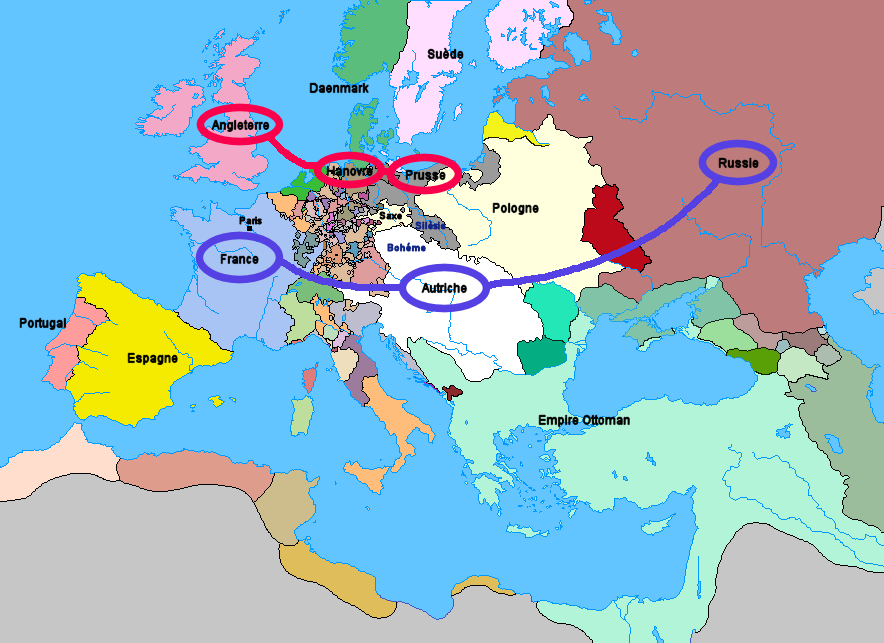
Image: The new alliances that resulted from the Diplomatic Revolution of 1756
Tuesday, July 11, 2017
None dare call it treason?
Sen. Tim Kaine (D-VA) on Tuesday said the federal investigation into Russian interference in the 2016 election and whether members of President Donald Trump’s campaign colluded with Russia may turn toward “potentially treason.”“We’re now beyond obstruction of justice, in terms of what’s being investigated,” the former vice presidential nominee said on MSNBC. “This is moving into perjury, false statements, and even into potentially treason.”Donald Trump Jr. on Sunday admitted he met with a Kremlin-linked lawyer in June 2016 because he was told the lawyer had damaging information about Hillary Clinton that could help Trump’s campaign.The New York Times on Monday reported that publicist Rob Goldstone, who contacted Trump Jr. about the alleged compromising information, suggested to Trump Jr. that the Russian government was behind the alleged “helpful” information.Trump Jr. on Tuesday released the emails he and Goldstone exchanged, including a reference to a “Russian government attorney” flying from Moscow for the meeting.''
The title of this post is a reminisce of the "good old" John Birch Society days (50s and 60s) when that right wing group was throwing around accusations very freely indeed!
Wednesday, May 03, 2017
Trump and democracy
But the real message from the President, one that’s clearly been a topic of conversation between him and his aides, only came in the flurry of interviews he did in which he had a chance to expand on his remarks. His dour mood reaches well beyond the filibuster.
Listen to these comments from his interview with Fox News …
I understand what has to be done, I get things done I’ve always been a closer. We don’t have a lot of closers in politics and I understand why. It’s a very rough system, it’s an archaic system. You look at the rules of the senate, even the rules of the house, bit the rule of the senate and some of the things you have to go through, it’s really a bad thing for the country in my opinion.Trump knows what needs to be done. And he gets things done. That’s who he is. But having been revealed as someone who almost literally can’t get anything done, he’s turned against the “rough … archaic system.” The system will need to change “for the good of the nation” because “it’s not fair, it forces you to make bad decisions.”
There are archaic rules and maybe at some point, we’re going to have to take those rules on because for the good of the nation things are going to have to be different. You can’t go through a process like this. It’s not fair, it forces you to make bad decisions. I mean, if you’re forced into doing things that you would normally not do except for these archaic rules.
We’ve had this system for a while. But three months in, Trump’s decided it’s time for a change.
This wasn’t off the cuff. Trump said much the same thing, actually used the same catchwords with CBS’s John Dickerson.
Why wasn’t anything getting done, Dickerson asks?
Just a system. It’s just a very, very bureaucratic system. I think the rules in Congress and in particular the rules in the Senate are unbelievably archaic and slow moving. And in many cases, unfair. In many cases, you’re forced to make deals that are not the deal you’d make. You’d make a much different kind of a deal.
You’re forced into situations that you hate to be forced into. I also learned, and this is very sad, because we have a country that we have to take care of. The Democrats have been totally obstructionist. Chuck Schumer has turned out to be a bad leader. He’s a bad leader for the country. And the Democrats are extremely obstructionist.
It’s pretty clear the President is thinking a lot about this and talking about it a lot with his advisors. I mean no disrespect but “archaic” does not strike me as one of the President’s go-to words.
The President’s fondness for foreign dictators is no secret. It won’t surprise you that I think that fondness and envy is tightly connected to the attitudes I’ve noted above. But many of us console ourselves with the notion that Trump is just demonstrably too inept and incompetent to be a strongman or push towards some kind of Americanized authoritarian rule.
This is a misunderstanding.
Incompetence and authoritarianism aren’t incompatible or even in tension. Historically they tend to go together. Incompetence and failure borne of ineptitude tend to show up both as a cause and outcome of democratic breakdown and collapse. Small-d democratic government is hard, by design. It’s meant to be. It should be. But it’s not just hard. It relies on a particular package of skills: persuasion, inspiration, patience, canny use of patronage, threats, carrots and sticks, both consensus building and fight.
Look at a Lincoln, an FDR, a Reagan – whatever you think of the different men’s politics, successful presidents are almost quite good at using this toolkit.
Just running down the list, virtually none of these are Trumpian traits. So in addition to the other obstacles he faces, it’s hardly surprising that he’s been such a flop as a chief executive. As any political scientist will tell you, the formal powers of the Presidency, outside of war-fighting, are quite limited.
The lack of patience, focus and skills appeared immediately with Trump as he gravitated toward the easy and mostly meaningless sugar high of executive orders over the hard work of legislating. It’s no mystery why he’s failed so miserably. It’s no mystery why he’s now so focused on how … basically democracy, the machinery of democratic government is the problem, how it’s not “fair”.
Not fair to who exactly? Trump, of course.
Even Trump’s rants against the secondary enemy of the ‘obstructionist Democrats’, who don’t control anything, tells a similar story. It’s true that the legislative filibuster is a significant tool for the Democrats right now. It is their only tool. But the real story is that they haven’t gotten really any chance to use it. Trump has failed before that even came into play. The on-going Trumpcare debacle is the best illustration of this. Trump keeps ranting at the Democrats about the failure of Obamacare repeal. But the Democrats have literally not done anything legislatively. I’m sure they would force Republicans to get 60 votes to repeal Obamacare. And they should.
But that hasn’t happened.
What’s held Trump back are the invisible hands of public opinion. He can’t get his bill or Ryan’s bill or whomever is claiming it at this point out of the House because Republicans are afraid of the electoral consequences of voting for it. They are afraid they will lose their seats if they vote for it.
That’s democracy in its most immediate form. It has nothing to do with the Democrats – unless we’re talking about the Democrats’ relative success at public persuasion about the awfulness of the President’s bill.
We’re talking about this failure in the House right now but the same pattern is ready to play out in the Senate. I think any reporter covering Capitol Hill would back me up when I say that there’s virtually no way Trump could get 50 votes for this bill, let alone 60 in the Senate.
He probably wouldn’t even get close to 50.
In other words, Democrats are ready and eager to obstruct using their one tool. But they’re not getting the chance because Trump is failing within his own party. Trump is ranting at the Democrats but what he’s talking about is public opinion. Democrats are responsible for making people not like him and not like his bill.
Democracy, of course, isn’t simply responding to the whims of public opinion. Sometimes it’s the height of democratic self-government for legislators to make decisions they know are unpopular for the public good. Needless to say, I think think Trumpcare is a moral as well as policy disaster. But for those who disagree, again, that’s part of democratic leadership: persuading legislators to take tough votes. And again, it’s one at which Trump has completely failed.
I am an optimist on American institutions. Adam Smith wrote that there’s “a lot of ruin in a nation”, by which he meant that countries and by analogy governments and institutions are more resilient than you’d think. I think America is stronger than Trump. I don’t think he’s going to be able to tamper with the 1st Amendment because it’s hard and he’s clown. But he is President. A President has vast powers, in many ways far more for destruction than construction. So the fact that he wants to matters a lot. The fact that three months in he’s already decided that the basic mechanisms of American government are ‘archaic’ and ‘unfair’ matters a huge amount too.
Saturday, February 04, 2017
Trump's rhetoric
Heather Havrilesky is on to something. If you are entitled to vote in the USA, your opinion means something to your Representative and Senators. Instead of ranting at your friends who already agree with you, and at real Trump supporters, who never will, try this strategy:
In just two short weeks, President Donald Trump has destabilized the globe and quickly eroded even our most trusted alliances. This is exactly what his likely sponsor Putin wants, of course. This is exactly what his white supremacist advisor Bannon wants — he’s said so on the record (“Lenin wanted to destroy the state, and that’s my goal, too.”). And if sowing fear in the populace offers the GOP an excuse to pump up military spending, so be it. Most Americans, however, prefer to sleep well at night. And if we’re going to take a clear, resounding stand against this unthinkable menace, we have to use his own tricks against him.
For instance:
Think about how you might discuss the head-spinningly bad judgment that led to his first and failed military operation in Yemen. Instead of talking about how all special ops are sticky but President Obama, in spite of his flaws, was incredibly careful about not putting American forces in harm’s way, try this: It was a disaster, a huge disaster, and totally preventable. Trump messed up. Completely incompetent. Or maybe you'd say: Those SEALs went in there, and got torn apart. Nightmare, never should’ve happened. Trump messed up, big league. Completely unstable. Of course, Democrats and progressives are incredibly afraid of using rhetoric of fear, like Trump and Bannon do. But isn’t fear our new reality? Aren’t we scared out of our minds over Trump, a man who has quickly demonstrated that he’s self-obsessed, unthinkably reckless, and utterly incapable of making even the faintest diplomatic sounds come out of his mouth? We can’t sit back and wait, because his mistakes are going to build on each other until they snowball into a global disaster.
Think about how you might discuss the head-spinningly bad judgment that led to his first and failed military operation in Yemen. Instead of talking about how all special ops are sticky but President Obama, in spite of his flaws, was incredibly careful about not putting American forces in harm’s way, try this:
It was a disaster, a huge disaster, and totally preventable. Trump messed up. Completely incompetent.
Thursday, January 26, 2017
Courtesy

David M. Parry would have us think about court culture in connection with Trump. Is America growing a court culture? Ask Alexis de Tocqueville. (Someone worth reading any time if you haven't done so already.)In short, everything considered, though I had before been in several courts of kings, dukes, princes, counts, and noble ladies, I was never at one which pleased me more, nor was I ever more delighted with feats of arms, than at this of the count de Foix. There were knights and squires to be seen in every chamber, hall and court, going backwards and forwards, and conversing on arms and amours. Every thing honourable was there to be found. All intelligence from distant countries was there to be learnt; for the gallantry of the count had brought visitors from all parts of the world. It was there I was informed of the greater part of those events which had happened in Spain, Portugal, Arragon, Navarre, England, Scotland, and on the borders of Languedoc; for I saw, during my residence, knights and squires arrive from every nation. I therefore made inquiries from them, or from the count himself, who cheerfully conversed with me.
 `
`Tuesday, June 21, 2016
Is this America?
 CBC's Radio program "The Sunday Edition" interviewed Rebecca Solnit and Andrew Solomon on the "Trump phenomenon" and violence in American politics. They were appalled, of course. Solomon said among other things
The gap has got wider and wider and wider ... The Trump phenomenon is so bewildering to the people who do not subscribe to it and feels so urgent to the people who do subscribe to it that I have the sense of a country and people who have no understanding of one other. Many friends of mine have said to me that "I thought I was an American but I don't know if I am if this is going on in our country." And I think that there is a real feeling that the sides are so far apart and that in particular the Republican side is so uninterested in compromise of any kind on any topic no matter how much such compromise might serve the public good I think ...the level of anger and frustration and alienation on both sides has escalated to a point that I have not seen in my lifetime.I don't know how old Solomon is, but I wonder if he remembers the civil rights movement and the murders and the riots of the 1960s. He certainly does not remember the imposition of Jim Crow to put the African-American population of the South back in their place, but I am sure he has heard of it. What this all reminds me of is the 1840s and 1850s, where besides the intense battle over the possible extension of slavery to the West, there was a strong anti-immigrant, anti-foreign religion, anti-intellectual movement best seen in the American Party, also known as the Know-Nothings. Of course, there were differences: back then the undesireable immigrants were Irish and German, and the bad anti-American religion was Catholicism. But what really reminds me of today was the possibly apochryphal origin of the name Know-Nothings: "I know nothing...except Americanism." Yes, this is America. Image: The Know-Nothings repel the invading papal hordes.
Sunday, June 19, 2016
Donald Trump as eccentric knight errant
...he risks becoming completely untethered — nothing more than the slithering id of a nervous age. He comes off too often as the candidate of “Game of Thrones” America, a bombastic, misogynistic knight errant in an endlessly wandering, unfocused narrative; traversing a fantasy landscape composed of a thousand borrowed mythologies, warning endlessly of a dire apocalypse that never quite materializes.I've read Arthurian romances like that...