Recently I have run across on Netflix two series which I found particularly satisfying because they were clearly created by people who like history as much as I do, and who have taken care to do it right.
One of them is the Frankenstein Chronicles, which might qualify as a good historical movie simply because it stars Sean Bean, but which has so much more. The story depicts what might have happened in intellectual circles in London after the publication of the novel Frankenstein. The movie shows as talented scientists being inspired by the book to attempt not just to understand the nature of life and death, but to find the the secret of immortality.
Of course, this doesn't work out very well for them.
What I liked best about the Frankenstein Chronicles was the convincing and detailed depiction of this pre-Victorian era. Lots of real people show up to add depth to the story: Mary Shelley, Sir Robert Peel (creating the "bobbies," the London police force), King William IV, William Blake (on his death bed) and several more. I can't swear to the absolute accuracy of any of these individual portraits, but the nuanced portrayal of the environment as a whole is very pleasing to this retired history professor. It reminds me of the care put into those prize historical movies of the early 70s, the Three Musketeers and the Four Musketeers.
Also on Facebook is a Spanish series, El Minesterio del Tiempo. The Ministry of Time is a branch of the Spanish government devoted to preventing unauthorized time travelers from changing essential elelments of the past -- specifically the Spanish past. I have screened only about a quarter of the series, but most of it so far shows the ministry agents most concerned that famous artists and writers are able to produce the works that they contributed to Spanish culture.
There are other entertaining features of the story. You probably wouldn't think of Spain as the most likely country to have a monopoly on time travel technology. If so, know that the characters agree with you! Anyway, the Spanish time travel technique is not obviously technology. It was invented by a 15th century rabbi, and ever since his time, the Ministry has been secretly using doors that go from one time and place to another. If there is an explanation for this. or for the creation of the Ministry itself, it is not clear to me.
But perhaps the best part of the series is the way the characters deal with a power that potentially makes them omnipotent. All the agents have been plucked out of the normal time stream, sometimes after some family tragedy. The agents can go back to their original environment any time they want, but they risk damaging their (our) timeline and their own mental health if thety do so.
El Ministerio del Tiempo is getting better as it goes along. The actors are great. Are they top-ranked stars in Spain?
Later: The portrayal of Goya discussing his theory of art is stunning.
Showing posts with label television. Show all posts
Showing posts with label television. Show all posts
Tuesday, March 20, 2018


Sunday, November 20, 2016
American Gods, Supernatural, and Jesus
Recently I have been reading American Gods by Neil Gaiman, as well as watching the TV show Supernatural, which has been on for pretty close to 15 years now. I am finding both of them quite enjoyable. They have strong similarities, specifically they both take place in America (Trump's America?) where behind the scenes of ordinary life (a pretty dreary ordinary life mostly in the country or very small towns) biblical or pagan gods, culture heroes, and etc. pursue their own agendas, generally with bad effects on human beings who stumble across them.
American Gods has a high reputation and it is very entertaining and well-written. The specific plot of the story is that many of the ancient gods of European or Middle Eastern origin are trying desperately to make a living, generally by running some kind of scam. They are old and weak because nobody much believes in them anymore more and sacrifices are hard to come by.
There is one very noticeable weak point in American Gods, and that is the complete absence of Jesus in the storyline. When the human hero of the story comes across these gods and goddesses, many of them talk about how things are not nearly as good as they were back in the old days. They are upset about the current condition and talk about it in some detail. But Jesus never comes up. Churches, priests, ministers, huge suburban ministries with a strong television presence likewise. Jesus should be there in that landscape, but he isn't, not even as a figure on whom to blame the sad plight of the old gods. It is fully in line with the tone and logic of American Gods that the old guys should take a new human ear as an opportunity to pour out their troubles.
Supernatural is a bit different. A lot of biblical and semi-biblical mythology is strongly present in the main plot line. You can kind of understand how the makers of the TV series might back off from including any commentary whatsoever on Jesus.
But it is very odd that a novelist who likes think of himself as innovative, would censor himself in this way. Or is there some other explanation for his strong desire to ignore the most important American God?
American Gods has a high reputation and it is very entertaining and well-written. The specific plot of the story is that many of the ancient gods of European or Middle Eastern origin are trying desperately to make a living, generally by running some kind of scam. They are old and weak because nobody much believes in them anymore more and sacrifices are hard to come by.
There is one very noticeable weak point in American Gods, and that is the complete absence of Jesus in the storyline. When the human hero of the story comes across these gods and goddesses, many of them talk about how things are not nearly as good as they were back in the old days. They are upset about the current condition and talk about it in some detail. But Jesus never comes up. Churches, priests, ministers, huge suburban ministries with a strong television presence likewise. Jesus should be there in that landscape, but he isn't, not even as a figure on whom to blame the sad plight of the old gods. It is fully in line with the tone and logic of American Gods that the old guys should take a new human ear as an opportunity to pour out their troubles.
Supernatural is a bit different. A lot of biblical and semi-biblical mythology is strongly present in the main plot line. You can kind of understand how the makers of the TV series might back off from including any commentary whatsoever on Jesus.
But it is very odd that a novelist who likes think of himself as innovative, would censor himself in this way. Or is there some other explanation for his strong desire to ignore the most important American God?
Saturday, June 04, 2016
Not a horned helmet among them
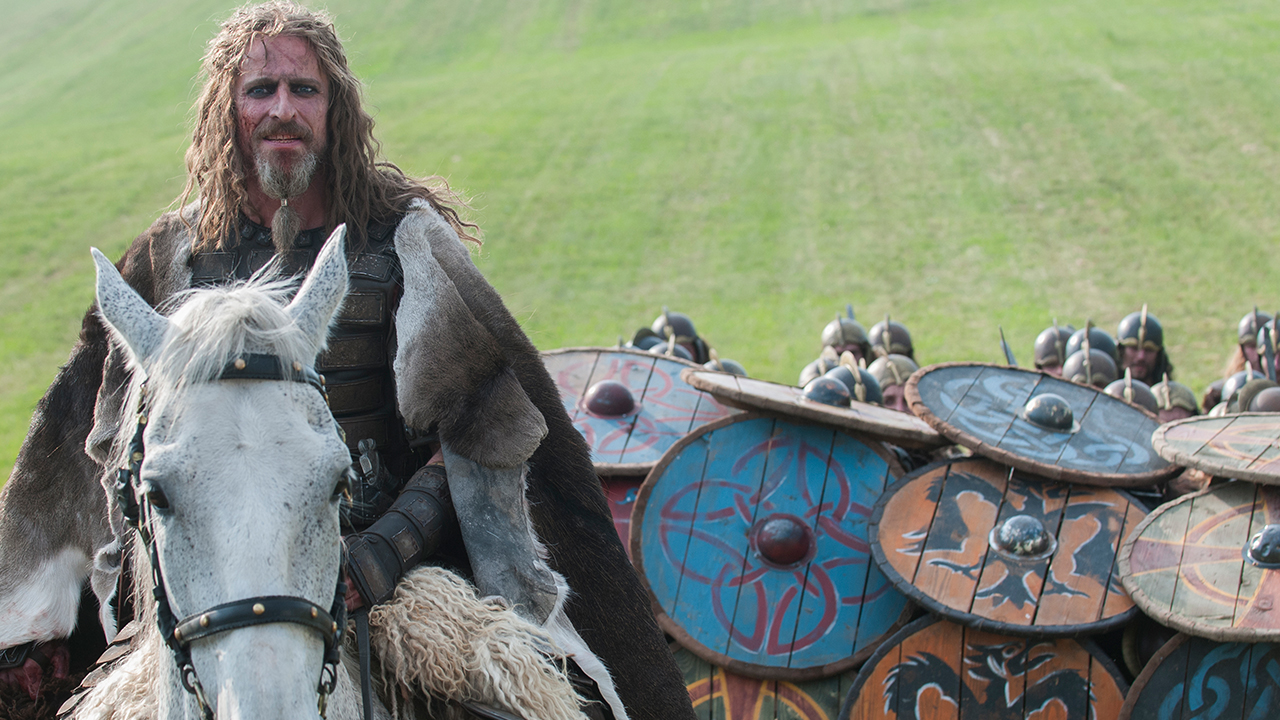 A couple or three weeks ago I had a look at the Last Kingdom, a TV series depicting the period of Alfred the Great and his wars with the Danes. I was referred by friends to a critique of the authenticity of this film put on YouTube by a man named Lindy Beige. Mr. Beige is repeatedly offended by the fact that ninth century warriors wore soft leather armo and all sorts of inexplicable fur and leather accessories. And even the kings are dirty. One of them wears the same clothes for 10 years!
Fair enough – but I have to say that I found the series inexplicably good. When was the last time you saw a commercial video depiction of the Vikings that has nobody wearing horned helmets? In my case I think I can say "never!"
It's also surprising to me that the treatment of Alfred the Great, a man who was very eccentric in terms of his own time, is reasonably believable.
Mr. Beige says sense somewhere in his critique that he has no trouble with the plot or the acting of the last kingdom. Indeed? And you want more?
A couple or three weeks ago I had a look at the Last Kingdom, a TV series depicting the period of Alfred the Great and his wars with the Danes. I was referred by friends to a critique of the authenticity of this film put on YouTube by a man named Lindy Beige. Mr. Beige is repeatedly offended by the fact that ninth century warriors wore soft leather armo and all sorts of inexplicable fur and leather accessories. And even the kings are dirty. One of them wears the same clothes for 10 years!
Fair enough – but I have to say that I found the series inexplicably good. When was the last time you saw a commercial video depiction of the Vikings that has nobody wearing horned helmets? In my case I think I can say "never!"
It's also surprising to me that the treatment of Alfred the Great, a man who was very eccentric in terms of his own time, is reasonably believable.
Mr. Beige says sense somewhere in his critique that he has no trouble with the plot or the acting of the last kingdom. Indeed? And you want more?
Thursday, June 02, 2016
Summon back the fire-witch to the court of the Crimson King
<\p>Did the young George R.R. Martin listen to King Crimson A LOT?
Saturday, April 16, 2016
Murdoch's Mysteries: we live in a new and incredible age
 For about a decade, CBC has been broadcasting an interesting murder mystery series set in Edwardian Canada, or rather, Edwardian Toronto. I have been watching reruns of the show over the last two or three weeks and like most series television, it is much more enjoyable when seen that way.
It would be easy enough to call the show "steampunk" except that the technology that sets the pace in the show is electricity. Murdoch, the lead character, is a Toronto detective who is enthusiastic about modern technology -- x-ray machines, electrical automobiles, movie cameras -- and uses it very effectively to solve crimes. In the course of his adventures he also runs into many leading figures of the time – Alexander Graham Bell, Henry Ford, Tesla, Marconi, Andrew Carnegie, Winston Churchill. He does not run into Sherlock Holmes, but he does run across somebody who thinks he is Sherlock Holmes.
I am also impressed by the depiction of the city of Toronto. Toronto circa 1899 is shown as being multi-cultural and multi-ethnic, wrestling with a variety of political, racial, and social conflicts, which are reasonably realistically portrayed. One of the main characters, for instance, gets in trouble for promoting contraception, which is illegal at the time. Other characters are properly shocked by this and there is a bit of a riot.
I think there may be more in-jokes in the series than I'm picking up. Two days ago I saw an episode where I was pretty sure two characters were modelled after Toronto's Ford brothers. The characters were not politicians, but they looked like the Fords and their personal interactions with each other matched what I know of the Fords.
All too often we think that people in the past were old-fashioned fuddy-duddies. In some places in some areas that is undoubtably true. But in other times people -- or many of them – are seized by an awareness of modernity. One of the great virtues of Murdoch's Mysteries is that it reminds us of that fact. "We live in a new and incredible age," says one character, and she is quite right.
Thursday, January 09, 2014
"Oh, Sherlock, neither of us was the first."
I am astonished by the achievement that is the recent remake of the Sherlock Holmes stories set in 21st century London.
Arthur Conan Doyle's stories always were more than a simple recounting of the accomplishments of the scientific detective who is also, because of his great gifts, a complete social misfit. I am pretty sure that Doyle did not invent that figure. The stories gave almost equal prominence to John Watson, the normal and cheerful friend – normal and cheerful, that is, if you ignore his rather odd devotion to his apparently indifferent friend (?).
The current re-envisioning gives much more prominence to the theme of intimacy and the difficulties of achieving it – not just between Holmes and Watson, but between others as well. 21st century London is ostensibly much freer or at least more freewheeling than Victorian London. But despite social and sexual liberation, the characters in the series struggle to reach out to each other without exposing themselves too much. They are terrified of rejection, and this keeps them just as much on edge as we imagine their 19th century counterparts were.
There must be Holmes fans out there who are raging at this series and its betrayal of some aspect of the canon. But though I'm not entirely satisfied with the stories as told, my basic attitude is one of astonishment at the chances taken by the creators and their rather amazing degree of success. In the last quarter hour of the Sign of Three episode, I sat with my mouth hanging open and my breath bated waiting to see what would come next. And it was the emotional and social struggles of the characters that surprised and yes, ensorcelled me.
Saturday, July 13, 2013
Wit and wisdom from Deep Space 9
Quark, a merchant and a predatory capitalist criticizes the chivalry of his time:
Do you know what I like about Klingon stories?… Nothing! Lots of people die and nobody makes any profit!
Monday, June 03, 2013
George RR Martin, master storyteller

I speak as someone who has read the Ice and Fire books, some of them more than once, but has not been following the TV series week by week. I like many others have criticized Martin in the past for brutalizing his readers and for letting his story grow uncontrollably as he follows many many characters at greater length. I like others have before me the terrible example of Robert Jordan, another author wrote a huge fantasy series but died before he finished it. Pictures of George RR Martin made me think he doesn't follow the healthiest of lifestyles.
Nevertheless, George RR Martin has become a major force in contemporary storytelling. Four times now he has made thousands, indeed millions, scream.
Some years ago, the book version of the death of Ned Stark shocked thousands of fans, many of whom rushed to log on to fan forums and express their passionate response.
Some years later, readers had a similar reaction to the Red Wedding in its original written form.
The TV version of these events have motivated millions to express themselves, to the point that some people said that last night the reaction to the video version of the Red Wedding "broke the Internet."
Anyone who can do that is a master storyteller.
(This may seem to undervalue the contribution of screenwriters, directors and others in the TV version of Game of Thrones, but my reading of interviews with the actors convinces me that they see themselves as following Martin's vision.)
Now this may all be a flash in the pan. There are other TV series that are making a big impact, getting serious discussion in other media, being lauded as cultural touchstones of our era. But I feel it necessary to admit, publicly, that Martin is really something.
Tuesday, August 28, 2012
More wisdom from Babylon 5

Naïve assistant: "But they are a very spiritual people!"
Londo: "Leave that in. That always scares them!"
Wednesday, July 18, 2012
It's too late for the pebbles to vote

"The avalanche has already begun, it's too late for the pebbles to vote."
Monday, April 02, 2012
An Irishman can't help himself -- scorn for Game of Thrones
John Doyle in the Globe and Mail:
A second reason is an aversion to medieval-fantasy material that is ludicrously inauthentic when compared with real history and genuine mythology and legend. I’ve no problem with the Arthurian legends because they arise from a bona fide cultural impulse. As an Irishman of a certain age, I could talk to you till your eyes fell out about the magic of An Táin Bó Cúailnge (The Cattle Raid at Cooley), the central story of the Ulster cycle of legends. It’s about an attempt to steal a particularity fertile bull. But it teems with warriors and magicians, dominated by the god-like warrior Cú Chulainn. There are even ravens swirling in the mist. It shares much with Game of Thrones in surface detail but there’s a powerful, authentic poignancy to An Táin, and a rawness to the action, the work of many hands and storytellers, generation after generation. In comparison, Game of Thrones is slick and contrived.
Saturday, November 05, 2011
Astonishingly good

The most recent episode was classic SVU. It could easily have been in season one -- heck, it would have been a good pilot, introducing the whole series. But somehow it pulled me in, really pulled me in. Was it the acting? The direction? Who knows?
But what really started this train of thought was the previous episode, about a young loser couple whose infant dies mysteriously. It was heartbreaking, and though the case was only marginally an SUV matter, it may have been the best episode ever. Here I have to say that the people who played the young couple were astonishingly good, and the writers should be proud.
Saturday, July 02, 2011
Yoga on TV
Last night while watching one hour-long crime show, I saw three different ads where yoga was used to stand for a healthy lifestyle. Two of them I'd never seen before.
It's everywhere.
And if you want a truly hypnotic yoga TV experience, try Namaste Yoga. An amazing piece of cinematographical design and quite inspiring yoga. And of course the yogis are something else.
It's everywhere.
And if you want a truly hypnotic yoga TV experience, try Namaste Yoga. An amazing piece of cinematographical design and quite inspiring yoga. And of course the yogis are something else.
Wednesday, August 25, 2010
Nipissing history students find the fun in academia

Some readers may disapprove, but seeing as this grew out of a seminar situation, this tickled me:
Yesterday, Matt and I went to Sudbury (Laurentian University) for a conference called "Social Science on the Final Frontier." Essentially, the conference was about the intersection of the social sciences and the science fiction genre. We presented about the conceptualization of the state of nature in the TV series LOST.More fun, perhaps, than reading Thomas More's creepy Utopia (at least, that's how I remember Utopia). More useful? Argue your opinion!
Here's our abstract if you were actually interested in what we were presenting about:
Nasty, Brutish and LOST: the State of Nature in the hit TV series LOST
By: Holly Ann Garnett and Matthew Morris
The state of nature has generally been described as life outside of society, the state, or government. Indeed, many political philosophers have envisaged the human being prior to, or exterior to, these social constructs in order to ascertain the true nature of humanity. Although a primarily hypothetical situation, the closest observations of the state of nature today could be in post-disaster areas, a hijacking situation or perhaps even the archetypal deserted island scenario, like in ABC’s hit science fiction saga of LOST.
Our discussion paper ponders the question: can the situations of ABC’s hit science fiction saga truly be considered the philosophical state of nature? We explore this question through an examination the theoretical underpinnings of this political concept through the writings of Thomas Hobbes, John Locke and Jean-Jacques Rousseau.We find that many of the characteristics of the state of nature that Hobbes, Locke, and Rousseau describe exist in the characters and scenarios of LOST, even if these diverse thinkers describes quite varied situations.
Now, if you were wondering why the heck we did this, it's really borne out of our honours seminar class, in which we ended up making references (and sometimes just talking about) the TV series LOST since we, and our professor, are such big fans of the show. So over the past few months (since April at least) Matt and I have been researching and reading about LOST and political philosophy (yes, academics is THAT fun!)
Image: The brooding, mysterious master of a far-away island.
Subscribe to:
Posts (Atom)