The pro-democracy uprising was propelled by a non-partisan coalition of young activists, who at long last tapped into a current of popular revulsion at the police-state techniques that the regime used to maintain its grip on power.
Whose public interest?
The opposition parties have a role to play in creating an alternative to Mubarak's rule. They are not necessarily well prepared to play this role after decades of hopeless marginalisation by the ruling NDP.
In order to bring about structural change to Egyptian politics they will have to focus not on the social context that makes regime's downfall possible (police state suppression, unemployment and poverty), but on Egypt's laws and constitution.
An end to torture as a primary tactic for maintaining the regime's power will require reforms in a legal system that combines powers of criminal prosecution with police investigation. These two functions are separate in the legal systems of Europe and the United States, but combined in Egypt and in many socialist countries.
The result in Egypt is that the office of public prosecutor (al-niyaba al-‘amma) has the authority to gather evidence in the criminal cases that it pursues. This would be considered an obvious conflict of interest in the United States.
In Egypt it means that a prosecutor who represents "the public interest" (aka the state) possesses powers of police investigation. This leads to systematic torture justified on grounds of it being "in the public interest".
It is no coincidence that when the power of the state was broken on the "day of rage" (January 28th), the pro-democracy protesters attacked many police stations throughout the country.
Police stations, not just the ministry of interior's Central Security Forces, were targeted because the Egyptian public has been subject to systematic torture by a police-judiciary nexus throughout the 30 years of Mubarak's rule.
Showing posts with label torture. Show all posts
Showing posts with label torture. Show all posts
Thursday, February 03, 2011
Torture as a leading issue in Egypt?
So argues this writer at Aljazeera English:


Saturday, January 02, 2010
Torture is still on the table
Andrew Sullivan is one of the few prominent commentators trying to roll back the easy approval of torture as a reasonable or even necessary tactic which of course the United States must use (bold indicates my emphasis):
More here.
The Bush administration treated the shoe-bomber exactly as the Obama administration has treated the pantie-bomber - and convicted him the way no one has yet convicted anyone directly connected to 9/11. But after years of banging the drum for torture as a routine tool for US government, and accountable only to one supreme leader, the right has now shifted the goalposts again. The ticking time bomb is now an ancient criterion. Torture, for Cheney, is about treating every seized terror suspect as an intelligence target, and the entire system he created - of lawless prisons, disappearances, black sites, freezing cells, stress position shackles, upright coffins, neck-braces to slam prisoners repeatedly against plywood walls, waterboards, sensory deprivation techniques, dietary manipulation, forced-feeding, threats against relatives and children - was designed for torture as its end.Marc Thiessen, one of those most committed to institutionalizing torture as part of the Western tradition, wants to torture the Detroit pantie-bomber:
It likely would not be necessary to use the waterboard to get Abdulmutallab to talk — only 3 terrorists underwent it and only 30 had any enhanced techniques used at all. But the vast majority of Americans have it right: You don’t put an enemy combatant who just committed an act of war into the criminal-justice system — and you certainly don’t give him a lawyer and tell him “you have the right to remain silent.” You make him tell you what he knows so you can prevent new attacks.
There is a lie in this, of course. Far, far more than thirty people were subjected to the torture techniques Cheney borrowed from the Gestapo, the Communist Chinese and the Khmer Rouge. Hundreds were treated this way at Abu Ghraib, Camp Cropper, Camp Nama (under the authority of Stanley McChrystal), Bagram and in many secret sites taken over from the KGB (yes, I'm not making this up!) in Eastern Europe.
But here's the critical line:
You make him tell you what he knows so you can prevent new attacks.
That's the line that defines torture. If you can impose enough mental or physical pain or suffering to make someone tell you something you want to hear you have forced them to say something, true or false, to get the torture to stop. The fact of the matter is: this is illegal under any rational understanding of domestic and international law. In fact, domestic and international law mandates that governments do not even contemplate such measures, especially in extreme circumstances.
So National Review is urging law-breaking at the very highest levels of government. They are urging an extra-legal, extra-constitutional apparatus to seize and torture terror suspects outside of ticking time bomb scenarios as a matter of first resort. And yes, if they are advocating it against the pantie-bomber now, days after his capture, it is a first resort.
This is how far Cheney and the pro-torture camp have moved the debate, and why Obama's calm attempt to overlook it is dangerous in the message it sends. What the Cheneyites themselves once refused to do, with Reid, they are now demanding Obama do to the pantie-bomber.
Wednesday, May 13, 2009
Reminder from the Star Trek universe

Torture, taking glee in torture, and justifying torture are characteristics of the bad guys.
Image: on a more cheerful note, isn't it great when moviemakers now need to depict the Saturn system, they can accurately do so?
Sunday, May 03, 2009
Torture works, of course. But for whom?
For the Dark Lords of Torture, who are living in comfort and respectability. So far.
Update: but then there's the reassuring fact that the fourth-graders care.
Update: but then there's the reassuring fact that the fourth-graders care.
Wednesday, April 23, 2008
More of this, please
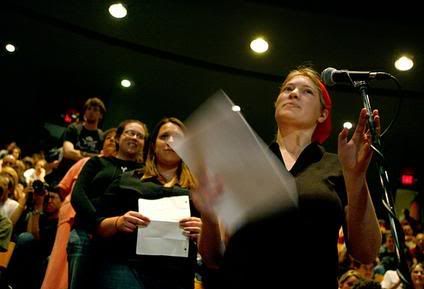 Last night at Knox College, Illinois, site of one of the Lincoln-Douglas debates, John Ashcroft, former US Attorney General tried to justify his legacy of torture and government spying. The students weren't having any of it. Read all about it at DailyKos.
Image: The Q&A session.
Sunday, April 13, 2008
Lies by omission
The Group News Blog says it:
And the story can barely be found even on Google News.
When people bemoan the Internet-induced death of quality journalism, remember this. The quality journalists, and they exist, are not allowed to do their work if the topic is really vital.
...the most shocking thing this weekend is the complete silence from the corporate media on this. 6 of the top people in the Bush administration were meeting for over a year, in the White House, to discuss torture techniques and the President knew and approved of it.
And the story can barely be found even on Google News.
When people bemoan the Internet-induced death of quality journalism, remember this. The quality journalists, and they exist, are not allowed to do their work if the topic is really vital.
Thursday, April 10, 2008
"History will not judge this kindly."
You bet.
ABC News reports that we now know who in the US government approved torture. Watch this:
I am sorry not to have a more cheerful subject to break my grading-related blogging silence, but some things need to be spoken immediately.
I rather like the statement by Colin Powell that implies he might not be able to remember discussions of the sort reported. You are a real hero, Colin. An example to the children of America. (That link not for those who are creeped out easily.)
Update: For those of you who care about the Constitution, see this (from talkingpointsmemo.com).
ABC News reports that we now know who in the US government approved torture. Watch this:
I am sorry not to have a more cheerful subject to break my grading-related blogging silence, but some things need to be spoken immediately.
I rather like the statement by Colin Powell that implies he might not be able to remember discussions of the sort reported. You are a real hero, Colin. An example to the children of America. (That link not for those who are creeped out easily.)
Update: For those of you who care about the Constitution, see this (from talkingpointsmemo.com).
Tuesday, February 26, 2008
Terror victim's body found

Just as my course on Medieval England got up to the reign of Edward II, what should come out in the news but the identification of a medieval corpse at Hulton Abbey, Staffordshire as that of Sir Hugh Despenser the Younger, a great favorite of Edward II, who was executed by "drawing and quartering" in 1326. "Drawing and quartering" was a horrible process which involved disembowlling the victim while still alive, and it was reserved for notable traitors.
The news articles are emphasizing that Edward II was possibly gay and Sir Hugh may have been his lover. In yesterday's lecture I emphasized that Edward was a man constitutionally addicted to listening to and favoring a small number of intimate friends while ignoring everyone else in the kingdom, including his wife and his "natural advisors," the earls and great lords. Sir Hugh and his father of the same name used their position to make themselves rich by plundering the heritages of others' families. This as much as any sexual transgressions made them hated, to the point that Queen Isabelle was able to use their behavior as a reason to overthrow the king in favor of his teenaged son, Edward III.
So why am I calling the greedy and vicious Hugh the Younger a "terror victim?" Note that I didn't say he was an innocent victim of terror. His execution, however, was meant as an object lesson: Lords and gentlemen, don't try to duplicate his illegitimate power! The Telegraph article I linked to above tells readers that he was executed before a "mob," to teach a lesson to the "masses." Well, I think however many people were present, and whatever their station in life, the main lesson was meant for the very restricted political class of England; mere disrespectful nobodies might get in trouble but they would not be given Sir Hugh's elaborate treatment.
Also, I have a problem with the word "mob." Its use implies that the members of it are the scum of the earth. Possibly true, but often not the scum you are thinking of. Many mobs are led by people with big political ambitions, or their direct henchmen, or henchmen of henchmen.
I remember about 20 years ago reading about the Toronto mob that destroyed the print shop of the reform newspaper of William Lyon Mackenzie in the 1830s. That mob was made up of members of the colonial governor's council, or their hangers-on. A zillion similar examples can be found in other eras and places, once one puts away the illusion that "mobs" are made up of opportunistic ordinary criminals.
I'll bet the mob of 1326 was, on average, a really well-dressed group.
Image: A 15th-century depiction of this execution from a ms. of Froissart's Chronicles.
Promoted from comments:
Phil Paine adds:
I recently read a half dozen books on the phenomenon of lynching. It's foundation in political culture rather than "human nature" seemed pretty obvious. During a period in which there were more than 3,000 lynchings recorded in the U.S., there were zero in Canada, and thorough efforts have been made to find them. The only known event was a case where an American probably murdered his wife, then organized a lynch mob to pursue a 14-year-old boy across the border into Canada, where he was tortured and then hanged. Subsequent evidence makes it clear that the boy was a diversionary scapegoat.
What leaps out of the evidence, but seems to escape the notice of the historians, is that time after time it is clear that the "lynch mob" was planned, organized, and lead by a local bigwig --- a wealthy landowner, merchant, or politician. For example, in the case cited above, the leader of the mob was a wealthy local citizen who later became a State Senator. In the west, the typical "classic lynchings" were lead by wealthy cattlemen seeking to dispose of farmers or small ranchers who wouldn't sell their land. The great wave of lynchings in the South, starting in the 1830's, were aimed at shutting down newspapers that might be sympathetic to abolitionism. Lynchings were organized by prominent southerners, and included elaborate expeditions, going hundreds of miles into Northern states to kill free blacks or the editors of abolitionist newspapers. In one case, the "mob" organized an excursion train with reservations, and printed instructions.
Southern pro-slavery newspaper editorials created a systematic myth that these events were spontaneous expressions of "grass-roots democracy" or at least understandable excesses of human nature outraged by fear of crime. Many northern papers accepted this propaganda and echoed it. Few now realize that the Civil War was preceded by decades of terrorist raids on the North, organized by the wealthy elite of the South. That alone made the war inevitable.
Yet in most of the books I read, the authors seemed to ignore their own evidence, and clung to the notion that lynching expressed a spontaneous aspect of human nature, or was a sociological side-effect of the "frontier" and its supposed absence of legal infrastructure.
This delusion ignores the facts that 1) Canada, which was far more of a frontier society than the U.S. during the lynching era, had no lynchings 2) most cases of lynching involved an organized mob breaking into a jail, removing a someone who was in the hands of the law, and killing them, usually after extended torture (burning alive, etc) 3)people who had been found guilty and were going to be executed were lynched just as often as those where the case was not concluded. 4) the heaviest concentration of lynchings was in areas that were far from the frontier, often areas settled for centuries.
Wednesday, February 20, 2008
Guantanamo terror trials fixed
The former chief prosecutor for the Guantanamo terror "tribunals" has gone public with the information that his eventual superior in the chain of command reacted this way to the idea that acquittals might make the process look better:
This from the Nation, via Talkingpointsmemo.com.
I wonder if this will get out into the press generally, especially in Canada. One of the six detainees is Canadian, imprisoned and by some accounts tortured since he was 15. Our government has done nothing to get him fair treatment.
Update: The AP reports that the prosecutor in question, Col. Morris Davis, may testify for the defense in one of these "trials." Imagine how angry, or ashamed, he must be. Thanks again to Talkingpointsmemo.com.
'Wait a minute, we can't have acquittals. If we've been holding these guys for so long, how can we explain letting them get off? We can't have acquittals, we've got to have convictions.'"
This from the Nation, via Talkingpointsmemo.com.
I wonder if this will get out into the press generally, especially in Canada. One of the six detainees is Canadian, imprisoned and by some accounts tortured since he was 15. Our government has done nothing to get him fair treatment.
Update: The AP reports that the prosecutor in question, Col. Morris Davis, may testify for the defense in one of these "trials." Imagine how angry, or ashamed, he must be. Thanks again to Talkingpointsmemo.com.
Friday, December 14, 2007
Torture
It revolts me that we have to say more about torture than, "the torturers are the bad guys, all the same bad guys, whatever they call themselves," but we do. And since we do, it is good to note that the inglorious Washington Post, enabler of so many government lies over the past five years, has published a useful article by Darius Rejali on Five Myths About Torture.
In further torture news, high ranking American officials are doing their level best to dissociate themselves from torture by destroying evidence and blocking investigations. See the invaluable Talking Points Memo on obstructionism by Republican senators to prevent a torture ban, obstructionism by the Department of Justice in an investigation of the CIA torture tapes, and a refusal from the Attorney General to discuss with Congress the now-destroyed torture tapes.
In further torture news, high ranking American officials are doing their level best to dissociate themselves from torture by destroying evidence and blocking investigations. See the invaluable Talking Points Memo on obstructionism by Republican senators to prevent a torture ban, obstructionism by the Department of Justice in an investigation of the CIA torture tapes, and a refusal from the Attorney General to discuss with Congress the now-destroyed torture tapes.
Subscribe to:
Posts (Atom)