Showing posts with label medieval history. Show all posts

Wednesday, August 15, 2018

White supremacy and medieval re-creation

An alarming situation for those of us who have been doing re-creations for fun for the last long time. Forwarded by Matt Gabriele from the Daily Beast. Note: is there any reference to a real Renaissance fair?
A lawsuit against a hoard of far-right groups, including the TWP, accuses them of using their shields like weapons. In order to escape litigation, a number of the groups in the lawsuit have agreed not to return to Charlottesville with weapons, including shields. Meanwhile, other medievalist communities have also struggled with alt-right incursion—and in the case of the Historical European Medieval Arts (HEMA) community, those unwelcome factions have more deadly weapons. Mondschein, the history professor and HEMA instructor, said the community is overwhelmingly a tolerant one.

But over the past several years, he has catalogued a far-right fascination with the field, which includes fencing and dueling with very real, very sharp swords. “Is anyones else besides me into [HEMA]?” a person with a swastika avatar asked in Iron March, a now-defunct Nazi forum. Mondschein included the post in a presentation at last year’s International Congress on Medieval Studies, where he gave a talk on white supremacist trends in his sport. He also conducted a survey (which, he stresses, is not peer-reviewed) of more than 300 HEMA participants, in which 10 to 15 percent of respondents indicated that they held far-right views. “Using hard plastic shields as battering rams, the group charged into a crowd of unarmed counter-protesters, shoving them on the pavement and stabbing them with flagpoles.

” tRadix Journal, a white supremacist site published by Richard Spencer, has run multiple pieces promoting HEMA, selling it as a more authentic medieval experience than games like Dagorhir. https://talkingpointsmemo.com/edblog/forget-about-impeachment“This ain’t LARPing,” one Radix article reads. Larry McQuilliams, a Texas man who attempted to destroy Austin’s Mexican Consulate with bullets and bottles of propane in 2014, was described by neighbors as being into “martial arts swords” and Renaissance Faires. McQuilliams, who was killed in a firefight with police after firing more than 100 shots in downtown Austin, was reportedly affiliated with the Phineas Priesthood, a Christian identity hate group that advocates violence against people of color. And just months ago, the HEMA community erupted in controversy after some of its best-known Swedish fighters were revealed to have liked or shared historical Nazi propaganda, or other racist imagery. In a long statement, the most prominent of the fencers, Axel Pettersson, denounced his old “Nazi jokes” as the product of a dark period in his life, for which he apologized. Pettersson said he was not a white supremacist and had friends of many races, but went on to describe views similar to that of the identitarian movement, warning that immigrants are “replacing” white Swedes, who “have the right to our own country.

“A lot of people are drawn to HEMA and other medievalist subcultures like the Society for Creative Anachronism because it fits into their overall Identitarian worldview, their ideas of European culture,” Mondschein said of the incident. “Particularly, these people in Sweden who attempted to hide their participation in some white supremacist websites, but if you read their various blogs and writings, you see it that it fits into an overall worldview that romanticizes an imagined homogeneous past.” In this “imagined past,” as medievalists describe it, historical accuracy often takes a backseat to fantasy. Neo-Nazis and European nationalists have laid claim to Beowulf, an Old English epic poem about a Norse warrior, which they interpret as a vision of an all-white warrior society. When a charity group produced a low-budget Beowulf adaptation starring a black actor in 2007, they received death threats from self-proclaimed “aryans”. On the recommended reading page of one of its websites, the murderous neo-Nazi group Atomwaffen lists the medievalist fantasy series Lord of the Rings alongside Hitler’s writing and texts that advocate terrorism. “You often had white southerners after the Civil War imagining themselves as characters in Ivanhoe and holding medieval-style tournaments as public recreation.”

Also on the Atomwaffen-approved reading list are three books by Varg Vikernes, a Norwegian musician who, in between prison and probation stints for murder, church-burning, and inciting racial hatred, has promoted his own brand of pagan white supremacy. Vikernes’ profile picture on his Amazon page shows him wearing a chainmail shirt. He describes himself as being interested in “tabletop role-playing games, HEMA, archaeology, pre-history, pre-Christian European religion and survivalism.”
Historically questionable fiction about medieval Europe has been fueling white supremacist fantasies for the past 150 years, Whitaker, the Wellesley College professor said. “In the 19th Century, it was largely through medievalizing novels like Sir Walter Scott’s Ivanhoe, which was probably the biggest and most well-known example,” he said. “That novel played a big role in racial politics in the mid-19th Century, before, during, and after the Civil War.” The result, particularly after the Civil War, was its own brand of LARPing. “You often had white southerners after the Civil War imagining themselves as characters in Ivanhoe and holding medieval-style tournaments as public recreation,” Whitaker said. “This was a way of recuperating their experience in the American Civil War as the medieval experience of Norman versus Franc.

That is one instance of a way in which this narrative of an all-white Middle Ages has been important to white supremacy for a long time.” Much in the way that would-be Confederates leaned on the “imagined past” of medieval England, modern racists have poured millions into an imagined Confederacy. Most of the Confederate flags and statues that dot the U.S.’s southern states did not appear during or immediately after the Civil War, but a century later, during the Civil Rights Movement. Though the statues’ advocates defend them as a symbol of pride and heritage, the construction of new Confederate sites has spiked during racialized conflicts, the Atlantic previously reported.
That LARPing lineage came full circle at Unite the Right, which was initially described as a rally in defense of a Confederate statue in Charlottesville. Now, with members of their communities marching among fascists at Charlottesville or sharing Nazi pictures, some anti-racist medievalists are fighting back. “It is safe to say that there are white supremacists and Nazis who are ACTIVELY using Dag as a personal and organizational training ground to give them an edge in premeditated race riots,” one Dagorhir participant wrote on Facebook after Walsh was revealed to have marched at Unite the Right. Dagorhir Battle Games, the sport’s organizing body, soon banned Walsh from future competitions.

But in HEMA, weeding out white supremacy can be more complicated. “The difficulty is that this idea of aboriginal European martial arts works very well as a dog whistle,” Mondschein said. “It’s very hard to detoxify that. We have people who are interested in this, and we have overt political statements.” Debates over the sport’s next steps have led to a “real split. I got challenged to a duel with sharp weapons” over his stance, Mondschein said.

That LARPing lineage came full circle at Unite the Right, which was initially desc Even medievalist academics are torn on how to address their field’s unwanted fanbase on the far-right. The rift turned bitter ahead of this year’s International Conference on Medieval Studies. Kim, the Brandeis professor, had previously called on her colleagues to condemn white supremacy. Some, including a University of Chicago medievalist who contributes to Breitbart, refused, resulting in a flame war against Kim and colleagues, Inside Higher Ed reported.

Whitaker said the recent tensions in his field haven’t surprised him. “The field propagated this idea, relevant since the 19th Century, of a homogeneously white Middle Ages and attracted people into the field—obviously not everyone, but some people—who thought ‘okay, I can deal with literature or history and not deal with these knotty modern problems of race,’” he said Kim told The Daily Beast she’s still calling on colleagues to address their field’s white supremacy problem head-on. “I think academics must counter academic white supremacy by calling it what it is and resisting it,” she said. “In other words, this is not a both-sides debate, this is about genocidal fascism that wants to harm the most vulnerable bodies in our society—Jews, Muslims, women, BIPOC, LGBTQIA, immigrants, refugees, etc.” As for the white supremacists LARPing alongside non-Nazis, their medieval enthusiast peers want them to drop the foam swords and step into reality. “In many ways, it’s a reaction to the current state of the world. This is their answer to it, by going back to the imagined past, which is of course futile, because you can’t turn back the clock,” Mondschein said. “You’ve got to learn to live in the world we’re in.”

Friday, August 10, 2018

Matt Gabriele scores!

I don't know how he managed it, but Matt Gabriele, a medieval historian at Virginia  Tech,is now writing a column for the business publication Forbes.  From my initial perusal, it looks like he interested in emphasizing the diversity of medieval culture.  See, for instance, his post on the Black Death  and the disappearance of the Norse colony in Greenland:

...The disappearance of the settlements might be further proof of just how transformative the Black Death really was for Europe. In a book published after his death in 1991, Prof. David Herlihy suggested in broad outlines the tremendous long-term cultural and intellectual changes brought about by the Black Death. Much of his conclusions have been challenged in recent years but Herlihy's genius was putting his finger on just how the massive scale of death changed the way people thought about themselves and their relationship to the world. Established authorities were questioned since they had no good answers to ending the plague. Social class was upended as economic and cultural communities struggled to replenish their ranks. If the settlement in Greenland left the island uninhabited for a century or more, this would support Herlihy's thesis about long-term change.
In other words, the findings of this research both challenges and confirms what medievalists have thought about their period for some time. In other words, as I've mentioned elsewhere, the research being done on the Middle Ages is exciting precisely because it oftentimes both confirms how much we already know about the period, while paradoxically reminding us of how much about the past there still is to discover.
I'll be curious as to how long this column continues.

Thursday, November 21, 2013

A mere ripple

C.S. Lewis, from his classic essay, "Courtly Love:"

Compared to this revolution [the invention of the "romantic species of passion" by medieval poets] the Renaissance is a mere ripple on the surface of literature.
Now that was a real, take-no-prisoners medievalist!

Monday, December 19, 2011

Matthew Gabriele's book reviewed in The Medieval Review

Gabriele, Matthew. An Empire of Memory: The Legend of Charlemagne,
the Franks, and Jerusalem before the First Crusade
. Oxford: Oxford
University Press, 2011. Pp. xii,  202. $90.00. ISBN: 9780199591442.

 Reviewed by Thomas F. X. Noble
     University of Notre Dame
     tnoble@nd.edu


"Charlemania" has been a growing industry in recent years and Matthew
Gabriele now takes a significant place on the shop floor.  His brief
and readable book demonstrates how, especially in the eleventh
century, a Frankish "Golden Age" was constructed, and with what
consequences.  There is a line in Flannery O'Connor about the danger
of parking your buggy on the track when the Dixie Special is coming
down the line.  Gabriele is the buggy and Anne Latowsky's forthcoming
book is the Dixie Special.  Nevertheless, I do not think the buggy was
flattened by the train.  I really like this book and learned a lot
from it.  Occasionally its prose is over the top and, in many
instances, it is more colloquial than some traditionalists find
congenial.  The argument and research are critical, thorough, and
sound.

Gabriele's method is basically aggregative.  He continually puts
layers of evidence on top of each other until they add up to a
cohesive, coherent picture.  In the first chapter "The Birth of a
Frankish Golden Age" gives away the story and the remaining chapters
flesh it out.  Gabriele shows, following other good scholars, that in
the ninth and tenth centuries, Charlemagne was not always visible and
was often contentious when he did emerge.  Yet a deep tradition was
implanted.  Then he, and with him his age, became a figure of prime
interest, a holy figure, and the ruler of an empire that stretched
from Iceland to Jerusalem.  Demonstrating these points alone would
have been original and important but what sets this book apart is its
careful explanation of how and why this happened and why it matters.
Specialists in vernacular literature know perfectly well that
Charlemagne exploded in the twelfth century.  Robert Folz famously
showed that the liturgical Charlemagne took flight in the same period,
only to soar ever higher in later times.  Anne Latowsky, who
ironically teaches in a French department, is going to reveal the
continuing power of the Latin tradition.  What we have lacked is the
essential background.

Interest in Charlemagne appears in various settings.  For example, 68
of 97 forgeries of Charlemagne's charters come from religious houses
that sought to claim him as their founder.  No other ruler even comes
close as a "source" of legitimacy.  But historical writers added to
the dossier, beginning with Benedict of St. Andrea who, around 970,
was the first to attribute to Charlemagne a journey to Jerusalem.
Materials dating from the late eleventh century and stemming from
Charroux also have this fictitious journey.  Around 1080 the
Descriptio Qualiter also has the story and adds a visit to
Constantinople where Charlemagne received relics and acknowledgment.
Crusade narratives sometimes said that armies followed Charlemagne's
path to the East.  These sources seem to have drawn on a common fund
of tradition;  they are not demonstrably dependent on one another.
Little by little Charlemagne was portrayed as the preeminent earthly
power.  Why?

Drawing on late antique and biblical resources, the Carolingians had
defined their realm as a Davidic kingdom based on Old Testament models
with Aachen as a new Jerusalem (it was a new Rome too, but that is not
Gabriele's theme).  In the post-Carolingian world, Jerusalem assumed
growing prominence.  More churches emulated Jerusalem's churches,
especially the Anastasis.  The liturgy increasingly drew on themes
pertaining to Jerusalem.  Relics of the passion proliferated.  This
constant and rising emphasis on an imaginary Jerusalem made the
tangible city more important, more desirable.  The eleventh century
witnessed a dramatic increase in pilgrimage to the Holy Land.  In 1026
Richard of St.-Vannes led perhaps 700 people to the East and then both
the number and size of pilgrimages expanded sharply.  As many as
12,000 people left Germany for the Holy Land in 1064-65.

The Carolingians uncoupled empire from Rome which opened up real and
imagined possibilities for assigning Charlemagne rule over all kinds
of lands and peoples.  The imaginary and expanded Carolingian Empire
came to be seen as a kind of imperial Christendom with roots in an
historic past but relevance in a fraught present.  Prophetic texts
said that at the end of time a Frankish king would lay down his
scepter on the Mount of Olives and thereby bring Roman and Christian
imperium to an end.  So an "empire of memory" lived on and one of its
key dimensions was that a Frankish ruler would defend Christendom from
its enemies right to the end.  In complex ways Antichrist, pilgrimage,
Charlemagne, and a Christomimetic emperor entered a coherent
narrative: "Charlemagne's militant, Frankish, Christian empire
prefigured the Last Emperor's;  and in the eleventh century, past and
future began to converge" (128).

Talking about Charlemagne was, thus, a way of unlocking a glorious
past that mattered in new ways in the present, particularly as that
past was seen as a militant one.  Gabriele has much to say about the
coalescence of a European identity built on a constantly shifting
Frankish one.  He demonstrates the importance for historians to be
attentive to many kinds of sources.  To be sure, he is alert to the
potential relevance of his findings for the First CrusaSde.  But he is
wise enough not to claim that he has explained that phenomenon.  Urban
II, Gabriele notes, never mentioned Charlemagne.  But Urban's words
were sounded, and resonated, in a world with a thick web of
associations which Gabriele disentangles beautifully.

In addition to his, let us say, empirical findings, Gabriele has
another agenda that will give the attentive reader a lot to think
about.  He quotes (66) Keith Michael Baker--a distinguished historian
of modern France--who said that "[h]istory is memory contested;
memory is history controlled and fixed."  I might have wished that
Gabriele's approach to this fascinating, original, and important
exposition of the theme was a little less allusive, or implicit, but I
think he is absolutely correct to place emphasis on how, with specific
reference to Charlemagne, history and memory were manipulated,
adjusted, intertwined, and differentiated.

Here is a suggestion: take Gabriele's book, Amy Remensnyder's
Remembering Kings Past (1995), Jay Rubenstein's Armies of
God
(2011), and Anne Latowsky's forthcoming (2012) book and teach
a terrific seminar.

Monday, December 21, 2009

Carnivalesque #57


A fine collection of recent posts from Ancient and Medieval blogs, collected at Zenobia: Empress of the East. Read!

Sunday, November 15, 2009

Blogging history

Monday, June 29, 2009

Medieval notes from my blog reader

Two blogs I regularly read contribute material worth passing on.

Another Damned Medievalist at Blogenspiel shows how you can just skip grad school entirely (not exactly what she said) yet still do an acceptable job of reading medieval charters. Go look and learn!

Did you know that today is the anniversary of the Battle of Kosovo? And some famous 20th century killings associated with it? If you don't know what I'm talking about, see what Jeff Sypeck has to say at Quid Plura?

Friday, May 29, 2009

Medieval women's magazine?


That is what the Toronto Star called this 15th century manuscript unearthed by Wilfrid Laurier University English professor James Weldon. More properly, it is a commonplace book, an interesting genre of writing not unlike blog writing (or better, diary writing) in some respects. Janice Liedl, a Laurentian University historian who has worked with such things, comments on the Star article:

While the Star’s characterization of the work as a precursor to a modern women’s magazine in the vein of Chatelaine or Cosmopolitan is a little bit over-the-top, it does seem to be a great example of a purpose-assembled collection of manuscript material ranging from medical recipes to literary excerpts, what we might call a florilegia [florilegium sm]. By the sixteenth century, these collections were known as commonplace books. And, contrary to the comments of some of the newspaper readers, literate women were hardly unknown at this time or uninvolved in producing their own manuscripts of either original works or anthologies. So this document is hardly unprecedented but I’d say it’s because of that context that the story seems all the more interesting.

I’ve worked with a number of women’s commonplace books at libraries such as the Folger (and really ought to get back to some of that line of enquiry, one of these days) that have a similar range of subjects, though most of those seem to be in the hand of one copyist, presumably the user who collected the tidbits of particular interest by copying them as they were encountered, rather than literally pulling folio sheaves together. This manuscript, from the images provided, has very different “hands” and might be assembled from different texts produced at many times and places. So it seems as if this set of texts have been more “collected for” an individual reader than “collected by” an individual copyist as most of the commonplace books have been.

So I’ll wait to see if some more information about this manuscript percolates out into the scholarly community. It’s certainly an example that I’ll be using in this fall’s senior seminar when we discuss gender implications for reading and writing in the early modern period!

Sunday, May 17, 2009

Robin and Marian (1976): the middle-aged Middle Ages

Robin Hood comes back to England after 20 years away, crusading and fighting in France, and finds that his old love, Marian, is now an abbess. And she is not young, or particularly impressed by his devil-may-care attitude. Everybody else Robin knew back when is old or dead. Nevertheless, he proceeds to try to live up to his own self-image and the even bigger legend that has grown up around him in his old neighborhood. The results are tragic, though derived from an actual Robin Hood ballad.

This is a remarkable movie. It stars Sean Connery, Robert Shaw, and a luminous Audrey Hepburn. The screenplay author is James Goldman, who wrote the Lion in Winter and They Might Be Giants. The director was Richard Lester, who gives this material an unheroic treatment similar to that which he gave to the Three Musketeers and the Four Musketeers a few years earlier. The physical setting, the buildings and the costumes are very good if not perfect. What really makes the movie is the psychological reality, of Richard Lionheart dying of his own greed and determination to be a king, or the contradictory impulses that drive Marian's behavior.

I probably should not say that this is a movie about middle-aged people for middle-aged people, but it is, and I mean it as a compliment. I certainly can't think of a better historical movie of this sort.

Wednesday, May 13, 2009

Congress, 2009

Kalamazoo Congress, that is.

I had more enjoyment, intellectually and socially, this time around than I can remember -- and I am a great fan of the Kalamazoo get-together. When before have I picked all good sessions and all good papers? Whenever have I had so much good companionship? I am not complaining about previous experiences, not in the slightest!

My paper on arms and law in the 1350s had the good fortune to be part of the popular De Re Militari series, and it was well attended. The response made me think that when I do write my book on Charny's Questions on War, there will be a reasonable audience for the work. Reassuring! I am also to have an opportunity to speak on the subject of my choice in two years' time. By that time, perhaps, I will have a chance to reread "The Chronicle of the Good Duke," and come up with something of general interest from it. (Some of you may laugh at that choice, but there really is such a book, and it's good.)

Saturday, April 18, 2009

Carnivalesque 49 -- Ancient/Medieval edition, April 2009

This is my first time editing Carnivalesque, the blog carnival that alternates between early modern (c.1500-1800CE) and ancient & medieval topics (up to c.1500CE). I hope you like my selections, which I've been collecting for a while.

Those of you who missed Carnivalesque 48 may have missed the announcement that medievalist Judith Bennett's History Matters: Feminism and the Challenge of the Patriarchy was to be the subject of a roundtable discussion by a series of feminist historians, with each post touching on some important questions about what it means to be a historian, what it means to be a feminist, and what it means for the two to intersect. The first discussion was hosted by Notorious PhD, and you can follow the now-complete series from there. Don't forget the freestanding comments by Magistra et Mater; the first of six is here. This excellent and substantial blogger has also recently delivered a well-deserved, commonsensical whack to that 18th-century sacred cow, "rational economic thinking."

Speaking of women in history, and neglected ones at that, did you know that Queen Zenobia hath a blog? Yes, the third century rebel against/savior of the Roman Empire in the East? Actually, it is Judith Weingarten who has the blog, Zenobia: Empress of the East, which is about that lady but includes other things as well.

Those of us who study distant but colorful eras (like Zenobia's) find our work all too often completely ignored by a public that would go nuts if they only knew what they were missing. If you write a book called Becoming Charlemagne, as Jeff Sypeck has, you are unfairly doomed to obscurity. Or are you? Go on over to Quid plura? and let Jeff explain to you why his opus should be the next pop-culture TV blockbuster series. After all, there is plenty of precedent; ancient material is very much at home on the Internet, as the alert Jennifer Lynn Jordan at Per Omnia Saecula, among others, have discovered for us.

I am a textual historian myself, but I have a lot of respect for people who deal with the material remains of the past, or reconstruct them. There are some good blogs out there on material culture. Darrell Markiewicz, a longtime blacksmith and historical metalworker talks about his work on a regular basis at Hammered Out Bits. Two of those "bits" caught my eye in the last little while. The first was where Darrell recanted his skepticism about legendary weapons made of meteoric iron. No such of a thing, he thought, until he stumbled across new evidence in the form of a wondrous weapon. I am glad he was honest enough to admit his mistake, otherwise I would never have known! He also put some time into reconstructing one of the first trademarked objects of northern European origin, +ULFBERHT+ swords. Don't miss his discussion of them.

From iron to slate: Jonathan Jarrett over at the excellent A Corner of Tenth-Century Europe reminds us once again that some Visigothic charters were written on stone, even though I don't think Jonathan's ever had the pleasure of handling such document. A good time to bring up hard copy in Iberia; at the other end of the peninsula, the most extensive inscription in the ancient Southwest Script has recently been found, which like all others on this sort was written on slate. Stephen Chrisomalis at Glossographia tells the story and supplies the links.

Will McLean at A Commonplace Book, also working at a bit of a remove from the originals, wants to know what an écranché shield was, what a targe was, and what an ecu was. Will, like me, is interested in late medieval deeds of arms, and for all I know he is building authentic shields as we speak. He is a serious reenactor and has built some amazing stuff in the past. He has worked on texts as well: this time he supplies us with a link to a fine article on German tournament rules of the 15th century.

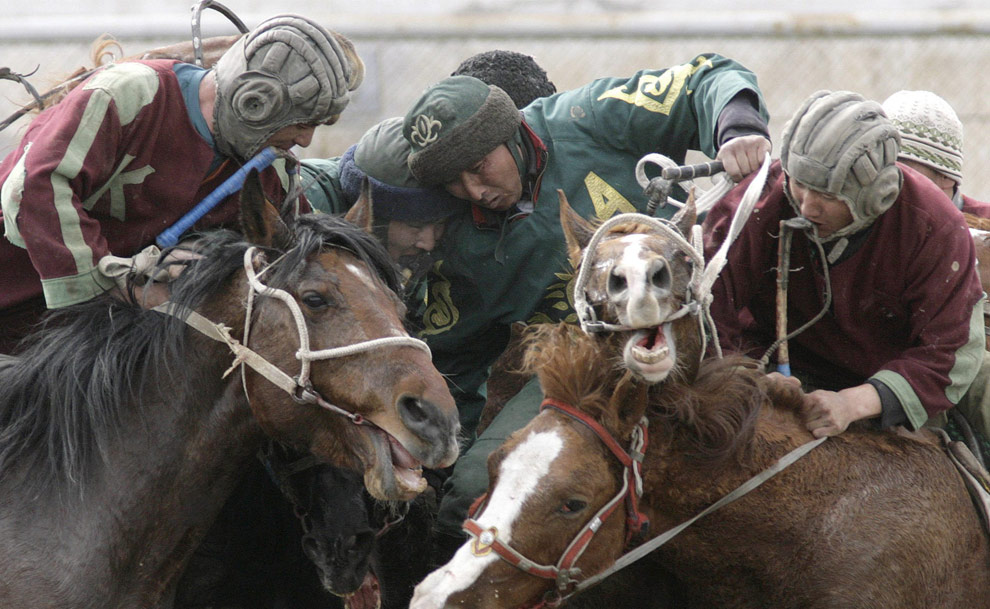
A tournament/jousting fan? Don't miss the 16th-century Burgkmair Tournament Book at the beautiful and new-to-me booksite, BibliOdyssey. For me, however, it is hard to beat the visual impact of two photos from Kyrgyzstan, where the sports of the medieval nobility survive: Kok-boru (the same game as Afghan Buzkashi) and falconry, if that's what you call it when they use golden eagles instead of hawks and falcons. Both of these come from The Big Picture, the regular news photo blog from Boston.com, one of the treasures of the Web.

One of the joys and/or torments of being a serious student of the farther past, whether as a pro or as a well read amateur, is the opportunity to try to correct popular and journalistic clichés about our favorite times. I say "try to correct" advisedly, because these things never get corrected -- there is an infinitely deep pool of misinformation, and journalists in particular seem to know exactly where it is. However, the effort of correction sometimes reaches the few people who actually care, and sometimes produces witty results.

I, for example, would never have learned about the new medieval datum about the Robin Hood legend if various intelligent bloggers had not been irritated by superficial reports of it. The superficial reports seem to focus on the idea that not everybody loved Robin Hood. no wonder the papers made such a fuss! He must be the only person in history not universally popular. But the blog Medieval News filled me in on the substance behind the writeups, and medievalists.net had even more. Thanks!

And did you know that the hamster wheel was a medieval invention? Well, the people over at ESPN.com do, and surprisingly enough they are right! At least, Carl Pyrdum at the ever-reliable Got Medieval traces it back indeed to late antiquity and Boethius' underappreciated second work on consolation, The Consolation of Owning a Pet Hamster. Even experts in illumination and sixth-century philosophy may be surprised to hear that some striking pictures from this work still survive!

Alas, not all journalistic historical discoveries and popular misconceptions are created equal. Jonathan Jarrett has a rant, a very substantial and entertaining rant on Celtic fonts and interlace. A perfect example of how a good rant can be cathartic not just for the writer for the reader as well.

Myself, sometime in the last while I was tempted to rant or at least poke fun at, costume advertising featuring the Deluxe Barbarian Queen. But then Eileen Joy came along at In the Middle and showed me that I should not; at least not without some thought. In all seriousness it was a moment of enlightenment.

To tie this up, let me mention that Paul Halsall, that benefactor of all humankind, and especially students and teachers of the past, blogs over at English Eclectic. It's usually personal observation, but it's not seldom, well, heaven on earth or something much like it.

And, oh yes! Nokes is back. Now that he has a fully-functional computer, the Wordhoard is Unlocked once more.

Friday, January 02, 2009

Karen Larsdatter's site


I know I mentioned this site long ago, but I lost track of it, and I am sure that many of my readers have never heard of it.

Actually Karen Larsdatter, one of those public benefactors like Roger Pearse, has two projects worthy of note. The first, Material Culture Linkspages for the Middle Ages and Renaissance, I will let her describe herself:
Links to material culture (stuff!) from the Middle Ages and Renaissance, including representations in period artwork. Some of these focus on garments, or surveys of occupational dress, or even animals. For a complete list of the linkspages and articles on this site, see the sitemap.

A good example is her recent linkspage on depictions of knighting ceremonies from datable manuscripts.

And if you want to keep up with her new linkspages and other interesting news, she's got a blog.

Image: The knighting of Roland as depicted in the mid-13th century.

Tuesday, December 16, 2008

Terminology of chivalry


For the second time in two years, I am teaching a seminar for fourth-year students entitled, simply, Chivalry. In the seminar we read a lot of primary sources discussing mounted warriors, vassals, men at arms, and so forth in an attempt to figure out what the knights of the Middle Ages were like, and how they were regarded and supposed to act.

There is a problem of terminology that bothers me a lot as as we work through the material, which is entirely in English translation. If we are trying to define "the medieval knight" and "knighthood" or "chivalry," what about the fact that the figure we call a knight in modern English was called in all of the relevant European languages either "a soldier (miles)" or "a horseman (chevalier or Ritter) or sometimes "a follower (vassal)?" How can we really discuss the evolution of this figure, in a practical or ideal sense, either one, unless we come to grips with the actual terminology? To my shame, I have yet to come up with a systematic answer to this problem, beyond discussing it in class where I feel the need, which is pretty often. I once thought that that would be enough, but I'm dissatisfied.

I am now fantasizing about a seminar where the modern English word "knight" can't be used at all, but where, depending on the original word, one must say "rider," " soldier," or "follower." The use of the word "chivalry" might be even more difficult...

I had a good close look at the Oxford English Dictionary before writing this post, and under the main entry for the noun "knight" I found no definition that reflects what students of medieval warfare often mean when they say "knight:" a mounted, fully armed and armored warrior. Surely it must be in there somewhere.

Image: a symbolic knight.

Monday, November 24, 2008

Happy Crusade! Happy Jihad!

Actually, I don't recommend either one for a roaring good time, unless your tastes run to rivers of blood. This is just my flip way of saying I had a very good time myself preparing and teaching my special topics course on Crusade and Jihad this fall. I'm not exactly done with it yet, there's a final exam to write and plenty of grading to do both before and after the exam, but all of my lectures and accompanying PowerPoint presentations are done.

Part of the enjoyment of this course has been a feeling that the students are also really enjoying it. (Course evaluations will eventually show how much they enjoyed it.) But there has been an intellectual thrill to what I personally have been doing, too. About a quarter of a century ago, when I was a new assistant professor, I taught the Crusades as part of a course on the High Middle Ages. I did a thorough and conscientious job of preparing those crusade lectures. Therefore, it was to a certain amount of astonishment that I returned to the subject in the last year or so (I begin to think about new courses long in advance) and found that the whole subject had changed dramatically in the meantime. The new interpretations of the crusading era were in part a matter of new perspectives, but some of those new perspectives were rooted in hard basic research. What a thrill to catch up with all of that stuff, and be paid for it! Even when I disagreed with the conclusions of the scholars I was reading, I enjoyed the process of engagement immensely.

As for the jihad part of the course, self-education was even more drastic. I have been teaching a course on the history of Islamic civilization for over a decade now, so I wasn't coming to the history of Jihad completely ignorant. Yet looking around for material, I had an even bigger surprise than I did in connection with the crusade scholarship. I found myself using almost exclusively books and articles that have been produced in the last 10 years. Thanks in particular to Carole Hillenbrand, David Cook, Patricia Crone, Christopher Tyerman, and Capt. John "Garick" Chamberlain, I was able to do an adequate and maybe more than adequate job of showing the differences and similarities between crusade and jihad and how the two different ideals clash d in the medieval Middle East and to some degree later. But 10 years ago almost none of the good stuff available to me had even been published. I am grateful to those scholars for stepping into the breach; and I have a nice feeling of being not so far behind the cutting edge of research, even if in this case I am entirely dependent upon secondary works in European languages. And my students have benefited -- at least I hope so.

Image: someone's take on the fall of Constantinople, 1453.

For your holiday gift lists

Will McLean, re-enactor extraordinaire, wrote a guide to Daily Life in Chaucer's England a decade or so ago; I liked it and once used it as a text for a course on 14th century England. Now, not quite in time for Christmas (but perhaps before New Year's) the second edition is coming out. Bigger, better, and with a snappier cover.

Also maybe in time for Christmas, Darrell Markewitz, blacksmith and ironmonger, is putting out a DVD on his research trip to Denmark earlier this year. The DVD is being put together in connection with a talk he is giving at the Peterborough, Ontario SCA meeting of November 26 (Traill College, 8 pm). To get an idea of what will be included in the DVD and whether you would be interested, have a look at this post on Darrell's all-historical-ironwork-all-the-time site, Hammered Out Bits.

A sage comment

Jonathan Jarrett at A Corner of Tenth-Century Europe wants to remind his readers that medieval charters are more safely seen as demands for royal action, or at least royal authorization for non-royal action, than as evidence for royal policy:

People: we give kings much too much work to have done. I don’t mean to suggest that their days were idle, Alfonso[I of Aragon]’s in particular clearly not, but it’s not as if no-one did anything in these areas without the royal say-so. Most of your life as a medieval settler you’d never have anything to do with the king. By ascribing all this initiative to the king we lift it off the shoulders of the people whose lives depended on these decisions, and to whom we should allow the credit of having taken them.
If you don't know Jarrett's blog but have a real interest in how medieval historians think, you owe it to yourself to check it out. Currently on top: free wine and beer at Kalamazoo, how to eat cheap at other scholarly locales.

Saturday, November 15, 2008

Jonathan Riley-Smith on the 11th c. reformation

The prominent Crusade historian in a 1993 interview at the Christianity Today Library:

In Europe today, if you drive five miles along any road, you will probably find two churches. Nearly all of those churches are built on eleventh- and twelfth-century foundations. Previously, there might have been one church every twenty miles, from which priests would go out to serve the sacraments. Eleventh-century reformers believed religion should be taken into the villages, and this evangelizing drive resulted in a great building program. This burst of construction ranks with anything the Roman Empire did. Someone in 1032 said, “France is becoming white with churches.”

Friday, November 14, 2008

Introducing the Emperor Frederick II...


...or at least his shoes!

Do you have any idea how rare surviving medieval shoes are?

Pretty rare!

Rarest of all are the pretty ones.

Wednesday, October 29, 2008

Why do historians study the subjects they study?


It's not just that they are faddy people, says Magistra and Mater, in a rather long (but interesting!) post:

Chris [Wickham] has contributed enormously to socio-economic history, and much of the talk was implicitly a call for this to be prioritised, in combination with archaeological expertise. Indeed Chris explicitly contrasted the fruitful relationship of history with archaeology in the 1960s and 1970s (with a historical tendency towards broad-sweep structural analysis, based on socio-economic history) with the historians’ later move away from archaeology with the linguistic turn. This meant that post-processural archaeologists in the late 1980s and 1990s found historical collaborators hard to come by.

It seemed clear to me in the talk that what Chris really wants is the 1970s back, but it’s not just structuralism that now seem as out of date as glam rock (and less likely to be revived). The big problem now is that socio-economic history provides few obvious reasons for studying the Middle Ages, let alone the early Middle Ages. Why should the economic history of the Middle Ages be of interest to anyone but specialists? My sense is that until recently there were two possible broader connections. If you were interested in grand Marxian analyses, then slave and feudal modes of production were an important part of the model to be studied. Meanwhile for an analysis of the roots of industrialisation or capitalism as a whole, late medieval England and its textile trade or late medieval Italy and its banking system were useful places to look.

The problem is that current global capitalism has advanced so far that many of the early steps look entirely irrelevant...

In contrast, other aspects of the early Middle Ages do seem to have more obvious contemporary resonance. Early medieval historians exploring theology, the construction of ethnicity, the development of the state, gender roles or the use of history as propaganda can all show connections between then and now in a way that has become difficult for early medieval socio-economic history. Archaeology can contribute to some aspects of these themes (it’s been very important for looking at ethnicity and culture, for example), but it’s not central to these issues in the same way as it is to socio-economic history.

That doesn’t mean that the study of medieval socio-economic history isn’t valuable or important in its own right, but I can’t see it returning to centre stage again. Chris ended by presenting an analysis of historical change in Palestine and Syria in the period 500-900. It was a good example of how much you can deduce from an area with a well-explored archaeological record without going to written sources. However, I’m not sure that many people apart from Chris are going to feel that the most important fact about seventh-century Islam is that it led to little change in the economy of the Levant. Arguing that archaeology should be an equal partner with history rather than its handmaiden may be a sound position, but it isn’t really going to be effective if what is offered is an attenuated vision of history where structural pattern has replaced story. [Emphasis Muhlberger.]

The bolded passage is the part that really caught my eye. Like M&M, I have tremendous respect for Chris Wickham and his work, but even without a lot of exposure to recent literary theory, my work of the last ten years has focused on why people tell the stories they do, in my case about war and chivalry.


Image: Could this come back???

Saturday, October 18, 2008

Don't believe news stories about "medieval times"


...if they depend on (a) journalists identifying when "medieval times" were or (b) journalists doing simple math.

As Got Medieval demonstrates.