Showing posts with label slavery. Show all posts

Monday, July 06, 2026

Might as well add Lincoln

This, like the letter of George Washington preceding the 4th of July post, is provided by Professor Emeritus Brad Delong.

Here's how Brad introduces one of the most important speeches Abraham Lincoln ever made Lincoln refused cynicism, and refused self-congratulatory moral posturing as well. He granted that he does not know “what to do… as to the existing institution” of slavery. He acknowledgeed the weight of prejudice and the political difficulty of genuine equality. And yet he insisted that there is a bright line between self-government and despotism: when one man governs another without that other’s consent, that is not self-government, but its negation.

Read this speech, therefore, as an early, groping attempt to articulate a politics of non-domination in an actually existing, deeply compromised republic. Lincoln’s target is not just the expansion of slavery into Kansas and Nebraska, but the larger slide from the “Spirit of ’76” into a world in which exploitation clothes itself in the language of liberty. It is to recall that Americans are defined as a people who have fled the Old World and its society-of-domination mistakes in order to work together to create, in this New World, a prosperous and free society. That requires, in the words of Æneas’s father Anchises: “pacisque imponere morem, parcere subiectis, et debellare superbos”—impose the ways of peace, be merciful to the subjected, and permanently subdue the haughty. Lincoln’s remedy is disarmingly simple and radically demanding: re-adopt the Declaration of Independence, and with it, the practices, and policy, which harmonize with it:

Abraham Lincoln (1854): Peoria Speech (October 16)

: ‘[Thomas] Jefferson… was, is, and perhaps will continue to be, the most distinguished politician of our history; a Virginian by birth and continued residence, and withal, a slave-holder; conceived the idea… to prevent slavery ever going into the north-western territory. He prevailed on the Virginia Legislature to adopt his views, and to cede the territory, making the prohibition of slavery therein, a condition of the deed. Congress accepted the cession, with the condition; and in the first Ordinance (which the acts of Congress were then called) for the government of the territory, provided that slavery should never be permitted therein. This is the famed ordinance of ‘87 so often spoken of.… Thus, with the author of the Declaration of Independence, the policy of prohibiting slavery in new territory originated. Thus, away back of the constitution, in the pure fresh, free breath of the revolution, the State of Virginia, and the National Congress put that policy in practice….

The repeal of the Missouri Compromise… is wrong; wrong in its direct effect, letting slavery into Kansas and Nebraska—and wrong in its prospective principle, allowing it to spread to every other part of the wide world, where men can be found inclined to take it. This declared indifference, but… covert real zeal for the spread of slavery, I can not but hate. I hate it because of the monstrous injustice of slavery itself. I hate it because it deprives our republican example of its just influence in the world—enables the enemies of free institutions, with plausibility, to taunt us as hypocrites—causes the real friends of freedom to doubt our sincerity, and especially because it forces so many really good men amongst ourselves into an open war with the very fundamental principles of civil liberty—criticising the Declaration of Independence, and insisting that there is no right principle of action but self-interest….

Let me say I think I have no prejudice against the Southern people. They are just what we would be in their situation. If slavery did not now exist amongst them, they would not introduce it. If it did now exist amongst us, we should not instantly give it up. This I believe of the masses north and south. Doubtless there are individuals, on both sides, who would not hold slaves under any circumstances; and others who would gladly introduce slavery anew, if it were out of existence. We know that some southern men do free their slaves, go north, and become tip-top abolitionists; while some northern ones go south, and become most cruel slave-masters.

When southern people tell us they are no more responsible for the origin of slavery, than we; I acknowledge the fact. When it is said that the institution exists; and that it is very difficult to get rid of it, in any satisfactory way, I can understand and appreciate the saying. I surely will not blame them for not doing what I should not know how to do myself. If all earthly power were given me, I should not know what to do, as to the existing institution.

My first impulse would be to free all the slaves, and send them to Liberia,—to their own native land. But a moment’s reflection would convince me, that whatever of high hope, (as I think there is) there may be in this, in the long run, its sudden execution is impossible…. What then?… I think I would not hold one in slavery, at any rate; yet the point is not clear enough for me to denounce people upon.

What next? Free them, and make them politically and socially, our equals? My own feelings will not admit of this; and if mine would, we well know that those of the great mass of white people will not. Whether this feeling accords with justice and sound judgment, is not the sole question…. A universal feeling, whether well or ill-founded, can not be safely disregarded…. It does seem to me that systems of gradual emancipation might be adopted; but for their tardiness in this, I will not undertake to judge our brethren of the south….

I trust I understand, and truly estimate the right of self-government. My faith in the proposition that each man should do precisely as he pleases with all which is exclusively his own, lies at the foundation of the sense of justice there is in me. I extend the principles to communities of men, as well as to individuals. I so extend it, because it is politically wise, as well as naturally just…. The doctrine of self government is right—absolutely and eternally right—but… just application depends upon whether a negro is not or is a man…. If the negro is a man, is it not to that extent, a total destruction of self-government, to say that he too shall not govern himself? When the white man governs himself that is self-government; but when he governs himself, and also governs another man, that is more than self-government—that is despotism. If the negro is a man, why then my ancient faith teaches me that “all men are created equal;” and that there can be no moral right in connection with one man’s making a slave of another….

Our Declaration of Independence says: “We hold these truths to be self evident: that all men are created equal; that they are endowed by their Creator with certain inalienable rights; that among these are life, liberty and the pursuit of happiness. That to secure these rights, governments are instituted among men, DERIVING THEIR JUST POWERS FROM THE CONSENT OF THE GOVERNED…”

The relation of masters and slaves is, PRO TANTO, a total violation of this principle. The master not only governs the slave without his consent; but he governs him by a set of rules altogether different from those which he prescribes for himself. Allow ALL the governed an equal voice in the government, and that, and that only is self government…. Slavery is founded in the selfishness of man’s nature—opposition to it, in his love of justice. These principles are an eternal antagonism; and when brought into collision so fiercely, as slavery extension brings them, shocks, and throes, and convulsions must ceaselessly follow. Repeal the Missouri compromise—repeal all compromises—repeal the Declaration of Independence—repeal all past history, you still can not repeal human nature. It still will be the abundance of man’s heart, that slavery extension is wrong; and out of the abundance of his heart, his mouth will continue to speak….

Near eighty years ago we began by declaring that all men are created equal; but now from that beginning we have run down to the other declaration, that for SOME men to enslave OTHERS is a “sacred right of self-government.” These principles can not stand together. They are as opposite as God and mammon; and whoever holds to the one, must despise the other.

When Pettit, in connection with his support of the Nebraska bill, called the Declaration of Independence “a self-evident lie” he only did what consistency and candor require all other Nebraska [Bill-supporting] men to do. Of the forty odd Nebraska Senators who sat present and heard him, no one rebuked him. Nor am I apprized that any Nebraska newspaper, or any Nebraska orator, in the whole nation, has ever yet rebuked him….

Let no one be deceived. The spirit of seventy-six and the spirit of Nebraska, are utter antagonisms; and the former is being rapidly displaced by the latter. Fellow countrymen---Americans south, as well as north, shall we make no effort to arrest this? Already the liberal party throughout the world, express the apprehension “that the one retrograde institution in America, is undermining the principles of progress, and fatally violating the noblest political system the world ever saw.” This is not the taunt of enemies, but the warning of friends. Is it quite safe to disregard it—to despise it? Is there no danger to liberty itself, in discarding the earliest practice, and first precept of our ancient faith? In our greedy chase to make profit of the negro, let us beware, lest we “cancel and tear to pieces” even the white man’s charter of freedom. Our republican robe is soiled, and trailed in the dust. Let us repurify it. Let us turn and wash it white, in the spirit, if not the blood, of the Revolution. Let us turn slavery from its claims of “moral right,” back upon its existing legal rights, and its arguments of “necessity.” Let us return it to the position our fathers gave it; and there let it rest in peace. Let us re-adopt the Declaration of Independence, and with it, the practices, and policy, which harmonize with it…

Friday, August 16, 2019

A new look at slavery

Today's Vox includes a substantial article by P.R. Lockhart on slavery   It's based on a recent book by Edward E. Baptist,  The Half Has Never Been Told: Slavery and the Making of American CapitalismIt has a provocative thesis, that slavery was the first modern big business, which was vital to the growth not just of the American South, but of the entire USA.  

Here's a excerpt from Lockhart :

Of the many myths told about American slavery, one of the biggest is that it was an archaic practice that only enriched a small number of men.

The argument has often been used to diminish the scale of slavery, reducing it to a crime committed by a few Southern planters, one that did not touch the rest of the United States. Slavery, the argument goes, was an inefficient system, and the labor of the enslaved was considered less productive than that of a free worker being paid a wage. The use of enslaved labor has been presented as premodern, a practice that had no ties to the capitalism that allowed America to become — and remain — a leading global economy.

But as with so many stories about slavery, this is untrue. Slavery, particularly the cotton slavery that existed from the end of the 18th century to the beginning of the Civil War, was a thoroughly modern business, one that was continuously changing to maximize profits.

To grow the cotton that would clothe the world and fuel global industrialization, thousands of young enslaved men and women — the children of stolen ancestors legally treated as property — were transported from Maryland and Virginia hundreds of miles south, and forcibly retrained to become America’s most efficient laborers. As they were pushed into the expanding territories of Mississippi and Louisiana, sold and bid on at auctions, and resettled onto forced labor camps, they were given a task: to plant and pick thousands of pounds of cotton.


The bodies of the enslaved served as America’s largest financial asset, and they were forced to maintain America’s most exported commodity. In 60 years, from 1801 to 1862, the amount of cotton picked daily by an enslaved person increased 400 percent. The profits from cotton propelled the US into a position as one of the leading economies in the world, and made the South its most prosperous region. The ownership of enslaved people increased wealth for Southern planters so much that by the dawn of the Civil War, the Mississippi River Valley had more millionaires per capita than any other region.

In recent years, a growing field of scholarship has outlined how America — through the country’s geographic growth after the American Revolution and enslavers’ desire for increased cotton production — created a complex system aimed at monetizing and maximizing the labor of the enslaved. In the cotton fields of the Deep South, this system rested on the continuous threat of violence and a meticulous use of record-keeping. The labor of each person was tracked daily, and those who did not meet their assigned picking goals were beaten. The best workers were beaten as well, the whip and other assaults coercing them into doing even more work in even less time. 
Read that again:  

The best workers were beaten as well,
 
As overseers and plantation owners managed a forced-labor system aimed at maximizing efficiency, they interacted with a network of bankers and accountants, and took out lines of credit and mortgages, all to manage America’s empire of cotton. An entire industry, America’s first big business, revolved around slavery.

“The slavery economy of the US South is deeply tied financially to the North, to Britain, to the point that we can say that people who were buying financial products in these other places were in effect owning slaves, and were extracting money from the labor of enslaved people,” says Edward E. Baptist, a historian at Cornell University and the author of The Half Has Never Been Told: Slavery and the Making of American Capitalism.

 This makes me want to teach Early Modern History again...

Wednesday, November 14, 2018

A good, thoughtful post from back when

A few months ago I read a good post from this blog and announced to the world that I would start re-running some of the best posts.

Well, if you are one of my faithful readers, you know that I haven't had the time or the energy to follow through on this plan.

But today, TODAY, I ran across this gem.  I can't completely reconstruct the context (Roman empire, Walter Goffart, Andrew Sullivan(!)), but it is clear that April 21, 2007 was a very good day for me.

Brave New War, The Upside of Down, and the fall of the Roman Empire

Andrew Sullivan's blog directed me to the inside flap blurb of John Robb's Brave New War as printed at Amazon. These passages caught my eye:

In Brave New War, the controversial terrorism expert John Robb argues that the shift from state-against-state conflicts to wars against small, ad hoc bands of like-minded insurgents will lead to a world with as many tiny armies as there are causes to fight for. Our new enemies are looking for gaps in vital systems where a small, cheap action—blowing up an oil pipeline or knocking out a power grid—will generate a huge return...

How can we defend ourselves against this pernicious new menace? Brave New War presents a debate-changing argument that no one who cares about national security can afford to ignore: it is time, says Robb, to decentralize all of our systems, from energy and communications to security and markets. It is time for every citizen to take personal responsibility for some aspect of state security. It is time to make our systems, and ourselves, as flexible, adaptable, and resilient as the forces that are arrayed against us.
Two weeks ago I was reading a similar argument in Thomas Homer-Dixon's The Upside of Down, though H0mer-Dixon, without ignoring "security," is more interested in the environmental challenges we face.

A couple of short reflections. Robb's subtitle is The Next Stage of Terrorism and the End of Globalization. It's not clear from the blurb (which was probably written by a staffer at the publisher's office, or even a free-lance editor) whether Robb believes that globalization, defined in the blurb as "worldwide economic and cultural integration," has been a matter of centralization, of more power in the hands of presidents, billionaire investors, and media owners. Opponents of globalization have seen it that way and you can understand why. But the globalization that some fairly ordinary people, obscure academics at small Canadian universities for instance, have enjoyed the fruits of, has never been a matter of centralization. We in North Bay, Ontario have been empowered to do work that formerly would only have been possible for people based in Toronto, New York, Oxford or Paris. So some of us are pretty keen on this idea of decentralized and flexible systems. Like the Internet, which numerous governments and "intellectual property owners" have already tried to rein in as a threat to their old-style power.

A worthwhile globalization is a matter of creating civilized networks that are more robust and powerful than the networks of people who want to blow up things and shut people up in secret prisons. It doesn't strike me that this is an unprecedented challenge. Some of the tactics of the destroyers and the slavers may be new, but the world has always been infested with small groups who want to make big killings -- literal, financial, or both -- and don't care who gets hurt in the process if it's not them. The new terrorists aren't going to be content to be crawling around blowing up pipelines forever. Some of them are looking forward to that Swiss bank account, that luxurious compound on the Riviera, that imperial palace filled with beautiful and compliant servants. These guys aren't all crazed, self-sacrificing martyrs. They employ crazed martyrs. And you can bet they appreciate the role of law and law enforcement in securing their gains. There's a big danger to innocent life and the productive economy and our environment as a whole from the cheapness of some possible aggressive tactics, but in some ways it's the same old game. The future world, if we avoid environmental collapse, may solve terrorism simply by strengthening slavery.

My second reflection is on the current debate about the fall of the Roman Empire (the fifth-century fall) between people who equate it with "the End of Civilization" (Bryan Ward-Perkins) and people who don't think it was an ending of unprecedented significance (say, Peter Brown and Walter Goffart). I really think that the unresolved and maybe unresolvable debate is about what civilization is. Is it a situation where a leisured minority sit around in the palace library, enjoying bread made from Egyptian wheat and dipping it in Syrian olive oil or Spanish fish sauce, and debating the great ideas of the ages, while other people dig minerals from the earth in dirty, dangerous mines, or harvest cotton in the hot sun, and die young? If that's it, then there was probably a lot less "civilization" in large parts of the formerly Roman world after AD 400 than there had been for some centuries, in that it was far more difficult to assemble a large variety of enviable luxuries in one spot through the routine operations of centralized imperial power. And there is more civilization now, because here I sit, not even close to being rich by Canadian standards, but able to read, think and then speak to a privileged minority around the world while hundreds of millions sweat profusely (and all too often, die young).

But it might be worth considering whether the height of luxury -- whatever luxury you prefer -- is the only measure of civilization.

I say, bring on those resilient decentralized networksand extend them as far as we can. The only alternative is slavery for somebody.

Thursday, November 08, 2018

From the University of Pennsylvania Press: Slavery in a "Free State"

 The University of Pennsylvania Press is advertising this fascinating book:

The Alchemy of Slavery
Human Bondage and Emancipation in the Illinois Country, 1730-1865

M. Scott Heerman

248 pages | 6 x 9 | 12 illus.
Cloth Sep 2018 | ISBN 9780812250466 | $45.00s | Outside the Americas £35.00
Ebook editions are available from selected online vendors
A volume in the series America in the Nineteenth Century
View table of contents and excerpt

"M. Scott Heerman provocatively muddies the waters, demonstrating how slavery survived in 'free' Illinois all the way through the Civil War. His reinterpretation does much to link the history of Middle America to the global history of slavery."—Christina Snyder, Penn State University

"M. Scott Heerman offers much-needed and close scrutiny of the Illinois Country, a region that, because it straddled empires, labor systems, freedom, and slavery, opens up new understandings along a number of fronts, not least of which is the relationship between slavery's many iterations and the kind of freedoms those slaveries engendered. This book joins a growing body of scholarship that considers slavery and its legacies to be a national (versus a southern) problem, and which illuminates slavery as a historical process as opposed to a static and singular institution."—Susan Eva O'Donovan, University of Memphis

"Ambitious and meticulously researched, The Alchemy of Slavery illuminates the complex development of slavery and freedom in Illinois over more than a century. Heerman demonstrates the significance of local practices without neglecting broader developments in the French and British empires and in Washington, D.C. This book is wonderfully attentive to questions of geography and scale and makes a significant contribution to our understanding of colonial and early national North America." —Kate Masur, Northwestern University

In this sweeping saga that spans empires, peoples, and nations, M. Scott Heerman chronicles the long history of slavery in the heart of the continent and traces its many iterations through law and social practice. Arguing that slavery had no fixed institutional form, Heerman traces practices of slavery through indigenous, French, and finally U.S. systems of captivity, inheritable slavery, lifelong indentureship, and the kidnapping of free people. By connecting the history of indigenous bondage to that of slavery and emancipation in the Atlantic world, Heerman shows how French, Spanish, and Native North American practices shaped the history of slavery in the United States.

The Alchemy of Slavery foregrounds the diverse and adaptable slaving practices that masters deployed to build a slave economy in the Upper Mississippi River Valley, attempting to outmaneuver their antislavery opponents. In time, a formidable cast of lawyers and antislavery activists set their sights on ending slavery in Illinois. Abraham Lincoln, Lyman Trumbull, Richard Yates, and many other future leaders of the Republican party partnered with African Americans to wage an extended campaign against slavery in the region. Across a century and a half, slavery's nearly perpetual reinvention takes center stage: masters turning Indian captives into slaves, slaves into servants, former slaves into kidnapping victims; and enslaved people turning themselves into free men and women.

M. Scott Heerman teaches history at the University of Miami.

Monday, February 02, 2015

The American Civil War as a global struggle

Excerpted “The Cause of All Nations: An International History of the American Civil War”by Don H. Doyle in a recent Salon:

While the war was being fought on the battlefields of Bull Run, Antietam, and Gettysburg, another contest was waged overseas. The Confederacy sought international recognition and alliances to secure independence, and the Union was determined not to let that happen. “No battle, not Gettysburg, not the Wilderness,” one historian claimed, “was more important than the contest waged in the diplomatic arena and the forum of public opinion.” The history of Civil War diplomacy—that is, the formal negotiations among governments and the strategies surrounding them—has been told and told well. This book turns to the less familiar forum of public opinion, which was filled with clamorous debate for four years. It took place in print (in newspapers, pamphlets, and books) as well as oratory (in meeting halls, pubs, lodges, union halls, and parliaments). Wherever free speech was stifled, as it was in France, the debate continued over private dinner tables and at cafés. Whatever one’s views, there was general agreement that the American question mattered greatly to the world and to the future.

The Union and Confederacy each hired special agents, who usually operated under cover of some kind. They were typically veteran journalists and political operators whose job it was, as one of them deftly put it, to give “a right direction to public sentiment” and correct “erroneous” reports that favored the other side. Some bribed editors and hired journalists, while others published their own pamphlets, books, and even newspapers. Few were above planting rumors or circulating damaging stories, and some of what they produced can only be described as propaganda and misinformation. But that was only part of the story of what was more often a sophisticated appeal to ideology and values.

In today’s parlance the diplomatic duel that took place during America’s Civil War can be understood as a contest of smart power, the adroit combination of hard-power coercion with soft-power appeals to basic values. Hard-power diplomacy typically involves the threat or use of military force, but can also include economic coercion (blockades, embargoes) and inducements (low tariffs, commercial monopolies). The employment of soft power involves persuasion and information, but the underlying strategy is to appeal to the fundamental values and interests of the foreign country, to demonstrate that the two countries in question share common aspirations. Soft power resides in “the power of attraction,” not in crude propagandizing.

The Union won and the South lost this diplomatic duel abroad not because the Union possessed an obviously more appealing message. To the contrary, at the outset many foreigners found the South’s narrative of valiant rebellion against the North’s oppressive central government far more attractive. Slavery had never disqualified a nation from acceptance into the family of nations. The United States and most European powers had at some point sanctioned slavery with no loss of status under international law. Confederate emissaries abroad were nonetheless instructed to avoid discus.sion of slavery as the motive for secession, and they happily pointed to Lincoln’s own promises to protect slavery in the Southern states as proof that this was not the issue. Southern diplomats crafted an appeal that evoked widely admired liberal principles of self-government and free trade. The conflict, they told the world, was one arising naturally between industrial and agrarian societies, not freedom and slavery. The industrial North wanted high protective tariffs, while the agrarian South wanted free trade with Eur. Southern leaders had rehearsed their foreign policy for years, and they began their rebellion fully confident that Europe would bow to “King Cotton.” “What would happen if no cotton was furnished for three years?” South Carolina’s James Henry Hammond asked in 1858. “England would topple headlong and carry the whole civilized world with her, save the South. No, you dare not make war on cotton. No power on earth dares to make war upon it. Cotton is king.

The American crisis not only heartened the enemies of democracy; it also emboldened them to invade the Western Hemisphere, to topple governments, install European monarchs, and reclaim lost American empires. Suddenly, the Civil War rendered the Monroe Doctrine toothless. Republican regimes in Mexico, the Dominican Republic, Peru, Chile, Uruguay, Paraguay, and, not least, the United States were suddenly vulnerable to imperialist aggression, including nefarious plots to install European princes and recolonize their lands.

The most audacious of European schemes was Napoleon III’s Grand Design for  Latin Catholic empire. It began with an allied invasion of Mexico late in 1861 and led to the installation of the Hapsburg archduke Maximilian as emperor of Mexico in 1864. The Grand Design went far beyond Mexico to envision the unification of the “Latin race” in America and Europe, under the auspices of the French, and to reverse the advances of Anglo-Saxon Protestantism and egalitarian democracy in the Western Hemisphere.As its bid to win support in Britain foundered, some thought due to popular antislavery sentiment, the Confederacy sought to align itself with Napoleon III by adopting a Latin strategy that would make common cause with the French and the Catholic Church against the “Puritan fanatics” of the North. The Confederacy sent emissaries to the vatican, appealing to Pope Pius IX, the archenemy of republicanism, to bless their “holy war” against the “infidels” of the North. They also contrasted the North’s “mobocracy” to the traditions of patrician rule among the South’s European-style gentry. Southerners even encouraged Europeans to think the Confederacy might prefer a monarchical form of government, perhaps under a European prince. on several occasions Southern leaders proposed some kind of permanent league with, or protectorate under, France, Britain, or Spain. All this portended far more than mere separation under a new flag.

Southerners also took pains to emphasize they were sympathetic with European designs to restore monarchy and Catholic authority in Latin America. Confederate diplomats were instructed to repudiate the South’s earlier imperialist ambitions for a tropical empire in Latin America. They assured Europeans that with an independent South, expansion would no longer be necessary.

... At the end of the war, Eugène Pelletan, a leading French republican, expressed eloquently what the American question had meant to the world: “America is not only America, one place or one race more on the map, it is yet and especially the model school of liberty. If against all possibility it had perished, with it would fall a great experiment."

Some readers may feel such unqualified admiration of America was undeserved. The Union, everyone knows, had been painfully slow to embrace emancipation, and America’s deeply ingrained racial prejudice would long outlast slavery. These were only some of the egregious flaws in the nation foreign admirers hailed as the Great Republic.

Yet we miss something vitally important if we view Pelletan and other foreigners who saw America as the vanguard of hope as naive or misguided. Foreign admirers typically regarded the United States not as some exceptional city upon a hill, but as exactly the opposite: an imperfect but viable model of society based on universal principles of natural rights and theories of government that originated in Europe but had thus far failed to succeed there. In the 1860s they were horrified to see government of the people seriously imperiled in the one place it had achieved its most enduring success. Abraham Lincoln was hardly boasting when he referred to America as the “last best hope of earth.” His was a forlorn plea to defend America’s—and the world’s—experiment in popular government.

In the mid-nineteenth century, it appeared to many that the world was moving away from democracy and equality toward repressive govern- ment and the expansion of slavery. Far from being pushed off the world’s stage by human progress, slavery, aristocratic rule, and imperialism seemed to be finding new life and aggressive new defenders. The Confederate South had no intention of putting slavery on the road to extinction; its very purpose in breaking away was to extend and perpetuate slavery— forever, according to its constitution. Had the Confederacy succeeded, it would have meant a new birth of slavery, rather than freedom, possibly throughout the Americas, and it would have been a serious blow to the experiment in egalitarian democracy throughout the Atlantic world.

Long after the defeat of the Confederacy, enemies of liberal, egalitarian society had every reason to look back on America’s Civil War with regret. In 1933, during an after-dinner discussion in Munich, Adolf Hitler bemoaned the South’s defeat in chilling terms: “The beginnings of a great new social order based on the principle of slavery and inequality were destroyed by that war, and with them also the embryo of a future truly great America that would not have been ruled by a corrupt caste of tradesmen, but by a real Herren-class that would have swept away all the falsities of liberty and equality.” Hitler’s reading of America’s history might have been grotesquely flawed, but his outburst echoed the same refrains against the evils of “extreme democracy” and “fanatical egalitarianism” heard in the 1860s.

Thursday, June 02, 2011

More from Coates

He's been reading George Fitzhugh, a pro-slavery writer of the pre-Civil War era who thought most white people (but presumably not himself) would be better off as slaves than as "free workers."  In discussing this Coates makes this striking point:
 
The value in Fitzhugh writing is, for me, first and for most its sheer beauty. The metaphor of free market capitalism as cannibalism is provocative and interesting, if not particularly convincing. His enstranged usage of voice--"we" instead of "I"--and his sampling of other primary sources make for a messy work of a literature, and one I thoroughly enjoyed.

But more than that, Fitzhugh unwittingly explains the difference between a society that tolerates slavery (New York in the 1820s, for instance) and a society where slavery is the dominant system of labor (South Carolina circa 1850. for instance.) As a country, we've yet to come to grips with the fact that Mississippi was not merely a place where black people were in slaves, but a police state where the majority of its population was enslaved. By understanding that difference we start to get how a War could be fought over slavery.

Tuesday, April 26, 2011

A tragic Civil War?

Ta-Nehisi Coates says no:

Yesterday, Robert Zimmerman was kind enough to link this podcast on the Civil War, and the reasons soldiers, Union and Confederate, offered up for fighting. It's a good segment which I heartily recommend, especially for those of us in the Effete Liberal Book Club. That said, one thing struck me about the conversation, which inevitably comes through any time smart people gather to discuss the Civil War. The conceded common ground was the following--The Civil War was a tragedy.

I think that ground is generally accepted by almost everyone, and for good reasons. Six hundred thousand people died in the Civil War, a shocking figure which doesn't really capture the toll that this sort of violence took on the country at large. And yet when I think about the Civil War I don't feel sad at all. To be honest, I feel positively fucking giddy.

And I don't think I'm abnormal because of this. Twenty-two thousand people died in the Revolutionary War, and we celebrate that with hot dogs and hamburgers every year. I'm sure that while Jews feel fairly horrible that the Holocaust happened, very few of them consider the fighting it took in order to liberate the death camps, "tragic." The Holocaust is tragic. Ending the Holocaust is not.

In that fashion, from my perspective, the most trenchant facts of the Civil War is not that it turned "brother against brother," or that it produced a plethora of great military minds, or even that it produced arguably our greatest leaders. In sum the most trenchant facts, for me, are as always t emanate from this:

Our position is thoroughly identified with the institution of slavery-- the greatest material interest of the world. Its labor supplies the product which constitutes by far the largest and most important portions of commerce of the earth. These products are peculiar to the climate verging on the tropical regions, and by an imperious law of nature, none but the black race can bear exposure to the tropical sun. These products have become necessities of the world, and a blow at slavery is a blow at commerce and civilization. That blow has been long aimed at the institution, and was at the point of reaching its consummation. There was no choice left us but submission to the mandates of abolition, or a dissolution of the Union, whose principles had been subverted to work out our ruin.

this:

Our new government is founded upon exactly the opposite idea; its foundations are laid, its corner- stone rests, upon the great truth that the negro is not equal to the white man; that slavery subordination to the superior race is his natural and normal condition. This, our new government, is the first, in the history of the world, based upon this great physical, philosophical, and moral truth...

And this:

You cannot make soldiers of slaves, or slaves of soldiers. The day you make a soldier of them is the beginning of the end of the Revolution. And if slaves seem good soldiers, then our whole theory of slavery is wrong.

It's really simple for me. One group of Americans attempted to raise a country on propoerty in Negroes. Another group of Americans, many of them Negroes themselves, stopped them. As surely as we lack the ability to see tragedy in violently throwing off the yoke of the English, I lack the ability to see tragedy in violently throwing off the yoke of slaveholders.

For most Americans, the Civil War is sudden outbreak of a existential violence. But for 250 years, African-Americans lived in slavery--which is to say perpetual existential violence. I don't know what else to call a system that involves the constant threat of your children, your parents, your grandparents, being sold off, never for you to see them again. That is death.

Malcolm X was fond of saying that that there was no such thing as a "bloodless revolution." I don't know if that's true, but it surely was true of black people. The Civil War is our revolution. It ended slavery, and birthed both modern America, and modern black America. 

That can never be tragic to me.

Friday, November 26, 2010

More good reading from Phil Paine: "identity," slavery, and genocide

The misuse of identity:

...I tend to get most on my high horse when I feel that some stu­pid or wicked notion is being smug­gled into our sub­con­scious by a turn of phrase or an implied definition.

This is exactly the case with the cur­rently accepted use of the word iden­tity. You see this word used all the time, and phrases like “iden­tity pol­i­tics” are assumed to have an eas­ily rec­og­niz­able mean­ing. I’ve just been read­ing a spate of archae­o­log­i­cal papers which rou­tinely refer to “iden­tity” inter­change­ably with eth­nic­ity. These papers, from a vari­ety of aca­d­e­mics, con­stantly repeat phrases like “nego­ti­at­ing their iden­tity” — inane jar­gon which the field has bor­rowed from soci­ol­ogy, and which is now firmly entrenched. Archae­ol­ogy is impov­er­ished by this kind of rub­bish, and drifts away from sci­en­tific rigour.

When some­one casu­ally refers to reli­gious affil­i­a­tion, or to eth­nic­ity, or nation­al­ity, or gen­der, as being their “iden­tity,” there is an implicit assump­tion that mem­ber­ship in large, for­mally defined or orga­nized groups of peo­ple is the essen­tial char­ac­ter­is­tic of an “identity.”

Now, I find this a pro­foundly wrong, and extremely offen­sive assump­tion. Your iden­tity, as far as I’m con­cerned, and as I’ve believed through­out my life, is that which makes you uniquely your­self. My “iden­tity” is com­posed of those things which refer to me and only me, expe­ri­ences that occured to me alone, pas­sions and ambi­tions that are mine, pri­vate sym­bols that only I under­stand, inner expe­ri­ences that belong only to me. These unique, indi­vid­ual char­ac­ter­is­tics form, all together, my Iden­tity. No char­ac­ter­is­tic that I share with some arbi­trary group of other human beings, or that is demanded of me by some col­lec­tive mush, or imposed on me by some pro­claimed Author­ity, can con­sti­tute my iden­tity. Cer­tainly no group that I am merely asso­ci­ated with by acci­dent of birth can ever be my iden­tity. I find the idea that any­one would con­sider their iden­tity to be, say, Nor­we­gianess, or their skin colour, a pro­foundly dis­gust­ing notion. It is to aban­don indi­vid­u­al­ity entirely, to crush and erase iden­tity, not to describe it.

This is a par­tic­u­larly creepy kind of creep­ing col­lec­tivism. The mean­ing of the word iden­tity has been dis­torted, per­verted, inverted. I don’t believe such things are ran­dom acci­dents. There are always pow­er­ful forces that seek to oblit­er­ate respect for, and recog­ni­tion of, the indi­vid­ual human being. If you can pur­suade peo­ple that their “iden­tity” is noth­ing more than their mem­ber­ship in a col­lec­tive blob, that there is noth­ing specif­i­cally notable or sig­nif­i­cant about them­selves, then half the work of enslave­ment has been accom­plished.
Amartya Sen has made a similar point in a recent book Identity and Violence, but his point was that reducing people to a single group identity led not just to enslavement, but genocide.

Similarly, this, from Chimamanda Adichie:


Update: Guy Halsall, anxious to elbow his way into this august company of great minds, recommends that anyone interested in this topic read his book Barbarian Migrations and the Roman West, 376 - 568, especially chapters 2 and 14; I would add that you might also want to be interested in barbarian migrations and "the fall of the Roman Empire." Seriously, though, I read Guy's book last month and it is quite fine, and the theme of multiple identities (as opposed to singular, essentialist ones) is surely there. This is not quite what Phil was talking about, but it is interesting and advances the historical debate on the "transformation" of Rome.

Monday, September 27, 2010

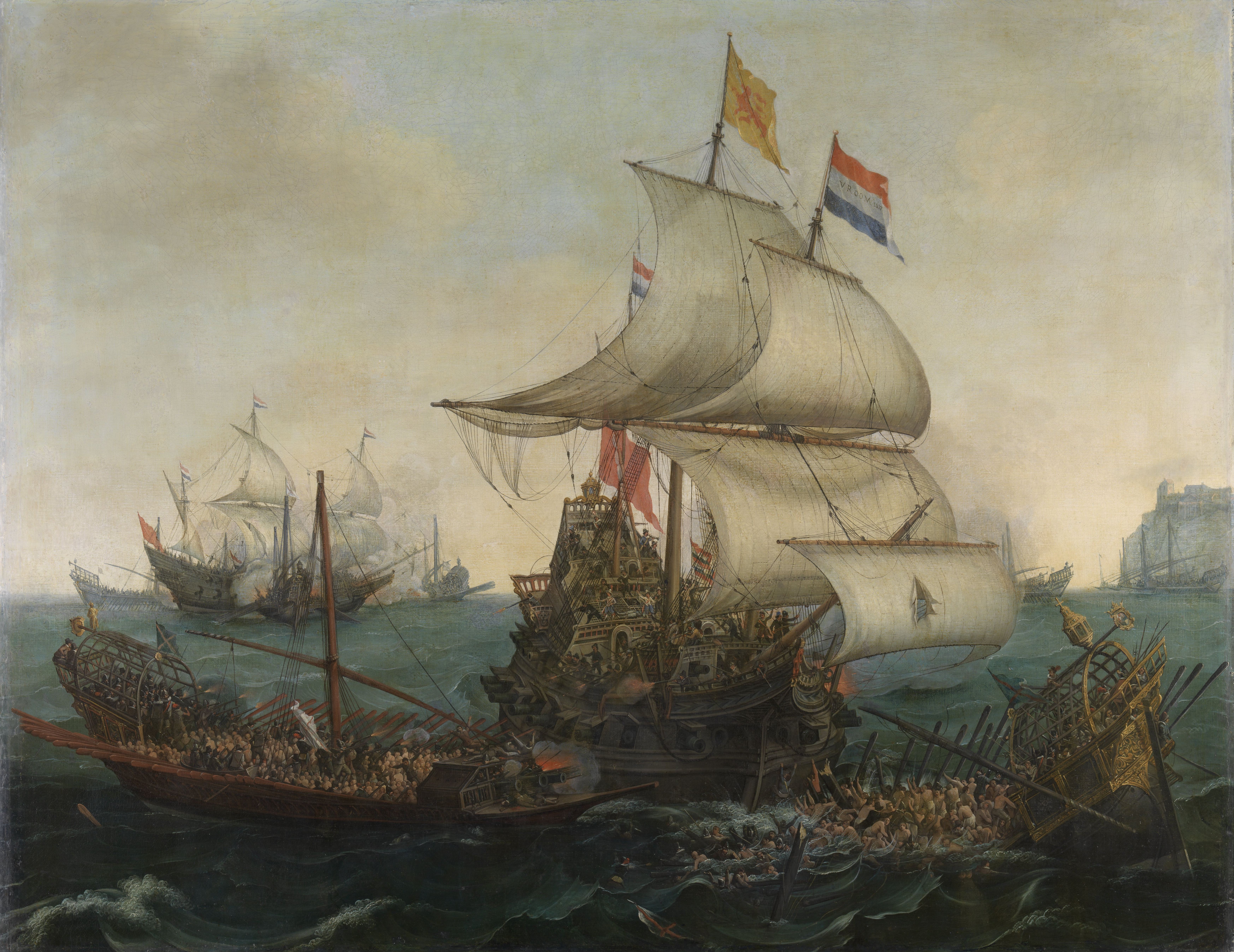
A forgotten slavery

The galleys, evoked by Dr. Beachcombing.

Image:  Spanish galleys fighting the Dutch, 1602.

Saturday, September 18, 2010

Compassion, understanding, and history


Ta-Nehisi Coates (above) works towards  understanding the slave holders and  turns to compassion to do so:
I've been quoting quite a bit from Drew Gilpin Faust's Mothers Of Invention, a history of women in slaveholding families during the Civil War...
For an African-American like me, the upshot of all this gorgeous writing is bracing--one is forced to behold beauty in those who saw no such beauty in us. Worse, the partisans of Confederate history are quite often necromancers who would defile that beauty with denialism, and Lost Cause hokum. The impulse is toward rage, toward justified fury. The impulse is to view any deft use of the English language, as hypocrisy, as devil-worship concealed beneath garland prose. 

It's an impulse I've felt, myself. I love this picture (it's from the cover of Mothers) because, all at once, I find it beautiful and rage-inducing. The problem with rage is that it's a conversation-stopper, it forecloses all other questions. I am resolved on the nature of the Confederate cause. I would no sooner now debate the primary cause of the Civil War, then I would debate roundness of the Earth. And still in all, I am filled with questions. Chief among them, how does any human being in the 19th century come to endorse mass slaughter for the cause of raising a republic built on slavery?

To answer such a question, it is not enough to understand cause of the Civil War. A debate over the meaning of the Confederate Flag is almost beside the point. You have to remove the cloak of the partisan, and assume the garb of the thespian. Instead of  prosecuting the Confederate perspective, you have to interrogate it, and ultimately assume it. In no small measure, to understand them, you must become them. For me to seriously consider the words of the slave-holder, which is to say the mind of the slave-holder, for me to see them as human beings, as full and as complicated as anyone else I know, a strange transcendence is requested. I am losing my earned, righteous skin. I know that beef is our birthright, that all our grievance is just.  But for want of seeing more, I am compelled to let it go.
...

In this society, we view compassion as a favor, something along the lines of forgiveness extended to the humble and deserving. No. My compassion is utterly selfish, and is rooted in a craving for power. It is compelled by my curiosity, itself, just another name for hunger, for desire, for want of the great power of knowing. It is not enough for me to sit around scoring morality points on dead people, all the while blind to the living morality of this troubled time. There's no power in that. I need to know more.
 
Read it all. And the comments.


Sunday, July 04, 2010

What to the slave is the Fourth of July?


Over at his blog, Brad DeLong republishes Frederick Douglass's famous 1852 speech. I will just link to the full text.

Read it.

I am in awe of Douglass's moral and physical courage.

Wednesday, April 14, 2010

American political debates and (world) history

I often have trouble restraining myself from commenting on US politics in this blog. The USA is a big, important country and no matter what definition of "world history" you adhere to, just ignoring it would wildly distort my commentary. On the other hand, we have so much American news available that it's easy to look at everything from a US point of view.

Sometimes, however, internal historical-political debates in the USA are really important for outsiders to have some acquaintance with, simply because some positions adopted by Americans are a little hard to believe. And American readers of this blog may find it interesting to consider why outsiders might feel that way.

So much for prologue. Today's example comes from the debate over health insurance reform in the USA (I consider that a more accurate term than "health care reform.")
Opponents of HIR have made all sorts of dire claims for the evil consequences of the Obama program, to the point that some of them are harking back to the policies of nullification and secession that defenders of slavery championed, in the name of liberty, in the early 19th century. Some justify their hostility by appealing not so much to "conservative" principles (since many American "conservatives" have proved to be pro-big government) but to "libertarianism."

Self-proclaimed libertarians tend to be cranky individualists, so it's hard to say how much common ground any group of libertarians have. So maybe some of you readers will find it interesting to look at a debate that has spilled out over some forums in the last little bit.

It started at Reason.com with David Boaz writing an article on the theme "There's no such thing as a golden age of lost liberty," which the editors of Reason paired with a critique by Jacob Hornberger which included this passage:

Let’s consider, say, the year 1880. Here was a society in which people were free to keep everything they earned, because there was no income tax. They were also free to decide what to do with their own money—spend it, save it, invest it, donate it, or whatever. People were generally free to engage in occupations and professions without a license or permit. There were few federal economic regulations and regulatory agencies. No Social Security, Medicare, Medicaid, welfare, bailouts, or so-called stimulus plans. No IRS. No Departments of Education, Energy, Agriculture, Commerce, and Labor. No EPA and OSHA. No Federal Reserve. No drug laws. Few systems of public schooling. No immigration controls. No federal minimum-wage laws or price controls. A monetary system based on gold and silver coins rather than paper money. No slavery. No CIA. No FBI. No torture or cruel or unusual punishments. No renditions. No overseas military empire. No military-industrial complex.

As a libertarian, as far as I’m concerned, that’s a society that is pretty darned golden.

And that really got people going. There were a number of responses, notably at Crooked Timber in this post and its many comments. I think the critics have the better arguments, but whatever you think you may find the debate itself instructive.

Let's go back to the moment to nullification and secession. Some state governors in the USA have found this an appropriate moment to celebrate or even revive Confederate History Month, while of course doing their best to disengage their proud heritage from slavery and Jim Crow. Of all the responses, this one byTa-Nehisi Coates, "The Ghost of Bobby Lee," may be one of the best possible. It's very thoughtful and no one passage can catch its high quality and complexity, but here's one I put on Facebook because I felt it had something to say about how the living use all kinds of history:

What undergirds all of this alleged honoring of the Confederacy, is a kind of ancestor-worship that isn't. The Lost Cause is necromancy--it summons the dead and enslaves them to the need of their vainglorious, self-styled descendants. Its greatest crime is how it denies, even in death, the humanity of the very people it claims to venerate. This isn't about "honoring" the past--it's about an inability to cope with the present.

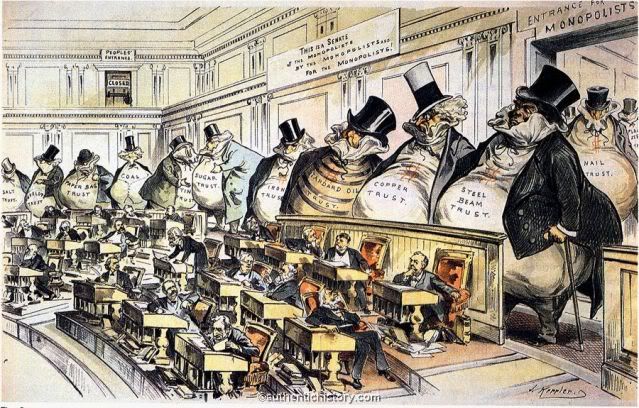
Image: Politics in the American golden age (it actually is called The Gilded Age): "Bosses of the Senate" by Joseph Keppler, 1889. Click for a larger, more legible image.

Update: a punchy cartoon comment on Confederate History Month.

Sunday, February 14, 2010

History and forgiveness

Once again Brad DeLong points me in the right direction, which in this case is to a column by Ta-nehisi Coates at the Atlantic site:

It's been twenty years since Nelson Mandela got out. This was like the defining political event of my youth. I was either a freshman or sophomore in high school, can't remember which. What I think is pretty cliche: Whatever South Africa's problems, the fact that the country (and its leaders) did not descend into mass revenge mode is an enduring tribute to compassion and empathy.

It's a great object lesson on how to handle being wronged. It's one of the things I've struggled to accept as an African-American. There is no Rosewood. Often you are wronged, and by your hand, or even in your lifetime, your persecutors will never be brought to account. There are limits to our justice. It doesn't mean you shrink in the face of injustice (South Africa did no such thing) but that you recognize that it's not really in your power to even the odds.

I've been thinking about this a lot in my study of the crimes of slavery, the Civil War and Jim Crow. I don't think the scales will ever be evened. I don't even know how you would begin to do that in any kind of moral way. That said, I want to differentiate between recognizing your limits, and sweeping a wrong under the rug. Our greatest problem, in regards to the legacy of white supremacy, is not it's effects, it's that we don't understand the rudiments of what happened.

There is a long and interesting comment section for this post, much of it about the Confederate general Longstreet, but on the main topic this response is sterling:
You know, I think part of what you're getting at here is revelatory. Most people believe forgiveness is conceptually similar to absolution, in that it is a transaction between people, given from one to another for wrongs against them, and that it wipes the slate clean.

In fact, forgiveness is a far sweeter and more complex thing. It has little to do with the person or thing being forgiven; they are incidental. Instead, it is a letting go within yourself; a surrendering of the right to feel victimized and hurt. You use the example of slavery and systematic dehumanization and oppression of blacks and the longing to have some "evening of the odds". Who is most affected by gripping the hurt of that injustice so strongly, so closely for so long? Who does it weight down and fill with anger and tip over and spill onto the ground? Not the people who perpetrate the injustice; just the people who suffer it.

The revelatory aspect of your post comes in your distinction between recognizing and calling out injustice, and allowing it to take hold in your heart like a cancer: "It doesn't mean you shrink in the face of injustice..." to "That said, I want to differentiate between recognizing your limits, and sweeping a wrong under the rug."

To reiterate: forgiving a wrong is not absolving a wrongdoer. 99% of people conflate these two very, very different concepts. Forgiveness is something you do for yourself; absolution is something you do to someone else.

Thursday, January 14, 2010

Haiti's "national debt"

Haiti is still financially crippled by paying for the freedom of their slave ancestors. Foreign Policy's Annie Lowrey explains this appalling historical injustice, citing the long and detailed Alex von Tunzelmann article in the Times of London:
Haiti, as a nation, has suffered violence, unrest, juntas, and natural disasters. One thing it need not suffer anymore, given the earthquake? Its debt obligations. This Times of London article explains how Haiti became so indebted in the first place.
The appalling state of the country is a direct result of having offended a quite different celestial authority -- the French. France gained the western third of the island of Hispaniola -- the territory that is now Haiti -- in 1697. It planted sugar and coffee, supported by an unprecedented increase in the importation of African slaves. Economically, the result was a success, but life as a slave was intolerable. Living conditions were squalid, disease was rife, and beatings and abuses were universal. The slaves’ life expectancy was 21 years. After a dramatic slave uprising that shook the western world, and 12 years of war, Haiti finally defeated Napoleon’s forces in 1804 and declared independence. But France demanded reparations: 150m francs, in gold.

For Haiti, this debt did not signify the beginning of freedom, but the end of hope. Even after it was reduced to 60m francs in the 1830s, it was still far more than the war-ravaged country could afford. Haiti was the only country in which the ex-slaves themselves were expected to pay a foreign government for their liberty. By 1900, it was spending 80% of its national budget on repayments. In order to manage the original reparations, further loans were taken out -- mostly from the United States, Germany and France. Instead of developing its potential, this deformed state produced a parade of nefarious leaders, most of whom gave up the insurmountable task of trying to fix the country and looted it instead. In 1947, Haiti finally paid off the original reparations, plus interest. Doing so left it destitute, corrupt, disastrously lacking in investment and politically volatile. Haiti was trapped in a downward spiral, from which it is still impossible to escape. It remains hopelessly in debt to this day.

This September, Haiti qualified for the cancellation of $1.2 billion of its $1.9 billion in external debt. To ensure the recovery of the nation and the livelihoods of its 9 million citizens, the IDB and any other lenders should fully cancel any remaining debt obligations.

If current debts are written off, it will be a remarkable and maybe unique manifestation of morality in international finance.

Maybe the big bankers can dip into their bonus fund?

Tuesday, August 18, 2009

Dixie down

I feel compelled to post most of the material following from Brad DeLong's blog, because "The Night They Drove Old Dixie Down" is the only depiction of the Civil War, historical or fictional, that has ever made me feel any sympathy for those who fought for the Confederacy:

Thus Robbie Robertson [member of "The Band" who wrote the song in 1969] incites the ire of Ta-Nehisi Coates, who believes that we have very different memories of the Winter of '65, and don't need to invent Robertson's particular one:

Ta-Nehisi Coates: What you see above is the train of Rebels fleeing the city, as the Union troops enter from the other side. I was thinking about the Richmond yesterday, and The Band's "The Night They Drove Old Dixie Down."... I'm told that it's a great song, and I don't so much doubt this, as I doubt my own magnanimity. I'm reminded of one of my father's favorite quotes, "The African's right to be wrong is sacred." Or Aaron McGruder's line, "I reserve the right to be a nigger." I can no more marvel at The Band then a Sioux can marvel at the cinematography of "The Died With Their Boots On." I wouldn't fault the man who could, but it's not me My empathy is a resource to be rationed like all others. My right to be wrong is sacred. My right to be a nigger is reserved. I started to play the song yesterday, and stopped myself. Again, I was angry. Again, another story about the blues of Pharaoh, and the people are invisible. The people are always invisible....

The expectation that someone else will tell your story for you, will write your ballads for you, will reconcile your history for you, is foolish and vain.... I'm no Robbie Robertson, but I do carry the words of my old, magical people:

I have just returned from the city of Richmond; my regiment was among the first that entered that city. I marched at the head of the column, and soon I found myself called upon by the officers and men of my regiment to make a speech, with which, of course, I readily complied. A vast multitude assembled on Broad Street, and I was aroused amid the shouts of ten thousand voices, and proclaimed for the first time in that city freedom to all mankind. After which the doors of all the slave pens were thrown open, and thousands came out shouting and praising God, and Father, or Master Abe, as they termed him. In this mighty consternation I became so overcome with tears that I could not stand up under the pressure of such fullness of joy in my own heart. I rested to gain strength, so I lost many important topics worthy of note.

Among the densely crowded concourse there were parents looking for children who had been sold south of this state in tribes, and husbands came for the same purpose; here and there one was singled out in the ranks, and an effort was made to approach the gallant and marching soldiers, who were too obedient to orders to break ranks.We continued our march as far as Camp Lee, at the extreme end of Broad Street, running westwards. In camp the multitude followed, and everybody could participate in shaking the friendly but hard hands of the poor slaves.

Among the many broken-hearted mothers looking for their children who had been sold to Georgia and elsewhere, was an aged woman, passing through the vast crowd of colored, inquiring for one by the name of Garland H. White, who had been sold from her when a small boy, and was bought by a lawyer named Robert Toombs, who lived in Georgia. Since the war has been going on she has seen Mr. Toombs in Richmond with troops from his state, and upon her asking him where his body-servant Garland was, he replied: "He ran off from me at Washington, and went to 'Canada. I have since learned that he is living somewhere in the State of Ohio." Some of the boys knowing that I lived in Ohio, soon found me and said, "Chaplain, here is a lady that wishes to see you." I quickly turned, following the soldier until coming to a group of colored ladies. I was questioned as follows:

"What is your name, sir?" "My name is Garland H. White." "What was your mother's name?" "Nancy." "Where was you born?" "In Hanover County, in this State." "Where was you sold from?" "From this city." "What was the name of the man who bought you?" "Robert Toombs." "Where did he live?" "In the State of Georgia." "Where did you leave him?" "At Washington." "Where did you go then?" "To Canada." "Where do you live now?" "In Ohio." "This is your mother, Garland, whom you are now talking to, who has spent twenty years of grief about her son."

I cannot express the joy I felt at this happy meeting of my mother and other friends. But suffice it to say that God is on the side of the righteous, and will in due time reward them. I have witnessed several such scenes among the other colored regiments.

Late in the afternoon, we were honored with his Excellency, the President of the United States, Lieutenant-General Grant, and other gentlemen of distinction. We made a grand parade through most of the principal streets of the city, beginning at Jeff Davis's mansion, and it appeared to me that all the colored people in the world had collected in that city for that purpose. I never saw so many colored people in all my life, women and children of all sizes running after Father, or Master Abraham, as they called him. To see the colored people, one would think they had all gone crazy. The excitement at this period was unabated, the tumbling of walls, the bursting of shells, could be heard in all directions, dead bodies being found, rebel prisoners being brought in, starving women and children begging for greenbacks and hard tack, constituted theorder of the day. The Fifth [Massachusetts] Cavalry; colored, were sfill dashing through the streets to protect and preserve the peace, and see that no one suffered violence, they having fought so often over the walls of Richmond, driving the enemy at every point.

Among the first to enter Richmond was the 28th U.S.C.T. better known as the First Indiana Colored Volunteers. . Some people do not seem to believe that the colored troops were the first that entered Richmond. Why, you need not feel at all timid in giving the truthfulness of my assertion to the four winds of the heavens, and let the angels re-echo it back to the earth, that the colored soldiers of the Army of the James were the first to enter the city of Richmond. I was with them, and am still with them, and am willing to stay with them until freedom is proclaimed throughout the world. Yes, we will follow this race of men in search of liberty through the whole Island of Cuba. All the boys are well, and send their love to all the kind ones at home."

Chaplain Garland H. White,
28th USCI, Richmond, Virginia,
April 12, 1865; CR, April 22, 1865

White's letter can be found in the book A Grand Army Of Black Men (p. 175.) For the serious civil war nerd, this book, a massive collection of letters written by black soldiers during the War, is indispensable.

Then again, maybe Robbie Robertson is saying something else. Virgil Cain may say so, but we all know that the real killer of Cain's brother Abel wasn't no Yankee stranger from afar, was he?

Wednesday, May 27, 2009

Our savage era

Over at Daily Kos, there is a diary showing excerpts from the Google Earth atlas of North Korea. (The original site is here, but I found it a little impenetrable.) Below are two images that chilled me.


"The image above depicts an area covered with mounds. It's speculated these mounds are actually mass graves for some of the more than 2 million people that starved to death in the famine of the 1990s. "

Then there is this:


"The structures in the picture are just a small portion of a North Korean prison camp called 'Camp 16.' The entire camp measures 18 miles by 16 miles (four times the size of the District of Columbia). No ground level pictures of the prison camp have ever made it out of the country."

Now you know why the pictures and films of liberated concentration camps at the end of World War II are so important.

Friday, May 15, 2009

Phil Paine finds his own memorial to genius and heroism in Toronto

He describes a rare moment:

When I first began to read seriously in history, as a boy, my instincts led me to avoid looking for heroes. Trying to find people in the past to admire and respect can be a trap. One is bound to be disappointed. The sad truth is that scoundrels and monsters routinely find their way into history books, but good people do not. The very fact that one is a decent human being virtually guarantees that one will be forgotten. Historical figures propped up as models or champions of this and that usually turn out to be outright frauds, or at the very least to have genuine accomplishments marred by major flaws. But there was one historical figure that I could not help admiring, and that was Frederick Douglass, whose Autobiography inspired me from childhood. And I did not know until recently that I could walk on the very floor where Douglass walked and spoke, right near my own home.

At the corner of King and Jarvis stands St. Lawrence Hall. This fine structure was built in 1850 to provide a venue for public meetings, concerts, balls, and other cultural events of the little city that was then maturing out of its crude frontier beginnings. Over the next century, the hall would be used to echo the voice of Jenny Lind, display the curios of P.T. Barnum, and be used as a practice dance hall by Rudolf Nureyev and Margot Fonteyn. The structure is well preserved, and an excellent example of the Renaissance Revival style of the mid-nineteenth century. Unlike most such structures, it has maintained its intended function throughout its existence.

The timing of its construction was propitious, for there was an important issue for public discussion: the recently enacted Fugitive Slave Law in the United States. This law allowed agents from the southern slave states to conduct a reign of terror in northern states, kidnapping runaway slaves, and many free blacks, and dragging them back to the slave pens of the south. It effectively unleashed the tentacles of the monstrously evil institution of slavery throughout the United States, canceling out existing abolitionist reforms. This hideous injustice would soon lead the United States into a bloody civil war. The activities of the Underground Railway, the organized resistance movement which smuggled escaped slaves to freedom in Canada, were now much more dangerous. Upper Canada had enacted legislation for the abolition of slavery in 1793. On the issue of slavery, Canadians were consistently and adamantly on the side of the angels. The underground railway terminated in Toronto. Escaped American slaves formed free agricultural communities scattered around rural Ontario, and much of the resistance was organized here.

So it's not surprising that Frederick Douglas came to Toronto, and spoke at the newly-built St. Lawrence Hall to a cheering crowd of 1,200 on April 3, 1851[1]. Yesterday, I entered the building, and walked through the empty hall, which has not much changed in general appearance.

Since I acknowledge so few heroes from the annals of history, I rarely get that special thrill that historians can enjoy... the pleasure of planting one's feet on a spot trod by a paladin. I once stood rapt with pleasure in front of Mozart's house, listening to one of his arias being sung. But Mozart's is an example of a tragic life, transcended by genius, and can hardly serve as an example to follow. I have no transcendent genius of my own, so his example is useless to me, personally.

But the work of Frederick Douglass has long been, for me, a kind of guidebook in the quest for freedom and human dignity. The man was a genius, no doubt about it, but it was a real-world genius.


Read the whole thing.

Friday, June 27, 2008

The not-so-good-old days

Medievalists are constantly being put in the position of responding to the modern connotations of the word "medieval." For many modern people the Middle Ages acts as a dumping ground for every nightmare that can be attributed to humanity. The great witchhunt of European history took place after the Middle Ages; the purges and holocausts of the 20th century put most medieval slaughters, ruthless and cruel as they may have been, in the shade. We often find ourselves pointing out such things to people who carelessly use "medieval" to mean "bad." (Indeed, my dictation software heard that last usage of medieval as "and evil" so we are seemingly in the position of fighting the machines, too.)

But we must face the fact that most of history, including the Middle Ages, were not exactly the good old days. Some scholarly blogging posts of the last week or so underline this.

Jonathan Jarrett, I believe, started the ball rolling with a post on Sex slaves in the early Middle Ages: what’s the evidence? over at his blog A Corner of Tenth-Century Europe. his point was that he didn't know what the evidence for sex slavery might be and he hoped someone would enlighten him. Soon after, he found himself shocked by reflecting on well-known evidence about the prominent monastery of Cluny in eastern France. As he put it, "slaves are all through the material from Cluny [in the tenth century]." that reflection, and chance meeting with another medievalist blogger, Magistra et Mater, went into this post on trading "ancillae [slave women]."

At the same time Magistra et Mater has been writing about some subjects that might excite prurient interest, but deserve serious thought, too. For instance, how exactly were disobedient monks flogged in the time of the Carolingian kings? And somewhat less grim, were families about the same time somewhat reluctant to write off their daughters as ruined if they indulged in a little premarital sexual activity? Maybe for good practical reasons the Carolingian Franks were a little less likely to condemn such girls than some other cultures. These are all isolated points perhaps, but important for visualizing how things actually worked for individual people, like a monk about to be flogged, or the teenager worried about how dad is going to react to her little adventure.

Finally, the subject of slavery (mostly later than medieval) is discussed by Phil Paine in this post, inspired by a book on 18th century Moroccan slavery (item 16305). Conclusion: there is no "nice slavery," ancient, medieval, early modern, or current.

Tuesday, July 10, 2007

07/07/07

Robert Heinlein was born on July 7, 1907. His centennial inspired this article in Reason Magazine which does a reasonable job of summing up his career and influence.

As someone who like so many others was deeply influenced in my youth by Heinlein, I have a few things I'd like to add to Brian Doherty's article.

First, it's a little unfortunate, but in the United States perhaps unavoidable, that the whole framework for discussing Heinlein is based on how it fits into American cultural obsessions. I like, however, Doherty's final conclusion that Heinlein was a "full-service iconoclast." Well said: whatever your sacred cow, Heinlein could slaughter it with a few well-chosen words or a long, perhaps excessive rant. Whichever way he managed it, he'd make you think -- if not necessarily agree with him.

Second, Doherty says little, except in connection with conscription, of Heinlein's loathing for slavery, and nothing at all about his hatred for racism. A complete and utter rejection of racism was not so common among Americans of the early 20th century, especially those raised in former slave states. As for slavery itself, no child who ever read A Citizen of the Galaxy (a bit of an homage to Kipling's Kim, but smarter) will doubt for a second that slavery is evil or that slavers' excuses for their attempts to own human beings are contemptible.

Third, and perhaps even more important than the second point, Doherty hardly touches on Heinlein's own great obsession, and the lack says a great deal. Heinlein spent most of his life not just writing about space travel, but promoting the real thing, and his influence on government research into rocketry in the late 40s and early 50s is an untold story. Heinlein believed that space exploration and the expansion of the human race throughout the universe was the obvious road to a great future. His extraordinarily influential juvenile novels were so because they made that future expansion -- with its rewards, costs, challenges and unimaginable discoveries -- look real and attainable. He would be appalled that going to Mars is for most people a fantasy, for the American leadership a cheap talking-point to be trotted out once to distract people from the rolling catastrophe.

He might say now, why can't we have the world of Kim Stanley Robinson's Red Mars, Green Mars and Blue Mars -- quite a scary place in some ways -- instead of the futility of the Iraq War and Darfur and heads in the sands about global warming?

Soundtrack: Written while listening to a track called They Came in Peace by Tranquility Bass, cablecast by the Galaxie music network of the CBC.

Tuesday, July 03, 2007

William St. Clair, The Grand Slave Emporium: Cape Coast Castle and the British slave trade

The Atlantic slave trade will naturally come up more than once in my fall and winter course, A History of the Modern World. It is one of the key characteristics of the early modern period (which I define as 1400-1800), and its results can be seen on the faces and fates of the Americas, Europe, and Africa.

The complexities of this trade are well-treated in this new (2006) book by William St. Clair, who has a genius for taking one series of sources and illuminating a huge web of relationships. His sources are the documents preserved in London from Cape Coast Castle (now in Ghana), a British fort established and maintained to promote and protect the British slave trade. St. Clair says that there are few places that are potentially so well known over a long period (1660s to the mid 19th century) . His own presentation of this material is quite wonderful. If only more people could write like this. I haven't finished the book yet, but even if it goes steeply downhill after p. 115 it will still have been an enjoyable and illuminating read.

Students who will be in my first-year class in September (if any come across this) might want to ponder this impressive list from p. 4:

Among those who received dividends from the slave trade were the British royal family, the British aristocracy, the English Church, and many institutions, families and individuals. Plantation owners in the West Indies and North America prospered from the sale of commodities produced by slave labour, as did some of their employess and business partners, and profits remitted to Britain skupported others who never left home. A similar reckoning coud be made for the other slaving nations. But it is scarcely an exaggeration to say that every person in the Europeanised world who put sugar in their tea or coffee, spread jam on their bread, who ate sweets, cakes, or ice0cream, who smoked or chewed tobacco, took snuff, drank rum or corn brandy, or wore coloured cotton clothes, also benefited from, and participated in, a globalised economy of tropical plantations worked by slaves forcibly brought from Africa.

The jam connection never occurred to me...

Image: Loango, now in the Republic of the Congo, an early modern African coastal metropolis.