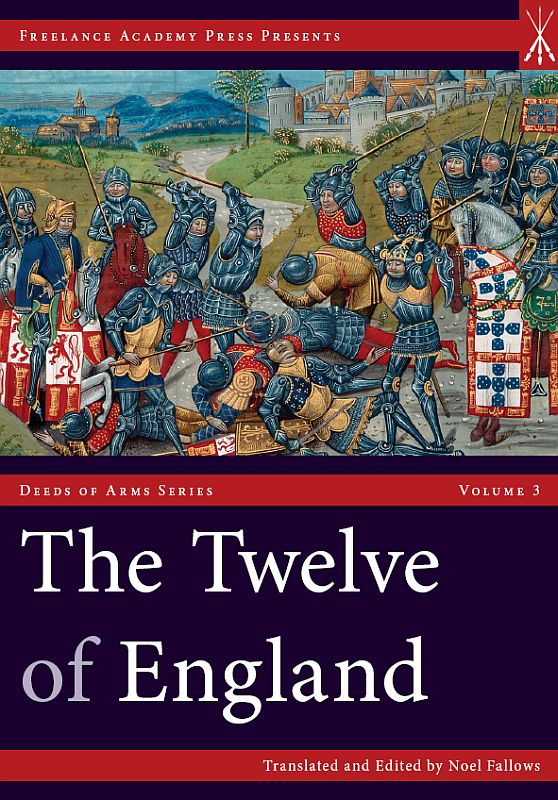
This reviewer, writing for the online Medieval Review, also has a high opinion of it.
Fallows, Noel.
Jousting in Medieval and Renaissance Iberia.
Woodbridge: Boydell and Brewer, 2010. Pp. xix, 541. $99.00. ISBN:
9781843835943.
Teofilo F. Ruiz
University of California, Los Angeles
tfruiz@history.ucla.edu
In this handsomely-produced and beautifully-illustrated book, Noel
Fallows offers, for the benefit of scholars and general readers alike,
four engaging, valuable, and interrelated contributions to our
understanding of jousting in late medieval and early modern Spain.
More importantly, the author, through a thoughtful deployment of texts
and images, takes us into the complex social and cultural world of
late medieval and early modern chivalry. Having just completed a book
on festive traditions (at the copy-editing stage presently), I can
only bemoan not having read this book earlier. And although I have
tried to incorporate many of Fallows' valuable insights and
information into my own work, his insights into these questions and
capacious treatment of the subject deserve more than just a passing
reference.
Anchored on the close reading of four seminal texts on jousting (plus
a series of other ancillary texts)--Pero Rodríguez de Lena's
El
passo honroso de Suero de Quiñones (1434), Ponç de Menaguerra's
Lo cavaller (1493), Juan Quijada de Reayo's
Doctrina del
arte de la caballería (1548), Luis Zapata de Chaves' "Del justador
(in his
Miscelánea, 1589-93), plus short excerpts from Hernán
Chacón's
Tractado de la cavallería de la gineta (1551)--Fallows
brings to life the chivalric world of jousting, connecting these texts
to their particular historical contexts. His four distinct and signal
contributions to the scholarship on jousting and other martial games
rest on his careful edition and translation of the above mentioned
works. His edition of the texts of Menaguerra, Quijada de Reayo,
Zapata de Chaves, and short excerpts from Chacón are the first modern
grouping of these works into one book. Although closely related to
each other thematically, they have never been examined as an almost
century and a half long discussion on jousting, warfare, and knightly
values. As such, his editions of these texts--also translated into
English for the first time--allow us to trace changes over time in the
rules, character, and equipment employed in Spanish jousts and
elsewhere in the West in the transition from the Middle Ages to the
early modern period.
Moreover, his new edition of significant portions--the most salient
ones--of Rodríguez de Lena's
El passo honroso (the ur-text of
jousting in the Iberian peninsula) offers, once again through his up-
to-date edition and translation, an important source for the study of
fictional warfare in late medieval and early modern Spain, and,
because of the international nature of jousting in this period in
general and of the
passo honroso in particular, the rest of
western Europe. His edited and translated short excerpts of Chacón's
Tractado is similarly the first version in English of a very
significant treatise on Spanish equestrian skills.
Second, although the edition and translation of the texts are found in
the second part of the book--almost as a stand-alone monograph--the
introductory study, found in Part One of
Jousting in Medieval and
Renaissance Iberia, expands on the textual evidence, offering to
the reader four diverse perspectives on Spanish chivalrous culture.
His introduction and chapter 1 provides a typology of knightly armed
encounters: mêlée tournaments, tournaments, jousts, and other such
martial games. The introduction also places Fallows' edition of the
texts within a judiciously drawn map of methodological and
historiographical approaches to the topic. His opinions are measured
and sound, dealing as he does with diverse and, often times,
contradictory interpretations. And he does this in a civil fashion,
assessing the worth of each approach, while presenting his own point
of view. Moreover, he allows the texts to guide us through these
discussions, and what can be better than his command of these primary
sources in guiding his readers to a new understanding of the evidence.
While noting the cultural importance of printing in the diffusion of
the new culture and technologies of jousting, Fallows, by deploying
Pedro Cátedra's ideas about "paper chivalry," Martín de Riquer and,
most famously, Huizinga's arguments about late medieval chivalry,
explores the links between literature and armed combat and the
circularity of writing about chivalrous deeds, fictional combat, and
the reality of lived lives. In chapter 1, Fallows turns to a careful
analysis of the three main treatises on jousting, examining how these
texts intersect with the authors' personal experiences, as well as the
different contexts from which they wrote. These brilliant mini-
biographies and case studies allow us to place the three main writers
of treatises on jousting within a long tradition of martial games,
warfare, and court life. For me in particular, the information on two
of these authors, Quijada de Reayo and Zapata de Chaves, and their
role at the great pageantry held at Binche in 1549 and at Philip II's
court is a most welcome revelation.
Although his introduction and chapter one are also in themselves a
small monograph, chapters 2 and 3 offer us a different and as equally
valuable contribution. These two chapters, erudite and technically
complex, discuss types of armor, helms, saddles, weapons, and every
other piece of equipment used by knights during jousts and
tournaments. Profusely illustrated, technically precise, and with a
myriad of examples and images from the sources, they are a veritable
mine of information and a source for tracing the evolution of armor
and other equipment associated with these martial games from the late
fifteenth century into the sixteenth.
Chapters 4 and 5 shift the inquiry from armors and knightly equipment
to the nature of combat, its rules, and expectations. Fallows notes
the principles or ideals that governed the joust, how scores were
kept, excessive harm prevented, and wounds tended to. In chapter 6, he
turns his attention to war or, far more accurately, to the
relationship between jousting and actual warfare. Fallows, once again,
places his inquiry within the historiographical debate on whether
tournaments were a form of preparation for war or simply a form of
theater and display. Yet, his somber reflections on the actual carnage
found in sixteenth century warfare, the increasing toll taken by
firearms, and by the emphasis (for the sake of victory over the enemy)
on infantry and well disciplined formations over heroic single combat
clearly show the disconnect between the world of jousting and that of
the battlefield. Chapter 7 focuses on other forms of martial
spectacle, with the game of canes and the running of bulls featured
most prominently. These two semi-martial activities came to parallel
the medieval joust, marking a transition that the author describes as
"from sport to spectacle."
Early in his introduction Fallows notes that "chivalry must be seen in
order to be understood."(p. 27) This he has done as best as it could
be done by his vivid textual examples, case studies, and vivid
descriptions, creating a textual portrait of the joust. This he has
done superbly well by his choice of images and by the abundant amount
of visual material included in the book and keyed to the text. When
Spanish images have been lacking, he has borrowed from Italian,
German, French, and English visual evidence to provide us with a clear
idea of what was like to be in a joust. Technical at times, highly
engaging at most other times, this is a book that does many different
things, and it does all of them well. While examining the diverse
social and cultural aspects of fictitious and chivalrous warfare, the
texts that he has so carefully edited and translated remain a thread
that links the book's varied themes into a comprehensive and
compelling vision. I would have liked to see a more careful discussion
of the game of canes and of the role of bulls. I, for one, think that
they occupied an important place in the festive imaginary of early
modern Spain, but this is a very small quibble on what is an
impressive and important achievement. Fallows' super book, beyond
bringing these important treatises to the attention of scholars and
other readers, reintegrates Spain--often neglected in Huizinga's
masterpiece or in Roy Strong's discussions of festivals--into the
general late medieval and early modern European culture of jousting
and chivalric culture. That in itself is a worthy achievement.