Showing posts with label book projects. Show all posts

Monday, December 11, 2017

3000, more or less -- and a new book


Blogger tells me that the previous post is number 3000.  That's not quite accurate.  I started blogging on a different platform, and I was very active on the blog back in the pre-twitter days.  Also the 3000 posts that Blogger counts includes drafts saved by the blog.

Still, it seems that a celebratory note is appropriate.  ESPECIALLY since yesterday I started another a new book, an English translation of Le Tournoi de Chauvency.  Le Tournoi is a verse account written in 1285 of a tournament in the north of France.  The poem seems to be a lighthearted celebration of the "noble, beautiful and good people" who took part, either as participants or as audience.  It's one of the few tournament accounts about real people.  Most such descriptions are about tournaments in Arthur's court or at least in Arthur's time.

So have a festive breakfast! I will say more about Chauvency soon.


Saturday, December 09, 2017

The Good Duke now speaks English! Done, sort of (again)

Back on October 13, I announced on this blog that I had (sort of) finished my translation of  the Chronicle of the Good Duke Louis de Bourbon.  Maybe one more  run-through and I'd be able  to start a new project.


Well,  my collaborator Phil Paine and I have done considerably more than that since October.  The problems we faced as we worked on the remaining trouble spots were really difficult -- which only makes sense if you think about it.


So today's announcement should be limited.  What's done is an acceptable translation from Middle French to modern English.  Truth be told there are a very few spots where figuring out what the best equivalent in Modern English is still uncertain.  Also missing are a short glossary of mostly military terms, a map (maybe) and an introduction that will help non-specialists understand the context of the chronicle.


And there is one big thing that remains to be done; I have to retranslate our rather literal English translation into a modern one.


Why is this necessary?  Well, let me tell you of my own experiences.  About ten years ago, I was teaching late medieval history.  I did my best to find accessible, affordable, translations, or translations that were in the public domain.  There were a few century-old public domain works that might have been fun, but as I looked them over, I realized that they would be very difficult for students of the 21st century to read.  Somebody would have to translate the translation first!


That's what I have to do now.  I'm going to treat the text Phil and I have produced and act like it is the base text, and transform it into a modern work, without constantly going back to the Middle French original (though you and I know that I will be looking closely at that original.


It will be a challenge to keep some of the medieval flavor., to avoid too much exoticism or a very dull 21st century presentation.   OTOH, it should be fun to try.


Saturday, September 17, 2011

Monday, May 24, 2010

Sabbatical update -- end of the Windsor sojourn

I will soon be returning to the North Bay area and although my sabbatical is neither formally nor informally over, there will be a break in my labors and a reorganization. In particular, I will have to organize course materials for my fall courses. So I thought that it was a good time to issue a complete scorecard of what I have accomplished so far.

Projects finished

Reviews:
  • Charles Kurzman, Democracy Denied (Journal of World History, accepted for fall 2010)
  • Mark Pegg, A Most Holy War (Michigan War Studies Review, now available online)
  • Richard Kaeuper, Holy Warriors (The Medieval Review, now available online)
Article:
  • "Republics and Quasi-Democratic Institutions in Ancient India: Their Significance Today," for the forthcoming book The Secret History of Democracy (a rethinking and recasting of an earlier web-published article; forthcoming this year; submitted and accepted)
Conference paper delivered:
  • "Chivalry: Military biographies and other tales of the later Middle Ages" at the 45th International Congress of Medieval Studies, Kalamazoo, Michigan; special lecture sponsored by De Re Militari and the Journal of Medieval Military History.
Still in process
  • The lecture delivered at Kalamazoo, revised and retitled, will be published in the Journal of Medieval Military History next year (as is the custom with this series of special lectures). This must be finished by the end of the year.
  • I have finished a first draft of my translation and commentary on Charny's Questions on War. Right now the draft is out with another informed reader. I hope to have a thorough rewrite done by the end of summer.
  • I have translated a good third of the Chronicle of the Good Duke -- about 110 pages in the printed edition. I hope to return to it by the fall.
  • I have been asked to write a substantial article on the ancient Indian republics for the
    The Edinburgh Companion to the History of Democracy, due end of September.

Sunday, May 02, 2010

Laws of arms: a contribution from Will McLean

Will McLean, author of the blog A Commonplace Book, has suggested that anyone interested in Charny's questions on war should take a serious look at the army ordinances issued by Richard II in 1385 in connection with campaign against Scotland. Instead of questions, these are answers: if I raise the banner of St. George and try to start a mutiny in the army, what punishment can I expect?

Will has posted the translated ordinances here.

I have corrected my initial attribution of the translation, which properly belongs to Francis Grose (1801), but we still have reason to be grateful to Will for hunting it out.

Tuesday, April 20, 2010

Sabbatical score so far -- update 2


I have not updated my sabbatical score since early November. That's about the time a lot of things went out the window. Nevertheless, I have got a lot done since November. You can add this to the earlier list.
  • I have -- some time ago actually -- finished a first draft of my translation and commentary on Charny's Questions on War. (Don't be too impressed, it's a short study.) Right now the draft is out with an informed reader who I have asked to find the holes in my presentation.
  • I have just finished the paper I will be presenting at Kalamazoo's International Congress on Medieval Studies. It concerns the Chronicle of the Good Duke. The paper may not be really done -- ask me in a few days -- but I could stand up and deliver it now with a good conscience and without dread, if I had to.
  • I've also translated a good third of the Chronicle -- about 110 pages in the printed edition.
Despite the distractions and tragedies, I have got quite a bit done. I put it down to motivation. And my realization of how few people get this kind of work situation. It would be a sin to waste it. And I haven't.

Image: Someone else's messy pile of books.

Tuesday, February 16, 2010

Book title needed

I am working away at a book about French military history in the 14th century, and I've just come to the realization that my planned title probably won't work out.

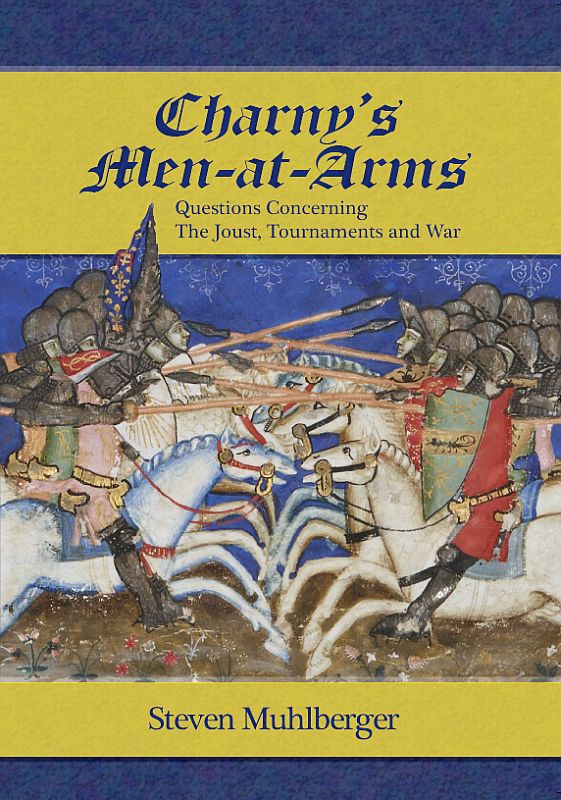
I was thinking of calling it Men-at-Arms, which goes nicely with my previous book Deeds of Arms. It is also appropriate because people holding the status of men at arms hold a key position in the mental universe of the document I'm working on. It's men at arms this, men at arms that, men at arms the third thing.

So if this is the case, why not use Men-at-Arms?

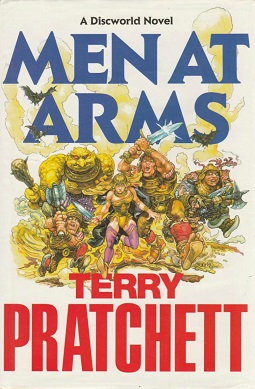
Well, there are two other books that already have the title. One is a general history of -- men-at-arms! I have never read it, but a former colleague of mine used it in his military history class, and he had a good instinct for what students might find accessible. My guess is that this book is used by a lot of profs. The other book is even worse news. Terry Pratchett has written a book of that name, and when you go to Amazon.com and put into words men at arms, you get screens worth of Terry Pratchett-related material before you ever find anything else.

So I hesitate to use what might be the most natural title in fear that potential readers will never find the book. Is this an unreasonable fear? If I am right, what might be a good replacement?

If you want to help me with this, let me tell you a little bit about the book's subject matter. in about 1350, a prominent French knight named Geoffroi de Charny was inspired or even asked by the King to put together a list of questions about how the law of arms, which regulated the relations between one night and another, applied to three knightly activities, jousting, tournaments, and war. Charny came up with some interesting legal problems, which are group of prominent French knights were to sort out. We don't know if this actually happened, but we have no answers to these problems, which is why most of you have never heard of Charny's questions. I am using the questions, however, to show what Charny thought was most important about the law of arms, as well as a number of other issues of honor and military science. Even with no answers, questions themselves stake out some interesting territory. I have already talked about the jousting and tournament questions in a book called Jousts and Tournaments. This book is about the much longer section of questions on war.

Given this, relevant subjects touched on by this book include: Royal reform of the French army, the Hundred Years War, the law of arms, Charny (increasingly well known among fans of chivalry), chivalry (but not as much as you might think).

I would like a title where the first phrase or main title is not obscure. There are too many academic books where a boring subject is disguised behind a title like this:
Long Words Bother Me: Winnie the Pooh and Heiddiger's influence on modern readers. Not a very successful disguise, is it? But people do this all the time. I don't want my very interesting book to look like this fortunately fictional monograph.

I appreciate all serious or hilarious answers. If it is just vaguely cute, though...

Image: the competition.

Tuesday, December 29, 2009

A medieval murder mystery begging to be written


It has been my experience that many medieval murder mysteries are set in the 14th century, often with the plague in the background. This makes them hardly medieval by my standards, but let that go. What you actually may be interested in is a free plot, which I found lurking on my hard disk. I think it's from a source collection on war in the later Middle Ages, but it is unlabeled. The story as we have it here is not a murder mystery, it's just a murder committed at the orders of important men in one of the great churches of England in a time of political turmoil, the year 1377 when Edward III died and his young grandson, Richard II, succeeded to the throne but not to actual power.

Robert Hawley and John Shakell, two esquires, had captured the count of Denia, a Spanish grandee, at the battle of Nájera [1367]. The count was allowed to go home on leaving his eldest son Alphonso as a hostage. In 1377 the money was said to be ready, and the English government therefore tried to get possession of the hostage. Hawley and Shakell refused to give him up, whereupon they were imprisoned in the Tower of London. Some months later they escaped and took sanctuary at Westminster. The Constable of the Tower followed them in force. Shakell was recaptured; but Hawley resisted and was killed in the choir of the Abbey, during the celebration of High Mass. Shakell remained in the Tower until 1379, when he came to terms with the government, and agreed to give up his hostage in return for his own release.

There are actually lots of documents on this case, because it went on and on.

Maybe it should be a movie -- can't you see the two hardbitten squires fighting for the "Treasure of the Count of Denia?"

Image: The Choir of Westminster Abbey in 1848. In the 14th century it would have had no pews.

Friday, December 04, 2009

Squires or esquires?


Here is an experiment in polling your potential audience, expert and amateur.

I am currently writing a book on 14th century military affairs. I talk a lot about "squires" or "esquires." I am not sure which word to use.

The early 14th century was a period when "squire/esquire" went from meaning "a military servant, usually lightly armed" to meaning "a lesser gentleman warrior" of the kind who had substantial equipment and might have been a knight bachelor in an earlier era. At least this seems to have happened in the Anglo-French world. Although there seem to have been a few squires/esquires hanging around in the mid-14th century who were not considered gentlemen, my sources show that they mostly were gentleman, quite distinct from other military servants like sergeants or valets, even when the latter had some armor and were considered effective fighters.

I am very interested in hearing from you about which word seems more suitable to you, and why. I would appreciate it if you answered in my comment section here, rather than on Facebook.

I would appreciate expert opinion, but if you consider yourself an ordinary reader don't hold back.

Image:
goofy gamer squires.

Tuesday, November 24, 2009

4000+

Now that I'm back from a family trip to Oklahoma, I've managed to push chapter 2 of Men at Arms up past the 4000 word mark. Wish me luck for tomorrow...

Wednesday, November 18, 2009

Slogging forward

Despite the international plot to keep me away from Men at Arms, I am up to 3000 words on Chapter 2. Of course, family business now takes me away from the book, but it's the kind of thing that can't be helped.

Wednesday, November 11, 2009

1000 words today!

That's 1000 words on the book I promised to write during this sabbatical! I feel that I'm finally getting my teeth into it.

Thursday, November 05, 2009

Sabbatical score so far -- updated

Since classes ended in April, I have completed the following academic projects:

Reviews:
  • Charles Kurzman, Democracy Denied (Journal of World History, accepted for fall 2010)
  • Mark Pegg, A Most Holy War (Michigan War Studies Review, now available online)
  • Richard Kaeuper, Holy Warriors (The Medieval Review, submitted and accepted)
Article:
  • "Republics and Quasi-Democratic Institutions in Ancient India: Their Significance Today," for the forthcoming book The Secret History of Democracy (a rethinking and recasting of an earlier web-published article; forthcoming next year; submitted and accepted)
Not bad, but these projects and some family health problems have slowed progress on the book I'm supposed to write; a scrappy first draft of Chapter 1 is all I have written so far, though I have also partly revised the translation of the crucial text.

Thursday, September 24, 2009

Terminology

I am writing a book on 14th- century men-at-arms based on Geoffroi de Charny's Questions on the joust, tournaments and war, especially the war section. As was the case in my 4th-year seminar last year, I am wrestling with terminology, especially the words "chivalry" and "knight." "Chivalry" as a word indicating an ideal or a standard of behavior is a tricky word, as David Crouch has shown in his Birth of Nobility recently, and Charny hardly ever uses that word, even in his Book of Chivalry. "Knight" is unique to English, and doesn't like other "chivalric" terms in other languages mean "horseman" or "warrior/soldier." I am going to have to be very careful in using "chivalry." I have an idea of how to proceed with the word "knight"-- use the words "chevalier" and avoid "knight," as much as possible. Avoiding an English term in a book almost entirely about Frenchmen should be reasonably practical.

Exception: for an English-speaking audience, you can't call the Knights of the Round Table anything but "the Knights of the Round Table," no matter what Edward III and his best Angl0-French buddies may have called them.

Another point of usage: Charny wrote a verse treatise on the life of arms called Livre Charny. I and other people I know usually have Englished this as The Book of Charny. But it occurred to me the other day that the real English title ought to be Charny's Book. A real "duh" moment, that may give us some real information on the chronology of Charny's writing career. Don't you think that this would be an appropriate title for your first rather than your second or third work, if your name was Charny?

Image: I am running out of good pictures that evoke Charny. This sticker is associated with the town of Charny in Quebec. See here.

Saturday, August 25, 2007

Desert Queen by Janet Wallach

I very much enjoyed this book, but can recommend it only with reservations.

Desert Queen is the story of Gertrude Bell, a British traveler, linguist and archaeologist who during the First World War became an effective intelligent agent and analyst, and was one of the architects of the new state of Iraq. She was daring and smart and determined, and so far as possible lived her life on her own unconventional terms. Not only is she an important figure -- about as important as her colleague T.E. Lawrence -- but the imperial project she was part of is of obvious relevance today.

Desert Queen effectively tells this story in some detail. Then why the reservations?

First, if you care about prose style and the unambiguous construction of sentences, you may wince many times as you go through it. This is as much the fault of Anchor Books, the publisher, as of the author. All authors need editors, and good editors are worth more than what they are probably paid. Also, the author was not responsible for the omission of two pages (at least) of notes at the back of the book.

Second, and more seriously, this is a book that seems to have been written almost entirely from Bell's point of view. The book is chock-a-block with quotations from Bell's voluminous correspondence, fortunately preserved, and so it is simple to see what she thought about various subjects -- and as I said, they are important subjects. However, there is no effort to reconstruct how others saw her, her opinions, and her actions. This is particularly important when her political efforts after 1914 are examined. Were her ideas sound? Were her evaluations of various actors accurate or well-based? We aren't given a chance to find out.

Gertrude Bell, as I learned from Wallach's book, was determined to be a "Person" in her own words, an important player in some great work. She also, according to people who knew her, was usually trying to impress some male figure, her beloved father, colleagues, superiors, the occasional figure of desire. To what extent did these factors influence her judgment as a policy analyst and political fixer? Gertrude's correspondence tells us that many men in the imperial service resented and criticized her. Did they have a point?

Similarly before the war Gertrude traveled extensively in the Middle East, meeting, talking to, and observing people unknown to other Europeans. How accurate were her observations? How do they hold up in the light of other sources?

You won't find these things out in Desert Queen. It doesn't qualify as a critical or first-rate biography. Is there one?

Gertrude was an enthusiastic photographer in her traveling phase. Some are already on the web here on a domain named "Gerty" after her. Despite the generosity of the Gertrude Bell Project at the University of Newcastle in posting those photos free, I think there might be a market, both scholarly and popular, for an annotated book of her pictures.