As someone who works on deeds of arms in the Middle Ages – deeds of arms including things like individual challenges, trials by combat, jousts, and tournaments – this is a very useful book. I have always thought there was a big difference between the duels of the early modern era and the the medieval deeds of arms we see in things like Froissart's Chronicles. Peltonen thoroughly documents that this was indeed the case. Early modern duels were part of a great debate about civility and politeness, as well as debates about Royal power and liberty. This was not what medieval deeds of arms were usually about.
There are a few things I didn't like about this book, and one of them is a common feeling I have these days about academic work in general. This author, like others, is so intent on citing as much evidence as possible that the reader can get overwhelmed. Critics of dueling in England made such and such an argument against the practice – and then we see every single time the point was made by every single author made it. This may not be literally true but it sure feels that way. I think that this book was far too encyclopedic for its own good. But then this may just be me; I used to be, and probably still am, the kind of person who reads big serious books word by word. Even though I can after many years in academe follow many arguments without doing that, I still feel a bit guilty about skipping over material. On the other hand, might it not be worth considering a change in academic practice? This book, which focuses on the written debate about dueling, could have been a lot zippier and still met the intellectual needs of most of its audience.
A final small gripe is that Peltonen doesn't seem to be very interested in what came before and what came after his period. Where early modern attitudes came from and why they dispersed are things I would like to know more about. Perhaps the author was smart to leave these aside; the book might have been truly vast if he had tried to master all the relevant sources and modern debates about them.
Anyway, if you have a serious interest in dueling, this is well worth looking at. I'm glad it showed up in our library, where it sits next to my recent Royal Jousts.
Showing posts with label law. Show all posts
Showing posts with label law. Show all posts
Wednesday, July 18, 2012


Saturday, February 26, 2011
Sharia and American law
Salon interviews an American Muslim lawyer, Abed Awad, on What sharia law actually means:
Can you give a couple examples of when sharia has come up in cases that you've handled?
In the past 12 years as an attorney, I have handled many cases with an Islamic law component. U.S. courts are required to regularly interpret and apply foreign law -- including Islamic law -- to everything from the recognition of foreign divorces and custody decrees to the validity of marriages, the enforcement of money judgments, probating an Islamic will and the damages element in a commercial dispute. Sharia is relevant in a U.S. court either as a foreign law or as a source of information to understand the expectations of the parties in a dispute.
Suppose a New York resident wife files for divorce in New York; her husband files for annulment in Egypt claiming the parties were never validly married. A New York judge must determine whether he has jurisdiction and whether state law governs this dispute. If the conflict of laws of New York requires that Egyptian law govern the issue of validity, the court would require expert testimony about Egyptian law that is based on Islamic law.
Another common use of sharia in American courts is in the enforcement of Muslim marriage contracts. Like the majority of Americans, Muslims opt for a religious marriage ceremony. In every Muslim marriage, the parties enter into a Muslim marriage contract. The contract includes a provision called mahr, which is a lump sum payment from the groom to the bride that, unless otherwise agreed, would be due at the time of the husband's death or the dissolution of the marriage. An American court would require expert testimony to understand what a mahr is, what a Muslim marriage contract is, and to better understand the expectations of the parties at the time of the contract. All of this would be necessary for the court to determine whether the contract is valid under state law.
Is sharia used in U.S. courts any differently than other foreign or religious systems of law?
No, it is utilized the same way as Jewish law or canon law or any other law.
A lot of critics of sharia have cited a case in New Jersey in which a husband cited sharia to argue that he did not rape his wife. What happened in that case?
The case is S.D. v. M.J.R. It's not about sharia as much as it is about a state court judge who failed to follow New Jersey law. In this case, the plaintiff-wife sought a restraining order against her husband, alleging that his nonconsensual action constituted physical abuse. She testified that her husband told her repeatedly that, according to his religion, she was obligated to submit to his sexual requests.
The trial judge refused to issue the restraining order, finding that the defendant was operating under a religious belief that he was entitled to have marital relations with his wife whenever he wanted. Thus, he did not form the criminal intent to commit domestic violence. But, of course, the appellate court reversed the trial court decision, holding that the defendant's nonconsensual sexual intercourse with his wife was "unquestionably knowing, regardless of his view that his religion permitted him to act as he did." The appellate ruling is consistent with Islamic law, which prohibits spousal abuse, including nonconsensual sexual relations. A minority of Muslims mistakenly believe that a husband can discipline his wife with physical force in the interest of saving the marriage and avoiding divorce.
What about stoning, which critics also claim is part of sharia?
The Quran does not provide for the stoning of adulterers. The punishment prescribed in the Quran is lashing. However, there is a prophetic tradition that adopted the Jewish custom of stoning adulterers. Many people describe the American legal system as having a Judeo-Christian heritage. Does that mean that we will stone adulterers as required in the Bible? No.
As long as a provision in Jewish law, canon law or sharia does not offend our constitutional protections and public policy, courts will consider it. Otherwise, courts would not consider it. In other words, foreign law or religious law in American courts is considered within American constitutional strictures.
What do you make of these state-level efforts to ban consideration of sharia in American courts?
Other than the fact that such bans are unconstitutional -- a federal court recently held that a ban would likely violate the Supremacy Clause and the First Amendment -- they are a monumental waste of time. Our judges are equipped with the constitutional framework to refuse to recognize a foreign law. In the end, our Constitution is the law of the land.
The only explanation is that they appear to be driven by an agenda infused with hate, ignorance and Islamophobia intent on dehumanizing an entire religious community. That a dozen states are actively moving to adopt anti-sharia laws demonstrates that this is part of a pattern. This is not haphazard. Someone -- a group of people -- is trying to turn this into a national issue. I believe this will become an election issue. Are you with the sharia or with the U.S. Constitution? It is absurd.
Thursday, April 15, 2010
Animals as witnesses in medieval English courts
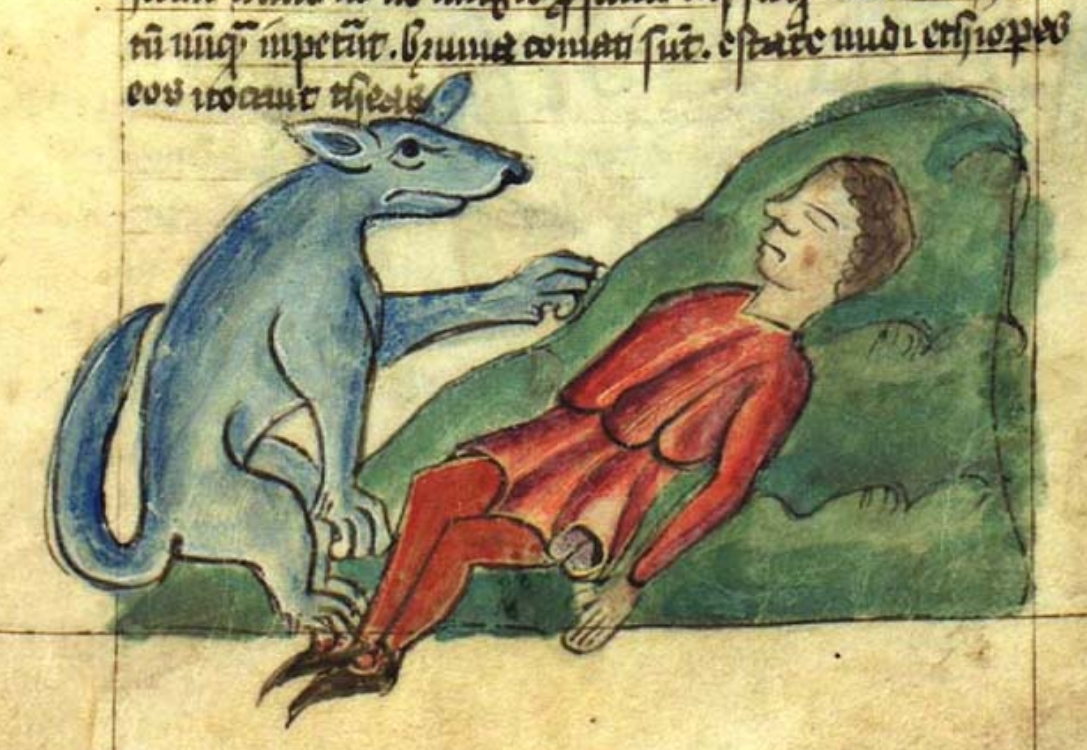
Over at the medieval studies blog In the Middle, Karl Steel has a great post on the legal standing of animals in English courts. I will just quote one of his citations and send you off to see his learned commentary:
If a ship is broken and no living soul escapes from it [de qua nullus vivus evaserit] [,] that may properly be called wreck, especially if the owner has drowned, because the true owner, coming from afar, may prove by certain proofs and signs that the things are his, as where a dog is found alive and it can be established that he is its master; it will be presumed that he is also the owner of the things, and so [also] if certain marks have been placed on the wares and goods.Here's Karl!
Image: a medieval dog by his presence helping to cure internal injuries.
Wednesday, November 07, 2007
Susan Thomson speaks on post-genocide justice in Rwanda
I would love to hear this talk, which is on Thursday, November 8, 4:30 to 6:00 pm,
in Room F213; but I am teaching myself.
in Room F213; but I am teaching myself.
Tuesday, October 02, 2007
Another perspective on old legal codes and charters
Students who have heard two lectures from me that discussed the doubts that surround the meaning of the Code of Hammurabi, which apparently was never cited by working judges in the Old Babylonian era -- might be interested in a view of old legal documents, early medieval this time, put forward in the blog A Corner of Tenth-Century Europe.
Subscribe to:
Posts (Atom)