Showing posts with label Combat of the Thirty. Show all posts

Thursday, July 28, 2022

My reaction to The Last Duel (2021)

I finally got a chance to see last year's The Last Duel, by my favorite poster and director, Ridley Scott. Some of my friends were less than enthusiastic when the movie came out, but I found it based on a credible reconstruction of 14th century French culture. A few "for-instances" show: the extremely strong desire to maintain one's honor; excellent interiors; the fact that different people speak different languages in different contexts; and so forth. What I respect most about this movie is that many details are included that only the most persnickety re-enactor or medieval archaeologist would notice Yet here they are, casting a glamor of reality over the whole drama.  I have to say that some of my good friends found the helmets used to be so wrong as to be a major flaw in the movie and really put them off.  I say, sadly, persnickety!  So much is right with the movie that I can't see this as a mortal sin.

My own work on duels and deeds of arms has a curious connection with the movie The Last Duel and the preceding book of the same by Eric Jager. Around the turn of the millennium I became aware of Jager's work. Frankly, I wasn't all that impressed -- at least, not until I found out that major Hollywood studios seemed to be showing an interest in making movies based on medieval deeds of arms. One day I got a call from a studio asking whether I knew of a translation of the account of the Combat of the Thirty. That was the end -- because at this early stage of my research I had not found the sources for the Combat.

,,> Anyway, I have found my interests, if no movie. Congratulations to Professor Jager -- and my gratitude for inspiring, in part, my decision to be a little more bold.

Monday, April 23, 2018

Ibn Battuta and the Empire of Mali in Extra History


Extra History is a series of hisotrical animations (I guess you could call them that) on You Tube.  Currently EH is posting material on the 14th century Empire of Mali (roughly today's West African country of Mali) famous as one of the world's chief sources of gold, and the location of Timbuktu.  EH is following the travelogue of the footloose Islamic scholar Ibn Battuta, who, if you take him at his word, went from his birthplace  in Morocco all the way to China, beating for distance the somewhat later Marco Polo.

When I was still teaching I loved talking  about Ibn Battuta, whose account gives us a good idea of what Islam meant to people outside the Arabic and Persian-speaking areas of the Middle East.  Ibn Battuta had a rather harsh judgement on these relatively new converts.  Not up to snuff, he said. But you can also get an idea of the flexibility of Islam in this period, which allowed it to appeal to people who lived in the Sahara, on the Russian steppes, and the islands of the Intian Ocean, to name just a few.

This EH series is one of the best of the bunch.  See it here.

Image:  A mosque in Timbuktu. By Senani P at English Wikipedia, CC BY 2.5, https://commons.wikimedia.org/w/index.php?curid=1831543

I can't help but point out that Ibn Battuta's Saharan journey took place at exactly the time that the Combat of Thirty v. Thirty.

Sunday, February 28, 2016

How many at the Combat of 30?

As many of my readers know, there was an arranged battle or deed of arms between two garrisons in Brittany in March 1351. The garrison commanders supported different claimants for the ducal title. The civil war was part of the wider Hundred Years War between rival claimants to the kingdom of France, and like the wider war it was going no place. Out of boredom or frustration, the commanders agreed to have an even number of their men meet halfway between the castles and fight to the finish – death or captivity. But what was that even number? And what was the total number of participants?

Well, 30+30 equals 60, right?

The problem is that various accounts imply that there were 30 men on a side in addition to the commander himself. Were there 31 on a side for a total of 62?

About 100 years ago, H.R.Brush edited the most detailed account, a product of Brittany and therefore written by someone well acquainted with the battle, and he concluded that there were 30 participants on either side. In my article, my chapter in the book deeds of arms, and in my source reader on the combat, I followed Brush.

But, at about the same time that I finished my source reader (called the Combat of 30, volume 2 of my series Deeds of Arms), Michael Jones wrote an article called "Breton soldiers from the battle of the 30 (26 March 1351) to Nicopolis (25 September 1396)," which appeared in Adrian R. Bell et al., eds., The Soldier Experience in the 14th century (Boydell Press, 2011). Jones was very interested in the careers of Bretons in the first half of the Hundred Years War, and the best examples he could find were the men at the combat of the 30. He followed them as closely as he could, and he was able to find a quite a bit about them, at least about those on the pro-French side.

And he came to the conclusion that there were 31 on a side.

I have not gone through his list systematically checking it against Brush's (in Modern Philology).

I'd love to farm this out to Will McLean but alas he is not available.

Friday, January 31, 2014

Chivalry: the Combat of the 30 and an odd story from the Arabian tradition


Today in my chivalry seminar we discussed the three most important accounts the Combat of 30 as found in my book of the same name. I started out by asking a general question about whether this was a chivalric deed of arms. One of my students launched into an enthusiastic affirmation. And you know what? He was taken by exactly the features of the deed that I think people of the mid-14th century most appreciated, in other words that it was a fair fight and no one ran away.

Just goes to show you.

A few days back another chivalric story swam into my ken, thanks to Phil Paine.

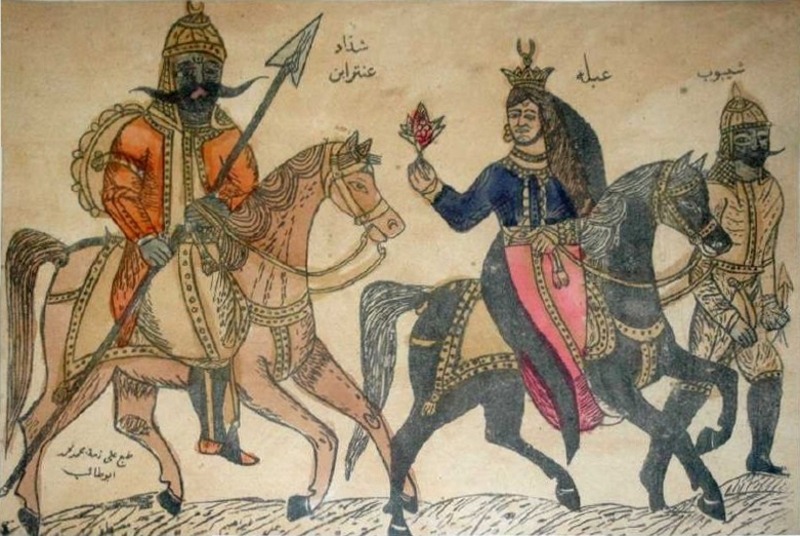
It is the Romance of Antar, derived from the poet Antar of the time of the Prophet, whose original poems were among the hanged poems in the Kaaba at Mecca. Students in my Islamic civilization course know Antar. Here's what Phil has to say about the later Romance of Antar and its significance.
Early Ara­bic lit­er­a­ture is not well-known in the English-speaking world, and some ele­ments of it might sur­prise some­one who is only famil­iar with the stuff from later peri­ods. Among the ear­li­est works in Clas­si­cal Ara­bic are a num­ber of tales that can only be called “chival­ric romances”, which strongly resem­ble the sort of thing you would expect in Mal­ory or Chré­tien de Troyes. What would most sur­prise a mod­ern reader is the treat­ment of female characters.
 And what is that treatment, Mr. Bones?

Here are some remark­able passages:
Zahir con­tin­ued his jour­ney, until he reached the Saad tribe, when he dis­mounted from his horse. He was cor­dially received and was pressed to take up his abode with them. His wife was at that time soon to become a mother, and he said to her: “If a son is given to us, he will be right wel­come ; but if it be a daugh­ter, con­ceal her sex and let peo­ple think we have a male child, so that my brother may have no rea­son to crow over us.” When her time came Zahir’s wife brought into the world a daugh­ter. They agreed that her name should be actu­ally Djaida, but that pub­licly she should be known as Djon­der, that peo­ple might take her for a boy. In order to pro­mote this belief, they kept up feast­ing and enter­tain­ment early and late for many days. 
 About the same time Moharib, the other brother, had a son born to him, whom he named Khaled (The Eter­nal). He chose this name in grat­i­tude to God, because, since his brother’s depar­ture, his affairs had pros­pered well.
 The two chil­dren even­tu­ally reached full age, and their renown was wide­spread among the Arabs. Zahir had taught his daugh­ter to ride on horse­back, and had trained her in all the accom­plish­ments fit­ting to a war­rior bold and dar­ing. He accus­tomed her to the sever­est toils, and the most per­ilous enter­prises. When he went to war, he put her among the other Arabs of the tribe, and in the midst of these horse­men she soon took her rank as one of the most valiant of them. Thus it came to pass that she eclipsed all her com­rades, and would even attack the lions in their dens. At last her name became an object of ter­ror; when she had over­come a cham­pion she never failed to cry out : “I am Djon­der, son of Zahir, horse­man of the tribes.”
 There is much more and Phil gives an extensive summary.

Tuesday, August 13, 2013

What was the point of the Combat of the Thirty (1351)?

At this year's Pennsic war, as for several preceding this one, there was a reenactment of the combat of the  thirty, which took place in Brittany in the year 1351 during the first phase of the Hundred Years War. As every time before, the sides were not even. Despite a big discrepancy in numbers, the sides are not evened up. The combatants chose to stay with the signs they had chosen or had been recruited into earlier. I think this is rather odd, given that the whole point of the original combat of the 30 was to see who was better if sides were kept even and no outsider was allowed to intervene. To remind the SCA community of what contemporaries thought was essential to the event, I am reproducing here from my book The Combat of the Thirty, three contemporary and near contemporary descriptions of how the combat was arranged.  
Jean le Bel's account
How thirty French fought against thirty English and Germans by certain agreements in Brittany, and the English and the Germans were defeated.
In this same season, there took place in Brittany a most marvelous deed of arms which should never be forgotten
Messire Robert de Beaumont, a valiant knight of a great family in Brittany, was castellan of Castle Josselin, where he had a great many men-at-arms and squires of his lineage.  And it so happened one day that he came  near the  castle of Ploermel, whose castellan was a German mercenary called Brandebourch, who had with him a great many German, Breton, and  English mercenaries, and he was of the party of the Countess.
When Messire Robert saw that none of the garrison was coming out, he went to the gate and called out this Brandebourch, under a guarantee of safety, and asked him whether he had any companion, or perhaps two or three, who wished to joust with steel lances against three, for the love of their ladies.  Brandebourch replied and said to him, that their lady loves would hardly wish that they should get themselves killed in a single joust, for this kind of venture was over too soon, and in it one got more of a reputation for presumption and folly than for honor and worth.
"But I will tell you what we will do.  If you like, you will choose twenty or thirty of your companions  from your garrison, and I will choose as many from ours  and we will go to a field where no one will be able to disturb or prevent us, and command on pain of the noose to all of our companions on either side, and all those who watch us, that none should give the combatants reinforcement or help."
"By my faith," replied Messire Robert, "I agree to thirty against thirty, and I swear it thus by my faith."
"I, too," said Brandebourch, "swear it, for he who carries himself well there will gain more honor than in a joust."   And so this affair was agreed and an appointment was made for the following Wednesday, four days hence.
During that time, each party chose their own thirty, just as they wished, and each of the sixty procured such armor for himself as he was able.
When the day had come, the thirty companions of Brandebourch heard Mass and then armed themselves and left for the field where the battle was to take place.  And they dismounted and ordered all those who were there that none of them should be so bold as to intervene for any reason whatever.
Those thirty companions whom we will call "the English" waited a long time for those whom we will call "the French."
When the thirty French had come, they dismounted and commanded just as the English had done, that no one should give them help or aid.   Some say that four or five of the French remained on horseback at the entrance to the field, and that twenty-five dismounted, just as the English had; but I don't know for certain, for I wasn't there.   However it was, they spoke a little, all sixty of them, and then stepped back, each party to its own side, and made all their people retreat well back from field.

La Bataille de trente Anglois et de trente Bretons


[IV]
“ Brambro,” said Beaumanoir, “Know for certain
That all your boasts will avail you nothing.
Those who say the most in the end deceive themselves.
Now please, Brambro, let us do the smart thing.
Let us get together to fight, by appointment,
With sixty companions, or eighty or a hundred,
And then indeed we will see for truth and for a certainty,
Who will have wrong or right, without further ado.”
“My lord, “ this Brambro said, “I swear it to you!”

V

Will “Brambro,” says Beaumanoir, “for the sake of God the just,
You are a valiant man and a very shrewd warrior,
Come on that day without asking for delay
In a year one says many a word which one wishes to recall,
And one often makes great boasts over dinner.
Do not do to me what you did to Pierre Angier
That valiant, noble man, that gentle bachelor.
He chose a day for battle with you
At the town of Ambissat. And I have heard said
That he went to that place to acquit his oath
With twenty-six spurred knights
All accoutered in gold and steel.
And Brambro, you defaulted.  You did not dare to go.
This deed we are discussing, is a very great one.
You should not mock it! 
People will speak of it for a very long time!”
“Beaumanoir,” says Brambro, “For God’s sake let be!
For I will certainly be the first on the field.
With me will be thirty men, no more, no less,
Who will all be covered in good iron and steel.
I will not bring any villain, God give me aid!
The least of them will be a squire,
Bearing a coat of arms on his chest.”
But Brambro lies to conceal his plan,
So you do not imagine that he will bring
A bastard villain vagabond
Strong enough to carry, easily, a setier of beans
Over his neck, whose stomach was bigger
Than that of a courser.  Brambro, by his great fierceness,
Armed him this day.  Through him he thought
To avenge Dagworth, when he should have struck down
Such a villain deceiver.

I now will tell you of the noble Beaumanoir.
To Brambro he says, “I wish concerning this to go
To castle Josselin, to muster my men.”
“You go,” Brambro told him.  “I also wish to issue my orders
Through all the duchy.   I will assemble all
The noble English I can find.”
Thus was the battle vowed, that without cheating or fraud
They should fight it out in good faith
And on either side, all would be on horseback.
Pray then to the King of Glory, who knows and sees all,
That he will help those who have the right,
For this is the point at issue.

Androw of Wyntoun’s Account


The lord of Beaumanoir in battle
Manfully approached an English knight
That spoke of Frenchmen quite lightly
And would often say scornfully
“What, are not the English the doughtiest men
Though God may sleep in his den
Yet I think and I think it true
One Englishman is worth two French.”
Thus he often spoke until the day
This lord of Beaumanoir said to him
“You speak, sir, too freely
Men may perchance find near at hand
Men of such quality
As you may find in your country.”
The knight said, “Sir, by my faith
That I would like to  put to the test
Where we could fight with even sides.
And I would like to be one of them.”
Beaumanoir then was angered
And said to him, “You may find perchance
Your fill of fighting if you dare.”
“Yes, God willing,” said he, “I will be there.”
“Good sir,” says Beaumanoir, “perhaps
If you wish to put it to the test
I shall make the covenant.
You shall go home to England
And choose of the best men in your country
Until there be thirty-one
And I shall choose as many for myself
Of kin and friends here with me
And let us set here a certain place
To meet, and if God gives me grace
I will have victory with my retinue
If you shall be slain in the combat
Your ransom I will forgive you
I shall not ask for anything
And if you are taken to prison
Then shall you double your ransom to me.
So shall men see if French can deal
As fiercely with Englishmen.



Tuesday, August 16, 2011

Steve Muhlberger on the Combat of the Thirty -- a Chivalry Today podcast

Earlier this summer Scott Farrell of Chivalry Today interviewed me on the Combat of the Thirty against Thirty of 1351 and the contemporary re-enactments by members of the SCA at its Pennsic War.

Here is that interview.

This year I did not take part, but I did get the T-shirt. Really.

Friday, September 12, 2008

My article on The Combat of Thirty against Thirty is out


This week I was informed that my article "The Combat of Thirty against Thirty," which is based on a conference paper of 2005, is now available from Brill in the collection
The Hundred Years War (part II): Different Vistas, edited by Andrew L.J. Villalon and Donald J. Kagay. It's always nice to be published, but being included in a classy Brill collection has its drawbacks. Brill aims at the research library market and their books are priced accordingly: $175 US in this case.

This pretty much guarantees the book will not find its way onto the shelves of private individuals.

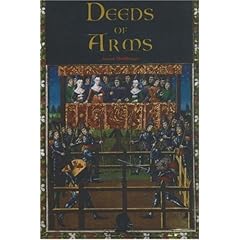
If, however, you are desperate to hear the latest word on the Combat of the Thirty against Thirty, you have two alternatives. You can buy my recent book Deeds of Arms, which has a whole chapter on the same incident (or get your university or public library to buy it). Or, quicker and cheaper yet: follow the tag "Combat of the Thirty" at the end of this post and see what I've already said here.

Image: I failed twice to paste in an acceptable image of "Different Vistas" so I'm just going with Deeds of Arms.

Saturday, August 16, 2008

The Pennsic War

During my recent vacation I attended, as I usually do, the SCA's Pennsic War. The Society for Creative Anachronism or SCA is a very large medieval re-creation group -- not a reenactment group because it does not reenact specific events of the Middle Ages, but has created its own Middle Ages for fun. The Pennsic War to give an example is fought between two SCA kingdoms, the Middle Kingdom and the East Kingdom, and their allies, none of which you will find on a map of Europe in any era. Wrapped around this war, which is by far the largest SCA event on the calendar, are a large number of organized and spontaneous activities, martial, educational, and artistic -- not to mention the parties and the various efforts to survive in what is essentially a tent city of 10,000 people or more.

I could go on for a long time trying to convey the Pennsic experience, but I will restrict my remarks to a few. First, reenactment. If neither Pennsic nor the SCA are primarily meant as reenactments, a fact that earns them scorn from many people who are aiming at reenactment, there are moments of reenactment nonetheless. At this Pennsic war I was able to witness attempts to re-create or reenact, with differing levels of accuracy, to deeds of arms of the 14th century which I have written about in scholarly venues, the Combat of the 30 against 30 that took place in Brittany in 1351, and the deeds of arms at Vannes, also in Brittany, of 1381. (The image above shows a few of the French 30 preparing for the combat.) Though one could easily stand back and list deficiencies in these reenactments, I found them enjoyable and even educational. (Here's my kvetch: Armor fans will note in the image above that the participants in this annual event tend to favor late- rather than mid-14th century armor. And many of them seem to be armored like princes instead of mercenary scum.)

More interesting even than the recreations and reenactments of the Middle Ages is the is a freewheeling modern-medievalist (?) culture of Pennsic. Two small examples will give an impression, I hope.

The first is the Pennsic rune stone. Long ago (1981), some SCA members from the American Midwest tried to express what the martial competitions at Pennsic, which are vigorous and sometimes painful but seldom really dangerous, meant to them. They did it in mock- Viking style by erecting stone monument. It is pictured above. The inscription, which I offer without comment, says:

In memory of Pennsic X.
In war we test our honor, courage and strength.
Let no man strike in anger.
Let no man lie in pain.

The work was done by Lars the Fierce, now a professional potter, who still attends Pennsic.


My second example is newer than the rune stone: it is a Turkish-style coffeehouse called Your Inner Vagabond, which is dedicated to the pleasures that can be achieved with such legal stimulants as coffee, sugar, chocolate, and all the spices of the silk road. Not to mention occasional music and dance. The IV, as the worst addicts call it, has been such a success that it now has a permanent location in Pittsburgh, about an hour from Pennsic site. The on-site location is now considerably bigger than shown in the picture above, which is two years old.

Usually my time at Pennsic is entirely devoted to nonliterate pursuits. I tend to avoid the printed page, and I entirely avoid the glowing screen. But this year I did something I've never done at Pennsic before: I wrote a lecture (on the Second Crusade). And I did it while sitting in the Inner Vagabond and sampling its wares. It was pure pleasure.

Friday, August 17, 2007

Combat of the Thirty against Thirty re-enactment

At the recent SCA Pennsic War, there was a re-enactment of the 1351 challenge between 30 French/Breton men at arms and 30 English. An entire chapter of my book Deeds of Arms is devoted to this episode, and a 19th century translation of a contemporary Breton account , Froissart's somewhat later account, and a 15th-century Scots version are available at one of my web sites.

This site by Eirik Andersen has a very impressive collection of portraits of the re-enactors,
shots of their armor, and action shots. Since there are 160+ photos, I suggest you use the slideshow function and go back to individual pictures you might be interested in.

Thanks to Will McLean for inspiring this post. I'll add to his comment by saying that none of the re-enacting "Bretons" who in real life won the combat seem to have identified themselves as such.

Image: an interpretation of a mid-fourteenth century English squire, "Richard Larmer."

Friday, July 20, 2007

Combat of the Thirty against Thirty: Cheaters?

I have just finished reading for the second or third time Maurice Keen's first book, The Laws of War in the Late Middle Ages (1965). It is a testament to what a brilliant, well-trained scholar with access to the most important archives and libraries can do. Forty years later, I am unaware of any comparable book on the subject. (I'd be glad to hear of another.)

The book's title, as Keen might admit if asked, is a bit of a misnomer, at least if one is interested in the later Middle Ages themselves. The Laws of War has quite a bit to say about medieval theory and practice as a prelude to the more modern era, from Grotius on, when a recognizable "law of war" developed. The emphasis, however, is on the law of arms, which in some respects was quite a different beast. The law of arms visualized a world where Christian warriors of noble background were the protagonists in war -- not just sovereigns as later on, and the focus of the law of arms was the rights of those warriors. I've discussed this myself in the books Jousts and Tournaments (an analysis of Charny's questions about the law of arms concerning those two "sports") and Deeds of Arms (on late 14th century formal combats); see the sidebar on the home page of this blog if you are interested in the books.

Reading Keen's book again reawoke a couple of question about the famous Combat of the Thirty (against Thirty) in Brittany in the early 1350s. Two garrisons, one pro-English, one pro-French (the majority of the 60 being Bretons in any case) challenged each other to a straight-up fight in which there would be 30 on a side, no more, and no one would run away, but rather stay to be captured (for ransom) or killed. The pro-French side won, and writers in Brittany and around Europe praised them for their fortitude (in contrast for instance with the French who ran away at Poitiers a few years later).

It's a famous episode of chivalry, which many people take to mean war pursued fairly and honorably.

I've always had my doubts that the combat was as fair as modern observers would like to think. First there is the matter of the guy on horseback. The pro-French side won, when things looked grim, when one of their members mounted a horse and broke up the tight infantry formation the English had adopted and which seemed impenetrable to their opponents. It seems to me that bringing in a horse late in the game would not be "best practice" today; and indeed, as I showed in Deeds of Arms even at the time fans of the event may have thought that this was a bit dicey.

Another thing that has bothered me for a while is the return of some of the pro-French captives to the fight when the man who captured them, the opposing captain Brandebourch, was killed. This is noted without comment in a Breton account of the episode as if nothing were more natural -- the man was dead, those who had surrendered to him were free of any obligation.

The problem is that as Keen shows, that was not standard practice. If you had surrendered, even if you were rescued, you were obliged to satisfy your captor. If your captor died, his heirs inherited his rights in you.

So were these captives cheating?

It's possible that in this earlier stage of the development of the law of arms, ransom law worked differently than later, or it worked differently in Brittany, something of a wild frontier.

But I don't believe it.

The other possibility that occurs to me is that the captives were exploiting a loophole. The usual thing that happened after the immediate surrender was that a written contract setting terms for ransom was drawn up at the next opportunity. Here, that had not taken place yet. Perhaps the captives used that circumstance to justify in their own minds that a real capture hadn't been consummated. Their friends and their Breton neighbors didn't object, and we actually have no idea what anyone in England thought.

Finally, it should be said that there was a lot of room for sharp practice in medieval chivalry; your own view of what your honor (= reputation) required might give you more or less room to play with the rules -- and the men at the Combat were mostly pretty modest men.