Showing posts with label writing. Show all posts

Wednesday, September 04, 2019

Creating the Fulani script

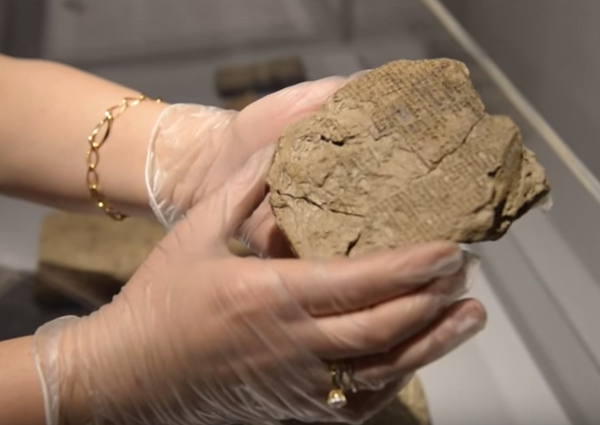
Microsoft has a site called "Stories" where they subtly brag on all the wonderful things that can be done with computers.  Today someone directed me to a particular "story" about the invention of a script for the Fulani.

Fulani is an important language in West Africa -- it may have as many as 50 million speakers.  However, it has never had its own script, one really suited to its structure.  People have made do with the Arabic and Roman alphabets.  This has limited the literacy of most uo f those millions.

So who is responsible for this  useful innovation benefiting millions?  Just a  couple of kids!
Related image

Friday, July 26, 2019

Heroic female historians in old Korea

I'm just now watching an entertaining Korean mini-series on Netflix, Rookie Historian Goo Hae-Ryung.  It is not exactly easy to follow, but not hopelessly obscure, either.

Goo Hae-Ryung is a young noblewoman sometime in the early modern period (at a guess). She loves literature, Korean, Chinese and European.  She may also be Maehwa, the author of the latest fad in Korean romance novels. Or maybe it's the young prince second in line to the throne who is Maewha.
The Korean state at this time works like the Chinese system.  Applicants for government jobs study classic literature and write exams based on that material.  The highly-educated office holders look down on the material written in Korean alphabets, on Korean novels, and on the people who read them.  Goo Hae-Ryung is a promoter of popular literature.  Lots of teenage girls are crazy for romances and when they hear that Maehwa is going to sign copies of his/her most recent book they practically riot.
The royal councillors decide to repress this "movement" by recruiting female historians OR forbidding the recruiting of female historians.  The King, who has been the target of bureaucratic criticism, takes the opportunity to open history offices to young women...Of course the male historians resist...

I am liking this series for its cinematography and the humorous depiction of character.  The music's good, too, which you might expect at a time when South Korea is strutting on the world music stage.

If you by chance run into me in person, I'll tell you both my Korean bureacrats' story and my Demilitarized Zone (DMZ) story.

Sunday, July 08, 2018

Aeon: The origins of writing

I stumbled across this article -- The Deep Roots of Writing -- on this site -- Aeon.  I love the history of writing and if you do too, go and read.  Other articles on Aeon look to be equally substantial.

Monday, February 29, 2016

Humbaba!

Missing pieces of the Epic of Gilgamesh found! Open Culture says:
That’s a pretty good deal for these extra lines that not only add to the poem’s length, but have now cleared up some of the mysteries in the other chapters. These lines come from Chapter Five of the epic and cast the main characters in a new light. Gilgamesh and his companion Enkidu are shown to feel guilt over killing Humbaba, the guardian of the cedar forest, who is now seen as less a monster and more a king. Just like a good director’s cut, these extra scenes clear up some muddy character motivation, and add an environmental moral to the tale.

Wednesday, August 21, 2013

Ta-Nehisi Coates writes "How I met your your mother"

An excerpt from the Atlantic:
But mostly I am thinking of you. I want to tell you that I have fallen for Paris. I think you know. I think you know because I am stupid and I am cliché. A serious man should should fall for some village in Moldova, for brandies made from magic apples, or ham taken from a rare and endangered hogs. A serious man should claim to have discovered Nashville, should live in Austin before it is Austin, then leave with tales of the edgy old days. I have been told that serious men are buying homes in Detroit. But I love chicken fingers. And I have never been to Foxwoods or Vegas. And I love New York against my better wishes. And I love Paris with that same familiar feeling--aching, everywhere and thin.

What I am telling you is that you do not need to know to love, and it is right that you feel it all in any moment. And it is right that you see it through--that you are amazed, then curious, then belligerent, then heartbroken, then numb. You have the right to all of it. You must want to own all of it. We will try to ward you away. We will try to explain to you that we have already walked that path. We will try to tell you that we have made your mistakes. We will claim that we are trying to spare you. But you will see our greed and self-service hiding behind our words. You will see us ward you away with one hand, while the other still shakes at the memories. Here is the thing--you have the right to every end of your exploration and no motherfucker anywhere can tell you otherwise.

Thursday, December 01, 2011

Quoting well--another useful guide

From the same website that tried to save you from glaring usage errors, some guidance on the use of quotations.

Tuesday, November 29, 2011

Writing errors that make you look dumb

I don't know if any of my current students read this blog, but any who do might consider that I think this article is right on the money!

Wednesday, April 13, 2011

The cinematic present tense

You know how when you are retelling the story of a movie you've seen, how you kind of naturally fall into the present tense?  Is there a name for that phenomenon?  Besides the one I've just made up?

Yes, this query is related to my essay grading.  I have a very consistent example of the use of the "cinematic present tense" right here.  (But I can't show you.)

Tuesday, April 12, 2011

Thoughts while grading essays

not "this"

It occurred to me on the third essay that all of them would have been considerably improved and earned higher grades if my students did two things:


1. Introduced each quotation.  E.g.:

As the prominent French knight Geoffroi de Charny said in his Book of Chivalry, "He who does more is worth more."
2. Began no sentences with a bare "this."  E.g.:
This is very important.  Rather: This characteristic statement is very important.

Oh, the vagueness and confusion that could be eliminated by these two simple steps!
(Doesn't that last line sound like an Internet weight loss ad?)

Tuesday, January 04, 2011

Students: you can do this too

 From the Chronicle of Higher Education, The Writing Group of Two.

An excerpt:
I've written in this space before about the usefulness of a "writing date." You buy a kind of accountability when you're with someone and you're both supposed to be working....

Last summer I got an astonishing amount of writing done, as did Nancy and Jeff; we all suffered together, over endless cups of coffee and an occasional scone.

But Nancy and I did something else, too. When one of us got stuck, we asked the other for help. And by stuck, I don't mean when you have to stop looking at the page for a while and go out for a run, bake a cake, or do whatever you do when your brain needs to be reset to start working again. I mean stuck as in paralyzed. You know what you need to do, but you just can't get there.

Maybe that doesn't happen to everyone. But it happens to me. And it happens to Nancy. It's easier for me when it happens to Nancy. And that's when we move from having a regular writing date to being members of the Writing Group of Two.

Here's how it works. Nancy will say something like, "I have to put this book proposal together." And then she will stare into space for three hours. Or start working on a syllabus for some course she might teach someday. Or search for an apartment to rent in Paris.
That's when I say, "OK, let's get to work." I make her think out loud and interrupt her with a stream of questions. I ask her what the argument is, and make her articulate the question she is trying to answer. I ask her why she is the right person to write the book. I tell her she has to come up with a table of contents. Nancy is a slow typist, so usually I grab her laptop and curse that rainbow-striped Apple when I can't find the right keys and make stupid mistakes. But I type as she talks.

Everything is already in her head. It's not that she's stuck on the thinking part. It's that she finds it difficult to get her thoughts onto the page. So, like a translator, or a secretary, I listen to what she's saying and I record. I don't worry much about getting things right—that's her job. What I do is help her produce that first impossible draft.

Then it's my turn. My problem is different. I can write a first draft. But often, while I suspect it's crap, I can't figure out where it's gone wrong. The language is generally fine. Sometimes, in fact, it's too good; fluid prose can hide hideous flaws of thought—at least from the author. If you get a draft that you like, you tend to memorize it; the sentences start to seem inevitable and unchangeable. I know that once it's out there in the world, there will be people quick to point out my inadequacies, my glibness, my habit of skimming along the shiny surface.

So Nancy reads my embarrassing first draft and says, usually, "I think it's more complicated." Then we discuss. She forces me to refine my thinking...

Tuesday, December 28, 2010

Actually cutting and pasting

Grad student Tanya Roth, no stranger to the tools of the computer age, sometimes takes out the scissors and starts hacking away:

My grad school colleagues know me as someone who uses a number of digital processes for the dissertation project. ...

Maybe that’s why my advisor seemed surprised when I told her about my other hacking process…the literal cut-and-paste process I use when I’m editing chapters. This is the part where I hack the printed pages into pieces... I fell into this practice as a college freshman when I took my school’s comp 101 class. Back then, it was just a 10-page paper, but it worked. I cut the draft into paragraphs, numbered each, and wrote notes on the sides of each paragraph – sometimes editing sentences, but other times just noting what the theme of the paragraph was so I could rearrange content more effectively.

I did the same for my undergrad thesis, and the whole process has reemerged periodically during the dissertation stages. For all my digital processes, I can’t deny that this cutting and pasting works for me: it gives me the ability to visualize the whole piece a little better because I can see more than just one or two pages on the screen. I can try out what it will look like/sound like to rearrange paragraphs.

There's more, in this post and in others.

I like the idea of seeing the whole chapter laid out:


I don't know if it would work for me, but it might be worth a try.

Saturday, August 28, 2010

"An honest to God Elizabethan psycho" and a fascinating reading list about literacy

So far this weekend two especially noteworthy posts have come to me via Google Reader.

Thanks to Dr. Beachcombing, I got to read about said Elizabethan psycho, Sir Richard Grenville, who
... was of so hard a complexion that, as he continued among the Spanish Captains, while they were at dinner or supper with him, he would carouse three or four glasses of wine; and, in a bravery, take the glasses between his teeth, and crush them in pieces, and swallow them down, so that oftentimes the blood ran out of his mouth, without any harm at all to him: and this was told me, by diverse credible persons that, many times, stood and beheld him.
To see what kind of excesses eating wineglasses can lead to, I refer you to this post.

If, however, you are in a less excitable mood, Stephen Christomalis provides the world with his reading list for a grad course on writing systems and literacy. Now if I could just pull myself away from this screen, I could indulge myself in such treats as

John Defrancis, The Chinese Language: Fact and Fantasy.
While the title suggests that it is more generally on language, the core of the book is on the nature and social context of the Chinese characters, ranging from basic semiotic issues to modern romanization efforts, and the gross misunderstandings most Westerners have of the script.
Enough to make your mouth water, isn't it? Beats reading debates on the fragile economy.

Friday, July 16, 2010

Finished


... the crappy first draft of what I hope will be a decent article eventually.

Do you have problems writing concluding paragraphs? Of course you do.

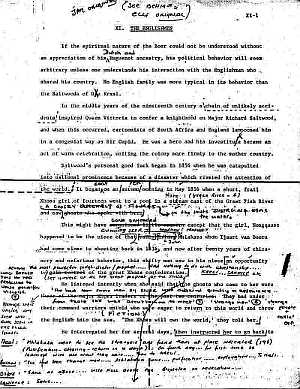
Image: This is what a corrected first draft looked like in the typewriter era. If you were a good writer, that is (in this case, James Michener).

Thursday, July 15, 2010

Writing: students, listen to the voice of experience

No, I don't mean me. Students never get (or respond to) good advice from their teachers!

But they might listen to a more experienced student (one writing a dissertation, perhaps) who has seen it all and is willing to tell uncomfortable truths about her writing life. Meet Tanya L. Roth:

The truth is that I am a perfectionist with my work. Or, as I like to think of it – I’m a recovering perfectionist, as this is something I’ve been working to overcome for the last five years. Perfectionism, as it turns out, gets in the way of things more than it actually helps. (As Lamott says, “Perfectionism is the voice of the oppressor…and it is the main obstacle between you and a shitty first draft.” Also, “perfectionism will ruin your writing, blocking inventiveness and playfulness and life force.” (Lamott, 28).)

In my experience, five years of graduate school teaches you a lot about your writing habits, your strengths, and your weaknesses. I’ve learned that revisions are my bread and butter, and that facing the blank page is one of my greatest challenges (see: perfectionist tendencies). My solution? Conquer the Blank Page.

I like to think I’ve gotten very good at drafting. I can eliminate the blank page in fairly short order and transfer something from my brain to the screen. That something tends to be the worst writing you have ever seen, but as it turns out, it helps me get started. In a couple of hours, I can pour out about ten to fifteen double-spaced pages of the very early thoughts on a chapter topic. I do this, of course, by simply writing.

There’s no rhyme or reason to it. It’s not quite freewriting (I pay attention to grammar and spelling and all that). In a sense, it’s stream of consciousness, but some of it will appear more Faulkneresque while other parts sound like I’m actually trying to write a real academic piece. I don’t delete anything. I do tend to write “this is crap” at least once or twice every two pages, and the general tone tends to be “here’s what I’m thinking I need to do in this chapter…” – as if I’m talking to my best friend.

Before I know it, I have something. Something I can create an outline from and begin to make into a real chapter. Once I have a rough outline – which will change, and become more detailed as I continue to write – I divide the chapter into sections. Sections, you see, are far more mentally (and physically) manageable to work with than the prospect of an entire chapter.

Lynn Hunt wrote in a recent issue of AHA’s Perspectives:

Everyone who has written at any substantial length, whether prose or poetry, knows that the process of writing itself leads to previously unthought thoughts. Or to be more precise, writing crystallizes previously half-formulated or unformulated thoughts, gives them form, and extends chains of thoughts in new directions.

This is why the shitty first draft – Lamott’s term, not mine – is so important. If you haven’t written anything yet, how can you know what you’re thinking?

More interesting thoughts here.

Update from Lynn Hunt's article:

The best advice about writing that I ever got was many years ago from the poet and prose writer Donald Hall. His book Writing Well was then in an early, if not a first, edition (it is now in its ninth), but he also generously read the pages of those of us who were junior fellows in the Michigan Society of Fellows. He was a senior fellow, and I knew that my dissertation needed serious work. From him I learned that writing requires an unending effort at something resembling authenticity. Most mistakes come from not being yourself, not saying what you think, or being afraid to figure out what you really think.
Wonderful! (I'll tell you about Sir Percival someday...)

Image: borrowed from these people.