Showing posts with label history of democracy. Show all posts

Wednesday, January 24, 2024

Some good news out of Nunavut


We hear that the Federal government of Canada has turned over control of resources and other areas of federal jurisdiction to the territorial government of Nunavut, the farthest northern territory of Canada, inhabited mostly by Inuit (formerly called Eskimo). This is a big deal. More later.

Here's the "More Later."

In Canada, as in the United States and I believe Australia and New Zealand and other colonies (Brazil?) the indigenous people were forced to surrender their claims to the land they lived on in exchange for small reserves.  These settlements, whatever they said gave control  of valuable or potentially valuable resources to colonial settlers.  The resources have become ever more valuable and strategic in recent years.  This Nunavut settlement seems to put the territory on the same footing as the Canadian provinces, which have a great deal of practical autonomy (see the case of Alberta and oil).

We'll see how it works out.  And if it has any effect on other countries' approach to indigenous issues.

Friday, June 30, 2023

Robert Reich, well-known political insider, says "Run for office? No thanks!"

Many of you readers have probably thought about this. I have too. But this brought into focus an important aspect of democratic politics that often doesn't get discussed.

I've included some big excerpts from this piece, but I urge you to read the whole thing:
Friends, Several of you have written asking if I might consider running for office. Well, I have an announcement to make. Brace yourselves. I’m not running — for president or anything else. I’ve run once before (for the Democratic nomination for governor of Massachusetts in 2002) and learned I don’t have what it takes. Before I ran, I thought I knew everything there was to know about getting elected — which made me think I could get elected, too. I’d been involved in dozens of campaigns. I’d advised candidates running for governor, senator, and president. I’d worked for three presidents. I was wrong. It takes several unique personality traits to successfully run for a major public office. I don’t have them

First, you need to be sufficiently narcissistic to be able to sell yourself to voters (and anyone you need to help bankroll your campaign). In 2002, so many Massachusetts residents urged me to run that I thought voters (and funders) would flock to me once I announced. But the moment I said I was actually running, the burden of proof instantly shifted onto me. Even my most ardent supporters wanted to know: What made me think I would be a good governor? Many of the people who I assumed would be generous with their dollars in support of my campaign became skinflints overnight. Sure, I could promote policy ideas — I’d done it all my life — but I was terrible at promoting myself. It felt excruciatingly embarrassing. Telling complete strangers why they should be enthusiastic about me made me want to crawl into a hole and disappear. Dialing for dollars was the most humiliating experience I’ve ever had.

Donald Trump is a masterful self-promoter because he’s a pathological narcissist. He boasts about himself nonstop and has probably done so since he was an infant. No matter that his bragging requires dangerous lies, vile smears, law-breaking, and a grandiosity that would cause normal people to cringe; he does it all without moral constraint. It’s all he does. He’s the extreme. But you’ve got to be big on self-promotion to get anywhere in electoral politics.

Second, you need to be wildly extroverted. By this I mean you get more energy out of every encounter with a total stranger — every handshake, pat on the back, morsel of conversation — than the energy you lose in such an encounter. So by the end of a day of such encounters, you end up more energized than at the start. Bill Clinton lived off this contact energy...

Third, you need to be a method actor. You have to be able to will yourself into feeling whatever a situation demands, so you come off as authentic. Ronald Reagan was a master of method acting, presumably because it had been his career before politics. Clinton was almost as good. Barack Obama and Joe Biden, far less so. Trump is fairly good at this. Richard Nixon and George W. Bush were lousy method actors; even when they told the truth, they seemed to be lying.
Lots more good stuff in the original post!

Wednesday, October 24, 2012

Pessimism day, 2: the USA

If you want real hardcore pessimism, try the League of Ordinary Gentlemen:

The Towering Legacy of George W. Bush

by Jason Kuznicki on October 23, 2012

Conventional wisdom errs when it says that George W. Bush was incompetent. He was a president of overwhelming influence, the most effective chief executive since FDR. We live in the world that W. created, for good or — mostly — for ill.
Weirdly, Powerline’s John Hinderaker, of the first and I believe only Time magazine Blog of the Year sort of… well… he was completely, absolutely, right:
It must be very strange to be President Bush. A man of extraordinary vision and brilliance approaching to genius, he can’t get anyone to notice. He is like a great painter or musician who is ahead of his time, and who unveils one masterpiece after another to a reception that, when not bored, is hostile.
Four years out of office, W. still can’t get anyone to notice. Electing Barack Obama was supposed to be a repudiation of his predecessor’s policies, and in many ways I wish it had been, but the truth is that it’s been nothing of the sort. W’s policy innovations have been so popular among the governing class that there have been few serious challenges to them from any corner at all. When these policies, all of them less than twelve years old, are challenged,the challenger is typically presumed to be a crank.
...

Why exactly is W. still viewed as an incompetent? And why, if his policies are so much in demand, is he still personally so unpopular? The man appears to have delivered exactly what the American electorate wanted, and he’s made it stick, and it’s what the American electorate apparently still wants, and they only disagree about whether it’ll be blue bunting, not red. (Could one of these colors ever mean something different from what it did just a few years before? Of course it could. Just take a look at W., who made it happen back in the day.)

One would never infer Bush’s accomplishments from his reputation. A poll conducted this month found that America’s favorite recent presidents were Ronald Reagan (38%) and Bill Clinton (34%), and that’s maybe unsurprising. But despite two terms of good economic times — and being at war — George W. Bush garnered a meager 1%. The same poll showed him tied Obama, at 28%, as the people’s choice for our worst recent president.
So what gives? And where’s the monumental architecture? I’ve got two answers. And honestly, I sort of hate both of them...


The second reason is that while many of us apparently like W.’s policies — they still poll pretty well — we Americans generally aren’t so comfortable with the sheer fact that we like them. We don’t like what that fact says about us: America used to be a much freer nation, and by that we mean: Most of us at one time knew better. We were more self-confident. At ease. Unsurveilled. A bit more able to trust. We’d defeated the Soviets, defeated the budget deficit, invented the Internet (and let’s not quibble just now about who exactly did it, or how, or with what aims in mind), and we were well on track to get our entitlement systems in order and make them solvent again.

Then something terrible happened, and we were told that it all had to go away. Confidence and freedom were dismissed as ignorance and naivete, or worse, as evidence that you were on the other side.

People thought that way for a while because they were — we all were — genuinely scared. There’s nothing wrong, in moderation, with being genuinely scared of things that are, let’s face it, genuinely frightening. Nowadays the emotion just doesn’t fit so well anymore, and yet the policies are in place now, and they’ll be very hard to change. Vested interests are seeing to them, caring for them, making sure we remain afraid, just afraid enough that we won’t bother fighting too hard. The various aspects of the Bush legacy are here to stay, and all that’s left is quibbling about the details.

Imagining that we might be better — that we might do without the constant, free-form authorization of war against any and all; that we might not need Gitmo; that unreviewable targeted killing of American citizens anywhere in the world is an abomination; wow, that we might even be able to balance the budget — all are extremist views now. Not to be taken seriously.

Wednesday, July 04, 2012

Some perspective on the Arab Spring

Juan Cole takes a positive view:
Americans forget that in the 1780s the Articles of Confederation did not work very well, and there were problems of too little federal government. They forget the Rhode Island farmers’ strike, Shays’ Rebellion, the Whiskey Rebellion, the various slave revolts, the continued conflicts with Native Americans, etc., etc. Thomas Jefferson, less timid than our contemporary pundits, remarked after Shays’ revolt that ‘a little rebellion now and then is a good thing.’ You have a sense he wouldn’t be that alarmed by contemporary Libya.


They forget that 15 years after the constitution was written, the vice president of the United States killed the first secretary of the treasury in a duel.

So give the Arabs some time to sort out their new situation. Let them craft their new constitutions, hold their further elections, and begin their transition in earnest. It is early days. What had the United States accomplished by 1785?

The slogan at Tahrir Square was “Bread, dignity and social justice.” That sounds a lot like their version of “life, liberty and the pursuit of happiness.” Liberty and democracy have been a central demand of contentious politics in the contemporary Arab world. Let us wish them well instead of always putting them down. After all, we’ve been at this for over 200 years and we still don’t have it down.

The whole thing is worth reading.

Tuesday, May 08, 2012

Does American democracy still work? Brad DeLong and a bunch of non-abusive commenters

http://delong.typepad.com/sdj/2012/05/berekeley-faculty-club-does-american-democracy-still-work.html

Sunday, April 22, 2012

What my students took away from History of Islamic Civilization

I just finished grading the final exams for History of Islamic Civiliztion. Half of the exam grade was based on essays my students wrote on recent events in the Middle East. They could write on Turkey, Tunisia, Egypt, Syria, Yemen or Iran, and were expected to touch on some of these phenomena: nationalism, sectarianism, Islamism, democracy, secularism, and foreign intervention. Here's what they actually wrote on (in no particular order, my summaries):

           Egypt -- ready for democracy?
           Egypt -- democracy, Islamism, Western concerns
           Tunisia -- instability threatens the revolution
           Iran -- nuclear program and foreign concerns
          Egypt -- significance of the revolution
          Iran -- society on edge, politics divided
          Iran -- if war breaks out
          Egypt -- a corrupt election?
          Egypt -- challenges of democratic transition
          Syria -- why the revolution may not succeed
          Syria -- effects of Syrian crisis
          Egypt -- religion and democracy
          Tunisia -- summary of revolution
          Iran -- the sanction regime
          Iraq -- attacks on Christians
          Iran -- counter-productive Western and Iranian policies
          Turkey -- AKP success
          Tunisia -- summary of revolution
           Iran -- domestic and foreign conflicts
           Iran -- what's at stake in current confrontation

And here's to those students: Well done. You rose to the challenge.

Image: Canadian students, but not actually mine.

Sunday, April 08, 2012

Phil Paine on bad news from Timbuktu

Phil reports:

I have a personal interest in Timbuktu (see blog for Mar 7, 2006), so I have followed, as best as I can, the recent events in Mali that affect it.  After the fall of Gaddafi’s regime, several hundred young Tuareg who had been serving as mercenaries in his army have returned to Niger and Mali. Along with them came a large stock of weapons.  This re-ignited the low-level civil war which had come to an apparently satisfactory peace settlement in 2009.  Disatisfaction with the response to this renewal of violence seems to have triggered a coup d’Ă©tat by the country’s military against the democratically elected government. As a consequence of the instability following the coup, the “National Movement for the Liberation of Azawad” (MNLA) quickly occupied the three largest northern towns (Gao, Timbuktu and Kidal) and declared an independent state of Azawad, cleaving away the thinly populated northern half of Mali.

Few events in the last few years have depressed me as much. Mali had lifted itself by its bootstraps from an intensely repressive Marxist dictatorship, heavily involved in the slave trade, to become West Africa’s most promising democracy. Now that promise is evaporating.

More here: http://www.philpaine.com/?p=4439

Thursday, March 29, 2012

Thursday, March 01, 2012

Beyond non-violence


This is a two-part blog post. The first is basically a long quotation from Jonathan Schell on non-violent protest.  That material, which is indented, is followed by my own reflections.

Over at TomDispatch, the long-running anti-imperial blog, Andy Kroll has posted an interview with Jonathan Schell, who, Kroll says, has been consistently right in his critiques of imperialism ever since the Vietnam War era, and who is therefore ignored by the policy-oriented media.

Schell has some interesting things to say about how non-violent protest, which he sees as invented by Gandhi "at the Empire Theater in Johannesburg, South Africa, on September 11, 1906," has changed politics and frustrated empires. He argues that even classic revolutions began with little violence:

AK: You point to four key moments in history -- the French, American, Glorious, and Bolshevik revolutions -- and describe how the real revolution, the nonviolent one, took place in the hearts and minds of the people in those countries. And that the bloody fighting that, in some cases, ensued was not the true revolution, but an extension of it. It's a revelatory part of the book. Did you already have this idea when you began Unconquerable World, or was it an Aha! moment along the way?

JS: It was really the latter. Gandhi's movement landed the most powerful blow against the entire British Empire, and the Solidarity movement and the revolution in Czechoslovakia and other popular activities in those places were in my opinion the real undoing of the Soviet Union. That's not the small change of history. Those were arguably the two greatest empires of their time. So, having seen that there was such power in nonviolence, I began to wonder: How did things work in other revolutions?

I was startled to discover that even in revolutions which, in the end, turned out to be supremely violent, the revolutionaries -- some of whom, like the Bolsheviks, didn’t even believe at all in nonviolence -- nonetheless proceeded largely without violence. Somebody quipped that more people were killed in the filming of Sergey Eisenstein's storming of the Winter Palace [in his Ten Days That Shook the World] than were killed in the actual storming. That was true because the Bolsheviks were really unopposed.

How could that be? Well, because they had won over the garrison of Saint Petersburg; they had, that is, won the “hearts and minds” of the military and the police.

AK: The Bastille was like that as well.

JS: The Bastille was absolutely like that. In that first stage of the French Revolution there was almost no violence at all. Some people were beheaded in the aftermath of the action, but the victory was not won through violence, but through the defection of the government’s minions. It didn't mean the revolutionaries loved nonviolence. On the contrary, what followed was the Terror, in the case of the French, and the Red Terror in the case of the Bolsheviks, who went on to shed far more blood as rulers than they had shed on their way to power.
...

JS: There is a conventional assumption that superior violence is always decisive. In other words, whatever you do, at the end of the day whoever has the biggest army is going to win. They're going to cross the border, impose their ideology or religion, they're going to kill the women and children, they're going to get the oil.

And honestly, you have to say that, through most of history, there was overwhelming evidence for the accuracy of that observation. I very much see the birth of nonviolence as something that, although not exactly missing from the pages of history previously, was fundamentally new in 1906. I think of it as a discovery, an invention.

The fundamental critique of it was that it doesn't work. The belief, more an unspoken premise than a conviction, was that if you want to act effectively in defense of your deepest beliefs or worst cravings, you have to pick up the gun, and as Mao Zedong said, power will flow from the barrel of that gun.

It took protracted demonstrations of the kind that we've been talking about to put nonviolence on the map. Now, by the way, states have come to understand this power and its dangers much better. Certainly, those who govern Egypt understand it. And what about the apparatchiks of the Soviet Union? They saw it firsthand -- the whole thing going down almost without a shot being fired.

Take, for instance, the government of Iran. They're very worried foreign activists or certain books might show up in their country, because they're afraid that a soft or velvet revolution will take place in Iran. And they're right to worry. They've had two big waves of protest already, most recently the Green Revolution of 2009-2010.


It hasn't succeeded there yet. And to be clear, there's nothing magical about nonviolence. It's a human thing. It's not a magic wand that you wave over empires and totalitarian regimes and they simply melt away, though sometimes it’s seemed that way. There can, of course, be failure. Look at what the people in Syria face right now. And look at the staggering raw courage they've displayed in going out into the streets again and again in the face of so many slaughtered in their country. It's anyone's guess who's going to emerge as the victor there.

AK: It can fail.

JS: It does fail. But the fact that it can succeed suggests something new historically.

This is very interesting material (say I, Steve Muhlberger), quite worthy of prolonged contemplation, but it has this weakness: it ignores the problem of consolidating the gains that people power can sometimes win. When the crowds go home, after having won significant concessions, perhaps a new Constitution, perhaps a popular government, what will prevent all that progress from being eroded, from being stolen by the men who will shoot down the women and children, arrest the inconvenient writers musicians and academics, or just bit by bit steal public property and privatize public power for the benefit of themselves, their children and their allies?

We have got techniques that have shown some success in preventing these outcomes. But many of us have ceased to understand how important these techniques are and how exactly these techniques are supposed to work. We, the not so rich and not so important, have gotten lazy.

The chief of these techniques, but not the only one, is honest elections that select, authorize and legitimize our public officials. No electoral system is perfect, but there are certain obvious methods that serve to rein in the less worthy tendencies of any group of people who have been granted power. The basic elements are rules that make it easy for people who legitimately hold the franchise to exercise it, and rules and institutions that assure that the votes cast by those people are accurately counted. (You, reader, can think of more.) The rules don't implement themselves. Without the habit and the determination of ordinary people to supervise the supervisors, elections become corrupt amazingly fast.

Examples of how such corruption establishes itself are almost too numerous to mention, except that nobody does mention them. Note the recent history of that that long established democracy, the United States of America. Anyone who believes that the presidential election of 2000 constituted a democratic and honest election is either partisan or a fool. I see no reason to grant legitimacy to the 2004 presidential election, either. Recent polls in the state of Wisconsin, where a radical agenda is being imposed by the state government, have to arouse deep suspicion, simply because in classic manner votes mysteriously materialize exactly when and where they are needed, and no one can explain where the votes came from. Add to this the effort by American conservatives to disenfranchise as many poor and otherwise disadvantaged people as they can, and the Supreme Court's decisions that allows the rich to set up corporate bodies that can spend unlimited amounts of money on elections, and you have a Constitution that is in serious trouble.

Canadians are fond of saying that things aren't nearly as bad here as they are in the United States, and that is usually true. Nevertheless the Canadian Constitution is in serious trouble, too. It is finally coming out that there was an organized effort to discourage people from voting in the last federal election by calling them and telling them that their polling place had been relocated, on the guise of passing on official information from Elections Canada. I say "it is finally coming out" because the election was all the way back in May. Elections Canada has an honorable history – see my review of an interesting book on the history of the vote in Canada – but it has been negligent up to now. (One wonders if the federal government has been starving it of funding and personnel.) We are now coming to a crucial moment in our history. Will the public get angry and demand a thorough investigation and the prosecution of wrongdoers? And if the current governing party is found to have used such tactics, will the public demand that it step down?

The corrosive element in both the United States and in Canada is the attitude that politics is so uninspiring and basically dirty that good people like us should stay as far away from it as possible. Maybe we should not even vote, after all, "they are all the same." The Occupy movement, for all its positive aspects, is a perfect manifestation of that attitude, of the ideas that elections don't really matter. At the same time people who are deeply dissatisfied with the politics of our times never seem to make a connection between the results of elections and the noxious policies they disapprove of, which are put in place by people who won the last election. People who contribute to political parties, people who serve as officers in political parties, people who volunteer their labor to their political party, heck, people who join political parties: they make the laws. The people who only vote, or don't even bother to do that, they merely suffer under the laws, which are designed to serve the interests of the people who take politics seriously. And most of them are considerably better off than you are, and understand very well how power works.

The same politically active people have more influence over what the media says about politics than the apathetic majority. Is it any wonder that one message that consistently comes from the media is that you and I should stay apathetic about politics? That it's basically a spectator sport -- if you are cool enough to sit back and laugh at the fools who take it seriously?

There is such a thing as being too cool – maybe too cool to live.

If democracy is going to survive in places where it has been established in the past, ordinary citizens are going to have to take the kind of interest in the workings of the franchise and the structure of the Constitution that serious people took in the 19th century. They will have to work elections, and not merely participate at a minimal level, or just sit back and watch. The theory and practice of nonviolent action are great inventions for sure, but even nonviolence has its limits.

Wednesday, February 15, 2012

Another version of the big lie: People in [name that country, culture, or religious group] don't really want democracy

...they love the censors, the secret police and the bosses.

Prof. John Keane of the Sydney Democracy Initiative comments on the situation in China:

James Madison famously remarked that a popular government without popular information, or the means of acquiring it, is but a prologue to a farce or a tragedy. The present government of the People’s Republic of China has set out to disprove this rule.
Rejecting talk of farce and tragedy, its rulers claim their authority is rooted within a new and higher form of popular government, a “post-democratic” way of handling power which delivers goods and services, promotes social harmony and roots out “harmful behavior” using state-of-the-art information-control methods more complex and much craftier than Madison could ever have imagined.
Information flows in China are not simply blocked, firewalled or censored. The authorities instead treat unfettered online citizen communication as an early warning device, even as a virtual steam valve for venting grievances in their favor.
This cooptation requires a vast labyrinth of surveillance that depends on a well-organized, 40,000-strong Internet police force. Skilled at snooping on Wi-Fi users in cyber cafĂ©s and hotels, it uses sophisticated data-mining software that tracks down keywords on search engines such as Baidu, along the way issuing warnings to Web hosts to amend or delete content considered unproductive of “harmony.”
Government officials working in “situation centers” meanwhile watch for signs of brewing unrest or angry public reactions. Reports are passed to local propaganda departments, where action is taken. So-called “rumor refutation” departments, staffed by censors, pitch in. They scan posts for forbidden topics and issue knockdown rebuttals.
A pivotal role is played by licensed Internet companies. Bound by constant reminders that safety valves can turn into explosive devices, they use filtering techniques to delete or amend “sensitive” content.
...
What are we to make of this repressive tolerance? Looking from the top down, likening the Chinese authorities to skilled doctors of the body politic, some wax eloquent about the new surveillance tactics of “continuous tuning” (tiao). The simile understates the ways in which the labyrinthine system of coordinated do’s and don’ts is backed by predigital methods: fear served with cups of tea in the company of censors; sackings and sideways promotions; early-morning swoops by plainclothes police known as “interceptors”; illegal detentions; violent beatings by unidentified thugs.
Proponents of the Communist Party’s Web-monitoring tactics are silent about such violence. They also overstate the efficiency, effectiveness and legitimacy of the China labyrinth. They ignore the popular resentments sparked by a regulatory system that treats more than a few subjects as ticklish, or taboo.
...
The upshot is that the authorities now find themselves trapped in a constant tug-of-war between their will to control, negotiated change, public resistance and unresolved confusion. They may pride themselves on building a regime which seems calculating, flexible and dynamic, willing to change its ways in order to remain the dominant guiding power. Yet they also know well the new Chinese proverb: Ruling used to be like hammering a nail into wood, now it is much more like balancing on a slippery egg.
Whether the authorities can sustain their present balancing act, so proving Madison wrong, seems doubtful. Within the China labyrinth the spirit of monitory democracy is alive and well. Whether and how it will prevail against the crafty forces of surveillance is among the global political questions of our time.

Tuesday, February 07, 2012

Review of "The Secret History of Democracy" by Christopher Hobson

A fair evaluation, I think:
The Secret History of Democracy is an ambitious attempt to offer an alternative narrative to the dominant account of the history of democracy. Reacting to a common tendency to draw a line from Ancient Athens, through Republican Rome to revolutionary America and France and so on, this book seeks out other historical instances of democracy. In highlighting these ‘hidden’ examples, the hope is to re-energise the way we now think about democracy. Even if not fully announced as such, what the editors are essentially trying to offer is a history of the present – a critical rereading of the past to better comprehend the contemporary situation and enable political action towards further democratisation. Lamenting the way democracy is regularly understood by the (Anglo-American) West, Isakhan and Stockwell propose that by ‘opening awareness of the breadth of democratic forms [it] gives people the means to deepen, strengthen and develop democratic practice and the opportunity to promulgate democracy more widely’ (p. 223). And the various chapters in the volume do indeed offer a broad selection of democratic pasts. The book considers pre-Athenian experiences elsewhere in Greece, the Middle East, India and China; it explores democracy in the ‘Dark Ages’ in Iceland, Venice and Islamic history; it revives forgotten democratic practices in colonial and settler contexts in Africa, Australia and Canada; and it looks at more contemporary examples in the Arab Middle East. In light of the ongoing Arab Spring, the notable inclusion of multiple chapters on the Arab Middle East – too often excluded from books on democracy – is particularly prescient and worthwhile.
For the most part, the individual chapters are strong, and they offer useful illustrations of how versions of democracy can be found in many places where we have forgotten to look. For instance, Philippe Paine provides a fascinating account of ‘Buffalo Hunt democracy’ that was practised by the MĂ©tis people of Western Canada. The extent to which the chapters contribute to the overarching aims of the book is more mixed, however. Contributions such as Steven Muhlberger's on Ancient India, Pauline Keating's on China, and Mohamad Abdalla and Halim Rane's on Islam's past clearly identify the relevance of previous democratic experiences for contemporary struggles, but some of the other chapters do not connect their historical examples to present-day concerns in a sufficiently deep manner. This does not undermine the value of the chapters as stand-alone pieces, but it does have consequences for the volume as a whole. In itself, identifying examples of democratic practices that fall outside the standard historical narrative is not necessarily that difficult. Few would maintain the extreme position that democracy has only existed in the West. The question then is how these past experiences with democracy can be mobilised so that ‘people all over the world may come to have a greater sense of ownership over democracy and take pride in practising and re-creating it for their time, for their situation and for their purposes’ (pp. 15–16). On this point there is less direction both from the editors and most of the contributors.
A further issue that arises is: why these specific cases? There are many ‘secrets’ in democracy's past, and there are many different examples that could have been considered. What is it about these experiences that make them particularly valuable in re-envisioning contemporary democracy? Here the editors give little guidance. For instance, given that there are many examples of democratic practices in countries that are now struggling to institute democracy, what is it that makes street protests in Iraq worthy of inclusion above so many other alternatives? In this regard, the volume would have benefited from a much better explicated set of cases, and a stronger attempt to link them to contemporary concerns over democracy. While noting these shortcomings, on the whole this is an interesting and worthwhile addition to the slowly growing literature on the global history of democracy. In redirecting our gaze away from the standard historical reference points, it offers an important corrective to the common tendency of identifying democracy as a Western product. This volume pushes us to question accepted thinking on the topic, and suggests that the past may be one route towards a more democratic future.
Christopher Hobson (2012): The secret history of democracy, Global Change,
Peace & Security: formerly Pacifica Review: Peace, Security & Global Change, 24:1, 193-194

Thursday, December 29, 2011

Reflections on 2011

Brian Ulrich reflects and analyzes developments in the Arab countries over at Brian's Coffeehouse.  This particularly caught my attention:
One framework we have seen the past year is that "the nation," meaning the people, is rising up against internal oppressors so as to establish a new government on its own behalf. One question now is how the "nations" will be defined, or what identities will be on people's minds as they act politically. In Iraq, probably moreso than under Saddam Hussein, loyalty to a community of Sunnis, Shi'ites, or Kurds competes with that to Iraq as a whole. Those "Arab Spring" countries with religious differences will face the question of deciding if those differences preclude national unity. This issue might be most explosive in Syria, but for the moment, it is also a subject for discussion in Egypt, where salafis see Christians not as equal citizens, but as a subject population under Muslim rule.
More good stuff here.

Sunday, December 25, 2011

More from Moscow

From msnbc.com:

For many protesters, the animosity goes way beyond Putin the candidate. Vasily's father, Fyodor, now 50, says he watched in shock as the Soviet Union fell 20 years ago, then in horror as Russia passed, rudderless, through a decade of economic collapse and war. And then came Putin. Stability. Prosperity. "All over the country there was a scream of joy when we got rid of this alcoholic, Yeltsin. We finally saw a man who was sane, who was physically fit, and he wasn't reading from his notes," recalled the older Gnuchev.

His son Vasily says he was too young to remember the bad old days of democratic Russia. But he prospered under Putin, and always felt free. And that's the real problem. The Putin regime's reportedly widespread electoral fraud pulled the rug from under a whole generation who believed in their leader, who believed in Putinism. "Now we see that everything is a lie," Vasily explained. "The Kremlin just stole our votes  -- it's just incompatible with the picture of the world we grew up in."

It's that humiliation -- indeed, violation -- mixed with anger that seems to drive many Russian, middle-class protesters into the streets -- even when the elements are conspiring against them -- and will keep the pressure on Putin, with promises of more protests to come. But what if this "people power" movement really blossoms, only to be thwarted yet again, not in a free and fair election come March, but by another brazen, Putin-led ploy to retain power?

Sunday, December 11, 2011

Iceland's president explains -- democracy was on the line

 
In the financial crisis of 2008-, Iceland refused to saddle its citizenry with huge debts incurred by private banks, despite tremendous pressure from European governments and institutions.  Today the president of Iceland described the danger to democracy at that time on CBC Radio's Sunday Edition.

Have a listen and learn:
  • How 15 demonstrators stood between police protecting the PM's office and rock-throwing protesters, preventing who knows what.
  • How when all of Iceland's allies turned their backs on Iceland, or made terrible threats against it, only China (!) was willing to discuss aid and support
  • How "Gordon Brown [UK PM] will be remembered in Iceland when he has been forgotten in Britain."
You will have to listen to, or skip over, some other material at the beginning of  the segment.

Image:  One of Iceland's other minor problems during the same period.

Monday, November 28, 2011

Sunday, November 20, 2011

Smarter protest, please

Phil Paine, continuing this earlier post:

Shakespeare didn’t have Romeo and Juliet commit suicide in the first act, and then let the remaining characters pitch tents on the stage and chat aimlessly for the remaining four acts.  That was because Shakespeare was a dramatist.  His aim was to move people to emotion, to make them think, to shock, horrify, or delight them.  Let us, for the sake of argument, assume that he was pretty good at it.  Today’s protesters could learn a thing or two from him.
As I mentioned in Part 1, the Occupy protest movement began by taking advantage of new methods (the social media), and then quickly reverted to an old formula.  The advantage that social media offered was the ability to bring people together quickly to do some strategic and dramatic thing —- to surprise.  The “flash mob” is the appropriate template for a protest using social media.  The flash mob originated as an amusement —- one in Toronto called people to a pillow fight in front of the Eaton Centre.  There have been some political protests using this technique, and these have been dubbed “smart mobs,”  but their use has been very limited, so far.  The key to the flash mob’s effectiveness is its ability to end as dramatically as it begins.  This leaves those in authority disconcerted, and makes them look incompetent.  It has the same advantage in protest that guerilla tactics can have in military conflicts.
The Occupy movement has squandered the opportunity to move into the modern age of protest.  Social media were used to bring people together, but once there, power reverted to the traditionalists, and the only thing they could think of doing was squatting down and staying put.  The smart mob turned into a “sit in,” a protest relic from a generation ago that is notorious for its ineffectiveness and tendency to alienate the very people that the protest is supposed to convince.

...

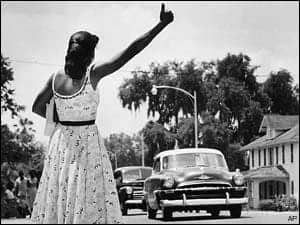
If you speak to these old-schoolers, it won’t be long before you hear them prat­tle non­sense about how they are con­tin­u­ing the tra­di­tions of the Civil Rights Move­ment in the 1950’s and 1960’s. They are delud­ing them­selves. The Civil Rights activists were not amus­ing them­selves. They did not go out on pic­nics. They were deal­ing with the Ku Klux Klan, and with cor­rupt and vio­lent state gov­ern­ments in the Amer­i­can south. They were in con­stant dan­ger. Civil Rights activists faced the seri­ous pos­si­bil­ity of being tor­tured or killed. Every­thing done was aimed at pro­ject­ing an atmos­phere of seri­ous­ness of pur­pose, and of clearly delin­eat­ing the moral issues involved. Any­one who wants to see real protest in action could do no bet­ter than to study the events of the Mont­gomery Bus Boy­cott of 1956. Protests like this led to a gigan­tic trans­for­ma­tion of Amer­i­can soci­ety, one of the most dra­matic in world his­tory. Take note of the fact that Mar­tin Luther King, Jr. and Ralph Aber­nathy did not orga­nize cat­fish fry-ups, spon­sor water­melon eat­ing fes­ti­vals, or instruct their fol­low­ers to dance the madi­son. They did not paint them­selves blue. They ratio­nally, intel­li­gently, and bravely, cal­cu­lated which actions would pro­duce the desired results, and under­took them, mak­ing huge per­sonal sac­ri­fices to do so. The Amer­i­can pub­lic came to realise that it was the State Gov­ern­ments and the Klan who were the sav­ages, the forces of chaos. 
I have become pro­gres­sively more annoyed with the Occupy move­ment because of its utter fail­ure to heed these sim­ple and obvi­ous facts. We des­per­ately need to get the Amer­i­can and Cana­dian pub­lic to under­stand the trou­ble we are in, and the dan­gers we face over the com­ing years. Intel­li­gent protest is one of the things that has to be done. I’ve out­lined some of the rea­sons why the protest we are see­ing is not intel­li­gent or effec­tive. Next, in Part 3, I will dis­cuss the types, dynam­ics, and struc­ture of protest.
Read the whole thing. 

Image:  Boycotting the segregated bus system, 1955

Monday, November 07, 2011

The situation of Arab Christians


Daniel Philpott:
A tense subplot of the Arab Spring is the increasing endangerment of the region’s Christians. In Egypt, Coptic Christians, 10% of the population, have been attacked repeatedly by Salafist Muslims unleashed – many literally released from prison -- by the fall of President Hosni Mubarak. No wonder that Christians in Syria now fear their fate at the hands of the country’s Sunni Muslim majority should President Bashar al-Assad’s government fall.
The experience of Christians in Iraq is hardly encouraging, either. The kidnapping and murder of Chaldean Catholic Archbishop Paulos Faraj Rahho by Muslim militants in early 2008 is emblematic of what Iraq’s Christian community has suffered since the fall of Saddam Hussein. The population of Iraqi Christians has declined from around two million to around 400,000 since the Gulf War of 1991, which weakened Hussein’s rule. Under the dictatorships of Mubarak, Assad, and even Hussein and Qaddafi, all of them unsavory to be sure, Christians enjoyed relative security, though it was sometimes bloodily interrupted and usually attended by pervasive social discrimination. Arab authoritarianism was a leaky shelter but it was nevertheless a roof over their heads.

But however dangerous Arab Christians’ fate now may be, going back to the good old days of dictatorships is not an option. The surge of democracy-demanding youth, popular impatience with corruption and economic stagnation, and a religious reawakening over the past generation all serve to block such a backslide. Of course, for other minorities and for Muslims at odds with their regimes, the good old days were not good at all. They were not good for the residents of Hama, Syria, 10,000 of whose inhabitants were murdered by the current president’s father, Hafez al-Assad; and they are not good for protesters of the son’s dictatorship, over 2900 of whom the regime has killed by now. They were not good for democracy activists or traditional Muslims in Egypt, over 20,000 of whom Mubarak held in his jails. Arab authoritarianism was a model that could not last. Apart from suppressing the dynamism of democracy and the free market, such regimes were repressively secular, creating legions of religious discontents and radicalizing traditional Muslims, often in the direction of violence. Ultimately this shelter for Christians proved to be not only leaky but rotten at its foundations.

The position of today’s Arab Christians is indeed precarious. Among the possible outcomes, Islamist regimes that afford Christians little freedom to practice their faith or participate in politics are entirely plausible. But this outcome is far from inevitable, no more inevitable than was the persistence of dictatorship. Only this past week, elections in Tunisia, the country that ignited the Arab Spring, gave a plurality of votes to an Islamic party, but one that is relatively liberal and that will rule in coalition with non-religious liberal parties. In Egypt, too, the possibilities are more complex than secularist safety and Salafist violence. When Christians are attacked it is not always at the hands of Muslims. The shooting of Christian demonstrators in Cairo this past October 9th was carried out by the army. When Muslims have attacked Christians, far more have defended them. Just after Muslim terrorists slaughtered 25 Coptic worshippers and injured some 100 others in Alexandria on New Year’s Day of this year, thousands of Muslims across the country gathered in candlelight vigils and formed human chains around Coptic churches during worship. Today, Egyptian Muslim office-seekers are divided among proponents of a strongly Islamic state and supporters of liberal rights, including religious freedom for Christians. The scenario of religious freedom, then, is plausible, too.
He goes on to discuss what outsiders might do to help.

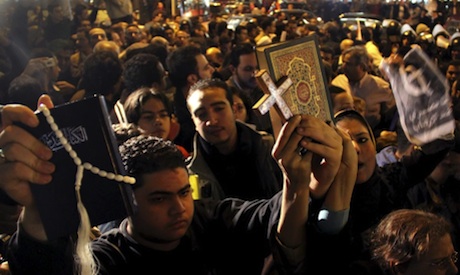
Image: Egyptian Christians celebrating Easter.