Showing posts with label Ontario. Show all posts

Thursday, June 07, 2018

Election Day in Ontario

Today is the provincial election day in Ontario.
It's an odd day. In particular, people are taking it very seriously; as well they should, given that the Ontario equivalent of Trump (the small time equivalent) has a lead in the polls. He has the potential of doing a lot of damage.
But there have been dangerous elections before. In none that I can remember have there been so many SCA people talking about the elections on SCA forums, including whom they intend to vote for. Granted, I wasn't paying attention to the Bush vs Gore election before election day.
My wife and I walked to our poll, holding our registration certificates in our hands, and we were greeted with smiles and positive comments by people on the street, who recognized the cards we were holding. In side the polling place, things were equally cheerful. It was overall a very cheerful occasion.
Image: No! No! No!

Saturday, September 02, 2017

University of Guelph - an unknown gem

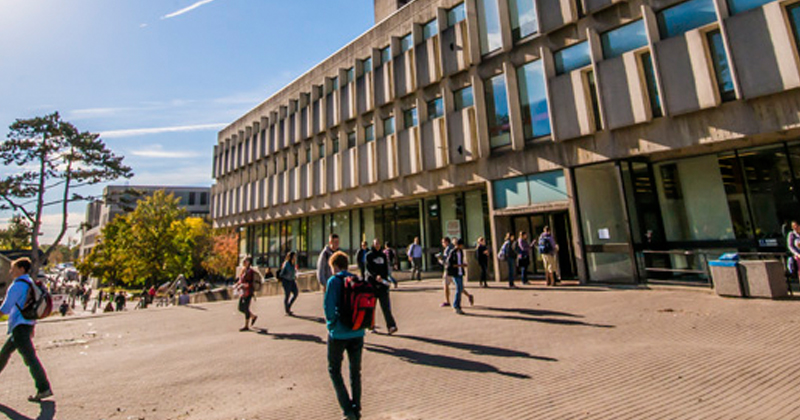
Yesterday I visited the University of Guelph in Guelph, Ontario. This is a medium-sized university in a medium-sized city which I believe is little known outside of Ontario, and even in the province it is mainly known for its agricultural program and its veterinary expertise. This obscurity is quite unfair. I know second hand of some excellent undergraduate programs that they have developed in recent years, and first-hand of the friendly atmosphere.
But what really impressed me was the beauty of the campus. Guelph was a tiny place not so long ago, and so most of the facilities are quite new. The designers of the modern campus did a fabulous job of laying it out, and designing buildings that are both very similar (most all of them are close to being the same height) but far from being identical. The campus also is big enough yet compact enough to make the place very easy to get around on foot.
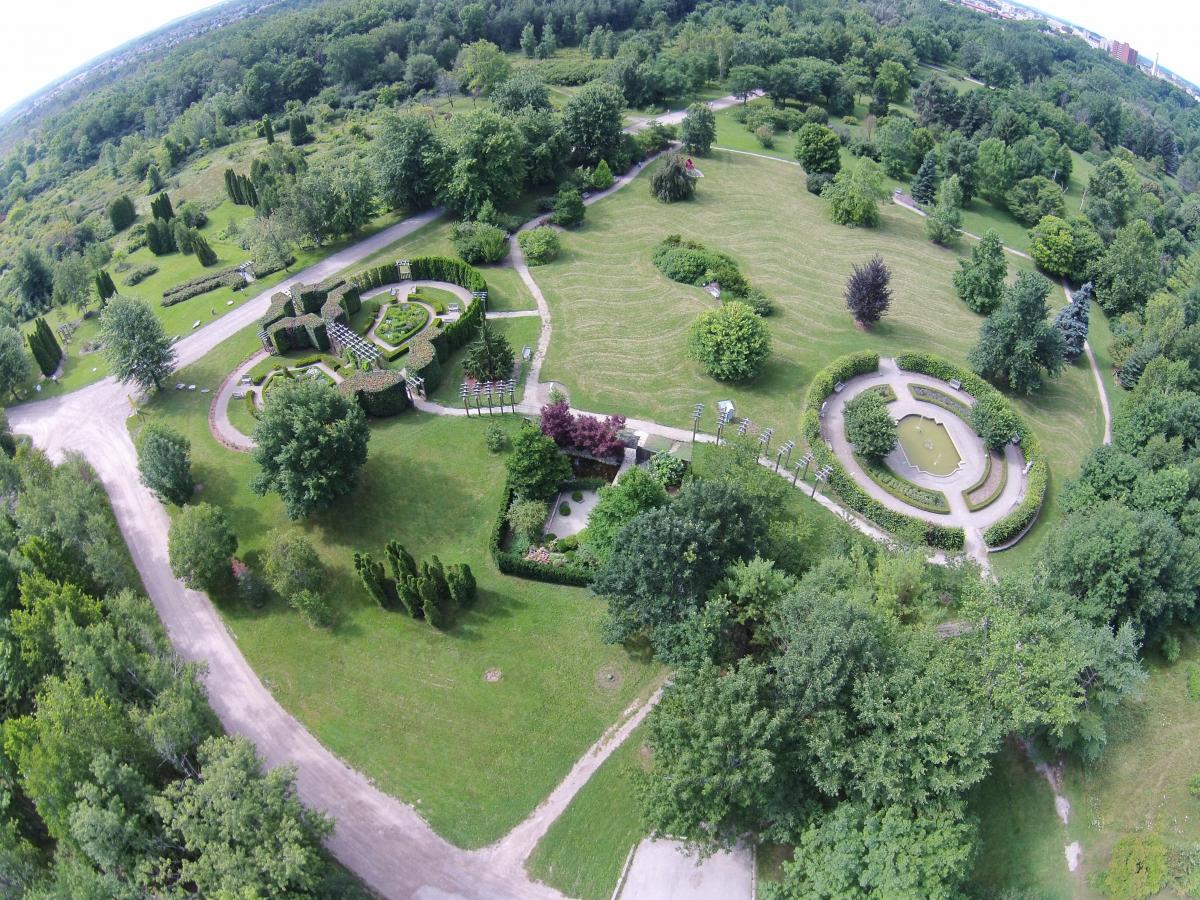
One feature worth noting is the arboretum, or what Joni Mitchell would call a "tree museum," but one you don't even need to pay a dollar and a half "to seeum." Image below:

Friday, April 12, 2013

A beehive cell

Darrell Markewitz, historically inspired metalworker par excellence, starts thinking about sacred enclosures and monastic beehive cells. Have a look!

Saturday, April 06, 2013

"Spring" in the Near North, 2013

Morning temp:  -14 C
Snow: 6-9 inches on the ground
Trees: barely any budding
In the air:  a bug.

Yakutia laughs.

Wednesday, June 13, 2012

Upper Canada before 1812

Some more analysis by Alan Taylor of Upper Canada "before the war."
To suppress sedition,, the government sought to control the flow of public information. In a stark contrast with the republic, the British restricted Postal Service in Upper Canada to official dispatches and to the letters of favored merchants. An American settler described Upper Canada as the land of "no mail, no post-offices, [and] no post riders." ... A Local schools worried officials, who feared that a little knowledge was dangerous in common minds, particularly when their teachers came from the United States. ... Distrusting local, common schools, officials preferred to fund only a few elite schools, one per district ,to educate the sons of gentlemen. ... Britons defined Upper Canada as a set of absences: as free from the social and political pathologies attributed to the United States. They celebrated the colony for lacking the land jobbing, Indian warfare, African slavery, Republican electioneering, libelous newspapers, majoritarian intolerance, and mob violence that blighted the republic.In 1792 Patrick Campbell boasted that the settler in Upper Canada could get "get lands for nothing, be among his countrymen, and run no risk of being ever molested by Indians, tarred or feathered." The British promoted Upper Canada more for what it was not, than for what it was.

Tuesday, June 12, 2012

Results of that nasty little war

Of 1812, that is.

Nasty or not, it was important.

Before the war, the geographical and legal boundaries of the Anglophone world were ambiguous; lots of people were more concerned about the radical Democratic-Republican or conservative Tory or Federalist next door than they were about people who lived on the other side of the ill-defined border. Not to mention all those radical Irishmen who could be anywhere, as indeed could Irish conservatives.  How different were American farmers in New York State from "Late Loyalists" in Upper Canada (i.e. Americans who had moved north to buy cheap land)?  Not much, though some were more radical than others, or perceived as such.  Geography did not determine this.

But after the war, the border (the UC-USA border) meant a lot.  On  the other side, whichever side you  lived, were people who had burned your houses and wrecked your farms and maybe unleashed scary Indians on you.  They were now The Enemy in a way that they had not been before.  Migration was not welcome; the policy in Upper Canada became one of recruiting settlers direct from Britain.
 
I also get from Alan Taylor the  notion that Britain came very close to winning the war outright.  The treaty of Ghent of 1814 gave the USA very little of what it had fought for, and with Napoleon out of the way, Britain could have crushed the broke, divided States like so many bugs, even while observing the treaty.  Instead, the imperial government took a rather minimalist view of  its role in North America. In particular the traditional alliance with the Indians south of the lakes was abandoned.

Why?  The empire had been fighting a world war for a long time and was TIRED. And the Battle of New Orleans made the point that hegemony in America would probably not be cheap.

Saturday, June 09, 2012

Alan Taylor on "Loyalist" Upper Canada

In Upper Canada most of the common people felt ambivalent about taking sides in the war. Drawn to the colony by low taxes and cheap land, the American-born majority had scant interest in politics and a great dread of war. Localist, pragmatic, and self-interested they balked at making sacrifices for any larger political cause, whether for an empire or a republic. The common folk were loyal enough to Britain so long as the colonial government left them alone, but they felt shocked by the sudden wartime demand for their services in the militia. British officials mistook their reticence for disloyalty, and the Americans misunderstood it as longing for a republic. . In fact most people just wanted to be left alone to tend their farms, so they hoped that one side or the other would win the war quickly.

Friday, June 08, 2012

What a nasty little war

As I read Taylor's the Civil War of 1812, the question in my mind becomes not was this an important war? But rather why would anyone want to be associated with either side in this war? It's a nasty war where most of those in arms are there for the loot while those who have some principles or goals have unadmirable ones. The Americans who are most interested in the conquest of upper Canada are former Canadians unhappy with the aristocratic domination of the provincial government and its general unfairness. Or they are unhappy about the situation in Ireland. Or both. American Federalists are more interested in discrediting the Republicans, and the Republicans are more interested in labeling the Federalists as traitors than either is in actually fighting the British. While Upper Canada conservatives are really keen to label anything like dissent as treason. Yuck.

Thursday, June 07, 2012

The Civil War of 1812 by Alan Taylor

I am reading Alan Taylor's recent book on the war of 1812, and it is excellent. It is a finely written narrative history that does an excellent job of describing people and situations, and also very good as an analytical treatment of the war. One of the characteristic features of this book is that it focuses on Upper Canada, much my surprise. It is in Upper Canada, today's Ontario, that Taylor sees many of conflicts of the early 19 century coming together in an interesting mixture. For instance, one conflict was between the concept of republic and its associated idea of citizen, and the concept of empire associated with the idea of the subject. Taylor: "We imagine that the revolution effected a clean break between Americans and Britons as distinct peoples. In fact, the republic and the empire competed for the allegiance of the peoples in North America – native, settler, and immigrant." Taylor is amazingly fair in showing the virtues and drawbacks of both systems of thought as they worked themselves out in North America.

Saturday, May 05, 2012

1812 -- controversial after all these years


In September, the Department of History at Nipissing University will be sponsoring a symposium on the War of 1812 in context.  I brought this up originally because I thought that professional historians based in Canada should create an opportunity to discuss a historical event of such obvious importance.

I was surprised when one of my colleagues said he wasn't sure that he wanted to be involved, because the bicentennial was being used by the current government to promote a militaristic view of Canada's past, in line with its militaristic view of Canada's present.

It seems, though, that my colleague's view is not an isolated one, and that officially sponsored celebration of the war is already generating pushback from people who identify with a long-established anti-war tradition.   And when I say "anti-war" I mean not just any war, but the War of 1812 in particular.  Today saw an article in the Globe and Mail about controversy over celebrations in Stouffville in York Region just north of Toronto:

North of Toronto, in Stouffville, a group of people who belong to pacifist churches are asking their MP to tone down a June event tied to the bicentennial. They say it doesn’t accurately reflect the history of the town, which was founded by Mennonites who conscientiously objected to war.It’s an affront to a truthful telling of that history,” said Arnold Neufeldt-Fast, a Mennonite ordained minister and associate academic dean at Tyndale Seminary.

The pushback in Stouffville is part of a movement to tell another side of the war’s story: those who didn’t fight and were proud of it.
Mr. Neufeldt-Fast represented people from Stouffville’s Mennonite, Quaker and Brethren in Christ churches when he spoke out against the bicentennial event at a council meeting earlier this week.
The town council voted 4-2 to approve Conservative MP Paul Calandra’s plan for a traditional Freedom of the City military march to the town hall. His plan also includes a parade and a request for CF-18 fly-by.
Mr. Neufeldt-Fast said he’s not opposed to commemorating the bicentennial of the war, which affected all of Upper Canada. What he’s opposed to, he said, is the suggestion that the town’s past is rooted in the military rather than pacifism. “It shows, actually, a degree of ignorance of our historical origins,” he said.
... 
Part of what swayed pacifists to move from the U.S. to Upper Canada was the Militia Act, which allowed people who could prove they belonged to peace churches to be exempt from war if they paid a tax, according to Laureen Harder-Gissing, the archivist for the Mennonite Archives of Ontario.
...
Clyde Smith, one of the two Stouffville councillors to vote against the bicentennial plan, said it was troubling to have to side either with his MP or the descendants of those who founded the community. Ideally, there would have been more time to find a compromise, he said, but that wasn’t an option.
“We were forced to make a choice,” he said. “I couldn’t support an event that was going to be divisive and offend a large number of people in our community.”
I have studied the fascinating history of Pennsylvania peace-churches that resisted involvement in the American Revolution on precisely the issues of pacifism, religious liberty and constitutional government, and I knew there was and is a strong connection between Pennsylvania and Ontario peace-churches, but this controversy about the history of Upper Canada has caught me completely by surprise.  Who would have thought that this old conflict would resurrect from local roots?

Image:  the Temple in Sharon, Ont.  Not Stouffville but part of the unique ecclesiastical history of York Region.

Tuesday, April 17, 2012

The Nero and Herod of Bonfield, Ontario

Last weekend the Lions Club of Bonfield held a Medieval Night to raise money to rebuild a footbridge in the park.  My wife and I put on our own medieval duds and went on over.  It was a lot of fun.  The Lions -- an international men's service club --supplied custom-made dinnerware, hats and other costume accessories, and really good food, featuring barbeque chicken and excellent, meaty ribs.

Part of the festivities was the presence of King Harold and Queen Tamela.  King Harold, who I bet had played this role before, spoke well and without too much phoney medievalesque affectation.  His main job was to raise money by finding excuses to put people in the stocks and then putting them up for auction. You could pay to release someone or to keep them imprisoned.  This worked very nicely.  Since I have just finished up teaching Gregory of Tours, I was delighted to hear King Harold addressed as "Herod," to which he quite naturally objected.  I don't know if the mistake was really a mistake or not.  This is a country township full of French Catholics and I am sure that a fair number of the attendees know perfectly well who King Herod was.  At least, that he was a bad man.

The Brueghel painting above was suggested by my wife who thought the whole scene was reminiscent of the Flemish painters, in large part because it was an old crowd (us included).  Speaking of age, after 20 years here, someone still felt compelled to comment on our funny accents.  True enough, we don't sound like North Bay area people, but still...

I heard something quite odd from one of those same people.  She said that when she moved to Bonfield from North Bay, some decades back, that she was warned  to buy a big mean dog and not go out at night.  I was surprised because she was too young to be talking about the really remote past, and in my 20 years there's never been anything happen to make  me feel that this is a rough place.  There used to be fights between French and English, but this was in the historic past by the time we got here.

Wednesday, March 14, 2012

Competence when it counts

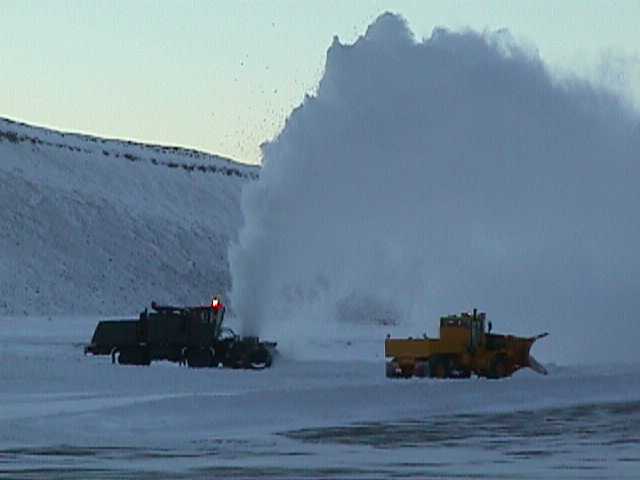
This week, the weather story in Ontario's Near North is the same as it is in many places in North America, it's all about the usually warm weather.  Last week, however, it was pretty dramatic around here.  There was a great big dump of snow, followed by a big melt-off, followed by an episode of blowing snow.

What I particularly noticed was the way that the people responsible for highway maintenance sent all hands on deck just before the predicted warmfront arrived to prevent a catastrophe. People with plows were pushing a winter's worth of snow accumulation off the shoulders of our country roads so that when melting occurred, the water would run off into ditches and not onto the road, where it very likely would refreeze.  Other workers with shovels moved lumps of snow that were blocking drainage, or soon would be.

They did this unglamorous job successfully and there was no catastrophe.

Just like every year.

I celebrate this competence, so easy to take for granted.

Image: somewhere in the Great White North.

Saturday, February 04, 2012

We could use more of this

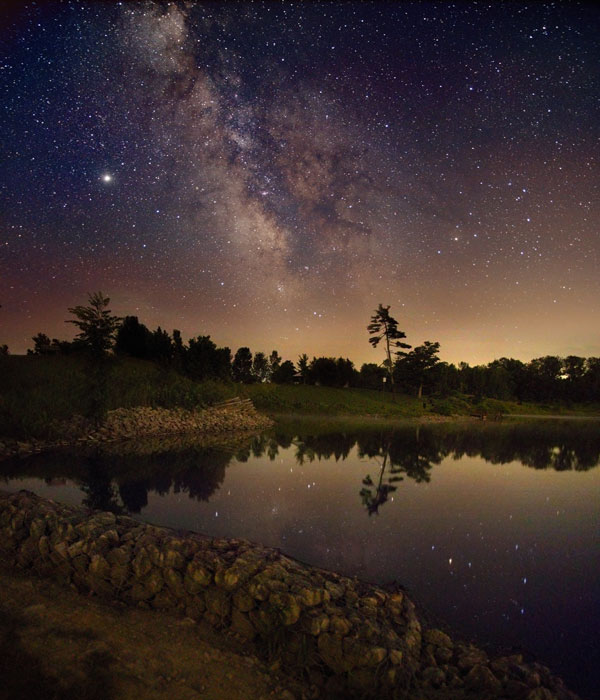
From the Weather Network site, the sun rising over Lake Nosbonsing:


It's been a gray winter.

Tuesday, December 13, 2011

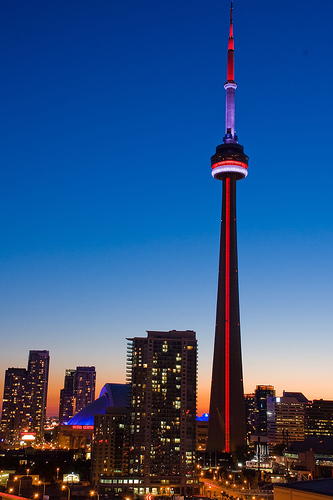
What is it about Toronto, anyway?

Or Ontario? Or Canada?

Phil  Paine recently wrote an essay on the theme, "Nobody [today] is likely to laud Toronto as the exemplar of anything."
 I bumped into a business traveller, recently, from the Indian State of Andhra Pradesh.  After discussing Andhra, he asked me, perplexed, why the urban infrastructure in Toronto was so backward.  I could only be embarrassed.  How could I tell him that there were no Hubbards, Harrises, or Hastingses around, and if there were, they would never be permitted to do anything. 
 He concludes by pointing directly at Toronto's mayor.  And he's quite right to do so.  Except...

He actually won the election (though by making assertions and promises that he must have known were untrue).  No one claims that the vote was rigged.  Nor is he the first of his kind.

This short-circuits the obvious question, which is where do the creepy leaders we all too  often get stuck with come from? and replaces it with the question, where do the people who elect them come from?  Canada has  many virtues, some large, some small, but it also has within its collective soul a big lump of small-minded, uncharitable hatefulness.  Don't believe in a collective Canadian soul?  You may be right.  Then where do all the people come from who do not value the Canadian virtues that I so admire?  The people who, for a small instance,  use the comment section of Globe and Mail to unendingly complain that Pierre Trudeau wrecked the country?  I am not an admirer of Trudeau, actually, but this is ludicrous.  The whole nearly 40 years I've lived in this country, it's been wrecked?  What are the values held by such people?  What process produces them?

Anyway, Phil's essay reminds us that we can do better, and have.  Take a look.

Image:  No one would build this today.

Sunday, August 28, 2011

There was a time in this fair land when surveyors were national heroes


Not to  mention engineers.

I'm talking Colonel By, children.

There is a World Heritage site in the province of Eastern Ontario that most Canadians are oblivious to -- the Rideau Canal that connects Kingston on Lake Ontario to Ottawa on the Ottawa River.  It was built in the 1820s and 30s as a military route that would be less vulnerable to American attack.  The job was entrusted to an English army engineer who accomplished the task of connecting lakes and rivers with canals and dams, thanks to the efforts of many navvies (= "navigators"), in short order (only to find himself being investigated for overspending).

And it is still all there in all its 19th century glory!

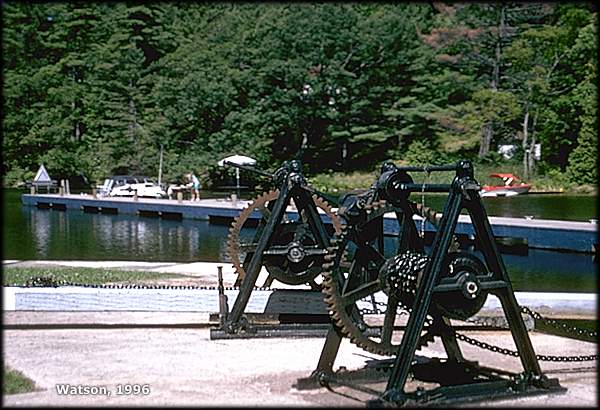
All but three of the locks are worked by human beings turning iron cranks by hand.  One of the explanatory signs canal-side calls this "brute force," but really there is nothing  brute about it.  The locks are so well-engineered that they move quite elegantly, and it really doesn't look like that much work -- though I am sure that it builds core strength in the university-age people who are there for the summer season.

In lovely contrast to the iron, timber and stone tech is the landscape that it goes through.  Parts of the canal system goes through intensively cultivated areas, but lots goes through what almost looks like wilderness.  Only very occasionally do roads cross the canal, and so if you are on a boat you feel like you are in a world apart from busy 21st century Canada.

Image:  Crabs or hand winches at Davis Lock; photo thanks to Paul Watson.

Wednesday, May 18, 2011

John Long wins a history prize!

An announcement from Nipissing University:

Congratulations to Dr. John Long, associate professor in the Schulich School of Education, who won the Fred Landon Award honouring the best book on regional history by the Ontario Historical Society, for his book, Treaty No. 9: Making the Agreement to Share the Land in Far Northern Ontario in 1905 (McGill-Queen’s University Press).

The award will be presented at the 2011 Ontario Historical Society Annual General Meeting and Awards Ceremony in June.  

In his book, Long reveals the complete story behind the signing of one of North America's largest land treaties, Treaty No. 9.
More here.

Wednesday, August 18, 2010

North Bay drivers pass a litter test


When you renew your vehicle license in Ontario, you get a little sticker, about a centimeter by 2 centimeters, that you put on the right upper corner of the metal plate to show when your license expires. The sticker is mounted on a piece of paper, and there is a smaller piece of paper that covers the adhesive backing of the sticker. Either of these papers could be dropped by a lazy or sloppy person, the though dropping the big one might be pretty obvious and even embarrassing if you cared about the public landscape. The little one, however, is so small that you would think that letting it fall on the ground would be the easiest thing.

This all occurred to me when I went to the bureau to renew my license plate and then came out to the parking lot to apply the sticker. As I stood there with a small, easily dropped piece of paper in my hand, I looked around to see if anyone in the parking lot had in fact dropped their trash on the pavement.

Not one had.

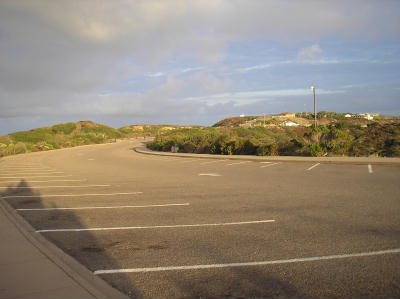
Image: a random North Bay parking lot.

Friday, June 04, 2010

Françoise Noël wins a prize!


Dr. Françoise Noel, longtime member of the History Department at Nipissing University, has recently been awarded the Ontario Historical Society's Fred Landon Award, for the best book on regional history in the past three years. the book is Family and Community Life in Northeastern Ontario, The Interwar Years, a study which is both solid in the scholarly sense and entertaining, especially for those interested in the grassroots history of our area. Family and Community Life is Dr. Noel's fourth book, which makes her a very productive scholar indeed.

This announcement gives me an excuse to reproduce the cover of the book, a wonderful work by a local artist.