Showing posts with label movies. Show all posts

Monday, August 17, 2026

My Brilliant Career -- a BRILLIANT series

 Last year I devoted several posts  to praising Mr, Sunshine, a brilliant series about Korea around 1900, wwhen the fate of the very traditional society was up in the air,  The series focused on two unusual characters: one a young woman who is training herself to being a terrorist, the other a young man who having been orphaned at an early age was raised in the USA.  Now he's a US Marine and is not sure whether he's  American or Korean.  It occurred to me that many Koreans today suffer from the same inner conflict.

Anyway The two fall  in love and...a bunch of things happen.

The acting, the cinematography, the  beautiful use of language, the costumes, all are better than fine. 

I thought Mr Sunshine was the top of the shows I had streamed, but I've just seen another of equal  quality anther series of equal quality-My Brilliant Career.s Australian, set in 1900, and concerns a young woman trapped as a servant in the outback because her father has carelessly piled up unpayable debts.  She is talented and wild and  her  famnily and friends don't understand, why she won't  settle down and a marry some rich guy-- a real possibility because even though she's not a great beauty she is a unique, lively personality. She wants to be a writer and even more, not to be owned by any man.

My Brilliant Career has  many virtues but  I really noticed its cinematography.

I highly recommend it.y Note  also  that both stories take place around 1900. Korea is exotic and is. still influenced by China. Australians are in the process of getting a new  Constitution, and wondering whether the former Empire Day (Jan 1) will  now be called Federation Day..

Wednesday, December 13, 2023

1670

I just finished watching 1670, a serial TV historical by Netflix about Poland in the era of Louis XIV. It's a savage satire that reminds me of The Servant of the People, which showed the Ukrainian people as very much responsible for buying into the corruption of their country. In 1670, there is one sensible charachter: a visiting Lithuanian. Recommended.

Thursday, January 05, 2023

Two movies: Spencer and Mr. Sunshine

 Spencer -- now on Prime</p>


The theme of this movie is that the atmosphere of the royal court drove Princess Diana nuts and only when she escaped did she become the beautiful, charming good mother, Diana Spencer.  I have seen this on the big screen and I'm not impressed.  The rest of the royal family really gets a hatchet job -- and quite possibly deserved it.  But the Hollywood-style finale is really too much.</p>


Mr. Sunshine -- Korea </p>


The excellences of this 20-some series can hardly be overstated.  Well, it is perhaps too long.  Otherwise, it is an amazing feat, artistically showing much about vulnerable Joseon (Korea) at the time of the Russian-Japanese war.  The music! The costumes!  The script! The outdoor photography! The colors! The you name it!</p>

Thursday, January 13, 2022

Hollywood clichés

I am sure there are many, many movie fans and even (gasp!) movie critics who could do a better job on this post, but I feel a need to say something myself about the phenomenon. And the phenomenon is – the amazingly restricted number of cliches that are in movies in the Hollywood traditions. Like a lot of people over the last two years, I have spent more time watching Netflix than ever before. I could not help notice how often certain phrases, actions, and themes showed up. Big news, eh?

But what really struck me was how omnipresent these cliches were. I could hardly get away from them. The list could be longer but I lost some earlier versions.

SCRIPT:

It’s my fault. It’s all my fault.

I have no choice. There’s always a choice

He’s a good man.

It’s complicated.

Thank you...for everything.

ADDED: Are you OK?

I'm fine [but he or she clearly isn't].

VISUAL ELEMENT: The protaganist or a villain or somebody else, overcome by anger sweeps a bunch of cluttter off a desk, smashing most of it. THEME: Father and Son don’t get along. Sometimes one of them is dead. Of course there are plenty of real father-son conflicts around the globe, but watch a few of these father-son movies and see if you think this item belongs on my list.

Like I said, this is not news. However, what does it say about the making of movies that somebody has to smash the office furniture, so, so often? Who is responsible for making endless confessions of responsibility for blameworthy activity -- with vast numbers of the offenders being immediately excused by their friends or partners or commanding officers?

Family. It's all about family. It's ALWAYS Do real people say “he’s a good man?” Unless they have just walked out of a cinema? Don’t writers feel choked by the unoriginality imposed on the whole movie-making project? Note: I don’t see many science-fiction or action movies. If I did, my list of Holywood cliches would probably be quite a bit longer.

Monday, August 23, 2021

Korean romance

I have been watching South Korean TV series lately, with an emphasis on historical flicks. I quite like them. Some are movies like other movies. Some are quite excellent. Can I recommend again Mr. Sunshine/p One characteristic is the handling of romantic elements. This is often really good. Of course South Korea is famous these days for romance in music, too, so that should be no surprise. This kind of emphasis appeals to teenagers anywhere...

I am now watching Clown and King on Netflix. One of the major plots involves a young Korean king and a young queen falling in love. There are various barriers keeping them apart. Nevertheless they talk to each other and speak eloquently about what love is or should be. A couple of eloquent passages. The young queen, when asks what she expects to get out of love, says:
I am here to laugh and cry together...
The young king answers a similar question:
[I am here] to see you with a bright smile, even just once.
And the visual element is really amazing.

Sunday, March 08, 2020

Master cliches of the 21st century

I have been watching movies on Netflix and I've started to notice how the storytelling talents of mainstream movie makers are constricted by repeated returning to a rather small number of cliches.  This is particularly true of English-language films; films from other regions and linguistic cultures not so much.

I'm going to start my collection of master cliches here and add to the list as I come across others.

"It's all my fault."  followed by another character absolving the speaker of responsibility for some crime or mistake. "It's not your fault."
"He's a good man." This is repeatedly applied to some good guy, often for no apparent reason.  But at least you know where he stands in the moral universe of the movie.
It doesn't take much thought to see how the interaction between these cliches can and do restrict the potential stories available to the main characters.

More later.

Saturday, October 05, 2019

More rookie historians

I've finished Rookie Historian Goo Hae-Ryung and I am very impressed with the series.  Highly recommended.

Sunday, March 17, 2019

The Turkmens hit the silver screen: Resurrection Ertugrul

I don't know anything about the Turkish film industry, but since I started to follow the movie Resurrection Ertugrul on Netflix I have begun to suspect that the best Turkish films, at least, must be very good indeed.

Turkmen is the name given to ethnic Turks who live a cattle-herding, nomadic style. This movie (actually a long-running serial) is about a tribe of Turkmens, the Kiya, and their trials and tribulations in the early 13th century. The movie is classic good-guy v. bad-guy stuff. The good guys are led by Ertugrul, a strong, silent type who stands for a virtuous life led according to tribal custom. The bad guys are just about everybody else -- Seljuks, Ertugrul's brother (at least some of the time), scheming Kiya women looking for a good marriage, the Knights Templar. Most of these people don't give a hang about antique virtue. They just want a good war that they can profit from, or vengeance.

This lauding of the virtuous, represented by the figure of the nomad reminds me of the movie Mongol which I blogged about maybe ten years ago. In that movie Genghis was the only guy playing by the rules. Everyone else was just waiting for a chance to stab him in the back, enslave his wife, etc.

Resurrection Ertugrul and Mongol have something else in common. They are really good.
Resuurection Ertugrul has it all. Lots of horses. Huge skyscapes. Great fighting sequences. A world-famous Sufi scholar who leads the good nomads in singing prayer-circles (the music is awesome).

A remarkable feature of the series is the rather minimal dialogue. People say something, assume an expression, and the audience is given time to absorb the significance of what has been said. It reminded me of opera, in which the songs make an emotional point, rather than building a narrative. The narrative gets built anyway, and it's not so hard to follow.

I wondered after about 10 episodes, what the directors would do if they decided to do a big series on the Round Table. It might be really cool.

Saturday, May 26, 2018

Welll, where are we? The Long Ships (1964)

In this big Hollywood epic, Norsemen seeking treasure in "Moorish Barbary" are captured by the local king and dragged before him. The whole population of the town turn out to see them.
VIKING: Well, where are we?
VIKING LEADER (ROLF, i.e. Richard Widmark): Civilization.
VIKING: Huh?
VIKING LEADER: You wouldn't understand that..,

Saturday, August 20, 2016

Mohenjo Daro hits the big screen!

Mohenjo Daro is one of the sites associated with the very ancient Indus Valley Civilization, which is roughly contemporaneous with the earliest Mesopotamian civilizations. They had writing but we can't read it. Thus when somebody decided to produce a movie, named Mohenjo Daro, about this long-ago era, they had to make just about everything up.

The news here is that they seem to have done a good job! At least according to AE Larsen, a scholar who runs a historical movie blog An Historian Goes to the Movies . Have a look at the trailer above. It's gorgeous! Oh, yes, Larsen reminds me that the remake of Ben Hur is imminent. It looks good, too.

Tuesday, April 28, 2015

The new Avengers movie: How your studies in Late Antiquity helped you understand Joss Whedon's plight

This is wonderful, wonderful. Thanks, Salon and Mr. O'Hehir:
It might be accurate to say instead that superhero cinema has reached a decadent plateau, a long-term steady state of self-nourishing bigness and reverberant meaninglessness. Whedon moves on from the Marvel empire not as its Augustus or its Spartacus, but more like one of the later, non-terrible Christian emperors who won some battles, made some reforms and convinced everybody that the glory of Rome would endure forever. Was it worth doing? That depends on what you think of Rome.

Monday, March 24, 2014

The Square (2013) – an intense look at the Egyptian revolution


The Square (meaning, Tahrir Square) is an Egyptian movie that follows several people from Cairo through their political journey through the  recent upheavals in their country. The filmmakers caught several eloquent and serious people to be their subjects, to show through their debates and ruminations what kind of different ideals have been present in this remarkable historical moment.

I have been thinking recently that nobody knows what's going on in Egypt, and I feel that more strongly now, if a bit more hopefully. All the possibilities are there, good and bad. And if you ever thought that people outside of "the West" could not possibly understand democracy and human rights, here's your refutation.

Of course there are no guarantees that they will achieve a worthwhile democracy, but many of them know that they want it and it's not so different from what many people in Canada and elsewhere want.

As of today The Square is available on Netflix and I highly recommend it.

Friday, August 17, 2012

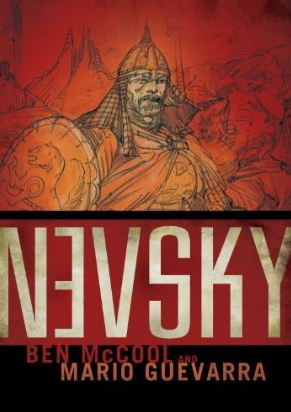
Nevsky, by Ben McCool and Mario Guevera


In our time artists have a lot of choices of which genre  they will use to tell stories that inspire them. One common strategy has been to take tales that originate in comic books or graphic novels and fill them out by using all the resources of the movies. The Marvel superhero saga dominates film production these days. A somewhat different example can be seen in the transformation of a popular graphic novel,300, into a film whose artistic roots are unapologetically in comics.

Here we have an example of other artists  going the other direction: taking an epic film and turning it into a book that can be held in one's hands. I would be interested, sometime down the pike, to know how successful, commercially and artistically, this project is, how popular it turns out to be with the target audience.

This is certainly a labor of love. It is a faithful rendering of the 1938 film Alexander Nevsky, one of the most famous products of Sergei Eisenstein's filmmaking genius. There is no effort to disguise how much the authors owe to the original version of this story. In fact, quite a bit of space is devoted to telling the reader about both the historical Alexander Nevsky and his interpreter, Eisenstein.

Alexander Nevsky was a 13th-century Russian warrior who was remembered for fighting for Mother  Russia against two dangerous enemies, and East (the Mongol Golden horde) and West (the Teutonic Knights). In the late 1930s the story seemed both relevant and useful to Eisenstein and the Soviet regime that employed and often abused him. Japan loomed in one direction, Nazi Germany in the other. Whatever the facts of the historical Nevsky, he was needed as a symbol of Russian/Soviet determination in the face of daunting odds.

A story of great courage and heroism defeating treason and cruelty was right up Eisenstein's alley. If you like your heroes unsullied and your enemies black as black can be, Eisenstein is your man. The successful conjuring up of such figures makes the movie unforgettable once you see it. And the stark contrast is clearly what has inspired the two creators to take on this remarkable project.
Of course, the success of Nevsky will depend to a very great extent on its artistic appeal to aficionados of the genre. I'm not really in that crew. To my eye it looks pretty good. The art combines rich colors, heavy shading, and the occasional use of odd angles to emphasize some aspect of a scene.
I have to wonder whether this book will result in a new audience finding Eisenstein's films.

Monday, April 30, 2012

Love scenes from Egyptian cinema, 1920s to 60s

Not exactly puritanical:


From Arabist.net with this commentary:

A wonderful video in the context of calls for strict censorship in state television and cinema in Egypt. More generally speaking, some of these kissing scenes from the 1940s-60s are more passionate than many scenes of the last 20 years.


Sunday, March 25, 2012

Panem Spring

Several people whose taste I trust had told me that the Hunger Games books were really good, and the early reviews of the movie, professional and amateur, were promising, but I knew I was in for a treat within a few minutes, when the movie cut cleanly and dramatically from the interview with guy in charge of the games about their profound meaning (blah, blah, blah) to life in the starving coal communities of District 12.

I have become more sensitive to the difference between acceptable and extraordinary editing of video, and how much it affects the final work, and this film was clearly going to be first rate in that department.

And as the film went on, it had acting that was so good that it wasn't like acting at all.

And it was full of references, obscure but coherent, to the history of the future, that made it seem real.

(For instance:  the representative from the Capitol wants the assembled people of District 12 to applaud the Tributes, but the people give a silent salute that surely, surely goes back to the original rebellion.  This, people, is why you have the original author involved in the making of the film.)

One theme that really hit the mark for me was the attention paid to the back-room deals that had as much affect on the outcome as the actions of the contestants or the outright manipulations of the people who ran the Games.

I've read lots and lots of SF dystopias not amazingly different in principle from this story, but this was really fresh and artistically successful nonetheless.

Side note:  Did anyone else find it rather pathetic that one of the chief technological wonders hogged by the Capitol ruling class are trains that are no faster than ones that already exist on other continents? Not to mention the dependence on coal...Clean Coal, no doubt.

Monday, January 16, 2012

A Scandal in Belgravia

I just saw the first of this season's episodes of the BBC's Sherlock.  I think it continues to be an absolutely brilliant adaptation.   But then I really, really liked A Knight's Tale, and not just for the jousting.

Thursday, December 08, 2011

End of term anxiety? and historical movies


Today was the last class meeting this term for my course on the History of Islamic Civilization.  It was the due date for a term paper, too.  So many students had asked for one or two day extensions that I rather expected a very low attendance and very few papers handed in.  (I actually don't mind giving extensions, not when I've heard credible reports from numerous students that they are swamped at end of term.)

Imagine my surprise when the vast majority showed up with essays in hand!  Was it just end of term anxiety that made them think they needed those extensions?

The class did me the courtesy of watching one of my favorite movies, The Man Who Would Be King (1975), which I used in place of a lecture on "the West's advantage," i.e. what factors led to European dominance of the globe by the 19th century.  The movie doesn't really have much profound to say about that subject, but it has its virtues, besides being fun.  First, it portrays the confidence (arrogance?) that Westerners eventually enjoyed, and implies the lack of confidence that might inflict the people on the other side of the confrontation.  Second, after lots of discussion of the rise and fall of Middle Eastern and Central Asian empires in the course of the term, the class got to see a dramatic, schematic depiction of  the rise of one tiny empire.

I have a short list of movies in my head which I think of as "history as it really works" or "what you won't learn from your classes or textbooks."  These are not necessarily realistic historical movies -- prominent on the list is The Life of Brian -- but they do cut through the crap, or at least provide an opening for a laugh of recognition of some truth or other.  The Man Who Would Be King could easily encourage  more mythological thinking as anything else.  It's a movie about Freemasonry, for goodness sake.  But for its tracing of the rise and fall of "Uta the Terrible," and for the figure of Billy Fish, it makes my list of movies that have something to say about history.

Friday, November 18, 2011

Dog sweat!

The very occasional blog IranWrites reviews the movie Dog Sweat.
 ...
Not long into the film, I felt that I had an urge to scream, “Say something for God’s sake!” when immediately the facial expression of an actress shuts me up, saying, “What is there to say. Don’t you see?”
No, I don’t see if there is no talk, no laughter, no crying, no discussions, no debates, no complaints, no questions, no answers, not a single complex sentence. But why?
“We are in strange land my dears, where language has gone through a massive transformation.  Language as the medium for communication has lost its function where communication has lost its place in the society and culture, where the efforts are made to hide rather than reveal, where one must divert rather than to direct, where one has to misguide rather than to guide; then words are better forgotten if one has to lie,” I’m whispering to myself.
Lips do not kiss, hands do not touch, gazes are afraid to connect. It is not restraint but hiding. There is no need for censorship since there is not even any desire for of any sort expression. There is still an outcry for an “empty nest,” an empty room, a dangling key to an empty apartment. It seems that finding “that key” is the ultimate goal, though I’m not so sure that there is anything but darkness behind the closed door. Even passion is absent …
‌But little by little, I learn to hear them. I learn their language. It is very simple, their facial expressions, sweet faces with bitter and sad expressions, tell us of boredom, aimlessness, hopelessness, very gently and good-naturedly.  But beneath those bitter expressions on those faces, those cold faces, those deadly silences, one can see the residue of some drive, of some hope and some faint and colorless shadow of something that might once have been a dream or fantasy. 
They narrate their own story, as if the film were a documentary and had been made spontaneously, with actors and actresses, without script, on stage thriving to tell their stories. It seems they have something to say only if they find someone to listen, if they feel safe, if they find privacy, if they know how....

Wednesday, October 26, 2011

A taste of Bollywood


I think I've posted this here before, but it is worth repeating.  You may want to turn on the captions.

Saturday, March 19, 2011

Sherlock (2010)

About a quarter of a century ago, the BBC produced the best in-period, true to the text adaptation of the Conan Doyle stories ever done, the version starring Jeremy Brett.  Loathe to compete with themselves and lose, they are currently doing Sherlock Holmes as a contemporary piece:  Dr. Watson is back after being wounded in Afghanistan (!) and is rooming with this arrogant young snot who claims to be the world's only consulting detective. The setting and the modern characters made me rethink the originals.  It works, though a bit unevenly.  I just finished watching episode 3, The Great Game, where everything came together.  I gasped!

Image:  Benedict Cumberbatch as Holmes.