Sunday, May 27, 2007

Living history

"Living history" has a normal meaning these days as a form of historical re-enactment or re-creation that is fairly strict in its efforts at accuracy.

I'm using it here in another sense -- as "history" that is still around. Like Clifton's Cafeteria in Los Angeles.

Once upon a time the place "fast food" occupies in North America today was held by cafeterias, which were a feature of the downtown areas where many jobs were located. If I remember family stories correctly, my grandmother worked for years in one called "Koontz's."

Well, the tide has been going out for such cafeterias for a long time now, but thanks to the LA Times (upon which may blessings shower down), I now know that even in the home of modern suburbanization some cafeterias still survive, including one of the most distinctive, Clifton's Brookdale branch. According to the story by staff writer Larry Gordon, this place has been serving the same food, to some acclaim, since 1935, when it opened.

Even better, it still preserves the original decor: a simulated redwood forest which includes "a waterfall, a tableau of a family fishing for trout and a tiny inspirational chapel perched on a rocky ledge."

As an architectural historian named Chris Nicols says."It's incredible to have a total immersive environment from the '30s that you can just walk into for the price of a cup of jello."

(The picture above is from this blog which includes the unprompted comments of a young customer.)

Not exactly my usual early history (before railroads, I like to think) but on the other hand its not exactly easy to find an undisturbed human environment that is over 70 years old. I was in New Delhi in 2005 and you'd be hard-pressed to find one there. There are a few sites that are centuries old but most of the rest has been built quite recently.

I can only echo the person in the article who said, roughly, "get out an enjoy these things while they are still there."

On a related theme, what about a feature of my own country that I never heard of, that has been called "the eighth wonder of the world," which has been fairly undisturbed for the last 1.3 million years?

In Northern Quebec, over a million years back, a huge meteor hit the ground, creating a 3.44 km wide crater that actually sticks out of the ground. It's been there ever since, collecting rain water that, thanks to being isolated from pesky primates, is very, very pure. It's called Pingualuit Crater (this site provides a permalink usable in Google Earth)and there's a very good article in the Globe and Mail about it.


The purity of the water in the absence of a local population and natural groundwater inflows means the sediments that do exist should be a valuable record of the climate, and more, over the past million years or so. Indeed, scientists have just drilled out a core and are no doubt hard at work on it.

There are days when I think the past is utterly lost, and we just have the present and its evidence for preceding mysteries. This is not one of those days.


Friday, May 25, 2007

Phil Paine in Transylvania and other adventures

Phil Paine, who has been hitchiking around Eastern Europe, seeing historical sites and the current scene, is catching up on his travel blog.

Image: a view of Sarmizegetusa.

Carnivalesque 27

Aadvarchaeology hosts a collection of ancient, medieval, and archaeological blog posts at Carnivalesque 27. Included: Geoffrey Chaucer's report on the Kalamazoo Congress of Medieval Studies.

Stuart Carroll, Blood and Violence in Early Modern France

One of my scholarly interests is chivalry, and I've written quite a bit about formal combats, or "formal deeds of arms." Thus I was glad when a colleague alerted me to the existence of this book, and another ordered it for the library.

The dominant understanding of the early modern duel (16th-17th century) in France is that it was a more civilized and ritualized form of the more barbarous blood feud, one of the symptoms of that historiographical favorite "the rise of the modern state." Carroll disagrees. I quote from p. 159:

The early modern French duel thus differed from its medieval predecessor in its lack of rules and in its brutality...[at the end of the 16th century] "They do not fight," the Venetian ambassador explained, "as usually is the case in Italy to the first or second drawing of blood, with seconds who separate them when time is up." Instead they fought to the "bitter end."

This quotation comes at the end of a chapter on "Combat" that some of my readers will find interesting.

For more see the H-Net (H-Law) review by Howard G. Brown.

Thursday, May 24, 2007

David Cook's Understanding Jihad

Not long ago I praised David Cook's book Martyrdom in Islam for shedding considerable light on important aspects of the evolution of Islam. I've now read his Understanding Jihad and am perhaps more impressed by this earlier book.

Once again Cook takes a single important issue in Islam and traces its significance over the centuries. Here he argues that the notion that military activity in the name of Islam is the "lesser jihad" and that (peaceful) religious and moral struggle is the "greater jihad" does not show up in texts written in Islamic languages for Islamic audiences. Indeed, the notion that the initial conquests in the name of Islam have always been taken as a confirmatory miracle demonstrating the truth of the Quran and its revelation, and as a result Islamic audiences have always been influenced by the notion that Islam would eventually spread across the whole earth and that fighting would be a legitimate part of that process. That notion made it particularly difficult for Muslims to tolerate 19th century European conquest of the Dar al-Islam and makes such incursions as the founding of Israel or the invasion of Iraq even more humiliating than they might be otherwise. He also argues that the rather muted response by Muslims (most of whom are no more bloodthirsty than anyone else) to the self-righteous claims of Muslim jihadists is rooted in the feeling that jihad is a legitimate and core part of the religion.

As in Martyrdom in Islam, Cook uses lots of primary materials and ranges over most of the Islamic world, putting jihad into all sorts of interesting contexts. Recommended.

Wednesday, May 23, 2007

From Paleo-Future: Anachronisms of the Future

The unique blog Paleo-Future has a news article from 1911 about a phenomenon that teaching historians and sharp-eyed filmgoers are now experiencing on a regular basis!

Yurts -- are they everywhere?

A few days ago we spotted a yurt within the city limits of North Bay. At about the same time a friend told me she had a French friend who rented yurts to campers. You can see that rental site here. They also rent teepees (as I spell it) and "trapper tents" which look a lot like tents used by Civil War and other re-enactors on this side of the Atlantic.

Courtly love: a definition

This term has been a difficult and controversial one since it was invented in the 19th century. But now, thanks to an undergraduate's final exam, we have the answer:

"Courtly Love: She married Kurt Cobain."

Tuesday, May 22, 2007

From Explorator, May 2007

I have on occasion recommended the long-standing resource Explorator, an e-mail newsletter on archaeology and ancient history that comes out most Sundays. I often find the most amazing stuff there.

This past weekend had two topics that amazed me. One was out of Norway, where someone last August, high in the mountains, found a leather shoe in a snowdrift. First opinions were that it was a thousand years old!

Wrong!

They now think it is 3400 years old!

More searching of the ground led to finding arrows and a wooden spade.

Fallout from global warming?

Explorator also pointed me to a story from Britain, where the A-level exam in Ancient History was on the chopping block. That would mean that what North Americans call high school students could no longer specialize in that topic. Fans of ancient history fought back and won the day. One thing that helped is that they won the sympathy of the cabinet minister in charge of schools, who sits in the Lords. His title is Lord Adonis.

How could they lose with divinity intervening for the cause?

Image: A terra-cotta "Dying Adonis" from the second or third century BC.

Monday, May 21, 2007

Bayeux Tapestry: a medieval "graphic novel" in a video version!


I was just talking about a graphic novel, 300, and its recent movie version, er, 300. This reminded me of a really old graphic novel, or perhaps we should say graphic history, that has also been redone in video form: the Bayeux Tapestry.

The Bayeux Tapestry is a huge embroidery history of the Norman Conquest of England in 1066 that hangs in a church in the Norman city of Bayeux. It shows the story of William the Conqueror taking possession of England from the point of view of the winners -- many people think that it was made for William's brother, Odo, the fighting bishop of Bayeux (and after the conquest, Earl of Kent).

The modern animation of this work gives it more impact to our eyes, which are accustomed to moving pictures and which are disappointed when we don't get state of the art images. But students in the upcoming course, Medieval England, might want to consider how impressive this embroidery 70 meters (230 ft.) long was to contemporaries. And indeed it's a very detailed story well portrayed (even if some parts are obscure to us). You have to wonder who conceived of this project, and whether they had any precedents to refer to. I can't think of any.

In Medieval England we will be covering 1100 years or so. The sources for that huge range of time will be diverse. Sometimes we'll only have archaeology to guide us. But we will always be trying to make the connection between what a written work, piece of art, artifact, or site meant originally, and what it might be able to tell us now.

For a non-animated version of the BT, see this site.

Sunday, May 20, 2007

Mordred Prince of Britain

When I was growing up reading science fiction, one of the oddest notions was the idea of alternate history. It's a common idea now, but back then you seldom ran across it outside of the small circle of science fiction readers, unless the subject was, what if the South had won the Civil War?

In such stories authors often gave their heroes technology that altered the time stream, weapons maybe, or even the printing press. But what about an alternate history where it's just an artistic image that's different? How big a difference could that make?

Some years back I was thinking about how Shakespeare wrote many of his "biographical historical" plays -- the non-English ones-- about characters that were really obscure. Who would ever have heard of Lear or Macbeth if Shakespeare hadn't used them to build a striking dramatic situation? Next to nothing is known about Macbeth and I have my doubts that Lear ever existed. Even the characters of Julius Caesar, Antony, and Cleopatra as we know them were somewhat new to his audience, since Plutarch's Lives had only recently been translated from ancient Greek into western European languages.

I thought, what if Shakespeare had not gone for the obscure figures he could shape to his liking, but preferred to reshape famous ancient legends? What if he'd done an Arthurian play? Instead of writing about a melancholic, haunted Hamlet, Prince of Denmark, he'd put his genius into portraying Modred (Mordred), Prince of Britain?

What would it mean to Anglophone culture -- world culture -- if these famous words were associated with the treacherous bastard son of Arthur?

What a piece of work is man! How noble in reason! how infinite in faculties! in form and moving, how express and admirable! in action how like an angel! in apprehension, how like a god! the beauty of the world! the paragon of animals! And yet, to me, what is this quintessence of dust? Man delights not me; no, nor woman neither, though by your smiling you seem to say so.

Maybe none. But maybe...

The movie "300" -- not fantastical enough

If there are any student in NU's upcoming course on Ancient Civilizations reading this blog -- instead of having fun in the sun -- here's a topic worth thinking about.

Will McLean in his blog Commonplace Book says you shouldn't be thinking about ancient Greece when you watch the recent movie on "Thermopylae," 300. Lots of people have said the same but Will provides us with a science-fiction rationale that makes sense of the 300 scenario -- sort of.

That's amusing in its way but then Will goes on to make quite a profound point. When the Frank Millers of the world try to make an edgy fantasy of the past, they seldom are fantastical enough. This analysis is not offered in a mean-spirited way, but with full acknowledgement that for any author, filmmaker, or other artist, recreating even the known aspects of the past is hard -- especially if you harbor any hope that your audience will be able to relate to the finished product. This is a really fine post.

Update: link to the entry is now fixed.

Friday, May 18, 2007

Marutha of Maiperqat


Love that internet.

A public benefactor named Roger Pearse has for some time now been posting translations of works by the early "church fathers" (bishops, monks, and other early ecclesiastical writers).

Today I got a note that he's posted an unpublished account of the Council of Nicaea by the obscure writer Marutha of Maiperqat. The Council of Nicaea, A.D. 325, was one of those crucial moments when a diverse, amorphus movement, the Christian churches, tried to define itself as "the Church," by specifying what real Christians believed and condemning all others as heretics (people with false opinions instead of true faith).

Well, of course, this effort and later ones ended up splitting the Christian assemblies (original meaning of ecclesia or "church") into hostile alliances, especially in the Middle East and the Eastern Mediterranean. The Council of Nicaea, which was called and presided over by Constantine, also provided a precedent for imperial control of the churches and their doctrine (not that this was ever entirely successful).

Now, today, for the very first time ever, you can read one sectarian account of that event, one not widely available for many centuries.

This seems to be a good time to mention that Ramsay MacMullen, a well-known historian of the Roman empire, has published a book called Voting About God in Early Church Councils.
I can't wait to get hold of it.

Image:
The Church Fathers at Nicaea.

Two different planets

Read the American news about Iraq, read the American debate on Iraq (any positions you care to read), then read this from an Iraqi employee of an American news service, McClatchy.

But then things are always different in the imperial capital than out on the frontier.

Thursday, May 17, 2007

Councils in Venezuela (history of democracy thread)


Today's Washington post has a very interesting article on Hugo Chavez's Venezuela. It's about the founding of community councils to partially replace elected mayors and municipal councils. It's not exactly clear how these councils are constituted, but the article states that for "big decisions" the elected councillors have to go back to community assemblies for a final decision.

I don't know quite to think about it. I haven't bought into the official American propaganda about how evil and threatening Chavez is, since it's entirely self-interested, but neither do I trust Chavez. The danger sign for me is that his preferred political methodologies seem to be ranting at the population for hours on end about every subject imaginable, and throwing government money around like there's no tomorrow. He reminds me all too much of Castro the Omniscent, not to mention every 20th century dictator you've heard of and all of those you haven't.

Also, the use of "community councils" can be a mere mask for dictatorship. Khaddafi abolished all the government institutions of Libya in favor of assemblies supposedly inspired by Berber customs, but guess who still controls everything, notably the energy revenues that constitute practically the entire economy the country?

Going back a couple of centuries, there are also the "section assemblies" of Paris during the Revolution that gave democracy such a bad name in Europe during the 19th century. "Section assemblies" were grassroots neighborhood groups that elected an electoral college which elected members of the National Assembly. After they chose the electoral college -- by voice vote -- the people were supposed to go home and let their betters run the government and guide the revolution. Well, a lot of them came back the next day, and the next, and the day after that and in the name of the people continually critiqued the elected government.

Sounds all very democratic, yes? Unfortunately, the sections in Paris became dominated by people convinced that they knew what the people wanted, and that everyone who opposed the people were evil "aristocrats." Continual voice votes in each section allowed the local aristocratic stooges (not necessarily nobles or even rich) to be identified and expelled. The sections, full of zealots, set up a communication network, armed themselves, and eventually seized control of the capital. This was a further step to dictatorship and government by Terror.
(The awful flavor of the word "terrorists" comes in part from the open use of terror -- revolutionary justice dispensed by kangaroo courts leading to execution -- by the resulting regime.)

So these community councils could go nowhere or worse. On the other hand, according to the WP article, there's a lot of enthusiasm on the popular level for this experiment, even among opponents of Chavez. Some people think that the old institutions of local government, which go back to colonial times, are worthless and the new councils may provide a way for them to solve some of their own problems. I direct you for some relevant thoughts about the vital role of local government in real democracies in Phil Paine's blog (under Sept. 25).

Good luck, Venezuela!

Image: Chavez surrounded by "the people"(?).

Phil Paine in Europe -- Prague

Phil Paine's account of his trip to Europe has been interrupted by the inaccessibility of Internet connections in places like Transylvania. But now he's in Prague and beginning to catch up.

Image: Lots of people crammed into a picturesque old street, sans tacky signs.

Wednesday, May 16, 2007

Nir Rosen on classic colonial tactics and their consequences in Iraq today


Nir Rosen is an accomplished American journalist who has written from the ground in Somalia, Jordan, Pakistan, Afghanistan and Iraq. Today in the Washington Post he wrote a response to a previous WP column by Paul Bremer, the man who ruled Iraq for United States' coalition for the first year after the invasion. Bremer insisted that his policies were right and necessary (forget about effectiveness. Rosen, who saw more of Iraq than Bremer ever did, disagrees. Rosen is particularly adamant that Iraqis generally did not think of themselves in sectarian terms before the occupation (my students will remember that Anthony Shadid agreed). Here is an important quotation from Rosen's column:

In Bremer's mind, the way to occupy Iraq was not to view it as a nation but as a group of minorities. So he pitted the minority that was not benefiting from the system against the minority that was, and then expected them both to be grateful to him. Bremer ruled Iraq as if it were already undergoing a civil war, helping the Shiites by punishing the Sunnis. He did not see his job as managing the country; he saw it as managing a civil war.

Actually Rosen says much harsher things, but they should not be read out of context.

I include this post not to add to the uncountable number already denouncing Bremer, but to draw attention to the classic "divide and rule" tactic that Rosen attributes to Bremer and those who hired him, accurately, I think. In last year's Islamic Civilization course I tried to put current events into a long context -- actually more than one -- and I thought that students from that course might be interested in this informed perspective.

Nir Rosen has a website which includes links to articles (lots of 'em) . He also has a book.

Image: One of many American references, public and private, to partitioning Iraq. If you read American blogs you find that even people who are vehemently "against the war" all too often think that the USA should impose such a "solution." It's like they never heard of the big two partitions of 1947, Palestine and India, and the consequences thereof. Not to mention Vietnam and Korea...

Tuesday, May 15, 2007

Yurts from Russia invade Ontario

I know a lot of people who do historical re-creation of various eras and various levels of seriousness. Thus when I saw yesterday a yurt by the side of Highway 11, in a boat dealership, I had this feeling that I probably knew the owner/builder.

Well, probably not. Today's English Russia features pictures of yurts made in that country which, according to that blog, are now being marketed commercially as cheap housing and (I guess) in Canada as camping gear. The many pictures of yurts in the English Russia post look quite like what I saw, including the decorative wooden door spotted by my companion.

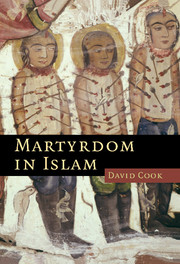
David Cook, Martyrdom in Islam: a recommendation


I soon hope to be talking about the ancient and medieval history classes I will be teaching in the fall, but right now I'm reading material on early and current Islamic history. Some of the books I picked up in the last month or so were not worth mentioning here. But on Saturday I was in Kalamazoo, Michigan for the 42nd International Congress for Medieval Studies, and bought two really good looking books at promotional prices.

One was The Rare and Excellent History of Saladin by Boha al-Din ib Shaddad, who actually knew Saladin and whose work has been published in Ashgate's series Crusade Texts in Translation. I'm looking forward to it.

Right now, however, I'm in the middle of a truly excellent book by David Cook, Martyrdom in Islam. (See cover above.)

I teach the history of Islamic civilization, not the history of the religion, Islam, but of course you can't do one without saying quite a bit about the other. The great challenge of my course is to make the connection between doctrine, the emotional impact on believers of that doctrine, and
the historic energies that have been generated by attempts to implement Islam, or to alter it.

This is tough and I'm not sure that I've ever done more than a mediocre job. I don't have deep background in the subject, just a lot of nerve and a burning certainty that someone should teach this material in Ontario universities.

So I am very happy indeed to find a book this good, which I may use for classes in the future, and will certainly order for our library.

It strikes me as an excellent second book on Islam for anyone really interested in Islam from a historical or religious studies point of view. The first would be any one of a number of books that briefly and systematically discuss the beliefs, the rituals, the institutions, and the historical development of Islam over the centuries. There are several good short books of this sort. Cook's book goes over some if not all of the same material from a different angle, since he is interested in describing the characteristics and effects of the Islamic concept of martrydom, and putting them all in historical context.

He does a fabulous job of this. I've learned all kinds of useful things that longer and presumably more complete books had not made clear to me. I've read lots and lots about the Sunni-Shiite division, but I feel I understand their mutual hostility and incomprehension better, now that I've read Cook.

I note that our own NU library has a Cook book called Understanding Jihad and I look forward to reading it. He also seems to have two more books on Muslim apocalyptic.

One question: if David Cook can write this cogently and accessibly on such important subjects, why is he only an assistant professor at his home institution?

Sunday, May 13, 2007

Jamestown 400th anniversary

A blogging historian I know has an interest in the early settlement history of North America and has been taking part in the 400th anniversary of the English colony at Jamestown, Virginia. Her post on this includes links to some of the best Jamestown sites, so I will link to her.

The image above is from one of those sites, Historic Jamestowne.

It's a silver seal showing a skeleton to remind the owner that life is short.

Wednesday, May 09, 2007

Islamophonic on the Guardian website

Do you like to listen to podcasts? Perhaps you'd be interested in the Guardian's weekly show on Muslim life in Britain.

Why I love English Russia

English Russia is a site which gives you some extraordinary picture of life in Russia today, every day. Many of the pictures are astonishing or hilarious.

I mean, Stalin himself is not funny, but who could not laugh at this? Granted, if you knew either Stalin or the car's owner, you might have a different reaction.

Why do I link to this site from an "early history" blog? The world historian in me has to love a site whose premise is: "just because something cool happens daily on 1/6 of the Earth's surface." Even the in the "sixths" we hardly ever think about.

Two developments of interest to students of Islamic Civilization

I am writing this and subsequent similar posts for the benefit of the students who just finished the course in Islamic Civilization, if any are still reading and any regular or chance readers who are also interested in recent news about Islam and Muslims. I have two items for today.

This past week saw an election for President in France, which was won by the "conservative" candidate, Nicolas Sarkozy. I put "conservative" in quotation marks because old terms like "conservative" and "liberal" have all sorts of meanings and certainly don't translate well across political systems, or generations. Heaven knows, for instance, what "conservative" is supposed to mean in the United States these days.

In any case, Sarkozy, who is a descendant of Hungarian immigrants himself, is widely considered to be anti-immigrant, especially Muslim immigrants. As a result of French colonialism in North and West Africa, there are a lot of French Muslims, some of whom come from families that have been there for generations. Juan Cole a few days back had an extended piece on his blog, Informed Comment, discussing what Sarkozy's narrow French nationalism -- leaning toward an ethnic or cultural or racial national identity rather than a civic one, "open to all ethnicities." If you know nothing about this set of issues I'd recommend taking a look; if you know more than Cole does, or have a different view, please comment, or send a link to something good.

Phil Paine, still traveling in Europe, has been writing about similar issues. Recently he found himself in the poor but famous London district of Whitechapel, where he saw unhappy Muslim youth wandering the street, radiating a sense of being excluded. Phil, who has lived in Toronto practically since it was "The Belfast of the North," has experienced many waves of immigration and I take his observations on such a matter very seriously. Here's what he says on another tricky word, "multiculturalism:"

I hear repeated references to “multiculturalism“ in Britain, but the word seems to have a different flavour here than back in Canada. In Britain, it seems to refer to government and institutional efforts to get Britons to accept Muslims as fellow-citizens, or at least to tolerate their presence. In Canada, acceptance is taken more or less for granted. The word there refers to the efforts of immigrant community organizations to preserve and transmit the elements of traditional cultures to the generation born and raised in Canada. One usage presumes that assimilation is difficult, the other that it is so swift and effective that there is a danger that parents and children might not understand each other. But the two countries have such profoundly different histories and social systems that the different attitudes and results are understandable.

This brings to mind my mind the "immigrant grandmother test" which I put forward on the very rare occasions I hear someone of old Canadian stock making remarks about immigrants not fitting in. I say, ask any immigrant grandmother about her grandkids. She'll say, perhaps sadly, "Oh, they are Canadian."

For more on this from Phil: go here and read the May 4th entry.

Another recent set of developments come out of Turkey. My former students know that the constitution and philosophy of Turkey is secular, despite the fact that 99% of the Turkish population is Muslim. This is due to the fact that Mustafa Kemal Ataturk, who built the modern Turkish state on the post-WW I ruins of the Ottoman Empire, was personally quite hostile to Islam and believed that the Turks had to join "the whole civilized world" by adopting European standards in just about every sphere of life, from the alphabet, to the law, to the wearing of fedoras instead of fezzes or turbans.

As you may imagine, a strictly secular constitution in an overwhelmingly Muslim country doesn't suit everybody, and for the last 20 years or so political parties that prize the Islamic heritage have proved pretty popular at the polls. The current ruling AK party (controls the cabinet and parliament but not the presidency) is one of these. Recently the AK put forward its foreign minister as a candidate for president, a powerful post. A significant number of people took to the streets to protest this nomination in the name of Ataturk's vision. In one interview I saw, a woman in her 60s said that the AK was trying to take them back to "the Dark Ages."
AK's candidate was blocked in parliament when the opposition parties were able to deny quorumm on the crucial vote. What's going to happen next? A law may be passed making the presidency a popularly-elected post.

In the past, when threats to Ataturk's model, whether socialist or religious, seemed to be strong, the Turkish military, which sees itself as the guarantor of his legacy, has intervened, either behind the scenes or through an open military coup. For them and many others, secularism trumps democracy. Could a coup be launched this? What would be the consequences for Turkey and the world? Remember, this is the most stable country in the Middle East, a candidate for European Union membership. Should it prove to be unstable...(an article that cites Algerian experience since 1990 as a warning).

On the other hand, what happens if AK takes control through democratic means? Plenty are willing to argue that they are a democratic organization, hardly extremists. But there are violent extremists in Turkey, as in most other places, and other Turks fear them.

Update: A huge demonstration of secular Turks against the ruling Islamist party on May 12.

Friday, May 04, 2007

Phil Paine in Europe

Not going to Europe but wish you were? Independent scholar Phil Paine is enjoying his first trip there in some years, and writing a colorful and intelligent commentary while he does so. (I love the Internet.)

If you want to tag along with him, go here and start with the April 28 post; then go here and start at the bottom.

Image: London's Guildhall.

Thursday, May 03, 2007

To my students, 2006-7

My work is done. Grades are submitted, and the research papers for the chivalry seminar can be recovered at my office. If you want to speak to me personally, I will be back in North Bay in about 2 weeks; or there is e-mail.

When I was ill this winter, the exercise of teaching was one thing that kept me going. As I started to get better, I began to realize what a privilege it is to teach undergraduates really interesting material. The fact that many of you responded did not hurt.

I should be at Convocation to see some of you graduate. If you're coming back next year and aren't in one of my classes, say hello anyway.

The image comes from our Chinese language site, which I didn't know we had.

PS: Like last year, I intend to post over the summer.

An interesting set of recent quotes

Chester Scoville has some interesting quotations from American pro-war writers over at his blog, The Vanity Press. There are days I am that angry.

Do people talk like this in Canada?

Image: Mussolini as the people.

Tuesday, May 01, 2007

The Medieval Warm Period at Medievalists.net

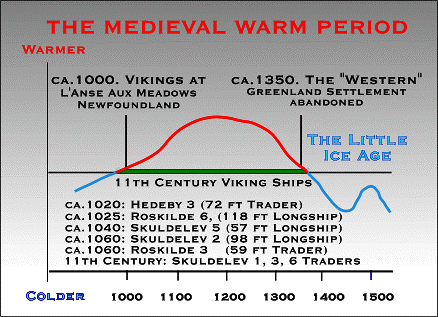
I haven't had much time to explore this yet, but some of you might be interested in a feature over at the Medievalists.net site, focusing on the Medieval Warm Period, a climactic phenomenon getting a lot of attention as we try to come to grips with climate changes today.

Medievalists.net up and running

Medievalists.net "aims to provide scholars and people interested in the Middle Ages with information and resources."

Congratulations to Peter Konieczny, the editor, on the launch of this ambitious project.

Monday, April 30, 2007

Steve Muhlberger speaks at Kalamazoo, May 12, 3:30 session


Along with thousands of other dedicated scholars of the Middle Ages, I will be presenting a paper at the 42nd International Congress of Medieval Studies in Kalamazoo, Michigan, which is kindly hosted by the Medieval Institute at Western Michigan University.

My paper will be in the 3:30 session on Saturday, May 12 in Schneider 1145. The title is "Non-noble deeds of arms in the Late Middle Ages."

I love the Kalamazoo Congress and when I'm not running off to its sister Congress in Leeds, England, I usually attend the whole thing. This year I can't guarantee I'll be there on any day but Saturday. If you want to say hello, why don't you come to the paper?

Sunday, April 29, 2007

Gertrude Bell


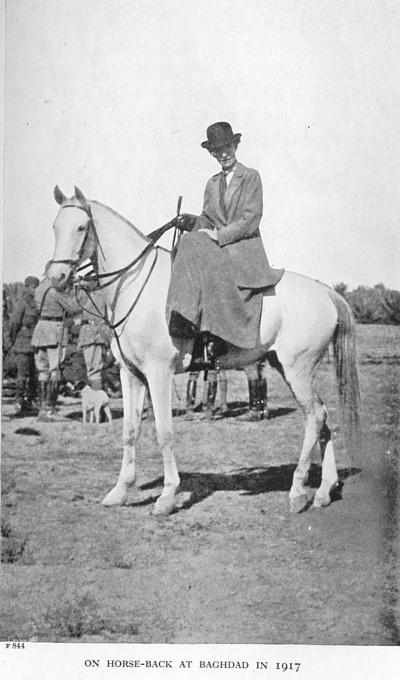
Gertrude Bell was a daring British traveler whose pre-World War One experience in the Middle East made her a key advisor on colonial policy in that area after the war -- more influential than Lawrence of Arabia. Some credit her with drawing the borders of modern Iraq and making possible the Hashemite monarchy that ruled there until 1958.

After reading a New York Times review of a recent book about her I went looking for pictures on the Web. (I showed at least one in Islamic Civilization but it was pretty fuzzy.) I stumbled across some pictures of "the Bell family" and this excellent page called (oddly) Gertrude in Persia. Give it a look.

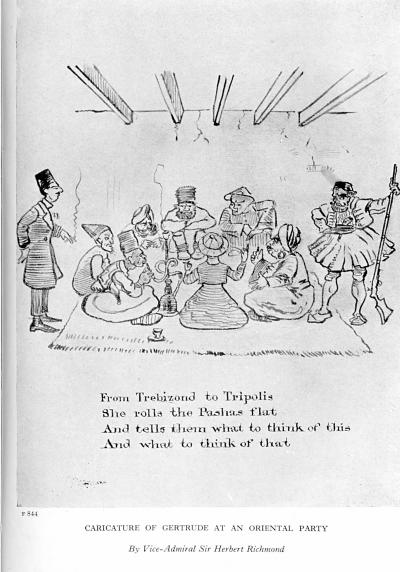
The top picture shows her in Baghdad in 1917. The one below is a cartoon showing her in action.

A wave of conversion to Shiism?

Some of my students in Islamic Civilization may be interested in this article from the NY Times Magazine. In officially secular but Sunni-majority Syria, people are converting to Shiism at an unknown but surprising rate. The reasons are quite varied. This article underlines how complicated and unpredictable religious and political affairs are in the Middle East.

Saturday, April 28, 2007

Military Q&A in 16th century Italy

Some of my readers know that I'm very interested in the Questions composed by the mid-14th century French knight Geoffroi de Charny on the law of arms. I've translated the questions on jousting and tournaments in a book called -- oddly enough -- Jousts and Tournaments (see sidebar) and I want to work this summer on his questions on war, a more challenging project.

Two things are notable about Charny's Questions. First, they have no answers. This leaves us wondering whether all or most of the issues were really debatable, and he was looking for answers, or whether it was more of a training exercise for the high-ranking French knights who were his audience.

The second noteworthy thing is that though Charny conceived of his questions as cases in "the law of arms," they don't concern issues that many of us would expect to be treated in a discussion of "the laws of war." There is next to nothing in the "war" questions concerning matters such as discipline, proper equipment, pay, things that later medieval monarchs who issued ordinances for their armies were demonstrably interested in. Charny's "laws of arms" are almost exclusively concerned with the rights of "men at arms" -- fully equipped and trained warriors, respectable men -- in dealing with each other.

So Charny's Questions are an odd and provoking composition. What the heck was he up to, and how did his ideas fit into the current thinking about war and warriors?

One of the challenges of interpreting Charny is finding other documents that are in some way
comparable. This month, however, I stumbled across something really neat -- another set of military questions from about two centuries after Charny. Questions that have answers!

Of course, they are quite different from Charny's questions in many respects. My Italian is rather slow and rusty, but this appears to be a set of questions posed by one "Ecc.mo sig. Gio. Battista Dal Monte" to prospective captains who wished to work for the Republic of Venice. The questions concern tactics and the management of armies, and are followed by "suitable answers" that a good captain would presumably offer.

Neat, eh?

I am very interested to hear from anyone who can identify the "Ecc.mo sig" GBDM.

Oh, the source of this document is Ercole Ricotti, Storia delle compagnie di ventura in Italia, Torino, 1847.

Canada: worst country in the world

High latitude kind of person? See this report on Vitamin D deficiency and cancer.

Friday, April 27, 2007

The Athenian navy: could they beat the 300?

I am going to start by pasting in a post from Adrian Murdoch's blog, Bread and Circuses and my own reply to that post:

The faculty of biological science at Leeds has some interesting research about the fitness of ancient rowers:

We may not be as fit as the people of ancient Athens, despite all that modern diet and training can provide, according to research by University of Leeds exercise physiologist, Dr Harry Rossiter.

Dr Rossiter measured the metabolic rates of modern athletes rowing a reconstruction of an Athenian trireme, a 37m long warship powered by 170 rowers seated in three tiers. Using portable metabolic analysers, he measured the energy consumption of a sample of the athletes powering the ship over a range of different speeds to estimate the efficiency of the human engine of the warship.

By comparing these findings to classical texts that record details of their endurance, he realised that the rowers of ancient Athens - around 500BC - would had to have been highly elite athletes, even by modern day standards.

Thanks fo AJ for passing this over.

And here's what I said, more or less:

[The demos (common citizens) who were paid to row Athenian warships] have often been accused of being a belligerent, imperialistic group because more war meant more pay (and presumably more profit from the empire).

If these guys were a large group of physical fitness fanatics, too, you can see how they might be a rather fearsome political pressure group.
Would you want to face these guys in a heated debate in the assembly -- 6000 overexcited Greeks all determined to exercise the sovereignty of the people?

I still have not seen 300, but when it came out lots of people remarked on the physiques of the Spartan heroes, and somebody said, roughly, that beautiful architecture and literary debates and even democracy were all very well, but sometimes you needed people who could give the opposition a kick where it counted for something.

Even at the time I thought, "Friend, you have no appreciation for the dynamic of Athenian democracy;" now I think, "Friend, who had better sixpacks, the rowers or the infantrymen?"

Bread and Circuses is well worth a look for all sorts of ancient material, especially concerning the Later Roman Empire. See this on a movie on the last emperor in the west.

Constitutional conflict, mano a mano

The US House of Representatives wants Secretary of State Condoleeza Rice to testify about fraudulent claims that Saddam Hussein was buying uranium from Niger, which claims were featured in the justifications for invading Iraq. Rice, who was National Security Advisor back then, seems inclined to refuse on the grounds of "executive privilege," i.e., that the President needs candid advice and certain discussions should remain confidential. The House has thus issued a subpoena, which requires Rice to appear or face arrest or other legal sanctions.

The only problem for the House is that the normal way to enforce such sanctions is through the office of the US Attorney for the District of Columbia, who works for and was appointed by the President, and might not be terribly motivated to expedite the House's will.

Stalemate? Well, have a look at this article in Slate which points out that the House has an officer of its own, the House Sergeant of Arms (one Wilson Livingood) who has both the legal authority and a weapon to enforce the House's will: the weapon being the Mace of the House.

The Slate article gives enough detail about both the British and American history of legislative bodies directly exerting jurisdiction to get you started on this fascinating topic (though if you go further don't ignore the history of the Roman Republic). I'd just like to say something about the symbol (?) of authority, the mace.

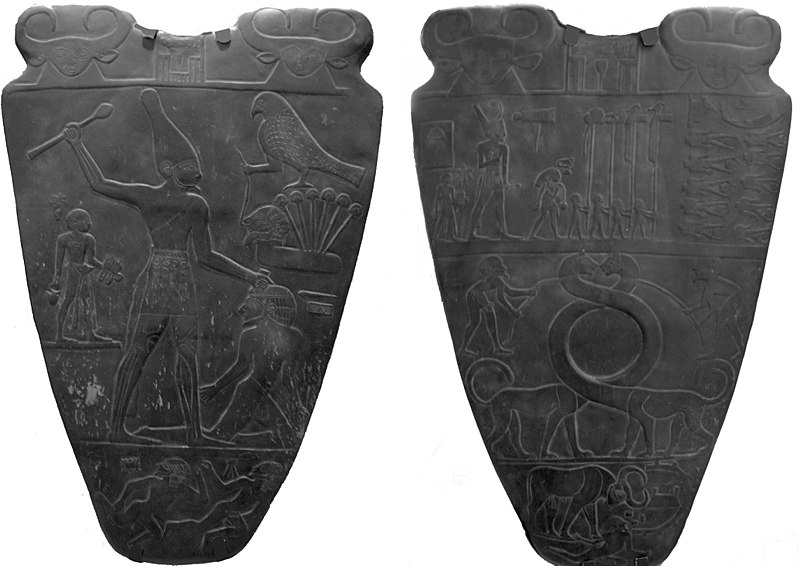
The mace is really no different from the scepter, and both are clubs. Have a look at this ancient Egyptian portrait of "Narmer" who may be the first king of the first dynasty, and note how he is using a scepter/mace to beat down his enemies. Do a Google Images search for "scepter" and one for "sceptre" and look at the images from older art. A scepter/mace is a symbol of power, and the jurisdiction -- ability to command and punish -- which is the essence of power.

For long periods of history, those who claimed jurisdiction held a scepter or mace to make their claim visible. In the Middle Ages, that included more than individual lords. A collective body with a significant degree of self-government and authority could have a mace, too. Like a university, which still has the power to grant legal rank (bachelor, master, and doctor) recognized by other authorities, and has its own rules of internal governance.

Does your university have a mace? Mine does, see the image above, in which Dr. Ted Chase is carrying it to a Nipissing University convocation.

I said the mace was a "symbol (?)" because battles over jurisdiction in the old days were often real battles. Slate cites a couple of examples in the article cited above. I don't know about the British/English Commons history of fisticuffs, but in the pre-Civil War days in the USA, it was not so unusual for members of Congress to beat each other up. One famous incident, the beating of Charles Sumner by Preston Brooks, helped bring on the war and shape the Reconstruction.

Has anyone written a social and pugilistic history of the pre-Civil War American Congress? Please tell me if you know of one.

Thursday, April 26, 2007

A blogger leaves Iraq

Perhaps the most well-known Iraqi blogging in English calls herself "Riverbend." After years of sticking it out in worsening conditions, she and her family are finally leaving Baghdad and Iraq. Her comments are here.

Exolife excitement

In the Daily Telegraph (Australia) there is an article from the Daily Mail (also Australia) which says, way, way down at the bottom:
It is difficult to speculate what - if any - life there is on the planet.
Of course most of the top of the story is filled with just such speculation, including these florid opening lines:

ABOVE a calm, dark ocean, a huge, bloated red sun rises in the sky - a full ten times the size of our Sun as seen from Earth. Small waves lap at a sandy shore and on the beach, something stirs...

Now this surely is a neat discovery and much better news than anything else in the news today, but I have to chuckle and wonder how many readers understand how faint the signals on which the planet's existence and nature.

As an old science fiction fan I'm glad to hear it, but I will get really excited when we go there or they come here.

It's nice to see other people getting excited about something this positive, instead of hate-driven fantasies about what their human neighbors are like.

Wednesday, April 25, 2007

Recipe for fascism (history of democracy thread)


Can one use the term fascism for any current political movement, philosophy, or strategy without being merely abusive?

Shall we just skip over that question for now (though comments are welcome)?

Naomi Wolf argued in yesterday's Guardian, in an article called Fascist America, in 10 easy steps, that many of the necessary actions needed to install a dictatorship in the United States have already been initiated, and most Americans are oblivious.

I liked that article for two reasons.

The first is that I share Wolf's concern with the ailing condition of American democracy. Skip down to the bottom of her piece and read what she says about the Military Commissions Act, all of which is factual, and then tell me what you think. "It can't happen here (or there)" isn't good enough: it already has.

Second, it is a clear argument on an important subject which does not depend on ad hominem attacks. These days "important" critics spend all too much time arguing through the contradiction of their favorite foes in the ranks of punditry. Wolf's argument is a straightforward argument based on citations that anyone who can read it on-line can easily follow up. Further, I like her comparative methodology. The current situation and its component features are not unique in history. We can make systematic comparisons to understand what's going on now. How rare such an approach is!

I usually think of at least one additional point after I've numbered them, so here's number 3: Wolf writes well. Take this passage here:
It is a mistake to think that early in a fascist shift you see the profile of barbed wire against the sky. In the early days, things look normal on the surface; peasants were celebrating harvest festivals in Calabria in 1922 [when Mussolini marched on Rome]; people were shopping and going to the movies in Berlin in 1931. Early on, as WH Auden put it, the horror is always elsewhere - while someone is being tortured, children are skating, ships are sailing: "dogs go on with their doggy life ... How everything turns away/ Quite leisurely from the disaster."
As you can imagine, if you read an earlier post I wrote today, my reaction to this insightful evocation of how events work is "more of this, please."

Image: An Umbrian harvest, 1976.

William Marshal, in my library

I am now the proud owner of the full new edition and translation of the History of William Marshal issued by the Anglo-Norman Text Society. As to why I am so pleased, and why you might want to consider acquiring it yourself, see my earlier discussion of the History.

Peter Heather's The Fall of the Roman Empire

I remarked on this book when it was issued at the same time as Bryan Ward-Perkins' The Fall of Rome (see this earlier post and this one, too). Now I'm actually reading it. I don't know what I think of it's argument (I'm not quite sure what the argument is, yet), but already on page 18 I can see that it may attract a wide non-specialist readership by retailing in clear prose things that specialists already know. On p. 18, for instance, Heather in talking about the aims of Roman elite education says this:

They...saw their literary texts as a kind of accumulated moral database of human behaviour -- both good and bad -- from which with guidance, one could learn what to do and what not to do. On a simple level, from the fate of Alexander the Great you could learn not to get drunk at dinner and throw spears at your best friend.

Well, it made me laugh. Simple things for simple minds, I guess.

A friend of mine has already criticized this book for precisely this kind of thing, but I think that more scholars should reach out in this way. Of course, that presumes they have something worthwhile to say. But if you do have something worthwhile, why not express it with wit and grace? Recently I almost didn't get through a good study of Hezbollah because it was slow and wordy, while I'm stalled at the beginning of a book on Wahhabism, an important subject I should know more about, because the author can't resist extraneous travelogue material. As a result my eyes went wandering until they rested on Heather's book.

Tuesday, April 24, 2007

Help needed from big thinkers!

Can you suggest a good book or two?

Last year I assigned two "big picture" books for my Ancient Civilizations course (a second year course) and asked students to compare and contrast. Neither was really an "ancient history" book, but they were books that reflected on the wide sweep of human experience and discussed the significance of ancient developments in that perspective.

The two books were:
David Christian, Maps of Time: An Introduction to Big History
and Ronald Wright, A Short History of Progress.

I'd love to assign a similar paper for the upcoming year's Ancient Civilizations but I need one or two new books that make an interesting contrast and have something to do with ancient history (mainly the ancient Middle East and the Mediterranean).

You don't have to be an ancient historian or a historian of any sort to be helpful in this quest; you just have to have a good idea. Neither of my previous choices were typical historical works.

Any thought you put into this, and any suggestions you make, will be gratefully received.

Sunday, April 22, 2007

How the news media fail us

Did you know about this? I was teaching about the Middle East during the 138 days this demonstration has been going, and I don't recall seeing a word about it in the Washington Post or the Toronto Globe and Mail. Maybe it's my failure but I don't think so.

Father of lies

The current movie 300 is based on a "graphic novel" (sorry, can't take that phrase seriously), which is based on a movie of the 1960s. Some Iranians have been outraged by the bizarre and ahistorical depiction of the ancient Persians, just as some Kazakhs have been by Borat. (The Uzbeks and Tajiks are just glad they dodged that bullet.) I have some sympathy for the Iranians, but haven't felt it necessary to keep track of their counterblasts, since in the end they'll just have to lump it (or make their own movie).

Somehow, though, I took a look at this article by Amir Nasseri in the online Persian Journal. Nasseri is upset, too, but more about Herodotus' supposedly contempory account, written sometime after the war, maybe a generation. Why, he asks, do people appeal to Herodotus against 300, when he himself tells a half-mythological tale that is inherently improbable?

Nasseri's not the first person to make these points, but he makes them reasonably well. I, too, have wondered how classicists over the century have found it possible to believe Herodotus' military statistics, or at least some of them.

Saturday, April 21, 2007

Chaucer


Quote from a student paper:

[As Howard Patch said,] Chaucer had a "mature and realistic mind, equable enough to observe that all shall pass and that odd things occur along the way."

Brave New War, The Upside of Down, and the fall of the Roman Empire

Andrew Sullivan's blog directed me to the inside flap blurb of John Robb's Brave New War as printed at Amazon. These passages caught my eye:

In Brave New War, the controversial terrorism expert John Robb argues that the shift from state-against-state conflicts to wars against small, ad hoc bands of like-minded insurgents will lead to a world with as many tiny armies as there are causes to fight for. Our new enemies are looking for gaps in vital systems where a small, cheap action—blowing up an oil pipeline or knocking out a power grid—will generate a huge return...

How can we defend ourselves against this pernicious new menace? Brave New War presents a debate-changing argument that no one who cares about national security can afford to ignore: it is time, says Robb, to decentralize all of our systems, from energy and communications to security and markets. It is time for every citizen to take personal responsibility for some aspect of state security. It is time to make our systems, and ourselves, as flexible, adaptable, and resilient as the forces that are arrayed against us.
Two weeks ago I was reading a similar argument in Thomas Homer-Dixon's The Upside of Down, though H0mer-Dixon, without ignoring "security," is more interested in the environmental challenges we face.

A couple of short reflections. Robb's subtitle is The Next Stage of Terrorism and the End of Globalization. It's not clear from the blurb (which was probably written by a staffer at the publisher's office, or even a free-lance editor) whether Robb believes that globalization, defined in the blurb as "worldwide economic and cultural integration," has been a matter of centralization, of more power in the hands of presidents, billionaire investors, and media owners. Opponents of globalization have seen it that way and you can understand why. But the globalization that some fairly ordinary people, obscure academics at small Canadian universities for instance, have enjoyed the fruits of, has never been a matter of centralization. We in North Bay, Ontario have been empowered to do work that formerly would only have been possible for people based in Toronto, New York, Oxford or Paris. So some of us are pretty keen on this idea of decentralized and flexible systems. Like the Internet, which numerous governments and "intellectual property owners" have already tried to rein in as a threat to their old-style power.

A worthwhile globalization is a matter of creating civilized networks that are more robust and powerful than the networks of people who want to blow up things and shut people up in secret prisons. It doesn't strike me that this is an unprecedented challenge. Some of the tactics of the destroyers and the slavers may be new, but the world has always been infested with small groups who want to make big killings -- literal, financial, or both -- and don't care who gets hurt in the process if it's not them. The new terrorists aren't going to be content to be crawling around blowing up pipelines forever. Some of them are looking forward to that Swiss bank account, that luxurious compound on the Riviera, that imperial palace filled with beautiful and compliant servants. These guys aren't all crazed, self-sacrificing martyrs. They employ crazed martyrs. And you can bet they appreciate the role of law and law enforcement in securing their gains. There's a big danger to innocent life and the productive economy and our environment as a whole from the cheapness of some possible aggressive tactics, but in some ways it's the same old game. The future world, if we avoid environmental collapse, may solve terrorism simply by strengthening slavery.

My second reflection is on the current debate about the fall of the Roman Empire (the fifth-century fall) between people who equate it with "the End of Civilization" (Bryan Ward-Perkins) and people who don't think it was an ending of unprecedented significance (say, Peter Brown and Walter Goffart). I really think that the unresolved and maybe unresolvable debate is about what civilization is. Is it a situation where a leisured minority sit around in the palace library, enjoying bread made from Egyptian wheat and dipping it in Syrian olive oil or Spanish fish sauce, and debating the great ideas of the ages, while other people dig minerals from the earth in dirty, dangerous mines, or harvest cotton in the hot sun, and die young? If that's it, then there was probably a lot less "civilization" in large parts of the formerly Roman world after AD 400 than there had been for some centuries, in that it was far more difficult to assemble a large variety of enviable luxuries in one spot through the routine operations of centralized imperial power. And there is more civilization now, because here I sit, not even close to being rich by Canadian standards, but able to read, think and then speak to a privileged minority around the world while hundreds of millions sweat profusely (and all too often, die young).

But it might be worth considering whether the height of luxury -- whatever luxury you prefer -- is the only measure of civilization.

I say, bring on those resilient decentralized networks and extend them as far as we can. The only alternative is slavery for somebody.

Friday, April 20, 2007

Woman scholar in disguise, Krakow, 15th century


Over on the MEDIEV-L e-mail list, Andrew Larsen a few days back told this story about a woman who studied in disguise at a late-medieval university. With his permission I am reproducing some of his remarks here. Thanks to Andrew and Michael Shank both:
Michael Shank discovered a fascinating case of a woman at the university of Krakow who studied there for several years disguised as a man).

She studied at the U. of Krakow for a few years, until two men made a bet that she was actually a woman, and then jumped her and tore her clothes off.

As a girl she had studied at a grammar school. When her parents died, she used her inheritance to enter the university and lived in disguise at one of the student hostels. She was unmasked by a "soldier in the house of a burgher named Kaltherbrig" and his companions. When
unmasked and taken before a judge, she was asked why she had done it. She replied "for the love of learning." She was sent to "the convent", where she became a teacher ('Magistra') and later on abbess. Shank suggests thatthe incident happened somewhere between 1400 and 1420.

For Shank's brief article on this incident, see Michael Shank, "A Female University Student in Late Medieval Krakow", _Signs_ 12 (1987), repr._Sisters and Workers in the Middle Ages_, ed. Judith M. Bennett et al, Chicago: University of Chicago, 1989).


Thursday, April 19, 2007

Walmart's world -- where their products come from

This relates to the last lecture in World History two weeks back. A better view at the originating site (or try clicking on the image above). I wonder what else might be there?

Wednesday, April 18, 2007

Inside Iraq

It is easy to treat the war in Iraq as a problem in American politics. Most of the news sees Iraq from the outside. If you want to see it from the inside and don't read Arabic, try this blog, Inside Iraq, which is written by Iraqis who work at the McClatchy Baghdad News Bureau. In line with my resolution to restrict my commentary to items with a certain historical perspective, I'm going to put a permanent link to this forum on my sidebar.

It's strong stuff, hard to read, but if you read it you will (a) learn any number of things and (b) find it difficult to feel that Iraq and its problems are on a different planet. Especially if you've ever played Diablo or Grand Theft Auto.

Tuesday, April 17, 2007

Help send an independent scholar to Transylvania

Phil Paine, my sometime collaborator, is going to Transylvania. He's still raising funds for the trip. If you have work he could do from a Toronto base, have a look at this post and his description of contract research work he's done in the past.

Early History and current events

My Fall/Winter courses are over, except for the final exam in Islamic Civilization, which my students are now preparing for. While Islamic Civilization and World History were running, I had them to excuse my commentary on current events in the Middle East, commentary that drew me away from my professed focus on "Early History" (roughly, history before railways).

So now that my excuse is gone, what will I do?

I could protest that World History will be back in September, and since I always take it up to the current year, I can comment away all spring and summer with a clear conscience. To do that, however, risks turning this into a current events blog, and there are plenty of those -- probably around 30 million of them.

On the other hand, I'm not going to give up commenting on recent events. First, it is one of my deepest convictions that what is happening in the world now is not unprecedented, that the past is more familiar and the present more exotic than we often give them credit for being. There is often something to be learned and intellectual pleasure to be gained in making historical connections across time and space. Second, current issues are vital. What's happening in the Middle East is of the greatest importance. The battle now raging over the US constitution and for the soul of America is also of extraordinary significance, and not just for the USA and Canada. Truly, my heart has been in my mouth since April, 2004.

These two areas in particular touch on things I've taught and researched over the years (see my CV for a list of publications if you are interested). If this blog is a bit of a bulletin board for my activities as a faculty member at NU, especially a place for things I'd mention in class if I had the time, then the commentary is appropriate.

I am going to do my best, however, to link to only the most important stories, or to ones that have a good historical perspective to suggest. For instance, one of today's links is to Juan Cole's daily Informed Comment where he suggests that Richard Cheney's idea that the tide of 21st century history favors American empire is dead wrong, and offers his reasons for thinking so. This post should mean something to Islamic Civilization students.

Perhaps even more interesting is one of the comments to that post, which reflects a thought I've had. Arnold Evans says:

I think a simple lesson is that post 1945, if a nation is hostile, no amount of sanctions, bombs or occupying troops can make it non-hostile.

This is a lesson that applies to Iraq, and also to Iran, Cuba and North Korea.

This sounds like a utopian, lovey-dovey peacenik idea, but the cold, hard real fact is that sanctions, bombing and occupation really do not work for the reasons described in the essay.

The United States will be much better off when it learns the lesson.

I don't know anything about Arnold Evans except that he has a blog called Middle East Realities in which he matches his perceptions of those realities against more common ones, by making predictions based on his ideas, posting them, and then letting the reader judge. I haven't actually gone through his archives and tested his accuracy, but I must say that it's an interesting idea.

I think I'm going to keep an eye on Evans. Here's part of a post from January worth the attention of a historian of democracy in world perspective (i.e., me):

A major reason democracy is an advance is that a group that becomes more powerful than its rivals has a non-violent way of attaining control of government - and does not have to wage a war that it probably could win.

When pro-Iran elements won the elections - even though Iraq was under direct US occupation and the US was flooding Iraq's electoral system with money, free television and other resources - the whole point of democracy is that now the pro-Iran elements don't have wage the war they probably could win.

America is now saying it wants to fight the pro-Iran elements even after the pro-Iran elements won the elections. That defeats the entire purpose of elections, and the pro-Iran elements are probably (definitely) going to win anyway, just like they won the elections.

Somebody should teach the United States about democracy. It sounds ironic but it is not a joke. US ideals about democracy are consistently put to the test in the Middle East and the US consistently, not just Bush but consistently for over 50 years, demonstrates that it does not understand or accept the theoretical underpinnings or consequences of democracy.
No, Arnold, I don't think you are joking, and irony is a much overused concept. And anyone who says something that cogent and applicable to our historical understanding has a place in this blog, whether they are talking about Early History or not.

Image: the bombing of Beirut, July 2006.

Monday, April 16, 2007

That Beautiful Somewhere -- Toronto opening

This announcement is from Bill Plumstead, author of the book Loon and the executive producer of the movie made from it, That Beautiful Somewhere:

In the movie business you become rather crass at snatching every opportunity for publicity. Our film "That Beautiful Somewhere" opens in Toronto this Friday, April 20,(also in Montreal at the Forum) and will play until at least Sunday, 22, at the Empress Walk 10 theatre on Yonge St North.(10 screens). In the newspaper listings it's under "Empire Theatres." The subway stop is North York Centre.There is free parking under this complex for moviegoers. If the weekend box office is solid, they'll keep us on for another week. Check us out at www.thatbeautifulsomewhere.com Thanks.
I recommend this movie.

Friday, April 13, 2007

World War II veterans

In the last couple of days I have had the opportunity to talk to veterans of World War II, one with experience in Europe, another who hopped from island to island in the South Pacific. Both of them had medals that they haven't had a chance to talk about for years. ("I don't know why I got that medal. I didn't do anything. I didn't save anybody. I just survived.")

Let me urge any students who may be reading this, or anyone else, to take a moment to sit down with people you know who experienced the war or any other fascinating past event, and let them talk. Don't restrict yourself to warriors, either. There are plenty of other kinds of stories.

You will kick yourself in later life if you don't do this while you still can.

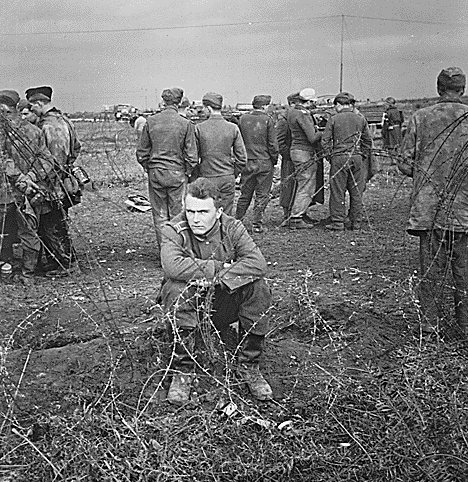
Image: German prisoners captured at Anzio, Italy, in 1943.

Tuesday, April 10, 2007

Sunday, April 08, 2007

Nomad life disrupted in Darfur

I know that some of my intro World History students will be taking Ancient History with me in September. One of the first topics we will be tackling will be the balance between nomadic and settled human groups. This article from the Washington Post about Darfur gave me something to think about -- especially the part about the boredom afflicting impoverished nomads.

Saturday, April 07, 2007

An exercise for my outgoing students

If you want your Easter holiday to be a lighthearted one, you may want to put this exercise off for a couple of days.

On the other hand, if you reserve any time for serious contemplation, this may be an appropriate subject.

For students in intro World History: Read the following report by Glenn Greenwald. Compare the people he quotes to various 19th and 2oth century ideologues discussed in Worlds Together, Worlds Apart.

For students in Islamic Civilization: Compare the impression you have of Iraqis from reading Night Draws Near to the picture sketched in the sources quoted by Greenwald.

Untermenschen, if you don't know, is a German word often translated as "sub-human."

Two treats from Unlocked Wordhoard for the holiday

Part of my regular reading is Richard Scott Nokes' blog. Nokes is an Alabama medievalist with a sense of humor and a personal touch in his writing.

In the past week he's posted two interesting things, one light-hearted that he's just passing along, the other quite serious and all his own.

The first is a YouTube video which shows the Bayeux Tapestry as animation. Those of us who are already familiar with the BT are astounded by how good this is. Those of you who don't know the BT should get on the Web and look up some good discussions of this unique piece of embroidery which was commissioned by the victorious Normans soon after they conquered England. There is an excellent disc version of the BT that you can buy, which includes lots of background material, but I can't find a link because there are a lot of free, online versions cluttering up my Google search.

The original Nokes contribution is his discussion of how he tries to put Boccaccio's apparently lightheared Decameron into its original context. As a history teacher myself I'm quite impressed.

As is often the case, clicking on the image above -- a short section of the BT -- will give you a bigger better image.

Wednesday, April 04, 2007

It's not Joan of Arc

Sometime in the 19th century, when the pressure was on to have Joan of Arc recognized as a saint, somebody faked up some relics using material from an Egyptian mummy.

Now they've been found out. CSI does it again! (Well, not exactly.)

For details see the online version of Nature.

Tuesday, April 03, 2007

Danger in Israel/Palestine

Another article on the perils of the current deadlock. This article sketches out Israel's demographic dilemma.

Monday, April 02, 2007

Hometown Baghdad

A video on YouTube, and a whole site.

America on the sidelines -- another reading for Islamic Civilization

Here's an informative and opinionated post from Tomdispatch.com. The most striking passage:

Arab regimes most closely allied to the U.S. face mounting crises of legitimacy at home, damned not only by their authoritarianism, but also by their paralysis in the face of U.S. and Israeli violence against Arab populations. Delivering the Palestinians to statehood is now seen by those regimes as essential to their own domestic political survival.

Methodist church becomes mosque in a Lancashire town

Students in Islamic Civilization may want to read this NY Times article.

Another day, another theory about the Great Pyramid

Thanks to Al Jazeera I now know that a French architect named Jean-Pierre Houdin thinks he's proved that the Great Pyramid was built by using a ramp that was inside the outer skin. Unfortunately the 3D animation that has convinced others did not work on my rather old computer at work. If you want to give it a try, go here.

Roland online

Today was the last class meeting of my Chivalry seminar. One member was speaking on the Song of Roland, and she used her laptop computer and NU's wireless network to show us the famous Bodleian ms. of the epic, and to play us an audio clip of someone reciting its first stanza in Old French.

Can I do less? No.

Here's the Bodleian manuscript and the audio clip.

Image: Charlemagne flanked by Roland and Olivier, from Notre-Dame Cathedral in Strasbourg.

Scotus for Dunces and medievalist humor

The Kalamazoo-based International Congress of Medieval Studies is coming up and I was looking at its thick, information-packed program yesterday and got some good laughs.

Laughs? Even medievalists themselves live in fear that the subjects they study are dry and boring (even though the period is full of blood and vinegar) and as a result the Congress program has numerous attempts to give papers and publications snappy titles. Some of these are laughable (in other words, pathetic) while others are rather clever.

One I sincerely liked was a paper on Sir Gawain and the Green Knight entitled "Two Beheadings and a Funeral."

But the real belly-laugh was reserved for a book on the Franciscan theologian of around 1300, John Duns Scotus. Congratulations to Mary Beth Ingham (and Franciscan Institute Publications) who had the nerve and the marketing savvy to call her book Scotus for Dunces: An Introduction to the Subtle Doctor.

Why is this funny? Ask your nearest medievalist, or look up the origin of the word "dunce."

Sunday, April 01, 2007

World democracy watch: American authoritarianism

Some Americans have just lost track of the essentials, as constitutional lawyer Glenn Greenwald points out. Despite the date, this is not an April Fool. (You may see an advertisement after the link but you can skip it.)