Wednesday, October 23, 2013

Some of the best stuff on the internet


 But it's fairly clear that hate that made the Shoah was neither an invention nor the magic of false-consciousness, but a reflection of the people themselves:


In the same poll of November 1946, one German in three agreed with the proposition that ‘Jews should not have the same rights as those belonging to the Aryan race’. This is not especially surprising, given that respondents had just emerged from twelve years under an authoritarian government committed to this view. What does surprise is a poll taken six years later in which a slightly higher. percentage of West Germans—37 percent—affirmed that it was better for Germany to have no Jews on its territory. But then in that same year (1952) 25 percent of West Germans admitted to having a ‘good opinion’ of Hitler.


Attendant to all of this was something that any student of white supremacy in America will recognize--a strong propensity toward national amnesia:


 In Italy the daily newspaper of the new Christian Democrat Party put out a similar call to oblivion on the day of Hitler’s death: ‘We have the strength to forget!’, it proclaimed. ‘Forget as soon as possible!’ In the East the Communists’ strongest suit was their promise to make a revolutionary new beginning in countries where everyone had something to forget...


It's worth taking a moment to think about this "strength to forget" notion. National forgetting is always a selective endeavor. Italy had no more intention of dismissing its Roman heritage as "the past," then Americans have of dismissing George Washington as "the past." "The past" is whatever contributes to a societies moral debts. "Heritage" is everything else. 


Judt is making a very disturbing argument--that postwar Europe was built on  a willingness to only push deNazification but so far. There is here something not wholly dissimilar to our own reunion accomplished on an agreement to "forget" what the War was over. So far does the myth advance that Judt finds president Eisenhower lauding the Wermacht--"The German soldier fought bravely and honorably for his homeland."
We are confronted with a series of awful questions: What are the actual limits of human justice? How much of human justice, ultimately, rests on the accumulation of guns? What is one to do when the people, themselves--not sinister hidden forces are the engines of persecution? Of useful killing? Of genocide? ...


Man.  Such hate. What can we do against such reckless hate. Don't study history to boost your self-esteem. Study history to lose your religion. Or maybe in the end, to gain it. I am not religious at all. But seeing the limits of all of us, you start to understand why people might appeal to some higher, more certain, more fierce, invention.

Tuesday, October 22, 2013

Goodbye to Ravenhill


Ravenhill (sometimes known as the Last Homely House South of the Mattawa (River)) was the name we gave to our 95 acre rural property in Bonfield Ontario. We sold the place about two weeks ago. It is the home that I have lived in longest.
I am sad to be leaving. It really is very nice to have a huge piece of property, where you can take your dogs for a walk, raise sheep, allow medieval reenactors to camp (every year for 20 years), ride your horses. Never again.


On the other hand, as we got older, the disadvantages became more and more obvious. It is a lot of work to manage a property and a house in the Canadian countryside. Eventually it got away from us. My health is not what it once was, and my very healthy and energetic wife has limits, too, though our friends  may doubt that.


It also became increasingly expensive and inconvenient to be a half-hour to 45 minutes from about anywhere. (Even when you get to North Bay, you are basically in the no shopping zone.)


On top of that, the Bonfield environment has been turning sour. Most people in the village are perfectly nice people, but even working with our neighbors we were not able to stop someone bringing in a horrifically noisy dragstrip, or our Township Council from launching an experiment in unionbusting.


And then… There is winter. I’ve been proud of being able to deal with winter and even enjoy it, but the idea that I might never need to own snow tires again pleases me mightily.


Some of my friends reading this will think that they have lost something too. Well, I rather hope you feel that way. We put a lot of effort into making the last homely house the welcoming place it was for you. And we were very glad to have you there.


Friday, October 11, 2013

Tam Lin

A friend sent me a link to this marvelous rendition by Anais Mitchell and Jefferson Hamer of the British folk song Tam Lin.


Hearing this version of the song was a shock. It forcefully read reminded me of this version of Tam Lin by the folk-rock group Fairport Convention,, which I first heard in the summer of 1972:


That summer I was in Norwich, England taking part in an archaeological dig. It was a wonderful way to celebrate my graduation from University. The people running the dig provided us with cheap housing and a little bit of spending money, and we scraped or dug dirt. It was a social and informal learning experience and I soaked it up.

The house we were staying in was a student house during term time, and the usual residents had left lots of their property, including a record player and the Fairport Convention album Liege and Lief. I played the album a lot, particularly the song Tam Lin, about "an earthly knight" rescued from the Queen of the Fairies by his lover. I was an SCA member, a historian hoping to be a professional medievalist some day, and someone who really appreciated the rock elements of this particular arrangement.

And Tam Lin was just the beginning. Somebody told me about a weekly get-together of folk music enthusiasts at a pub near our dig, and I went there more than once, although I never had the nerve to to sing an American folk song. And before I left England a friend of mine gave me one of the early Steeleye Span albums.

The result was that I had found in British and later Irish folk the soundtrack of my life for the next decade, The decade when I was a graduate student and when I was most intensely involved in the SCA.

It was really something to reflect on that..

Friday, October 04, 2013

Sunday, September 29, 2013

Rant: digging up Richard III

It's not my rant but Howard Williams' of the University of Chester, referred to me by Guy Halsall.  Here is part of it:

Worshipping Dead RoyalsThe third objectionable aspect of the excavation of Richard III is the royal cult of personality that surrounded the excavation and the respect shown to his remains. I personally don’t have time for those that fawn over present-day living royals and their sprogs, but it seems somehow cut-rate and sordid to be fawning over long-dead royals in the hope of ‘rewriting the history books’ or getting to know their true person through their bodies. I can imagine the same sensitive facial reconstructions done for the butchers of the 20th century and imagine cult followers shedding tears over their sensitive small moustaches and their kind eyes.
Now I am sure Will, Kate and little baby George are all lovely. Even the Duke of Edinburgh makes me laugh. However, this royal necrophilia gets right up my archaeonose. Rather than the scientific study of human remains to understand life and death, this becomes a faux-forensic investigation into the individual’s life and death. Whether hero or villain, it is ironic that our obsession with the remains of the individual cadaver of Richard III flies in the face of the aspirations we have as a discipline for writing about the past in a social and humanising way.  Implicated in this view is that only rich and powerful people in the past matter today. In other words; the bones of toffs are venerated today as sacred, the bones of plebs are trowel fodder.
There is a strong case for Leicester cathedral to create a medieval equivalent to Westminster Abbey’s ‘tomb of the unknown soldier’. If you want to spend a million, select one of the many thousands of medieval graves we archaeologists have dug up – an old woman who died of leprosy, an infant who died in childbirth – and create a monument for them that makes us reflect on present-day poverty in the rest of the world and how many millions live in poverty today and die in agony from curable diseases. Don’t honour a warmongering royal, honour humanity.

Saturday, September 28, 2013

Well Met: a book on Renaissance Faires


I have yet to read this book, but Jeff Sypeck's post on Quid Plura is intriguing:

What hath the Renaissance faire to do with psychedelic rock? The vogue for “world music”? The frilly shirts of Jimi Hendrix? The rise of craft breweries? The House Un-American Activities Committee? Before reading Well Met: Renaissance Faires and the American Counterculture, I hadn’t thought to ask—but Rachel Lee Rubin’s book is a useful reminder that pseudo-medieval pursuits are sometimes more about the present than they are about the past.
Rubin starts with the basics: how the first faire grew out of a children’s commedia dell’arte troupe organized at a California youth center by teacher Phyllis Patterson. In May 1963, Patterson and others organized the first “Renaissance Pleasure Faire and May Market” as a fundraiser for left-wing Pacifica Radio, drawing more than 3,000 revelers to a North Hollywood ranch. Associated with hippies and drugs by local detractors, the event quickly outgrew Pacifica. It spawned its first imitators in Minnesota and Texas in the early 1970s; more than 200 Ren fests of varying sizes now thrive across the United States.
So how did a countercultural crafts-and-music romp evolve into a nationwide subculture overseen, in some cases, by a large entertainment corporation? Well Met doesn’t chart the growth and commercialization of the Ren faire. Instead, Rubin has two goals: to explain “the ways in which various forms of cultural expression ‘tried out’ first at the faire became recognizable staples of American social and cultural life,” and to restore the Renaissance faire to a central place in the history of the counterculture. Once I got past my initial disappointment that the book wasn’t a history, I was won over by Rubin’s argument for the importance of the Renaissance faire to the culture of the 1960s and 1970s—and its long-overlooked ubiquity.
Her evidence is legion: how the Los Angeles Free Press began as the Ren faire newspaper; how Americans, who now consume beer from nearly 2,500 craft breweries, first sampled ale at the faire; how fashion choices and even the typefaces on psychedelic album art recall early faire fliers; how the faire anticipated renewed markets for handmade crafts and set precedents for large outdoor rock concerts; how occasional faire-goer Michael Jackson mimicked the moves and style of faire mime Robert Shields; how the Flying Karamazov Brothers, the Firesign Theater, and Penn and Teller all got their start at Ren faires; and how the faire coincided with a Middle Eastern cabaret boom in California that helped build an audience for international music. Rubin even suggests that the Ren faire helped revive interest in the klezmer. Who knew?

There's more...

Thursday, September 26, 2013

In Georgia in the Caucasus, a modern stylite monk revives living on a stone pillar

Here's the story (Radio Free Europe/Radio Liberty):
In an isolated part of the Caucasus, a monk is spending his days in prayer and silence atop a 40-meter pillar of limestone in western Georgia (near the town of Chiatura). The Katskhi Pillar was used by stylites -- Christian ascetics who lived atop pillars and eschewed worldly temptations -- until the 15th century when the practice was stopped following the Ottoman Empire's invasion of Georgia. For centuries the pillar was abandoned and locals could only look up at the mysterious ruins on its summit. Finally, in 1944, a mountain climber ascended the pillar, discovering the skeleton of a stylite and the remains of a chapel. Shortly after the collapse of communism and the resurgence of religion in Georgia, former "bad boy" Maxime Qavtaradze (now 59) decided to live atop the pillar in the way of the old stylites. “When I was young I drank, sold drugs, everything. When I ended up in prison.... It was time for a change. I used to drink with friends in the hills around here and look up at this place, where land met sky. We knew the monks had lived up there before and I felt great respect for them." In 1993 Maxime took monastic vows and climbed the pillar to begin his new life. "For the first two years there was nothing up here so I slept in an old refrigerator to protect me from the weather." Since then Maxime and the nearby Christian community have constructed a ladder to the top, rebuilt the chapel, and built a cottage where Maxime spends his days praying, reading, and "preparing to meet God." As a result of the interest in the site there is now a religious community at the base of the pillar. Men with troubled lives come to stay and ask for guidance from Maxime and the young priests who live at the site. The men are fed and housed on the condition they join the priests in praying for around seven hours per day (including from 2 a.m. until sunrise) and help with chores. (19 PHOTOS) Photos by Amos Chapple.

Tuesday, September 17, 2013

The Maidenform Middle Ages

 The blog Quid plura? focuses on American medievalism and it is always good. The most recent entry, however, is really outstanding. An excerpt:
Maidenform’s “I Dreamed…” campaign, which began in 1949 and ran for 20 years, was apparently so successful that it’s still studied in business schools. The other ads weren’t medievally themed, but they all showed a shirtless woman in some professional or historical setting. The “medieval maiden” ad stands out, though, for its fidelity to its source.
Place the ad and the tapestry side by side and you can see how little got removed (other than the maiden’s blouse).The heraldic symbols on the banner (and on the unicorn’s little Thundershirt-shield) are intact, even though they’re meaningless now. The grimacing lion is gone; modern people might have have been distracted by him or found him comical. The woman no longer holds the unicorn’s horn but caresses it near its mouth. She’s also been decked out in a hat on loan, I would guess, from the neighborhood gnome.
Maidenform was determined to portray not just some fantasy scene, but a real and very specific medieval work. Why?

Sunday, September 15, 2013

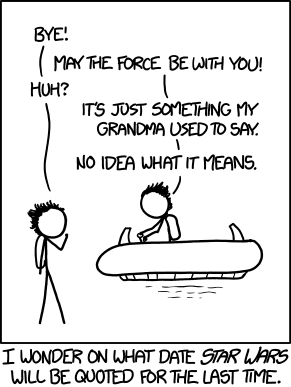
This is brilliant

Anyone who thinks seriously about cultural history will probably love this.


Thanks to xkcd!

Wednesday, September 11, 2013

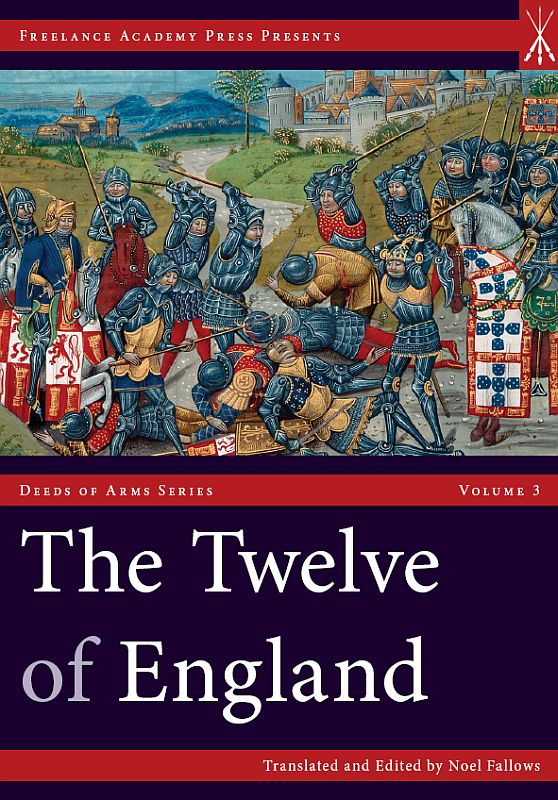
Twelve of England


The Deeds of Arms series, which I edit for Freelance Academy Press, has just issued its third volume, the Twelve of England. This is perhaps the most famous chivalric story in the Portuguese tradition, and the volume was prepared by the leading scholar of Iberian chivalry, Noel Fallows. I am very happy that I had the chance to work with him. Those who want to know more can look here:

Thursday, September 05, 2013

Le Tournoi de Chauvency

Back around the end of the 13th century, the poet named Jacques Bretel wrote a semi-satirical account of a tournament, Le Tournoi de Chauvency. It was a real event and the poem features real people. Alas for me, the focus was not on the fighting, but on the audience and attendees, and how they contributed to what was a big, expensive and lighthearted celebration. For instance, the poem is hardly started when it begins making fun of people's accents, showing named figures protesting that their French is as good as anybody's. In another section, prominent ladies are shown singing songs appropriate to the occasion. I've always wanted to read the poem, but the language is old enough that I have put off tackling it.

But if you want to read about the poem, there is now this detailed treatment, just recently reviewed in The Medieval Review (but not yet on their website):

Chazan, Mireille, and Nancy Freeman Regalado, eds. Lettres, musique et société en Lorraine médiévale: Autour du Tournoi de Chauvency (Ms. Oxford Bodleian Douce 308). Series: Publications romanes et françaises. Geneva: Droz, 2012.  Pp. 583. Euros 78.00 or $96.00. ISBN-13: 9782600014656.

And if you want to hear a musical composition based on the poem there is this on YouTube.

Armies of Heaven, by Jay Rubenstein

This book presents itself as an argument that the first crusade was both inspired by apocalyptic thinking – the conviction that humans have entered a part of history where their actions take on cosmic significance – and also promoted that kind of thinking.

Jay Rubenstein's book does that, but the reader who expects an unwavering focus on apocalypticism may be disappointed. A great deal of Armies of Heaven is devoted to a rather detailed narrative history of the crusade. On the other hand, for a lot of readers this may be a virtue. Rubenstein does a good job of telling the basic story.

Recent scholarship has tended to focus on religious motivations for going on crusade, dismissing the idea that people went to Jerusalem for profit and self-advancement. Reading Rubenstein's book, devoted to the emergence of apocalypticism, has the perhaps paradoxical effect of showing that there was a real struggle between ordinary, greedy, ambitious warlordism and the more abstract motives of those most devoted to bringing on the final days. There are plenty of non-apocalyptic motives out there.

In an earlier blog post, I drew attention to the fact that Pope Innocent III in the early 13th century used the idea of crusading to attack any disobedient or unorthodox target, in Europe or in the Middle East. Somewhere in this book Rubenstein quotes people considerably earlier than Innocent saying much the same thing. "We have beaten the infidels in the Middle East, but have not yet been able to do something about the heretics and schismatics out this way."

You can hear Rubenstein being interviewed at New Books in History.

Wednesday, August 28, 2013

Intervene in Syria?

I have been following Joshua Landis at Syria Comment since before the Civil War broke out in Syria, and I found him to be a sensible guide. Here is what he says now.

How the combat worked at the Red Knight's Deed

Some of you will be interested in this.

Almost all the weapons, pole axes and spears apart, were steel weapons, rebated in some cases.

There were two types of combat: unarmored and armored.

In unarmored combat, the fighters wore armor on heads necks hands and lower arms and generally some type of gambeson or pourpoint on the body. The vast majority of the pieces were in medieval style, though there were some modern fencing masks.

In unarmored combat, a distinct touch to any part of the body was sufficient to end the pass. The first combatant to win three passes won the whole combat. As one might expect, thrusting predominated as a tactic, and hands were a favorite target.

In armored combat, there were three different kinds of fighting. There was what was called "outrance" where the first combatant to strike a good blow against a gap in the armor won the combat. Good blows had to be delivered to a lightly armored area or a gap between plates. Plate armor was proof against a thrust or a blow of the sword. Grappling and throwing one's opponent was allowed in this style and in no others.

Second, there was what was called "plaisance" where each fighter was allowed to throw 12 blows against his opponent with no breaks in the action. Victory was judged by the Herald/marshal, and the Duke, Duchess and ladies.

Third, there was an unnamed type of combat in which the first combatant to strike three good blows against his opponent won the match. There was a break after each could blow.

In most situations combatants judged the effect of blows on themselves, but final judgment rested with the presiding authorities. For instance, if two fighters grappled and fell to the ground, as presiding judge whether one of the two had had sufficient control to claim victory.

Monday, August 26, 2013

Deed of the red knight

As many readers know, I have been participating in the Society for Creative Anachronism for decades. One of the things I have done in that time is designed and run medieval – style tournaments. So my scholarly work on formal combats ( deeds of arms) has been paralleled with attempts to re-create, for fun and for interest, various kinds of formal combats. The distinction between running an SCA event that has some pretensions to a medieval atmosphere and running, either in SCA context or elsewhere, something closely modeled on an actual medieval event may be a little bit fuzzy, but let it suffice to say that I've tried to get closer to medieval exemplars as time goes along.   Christian Cameron, novelist and reenactor, has similar ambitions and this past weekend I was privileged to take part and indeed help design an effort at re-creating late 14th century formal combat. Christian wanted to experience a close reenactment to help him understand and write about such an event in one of his upcoming novels, part of a Red Knight series. He also wanted to invite some of the most interesting reenactors he knew to a special party. Did he ever succeed! Christian happens know some very creative people, and also has access to a lakefront property of great beauty in Prince Edward County, Ontario. So this past weekend, some serious but fun-loving folk showed up with pavilions, armor, and civilian costume of the highest level. He asked Cole Cioran and I, who ran a Roland-inspired deed at the Pennsic war about 10 years ago, to come up with a usable and satisfying set of rules and competitions that would appeal to Western martial arts aficionados, historic reenactors, and serious SCA people. We were also given the task and the authority to manage the fighting aspect. Cole was the chief Herald and the marshal of the lists, while I played "the Duke," a presiding noble who with his Duchess Judith, (in real life the owner of the site and a most gracious patron) acted as the final authority as to what took place in the lists. Duchess Judith and I also, with the jury of ladies, gave awards and honorable mentions to the fighters who were the most impressive. These were satisfying roles to play, especially considering the quality of the competitors and their general good attitude and desire to re-create a chivalric deed of arms. Duchess Judith, whom as far as I know has no experience with such events, turned out to be an enthusiastic and sensible contributor to the action. Besides the combat in the lists, there was also archery and a rather marvelous feast prepared on the spot in a rather wonderful outdoor kitchen which is a permanent part of the site. As we ate we were entertained by the Schola Magdalena, who performed 14th century choral music at the highest level of skill and beauty. But the greatest pleasure was simply being there overlooking Lake Ontario and chatting and drinking with like-minded happy people. And there were no disasters, thank heaven. Even though I was there as an experienced hand, in one sense I was a complete novice. I had never before seen that much combat with steel weapons, nor such a large group of people using actual armor for actual protection. SCA style combat has its virtues, but here it was steel (mostly) swords against (almost entirely) mail and plate. Impressive. I may have more to say about it in a bit


Image: Cole at work.

Thursday, August 22, 2013

Boucicaut the younger, another medieval nut case

Boucicaut the younger, as readers of my book Deeds of Arms know, was one of the most prominent fighters of formal combats in the late 14th century. He was, for instance, one of the three French champions at St. Inglevert. His performance as a bold champion raised his profile to the point that he was made a marshal of France, a high command position, by the age of 25. Some people thought him a great hero, obviously, and in his later life there was an entire book written to show that he was an exceptional figure. But I've always thought that he was a military disaster for France, since he was one of the commanders in two of the greatest defeats France suffered on either side of the year 1400, the battle of Nicopolis and the battle of Agincourt. Seems that the people associated with the Chronicle of the Good Duke shared my doubts, back in 1429. See this passage from the account of the crusade to North Africa, just after St. Inglevert.
...it happened that Boucicaut took his turn at the watch, which was always ordered between the Army and the Saracens. Boucicaut was a chivalrous man who went to seek a skirmish where he was, through some interpreter asking whether there was any Saracen who wished to combat him on foot or horse. They replied no. Then Messire Boucicaut asked that if they wished to perform arms 10 against 10 or 20 against 20 he and his company would be ready. So the Saracens responded no, not if the Kings their Lords did not want them to. When Boucicaut saw their refusal he said to them that he would fight in a secure field, 20 Christians versus 40 of their Saracens. As long as this conference lasted it was ordained that they should not make war on each other. And scarcely were these Christian and Saracen negotiators together this astounded the Duke of Bourbon, the Lord of Couci, the count of Eu, the souldich of Estrau, and the other barons, for the whole Army ran to this assembly so that the Lord of Couci, the Count of Eu and others, who saw the Army taking leave of its senses, said to the Duke of Bourbon, “Monseigneur, the people run like beasts over there with Bouicaut and they are not able to keep guard and it seems to us that if you do not order some to retreat, things will turn out badly for us.” Then replied the Duke of Bourbon: “I can’t then send a better message, I’ll go there myself.” So he asked for a mule he always had...
So the Duke mounted his mule left his tent and went off with the people of his household. It was not long before more than 300 gentlemen were following him. The Saracens saw that the Duke of Bourbon whom they recognized by his coat of arms, came to join Messire Boucicaut with many men at arms, and began to retreat towards their tents, and Boucicaut and those with him to chase them. And Boucicaut who saw the Duke of Bourbon coming, gave himself over to pride and chased the Saracens more boldly and the Duke of Bourbon with his company went after to bring about a retreat. When Boucicaut was at the tents, the Moorish Kings and their Saracens put themselves in formation for battle outside their lodgings, and Boucicaut put himself in battle formation with his, awaiting the Duke of Bourbon and those who came with him. And the Duke of Bourbon caught up with those whom he wished to make retreat, and he very violently spoke to Boucicaut, concerning his great follies.

In some of the accounts of deeds of arms I've read there is lurking behind the heroic account a group of people who think that a given deed was presumptuous and foolish. Here the critics come out in the open. It would be interesting to know what "chivalrous" meant to the author and his audience.

Wednesday, August 21, 2013

Ta-Nehisi Coates writes "How I met your your mother"

An excerpt from the Atlantic:
But mostly I am thinking of you. I want to tell you that I have fallen for Paris. I think you know. I think you know because I am stupid and I am cliché. A serious man should should fall for some village in Moldova, for brandies made from magic apples, or ham taken from a rare and endangered hogs. A serious man should claim to have discovered Nashville, should live in Austin before it is Austin, then leave with tales of the edgy old days. I have been told that serious men are buying homes in Detroit. But I love chicken fingers. And I have never been to Foxwoods or Vegas. And I love New York against my better wishes. And I love Paris with that same familiar feeling--aching, everywhere and thin.

What I am telling you is that you do not need to know to love, and it is right that you feel it all in any moment. And it is right that you see it through--that you are amazed, then curious, then belligerent, then heartbroken, then numb. You have the right to all of it. You must want to own all of it. We will try to ward you away. We will try to explain to you that we have already walked that path. We will try to tell you that we have made your mistakes. We will claim that we are trying to spare you. But you will see our greed and self-service hiding behind our words. You will see us ward you away with one hand, while the other still shakes at the memories. Here is the thing--you have the right to every end of your exploration and no motherfucker anywhere can tell you otherwise.

Tuesday, August 20, 2013

Canada as bad example

Australia is in the midst of an election where climate change is one of the biggest issues. Climate change is hitting Australia hard now. Guess what country embodies the fears of many political observers?
One of Connor’s biggest fears is that the country emerges from all this political upheaval looking something like Canada has under the anti-environmental government of Conservative PM Stephen Harper.

“I look at Canada as a similar country, and it is my nightmare,” Connor said. “Australia can easily become an international pariah, we are very good at derailing international negotiations as an effective middle power and vicious defender of self interest. Some of the Coalition have been to Canada and seen how they get away with walking away from Kyoto and exploiting the tar sands.

“The transition away from fossil fuels is a very hard one culturally, socially and economically for Australia to make,” Connor continued. “We are on the knife edge of walking backwards or moving forwards in sensible way.”
Canada, nightmare.

My new e-book, Formal Combats in the 14th Century

My first e-book is now available through Amazon and soon through Barnes & Noble. It is called Formal Combats in the Fourteenth Century and consists of three chapters adapted from public presentations I gave over the last 10 or 12 years. If you have already read the book Deeds of Arms you may not need this book, though I think there is enough original material in it that you may want it anyway.

http://www.amazon.com/Formal-Combats-Fourteenth-Century-ebook/dp/B00ENVKYE4/ref=sr_1_5?s=books&ie=UTF8&qid=1377005126&sr=1-5&keywords=Formal+combats

For the American edition.

This is a good introduction to my thinking about formal combats and has some good stories too.

Thursday, August 15, 2013

Bad times in Big Egypt -- Arabist.net

Short and not at all sweet: August 14 in Egypt in numbers Ursula Lindsey

Dead (according to Ministry of Health, and still counting): 525

Wounded: 3,500

Churches, monasteries, Christians schools and libraries attacked (Source) : 56

Days that Mohamed ElBaradei lasted as a civilian figure-head of the army-run "second revolution" before resigning in protest: 28

Other resignations: 0

Justifications presented by Egypt's non-Islamist media and political parties for the gratuitous murder of hundreds of their fellow citizens, and commendations of the security forces for their "steadfastness" and "restraint": too many to count

A longer analysis that feels right:

It only gets worse from here

Issandr El Amrani

You could ask a thousand questions about the violence that has shaken Egypt ... But the question that really bothers me is whether this escalation is planned to create a situation that will inevitably trigger more violence – that this is the desired goal.

The fundamental flaw of the July 3 coup, and the reason those demonstrators that came out on June 30 against the Morsi administration were wrong to welcome it, is that it was based on an illusion. That illusion, at least among the liberal camp which is getting so much flak these days, was that even a partial return of the old army-led order could offer a chance to reboot the transition that took such a wrong turn after the fall of Hosni Mubarak on February 11, 2011. This camp believed that gradual reform, even of a much less ambitious nature than they desired in 2011, would be more likely to come by accommodating the old order than by allowing what they perceived as an arrangement between the military and the Islamists to continue. Better to focus on fixing the country, notably its economy, and preventing Morsi from sinking it altogether, and take the risk that part of the old order could come back.

In this vision, a gradual transformation of the country could take place while preserving political stability through the armed forces.

...

Unfortunately, among the broad liberal camp in Egypt, those who entertained such hopes are in a minority. Even among the National Salvation Front, as its obscene statement praising the police today showed, most appear to have relished the opportunity to crush the Muslim Brothers and appeared to believe that other Islamists could simply choose to be crushed alongside it, kowtow to the new order, or be pushed back into quietism. It appears that much of the business and traditional elite – represented politically by the Free Egyptians and the Wafd Party among others – falls into that category. They are joined by the security establishment, or deep state if you prefer.

Over the last week there was much talk of divisions between this segment and those symbolically important liberal members of the government, such as ElBaradei, over whether or not to negotiate with the Brothers or break their sit-ins. The camp that eventually won does not just believe that the Brothers are not worth negotiating with. They want to encourage it in its provocative sectarian discourse, its supporters desire for violence, and the push as much as the Islamist camp as possible into being outlaws.

...

Their thinking is cynical in the extreme, not unlike Bashar al-Assad's push towards militarizing the political conflict he faced in 2011. They are willing to live with the violence, impact on the economy, and other downsides if it strengthens their own power and legitimacy.

...

In their strategy against the July 3 coup, the Brothers and their allies have relied on an implicit threat of violence or social breakdown (and the riling of their camp through sectarian discourse pitting the coup as a war on Islam, conveniently absolving themselves for their responsibility for a disastrous year) , combined with the notion of democratic legitimacy, i.e. that they were after all elected and that, even if popular, it was still a coup. On the latter argument, they may have gained some ground over time both at home and abroad. But on the former, they got things very, very wrong: their opponents will welcome their camp's rhetorical and actual violence, and use it to whitewash their own.

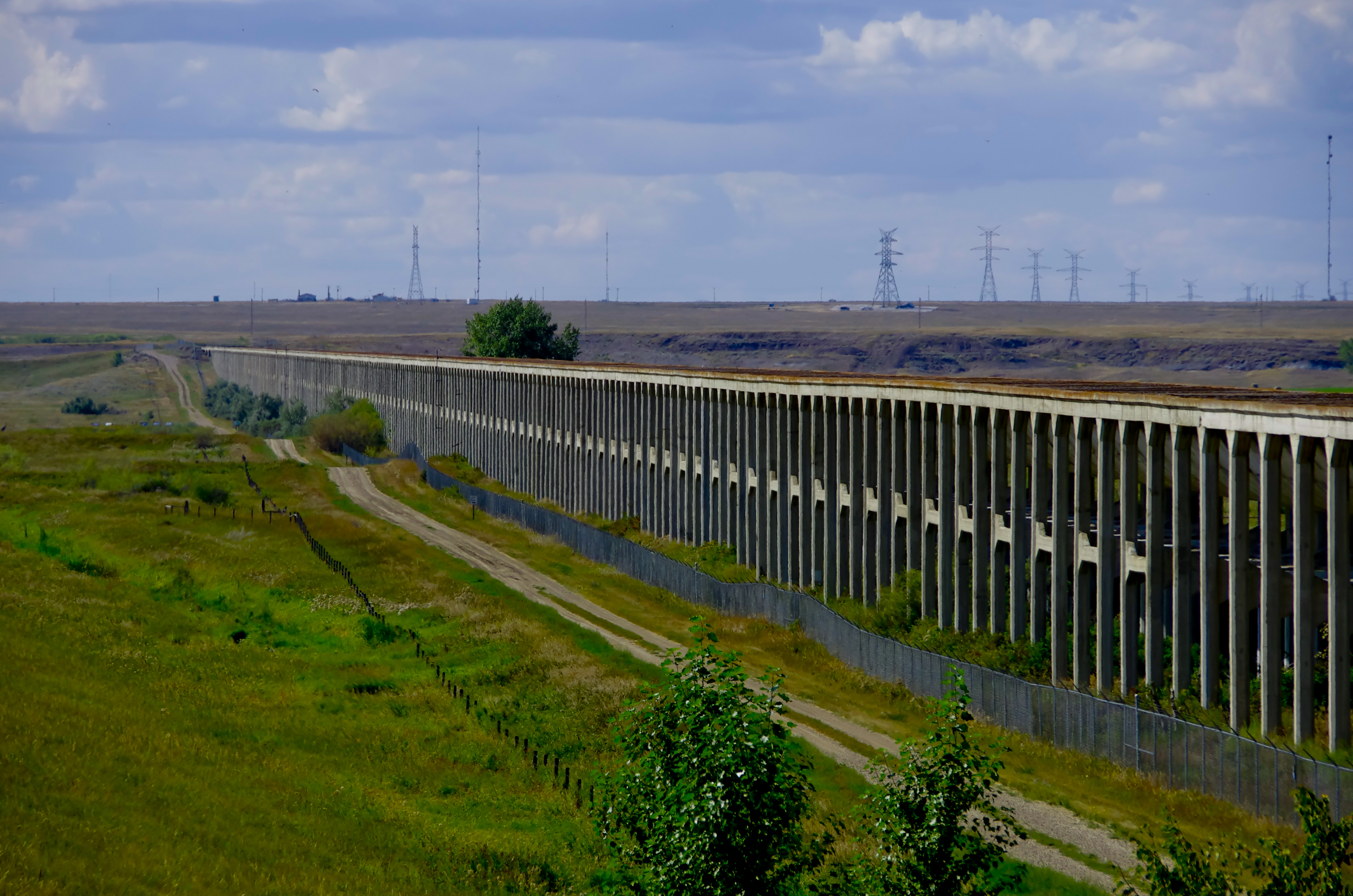
Another amazing but unknown -- to me -- piece of Canadian monumenal architecture

The Brooks Aqueduct in Alberta. Saw it this morning on a spot on an Alberta TV station. Its size is quite understated by this still photo.

Tuesday, August 13, 2013

What was the point of the Combat of the Thirty (1351)?

At this year's Pennsic war, as for several preceding this one, there was a reenactment of the combat of the  thirty, which took place in Brittany in the year 1351 during the first phase of the Hundred Years War. As every time before, the sides were not even. Despite a big discrepancy in numbers, the sides are not evened up. The combatants chose to stay with the signs they had chosen or had been recruited into earlier. I think this is rather odd, given that the whole point of the original combat of the 30 was to see who was better if sides were kept even and no outsider was allowed to intervene. To remind the SCA community of what contemporaries thought was essential to the event, I am reproducing here from my book The Combat of the Thirty, three contemporary and near contemporary descriptions of how the combat was arranged.  
Jean le Bel's account
How thirty French fought against thirty English and Germans by certain agreements in Brittany, and the English and the Germans were defeated.
In this same season, there took place in Brittany a most marvelous deed of arms which should never be forgotten
Messire Robert de Beaumont, a valiant knight of a great family in Brittany, was castellan of Castle Josselin, where he had a great many men-at-arms and squires of his lineage.  And it so happened one day that he came  near the  castle of Ploermel, whose castellan was a German mercenary called Brandebourch, who had with him a great many German, Breton, and  English mercenaries, and he was of the party of the Countess.
When Messire Robert saw that none of the garrison was coming out, he went to the gate and called out this Brandebourch, under a guarantee of safety, and asked him whether he had any companion, or perhaps two or three, who wished to joust with steel lances against three, for the love of their ladies.  Brandebourch replied and said to him, that their lady loves would hardly wish that they should get themselves killed in a single joust, for this kind of venture was over too soon, and in it one got more of a reputation for presumption and folly than for honor and worth.
"But I will tell you what we will do.  If you like, you will choose twenty or thirty of your companions  from your garrison, and I will choose as many from ours  and we will go to a field where no one will be able to disturb or prevent us, and command on pain of the noose to all of our companions on either side, and all those who watch us, that none should give the combatants reinforcement or help."
"By my faith," replied Messire Robert, "I agree to thirty against thirty, and I swear it thus by my faith."
"I, too," said Brandebourch, "swear it, for he who carries himself well there will gain more honor than in a joust."   And so this affair was agreed and an appointment was made for the following Wednesday, four days hence.
During that time, each party chose their own thirty, just as they wished, and each of the sixty procured such armor for himself as he was able.
When the day had come, the thirty companions of Brandebourch heard Mass and then armed themselves and left for the field where the battle was to take place.  And they dismounted and ordered all those who were there that none of them should be so bold as to intervene for any reason whatever.
Those thirty companions whom we will call "the English" waited a long time for those whom we will call "the French."
When the thirty French had come, they dismounted and commanded just as the English had done, that no one should give them help or aid.   Some say that four or five of the French remained on horseback at the entrance to the field, and that twenty-five dismounted, just as the English had; but I don't know for certain, for I wasn't there.   However it was, they spoke a little, all sixty of them, and then stepped back, each party to its own side, and made all their people retreat well back from field.

La Bataille de trente Anglois et de trente Bretons


[IV]
“ Brambro,” said Beaumanoir, “Know for certain
That all your boasts will avail you nothing.
Those who say the most in the end deceive themselves.
Now please, Brambro, let us do the smart thing.
Let us get together to fight, by appointment,
With sixty companions, or eighty or a hundred,
And then indeed we will see for truth and for a certainty,
Who will have wrong or right, without further ado.”
“My lord, “ this Brambro said, “I swear it to you!”

V

Will “Brambro,” says Beaumanoir, “for the sake of God the just,
You are a valiant man and a very shrewd warrior,
Come on that day without asking for delay
In a year one says many a word which one wishes to recall,
And one often makes great boasts over dinner.
Do not do to me what you did to Pierre Angier
That valiant, noble man, that gentle bachelor.
He chose a day for battle with you
At the town of Ambissat. And I have heard said
That he went to that place to acquit his oath
With twenty-six spurred knights
All accoutered in gold and steel.
And Brambro, you defaulted.  You did not dare to go.
This deed we are discussing, is a very great one.
You should not mock it! 
People will speak of it for a very long time!”
“Beaumanoir,” says Brambro, “For God’s sake let be!
For I will certainly be the first on the field.
With me will be thirty men, no more, no less,
Who will all be covered in good iron and steel.
I will not bring any villain, God give me aid!
The least of them will be a squire,
Bearing a coat of arms on his chest.”
But Brambro lies to conceal his plan,
So you do not imagine that he will bring
A bastard villain vagabond
Strong enough to carry, easily, a setier of beans
Over his neck, whose stomach was bigger
Than that of a courser.  Brambro, by his great fierceness,
Armed him this day.  Through him he thought
To avenge Dagworth, when he should have struck down
Such a villain deceiver.

I now will tell you of the noble Beaumanoir.
To Brambro he says, “I wish concerning this to go
To castle Josselin, to muster my men.”
“You go,” Brambro told him.  “I also wish to issue my orders
Through all the duchy.   I will assemble all
The noble English I can find.”
Thus was the battle vowed, that without cheating or fraud
They should fight it out in good faith
And on either side, all would be on horseback.
Pray then to the King of Glory, who knows and sees all,
That he will help those who have the right,
For this is the point at issue.

Androw of Wyntoun’s Account


The lord of Beaumanoir in battle
Manfully approached an English knight
That spoke of Frenchmen quite lightly
And would often say scornfully
“What, are not the English the doughtiest men
Though God may sleep in his den
Yet I think and I think it true
One Englishman is worth two French.”
Thus he often spoke until the day
This lord of Beaumanoir said to him
“You speak, sir, too freely
Men may perchance find near at hand
Men of such quality
As you may find in your country.”
The knight said, “Sir, by my faith
That I would like to  put to the test
Where we could fight with even sides.
And I would like to be one of them.”
Beaumanoir then was angered
And said to him, “You may find perchance
Your fill of fighting if you dare.”
“Yes, God willing,” said he, “I will be there.”
“Good sir,” says Beaumanoir, “perhaps
If you wish to put it to the test
I shall make the covenant.
You shall go home to England
And choose of the best men in your country
Until there be thirty-one
And I shall choose as many for myself
Of kin and friends here with me
And let us set here a certain place
To meet, and if God gives me grace
I will have victory with my retinue
If you shall be slain in the combat
Your ransom I will forgive you
I shall not ask for anything
And if you are taken to prison
Then shall you double your ransom to me.
So shall men see if French can deal
As fiercely with Englishmen.


Saturday, August 10, 2013

I had no idea

The Saguenay River, Quebec:


I was reading about it, and decided to look it up...

Thursday, August 08, 2013

Why the Middle Ages Are Important


This talk, prepared for a exhibit opening at North Bay's museum, was never delivered as written; I gave a much more informal presentation that involved talking about items and displays in the collection.  I just now stumbled across this script and I like it. 

May 24, 2008

@Discovery North Bay, opening of

"Once upon a time..."

I would like to thank @Discovery North Bay for the invitation to speak at today's opening.   Nipissing University was founded by citizens of North Bay and the surrounding region because they believed their home region could make an original and worthwhile intellectual and cultural contribution to Canadian life.  When the university and the community meet here on occasions like this, we are fulfilling the dreams of those founders.
Why are the Middle Ages important?  I don't have to argue today that they are important because the exhibit itself is proof enough.  It was not created by professional academic medievalists, but by museum staff who work with the public all the time, and their judgment was that people in Ontario want to know more about the Middle Ages.   If their own contacts with the public were not good enough, they could point to such recent films as the Lord of the Rings, or  the three different recent movie versions of Beowulf, or the wild success of the Da Vinci Code, book and movie both.  None of these modern cultural products show the Middle Ages as they really were.  They are all consciously or unconsciously legendary or mythological reworkings of medieval material.  Tolkien knew medieval literature better than almost anyone, and was a brilliant and original analyst of Beowulf, among other things, but when he wanted to talk to a contemporary public, he created a whole new world, similar to northern Europe in the Middle Ages but in many ways vastly different. And it's not just modern people who have reworked the Middle Ages to make a point.  The anonymous Beowulf poet didn't show his hero as a normal person in normal country in a normal time, but put him in a landscape full of monsters and superhuman challenges.  Thus when modern film directors mess around with Beowulf they've got good precedent.
But “Once upon a Time,”  even though its title  evokes the Middle Ages as a source of modern dreams, is not a mythological treatment.  Like scholarship in other forms, it tries to get behind the myths and legends and appreciate the people the Middle Ages in this case the later Middle Ages as the home of real people with real problems and real aspirations, who came up with solutions and created social institutions that are still alive in our own world.  “Medieval” is often used to  mean something like “unfathomable cruelty,”  a phrase I stole from Carl Pyrdum, a graduate student at Yale, but much that we are familiar with and value in the modern world originated in the Middle Ages.  The people who invented the phrases “dark ages” and “middle ages” meant to put down the postclassical era, and inspire people to build a better modern world to rival the great accomplishments of antiquity.  Yet we can hardly do without the heritage of the Middle Ages.  To take two examples relevant to Canada, both parliament and universities came out of the efforts of knights and warriors on one hand and clerics on another to improve their own society.   The original members of the House of Commons were knights, seeking effective and fair government, the original university students and teachers were members of the clergy, seeking to understand theology and law, universal and human order.  The Middle Ages created things so large that we hardly appreciate their medieval origins: in pre-medieval times there was no England, no France, no Poland, no Russia.  The Romans had fantastic public bathhouses but no mechanical clocks, yet by the end of the Middle Ages every important town in Europe had a public clock.  Think of Big Ben next to the British Houses of Parliament and not far from Westminster Abbey or the University of London and you think about our practical medieval heritage.

I hope you enjoy “Once Upon a Time…” which highlights some of the more striking and beautiful accomplishments of the Middle Ages.  But I hope you will take a moment, when looking at the artifacts and reconstructions, think about the people behind them:  the real medieval people who are the subject of the exhibition, and the real modern it's people who put it together for you.  You'll get a taste of the fascination of the Middle Ages today, but just a taste. I hope it will inspire you to look closer.  One thing about history is that no matter how good a given reconstruction is, there's always more.  Life is big and complicated and hard to describe.   “Once upon a time..." can be the end of your journey to the Middle Ages, but I rather hope there will be a beginning or perhaps a new beginning.

Friday, July 19, 2013

Insight re Crusade and Jihad

There were plenty of religious rivalries before 1096, and a great many were  Christian v Christian and       Muslim v Muslim. Like Syria or Iraq today.

Tuesday, July 16, 2013

Democracy in trouble

People in Egypt and elsewhere have expressed their concern about recent events in that country as indicating a breakdown in a commitment to democratic values and democratic institutions. The recent deposition of the democratically elected but increasingly autocratic president has divided Egyptians and observers alike. Was that deposition of Morsi necessary and justifiable or was it a strategic mistake in the long run, since electoral politics has been trumped once again by direct action, and the intervention of the Army? I think it is safe to say that many people don’t know what to think, given the unattractive alternatives.

It is easy enough to point out that Egyptians have not had much experience in democratic debate and dealmaking, with the result that an appeal to force or the threat of force comes too easily. However, a little bit closer to home for those of us in North America we are also seeing the erosion of democratic principles and practices.

First let us look at Canada. Our parliamentary institutions are based on 19th century practices and beliefs. Many of them are not really written down. Both parliamentarians and the general public have lost track of customs that worked very well in the 19th century but are not really understood today. Canadians strictly speaking do not elect a leader, a president, a Prime Minister, but a government which can command the support of the House of Commons. Ministers of the Crown hold that position as much through a relationship with the Crown as they do as partners with the Prime Minister. In principle they have a lot of independent authority. Thus the now obsolescent practice of ministers who have blown it big time resigning their position in Cabinet. They held the authority in the situation in question, and because they did not fulfill their role adequately, they felt obliged to quit. When was the last time this happened in Canada? Ministers no longer resign because of scandals and no one can really make them do so except perhaps the Prime Minister, because it’s an old custom that no longer is part of the political culture of either parliamentarians or the population at large.

Indeed an even more important principle has been lost track of in just the last few years. That is the idea that the Prime Minister and his cabinet only hold office when they can command the confidence of the House of Commons. Remember when Steven Harper was held in contempt of Parliament by majority of the members? And the Governor General let him get away with ignoring this and treating it as merely a partisan stunt? One can have a certain amount of sympathy for the Governor General who probably felt that if she fired Harper instead of letting him prorogue Parliament, she would enjoy no support whatsoever in the political class. She was right, but right here the Canadian Constitution broke down, and few people noticed or at least took it seriously. Our elections seem to have been transformed into something like a plebiscite on who makes the best Prime Minister. Canada has come to have something like a presidential system but without much in the way of countervailing institutions – with the important exception of the power of the provinces to resist the feds.

So our 19th century institutions are in a shambles because we don’t remember the 19th century principles that made them effective, and we haven’t replaced them with more recent principles and institutions. Close as we come is the tremendous power of the Prime Minister’s Office (PMO) which I’m pretty sure is not constitutionally defined institution at all.

If you look at the United States things are even worse. The United States has at least two governments, the publicly recognized one and the secret security apparatus. The security government does pretty much what it wants, while the publicly recognize government flails around, and fails spectacularly at dealing practically with real problems. See this recent article about the Republican tactic or attitude of devaluing legislation, at least on the federal level where there are many important fights that they can’t win. Compromise and dealmaking are out – just like in the 1850s! (Alarm should sound!)The dysfunction is not on the constitutional level, rather in the bizarre rules of the House and Senate that make sensible discussion almost impossible. These bizarre rules are not anything new, but when the will to discuss issues evaporates – well, anyone can see the result.


John Keane in his Life and Death of Democracy has pointed out that what we think of as democratic institutions – elections and parliaments – are really not sufficient to make democratic practice possible in the modern world. This is even more true of democratic ideas. Too many people in established democratic countries have no serious understanding of how the system might and could and should work, and the price they pay is its dysfunctional situation now.

More of the story of the Good Duke

Okay, when it came to writing down the story of the Good Duke decades later, who exactly was it who remembered that he took 2000 head of poultry and 200 pieces of salt pork on his expedition to Africa? And who thought it was interesting to include this material and why?

Saturday, July 13, 2013

Michael the Syrian says

Concerning the War of the Birds.
In 1434 of the Syrian Era [A.D. 1123], a great war of the birds took place. Cranes and storks assembled for many days in the country from Amida to Tellakum (T'lxum/T'e"lxam). Then they began sending emissaries back and forth for three days. After a good deal of this traffic, they commenced fighting from the third hour [g411] until the ninth hour, shrieking loudly the while. There was a great slaughter on both sides. The storks were defeated and fled, and the war ended. Only God knows the reason for this. 
More on this important chronicle and its new English translation soon. 

Wit and wisdom from Deep Space 9

Quark, a merchant and a predatory capitalist criticizes the chivalry of his time:

Do you know what I like about Klingon stories?… Nothing! Lots of people die and nobody makes any profit!

Friday, July 12, 2013

It's not the Arab Spring, it's the French Revolution (1789-99)

 From Foreign Policy:

This massive financial support follows on, and replaces, billions of dollars given by Qatar to the previous Muslim Brotherhood government. It is likely to prove equally ineffectual in delivering the desired payoffs, though. As Doha discovered to its dismay, money will buy only temporary love and symbolic returns. Whatever Gulf paymasters might hope, the new Egyptian government will be forced to respond to its own intensely turbulent, polarized, and dysfunctional domestic political arena. No outside player -- not Washington, Riyadh, Doha, or Tehran -- can really hope to effectively shape the new Egyptian politics for long.

Monday, July 08, 2013

Deadly economic myths

Over at Salon, Atkinson and Lind argue that simpleminded faith in economic myths is killing America.  

I say, not just America.

I particularly liked this passage:

Myth 3: The economy is a market.

In the world of Econ 101, “the economy” is usually treated as a synonym for “the market.” But an enormous amount of economic activity takes place outside of competitive markets dominated by for-profit, private firms.

In the industrial nations of the OECD, government spending at all levels on average accounted for 46 percent before the Great Recession. Even in capitalist countries, the government is usually the largest employer, and the largest consumer of goods and services in areas like defense, education and infrastructure. Other non-market sectors responsible for goods and services production include the household (your chores are economic activity too, even if Econ 101 ignores them) and nonprofits like religious institutions, colleges and universities, charities and think tanks like ours. Markets, then, account for around half of a modern nation’s economic activity — maybe less, if uncounted household production is as big a part of the real economy as some have claimed.

Sunday, June 30, 2013

The Forbidden City for the masses


That's what my reaction to my first day at Walt Disney World was.

By no means was this meant as a snobbish put-down. When it comes to Forbidden Cities, I am one of the masses.

Phil Paine on Metis democracy

http://academia.edu/1649062/The_Hunters_Who_Owned_Themselves

Saturday, June 22, 2013

You are history

A friend of mine wrote this perceptive piece.  An excerpt:
“I want to make sure we get everything back to where it belongs,” [An institutional librarian] said.
I nodded. “You know, you should get some deacidification spray and treat each page. Also, make a note as to when you drew them, and sign them.”
He looked at me like I was nuts. Deacidification spray is expensive. “Why, they’re just sketches for my own use.”
I smiled. “No, they are wonderful documentation of exactly how each of these rooms was arranged in early 2013.”
“So?”
“So now you use them, treat them, and then file them away in one of your flat files. They’ve just become part of the history of this place, and in a couple hundred years some researcher will delight in holding these simple drawings of yours.”
He looked down at the sketches in his hand. “Huh.”
"Yeah, you’re history.”

Friday, June 21, 2013

A Tribe Called Red

Contemporary Native Canadian music out of Ottawa as broadcast on CBC's Q.

Who has the heavy horses?

In the last generation, many medieval military historians have applied and adapted the idea of a military revolution to the era of the Hundred Years War. One element of that supposed revolution was the deemphasis of cavalry and new emphasis on infantry, especially infantry using projectile weapons. A few years back at the Kalamazoo conference there was a rather humorous session in which a well-known scholar felt it necessary to argue the cavalry was not completely useless, and he received a rather jocular reception.

Exactly how cavalry was used in the high Middle Ages, how useful it was, and how its role changed in the later Middle Ages and the early modern period is a difficult question, or series of questions. However, I feel on very solid ground to assert that horsemanship and fighting on horse back were considered by contemporaries to be an essential element of noble identity. A man at arms, a warrior of high standing, was a cavalryman, and – here's a practical note – was paid more than men on foot, gens de pie, were.

Here's another interesting story relevant to this matter. It comes of course from my favorite text, the Chronicle of the Good Duke, written in 1429 but in this case claiming to report an incident of 1388. Once again the Duke of Brittany and the Constable of France were fighting. The Duke had brought up a substantial army and the Constable was outnumbered. Here's what happened next, according (probably) to a survivor of this campaign, Jean de Chastelmorand.

The Duke of Brittany seeing the battle order of the Lord of Clisson told his men, "My lords and companions, see Clisson there, who has arranged his companies and desires nothing but battle. I would not refuse it at all. willingly but I see that he has put together a great wing of his men who are mounted on great coursers of superior quality. Our horses are small; those over there will come charge us and we will not be able to withstand them; and things will be the worse for us."
Some of my readers will know the catchphrase "who gets the horse?" that came out of recent discussions of Charny's questions. Here we have "who has the heavy horses?"

Update: somewhat later, the Lord of Clisson says something of this sort:

Beaumanoir will lead the remaining men of my household and I don't want you to have more than about 150 men at arms for you are plenty for 600 horses of Bretons. And I swear to God that the horse of the Bretons are worth nothing and it seems to me that you will not fail to find your adventure and you will be able to take it looking good and complete it.
 Further update:

When it came to the middle of the day, the Lord of Clisson said to his men, “My good Lords, you are well mounted, the horses of those over there are small; charge into these Bretons and push them into the battalion of the Duke.” And they did it just so and in this melee both a good 100 Bretons of the Duke’s party were killed and a good 100 horses gained; 

Thursday, June 20, 2013

Secret History of the Bill of Rights

This Salon article reveals the messiness of early American constitutional history:
http://www.salon.com/2013/06/20/the_secret_history_of_the_bill_of_rights/

An excerpt:

Ironically, it is to the pressure of the slave-holding oligarchy on Virginia’s federal representatives that we owe the Bill of Rights. To be specific, in running for the first Congress in 1788 James Madison beat his rival James Monroe by only 336 votes out of 2,280. This near-death experience led Madison to do a classic political flip-flop, trying to co-opt his opponents by embracing their cause, the addition of a bill of rights to the Constitution. Pennsylvania’s Sen. Robert Morris sneered that Madison “got frightened in Virginia and wrote a book” — the amendments that became the Bill of Rights.
...
In introducing his proposed amendments to Congress, Madison acknowledged that his bill of rights was an incoherent philosophical and legal mess:
...
Madison’s bill of rights was a hodgepodge slapped together hastily to try to conciliate former opponents of the newly ratified federal Constitution.  This was a typical case of damage control by a reluctant politician trying to head off a more radical alternative by enacting a watered-down substitute. Madison would have been proud to be remembered as “the Father of the Constitution.” But he would have been appalled to be told that without his Bill of Rights the U.S. would be a tyranny. That was the rhetoric of the Anti-Federalists whom he reluctantly sought to appease.
History has vindicated the skepticism about bills of rights shared by Hamilton and Madison and a majority of the drafters and ratifiers of the U.S. Constitution. Mere paper guarantees of rights have never been enough to secure liberty, in periods when the public is panicked — think of Lincoln’s excessive suspension of habeas corpus during the Civil War, or FDR’s wartime internment of Japanese-Americans. And the American system of checks and balances has repeatedly, if belatedly, worked to check imbalances of power, as it did when Congress reined in “the imperial presidency” in the 1970s.
In the contemporary debate about civil liberties and government surveillance, absolutist civil libertarians routinely claim that “the Founders” viewed the Bill of Rights as essential to American liberty. But paranoid rhetoric about our allegedly tyrannical government is closer to the rhetoric of the Anti-Federalists who denounced the U.S. Constitution than to the thinking of the Constitution’s drafters, ratifiers and supporters. The real Founders thought little of lists of abstract rights, putting their faith instead in checks and balances and accountability through elections. In the spirit of the real Founders, we should be debating what kind of system of congressional and judicial oversight of executive intelligence activity can best balance individual liberty with national security — and we should leave anti-government paranoia to today’s Anti-Federalists.
Years ago when I was reading on the revolutionary movements in the late 18th-century, I also noticed that practically the only Americans to use the word democracy in a positive sense during the constitutional debates of the 1780s were white South Carolinans who saw their brand of local autonomy as a laudable democracy. These people were a tiny minority of slavers who controlled a large slave population.

Given the world's experience of political democracy up to that date – think the Greek polis – you can see why they thought that was a reasonable label.

Wednesday, June 19, 2013

Foreign Policy on democratic transitions

I have been reading the magazine Foreign Policy recently, and despite the fact that is understandably American-centric, it does tend to take a broader than usual view of world events.


2. On elections, "Fake it till you make it."
A clear lesson from our case studies is that elections -- even sham elections -- lead to greater success in the transition to substantive democracy. International observers often denounce flawed elections as meaningless attempts to dress authoritarian rule in the trappings of democracy, but elections can also sow the seeds of public expectations that over time blossom into democratic demands that cannot be ignored.
Mexico offers a great example of the unintended consequences of controlled elections. In the 1970s, the ruling Institutional Revolutionary Party took its quest for electoral legitimacy so far that when the loyal opposition failed to field a presidential candidate in 1976, the government revised the election laws to make it easier for the opposition to gain a few seats. To the party's surprise, when the economic crisis of the early 1980s hit, the opposition was able was able to use this opening to marshal civil society organizations in a campaign for more transparent elections.
In Brazil, the military regime likewise tolerated an opposition it believed it could control. But as economic crisis led to widespread discontent in the early 1980s, the military began to lose its grip on the political situation. Having won their place in the political arena, the opposition was now poised to win a surprisingly large victory in the 1982 elections for Congress and state governors. The earlier "rigged" election had set the stage for the military's downfall in the presidential election of 1986.
Other quantitative evidence confirms that authoritarian regimes with partial political openness are the likeliest to become more democratic, especially if they provide for multiparty electoral competition. So go ahead, support the vote, even if it's not perfect.
Of course, I am still waiting for the article that talks about the problems (!!!) in the United States and elsewhere, where democratic institutions are clearly failing. I have my own theory on this, which I hope to talk about soon.ff

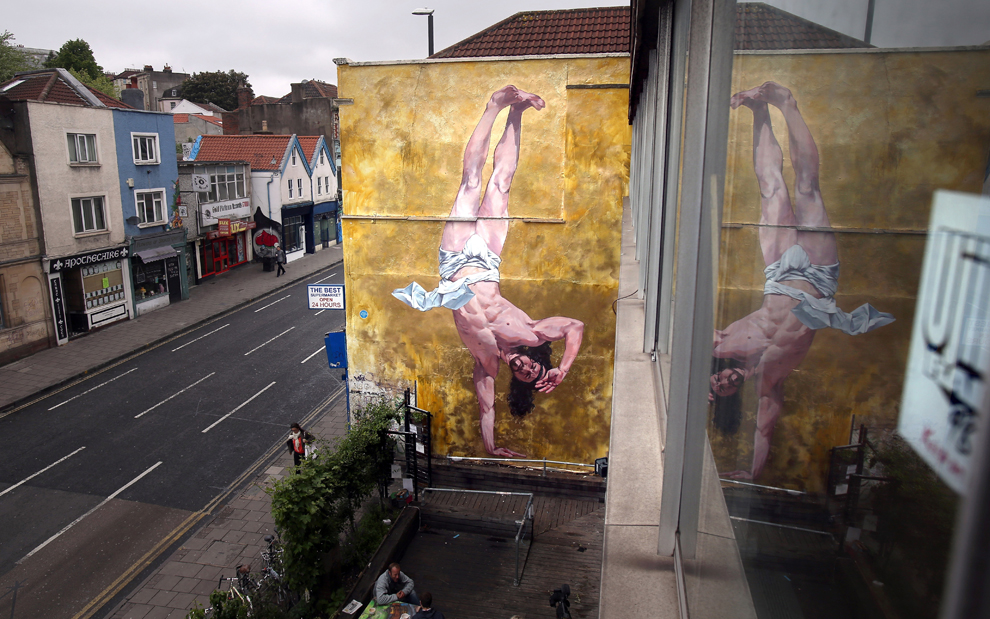
One of many walls in the world

Cosmo Sarson's mural of Jesus breakdancing on the wall beside The Canteen, Bristol, England.One of many great walls on this edition of The Big Picture.

Wednesday, June 12, 2013

The Good Duke speaks

Duke Louis of Bourbon proposes a plan when he hears that the English army, besieging a Spanish city, is dying of disease:

Since they are dying, it would be a good thing to go help them to die some more.

Monday, June 03, 2013

A hillside settlement in Sichuan


George RR Martin, master storyteller

This blog post is dedicated to the proposition that George RR Martin is objectively a major figure in the literature of the early third millennium.

I speak as someone who has read the Ice and Fire books, some of them more than once, but has not been following the TV series week by week. I like many others have criticized Martin in the past for brutalizing his readers and for letting his story grow uncontrollably as he follows many many characters at greater length. I like others have before me the terrible example of Robert Jordan, another author wrote a huge fantasy series but died before he finished it. Pictures of George RR Martin made me think he doesn't follow the healthiest of lifestyles.

Nevertheless, George RR Martin has become a major force in contemporary storytelling. Four times now he has made thousands, indeed millions, scream.

Some years ago, the book version of the death of Ned Stark shocked thousands of fans, many of whom rushed to log on to fan forums and express their passionate response.

Some years later, readers had a similar reaction to the Red Wedding in its original written form.

The TV version of these events have motivated millions to express themselves, to the point that some people said that last night the reaction to the video version of the Red Wedding "broke the Internet."

Anyone who can do that is a master storyteller.

(This may seem to undervalue the contribution of screenwriters, directors and others in the TV version of Game of Thrones, but my reading of interviews with the actors convinces me that they see themselves as following Martin's vision.)

Now this may all be a flash in the pan. There are other TV series that are making a big impact, getting serious discussion in other media, being lauded as cultural touchstones of our era. But I feel it necessary to admit, publicly, that Martin is really something.

Sunday, June 02, 2013

Good news from Iraq

The marshes are coming  back!

http://www.bbc.co.uk/news/magazine-22706024

The BBC article shows a town hall made of reeds, just like in the old, old days.