
Here's a German view of the situation in Afghanistan. It's not very cheery.
 Students in HIST 1505 already know this, but I thought others would be interested.
 I've just discovered a site called The War in Context, a collection of up-to-date news and analysis from a variety of sources.
 I have a long-standing interest in the history of democracy as a world phenomenon. What I've written on this subject has been done in collaboration with Phil Paine.
The fact that Prime Minister Thaksin just happened to be the richest man in the country makes it plain that his regime was "democratic" in name only. That is not what happens in genuine democracies. It is clearly no real loss to the world democratic movement that he has been ousted, even though the precedent of military action is extremely damaging. But Thailand is still left in the position of having no real democratic infrastructure.What is a democratic infrastructure? It is local democratic institutions well-integrated with higher levels of government:
In a functioning democracy, a head of state gets into their role by working their way through layers of public service, until they have proven themself responsible to larger and larger electorates. The most successful national democracies were built on foundations of democratic process on the local level.
The existence of such shell democracies or mock democracies is more of a hindrance to evolving functioning democracies than outright dictatorship. With a crude dictatorship, the problem and the alternative are clear. With shell democracies, ordinary people are left with the impression that this kind of "big man" autocracy is what the word "democracy" is supposed to mean, and so the idea of democracy itself falls into disrepute.
 Thursday October 12 (Study Week here at NU) I will be in Toronto speaking to the Friends of the Medieval Studies Society of the Royal Ontario Museum.
 I must have been pretty busy this week to miss commenting on "Lucy's baby," the most important find relevant to human origins in quite a few years. I always talk about this stuff in connection with HIST 2055, Ancient Civilizations. If this announcement had been made this time last year, it would have been quite a treat to bring it into the classroom.
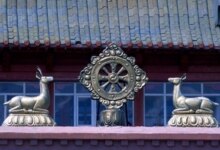 In both World History and Islamic Civilization we've discussed nomads and their environments. Here's a story from Radio Free Europe/Radio Liberty -- one of the best news services around -- about the collapse of populations of saiga antelopes in Central Asia.
 There are two kinds of students: those who know where the money is, and those who don't.
 Miland Brown of the World History Blog is hosting the latest Carnival of Bad History. Check it out!
 In a comment to my post entitled What You Can Look Like at 41, Phil Paine seconds my remarks on the historical significance of public health measures and says:
People like Dr. John Snow, who discovered the link between water delivery systems and cholera, and who fought heroicly against established powers to institute the necessary legal and technological solutions, will someday be regarded as the true giants of history.

The 13th century records of the English Hotot family preserve a story of one of their ancestors, Dionisia, who “when a maiden, clad in a tunic, with a hat upon her head and armed only with a hollow shield, about the seventeenth year of King Stephen (1151) …attacked a certain knight, with one blow of her spear bringing him to the ground, and carried off his horse.” Edmund King, ed., A Northamptonshire Miscellany (Northampton, 1983), 8.This from my Deeds of Arms, p. 3 n. 5.

