 Easy walking distance from the hotel (near Paddington Station) and even more interesting than this picture
Friday, April 30, 2010
Little Venice, London
Easy walking distance from the hotel (near Paddington Station) and even more interesting than this picture


News from Iran
Sitting in a London hotel I read The Fear Factor: a piece in the Independent on a profoundly divided society.
Wednesday, April 28, 2010
I'm off!
 If things work out and the volcano don't rise, I'll be flying today to the UK for another Cornish walking holiday. Wish us safe travel and good weather, and no inconvenient vulcanism.
In the meantime I have left a few posts timed for various points in the next two weeks. I've chosen material that should have a sufficient shelf-life.
For those who might be curious, I plan on being at the Kalamazoo Congress around noon on the Thursday.
Image: Standing stones, in other words, stones that haven't fallen down yet.
Destruction of sites associated with early Islam
Brad DeLong suggests we have a look at this Wikipedia article, which gives a hint of the many divisions among Muslims, even on what would seem to be really important issues. It also says something about the unusual position of Saudi Arabia and its official Wahhabi form of Islam.
Tuesday, April 27, 2010
Breaking news for once -- Canadian government (can be held) in contempt of Parliament
Update: Title changed to reflect the somewhat ambiguous ruling of Speaker Milliken.
As per the ruling of the Speaker of the Canadian House of Commons, who gives the Government (the PM, his cabinet, and the Conservative caucus) and Parliament (the other parties in the Commons) two weeks to solve their conflict. And then? Doesn't exactly say!
Rough(?) quote from Milliken via the Globe and Mail.
Another update: Globe and Mail account, April 28.
As per the ruling of the Speaker of the Canadian House of Commons, who gives the Government (the PM, his cabinet, and the Conservative caucus) and Parliament (the other parties in the Commons) two weeks to solve their conflict. And then? Doesn't exactly say!
Rough(?) quote from Milliken via the Globe and Mail.
It is the view of the Chair that accepting an unconditional authority of the executive to censor the information provided to Parliament would in fact jeopardize the very separation of powers that is purported to lie at the heart of our parliamentary system and the independence of its constituent parts. Furthermore, it risks diminishing the inherent privileges of the House and its Members, which have been earned and must be safeguarded.Back to the Good Parliament...
Another update: Globe and Mail account, April 28.
Ship report: Quebecois
Ships have been moving on the river for quite a while, but I'm seldom in the right place to see them, and sometimes I can't read their names. A few days ago, however, I caught this one -- Quebecois.

Monday, April 26, 2010
Unleashed upon a waiting world -- Carnivalesque!
Bloggers with a particular interest in ancient, medieval or early modern history occasionally get together at the grand carnival called Carnivalesque. A carnival is one of those "Internet traditions" you sometimes hear about. Some hapless volunteer is dragooned into looking over recent contributions by her or his peers, and choosing the ones to recommend to everybody else. Carnivalesque comes out roughly monthly, and alternates between ancient/medieval material and early modern mostly European. Today Gill Polack, who claims to come from someplace more remote than Bonfield, Ontario -- a mythical antipodes? -- has put together a compilation of the earlier eras. Go read!
The comparative present
Thanks to Brad DeLong, from whom many good things come, I have just been alerted to the existence of the publication called Business Insider, which seems to have a real predilection for charts and lists illustrating current trends. This kind of thing can be either very useful or very deceptive, but I love it, even if a given example doesn't hold up very well under strict examination. Comparative material has a lot of potential to make people think, if they don't take the first analysis they see as the final word.
Business Insider first two lists of can which I found interesting. Some readers may remember that I am skeptical about alarmism in connection with demographic crises, especially crises of shrinking population. Business Insider offers us a list of 10 countries heading for a demographic crisis, and what is interesting here is that includes both countries with too much and too little population growth, and some detailed discussion of each. I haven't had the time to read it properly myself, but at least I think it will be worth reading.
The second list discusses 10 countries that have significant oil reserves and can be expected to pump away in the "distant future," long after places like Saudi Arabia have run dry. Of course it is hard to say what the world will be like then anyway, but the list does alert me to a couple of things. One, Iran has a lot of oil, and so will continue to be a "trouble spot" no matter what the ideology of the people in charge. Two, Canada is on that list, which I find quite alarming but not entirely surprising. I would rather not be a "trouble spot."
Business Insider first two lists of can which I found interesting. Some readers may remember that I am skeptical about alarmism in connection with demographic crises, especially crises of shrinking population. Business Insider offers us a list of 10 countries heading for a demographic crisis, and what is interesting here is that includes both countries with too much and too little population growth, and some detailed discussion of each. I haven't had the time to read it properly myself, but at least I think it will be worth reading.
The second list discusses 10 countries that have significant oil reserves and can be expected to pump away in the "distant future," long after places like Saudi Arabia have run dry. Of course it is hard to say what the world will be like then anyway, but the list does alert me to a couple of things. One, Iran has a lot of oil, and so will continue to be a "trouble spot" no matter what the ideology of the people in charge. Two, Canada is on that list, which I find quite alarming but not entirely surprising. I would rather not be a "trouble spot."
Applying a classic political idea to a current controversy
Every so often on the Internet, someone uses a well-known historical incident or classic argument well enough to shed light on what was interesting about the original situation or controversy, better perhaps (perhaps!?) than the usual textbook explanation. Or a blog post will open up a subject worthy of wider thought (again).
Thus in a frankly partisan but hardly outrageous piece at Slate, Ron Rosenbaum says: Don't ignore the Tea Party's toxic take on history.
Here's an excerpt:
Rosenbaum goes on to discuss the "stab in the back" myth that helped bring Hitler to power. Some people will cry foul. What I thought about, however, was not about whether Rosenbaum got it exactly right, factually or rhetorically, but about how inadequate history education generally is. You would think, given the emphasis on American history in the USA, that the Tea Party types would have a reasonable understanding of that history. But all too many seem to be modern Know-Nothings (part of American history that deserves more attention).
But maybe it's not a matter of education, as it is a matter of historical opportunism. Grab for the doctrine of Nullification (look it up) if it suits your needs, psychic or tactical, and forget about consistency.
Brad DeLong, an economist who clearly believes economics is or can be a philosophical pursuit, often reflects on what history has to say on a given issue, recently applied a classic thinker's arguments to whether the United States should pay historical reparations to the descendants of slavery. I think that this is a wholly impractical idea, and I've never been all that impressed with the 18th century liberal/conservative (he's called both) Edmund Burke. His positions on the issues of the day were all too often perfectly calculated to defend the interests of himself or his patrons. But he occasionally had a striking insight, as in his prediction of the rise of Napoleon.
Brad makes interesting use of a famous Burkean notion, that society is a contract across the generations, not just among the living. Definitely some problems with that, the devil being in the details. But this post shows the idea deserves to be taken seriously.
Worth reading and thinking about.
Thus in a frankly partisan but hardly outrageous piece at Slate, Ron Rosenbaum says: Don't ignore the Tea Party's toxic take on history.
Here's an excerpt:
Most people with a basic grounding in history find Tea Party ignorance something to laugh about, certainly not something to take seriously. But I would argue that history demonstrates that historical ignorance is dangerous and that it can have tragic consequences, however laughable it may initially seem. And thus the media, liberals, and others are misguided in laughing it off. And educated conservatives are irresponsible in staying silent in the face of these distortions.
The muddled Tea Party version of history is more than wrong and fraudulent. It's offensive. Calling Obama a tyrant, a communist, or a fascist is deeply offensive to all the real victims of tyranny, the real victims of communism and fascism. The tens of millions murdered. It trivializes such suffering inexcusably for the T.P.ers to claim that they are suffering from similar oppression because they might have their taxes raised or be subject to demonic "federal regulation."
Rosenbaum goes on to discuss the "stab in the back" myth that helped bring Hitler to power. Some people will cry foul. What I thought about, however, was not about whether Rosenbaum got it exactly right, factually or rhetorically, but about how inadequate history education generally is. You would think, given the emphasis on American history in the USA, that the Tea Party types would have a reasonable understanding of that history. But all too many seem to be modern Know-Nothings (part of American history that deserves more attention).
But maybe it's not a matter of education, as it is a matter of historical opportunism. Grab for the doctrine of Nullification (look it up) if it suits your needs, psychic or tactical, and forget about consistency.
Brad DeLong, an economist who clearly believes economics is or can be a philosophical pursuit, often reflects on what history has to say on a given issue, recently applied a classic thinker's arguments to whether the United States should pay historical reparations to the descendants of slavery. I think that this is a wholly impractical idea, and I've never been all that impressed with the 18th century liberal/conservative (he's called both) Edmund Burke. His positions on the issues of the day were all too often perfectly calculated to defend the interests of himself or his patrons. But he occasionally had a striking insight, as in his prediction of the rise of Napoleon.
Brad makes interesting use of a famous Burkean notion, that society is a contract across the generations, not just among the living. Definitely some problems with that, the devil being in the details. But this post shows the idea deserves to be taken seriously.
I reject the quitclaim deed [Henry Louis Gates -- see the original post] offers: just because there were people with skin of another color on another continent who aided and conspired with my ancestors in their crimes does not mean that I am quits of all obligations as I sit here still enjoying the fruits of their crimes.
This is the reason that when--back in 2003--Andrew Sullivan called me a:classic example of the arrogant liberal. He supports affirmative action and believes that individuals in 2003 bear a direct responsibility for those people who enacted slavery and made life a living hell for many black Americans in decades and centuries past...
I rejected Sullivan's critique. He was simply wrong. I was not and am not an arrogant liberal on these issues. Instead, the arguments that convince me (and that lead me to reject the quitclaim that Henry Louis Gates offers) are not liberal but conservative ones--Burkean ones, to be exact:
A liberal sees society as a result of a social contract implicitly made between all of us alive today: we agree to live by rules and laws that we then have a chance to rethink, remake, and reform. It's important that this social contract be fair to us. From this perspective, the questions "Why should recent Korean immigrants bear any responsibility for repairing the damage left by the marks of slavery and Jim Crow?" and "Why should African-Americans find their own capabilities and potential accomplishments still limited by the marks of slavery and Jim Crow?" are both very good ones. (Somehow Andrew Sullivan only asks the first, and never thinks to ask the second. But thinking about why would take us far afield.)
I begin from a different point, from the observations that we Americans alive today are all the recipients of an extraordinary and unmerited gift, an inheritance of institutions, principles, and organizations that is without peer anywhere on the world today and that is of inestimable value. We aren't independent liberal individuals making a social contract in the rational light of Enlightenment Reason. Instead, we are heirs who have received an enormous inheritance from our predecessors. As Burke wrote, we:claim and assert our liberties as an entailed inheritance derived to us from our forefathers, and to be transmitted to our posterity--as an estate specially belonging to the people.
It's not a contract, or if it is a contract it is not one just between those alive today. Again, as Burke puts it, if you are to think of a social contract you have to recognize that it is not:a partnership agreement in a trade of pepper and coffee, calico, or tobacco, or some other such low concern, to be taken up for a little temporary interest, and to be dissolved by the fancy of the parties.... It is a partnership in all science; a partnership in all art; a partnership in every virtue and in all perfection. As the ends of such a partnership cannot be obtained in many generations, it becomes a partnership not only between those who are living, but between those who are living, those who are dead, and those who are to be born.
But estates that are inherited come not only with assets, they also come encumbered with debts. If we are to be Americans--if we are to take up the wonderul unmerited gift, accept the marvelous entailed inheritance that is offered to us--we must take up not just the benefits and advantages, but also the debts that America owes from its past actions as well. To do otherwise--to ignore the debts while grabbing the goodies with both hands--is to show that we are not the true heirs of Benjamin Franklin and company. And chief among the debts that America owes from its past actions is the obligation to erase the marks left by slavery and Jim Crow....On many issues I am an arrogant liberal. But not this one. On this issue, I'm an arrogant conservative.
Worth reading and thinking about.
Sunday, April 25, 2010
Dead Kennedys’ Plastic Surgery Disasters and Christian-Muslim relations in Early Medieval Spain

If you are one of those people who comes here looking for insights into obscure medieval topics, I am afraid I've got nothing for you today -- except, of course, something from Jonathan Jarrett, who is trying to interpret a ninth-century theological treatise written in Muslim -ruled Cordoba, Spain.
And if you want to know what the Dead Kennedys have to do with this, you'll have to read not just the post but the footnotes.
Image: the martyrs of Córdoba at the Last Judgment.
Saturday, April 24, 2010
Madison Square Park, New York, c. 1900
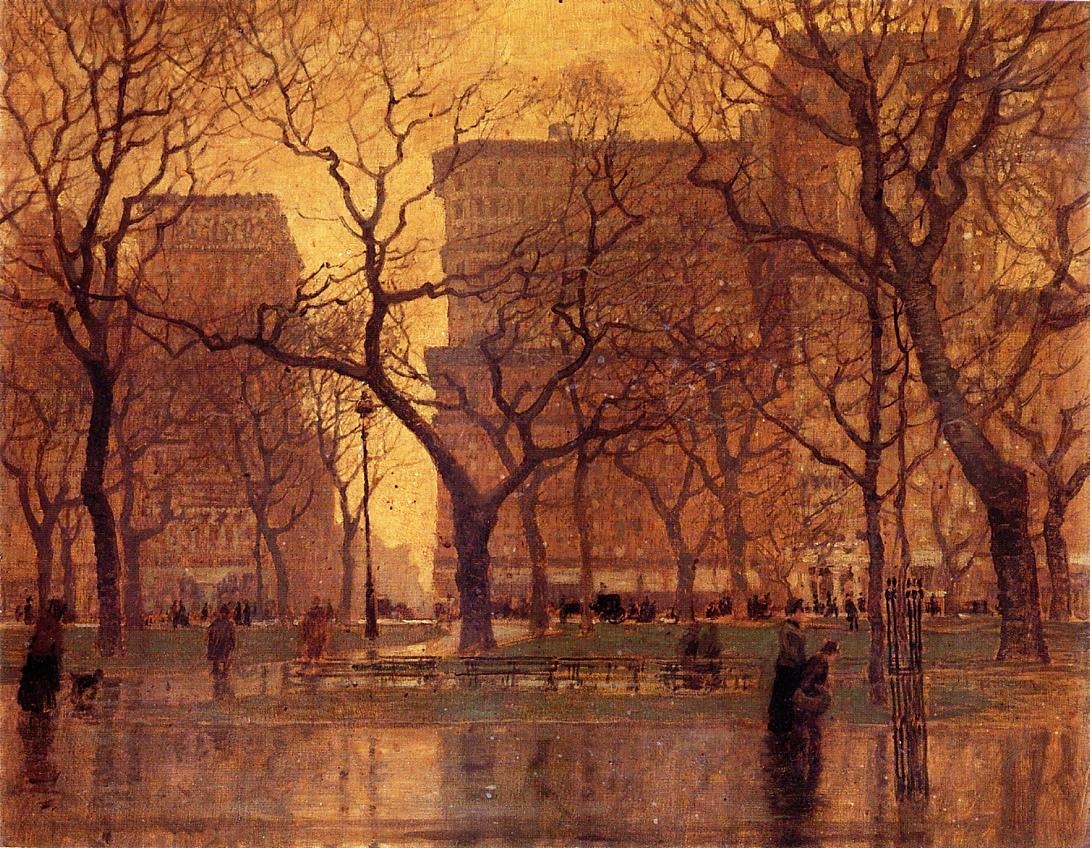
From the blog Ephemeral New York. Check it out for images and stories.
Painting "After the Rain" by Paul Cornoyer. Click to see a much larger version.
Friday, April 23, 2010
Coffee shops: Iran's aboveground underground
Trying to find some psychic elbowroom in Tehran's 'Islands Of Forgetfulness:'
While making an espresso Mehrdad [the shop owner] continues: “The present culture of drinking coffee came from university students wanting to stay up for exams, although drinking Turkish coffee was not uncommon in households, especially if it was followed by fortune telling.”
I hear a giggling sound from the table behind me and as I turn I realize that one of the girls has an upside-down cup in her hand, one of the rituals of reading the coffee grounds....
“The majority of customers are lovers, be it a girlfriend-boyfriend couple, a mistress or a lover, fiances, newly married couples, or just interested parties needing a place to sit, look at each other and talk over a coffee," Mehrdad says.
Music Sharing
A young man with a strange hairdo (strange that is to the norms of Iranian society) then came to sit at our table.
His name was Bahador and without hesitation he starts to promote his music. “We've produced this CD ourselves. It's a rock album that has got some air time in San Jose. It would mean a lot to us if you purchase it and support our underground production,” he says.
As I was paying for the original but illegal CD (not bootlegged but illegal because this kind of music is prohibited by the government) Mehrdad whispers, “This is the second group of coffee-shop customers: artists, musicians, writers, and intellectuals.”
“There are no ways and no places for musicians whose work is not approved by the government to promote their music," Mehrdad says as Bahador left our table.
Thursday, April 22, 2010
The (American) Middle East Peace Religion
This Foreign Policy article by Aaron David Miller is about official American priorities, policies and assumptions. These are important things to know about, but not to be mistaken for an overall analysis. Still, some readers may find this useful. I liked it for illustrating how perspective changes over time, since I can remember every event mentioned here.
An excerpt:
An excerpt:
On October 18, 1991, against long odds and in front of an incredulous press corps, U.S. Secretary of State James A. Baker III and Soviet Foreign Minister Boris Pankin announced that Arabs and Israelis were being invited to attend a peace conference in Madrid.
Standing in the back of the hall at the King David Hotel in Jerusalem that day, I marveled at what America had accomplished. In 18 months, roughly the time it took Henry Kissinger to negotiate three Arab-Israeli disengagement agreements and Jimmy Carter to broker an Egypt-Israel peace treaty, the United States had fought a short, successful war -- the best kind -- and pushed Iraq's Saddam Hussein out of Kuwait. And America was now well-positioned to bring Arabs and Israelis across the diplomatic finish line.
Or so I thought.
Baker, who lowballed everything, was characteristically cautious. "Boys," he told a few of us aides in his suite after the news conference, "if you want to get off the train, now might be a good time because it could all be downhill from here." But I wasn't listening. America had used its power to make war, and now, perhaps, it could use that power to make peace. I'd become a believer.
I'm not anymore.

Wednesday, April 21, 2010
Student blog competition at Nipissing University
Nipissing University sponsored a student blog competition this past term, and the winners have just been announced. If you want to see life at NU from other perspectives, go here for links to the top three.
Tuesday, April 20, 2010
Sabbatical score so far -- update 2

I have not updated my sabbatical score since early November. That's about the time a lot of things went out the window. Nevertheless, I have got a lot done since November. You can add this to the earlier list.
- I have -- some time ago actually -- finished a first draft of my translation and commentary on Charny's Questions on War. (Don't be too impressed, it's a short study.) Right now the draft is out with an informed reader who I have asked to find the holes in my presentation.
- I have just finished the paper I will be presenting at Kalamazoo's International Congress on Medieval Studies. It concerns the Chronicle of the Good Duke. The paper may not be really done -- ask me in a few days -- but I could stand up and deliver it now with a good conscience and without dread, if I had to.
- I've also translated a good third of the Chronicle -- about 110 pages in the printed edition.
Image: Someone else's messy pile of books.
Medieval soldiers' profiles
Once upon a time the scholarly site The Soldier in Later Medieval England had a feature called Medieval Soldier of the Month. It's now called Soldier Profiles. Highly recommended, especially to students who take my 2010 fourth-year seminar on chivalry and medieval men-at-arms.
Monday, April 19, 2010

Subscribe to:
Posts (Atom)