Saturday, October 17, 2009

What's happening in Pakistan?


The Independent out of the UK has the best connected account I have seen.
Note this passage:

Ordinary Pakistanis have been left bewildered [by recent terrorist attacks], unable still to believe that the danger comes from within the country.

"Only God knows where such people come from because I know that Muslims cannot kill other Muslims," said Mohammad Yousaf, a 55-year-old, who runs a tea shop near one of the police training schools in Lahore and spent several hours hiding instead his store Thursday as gunfire and explosions engulfed the area.

Image: Outside Army HQ after the attack on it this month.

Friday, October 16, 2009

Jokes Iraqis tell each other in traffic jams

From the McClatchy-affiliated blog written by Iraqi journalists, Inside Iraq.
Image: Baghdad traffic jam, 2008.

Review of The Medieval Cook by Henisch

From TMR, a great source for timely reviews:

Henisch, Bridget. The Medieval Cook. Woodbridge, Suffolk:
Boydell Press, 2009. Pp. 245. $47.95. ISBN: 9781843834380.

Reviewed by Gina L. Greco
Portland State University
grecog@pdx.edu


Studies of cookery in the Middle Ages, whether scholarly or popular,
have focused on the production and procurement of ingredients, the
preparation and presentation of dishes, and the organization and
conventions of meals. The Medieval Cook examines these same
topics from the perspective of the different women and men in the
kitchen--peasant housewives, street stall vendors, hired caterers and
master chefs. The result is an accessible overview of medieval
culinary practice that will entertain and inform the general public.

Chapter 1, "The Cook in Context," offers an impressionistic survey of
positive and negative attitudes towards cooks and their craft, culled
from a rich variety of sources including Latin exercise books, royal
account books, biblical commentary, Arthurian romance, plays, and
children's games, supported with careful secondary research. The next
two chapters, "The Cottage Cook" and "Fast Food and Fine Catering,"
present different types of amateur and professional cooks, the tasks
they performed, materials they used, and challenges they encountered.
Chapters 4 and 5 explore the diverse expectations and economic
realities cooks addressed, whether preparing meals for the immediate
household in "The Comforts of Home," or entertaining guests on a
lavish scale in "The Staging of a Feast." Throughout these chapters
Henisch continues to draw from an assortment of historical, literary,
and scholarly documents to illustrate her vignettes. The final
chapter, "On the Edge: the Cook in Art," canvasses visual
representations of cooks and their tools uncovered in the margins of
manuscripts, woodcuts, and sculpture. Notes are followed by a Select
Bibliography, Selection of Medieval Recipes, Suggestions for Further
Reading, and an Index.

Each chapter is divided into many short sections, one to seven pages
in length, the majority under four pages. These units, covering such
varied topics as "Hospitality," "Cook and Physician," "Methods and
Equipment," "Eggs," "Street Snacks," "Pie Makers," "Provisioning,"
"Crisis Control," "Economy and Discipline," and "Hell's Kitchen,"
offer the reader savory tidbits and easy entry into the world of the
medieval kitchen. Chapter titles, however, do not give adequate clues
to the content, and readers looking for a discussion of a particular
topic will regret that the table of contents does not outline these
section titles. While an adept user of the Index can navigate the
material, that task would have been greatly facilitated by a list. Of
course, these decisions are often based on a press's editorial
practice, and it is probably unfair to expect such detail in a volume
not intended as a reference work.

Henisch's focus on the cook as both historical person and fictional
character allows her to paint engaging, anecdote-rich sketches
appropriate for a book aimed at a general audience. However, this
organizational choice does occasion a certain amount of duplication
since in each different context--that of the home cook, the
professional cook, the family meal, the feast--many of the same topics
are by necessity revisited. In some cases, identical textual examples
and citations are fully repeated. For example, a reference to Gawain's
bleak mood when denied the pleasure of good food, including the direct
quote "ther he fonde noght hym byfore the fare that he lyked," is used
on p. 3 to illustrate the connection between food and mood, and then
the same the reference and quote reappear on p. 107 to make a similar
point. In a volume this short (200 pages of text, plus back matter),
the editor should have identified and eliminated such reiterations,
especially when the argument could have been supported by a fresh
quotation selected from a new source.

Another drawback to the book's structure is that the rapid movement
between brief chapter sections leaves little room for analysis, and as
a result there is no overarching argument to the volume. To be fair,
the author's stated aim is more descriptive than analytic: "to
consider medieval cooks in the context of time and circumstance, to
show how they were presented in the art and commentary of the period,
how they functioned, and how they coped with the limitations and
expectations which faced them in different social settings" (ix).
While an extensive amount of textual evidence is presented to that
effect, the author seems to take those sources at face value, when a
more critical reading might reveal a deeper and more nuanced
understanding of the context. For example, following the description
of a young woman kneading dough "for her playser and disporte"
presented as a rare "glimpse of the lady of the house at work,"
Henisch simply concludes: "She was really enjoying herself" (111-112).
This quick judgment ignores the fact that the scene is gleaned from a
moral tale juxtaposing a good niece, rewarded for her
affectionateness, with a bad niece, punished for her vanity. Given the
context, which would value moral truth over realism, the attentive
reader would expect the good girl to embody societal notions of female
goodness. The pleasure the character finds in domestic tasks might
therefore reveal much about her society's expectations and values, but
whether that means real women found true delight in what can be back-
straining work remains open to debate. This anecdote is followed
immediately by a section entitled "The Balancing Act," in which
comments on the "grim picture of the domestic misery for a husband
cursed with a feckless wife" (113) again beg the question of what grim
reality the housewife may have faced.

The comprehensive endnotes (531 for 200 pages of text) suggest that
the volume is intended for an academic as well as popular audience.
Scholars, however, will find little new material in The Medieval
Cook
, which recycles a large number of textual and visual
references from the author's 1976 book, Fast and Feast: Food in
Medieval Society
. The passage from Sir Gawain and the Green
Knight
mentioned above, for example, had already appeared in
Fast (71). Of the nineteen illustrations included in The
Medieval Cook
, six are repeats from Fast and several others
were also discussed, although not reproduced, there. Not only is a
substantial amount of material found already in the author's earlier
work, but it was often presented that first time in a fuller context
that provides more satisfying insight. Unfortunately, the student or
scholar cannot easily turn to that more developed exploration since in
the numerous instances of reused exempla that I detected, not once did
the endnotes indicate that the passage had been cited previously.
While the lack of cross-referencing will not disturb the general
reader--in fact, such heavy notations would have been off-putting to
many--it does diminish the volume's utility to the academic community.
Henisch's own conclusion offers a fitting summary of The Medieval
Cook
's strengths and weaknesses: "With patience and close
attention, it is possible to form a vivid, if not entirely coherent,
impression of their craft, a patchwork pieced together from bright
scraps and stray sightings" (202). While specialists will regret the
lack of a coherent argument, the general audience will be seduced by
the lively medley of cooks and kitchens the book presents

Thursday, October 15, 2009

I'm shocked! Shocked!

From the New York Times Magazine:

Worse yet, for all of America’s time in Afghanistan — for all the money and all the blood — the lack of accomplishment is manifest wherever you go. In Garmsir, there is nothing remotely resembling a modern state that could take over if America and its NATO allies left. Tour the country with a general, and you will see very quickly how vast and forbidding this country is and how paltry the effort has been.

And finally, there is the government in Kabul. President Hamid Karzai, once the darling of the West, rose to the top of nationwide elections in August on what appears to be a tide of fraud. The Americans and their NATO allies are confronting the possibility that the government they are supporting, building and defending is a rotten shell.
Come on now, possibility? These people should be old enough to remember the Vietnam War.

Tuesday, October 13, 2009

"We should avoid simple dichotomies."

I had a pleasant shock this weekend. I found out that I had already read, some years ago, a key work by one of the most recent winners of the Nobel Prize in economics, Elinor Ostrom. Her book Governing the Commons: The Evolution of Institutions for Collective Action, is relevant to the questions that Phil Paine and I have addressed in connection with our interest in a world history of democracy. Brad DeLong's blog directed me to this entry on Marginal Revolution which explains some of the reasons her work is considered interesting and important:

Elinor Ostrom and the well-governed commons

Elinor Ostrom may arguable be considered the mother of field work in development economics. She has worked closely investigating water associations in Los Angeles, police departments in Indiana, and irrigation systems in Nepal. In each of these cases her work has explored how between the atomized individual and the heavy-hand of government there is a range of voluntary, collective associations that over time can evolve efficient and equitable rules for the use of common resources. [emphasis SM]

With her husband, political scientist Vincent Ostrom, she established the Workshop in Political Theory and Policy Analysis in 1973 at Indiana University, an extraordinarily productive and evolving association of students and professors which has produced a wealth of theory, empirical studies and experiments in political science and especially collective action. The Ostrom's work bridges political science and economics. Both are well known at GMU since both have been past presidents of the Public Choice society and both have been influenced by the Buchanan-Tullock program. You can also see elements of Hayekian thought about the importance of local knowledge in the work of both Ostroms (here is a good interview). My colleague, Peter Boettke has just published a book on the Ostrom's and the Bloomington School.

Elinor Ostrom's work culminated in Governing the Commons: The Evolution of Institutions for Collective Action which uses case studies to argue that around the world private associations have often, but not always, managed to avoid the tragedy of the commons and develop efficient uses of resources. (Ostrom summarizes some of her findings from this research here). Using game theory she provided theoretical underpinnings for these findings and using experimental methods she put these theories to the test in the lab.

For Ostrom it's not the tragedy of the commons but the opportunity of the commons. Not only can a commons be well-governed but the rules which help to provide efficiency in resource use are also those that foster community and engagement. A formally government protected forest, for example, will fail to protect if the local users do not regard the rules as legitimate. In Hayekian terms legislation is not the same as law. Ostrom's work is about understanding how the laws of common resource governance evolve and how we may better conserve resources by making legislation that does not conflict with law.

The MR links and comments by its readers are worth following up. In particular I am grateful for the link to this appreciation of the work of Elinor and her husband Vincent, which includes long interviews with both of them. I think anyone interested in the history of government or economic history or institutional history of just about any sort would benefit from looking at this. The quote that I used for the title of this post comes from Vincent, who said, in a rectification of names spirit,
Language always simplifies. Yet, recourse to overly abstract simplifications such as "states" and "markets," "capitalism" and "socialism," the "modern" and the "less developed," is becoming increasingly useless. We must take care not to reify concepts and conceptual models -- to treat them as though they are realities. We should avoid simple dichotomies.

Saturday, October 10, 2009

Autumn in the Northern Hemisphere, 2009

The Big Picture has a great portfolio of Fall pictures. This one is from Highlands, New York on Saturday, Oct. 3, 2009. Click for a larger view.

Fencing: A Renaissance Treatise, First English translation, edited by Ken Mondschein

I haven't actually seen this book yet, but it is in an area I have some interest in. Here's part of the publisher's blurb:

Camillo Agrippa’s widely influential Treatise on the Science of Arms was a turning point in the history of fencing. The author — an engineer by trade and not a professional master of arms — was able to radically re-imagine teaching the art of fencing.

...

His treatise was also a microcosm of sixteenth-century thought. It examines the art, reduces it to its very principles, and reconstructs it according to a way of thinking that incorporated new concepts of art, science and philosophy.

Contained within this handy volume are concrete examples of a new questioning of received wisdom and a turn toward empirical proofs, hallmarks of the Enlightenment. The treatise also presents evidence for a redefinition of elite masculinity in the wake of the military revolution of the sixteenth century. At the same time, is offers suggestive clues to the place of the hermetic tradition in the early-modern intellectual life and its implications for the origins of modern science.

Camillo Agrippa’s Treatise on the Science of Arms was first published in Rome in 1553 by the papal printer Antonio Blado. The original treatise was illustrated with 67 engravings that belong to the peak of Renaissance design. They are reproduced here in full.

Obama's Nobel


When something big (or at least noisy) like this happens, I don't feel obliged to add an opinion that has already been expressed, more or less.

However, if anyone actually cares what I as an individual think, here are two posts that are close to my take:

Juan Cole, Obama as Nobelist, Obama as game-changer.

Nashville fan at Daily Kos, Nobel Shock shows America oblivious to its reign of terror.

Image: The Nobel Peace Center in Oslo.

If you want to slam academia...

...you don't need to go after advanced literary theory. In fact there are juicier and more important targets. From D-squared Digest, via Brad DeLong:

Part Five - How Freaked Is Economics?

Well, I promised myself I'd finish this before the sequel appeared in the shops, and the conclusion has been made, shall we say, somewhat easier by the fact that the burden of my conclusion - that there is something terribly, horribly wrong with the state of modern economics - has become somewhat of an open door to push against. I swear that my notes for this review (begun in 2003!) contain the draft passage:

"When future generations ask the economics profession 'What were you doing while the great bubble built up ahead of the Second Great Depression?', and we have to reply 'Lots and lots of quirky little working papers about sumo wrestling and speed-dating', it is going to be really, really, fucking embarrassing"

And we did, and it was; thank God nobody told the truth to HM The Queen, or the high brows of the economics profession might be decorating a series of pikestaffs outside Traitors' Gate.

The basic problem with the Freakonomics era was that the profession abandoned the study of production, consumption and exchange. I don't wholly agree with Lord Skidelsky, but he is right - economics is the study of the economy, it's not the study of "rational choice" or "behaviour" in the abstract, and the fact that econometricians have invented a huge part of the toolkit of modern statistics doesn't mean that anything you can estimate using an econometrics package is thereby "economics".

We stopped doing economics and started doing awful amateur-hour sociology, basically, because we believed that all the major problems had been solved, that some form of dynamic general equilibrium was all that there was to be said about the economy considered as a system, and that the only interesting things to do were growth theory and finance. It is no coincidence that Freakonomics began in Chicago; for a guy like Levitt who doesn't possess the engineering-maths to be a finance theorist or the empirical skills to do endogenous growth, there was literally nothing to do.

The sociology of academia in the USA also played its part, as James Heckman spotted at the time. Because of the unenviable economics of the academic labour market in American universities, graduate students were encouraged to finish their PhDs according to a specific schedule, to write dissertations that were capable of being turned into journal articles in a specific way, and to follow fashion in citation-gathering. Heckman was tearing his hair out over this, obviously, as this made it more or less economically unviable to carry out the kind of economic work that he does (and did) - careful, time-consuming, incremental, often abstruse but always relevant to the very big questions of the economy.


And so we ended up with Freakonomics, the disciplinary equivalent of the battery chicken. The subject matter became more and more cutesy and trivial, methodological corner-cutting in "natural experiments" became the norm, and the idea that there could actually be a subject of macroeconomics became almost quaint. ...

But however things have turned out, my intuition is that Freakonomics has had its moment in the sun. The central selling point was always, basically, academic machismo; the presumption on the part of economists that because they were "smart" in the Larry Summers sense, they could turn their hand to anything and the rest of the world was bound to listen to them. Those days, to put it mildly, are gone.


To be able to put such material before student-age readers (of whom I hope I still have some) was one big reason for starting this blog. Will you find a killer critique like this in a textbook? Unlikely.

Wednesday, October 07, 2009

Don't underestimate those little guys

Phil Paine has added to his ongoing reading list. I found this review particularly interesting:


Antoine de la Sale,[Petit] Jehan de Saintré [c. 1455]

This fourteenth century French prose work is an odd item. It's a "roman" — prose fiction. But it's nothing like the fantastic fantasies that dominated the era. No quests, no dragons, no trips to the moon. Instead, it's a realistic narrative focusing on tournaments and deeds of arms. In the first few chapters, the central character arrives at court as a page, at the age of thirteen. A Great Lady immediately begins a campaign of seduction, twisting and tormenting the lad until he surrenders his innocence. This is coyly, but still pretty blatantly recounted by the author. But the romance is meant to be edifying as well as titillating... she is given to quoting Greek philosophers while making love, and recommends a long list of books for him to read between carving the King's roasts, learning to fight, and providing her with stud service. Few teenagers have to face this kind of stress, today.

By sixteen, he becomes a star of the jousting circuit, albeit embarrassingly short and skinny for the role. This is continuously rubbed in, as contender after contender is fooled into under-estimating him. There's not a lot of plot, and not much character development. There's endless detailed description of clothing, meals, gifts exchanged between nobles, and, most of all, the pageantry of the tournament. Jousts are described blow-by-blow:


A la ije course le seigneur de Loisselench [a visiting Polish knight] actainct Saintré a la buffe tellement que a bien peu ne l'endormist, et Saintré l'ataint au front de son heaume et perça son buef d'argent tellement que au passer que les cahevaulz firent le sien tourna ce devant darriere, et a ceste course Saintré un peu se reposa.
A la iije course le seigneur de Loisselench, tout ainsin que Saintré l'avoit actaint, il actaint Saintré et lui emporta sur la pointe de sa lance son chappellet de byevre tout ainsin garny comme it estoit, et Saintré l'actaint ou hault de son grant gardebras qu'il lui faulsa avec son double et rompist les tresses, et le gardebras a terre vola, et alors recommença le cry et le bruit des gens et des trompectes tellement que a peine les pouoit on faire cesser.

Eventually, "little Jehan" goes off to war, joining the Crusade in Prussia, where he fights vast armies of "saracens" — the geography and anthropology are somewhat vague.

The riff on Jehan's small size reminded me of this French account by the Monk of St. Denis of the famous joust at St. Inglevert:

While a truce endured and there was hope of peace between the French and the English, Englishmen of the highest nobility were able to cross France freely for the sake of curiosity. There were always debates between the two groups concerning prowess and success in arms, and they argued about which of the two should be given more honor. The English were accustomed to keep silent about domestic calamities and to extoll their victories unendingly; which extremely displeased the French, who attributed that habit to presumption.
As a result those prominent knights and spirited youths, Reginald de Roye, Jean called le Maingre, alias Boucicaut, and the lord of Saimpy, aflame with zeal and vigor, resolved to settle the matter through an unprecedented deed of arms, which is worthy of being recorded. So that they might restore the worthy renown of the French chivalry and gain everlasting glory for the kingdom, they bound themselves by oath that they should measure their strength against any foreign men at arms; and they begged the king with the strongest entreaties and obtained permission with great difficulty, since in the judgment of all prudent men, they were attempting a task beyond their strength, since Saimpy was puny and thin, Boucicaut of the same stature but with better built limbs, and Reginald, likewise of medium size and superior to the others only in nimbleness. Thus the prudent advised the comrades that they should come to their senses and give up the project. They refused to do so, responding over and over that "Nature doesn't deny constant spirits to the small of stature." After gaining the king's support they had the deed of arms proclaimed to all lords and ladies in neighboring countries and especially in England by heralds accompanied by trumpeters. Without doubt this gave offense to the ears of many critics and incited envious statements: "Now, without doubt, the French are showing their pridefulness."


Of course, the three Frenchmen cleaned up.

Tuesday, October 06, 2009

A new translation of the Menagier de Paris


An excerpt of the review on the e-mail list, TMR-L (The Medieval Review), a useful and timely resource you can subscribe to free.

Greco, Gina L. and Christine M. Rose, translators. The Good
Wife's Guide (Le Menagier de Paris): A Medieval Household Book
.
Ithaca: Cornell University Press, 2009. Pp. 384. $69.95. ISBN: 978-0-
8014-4738-9.

Reviewed by Kate Kelsey Staples
West Virginia University
Kate.Staples@mail.wvu.edu


According to the fourteenth-century Le Menagier de Paris, the key to being a good wife included these edifying directives: "be obedient...to your husband and to his commandments, whatever they be, whether they be made in earnest or in jest" (104); "choose rather to please your husband than yourself, because his happiness must come before yours" (104); "it is through good obeisance that a wise woman
obtains her husband's love and, in the end, receives from him what she desires" (119); "protect [your future husband] from holes in the roof and smoky fires, and do not quarrel with him, but be sweet, pleasant, and peaceful with him"(139); "steer clear of swaggering and idle young men who live beyond their means and who, possessing no land or lineage, become dancers" (94). While perhaps shocking to modern sensibilities, or comical in turn, this fascinating and relatively understudied text overflows with suggestions for a woman's obedience, attention to reputation, proper piety, and correct conduct. The anonymous author also advises his audience, presumably his young wife, on the practicalities household management: when to transplant cabbage (212), how to delegate tasks to servants (section 2.3), in what ways to tend to ropy, musty, and moldy wine (221), and how to care for horses (223-228). Completing the manual of instruction is a rich selection of cooking menus and a guide to buying spices and foodstuffs, continuing the practical nature of the guidebook.

As the first modern English translation of Le Menagier de Paris, this edition makes a gem of a text accessible beyond French literary courses. With their clear translation, Gina Greco, Associate Professor of French, and Christine Rose, Professor of English, both at Portland State University, open spaces for discussion of the composition of the late medieval household, the reading practices of the bourgeoisie, late medieval culture, culinary practices, and women's history, more generally.

One of the greatest attributes of this edition is that Greco and Rose present Le Menagier de Paris as we may expect it to have originally appeared. There are only three surviving fifteenth-century manuscripts and one early sixteenth-century manuscript; the original is lost (2). The modern scholarly Middle French edition (Brereton and Ferrier, 1981) omits three sections of the text that appear in the
manuscripts: the Griselda tale, the Melibee tale, and Jacques Bruyant's Le Chemin de povrete et richesse (here, too, appear the first modern English translations of the latter two texts). Karin Ueltschi's Middle French and Modern French facing-page translation (1994) includes the tales of Griselda and Melibee, but consigns Le
Chemin
poem to an appendix. As the translators rightfully point out, presenting it without these texts or in an alternate order, even if they were not originally compiled by the author, does a disservice to understanding reading practices, the author's goals, and household composition in late medieval France (5)...

Monday, October 05, 2009

A big-city kid in the 1920s and 1930s

This account, by science fiction writer Frederik Pohl, sure feels like "early history" to me.

Some excerpts:

I count it one of the great good fortunes of my life that I grew up with all the resources of one of the world’s greatest cities within my reach. Young kids of the present, I do devoutly pity you, stuck in your pasteurized suburban developments except when Mom chauffeurs you into town. I had the city streets, always exciting in themselves, and I had the subways.

Of all the modes of mechanized urban transport man has devised, the subway is the most nearly perfect. I love them all, from the creaky tiny cars of Budapest to the shiny streamliners of Toronto, under ground and above. Moscow’s is beautiful. London’s is marvelously efficient. Paris’s runs engagingly from the super-technological to the quaint. But first loves are best, and New York’s subways are what I grew up on.

In the days of my youth the five-cent fare was sacred, and so for a nickel you could be carried from the Bronx to Coney Island, from sylvan Flushing to Wall Street. If you were a young boy and willing to take minor risks (jail, electrocution, things like that), you didn’t even need the nickel. I was six years old when I learned that you could ride free from the Avenue H station of the BMT just by climbing over the exit doors. If I chose to visit friends in Sheepshead Bay, I could ride there free, and ride back at the same economical rate just by climbing an embankment, stepping carefully over the third rail, and entering the platform of the station there.

...

It wasn’t my first burlesque show. Not by, even then, a number of years. ‘When I was a little kid, five or so, my parents had taken me with them to the Oxford Burlesque, near where Atlantic and Flatbush avenues met in Brooklyn. I liked the baggy-pants comedians, didn’t understand what the stripping was all about, but was thrilled to be included in something Grown-up.

I kept in touch with the Oxford, one way or another, all through my childhood. When my parents stopped taking me, as soon as I was old enough to pass the ticket taker’s scrutiny, I went by myself; and in the famine period between I would still skate down to the nearby Loft’s soda fountain, and often enough I’d see the chorus girls, makeup an inch and a quarter deep around their eyes, sipping sodas through a straw and gazing at themselves in the mirrored walls.

...

Let me tell you about Brooklyn. For the first part of Brooklyn’s life it was not a conquered province of New York City, it was a competitor. Even after the consolidation, it still competed. Brooklyn had its own baseball team (the Dodgers), its own library system (better than New York’s in every respect, except for, maybe, the Fifth Avenue reference facility), its own parks (after Frederick Law Olmsted designed Central Park in Manhattan, he took what he had learned to Brooklyn and laid out the even more spectacular Prospect Park), its own museums, its own zoo.

Downtown Brooklyn had its own department stores — Namm’s, Loeser’s, A & S — and I still think they were nicer than, and almost as big as, Macy’s or Gimbels. Downtown Brooklyn had four or five first-run movie houses, including the Brooklyn Paramount, as lavish a marble-staired temple as any in the world, at least until the Radio City Music Hall came along.

On Fulton Street, it even had legitimate theaters, with the same sort of bills as theaters in Boston or Chicago. Road companies of Broadway shows played there after the New York runs had closed, and sometimes Broadway shows opened there for tryouts...

Go read the whole thing.

Friday, October 02, 2009

Heart and soul

In the next little while I will be reviewing Mark Pegg's A Most Holy War (on the Albigensian Crusade) for the Michigan War Studies Review. I am just now looking at it. It is a rather slim volume, and I rather expected that it would be an up-to-date -- or not -- summary of what is known about this 13th century crusade in southern France. But now I don't think so. For one thing, I was surprised and impressed by the preface in which Pegg lays it all out on the page, why and how he does history, which is with a great deal of personal involvement. Vide:
Any meditation on the past that starts with the presumption that some things are universal in humans or human society -- never changing, ignorant, immobile, -- is to retreat from attempting a historical explanation about previous rhythms of existence.... Arguing for immutable values from biology is no different from arguing for immutable values from theology -- selfish genes, selfish doctrines, they both deny history. Assuming that why we do what we do, what we think what we think, is somehow or other beyond our control, and that we would be this way in mind and body whether we lived in Cleveland in 1952 or Toulouse 1218, forfeits the vitality and distinctiveness of the past to the dead hand of biological determinism, cognitive hotwiring, psychological innateness, liberal pleas for bygone victims, conservative pleas for God-given principles, and amaranthine mush about authenticity.
I have nothing much to say about this except: I know (and have loved) the word amaranthine from the Gormenghast books I read 40 years ago, ("By all that's amaranthine" said the doctor) and I've yet to find an opportunity to use it myself. Pegg obviously tries harder.

Tuesday, September 29, 2009

Roll it!

From the New York Times At War blog:

MINGORA, Pakistan — The Taliban are gone in Swat, and one of the best illustrations of their absence was on display a few days ago at a local cinema: the movies are back.

The men began lining up at 10 a.m. Forty-five minutes later, they began surging past a security guard into the courtyard through a side gate. They sidestepped the ice cream vendor and shoved and jostled their way to the box office for 150-rupee tickets. Seats are cheap; there are wooden benches, no recliners, no popcorn, no candy. But there are cigarettes, excitement and testosterone aplenty.
There's more...

Monday, September 28, 2009

The Pennsic War, July-August 2009

A while back Will McLean posted a video on the most recent Pennsic War. It rather got overshadowed by the Staffordshire Hoard, but now I will embed the video, a classy job by Voice of America. (No, I'm not in it.)

Friday, September 25, 2009

Galactic center, Milky Way

From Astronomy Picture of the Day.

More on the Staffordshire hoard

The BBC has a good article.

Excerpt:

... there are two main possibilities.

The first is that this treasure has been purposefully deposited, like an offering to a god.

But, from my 21st-Century perspective, I find it bewildering that someone could shove so much metalwork into the ground as an offering. That seems like overkill.

The other possibility is it's a treasure chest that got lost, or they couldn't come back for it.

The material is predominantly associated with war - swords, sword fittings, bits of helmets and the like - but all the precious metalwork has been stripped.

That means they're not treasuring the objects as wholes,they're taking the precious metals off and keeping them.

Most things we find from the Anglo-Saxon period are what we call "chance finds", in other words the things people lost, or hoards purposefully deposited, or finds from burials.

But hoarding is more associated with the Viking period. Things like big coin hoards are more a 10th-Century sort of find. This is a strange phenomenon in this country for the 7th Century.

People will now be working to understand when the material was deposited, then we'll look at what we know of the history - which is not a lot - to tie it down.

The finds date from a wide period, which is unusual, so the first thing this may do is help us improve our dating of the Anglo-Saxon period.

What I said about Spain and India -- a follow-up to the "Bad Samaritans" post

Ha-Joong Chang said in his book Bad Samaritans that "cultural explanations" of economic development often seem to be self-justification based on 20/20 hindsight. Here's what I said in 2005 at a conference at the Political Science Department of the University of Delhi about how similar discussion of the world history of democracy often misses the point.

What we need, as the record of modern democracy becomes longer and more detailed, is to focus on two things: distinct cases (to avoid the lifeless, silly, or counterproductive overgeneralizations); and the connections between democratic developments across borders and across cultures, so that we can progress from a number of national or regional histories of democracy, to a true world history.

To illustrate the importance of this effort, let’s look at the case of Spain, a provocative puzzle for any historian of world democracy. Spain was early on affected by the French Revolution, but for more than a century and a half thereafter, Spanish democracy seemed like an impossible dream. Spain appeared doomed by its culture and history to either authoritarianism or chaos. Yet in the mid-1970s democracy emerged in post-Franco Spain, and despite separatist sentiment and intermittent domestic terrorism, it has survived and flourished. The case of Spain, like the similar case of neighboring Portugal, confounds easy generalizations about the historical roots of democratic development.

For a very long time it was obvious to historians and commentators of all sorts that Spain, with its absolutist monarchical tradition and its intolerant religious establishment, must be outside the grand democratic tradition of the “West;” yet somehow despite all that historical baggage, in a moment and without attracting much attention, Spain transformed itself into a member in good standing of the democratic club. I cannot claim that this democratic transition has not been studied.[1] But one wonders how many historians not concerned with modern Spain have thought seriously about it, and whether any of them have revised their understanding of Spanish or European history in light of it. As a historian I can hardly argue that “historical baggage” is irrelevant to the life of a society; but clearly in the case of Spain a focus on historical baggage, on the national history and cultural history of Spain, narrowly conceived, deceived us all. Spain deserves more study, and it deserves to be put into a wide context, not as an odd exception, but as a prime datum in the political history of the late 20th century world.

The same can be said, even more forcefully, for India. That India is not like other successful democracies is a well-worn cliché. For non-Indians, how much thought follows the phrase “world’s largest democracy?” Very little, I suspect. The importance of India’s success so far, for the world as a whole, may not be widely appreciated in India, either. Let me briefly state my point of view, which is based on a simple comparison of India with some other, well-known countries.

Imagine the world in 1900. Informed observers examine the prospects of four important regions over the upcoming century: Germany, China, Russia, and India. Which would be picked as the most likely to succeed? And which has, in retrospect? Restrict the criterion of success to “lowest casualty count,” to my mind a more sensible criterion than per capita GDP. Who comes out ahead? I think it is inarguable that, even keeping in mind the tragedies of Partition, the consequent wars on the subcontinent, and many other incidents of violence and disorder, that the casualty count has been much lower in India than in the other three. This alone is a significant fact of 20th century world history. But of equal importance is the explanation for that fact. Indian aspirations for democracy, and Indian implementation of democratic institutions deserve the credit. Again, do the thought experiment. Take away the aspiration, take away the implementation, what would the subcontinent look like today?


[1] Indeed, one of the first systematic treatments of the new democratic developments of the late 20th century was partly inspired by the Spanish case: Guillermo O’Donnell and Philippe C. Schmitter, Transitions from Authoritarian Rule (Baltimore: Johns Hopkins U.P., 1986).

Bad Samaritans, by Ha-Joon Chang

I just discovered this book, which came out a couple of years ago, thanks to Brad DeLong, who provided a link to a pre-print to chapter 9, "Lazy Japanese and Thieving Germans
- Are Some Cultures Incapable of Economic Development?"


Phil Paine and I have been working from a similar set of ideas when we discuss the world history of democracy (or political systems of other kinds). If I were teaching first-year World History, this might be the first thing I would have my students read. Anyone interested in world or comparative history should be exposed to this.

Here are some killer quotes:

So there you go. A century ago, the Japanese were lazy rather than
hardworking; excessively independent-minded (even for a British socialist!)
rather than loyal “worker ants”; emotional rather than inscrutable; lighthearted
rather than serious; living for today instead of considering the future
(as manifested in their sky-high savings rates). A century and half ago, the
Germans were indolent rather than efficient; individualistic rather than
cooperative; emotional rather than rational; stupid rather than clever;
dishonest and thieving rather than law-abiding; easy-going rather than
disciplined.
These characterisations are puzzling for two reasons. First, if the
Japanese and the Germans had such “bad” cultures, how have they become
so rich? Second, why were the Japanese and the Germans so different from
their descendants today? How could they have so completely changed their
“habits of national heritage”?

...

Not being able to see this, culture-based explanations for economic
development have usually been little more than ex post facto justifications
based on a 20/20 hindsight vision. So in the early days of capitalism when
most economically successful countries happened to be Protestant Christian,
many people argued that Protestantism was uniquely suited to economic
development. When Catholic France, Italy, Austria, and Southern Germany
developed rapidly, particularly after the Second World War, Christianity,
rather than Protestantism, became the magic culture. Until Japan became
rich, many people thought East Asia had not develop because of
Confucianism. But when Japan succeeded, this thesis was revised to say that
Japan was developing so fast because its unique form of Confucianism
emphasised cooperation over individual edification, which the Chinese and
Korean versions allegedly valued more highly. And then Hong Kong,
Singapore, Taiwan, and Korea also started doing well, so this judgment
about the different varieties of Confucianism was forgotten. Indeed
Confucianism as a whole suddenly became the best culture for development
because it emphasised hard work, saving, education, and submission to
authority. Today, when we now see Muslim Malaysia and Indonesia,
Buddhist Thailand, and even Hindu India doing economically well, we can
soon expect to encounter new theories that will trumpet how uniquely all
these cultures are suited for economic development (and how their authors
have known about it all along).

...

Fortunately, we do not need a cultural revolution before economic
development can happen. A lot of behavioural traits that are meant to be
good for economic development will follow from, rather than being
prerequisites for, economic development. Countries can get development
going through means other than a cultural revolution, as I explained in the
preceding chapters in this book. Once economic development gets going, it
will change people’s behaviour and even the beliefs underlying it (namely,
culture) in ways that help economic development. A “virtuous circle”
between economic development and cultural values can be created.
This is essentially what happened in Japan and Germany. And it is
what will happen in all future economic success stories. Given India’s recent
economic success, I am sure we will soon see books that say how Hindu
culture – once considered the source of sluggish growth in India (recall the
once-popular expression, “Hindu rate of growth” 29) – is helping India grow.
If my Mozambique fantasy in the Prologue comes true in the 2060s, we will
then be reading books discussing how Mozambique has had a culture
uniquely suited to economic development all along.

Thursday, September 24, 2009

Boxes and boxes of gold


That's what one expert said about the biggest Anglo-Saxon treasure trove ever found -- a huge collection of items, many of them stripped off weapons. This has got to be the hidden wealth of a king or a very successful army at the end of a string of luck. The image above, from the BBC story, is engraved with a biblical verse in Latin: "Rise up O Lord, and may thy enemies be dispersed and those who hate thee be driven from thy face." Says the BBC: "It has two sources, the Book of Numbers or Psalm 67, taken from the Vulgate, the Bible used by the Saxons."

If you want to see more -- lots more -- go to this Flickr page and use the slide show.

Top story in the UK today, I hear.

Terminology

I am writing a book on 14th- century men-at-arms based on Geoffroi de Charny's Questions on the joust, tournaments and war, especially the war section. As was the case in my 4th-year seminar last year, I am wrestling with terminology, especially the words "chivalry" and "knight." "Chivalry" as a word indicating an ideal or a standard of behavior is a tricky word, as David Crouch has shown in his Birth of Nobility recently, and Charny hardly ever uses that word, even in his Book of Chivalry. "Knight" is unique to English, and doesn't like other "chivalric" terms in other languages mean "horseman" or "warrior/soldier." I am going to have to be very careful in using "chivalry." I have an idea of how to proceed with the word "knight"-- use the words "chevalier" and avoid "knight," as much as possible. Avoiding an English term in a book almost entirely about Frenchmen should be reasonably practical.

Exception: for an English-speaking audience, you can't call the Knights of the Round Table anything but "the Knights of the Round Table," no matter what Edward III and his best Angl0-French buddies may have called them.

Another point of usage: Charny wrote a verse treatise on the life of arms called Livre Charny. I and other people I know usually have Englished this as The Book of Charny. But it occurred to me the other day that the real English title ought to be Charny's Book. A real "duh" moment, that may give us some real information on the chronology of Charny's writing career. Don't you think that this would be an appropriate title for your first rather than your second or third work, if your name was Charny?

Image: I am running out of good pictures that evoke Charny. This sticker is associated with the town of Charny in Quebec. See here.

Tuesday, September 22, 2009

Gregory of Tours and Obama

A fine little essay from Magistra et Mater. An excerpt:

Historians once largely believed what Gregory of Tours wrote in his ‘Ten Books of History’ (which is how the History of the Franks is now more accurately referred to). Gregory might be naive (all that reporting of miracles), but his artlessly gory portrayals of Merovingian life told us all we needed to know about the horrors of Merovingian society.

A more recent view of Gregory, along with many other medieval historians, is that his history reflects his own prejudices or that he is writing propaganda. Nevertheless, even though his text is not transparent, we can read through it to get useful material. We can see the outlines of particular actions by his enemies through his distorted stories about them. Alternatively, for social/cultural historians, even if his stories are not true at all, but purely propaganda, they reflect what a king or a queen or a bishop could feasibly do. Propaganda, after all, needs to be plausible.

I would have adhered to such views once, but recent events have made me less certain. If you look at many of the claims circulating in the US about Barack Obama, (such as the claim that he is not a citizen) they’re not remotely plausible, and yet they’re widely accepted. One answer is that this is simply because such stories have been pushed so hard by particular powerful interest groups. But there are implausible stories which have achieved wide circulation and belief without such long term propaganda efforts: Slacktivist has an interesting example of one.

And some claims go beyond the merely deeply implausible to a different level. Take the claim that Obama’s plan for health care involves ‘death panels’, for example. You could see this as an extreme distortion of some possible plans for living wills or not paying for heroic treatment of the terminally ill, but it’s probably better to see these statements as symbolic. Obama is an evil ruler and therefore of course he is planning death panels, because that’s what evil rulers do. And, in glorious circularity, he is planning death panels and so that is ‘proof’ that he must be an evil ruler.

I’ve just been reading Martin Heinzelmann,Gregory of Tours: History and Society in the Sixth Century (CUP, 2001) who argues convincingly and in great detail that Gregory is using symbolic figures in the Ten Books of History: the Good King, the Bad King, the Good Bishop etc. What he doesn’t really get into is looking at how that might affect historians who actually want to know something about the sixth century (as opposed to those wanting to understand how Gregory’s mind works). If Gregory’s stories are largely symbolic, can we take anything factual from them beyond a few names and events? Or are we faced not just with a distorted mirror on the Merovingian past, but a fantasy view of it?

I have wrestled with this question before, in regards specifically to Gregory of Tours, but I increasingly find my own contemporaries at least as mysterious as people of the 6th century. Can people really believe such things (you name it)? And if they don't believe it...but perhaps that's what M&M means.

Scenes from the last Afghan war

...done in ballpoint pen by a Russian soldier. From English Russia.

Russian soldier in Afghanistan draws pictures

Monday, September 21, 2009

Then there is this...

Behind the Veil, a video report on women in Kandahar from the Globe and Mail.

Meet the Afghan Army: Is It a Figment of Washington's Imagination?

This is one title of an article by Ann Jones in Tomdispatch.com and the Huffington Post that simply must be read. Will any Canadian MP have the guts to ask the Government where the Afghan Army is?


The killer excerpt (lots more, it's a long and detailed article):

The Invisible Men

What is there to show for all this remarkably expensive training? Although in Washington they may talk about the 90,000 soldiers in the Afghan National Army, no one has reported actually seeing such an army anywhere in Afghanistan. When 4,000 U.S. Marines were sent into Helmand Province in July to take on the Taliban in what is considered one of its strongholds, accompanying them were only about 600 Afghan security forces, some of whom were police. Why, you might ask, didn't the ANA, 90,000 strong after eight years of training and mentoring, handle Helmand on its own? No explanation has been offered. American and NATO officers often complain that Afghan army units are simply not ready to "operate independently," but no one ever speaks to the simple question: Where are they?

My educated guess is that such an army simply does not exist. It may well be true that Afghan men have gone through some version of "Basic Warrior Training" 90,000 times or more. When I was teaching in Afghanistan from 2002 to 2006, I knew men who repeatedly went through ANA training to get the promised Kalashnikov and the pay. Then they went home for a while and often returned some weeks later to enlist again under a different name.

In a country where 40% of men are unemployed, joining the ANA for 10 weeks is the best game in town. It relieves the poverty of many families every time the man of the family goes back to basic training, but it's a needlessly complicated way to unintentionally deliver such minimal humanitarian aid. Some of these circulating soldiers are aging former mujahidin -- the Islamist fundamentalists the U.S. once paid to fight the Soviets -- and many are undoubtedly Taliban.

American trainers have taken careful note of the fact that, when ANA soldiers were given leave after basic training to return home with their pay, they generally didn't come back. To foil paycheck scams and decrease soaring rates of desertion, they recently devised a money-transfer system that allows the soldiers to send pay home without ever leaving their base. That sounds like a good idea, but like many expensive American solutions to Afghan problems, it misses the point. It's not just the money the soldier wants to transfer home, it's himself as well.

...

Recently Karen DeYoung noted in the Washington Post that the Taliban now regularly use very sophisticated military techniques -- "as if the insurgents had attended something akin to the U.S. Army's Ranger school, which teaches soldiers how to fight in small groups in austere environments." Of course, some of them have attended training sessions which teach them to fight in "austere environments," probably time and time again. If you were a Talib, wouldn't you scout the training being offered to Afghans on the other side? And wouldn't you do it more than once if you could get well paid every time?

Have a cheery day!

Sunday, September 20, 2009

Book review Sunday: Europe's Barbarians AD 200-600, by Edward York

Leonard Lipschutz over on MEDIEV-L contributes this:
Last month Edward James, author of The Franks (1988) published an outstanding new scholarly work, Europe’s Barbarians AD 200-600 (2009). The first chapters provide an up-to-date chronological survey, and analytical chapters expertly review current debates, on ethnicity, archaeology, reception by Rome, migration, assimilation, conversion and government. The bibliography is super.

At p. 50 he calls movements of Visigoths and Vandals, movements of “barbarian peoples,” showing reluctance to depart completely from old paradigms. But in the analytic portion, at p. 172, he caves in, stating: "My own conclusion would be that the break-up of the Western Roman Empire occurred because, in the different provinces, local populations began to give their allegiances to local warlords, rather than to the emperor, because those warlords were more effective as protectors and patrons. Not all these warlords were barbarians, but the majority were, because of the domination of barbarians within the Roman army." At the end of the book he states that he has not addressed directly the role of barbarians in the collapse of the western empire. Indeed, he does avoid saying anything about Heather’s Huns thesis. But James seems to anticipate further paradigm changes than he has conceded: "We tend to laugh or sneer at the simplicities or distortions of past views of the barbarians; sooner or later, this will be the fate of this book too."

Regarding ‘warlords’ it would be helpful to have a bold admission that the original forces of Alaric, Geiseric or Clovis, usually described as peoples or tribes, were in fact mercenary armies recruited on Roman soil and named for the ethnic origin of their leader. Regarding ‘the break-up,’ most likely it was not Huns, but a Roman struggle for power in 405 that set off a series of events leading directly to the break-up. When Stilicho finally hired Alaric, in that year, to support his intended attack on the east, the great eastern minister Anthemius responded in kind by hiring Radagaisus and Godegisil to raise armies in Pannonia and create a diversion in the west. Goffart made such a suggestion on p. 79 of Barbarian Tides (2006), and I think that interpretation will ultimately prevail.


Edward James' The Franks was a really good book which I would recommend to anyone with an interest.

The Long Morning of Medieval Europe, ed. by Jennifer R. Davis and Michael McCormick

I didn't know about this book until a few minutes ago, but I take a positive review by Jonathan Jarrett on such a subject pretty seriously. Here's how it starts:

Yes, I know I was writing about something else but this is important. If you’re working on the early Middle Ages, especially the Continental early Middle Ages, you need to get hold of a copy ofJennifer Davis’s and Michael McCormick’s The Long Morning of Medieval Europe.1 I got it mainly because I was citing something in that my erstwhile supervisor had written from a pre-print and needed up-to-date page numbers (and also knew that that was good, and that the other stuff in it looked interesting). But only this last week have I got round to actually reading the rest. I’m a fool. While it acknowledgedly doesn’t cover the whole field, and the editors say that they don’t think this could be done by a single volume, they have nonetheless done their utmost to provide a genuine state-of-the-field discourse for each of the themes they do cover.2So, for example, the section on the economy has an intro by McCormick, then twelve absolutely crystal pages by Chris Wickham (who, as that link shows, has finally let himself be pictured on the Internet) explaining how he now sees the European economic system of the early Middle Ages having written his Framing the Early Middle Ages, then Joachim Henning explaining economy at the village level, and so on, and after reading all the essays you’d be set not just to answer an essay question but possibly to teach one. And it’s all sharp and up to date and written by some of the top experts in the field and it reads a lot like a quick way to get up to date on a lot of important thinking.


There's quite a bit more detail (and more to come?).

Saturday, September 19, 2009

This (among many other things) is Communist China, 60 years on


The National Grand Theatre, lit and surrounded by water.

Geoffroi de Charny, VIP

Those of us who have read and enjoyed Geoffroi de Charny's 1350s treatise The Book of Chivalry quite naturally think that he was a pretty important guy. But while writing the introduction for my book Men at Arms it really hit home to me how an extraordinary a figure he was.

In evaluating the past it is sometimes hard to avoid overrating people who wrote or were written about in surviving, high quality works. Plato's had lots of followers; but what would you think if you were in a position to meet him in 4th century BC Athens? Just another "I am not a sophist" rich boy crank? (Am I giving away too much here?)

So in thinking about Charny I have sometimes leaned towards thinking that he was a sometimes-tiresome pedant whom the other knights and courtiers used to tease by asking him hard questions about chivalry, and then not listening to his sometimes overlong answers. That could be Charny.

However, looking closely at the not-very-extensive evidence for his life, I have come to the conclusion that not too many people ever ignored G. de C.

First, everyone agrees that Charny started out as an "obscure" knight and not a rich one. His early campaigns, starting around the age of 30 (in other words, not a raw kid), saw him leading a small retinue made up only of squires. He himself was a bachelier who did not quite dare to call himself a chevalier and the title does not seem to have been offered him for some years. He may have had a certain amount of good will among the more important people due to old family connections, but as William Marshal had found out earlier, this does not reliably pay the bills.

Nonetheless, consider these facts. Starting about 1347-8, Charny was given high command on the northern front (the region of Calais), a role he played off and on until fall of 1352. At one point he was called Captain General of the wars of Picardy and the frontiers of Normandy, a pretty exalted title and a pretty exalted role. Correct me if I am wrong, but this is the kind of position you might put a prince in. If you, as king, had a good reliable prince.

Another fact: When in the course of his duties Charny was captured and carted off to England, the King of France (eventually) bought him back for 12,000 ecus, one heck of a lot of money when the French crown was strapped for cash and always on the lookout for ways to save money. My conclusion: King Jean II felt he desperately needed Charny back.

Finally, the clincher. In the mid-1350s, the King's cousin Charles the Bad of Navarre, a man who thought he had as good a claim to the French throne as Jean, was making a lot of trouble, relying on his royal descent, his strong position in strategic Normandy, and his natural talent for intrigue. He was hard to handle -- that family conflict thing, acted out by two guys with crowns on their heads. When this touchy situation had to be resolved, who did Jean send to talk to Bad Charles? Who got to hear all the dirty secrets of the dynasty retailed? Well, a whole delegation, but among them was the formerly obscure Geoffroi de Charny.

You see what I mean.

Wednesday, September 16, 2009

A linguistic anthropologist delivers his spiel

Stephen Chrisomalis at Glossographia revisits an old debate. A couple of tasty passages:

I do not believe there are any grounds at all to believe that there is such a thing as ’science’ to be made clearly distinct from ‘the humanities’ – that at best these are used to designate semi-useful collocations of perspectives, and at worst, they are self-serving labels used to isolate oneself and to denigrate others. ...

[C.P.]Snow lived and worked at the height of modernism in the academy: for the social scientist, behaviorism, functionalism, and structuralism were all in full bloom. What he did not foresee, and could not possibly have foreseen, is the emergence of the ‘Science Wars’ or ‘Culture Wars’ in which two camps defined themselves in opposition to one another. Starting in the 1970s (or earlier or later, depending on who you ask), ’science’ was severely criticized from various angles that we might generally label postmodern or poststructuralist. The response from ’scientists’ (do people really call themselves ’scientists’ unironically any more?) ranged from ignoring the new trend to bafflement to outright hostility. Certainly the response from the scientific community followed the initial criticisms of the humanists.

In fact, however, the label ‘war’ is quite inappropriate since very little of the academic discussion that we might now define under one of these terms actually involved academic debate between the two camps. Rather, the sides served as useful straw men to be marshalled in front of one’s fellow-travelers, serving as an emblem of clan identity (as a shibboleth). Moreover, drawing these boundaries allowed one to safely ignore that which lay beyond them as unnecessary, irrelevant, or just plain wrong. Just as we recognize that you can’t draw a line around ‘a culture’ without asking who is doing the defining and for what reason (and in whose interest), I believe that there is ultimately very little behind the distinction between Science and Humanities that cannot be explained in terms of a rather narrow set of interests, both internal and external....My question ultimately rests on how distinct the humanities and the sciences were as concepts, prior to World War II, and what explanation we might give if they have become increasingly distinct over time. I proposed, only half-jokingly, that to define the humanities as a bounded group of disciplines allows Science to define ‘those whom we do not have to fund’, and to define Science allows the humanities to define ‘the object of our newfound ire’.

There is quite a bit more at the blog, in this and other posts. Glossographia is a blog we could easily have more of if the author wasn't, you know, doing real academic work (as most interesting academic bloggers are).

Sunday, September 13, 2009

Play along

Driftglass sends us this Penn and Teller piece on the game "Greatest Human Being."


Got another candidate?

Saturday, September 12, 2009

From the NYT: Fashion in Iraq now


I was reading a short time ago about the visible spread of conservative dress among Iraqi women over the last decade. Now things may be swinging the other way.

Image: Engineering students in Baghdad.

Wednesday, September 09, 2009

Froissart lives!

Will McLean says:
Eric Jager's The Last Duel (New York, 2004) is written in the spirit of Froissart. And I don't mean it in a good way. I mean that just like Froissart, Jager likes to present a vivid and compelling narrative full of convincing detail, and he doesn't mind making stuff up to do it.

And then Will goes on, correctly, to critique Jager's account of "the big fight scene" as a modern, uninformed fantasy.

Now I thought the book was OK in general, but I think that representatives of the (major) publisher had a lot of input into its shape. Note the long list of such reps at the head of the book. It's a simple enough story that I don't think it needed so much massaging by people with no particular historical expertise.

Tuesday, September 08, 2009

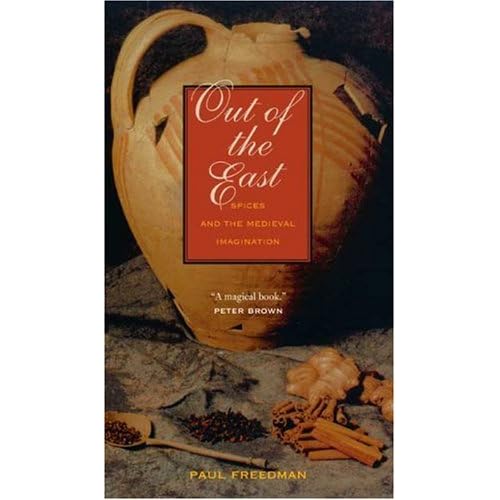
Out of the East: Spices and the medieval imagination, by Paul Freedman


This book was a real treat, and not just because much of it was about food and dining. It's one of the best-written medieval/early modern history books I have read in a long time, and one of the most original.

If you have ever eaten, tried cooking or just read about aristocratic food in the Middle Ages -- and aristocratic food is almost all we know about -- you already are aware that medieval feasts included a lot of highly spiced foods. The spices used in "savory" dishes then are hardly ever used today except perhaps in desserts; some, like grains of paradise and zedoary are hardly known. There has been some good scholarly work in recent years as to why medieval cooking and modern European differ so much; Terence Scully, for instance, has explained the connection between the ancient and medieval medical theories involving the four humours and medieval recipies and feast design. But Paul Freedman's book probably is accessible to more readers while actually covering a great deal of novel material.

One very interesting subject Freedman covers is how the appeal of some of the favorite exotic spices faded dramatically when European merchants gained direct, routine access to them. People still wanted cloves and nutmeg, but they no longer thought of them as powerful, almost spiritual substances. And when it became known that grains of paradise came from the mundane West Africa (precisely, "the Grain Coast") and not the earthly paradise, Europeans slowly lost interest in them.

There is much more in this book -- lots about early European exploration and the role of spices in motivating it -- and I highly recommend it to anyone who finds this review in the least interesting.

Update: Phil Feller directs us to an NPR interview with Freedman.

Historical re-creation, up close and personal


From a recent joust in Ontario. Click the pic for an even closer impression.

Thanks to Kyle Andrews.

Thursday, September 03, 2009

An episode in universal history: the face of war


Someone told me this story this evening.

A Hungarian woman carrying bread passed by an internment camp where Polish PoWs were being held. Some of the prisoners called out to her and she gave them some of her bread. The German guards were incensed and began to shout at her. The woman drew herself up to her full, stern-mother height and said, "Don't fuss, when it is your turn I will give you some."

Eighteen months later, the camp was indeed full of Germans...
Image: American intelligence troops search German Prisoners Of War in the Menil la Tour prison camp.

More discouraging news from Iraq

Many of my readers are academics or students and naturally have their complaints about their educational institutions. McClatchy's Inside Iraq has a story that may be hard for most of us here to match:

One of the old story that I heard was about the former British Prime Minister Winston Churchill was when one of his advisers told him that corruption had invaded most of the ministries. The story says that Churchill asked him "how about the ministries of education and justice?'. The adviserr said "they are fine until now". Churchill answered him "then England is fine"

I do not know for sure whether the story is real or no but what I care about is its idea or main point. It gives an idea about the importance of the two ministries.

During my work, I heard different stories about corruption including these two ministries. I heard about judges who released insurgents and criminals and I heard about teachers who gives high marks for money but all I heard were stories without evidences but the story of the Monday was somethings different.

I saw one of the my friends who teaches English language in of the high schools. After few minutes of talking about the main issue that all Iraqis talk about , I mean security situation and life troubles, I asked him about his work and thought to hear some complains because of the lazy students but the story he told me was something completely new for me and killed any hope to have a new good life in this country.

He told me that one of his student is the son of his educational inspector. My friend told me that this student could not pass the exams because he knows nothing about English language. The educational inspector duty is to check whether the teacher is doing his duty correctly and to help him in passing over any problems to improve the level of the students but this one is completely different.

In addition to neglecting his own son, he threatened to send my friend to jail because he did not give the success mark for his son. The educational inspector said "I will send this teacher to jail and if he believes that anyone can help him then he is wrong"

It looks that our problem is so deep because people who are supposed to apply law consider themselves as exceptions.

I know that any building starts from the base and the base of building a new country starts from scholls where the youngs get either the rights principles or the wrong ones. For sure, having people like this inspector would never install the right bases