This week the CBC TV show The Nature of Things had an episode on the discovery and archaeological rescue of one of the major harbors of Constantinople. I missed it, but fortunately the whole episode is on the web.
The reason that this harbor was found was the construction of a train tunnel across the Bosphorus. Both the construction of the tunnel and the archaeological rescue are technological wonders. This is a technological nerd-fest.
And the photography of Istanbul is great, too.
Did I mention that they found 37 medieval ships?
Image: rescue archaeology.
Ancient, medieval, Islamic and world history -- comments, resources and discussion.
Saturday, November 26, 2011
Digging the lost harbor of Theodosius
Labels:
archaeology,
Istanbul,
ships
Friday, November 25, 2011
Thanks to my audience
In North Bay, Ontario, you can fill a room late Friday afternoon, late in dreary November, with faculty members, students, non-university community members and a dean or two, to listen to a paper on the fears and insecurities of 14th century men-at-arms.
Who knew?
Thanks for coming, people.
Image: Someone else's seminar, in Hong Kong. They had a bigger audience.
Who knew?
Thanks for coming, people.
Image: Someone else's seminar, in Hong Kong. They had a bigger audience.
Thursday, November 24, 2011
Newt Gingrich, the Republican candidate with the history PhD, analyzes our current troubles
As summarized by Jim Wright:
Apparently, according to Newt, America’s current economic woes stem from two sources: greedy middle school janitors and unemployed children.There's more, and all of it equally on target.
Newt’s solution? Fire the janitors, hire the kids.
Like chocolate and peanut butter, or feeding the homeless to the hungry, kids and janitorial work naturally go together. It’s just so, so obvious when Newt points it out, isn’t it?
Fire the janitors, hire the kids.
Brilliant.
First we recoup billions in janitor salaries.
Those goddamned janitors and their outrageous salaries. Who can forget those greedy maintenance men commuting to school each morning? Their private helicopters landing on the roof of the gymnasium, flying in from the Hamptons after a weekend of booze, blow and hookers? Their chauffer driven limos blocking the school bus loading zones? Oh yes, let us never forget who caused this financial disaster, them with their 24K gold handled mops and gilded toilet plungers while our children could barely afford to chew gum and stick it to the bathroom mirrors? I tell you, nothing chaps my ass more than when those key-twirling broom jockeys took billions in taxpayer bailouts and then gave themselves millions in bonuses. Personally I think it’s a Goddamned outrage that they get taxpayer funded lifetime pensions and golden parachutes even after being found guilty of ethics violations and forced to resign from their jobs. Honest to God, folks, how many more countries could we have invaded if these jumpsuit wearing sons of bitches weren’t bleeding us dry? How many more faith based programs could we have funded? How many high school girls had to graduate because those damned janitors stole money for abstinence only birth control classes? How many aircraft carriers could we have built? Ask yourself this, how many more tenured history professors could we have hired if we hadn’t had to pay those stinkin’ greedy Janitors? Hell, we could have filet mignon and caviar in the Congressional lunchroom three meals per day instead of, well, ok bad example, but I think I’ve made my point here.
P.s. When was the last time you heard someone in the public forum speak up for more tenured history professors? Oh, I know it's satire, but even still...
Monday, November 21, 2011
Sunday, November 20, 2011
Smarter protest, please
Phil Paine, continuing this earlier post:
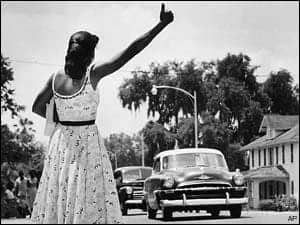
Image: Boycotting the segregated bus system, 1955
Shakespeare didn’t have Romeo and Juliet commit suicide in the first act, and then let the remaining characters pitch tents on the stage and chat aimlessly for the remaining four acts. That was because Shakespeare was a dramatist. His aim was to move people to emotion, to make them think, to shock, horrify, or delight them. Let us, for the sake of argument, assume that he was pretty good at it. Today’s protesters could learn a thing or two from him.Read the whole thing.
As I mentioned in Part 1, the Occupy protest movement began by taking advantage of new methods (the social media), and then quickly reverted to an old formula. The advantage that social media offered was the ability to bring people together quickly to do some strategic and dramatic thing —- to surprise. The “flash mob” is the appropriate template for a protest using social media. The flash mob originated as an amusement —- one in Toronto called people to a pillow fight in front of the Eaton Centre. There have been some political protests using this technique, and these have been dubbed “smart mobs,” but their use has been very limited, so far. The key to the flash mob’s effectiveness is its ability to end as dramatically as it begins. This leaves those in authority disconcerted, and makes them look incompetent. It has the same advantage in protest that guerilla tactics can have in military conflicts.
The Occupy movement has squandered the opportunity to move into the modern age of protest. Social media were used to bring people together, but once there, power reverted to the traditionalists, and the only thing they could think of doing was squatting down and staying put. The smart mob turned into a “sit in,” a protest relic from a generation ago that is notorious for its ineffectiveness and tendency to alienate the very people that the protest is supposed to convince.
...
If you speak to these old-schoolers, it won’t be long before you hear them prattle nonsense about how they are continuing the traditions of the Civil Rights Movement in the 1950’s and 1960’s. They are deluding themselves. The Civil Rights activists were not amusing themselves. They did not go out on picnics. They were dealing with the Ku Klux Klan, and with corrupt and violent state governments in the American south. They were in constant danger. Civil Rights activists faced the serious possibility of being tortured or killed. Everything done was aimed at projecting an atmosphere of seriousness of purpose, and of clearly delineating the moral issues involved. Anyone who wants to see real protest in action could do no better than to study the events of the Montgomery Bus Boycott of 1956. Protests like this led to a gigantic transformation of American society, one of the most dramatic in world history. Take note of the fact that Martin Luther King, Jr. and Ralph Abernathy did not organize catfish fry-ups, sponsor watermelon eating festivals, or instruct their followers to dance the madison. They did not paint themselves blue. They rationally, intelligently, and bravely, calculated which actions would produce the desired results, and undertook them, making huge personal sacrifices to do so. The American public came to realise that it was the State Governments and the Klan who were the savages, the forces of chaos.
I have become progressively more annoyed with the Occupy movement because of its utter failure to heed these simple and obvious facts. We desperately need to get the American and Canadian public to understand the trouble we are in, and the dangers we face over the coming years. Intelligent protest is one of the things that has to be done. I’ve outlined some of the reasons why the protest we are seeing is not intelligent or effective. Next, in Part 3, I will discuss the types, dynamics, and structure of protest.
Image: Boycotting the segregated bus system, 1955
Labels:
favorites 2011,
history of democracy
National Geographic and the Big Picture present pictures to make you weep
The Big Picture always presents amazing examples of photojournalism; National Geographic, with more than a century of dedication to photography as an art, runs an annual photography contest for portrayals of people, places and nature. When the two together present a selection (this year's contest is still open), what do you think?
Well, it's even better than that.
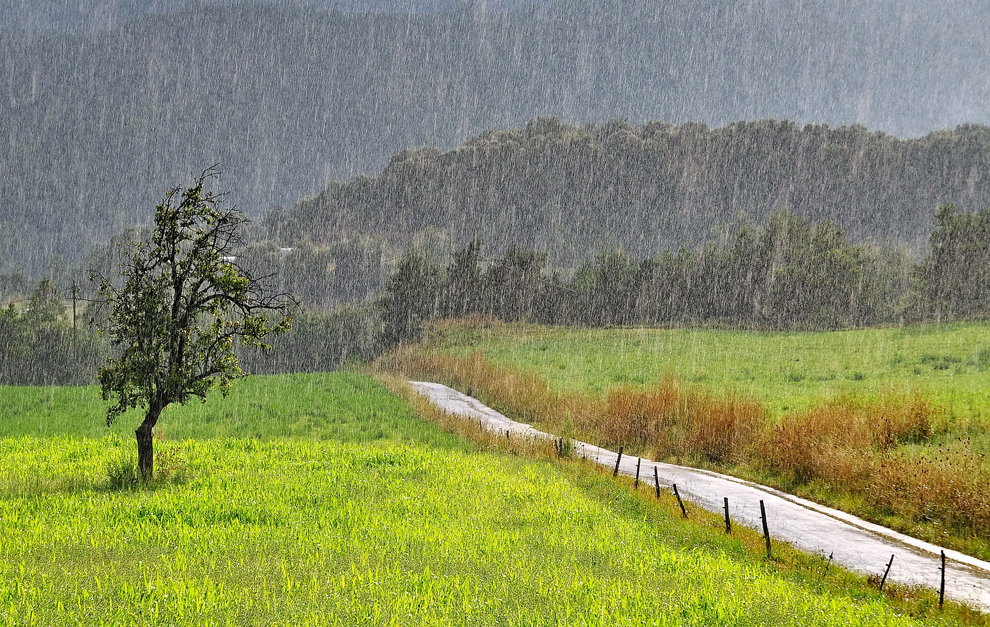
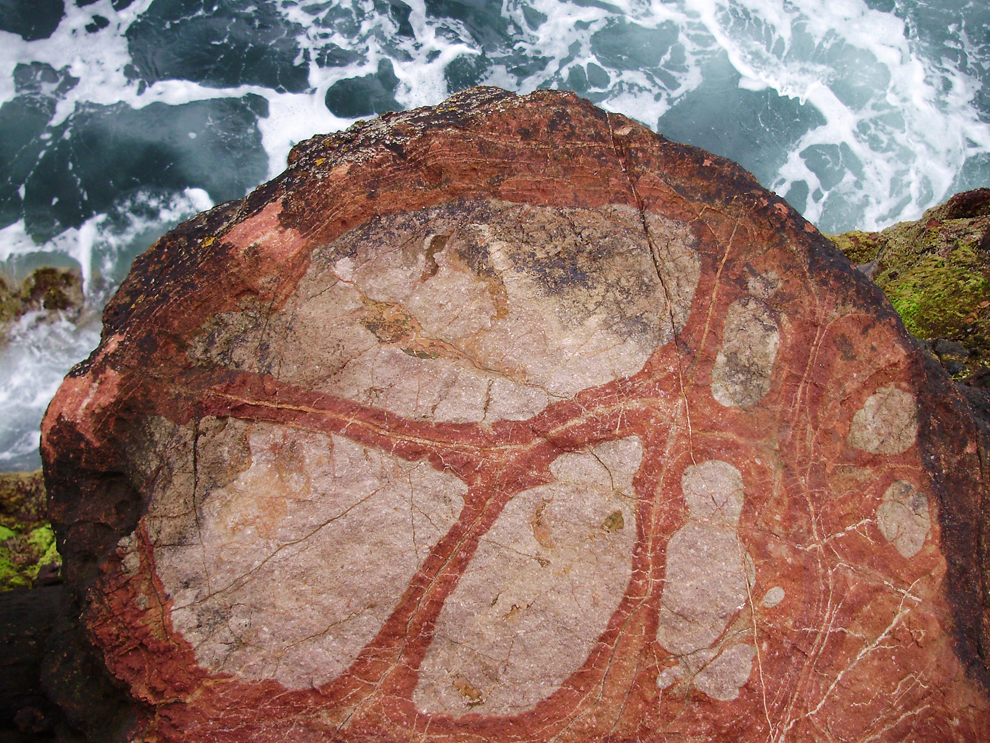
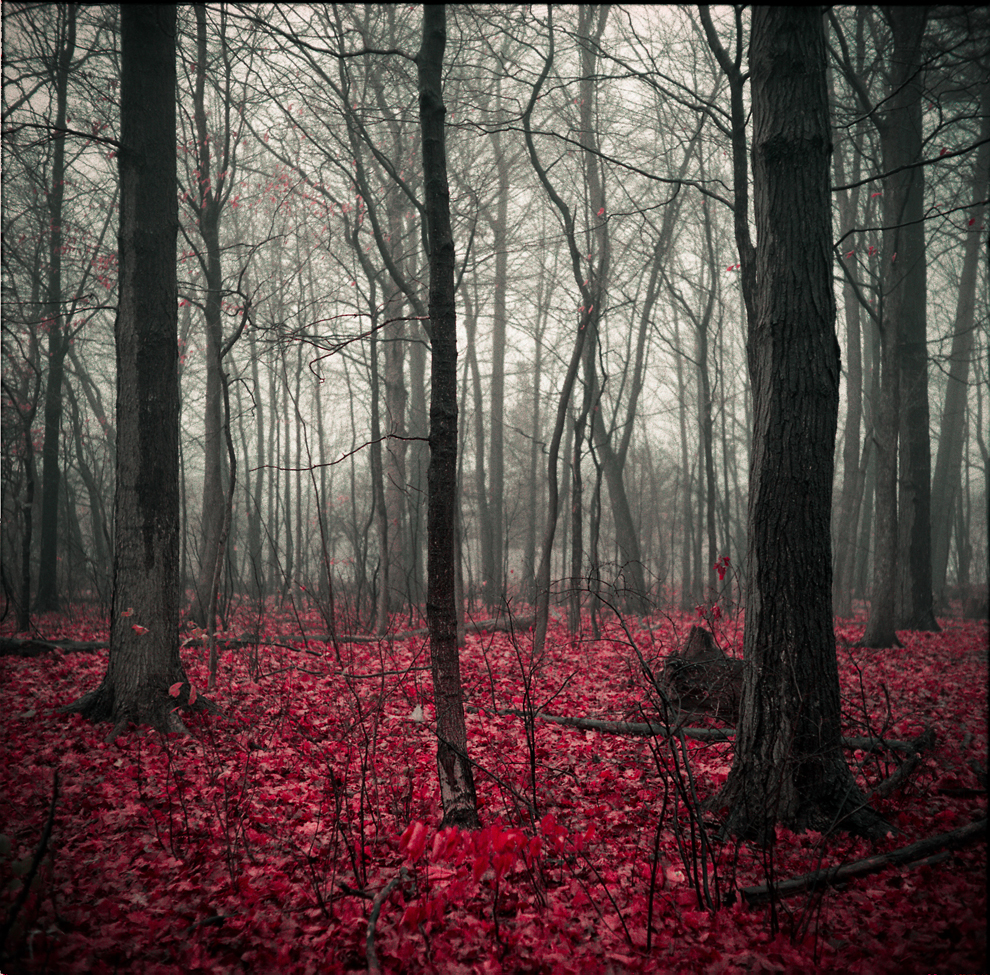
There's the link up there, and here are three pics I really like to whet your appetite. Click to see them at a more appropriate size, or go see the originating site. Yes, go.
go.
Above: Sun and rain in Catalonia.
Above: Rock and water, East Lothian, Scotland
Above: Flesh and Bones, Toronto
Well, it's even better than that.
There's the link up there, and here are three pics I really like to whet your appetite. Click to see them at a more appropriate size, or go see the originating site. Yes, go.
go.
Above: Sun and rain in Catalonia.
Above: Rock and water, East Lothian, Scotland
Above: Flesh and Bones, Toronto
Saturday, November 19, 2011
Fior di Battaglia (The Flower of Battle) -- a new and accessible treatment
There are a lot of people pursuing various kinds of historical re-enactment and re-creation, and I know a great many of them. One variety I take an interest in is the effort to re-discover the methods and techniques of medieval one-on-one combat. This not as hopeless a project as you might think. Starting with the late 13th and early 14th century, there are a number of illustrated treatises. Interpreting is no easy matter, but hey, that's scholarship for you.
One of the most interesting of these treatises is Fiore dei Liberi's substantial and systematic Flower of Battle. Just recently Ken Mondschein has published (with Getty Publications) an accessible introduction, The Knightly Art of Battle. What do I mean by accessible? Thanks to the support, I imagine, of the J. Paul Getty Museum, which owns a very good manuscript of the work, it has (1) 93 color illustrations and (2) costs only $14.95. Yes, that's what it says.
If you are interested in having this book, here's the link to the Getty shop; and of course you can poke around the web for information and discussion of Fiore and other medieval masters.
One of the most interesting of these treatises is Fiore dei Liberi's substantial and systematic Flower of Battle. Just recently Ken Mondschein has published (with Getty Publications) an accessible introduction, The Knightly Art of Battle. What do I mean by accessible? Thanks to the support, I imagine, of the J. Paul Getty Museum, which owns a very good manuscript of the work, it has (1) 93 color illustrations and (2) costs only $14.95. Yes, that's what it says.
If you are interested in having this book, here's the link to the Getty shop; and of course you can poke around the web for information and discussion of Fiore and other medieval masters.
Friday, November 18, 2011
Dog sweat!
The very occasional blog IranWrites reviews the movie Dog Sweat.
...
Not long into the film, I felt that I had an urge to scream, “Say something for God’s sake!” when immediately the facial expression of an actress shuts me up, saying, “What is there to say. Don’t you see?”No, I don’t see if there is no talk, no laughter, no crying, no discussions, no debates, no complaints, no questions, no answers, not a single complex sentence. But why?“We are in strange land my dears, where language has gone through a massive transformation. Language as the medium for communication has lost its function where communication has lost its place in the society and culture, where the efforts are made to hide rather than reveal, where one must divert rather than to direct, where one has to misguide rather than to guide; then words are better forgotten if one has to lie,” I’m whispering to myself.Lips do not kiss, hands do not touch, gazes are afraid to connect. It is not restraint but hiding. There is no need for censorship since there is not even any desire for of any sort expression. There is still an outcry for an “empty nest,” an empty room, a dangling key to an empty apartment. It seems that finding “that key” is the ultimate goal, though I’m not so sure that there is anything but darkness behind the closed door. Even passion is absent …But little by little, I learn to hear them. I learn their language. It is very simple, their facial expressions, sweet faces with bitter and sad expressions, tell us of boredom, aimlessness, hopelessness, very gently and good-naturedly. But beneath those bitter expressions on those faces, those cold faces, those deadly silences, one can see the residue of some drive, of some hope and some faint and colorless shadow of something that might once have been a dream or fantasy.They narrate their own story, as if the film were a documentary and had been made spontaneously, with actors and actresses, without script, on stage thriving to tell their stories. It seems they have something to say only if they find someone to listen, if they feel safe, if they find privacy, if they know how....
Uzbekistan in English Russia
English Russia, a Russian photosite captioned in English, used to be part of my daily routine. Eventually the flood of traffic wore me out. Just now I went back for a look and I found it is still publishing a tremendous amount of striking visual material. Go have a look at Colors of Uzbekistan, or the recent montage of photos from Chechnya.
Image: the mausoleum of Tamerlane (Timur). Click to see it large and even more beautiful.
Labels:
architecture,
Chechnya,
English Russia,
Timur,
Uzbekistan
Tuesday, November 15, 2011
Chilperic, King of the Franks: Gregory of Tours' mysterious but oddly contemporary characterization
Labels:
France,
Gregory of Tours,
Middle Ages,
monarchy
Dumb stuff
Phil Paine on the flaws in the "Occupy" movement:
More here.
All that said, I can’t say that I’m a big fan of the “Occupy” movement. When social media made if possible for a broad range of people to make their disatisfaction known, it had a salutory effect. If that technology had been used to draw people to specific places, where they could engage in some surprising and dramatic symbolic activity, then equally quickly disappear, leaving the authorities to wonder what would happen next, and the public eager to understand what it was all about, then it would have had even more impact. But, instead, things instantly reverted to the accepted formulae. Camping out on the protest site for some undetermined time is just plain dumb. Now, of course, it’s the old-school, old-fart habitual protesters back in control, and those people don’t have the slightest interest in changing anything. There is no group of people more stuck in the past, more hide-bound with orthodoxy, and more ill-suited for intelligent protest
More here.
Labels:
Occupy movement,
Phil Paine
Sunday, November 13, 2011
Worthwhile Canadian initiative
There is an economics blog called "Worthwhile Canadian Initiative," supposedly named after a phrase that won a contest for "most boring possible headline." Today I ran across a real-life WCI, an amazing example of the strengths of the public health approach to problems so characteristic of my adopted country (as opposed to the moralistic approach elsewhere, but unfortunately now being imitated by the current federal government).
This WCI is likely going to be buried, but I am going to do my bit to spread the news, which I read in the Ottawa Citizen:
The number of rabies cases in Ontario's foxes, skunks, raccoons and livestock has just doubled. But paradoxically, this doubling is a minor blip.
Through most of 2011 there had been only a single rabies case in the entire province. As of last week, there are two. One new case was enough to double the total.
Two rabid animals, in the province that was once the rabies capital of North America, with thousands of confirmed cases a year.
One of the most stunning victories in the fight against infectious disease has been fought and won in Ontario, which had more than 3,000 cases of "terrestrial" rabies (meaning all animals except bats) in 1980.
Back then, Ontario had more rabies than all other provinces and U.S. states combined. The disease threatened children, hunters, livestock, and household pets.
For reasons never really understood, today's commonest strain of rabies crept south from Arctic foxes in the 1950s, spreading in animals' saliva along Hudson Bay to Ontario, where it stayed - not just in foxes, but commonly in skunks and raccoons too.
It's almost all gone now. And a strain called raccoon rabies, which spread north from Florida, has been completely wiped out in Ontario since 2005.
The strange story of how we rid the province of nearly all rabies is a combination of vaccine research, animal psychology, and the skill of bush pilots.
...
Here's what happened. Around 1980, someone had the bright idea of vaccinating wildlife against rabies. After all, it works in dogs and cats.
Obviously the problem was delivering the drug in the wild.
The solution was blindingly simple: Put oral vaccine in meatballs. A government airplane flies low with a pilot, navigator and bombardier, and they drop vaccine-laced bait onto the land below.
The bait also contains tetracycline, a common antibiotic that stains an animal's teeth brown. That reveals what proportion of wild animals are taking the bait.
There's more.
Image: There's still need for progress on the bat front...
Labels:
Canada,
public health
Monday, November 07, 2011
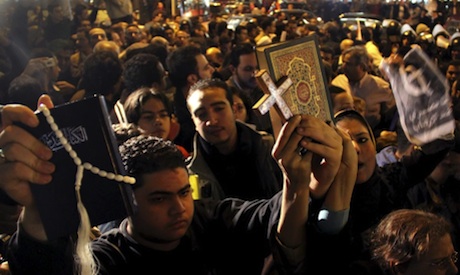
The situation of Arab Christians
Daniel Philpott:
He goes on to discuss what outsiders might do to help.A tense subplot of the Arab Spring is the increasing endangerment of the region’s Christians. In Egypt, Coptic Christians, 10% of the population, have been attacked repeatedly by Salafist Muslims unleashed – many literally released from prison -- by the fall of President Hosni Mubarak. No wonder that Christians in Syria now fear their fate at the hands of the country’s Sunni Muslim majority should President Bashar al-Assad’s government fall.The experience of Christians in Iraq is hardly encouraging, either. The kidnapping and murder of Chaldean Catholic Archbishop Paulos Faraj Rahho by Muslim militants in early 2008 is emblematic of what Iraq’s Christian community has suffered since the fall of Saddam Hussein. The population of Iraqi Christians has declined from around two million to around 400,000 since the Gulf War of 1991, which weakened Hussein’s rule. Under the dictatorships of Mubarak, Assad, and even Hussein and Qaddafi, all of them unsavory to be sure, Christians enjoyed relative security, though it was sometimes bloodily interrupted and usually attended by pervasive social discrimination. Arab authoritarianism was a leaky shelter but it was nevertheless a roof over their heads.
But however dangerous Arab Christians’ fate now may be, going back to the good old days of dictatorships is not an option. The surge of democracy-demanding youth, popular impatience with corruption and economic stagnation, and a religious reawakening over the past generation all serve to block such a backslide. Of course, for other minorities and for Muslims at odds with their regimes, the good old days were not good at all. They were not good for the residents of Hama, Syria, 10,000 of whose inhabitants were murdered by the current president’s father, Hafez al-Assad; and they are not good for protesters of the son’s dictatorship, over 2900 of whom the regime has killed by now. They were not good for democracy activists or traditional Muslims in Egypt, over 20,000 of whom Mubarak held in his jails. Arab authoritarianism was a model that could not last. Apart from suppressing the dynamism of democracy and the free market, such regimes were repressively secular, creating legions of religious discontents and radicalizing traditional Muslims, often in the direction of violence. Ultimately this shelter for Christians proved to be not only leaky but rotten at its foundations.
The position of today’s Arab Christians is indeed precarious. Among the possible outcomes, Islamist regimes that afford Christians little freedom to practice their faith or participate in politics are entirely plausible. But this outcome is far from inevitable, no more inevitable than was the persistence of dictatorship. Only this past week, elections in Tunisia, the country that ignited the Arab Spring, gave a plurality of votes to an Islamic party, but one that is relatively liberal and that will rule in coalition with non-religious liberal parties. In Egypt, too, the possibilities are more complex than secularist safety and Salafist violence. When Christians are attacked it is not always at the hands of Muslims. The shooting of Christian demonstrators in Cairo this past October 9th was carried out by the army. When Muslims have attacked Christians, far more have defended them. Just after Muslim terrorists slaughtered 25 Coptic worshippers and injured some 100 others in Alexandria on New Year’s Day of this year, thousands of Muslims across the country gathered in candlelight vigils and formed human chains around Coptic churches during worship. Today, Egyptian Muslim office-seekers are divided among proponents of a strongly Islamic state and supporters of liberal rights, including religious freedom for Christians. The scenario of religious freedom, then, is plausible, too.
Image: Egyptian Christians celebrating Easter.
Sunday, November 06, 2011
Ancient brews recreated
Mcleans reports:
There's more at the link...
And then there’s Patrick McGovern, an archaeologist at the University of Pennsylvania who, after analyzing the residue that lingers in the nooks and crannies of millennia-old potted vessels, is bringing ancient elixirs back to life. It’s gastronomical nostalgia on steroids.
McGovern, a pioneer in the field of biomolecular archaeology who did undergraduate work in chemistry and has a Ph.D. in Near Eastern archaeology, has collaborated on five beverages with Sam Calagione, the award-winning founder and president of Dogfish Head brewery in Delaware: Midas Touch, an Iron Age beer based on samples found in the king’s supposed tomb; Chateau Jiahu, a Chinese blend of grapes, rice and honey based on the oldest sample of booze ever discovered; Theobrama, a 3,200 year-old Honduran chocolate drink; Chicha, a corn beer with Peruvian lineage; and Ta Henket, an Egyptian ale being released in December with 18,000-year-old components.
There's more at the link...
Labels:
historical re-creation
A remarkable Waterloo re-enactment
Labels:
favorites 2011,
historical re-creation
Saturday, November 05, 2011
Polite Canadians
The Globe and Mail reports on what happens when you give 'em a gun and the prospect of filling the freezer with moose meat.
Armed gangs defending their turf. Death threats and torched property. Victims too fearful to go to police.
Sounds like another organized-crime offensive on the streets of Montreal. But the action is playing out in a more improbable setting: the backwoods wilderness of Quebec during hunting season.
Generations of hunters have turned to the rugged forest of the Gaspé Peninsula each fall to bag a moose, but an explosive growth in the number of animals, coupled with growing competition for hunting spots, has turned nature’s idyll into a battleground.
Although Quebec sets aside vast swaths of Crown land for hunting, territory that in theory belongs to everybody, some take matters into their own hands to protect what they regard as their personal hunting spots.
The problem has come to a head on the Gaspé, where some 25,000 permit-holders descend in the forest in a nine-day firearm hunt lasting to late October. During that time, according to several officials and witnesses, a supposedly public playground gives way to roadblocks, armed patrols and less-than-subtle warnings by rival hunting gangs to keep out.
Some hunters are tasting the woods’ frontier justice firsthand. Michel Guénette is a 54-year-old truck driver who has been hunting in the Gaspé since he was a boy. Last year he discovered his family’s six trailers incinerated, with empty canisters of propane lying amid the rubble. When he showed up for the hunt this year, his tree blind was trashed.There's more where that came from.
Labels:
Canada
Astonishingly good
Law and Order SVU is in its 13th season and I have to say, that although in the normal course of events the series should be as stale as thirteen-year-old bread, in some ways it is better than ever.
The most recent episode was classic SVU. It could easily have been in season one -- heck, it would have been a good pilot, introducing the whole series. But somehow it pulled me in, really pulled me in. Was it the acting? The direction? Who knows?
But what really started this train of thought was the previous episode, about a young loser couple whose infant dies mysteriously. It was heartbreaking, and though the case was only marginally an SUV matter, it may have been the best episode ever. Here I have to say that the people who played the young couple were astonishingly good, and the writers should be proud.
The most recent episode was classic SVU. It could easily have been in season one -- heck, it would have been a good pilot, introducing the whole series. But somehow it pulled me in, really pulled me in. Was it the acting? The direction? Who knows?
But what really started this train of thought was the previous episode, about a young loser couple whose infant dies mysteriously. It was heartbreaking, and though the case was only marginally an SUV matter, it may have been the best episode ever. Here I have to say that the people who played the young couple were astonishingly good, and the writers should be proud.
Labels:
television
Wednesday, October 26, 2011
A taste of Bollywood
I think I've posted this here before, but it is worth repeating. You may want to turn on the captions.
Friday, October 21, 2011
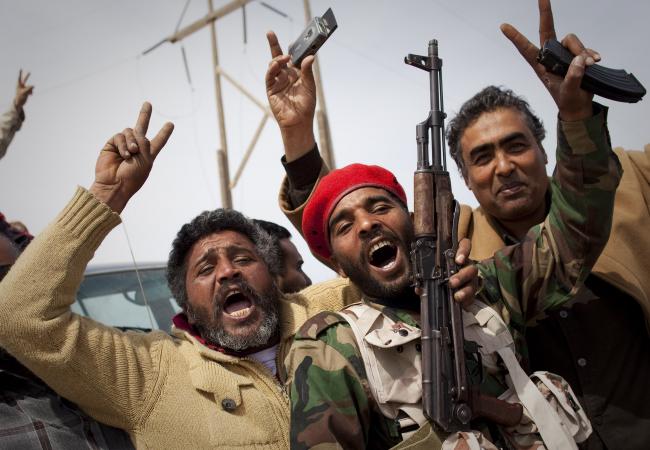
Will Mclean reports on Libya
Moamar Khaddafy is Dead
In related news, so is Gadhafi, Gaddafi, Qadhafi, Qaddafi, and el-Qaddafi.
Diversity
I think the next time I hear "Canada is becoming more diverse," I may scream.
Has there been a single week since 1763 when that was not true?
Image: Here they come -- whoever they are. :-)
Has there been a single week since 1763 when that was not true?
Image: Here they come -- whoever they are. :-)
Labels:
Canada,
immigration
Two optimistic views of the fall of Qaddafi
From Juan Cole:
And a more pessimistic view:
The last stand at Sirte was very like Jim Jones’s last stand in the jungles of Guyana. Jones was an American religious leader who gradually went mad, demanding more and more sacrifice and obedience from the members of his People’s Temple congregation, which then gradually became a cult. I define a cult as a group wherein the leader makes very high demands for obedience and self-sacrifice, and the values of which diverge from those of mainstream society. When the outside world seemed clearly to be pursuing the People’s Temple into Guyana, with a Congressmen showing up in Jonestown to rescue a handful of adherents who wanted to go home, Jones reacted with fury, first sending a militia to kill the congressman and the defectors, and then instructing his followers to drink poisoned Kool-Aid. Many were injected with cyanide laced with liquids or shot. Those who would not agree voluntarily to be “translated” to the next world together with their messianic leader would be subjected to the ultimate coercion.
Qaddafi’s stand at Sirte underlined the cultish character of his politics,...
The final defeat of Qaddafi and Qaddafism is a victory for the Fourth Wave of democratization that began in Tunisia and continued in Egypt. There is now a contiguous bloc of 100,000,000 Arabs in North Africa who have thrown off dictatorship and aspire to parliamentary government (Tunisia’s elections are coming up on Sunday). Those who dismiss this movement because Muslim religious forces will benefit are exhibiting a double standard. Roman Catholicism benefited from Third Wave democracy movements like those in Poland and Brazil, as did Eastern Orthodoxy. Were democracy to break out in Burma, Theravada Buddhism would benefit. So what?
The Arab League, President Obama and NATO have been vindicated in their decision to forestall the massacre of eastern Libyan cities such as Benghazi. The region’s remaining bloodthirsty tyrants, who have not scrupled to massacre non-combatants for exercising their right of peaceable assembly and protest, should take the lesson that mass murder is a one-way ticket for them to the sewage drain of history. As I told the NYT today, ““The real lesson here is that there is a new wave of popular politics in the Arab world… People are not in the mood to put up with semi-genocidal dictators.”
And at cbcnews.ca:
So if the Libyans themselves hadn’t risen up in the first place, NATO wouldn’t have considered intervening, and Gadhafi would almost certainly still be alive and in charge.
That’s the lesson the Arab world takes away from Gadhafi’s fall, and it’s a valuable one.
Many if not most in the Arab world likely believe it was the Libyans who “got” Gadhafi.
In those pictures he was surrounded by Libyan fighters, not foreign troops. It is precisely the image — if not the exact circumstances — that both the NTC and NATO wanted right from the start, to avoid the Iraq mistake and the baggage that came with that.
Among Arabs those nuances count for a lot. And so those images will undoubtedly breathe new life into the flagging uprisings in Syria and Yemen. They will also give pause to the autocrats who still rule them.
Arab editorials in today's papers openly wondered who would be next in what they now willingly call the Arab Spring, and what might be on the minds of the possible candidates as they watched Gadhafi’s final moments.
It is a very different Arab world than it was when Saddam was caught. This Arab Spring, sparked singlehandedly by a desperate Tunisian young man, is all about people, and therefore legitimate in the eyes of most of the region. The old rules lurk behind the scenes, but they are weakening as the people continue to press for substantive change.
Even in countries where there has been no large scale protest, old regimes have clamoured to introduce change. Saudi Arabia would not have given women the right to vote and run in municipal elections without the Arab revolts. Jordan has had two governments resign in the span of months in the name of introducing reform.
The Arab Spring has been a messy affair, and it will continue to be, and in some countries, spring may never come. But in each of those countries where it has or will, it unfolds differently — as evidenced by those affected so far — and with different speeds and efficacy.
Having world powers on your side certainly seems to help--whether it's moral or military. In future, other revolutions may or may not involve foreign intervention, and we may yet see an example that involves only regional intervention, without the involvement of Western powers.
But the one common, requisite ingredient in all of them has been a willing people. People who have broken the barrier of fear, who refuse to remain silent — even after they might have managed to fell longstanding regimes, as in Egypt's case.
After now watching three strongmen fall in successively higher degrees of humiliation, you can bet the continuing uprisings will have a renewed momentum.
And a more pessimistic view:
Arab Spring a failure so far
All in all, as noted above, a fine candidate for early departure from this life.
But that's as far as it goes. Other than that, Gadhafi's death demonstrates nothing more than the ability of Western militaries to cut down whomever they choose.
There will, no doubt, be attempts to portray his downfall and death as an example of what happens when a nation decides to rise up against tyranny and pursue its own destiny.
Americans, in particular, love that narrative, which is why the phrase "Arab Spring" is still so popular in the mainstream media here.
The fact is, the Arab Spring, if it even existed, has been a sputtering failure so far. It certainly didn't even threaten Gadhafi. He was hunted down by NATO military power, plain and simple.
Had it not been for NATO warplanes, Gadhafi would still be in command, violently persecuting his own people.Image: And the women?
Labels:
Arab Spring,
history of democracy,
Libya,
Qaddafi
Thursday, October 20, 2011
Polo in Kashmir
From the Big Picture. Click to see it bigger.
Labels:
horses,
Kashmir,
polo,
The Big Picture
Tuesday, October 18, 2011
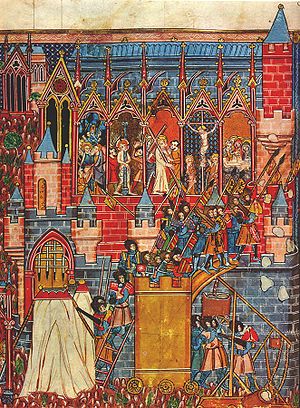
The taking of Jerusalem, 1099
People often wonder how medieval Christians could have taken part in holy war, given Jesus's well-known pacifistic pronouncements. Here are excerpts from a lecture I gave yesterday on the taking of Jerusalem, which ended in a massacre, which touches on the issue:
Here’s what Tyerman (page 31) says about a famous Christian account of the massacre:
Raymond of Aguilers… who witnessed the fall of Jerusalem in 1099, described the ensuing massacre on the Temple Mount: "it is sufficient to relate that in the Temple of Solomon and the portico crusaders rode in blood to the knees and bridles of their horses." What ever the atrocities performed that day, Raymond was quoting Revelations 14:20 "and the winepress was trodden without the city and the blood came out of the winepress even to the horse bridles."
Two further points:Comments? [No comments from students.]
Here are my comments. Massacres of garrisons and the civil population of fortifications and cities that had resisted for a long time were pretty common in medieval times. According to the laws of war (or the customs of war) those who resisted, even if they were not armed and had no authority or say in the waging of war, brought the consequences of such resistance upon themselves. It was kind of a no-win situation because people who surrendered too quickly to a threat of siege might invite the revenge of their rulers if the rulers won the war eventually. But to focus on the other situation: we've already seen in this course that a siege was a hard task and a dangerous one even for the people outside. I sometimes joke that it is no real joke that sieges came down to who caught dysentery first, the people outside in their squalid camps, or the people inside crowded together in bad conditions. Besiegers died in significant numbers in a hard siege, and the numbers went up significantly if there were a number of unsuccessful assaults. Besiegers became targets for missiles thrown at them from above, and insults meant to break the morale and boost morale on the other side. When besiegers swarmed into a city through a gap in the walls or by the treachery of the tower commander, that they were not in a good mood all. All the anger fear and hardship came together in a murderous rage and perhaps a sudden feeling of invulnerability. Like hunters, they fell upon their prey, animate and inanimate.Further remark is necessary in the case of Jerusalem, however. Modern observers from the historically Christian environment often expressed wonder that the religion of peace and my kingdom is not of this world could have inspired warfare. Forgetting entirely about Muslim and Jewish accounts of the slaughter of Jerusalem, we can see just from Christian accounts that not only did nominal Christians take part in mass murder like anyone else, they felt more justified in doing so in this case because they had scriptural authority behind them. Those who took part and had read their Bible knew that this was God's will.
- Any important and popular religion contains a multitude of contradictory elements that can be used to justify all sorts of actions.
- People who study religion or are particularly pious or are opposed to some specific religion often act like a person or group can be completely characterized as "Christian" or "Muslim" or "Shiite" or whatever. Not so. Those Crusaders at Jerusalem liked to think of themselves as Christians, bound by the law of God, but also as warriors, subject to the customs of war. This should be obvious, but the way people talk, it clearly isn't.
Labels:
Crusades,
favorites 2011,
Middle Ages,
religion,
religious history,
war and peace
Monday, October 17, 2011
Big trouble in Egypt
Labels:
Arab Spring,
Egypt,
revolution
From a Facebook commentary
Thanks to the originators (kept anonymous)!
Labels:
historiography
Saturday, October 08, 2011
The sad historian thinks...
...That there are whole cultures that will never enjoy maple syrup.
But then he realizes that Ethiopian monks once said that about coffee...
Labels:
coffee,
maple syrup,
world history
Tuesday, October 04, 2011
Passed a million page views...
Sometime in the last two or three days this blog passed 1,000,000 page views. And that's just since I changed the name and hosting arrangements about three (?) years ago!
Huzzah!
Labels:
blogging
Sunday, October 02, 2011
Saturday, October 01, 2011
The threat of sectarian violence in Syria
From Foreign Policy, via Brian's Coffeehouse:
From the start of the Syrian revolution, the Assad regime's media have portrayed the overwhelmingly peaceful grassroots protest movement as a foreign-backed military assault. Its preferred catchall term to describe the tens of thousands of patriots it has kidnapped and tortured, as well as the thousands it has murdered, is "armed gangs." Despite a series of televised "confessions," the regime has not provided any serious proof of the supposed American-French-Qaeda-Israeli-Saudi-Qatari plot against the homeland. Nor has it explained the evident contradictions between its narrative and the thousands of YouTube videos and eyewitness accounts of security forces shooting rifles and artillery straight into unarmed crowds.
Of course it hasn't. Yet its propaganda is taken seriously by Russian and Chinese state media, certain infantile leftists, and a vaguely prominent American academic.
Tragically, the propaganda is also taken seriously by members of Syria's minority sects -- not by all of them by any stretch, but perhaps by a majority. It's tragic because perceived minority support for this sadistic regime will inevitably tarnish intersectarian relations in Syria in the future.
Those Sunni Syrians who are (understandably) enraged by the minorities' siding with the dictatorship should remember first that many Alawis and Christians, as well as many more Druze and Ismailis, have joined the revolution and that many have paid the price. Second, Sunnis should remember that Alawis and Christians have good reason to fear change, if not to believe the propaganda.
Alawis have a complex, esoteric religion that throughout history has been savagely denounced, and its adherents savagely oppressed. Ultimately it's a matter of political interpretation whether or not Alawis are to be considered Muslims. The Ottoman Empire didn't even consider them "People of the Book," which meant that unlike Christians, Jews, and mainstream Shiites, Alawis didn't enjoy any legal rights. The ravings of the influential medieval scholar Ibn Taymiyya (who thought Alawis were "greater disbelievers than the Jews, Christians, and Indian idol-worshipping Brahmans") contributed to their oppression and justified the theft of their lands around Aleppo and their forced retreat into the mountains. Until the 1920s, the Alawis were stuck in those mountains. Antakya (Antioch) was the only city where Alawis lived with Sunnis, and Antakya was gifted by France to Turkey before the independence of the modern Syrian state.
Most Alawis today are not particularly religious. Far from pushing Alawi tenets on the general populace, the Assads discouraged the study of the faith and repressed the traditional Alawi clerics. As a result, if individual Alawis do turn to religion, most tend to practice Sunni or mainstream Shiite rituals.
Of course, as far as the business of state is concerned, it should be entirely irrelevant whether or not Alawis are Muslims or even People of the Book. As Syrian citizens they should be guaranteed the same rights and the same access to political office as anyone else. It would help a great deal if revolutionary leaders and Sunni clerics were to state this as clearly and as often as possible. The blatant anti-Alawi sectarianism of Sheikh Adnan al-Arour (given prominence by Saudi Arabia) and Sheikh Yusuf al-Qaradawi (given prominence by Al Jazeera), both supposed friends of the revolution, does not help at all. Speaking to "those [Alawis] who stood against us," Arour recently promised, "I swear by God we will mince them in grinders and feed their flesh to the dogs."
The one thing the regime has done intelligently in the last six months is to play on minorities' fears. ...
The two scenarios that most terrify the minorities (and almost everyone else) are, first, the rise of intolerant Islamism, and, second, sectarian civil war. Unfortunately, both scenarios become more likely with every moment the regime remains in power. The experience of being shot at, besieged, and tortured will inevitably drive some toward more extreme views. In addition, the military units slaughtering the people are overwhelmingly Alawi and commanded by Alawis. The regime's shabiha militias in Hama, Homs, and Latakia are Alawis recruited from the surrounding villages. These are the people torturing Sunni women and children to death, burning shops and cars, beating and humiliating old men. Their actions will have consequences. If the regime falls soon, the consequences will be legal and targeted solely at the guilty. If the regime doesn't fall soon, the consequences may be violent, generalized vigilante "justice." Then Iraq and Lebanon will become Syria's models.
Labels:
favorites 2011
Ontario election trivia--UFO and NOHP
Early in the 20th century, Ontario was governed by the UFO -- United Farmers of Ontario. Such a party would be a non-starter today.
Another probable non-starter is the Northern Ontario Heritage Party, which wants provincial status for the North. NOHP can't field candidates for more than 2 of the 11 northern ridings -- but somehow has a candidate in downtown Toronto. So if you live in the St. Paul riding and want to cast a real protest vote, NOHP is available...
Friday, September 30, 2011
State of the Revolution in Egypt -- from Arabist.net
FIVE JANUARY 25 GAINS THAT HAVE (SO FAR) SURVIVED THE COUNTER-REVOLUTION
By Steve Negus September 30, 2011 at 12:12 PM Share
As quite a few commentators have gloomily noted, an Egyptian counter-revolution appears to be in full swing. The Supreme Council for the Armed Forces has vowed to step up its use of Emergency Law and demonstrating a willingness to crack down on street protesters, strikers, critics of the military, NGOs who receive foreign funding, and anyone else who might trouble their hold over the country. Newspapers are again being censored. The Interior Ministry seems to have successfully resisted real reform, at least for the time being. Supporters of the revolution are trying to count the tangible achievements of the January uprising and coming up short, sober observers are reminding us that those who create a revolution rarely get to determine its outcome, and some Edmund Burkes are surveying the scene and declaring that they knew all along that the naive youth of Facebook could never seriously shape the course of Egypt's future, except as pawns.
I would agree that the vision of Egypt's future articulated by protesters in Tahrir is still far from being realized. However, they have already accomplished far more than many would give them credit for doing. Some examples:
1) Egypt's media and political political landscape has become vastly more pluralistic. SCAF has been cracking down on the media, but in a very piecemeal fashion, a few pebbles tossed against the torrent of licensings of newspapers and television channels licensed in the first months after Mubarak's departure. Every major political trend in the country has been allowed to form its own political party. This means, among other things that parties have more internal democracy: Islamists no longer have to huddle together under the semi-tolerated protective umbrella of the Muslim Brothers to avoid prosecution for illegal political activity, but have been free to split off into smaller groups that express their discontent with the parent organization.
2) Liberals have established themselves as a real force in Egyptian politics. Electorally, they may not be as organized as the Islamists, but the leftist/liberal secular-leaning youth are the acknowledged heroes of January. Groups like April 6 and the Revolutionary Youth Coalition now have major name recognition, and polls suggest that they are at the very least competitive with the Muslim Brothers. Prior to January, very few people would have mentioned the Islamists and the liberals even in the same breath as political forces of comparable power.
3) Egypt's political discourse has become increasingly liberal. The demands of the January uprising have hardened the consensus that Egypt needs to have a democratically elected government. And we're not talking about the "democratic transition" offered by Mubarak, where Egypt may be allowed to elect their 20 years down the road, if conditions are absolutely perfect -- pretty much everyone has agreed in principle that the next government must be fairly elected under the supervision of an independent judiciary. And with the exception of a few Salafis, pretty much every group insists that the government be "civil" -- ie, not an Islamic state. You may or may not believe that the Muslim Brothers would not establish a theocracy if given the chance. But in order to implement a radical agenda, a would-be radical vanguard party usually needs to pitch itself as offering a major alternative to the current order. Very few Egyptian politicians seem to have calculated that there is a market for religious radicalism.
The revolution also seems to have strengthened the consensus in favor of individual rights -- leading Islamists have acknowledged a right for Muslims to convert out of Islam, for example, while Coptic activists have become more vocal in demanding that the Church should no longer have the capacity to regulate their personal lives, in particular their right to divorce.
4) Hundreds of thousands of Egyptians have become politically active -- not just in the crowds in Tahrir, but in the workplace as well. Egypt was never quite as compliant as it was portrayed to be, and workers, government employees, professionals, tenants, and other aggrieved groups have always staged strikes and demonstrators to further interests. But under Mubarak, the regime was usually able to keep these groups focused on their specific needs and fairly easily appeased with small concessions. Now, workplace organizations are far more militant, and far more likely to mix their own parochial demands with pressure to keep up reforms at a national level. Also, Egyptian institutions from labor unions to al-Azhar have signalled that they will no longer tolerate their leadership being appointed by the state, and insist on autonomy.
5) The calculus of running the country has been changed. No future government can assume, as Mubarak's did, that it can violate its pledges or make an utter mockery of elections, and only a small handful of activists will turn out to protest, outnumbered by the Central Security forces which surround them. No future autocrat can quite as cocky about rigging elections, about promoting a family member as heir, or otherwise ignoring the desires of the Egyptian public.
None of these successes is irreversible. None are cast-iron guarantees of fair and democratic elections. But they are major obstacles in the path of any would-be strongman who wishes to reestablished an entrenched and lasting autocracy.
Monday, September 26, 2011
Where did the money go?
From NPR:
The amount the U.S. military spends annually on air conditioning in Iraq and Afghanistan: $20.2 billion, according to a former Pentagon official.From Dan Froomkin at Huffington Post:
That's more than NASA's budget. It's more than BP has paid so far for damage from the Gulf oil spill. It's what the G-8 has pledged to help foster new democracies in Egypt and Tunisia.
"When you consider the cost to deliver the fuel to some of the most isolated places in the world — escorting, command and control, medevac support — when you throw all that infrastructure in, we're talking over $20 billion," Steven Anderson tells weekends on All Things Considered guest host Rachel Martin.
With just over three months until the last U.S. troops are currently due to leave Iraq, the Department of Defense is engaged in a mad dash to give away things that cost U.S. taxpayers billions of dollars to buy and build....
The most colossal relics of the U.S. invasion of Iraq will be the outsize military bases the Bush administration began erecting not long after the invasion, under the never explicitly stated assumption that Iraq would become the long-term staging area for U.S. forces in the region...
Most of the $2.4 billion was spent building about a dozen huge outposts that, in addition to containing air strips and massive fortifications also have all the comforts of home. The Al-Asad Airfield in Anbar province, for example, covers 25 square miles -- about the size of Boulder, Colo. -- and is known as "Camp Cupcake" due to its amenities.
The 15-square-mile Joint Base Balad, as Whitney Terrell wrote earlier this year for Slate, is "home to three football-field-sized chow halls, a 25-meter swimming pool, a high dive, a football field, a softball field, two full-service gyms, a squash court, a movie theater, and the U.S. military's largest airfield in Iraq."Imagine, a whole new Boulder in Iraq!
Image: Al-Asad Airfield in its glory days.
Sunday, September 25, 2011
For the proud daughters
Speak to me of summer,
Long winters longer
Than time can remember,
Setting up of other roads,
Travel on in old accustomed ways.
I still remember the talks by the water,
The proud sons and daughters
That knew the knowledge of the land,
And spoke to me in sweet accustomed ways.
Long winters longer
Than time can remember,
Setting up of other roads,
Travel on in old accustomed ways.
I still remember the talks by the water,
The proud sons and daughters
That knew the knowledge of the land,
And spoke to me in sweet accustomed ways.
Labels:
Yes
Saturday, September 24, 2011
Clash of civilizations time?
Since I am teaching both Islamic Civilization and Crusade and Jihad this term, you can see how this piece, summarized from an Arabic source in Syria Comment, could not help but draw my attention.
Why don’t the Christians in both Lebanon and Syria immigrate to Europe is allegedly what Sarkozy asked the Maronite religious leader on his recent visit to France. According to the article, Christians had no place in the Middle East given the clash between Christianity and Islam. The Maronite leader was shocked by what he heard which prompted the French leader to point to a document that cites how over three million Christians immigrated from Lebanon over the past 20 years and that the Middle East will face many problems in the future.One wonders, but not very much, what the French president thinks about all those Muslims in France.
Friday, September 23, 2011
Observation Post Mustang, Afghanistan
Labels:
Afghanistan,
The Big Picture,
war and peace
Kunar province, Afghanistan
From The Big Picture.
Labels:
Afghanistan,
The Big Picture
Monday, September 19, 2011
Another impressive re-enactment I missed: WMAW
That's "Western Martial Arts Workshop" to you, and it took place in Chicago this past weekend. Get a gander at that gorgeous armor!
Sunday, September 18, 2011
About that Overview of Late Antiquity
Back when I came to Nipissing University in the late 80s and early 90s, I was finishing up my first book, on fifth-century Latin ecclesiastical chronicles, and casting around for a new project. One idea that occured to me was a zippy textbook on Late Antiquity, with lots of maps and pictures and punchy, straightforward language, not to mention fearless generalization. After all, I had spent well over a decade reading intensively about the period, and I had a pretty good idea of how to fill the major holes that remained in my personal knowledge.
So I happily began to read, write, and sketch maps.
When it was more or less done, I kind of chickened out. I thought this "Overview of Late Antiquity" was pretty good, and accessible to a student or general audience -- a big priority -- but was it commercial? Shouldn't it perhaps go as far as the First Crusade? Undercutting myself, I showed it to no publishers (DON'T DO THIS!) and put it on the shelf.
If it hadn't been for the Web, that would have been it.
But the Web did come along, I was approached by ORB to put together a section on Late Antiquity, and one of the first things I did was web the Overview. At least, the text plus links to pictures elsewhere on the Web. Regretfully, I never turned the sketch maps into polished images.
The Overview has been freely available on-line since about 1995, and I am sure it has been read by many more people than would have seen it if it had been put into print. Currently, I am using it again to supply background material to my seminar students in the course "The World of Gregory of Tours."
And you know, I think it's pretty good. You can see what you think if go here, or if that doesn't work, here.
Image: A late-antique version of heaven, from a 6th-century church in Ravenna.
So I happily began to read, write, and sketch maps.
When it was more or less done, I kind of chickened out. I thought this "Overview of Late Antiquity" was pretty good, and accessible to a student or general audience -- a big priority -- but was it commercial? Shouldn't it perhaps go as far as the First Crusade? Undercutting myself, I showed it to no publishers (DON'T DO THIS!) and put it on the shelf.
If it hadn't been for the Web, that would have been it.
But the Web did come along, I was approached by ORB to put together a section on Late Antiquity, and one of the first things I did was web the Overview. At least, the text plus links to pictures elsewhere on the Web. Regretfully, I never turned the sketch maps into polished images.
The Overview has been freely available on-line since about 1995, and I am sure it has been read by many more people than would have seen it if it had been put into print. Currently, I am using it again to supply background material to my seminar students in the course "The World of Gregory of Tours."
And you know, I think it's pretty good. You can see what you think if go here, or if that doesn't work, here.
Image: A late-antique version of heaven, from a 6th-century church in Ravenna.
Students in HIST 4505
There seems to be a problem accessing the Overview Of Late Antiquity. Try this direct link to chapter 1 section 1.
http://www.nipissingu.ca/department/history/muhlberger/orb/ovc1s1.htm
Saturday, September 17, 2011
And a book manuscript wings its way to a publisher
Labels:
book projects
Scandal at Marathon
Labels:
Greeks,
historical re-creation,
Marathon
Friday, September 16, 2011
Time and a word
This evening I listened to the second album by Yes, Time and a Word, from about 1971. Did it take me back? Perhaps, but maybe not to the actual 1971, but to the alternate world they created with their music in 1971.
I feel the same way about the Beatles, heard most recently on CBC1 as we drove home from North Bay. Timeless -- but the music was timeless then.
Not to be missed: conjuring up Rome in AD 600
Dr. Beachcombing imagines the near-ghost town it must have been:
Let’s take the lowest sensible estimate for classical Rome – half a million – and the highest for Rome c. 600, about 50,000. That means that the population has not only been decimated, but that it had been decimated nine times over. And what is more these heirs of Rome (as fashionable ‘late antique’ historians call them) were resident in an echo box; a city that they no longer had the technology to repair, let alone recreate, where nine out of every ten residences were empty, where three and four story buildings gradually keeled over into the streets and where the Parthenon and the Coliseum looked down mockingly on the little people below, not so much dwarfs on giants’ shoulders, as blue-bottles buzzing around a cow’s backside.
Then, remember, perhaps the actual population of Imperial Rome was more like a million and the population of Rome c. 600 was more like ten thousand, a hundredth of what it had been. The psychopathic Anglo-Saxon guard, the tourist from Scythia and the Pope and his tiny administration could shout as loud as they wanted and no one would have heard them in their ghost town. No one was listening, not even the red baked tiles made in a happier age.I have recently lived across the river from Detroit...so this is evocative. Detroit is not, however, quite so echoic.
Parthenon presumably should be Pantheon (above).
More on ancient population estimates in a later post.
Labels:
Britain,
Detroit,
favorites 2011,
late antiquity,
population,
Rome
Unexpectedly well
Why have things gone better in Libya than in Iraq after the fall of Saddam Hussein? Veteran observer Rory Stewart has his theories but admits he doesn't know. But this time it is different:
Libya did not look as shabby or dangerous as Iraq. Despite six months of fighting and uncertainty, the lawns in Tripoli were mown, the bougainvillea bushes were bright, and the rubbish was still in garbage bags, not strewn, as in Basra, in suppurating ditches. The shops and petrol stations were reopening, the water supply was beginning to return. The armed 15-year-olds were polite. No one at any of the checkpoints asked for a bribe, or our satellite phones. The Misrata militia in their jeeps were as friendly as the Knights of Zintan in their pick-up trucks. There was little talk of revenge. No one was shooting anyone else.
And to my surprise, there was little looting. In the executive offices, it was not just the furniture and the televisions that were untouched: even the silver ashtrays and gold paperknives were still on the desks. It seemed that no one had slipped even a fountain-pen into their pocket when the government left and the rebels came in. At night, the streets of Tripoli were so jammed with honking cars, waving flags, boys wearing the national colours, that one might imagine Libya had just won the World Cup. The government and the police were not in any position to prevent disorder, but it seemed that the Libyans were not drawn to looting or violence. And no one I spoke to, from expatriate engineers to young gunmen, expected that.
Already people are claiming that the euphoria and calm after the fall of Tripoli could have been predicted and can be easily explained. But such civility was not inevitable; it could not have been assumed from Libyan history or culture. Libya shares many features of countries where anarchy has prevailed. Like Afghanistan or Iraq, it has a distinguished history and has experienced periods of stability but lacks the essential trinity of the international state-building apostles: ‘a vibrant civil society’, ‘rule of law’ and ‘good governance’. It has a rapidly growing young population, which is only partially educated, and few jobs. The traditional forces of tribe and Islam co-exist with more cosmopolitan aspirations, as they do in the rest of the Islamic world.
Many of the positive things that can be said about Libya can be said about other more troubled countries – right down to the small details.
...
If we cannot come to any satisfactory conclusions on the London riots – a limited event, exhaustively documented, in our own capital – what sense can we make of why they did not riot in Tripoli?
Labels:
Arab Spring,
Libya
Wednesday, September 14, 2011
Marathon re-enactment
Labels:
ancient history,
Greeks,
historical re-creation,
Marathon
Monday, September 12, 2011
Phil Paine in Crete
A long-time and well-read fan of Minoan archaeology gets to see the real thing up close:
On the Road Again
There ain’t no justice on the Aeriopagus
Athens Redux
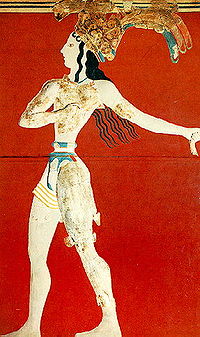
The Prince of the Lilies
Minoan Exiles
Plateau of Lost Souls
Phaestos and Aghia Triada
Sleeping in Graveyards
Before the gates of Excellence.…
Imagine my surprise
In the first class meeting of my Crusade and Jihad course this morning, I said something like this:
You don't have to want to be a Christian crusader in the present, or even be a Christian, to have a vague positive feeling about those old holy wars. For example, the recent movie Kingdom of Heaven by implication condemns some aspects of crusading, especially fanatics who go too far, but does not condemn crusading or Crusaders completely. There are plenty of literary and film examples of this going back to Walter Scott in the early 19th century. This results in the nostalgic feeling that somewhere sometime there was a worthy crusade pursued by sincere people who even if they made some mistakes had good hearts.Then I asked my students if they had any such nostalgic feeling.
Not one said they did.
Image: Richard Lionheart, North Bay seems to have fallen out of love with you...
Saturday, September 10, 2011
Course materials for my students
I have posted course outlines:
Apologies for the ugliness due to the loss of formatting. HTML is so complicated these days that I am going to need expert help just to find the problems.
A taste of revolution
Football fans taunt the police in Cairo:
Discussed in detail and translated at Arabist.net.
Update: Chanting, voting, and ancient church councils.
Discussed in detail and translated at Arabist.net.
Update: Chanting, voting, and ancient church councils.
Labels:
Arab Spring,
Egypt,
favorites 2011,
revolution
Nothing to say but it's ok...
Good morning, good morning!
Friday, September 09, 2011
Egyptian revolutionaries attack Cairo's Israeli embassy
I've called Cairo "Paris, 1791." It may be progressing to Paris, 1792, or even Tehran, 1980--the attack on the US embassy comes to mind, an attack on the hated foreign ally of the Old Regime.
Labels:
Arab Spring,
Egypt,
French Revolution,
Middle East,
revolution
Wednesday, September 07, 2011
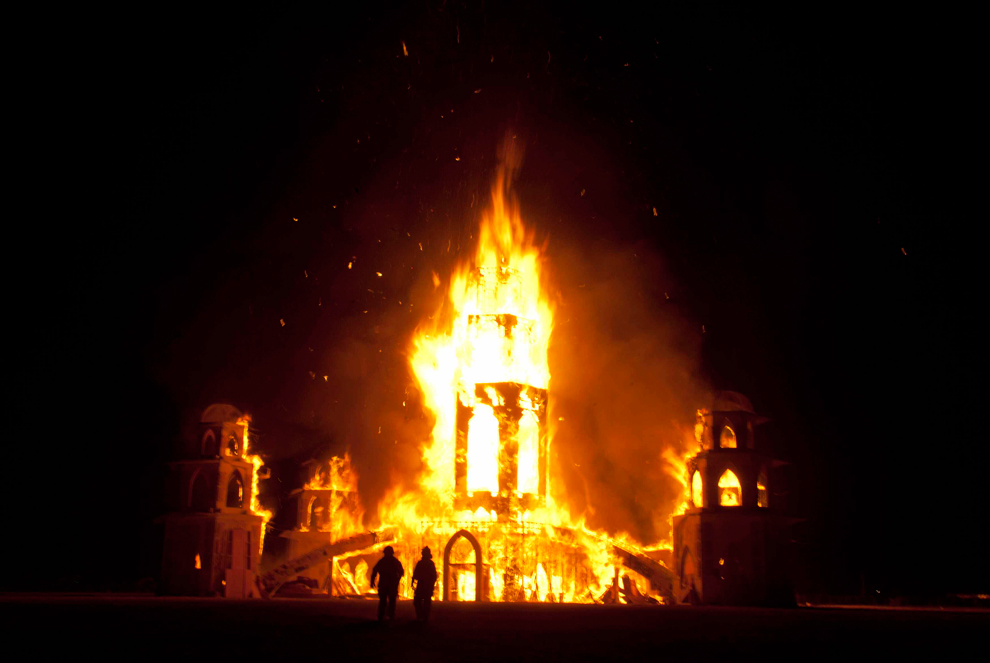
What other people were doing on Labor Day weekend
Labels:
Burning Man,
USA
Tuesday, September 06, 2011
Fighting in the woods
I am there dodging swords. Thanks again to Kyle Andrews.
Labels:
historical re-creation,
SCA
Jack Vance's hadaul, done SCA style as "Mordain's Rings"
A little medievalesque fun on my back field. Thanks to Kyle Andrews.
Labels:
historical re-creation,
SCA
Phil Paine visits Knossos, at last
His reflections after fulfilling a life-long dream:
I have my owned preferences about interpreting Knossos, but until now they’ve been based on photographs, written descriptions, and site plans. These second-hand things give little feeling for the three-dimensional reality. It was only after examining every corner of the real site that I could confidentially feel confirmed in my own interpretations. I am convinced that the “palace” of Knossos was no palace. The Minoan state of Knossos may or may not have had kings, but if they did, this complex was not an expression of it. It is nothing like the royal palaces of Mesopotamia.
The most discussed part of the complex is the Central Plaza, which Evans visualized as a palace courtyard, and the venue for the bull-leaping portrayed in Minoan art. The plaza seems singularly impractical for such an activity, but it is not impossible. Whatever ceremonies were performed there, it seems to me unlikely that they were primarily for the entertainment of a king, queen and court. Communal feasting seems more likely. Perhaps the bull-leaping was done elsewhere, and the bull brought to the plaza for sacrifice. Large quantities of cups have been found, to delicate for normal use, and there are other signs of large-scale cooking.
The most important alternative explanation of the primary purpose of the complex has been that it might have been a monastic complex. There are striking analogies in its layout to monastic complexes in Tibet (which also focus on a rectangular plaza), or the medieval European monasteries (which also had extensive storage and workshop facilities). I think this is closer to the truth, but I would take the argument a step further. At one point, I turned to Filip and said: “This is an Agora.”
Everything about the place says “Agora” to me. In my mind’s eye, I can see a market place (gr. agora), springing up between two or small sacred places that have turned into sanctuaries and places of pilgrimage. These gradually evolved into shrines served by priestesses, and eventually into a complex of monastic institutions, but always maintaining the central open space for a mixture of commercial, ritual, judicial, and political use. There is no one overwhelming sacred place, as with a Cathedral or a Mesopotamian temple. There is no one central audience hall where a king could overawe his subjects. The structure which Evans imagined to be a royal throne room is completely inappropriate for such use. It’s a small room, with a small chair set against the longest wall, at floor level. The “throne” faces a narrow space partly filled with some kind of offering bowl. Nobody ever built throne rooms like that. The aesthetics is overwhelmingly intimate and religious, not monarchical. No king who could command the impressive resources of so wealthy a state would be content with such a dinky little room, in which he could impress no one. All over the complex, there are no murals conveying kingly power and authority, nothing saying “look on this, ye mighty, and despair.” There are only pictures of flowers, children playing games, dolphins leaping in the sea, farmers harvesting their crops, athletes, elegant ladies, pets, and so on. The architectural feature are everywhere consistent with domestic, commercial, and small-scale religions uses.
At some points in time, the whole complex seems to have been consolidated or rebuilt by a uniform plan, but that is quite possible in a non-monarchical context. The Agora of Athens underwent such a process under democratic rule.
Which brings us to the intriguing possibility that Knossos, and the other Minoan cities such as Malia, Phaestos, and Gortyn might have been republics of some kind. Of course, no proof exists for such a hypothesis, but no proof exists for Evan’s royalist interpretation, or subsequent priestly theories. The level of evidence simply does not permit any certainties. Only the possibility of deciphering the Linear A or the hieroglyphic texts holds any hope for that. But I think that a republican interpretation has been resisted by archaeologists and historians under the influence of dubious assumptions about linear social evolution.
The emergence of republican state institutions in the 18th and 19th centuries was partly inspired and harked back to Medieval and Renaissance republics, though the continuity between them was slim stuff, and largely dependent on folkloric institutions below the state level. The Medieval republics similarly harked back to the Classical republics of Greece and Rome, though again the continuity was ephemeral. It may be that the Democracy that emerged in the Greek polis of the fourth century BC was itself harking back to remote precedents in the Bronze Age.
Before coming here, I had no clear notion of the broader physical setting of Knossos. The “palace” was surrounded by a large (by Bronze Age standards) city, of which we know very little. There were some large outlying structure, and probably a network of villages subservient to, or integrated with the city. There were roads which led directly to the central plaza — another feature that suggests an Agora. It’s only when you stand in them that you grasp that they were as technically advanced as anything the Romans built. The plaza is aligned with the region’s most dramatic looking mountain peak. It is in a valley of fabulous agricultural potential. The surrounding hills are terraced, and from what I gather the terraces, constantly rebuilt, were there in Minoan times. This valley in turn was part of a system of broad, fertile valleys and plains that dissects the island of Crete, with other major Minoan sites scattered in it. This area is extraordinarily beautiful. The Neolithic agricultural “package” of domestic animals and crops would have supported a very high standard of living, and combined with fishing and sea trade would have made life very sweet by ancient standards. The murals don’t seem to lie.
We returned to Iraklion and visited its Archaeological Museum. This was almost as great a pleasure as Knossos itself. It contains most of the famous artifacts unearthed at Knossos. It’s only when you see them in real life that you can fully appreciate them. Some are of great beauty. Some are just delightful, like the toy or model house, which is so detailed and obviously intended to be realistic that we can confidently picture what Minoan houses actually looked like. The famous murals are there. You can imagine my delight at being photographed in front of the “Prince of the Lilies” mural that adorned my website for years.
Image: the mural.
I have my owned preferences about interpreting Knossos, but until now they’ve been based on photographs, written descriptions, and site plans. These second-hand things give little feeling for the three-dimensional reality. It was only after examining every corner of the real site that I could confidentially feel confirmed in my own interpretations. I am convinced that the “palace” of Knossos was no palace. The Minoan state of Knossos may or may not have had kings, but if they did, this complex was not an expression of it. It is nothing like the royal palaces of Mesopotamia.
The most discussed part of the complex is the Central Plaza, which Evans visualized as a palace courtyard, and the venue for the bull-leaping portrayed in Minoan art. The plaza seems singularly impractical for such an activity, but it is not impossible. Whatever ceremonies were performed there, it seems to me unlikely that they were primarily for the entertainment of a king, queen and court. Communal feasting seems more likely. Perhaps the bull-leaping was done elsewhere, and the bull brought to the plaza for sacrifice. Large quantities of cups have been found, to delicate for normal use, and there are other signs of large-scale cooking.
The most important alternative explanation of the primary purpose of the complex has been that it might have been a monastic complex. There are striking analogies in its layout to monastic complexes in Tibet (which also focus on a rectangular plaza), or the medieval European monasteries (which also had extensive storage and workshop facilities). I think this is closer to the truth, but I would take the argument a step further. At one point, I turned to Filip and said: “This is an Agora.”
Everything about the place says “Agora” to me. In my mind’s eye, I can see a market place (gr. agora), springing up between two or small sacred places that have turned into sanctuaries and places of pilgrimage. These gradually evolved into shrines served by priestesses, and eventually into a complex of monastic institutions, but always maintaining the central open space for a mixture of commercial, ritual, judicial, and political use. There is no one overwhelming sacred place, as with a Cathedral or a Mesopotamian temple. There is no one central audience hall where a king could overawe his subjects. The structure which Evans imagined to be a royal throne room is completely inappropriate for such use. It’s a small room, with a small chair set against the longest wall, at floor level. The “throne” faces a narrow space partly filled with some kind of offering bowl. Nobody ever built throne rooms like that. The aesthetics is overwhelmingly intimate and religious, not monarchical. No king who could command the impressive resources of so wealthy a state would be content with such a dinky little room, in which he could impress no one. All over the complex, there are no murals conveying kingly power and authority, nothing saying “look on this, ye mighty, and despair.” There are only pictures of flowers, children playing games, dolphins leaping in the sea, farmers harvesting their crops, athletes, elegant ladies, pets, and so on. The architectural feature are everywhere consistent with domestic, commercial, and small-scale religions uses.
At some points in time, the whole complex seems to have been consolidated or rebuilt by a uniform plan, but that is quite possible in a non-monarchical context. The Agora of Athens underwent such a process under democratic rule.
Which brings us to the intriguing possibility that Knossos, and the other Minoan cities such as Malia, Phaestos, and Gortyn might have been republics of some kind. Of course, no proof exists for such a hypothesis, but no proof exists for Evan’s royalist interpretation, or subsequent priestly theories. The level of evidence simply does not permit any certainties. Only the possibility of deciphering the Linear A or the hieroglyphic texts holds any hope for that. But I think that a republican interpretation has been resisted by archaeologists and historians under the influence of dubious assumptions about linear social evolution.
The emergence of republican state institutions in the 18th and 19th centuries was partly inspired and harked back to Medieval and Renaissance republics, though the continuity between them was slim stuff, and largely dependent on folkloric institutions below the state level. The Medieval republics similarly harked back to the Classical republics of Greece and Rome, though again the continuity was ephemeral. It may be that the Democracy that emerged in the Greek polis of the fourth century BC was itself harking back to remote precedents in the Bronze Age.
Before coming here, I had no clear notion of the broader physical setting of Knossos. The “palace” was surrounded by a large (by Bronze Age standards) city, of which we know very little. There were some large outlying structure, and probably a network of villages subservient to, or integrated with the city. There were roads which led directly to the central plaza — another feature that suggests an Agora. It’s only when you stand in them that you grasp that they were as technically advanced as anything the Romans built. The plaza is aligned with the region’s most dramatic looking mountain peak. It is in a valley of fabulous agricultural potential. The surrounding hills are terraced, and from what I gather the terraces, constantly rebuilt, were there in Minoan times. This valley in turn was part of a system of broad, fertile valleys and plains that dissects the island of Crete, with other major Minoan sites scattered in it. This area is extraordinarily beautiful. The Neolithic agricultural “package” of domestic animals and crops would have supported a very high standard of living, and combined with fishing and sea trade would have made life very sweet by ancient standards. The murals don’t seem to lie.
We returned to Iraklion and visited its Archaeological Museum. This was almost as great a pleasure as Knossos itself. It contains most of the famous artifacts unearthed at Knossos. It’s only when you see them in real life that you can fully appreciate them. Some are of great beauty. Some are just delightful, like the toy or model house, which is so detailed and obviously intended to be realistic that we can confidently picture what Minoan houses actually looked like. The famous murals are there. You can imagine my delight at being photographed in front of the “Prince of the Lilies” mural that adorned my website for years.
Image: the mural.
Thursday, September 01, 2011
More ominously from Syria
Again from Anthony Shadid:
Abdullah represents what the government insists it is fighting. He is a Salafist, an adherent to a puritanical Islam, though he disavows the term. To him, Salafists bear arms, and he understands that the moment he and others fire a bullet in Homs or anywhere else, the regime will have the justification it covets to crush them with even more force. But there was no question of his devotion to a state that adheres to Islam as its foundation, and he dismissed the comparatively liberal rhetoric of some Islamic activists, like the Muslim Brotherhood. “They want to satisfy the West, and they don’t want to satisfy Muslims,” he told me the next morning. “They say, ‘We’re a modern Islam.’ But there’s no such thing as modern Islam. There’s Islam, and there’s secularism.” We debated the imposition of religious law and whether Christians and Muslims could intermarry. For the first time since I met him, Abdullah grew angry at me, when I suggested that no Christian or Alawite would subscribe to his vision of the state he would build in the wake of the revolution. He quickly cooled, aware that he shouldn’t show his emotions. At one point, he even suggested that however he might feel, however draconian he believed religious law should be, he was still a minority in the opposition. As much as the activists here talk of unity in the face of government oppression, I often felt as I did in Iraq in those early months after the American invasion in 2003. The more people denied their differences, the more apparent they became. For Iyad, Abdullah and others, there was deep anger at Hezbollah, the Lebanese Shiite movement that has baldly supported the Syrian regime. That anger had spilled into chauvinism against Shiite Muslims, intensifying the hostility they already felt for Alawites. They understood the importance of nonviolence, but even Abdullah admitted that if Assad fell, sectarian vendettas would erupt in the countryside. One of the young men warned darkly that events “were headed toward violence.”
Labels:
Arab Spring,
Islam,
religious history,
Syria
Subscribe to:
Posts (Atom)