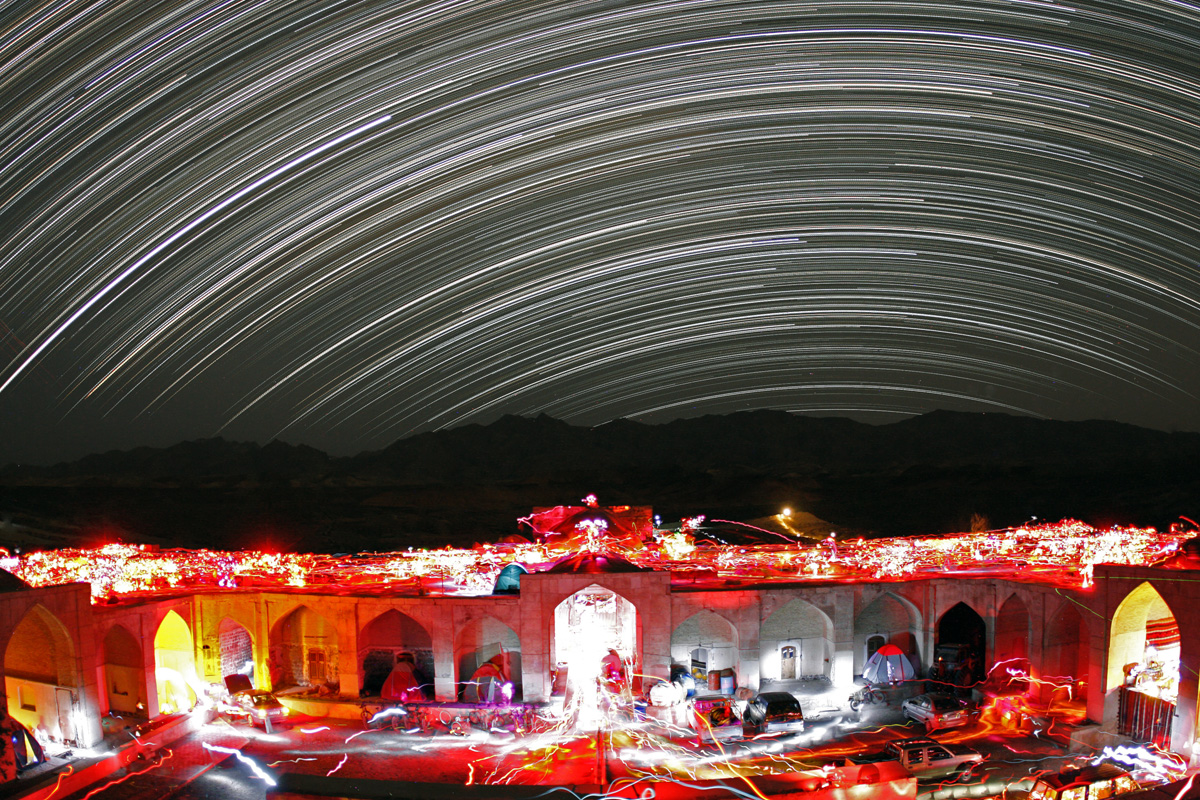
 It's beyond me to explain. Go here, though, and check it out.
Saturday, April 19, 2008
What is this and what does it represent?
It's beyond me to explain. Go here, though, and check it out.

Friday, April 18, 2008
How on earth do you find these things?

I asked that question of Will McLean, author of A Commonplace Book, when he came up with an obscure trove of information about historic archery. He was kind enough to answer the question in this post.
The essence of the post is here:
In trying to recreate the Middle Ages, the 17th and 18th c. are useful places to look for hints if you can't find the information in a medieval source. It’s not perfect, but a lot better than using your enormous 21st c. brain to attempt to deduce things you don’t know from first principles. Diderot’s Encyclopedie was a great help to me in trying to recreate medieval scabbards, for example.
Will knows whereof he speaks. He has seen many enormous re-enacting brains come a-cropper, some as long ago as the 20th century, and has done lots of good work using, you know, scholarship.
A list of some of his favorite resources is here.
Image: Will, in one fabulous suit of armor.
A simple pleasure

One inobvious pleasure of being a professor is that I am introduced in every year and in every course to a list of student names. I have always loved the variety of names, their history, their idiosyncrasies. And some names are just pleasant.
Some of what I'm talking about is probably pretty obvious. I get to watch the name fads of 20 years ago march across my class lists, climb into prominence, peak, then fade out or perhaps make a comeback. Right now in Ontario the name Kaitlin ( various spellings) is coming on strong, while Jason seems to be less popular in my student cohort than it was a few years ago. I get to note such facts as the astonishing frequency of Francophone surnames among Ontarians people who probably don't think of themselves as Francophones -- at least their French is nonexistent. (And no, few of them are from Northern Ontario, where you might expect this.) Occasionally someone with a fictional or historical name of some fame shows up in my classes.
But the most fun of all is finding beautiful and unusual names in a class list. What I mean is, names that aren't obviously common in any language I know, that to me are just beautiful syllables, about which one can endlessly speculate. Are they in fact names that are common someplace unfamiliar to me, or are they made up by people with a lot of taste?
This year was a good one for the simply beautiful. Unfortunately, I can't share them with you, certainly not in this forum. That would be a terrible abuse of people's privacy. But there is nothing to stop you from looking around your wordy environment for this simple pleasure.
Image: names as inversions by Scott Kim, puzzlemaster.
Tuesday, April 15, 2008

Monday, April 14, 2008
What I should have talked about in the last World History lecture
I have concluded that I missed an opportunity to discuss two important issues in the last World History lecture last Monday. I blame it on end-of-term fatigue.
The first of these issues is the coming global famine. I walked into the room wanting to say something about this, which reading the Egyptian news at Al-Ahram had alerted me to. Food prices have gone up for a while and now reasonably stable if not very prosperous countries like Egypt are being hit hard. Since Monday, I've read a lot more. Here is a detailed article from the Wall Street Journal, and here are Phil Paine's remarks at his blog (April 13 post). The Journal blames the rise on commodity prices, which is just code for oil; thus the food crisis is another indirect effect of the Iraq war.
The second issue I did mention briefly, in connection with the international criminal court in the Hague. The United States, extremely imperfectly, has provided leadership in the post-World War II world and various public and especially private initiatives originating there have had a positive effect. We cannot depend upon that anymore. Not only has the USA abandoned the multilateral approach to world peace, the need for which was so evident after both world wars, it has become a great danger to that peace, not in just one place or region, but everywhere its influence reaches. This post at the blog Empire Burlesque -- Too Much of Nothing: Crime Without Punishment, War Without End -- pretty much catches my mood. I'm not sure there will be an attack on Iran, but even without that concluding bit, things are quite bad enough as it is.
One of my more attentive students challenged me privately after the last lecture for my doom and gloom view of recent events. Actually, I felt I was softening the blow. I am afraid we will see just how much damage a modern superpower without a moral compass can do, to itself and everyone else.
(Thanks to Atrios at Eschaton for the EB link; that's why I read you, Atrios.)
The first of these issues is the coming global famine. I walked into the room wanting to say something about this, which reading the Egyptian news at Al-Ahram had alerted me to. Food prices have gone up for a while and now reasonably stable if not very prosperous countries like Egypt are being hit hard. Since Monday, I've read a lot more. Here is a detailed article from the Wall Street Journal, and here are Phil Paine's remarks at his blog (April 13 post). The Journal blames the rise on commodity prices, which is just code for oil; thus the food crisis is another indirect effect of the Iraq war.
The second issue I did mention briefly, in connection with the international criminal court in the Hague. The United States, extremely imperfectly, has provided leadership in the post-World War II world and various public and especially private initiatives originating there have had a positive effect. We cannot depend upon that anymore. Not only has the USA abandoned the multilateral approach to world peace, the need for which was so evident after both world wars, it has become a great danger to that peace, not in just one place or region, but everywhere its influence reaches. This post at the blog Empire Burlesque -- Too Much of Nothing: Crime Without Punishment, War Without End -- pretty much catches my mood. I'm not sure there will be an attack on Iran, but even without that concluding bit, things are quite bad enough as it is.
One of my more attentive students challenged me privately after the last lecture for my doom and gloom view of recent events. Actually, I felt I was softening the blow. I am afraid we will see just how much damage a modern superpower without a moral compass can do, to itself and everyone else.
(Thanks to Atrios at Eschaton for the EB link; that's why I read you, Atrios.)
Sunday, April 13, 2008
Democracy vs. Crime: Phil Paine's Sixth Meditation on Democracy, part one

This is the best of Phil Paine's meditations yet.
Here's the key passage, I think:
Democracy is a mode of human social interaction that can be practiced by any human group, of any size, with any type of technology, and at any time or place.
Democracy is a product of human intelligence and creative imagination, in the same way that technology, art, and music are. These fields of human creativity are the direct consequences of human faculties, not passively determined by environment. In other words, human sculpture in wood comes about because of a built-in need of humans, as conscious, thinking, and self-aware beings, to manipulate physical objects for representational and symbolic purposes. It is not merely a side-effect of the availability of wood. If wood is not available, then the impulse to carve will find another object, such as bone, stone, clay, or even the human body itself. Similarly, democracy is a product of the profoundest creativity in human nature, the ability to grasp that other human beings are not merely external objects, but conscious beings, similar and equal to oneself. Consequently, democracy cannot be explained as the result of temporary conditions, such as population density, climate, resource limits, birthrates, or modes of production, though these variables may influence its application.
The purpose of democracy is to promote and protect the well-being of humans, while its opponent principle, crime (warfare, caste systems, hereditary privilege, tyranny, aristocracy, dictatorship, theocracy, and totalitarian ideology) is pathological. Thus the relationship of democracy to the “political” concepts subsumed in crime is similar to that of the healthy organism to infectious disease. The relationship is one of constant strategy and counter-strategy, innovation and adaptation, with the predators on humanity exploiting every novel condition as an “opening” to establish their infection. Thus, political crime, embodied in caste, aristocracy, or kingship, is “normal” and “natural” to human societies, in the same sense that infectious disease is endemic to it. That “normalcy” does not mean that crime is either desirable, or that we should passively tolerate it. Democratic thought and action constitute the practical strategy for surviving the pathology of tyranny, just as understanding biology and practicing cleanliness are the practical strategy for surviving the ever-variant assaults from disease.
Those of you interested in American politics may want to compare Phil's analysis to this front-page post at Daily Kos.
The first blackfly of spring!
Arrgh!
A late snow has covered everything in white, but the bright sun is bringing out early blackflies ANYWAY!
Image: a T-shirt design from a nearby town.

A late snow has covered everything in white, but the bright sun is bringing out early blackflies ANYWAY!
Image: a T-shirt design from a nearby town.

Holy Lance Church in Armenia
 Many people know that the discovery of the Holy Lance in Antioch saved the First Crusade. Today English Russia posted several pictures of an alternate site for the Holy Lance, at a church in Armenia. I've also heard the Lance was at Constantinople (which led some churchmen at Antioch during the crusade to doubt the reality of the just-discovered one).
This rather odd art looks strangely familiar to me. What am I thinking of? Readers?
Lies by omission
The Group News Blog says it:
And the story can barely be found even on Google News.
When people bemoan the Internet-induced death of quality journalism, remember this. The quality journalists, and they exist, are not allowed to do their work if the topic is really vital.
...the most shocking thing this weekend is the complete silence from the corporate media on this. 6 of the top people in the Bush administration were meeting for over a year, in the White House, to discuss torture techniques and the President knew and approved of it.
And the story can barely be found even on Google News.
When people bemoan the Internet-induced death of quality journalism, remember this. The quality journalists, and they exist, are not allowed to do their work if the topic is really vital.
Cellphone world

Here is an article from the New York Times Magazine that's so interesting I wanted to copy the whole thing into my blog. on one level, it's about Jan Chipchase, has one of the most interesting jobs in the world, and for that alone it's worth reading. more broadly, it's about how the mobile phone, or improved communications, can make a huge difference not only to the global poor, but everybody else as well.
Catch this:
Jan Chipchase and his user-research colleagues at Nokia can rattle off example upon example of the cellphone’s ability to increase people’s productivity and well-being, mostly because of the simple fact that they can be reached. There’s the live-in housekeeper in China who was more or less an indentured servant until she got a cellphone so that new customers could call and book her services. Or the porter who spent his days hanging around outside of department stores and construction sites hoping to be hired to carry other people’s loads but now, with a cellphone, can go only where the jobs are. Having a call-back number, Chipchase likes to say, is having a fixed identity point, which, inside of populations that are constantly on the move — displaced by war, floods, drought or faltering economies — can be immensely valuable both as a means of keeping in touch with home communities and as a business tool. Over several years, his research team has spoken to rickshaw drivers, prostitutes, shopkeepers, day laborers and farmers, and all of them say more or less the same thing: their income gets a big boost when they have access to a cellphone.Or this:
Ugandans are using prepaid airtime as a way of transferring money from place to place, something that’s especially important to those who do not use banks. Someone working in Kampala, for instance, who wishes to send the equivalent of $5 back to his mother in a village will buy a $5 prepaid airtime card, but rather than entering the code into his own phone, he will call the village phone operator (“phone ladies” often run their businesses from small kiosks) and read the code to her. She then uses the airtime for her phone and completes the transaction by giving the man’s mother the money, minus a small commission. “It’s a rather ingenious practice,” Chipchase says, “an example of grass-roots innovation, in which people create new uses for technology based on need.”It’s also the precursor to a potentially widespread formalized system of mobile banking. Already companies like Wizzit, in South Africa, and GCash, in the Philippines, have started programs that allow customers to use their phones to store cash credits transferred from another phone or purchased through a post office, phone-kiosk operator or other licensed operator. With their phones, they can then make purchases and payments or withdraw cash as needed. Hammond of the World Resources Institute predicts that mobile banking will bring huge numbers of previously excluded people into the formal economy quickly, simply because the latent demand for such services is so great, especially among the rural poor. This bodes well for cellphone companies, he says, since owning a phone will suddenly have more value than sharing a village phone. “If you’re in Hanoi after midnight,” Hammond says, “the streets are absolutely clogged with motorbikes piled with produce. They give their produce to the guy who runs a vegetable stall, and they go home. How do they get paid? They get paid the next time they come to town, which could be a month or two later. You have to hope you can find the stall guy again and that he remembers what he sold. But what if you could get paid the next day on your mobile phone? Would you care what that mobile costs? I don’t think so.”
Watch out, banks!
On a day when I'm angry that no one cares about the torture memos or the torture meetings in the White House, it's nice to have some good news.
Image: from Jan Chipchase's blog Future Perfect, from a post on using mobile communications to publicize human rights abuses.Saturday, April 12, 2008
In Marca Hispanica -- the series

Jonathan Jarrett is the author of a blog called A Corner of 10th-century Europe. Its appeal time for me is that it's an academic blog that is primarily about scholarship but is charming nonetheless. Not to mention well illustrated (see above). The corner of Europe the title refers to is Catalonia in northeastern Spain. The documentation for this corner, as for other areas in this time, is mostly charter evidence for the transfer of property by important people. From this kind of evidence, scholars like Jarrett try to reconstruct the society of the time.
Recently, I'm not sure when, Jarrett traveled through present-day Catalonia to consult archives and see the country. Lots of medieval buildings and street-scapes still exist there. He's been recording the trip on his blog and just recently concluded the series. I like the series well enough that I am putting links to its episodes in the order that the posts were written. The reason? If I said, "go to the blog and read these posts," few would have the patience to go backwards through the blog and find them. This is the disadvantage of the blog format. But if I list the links here maybe a few will actually read the series. If you are a scholar or a fan of scholarship, do not miss the very last episode.
Note: the first In Marca Hispanica post does not tell us when exactly this trip took place. Hey, it began life as a blog entry among other blog entries.
The series:
In Marca Hispanica I: Girona
In Marca Hispanica II: Barcelona from Romans to Gaudí
In Marca Hispanica III: cartoon nationalism
In Marca Hispanica IV: Sacalm and Tona, and nationalist sentiment 889-2008
In Marca Hispanica V: Vic (charters, cathedrals, metal bishops and stone slabs)
In Marca Hispanica VI: Plana de Gurb (but not the castle)
In Marca Hispanica VII: Besalú and its rainy gardens
In Marca Hispanica VIII: pilgrimage to see Emma
In Marca Hispanica IX: actual charter scholarship
Preparing for HIST 3805 -- "History of Islamic Civilization" (Fall-winter 2008-9)

I have this fantasy that some of my students are interested -- or will be, once final exams are over -- in some gentle preparation for fall courses. Bear with me here -- it's a harmless fantasy. It originates in my own work habits. If I don't prepare well in advance for my part in the courses, I know that books won't be ordered in time, handouts won't be finished, and my brain won't be on track. So I've actually been thinking about fall courses, especially my new Crusade and Jihad course (HIST 3116) and a possible restructuring of Islamic Civilization (HIST 3805) for quite a while.
I repeatedly think about the Quran. It certainly would be an advantage to any student in either of those two classes to read the holy book of Islam before they walked into the classroom. But I've only read it straight through myself once because it's long enough and difficult enough that I just can't seem to fit it in.
I have thought yesterday, however. Why not look on the web for a site that leads you through a reading of the Quran day by day? I looked, but found no sites that I liked. However, I did find one that provides a recitation of an English translation of the Quran on a daily basis. There is something very appealing about this approach; after all, the Quran was originally revealed through recitation and was only written down after the Prophet's death.
So, students and other readers, I invite you to join me in listening to the Quran for six minutes every day. Surely, you often find yourself sitting in front of a computer with six extra minutes to waste?
Warning: Don't expect the Quran to be like the Gospels or the historical books of the Old Testament. It's not a story, it's a series of divine revelations, which when they were written down were not arranged in chronological order. if you want a straightforward history of the Prophet and his mission, you need to go elsewhere. What you are getting here is the message of the Messenger. And what you may gain is a feeling for the religion that goes beyond a historical account.
Thursday, April 10, 2008
"History will not judge this kindly."
You bet.
ABC News reports that we now know who in the US government approved torture. Watch this:
I am sorry not to have a more cheerful subject to break my grading-related blogging silence, but some things need to be spoken immediately.
I rather like the statement by Colin Powell that implies he might not be able to remember discussions of the sort reported. You are a real hero, Colin. An example to the children of America. (That link not for those who are creeped out easily.)
Update: For those of you who care about the Constitution, see this (from talkingpointsmemo.com).
ABC News reports that we now know who in the US government approved torture. Watch this:
I am sorry not to have a more cheerful subject to break my grading-related blogging silence, but some things need to be spoken immediately.
I rather like the statement by Colin Powell that implies he might not be able to remember discussions of the sort reported. You are a real hero, Colin. An example to the children of America. (That link not for those who are creeped out easily.)
Update: For those of you who care about the Constitution, see this (from talkingpointsmemo.com).
Saturday, April 05, 2008


Spring treat
 It feels like spring here at last, but it was still possible to skate on a runoff pond this morning. I'll bet the sap is running fast today.
Friday, April 04, 2008
Walking across Mars
 According to Astronomy Picture of the Day, if you could stay warm and breathe, it wouldn't take long at all to cross this interesting rock formation on Mars. For a discussion of this landscape, Aureum Chaos, see this page.
Appalling
 English Russia has some appalling pictures of an abandoned library. I wonder what the story behind this is?
Thursday, April 03, 2008
Checking out the archives of Vic
At any good university the historians insist that students use original sources. But only a few early medieval historians get to use sources like this in their original form:
 The archive in question is in Vic, in Catalonia (which may be in Spain, depending on who you ask).
Also in Vic is this modern statue 11th century bishop Oliba, which symbolizes his connection to the Peace and Truce of God, which students in HIST 3116 next fall will be learning about to their complete satisfaction.
Thanks to Jonathan Jarrett at A Corner of Tenth-Century Europe who had entirely too much fun in the archives.

 The archive in question is in Vic, in Catalonia (which may be in Spain, depending on who you ask).
Also in Vic is this modern statue 11th century bishop Oliba, which symbolizes his connection to the Peace and Truce of God, which students in HIST 3116 next fall will be learning about to their complete satisfaction.
Thanks to Jonathan Jarrett at A Corner of Tenth-Century Europe who had entirely too much fun in the archives.

Human rights, religious freedom, and tolerance in Canada
Phil Paine has written at philpaine.com an essay on a human rights case in Toronto entitled Distinguishing between real and fake human rights issues. followed the link and page down Wednesday, April 2, 2008.
Although Phil does not have a comment section on his website, he encourages replies from his readers. Drop him a line.
Although Phil does not have a comment section on his website, he encourages replies from his readers. Drop him a line.
Wednesday, April 02, 2008
Back in the field, April 2, 2008
I'm pining for some warm weather and some real Spring green, but there is something fascinating about the process of snow melting, forming pools, and then freezing over again. The hollow we use for our Labour Day get-together filled with rain and run-off yesterday and soldified into what looks like a perfect natural rink. (I doubt that it's strong enough to skate on, though.)
The pictures below show the Viking forge, the barrier (at the moment disassembled) for foot combats, and one of our dogs -- or is it a bear? -- in front of same barrier.


The pictures below show the Viking forge, the barrier (at the moment disassembled) for foot combats, and one of our dogs -- or is it a bear? -- in front of same barrier.


Canada is at war

Canada is at war, and has been for a long time. Like a lot of people, perhaps, I have had a hard time coming to grips with this. In my case, I've been distracted by the rolling catastrophe in Iraq, and in the United States.
Today I came to grips with my "Afghanistan War avoidance syndrome" and started looking at something that's been staring me in the face for days, every time I've gone to the Globe and Mail site. There you and I can find the results of an astonishing journalistic project, especially astonishing in this era where a mostly corrupt and stupid US press sets the tone.
The project is called Talking to the Taliban, and that title describes it well. Reporter Graeme Smith commissioned an unnamed interviewer to put a list of 20 standardized questions to 42 Taliban fighters. As Smith says, not all of the individual answers are very enlightening, but the procedure had the advantage of being an effort to create a systematic picture. People who call themselves "oral historians" do things like this, but journalists?
I'm impressed. My reactions to the content later.
Resurrection of the Iraqi National Museum
Five years ago, during the invasion, the enormously significant archaeological collection at the Iraqi National Museum was plundered. (I'm sure there is a big story behind that plundering, not that we are likely ever to know it.)
Now, some good news: progress is being made towards restoration. The Globe and Mail has a short video report here.
Now, some good news: progress is being made towards restoration. The Globe and Mail has a short video report here.
Tuesday, April 01, 2008

Monday, March 31, 2008
Mississauga and New Orleans
 Phil Paine has a new essay at his site: The Poisoning of a People (page down to the entry for Saturday, March 29, 2008).
The Mississauga disaster he refers to was handled so well that people in downtown Toronto, like me, were hardly affected, when indeed it could have disrupted the entire metropolitan area.
Image: The Mississauga train derailment.
Update: After reading Phil's piece, read this.
Heroes of medieval historical research
 Perhaps because I am teaching communism at the same time as the history of medieval England, I am minded to award to my students in HIST 3425 the heretofore unheard of award, "Heroes of Medieval Historical Research, Undergraduate Class," for unprecedented efforts in tackling the Parliamentary Rolls of Medieval England.
PROME is a wonderful resource, a CD/online searchable edition of all the medieval records of parliament from the beginning until they stopped using rolls and started using codices. By then you are well into Tudor times. Nipissing University allowed me to acquire a site license to PROME and so I was able to assign my Medieval England students an essay based on these valuable primary resources. They just finished that assignment.
They are not heroes because they did well on the assignment (how well they did is not your business) but because their diligence in research showed up on the site statistics of the online version of PROME. The publishers (see link above) noticed and wrote to their contact at the NU Library and said, who's making such substantial use of our material? (They were very pleased.) My students had beat the entire scholarly world for the month of March!
Congratulations, heroes!
Saturday, March 29, 2008
Inside Iraq: "They don't think about us"
I'm copying here the most recent blog entry from Inside Iraq, which is part of the excellent McClatchy News site. The writer is an Iraqi employee of this US news service:
If you are still up for it, look at this at another McClatchy blog.
It had been my fourth days in the office. I couldn’t go home since I came on Wednesday. When I tried to go home on Thursday afternoon, I couldn’t find a taxi because of the violence wave that swept Baghdad neighborhoods which pushed the government to announce curfew. In a way or another, I could manage staying in the office in spite of the big pain in my heart. I always think about my son. I miss him so much. I miss hugging him, I missed his sweet kisses on my face, I miss his sweet smile when he sees me, I miss his tears when my wife doesn’t allow him to do whatever he wants and I really love his face when I defend him as if he teases his mother. I was planning to tell my boss that I want to go early tomorrow and I know she wouldn’t mind at all but it looks that planning for more that one hour is impossible in my country. About less than one hour ago and while I was watching a football match with my colleague, our office manager told us that the government decided to extend the curfew until further notice which means I have to stay another night in the office.
When I heard the news, I started thinking seriously about the most important thing. I started thinking about food, not my food but Iraqis food. I’m really surprised with the way our government thinks because it didn’t take in consideration the most important need for the people, the government didn’t ever think about food. Iraqi families are locked in their house for the last four days; they didn’t store much food because they never expected such a curfew. The food that the families usually store might be enough for two days as a maximum. The markets are empty since the second day of the curfew. It looks that our great government forgot that not all the Iraqis are prime minister or high rank officials or it may believe that Iraqis use the solar power to live. It looks that our politicians never read history; they never realize that hungry stomachs are timed bombs that may explode any moment.
Come on our great politicians, we don’t have the money you have, we don’t have the power you have and more than that, we have real human hearts not politicians hearts.
Remember this: "It looks that our politicians never read history; they never realize that hungry stomachs are timed bombs that may explode any moment."
If you are still up for it, look at this at another McClatchy blog.
Friday, March 28, 2008
This could be Canada

This could be my township! But it's ice fishers in Russia rescuing cars and snowmobiles that went just a little too far.
Thursday, March 27, 2008
"I'm new in town; I've been here 17 years."
I got to say that today at a township zoning committee meeting tonight, where I spoke against a proposed drag strip all too close to my house.
It was a bit of a laugh line but I thought it was necessary to say it since my neighbors were getting increasingly irritated by outsiders from the Big Bad City down the highway telling them what a great idea this was. And no one would mistake me for a born-and-bred inhabitant of the township.
But it seems that the vast majority of my neighbors and I are on the same wavelength on this issue.
It was a bit of a laugh line but I thought it was necessary to say it since my neighbors were getting increasingly irritated by outsiders from the Big Bad City down the highway telling them what a great idea this was. And no one would mistake me for a born-and-bred inhabitant of the township.
But it seems that the vast majority of my neighbors and I are on the same wavelength on this issue.

Wednesday, March 26, 2008
Tour Barcelona on foot with a medievalist
 Long ago I had a day in Barcelona in the spring; it was indeed a beautiful city, and I remember people doing circle dances before the medieval cathedral.
Now Jonathan Jarret, who researches this area specifically and blogs about it at A Corner of Tenth-Century Europe, is enjoying the city, even if he is missing all the hot nightspots. If you want a happier cityscape than Baghdad's, have a look at his most recent post, In Marca Hispanica II.
Image: Barcelona's other, modern cathedral.
Two conferences at Nipissing University, March 28, 29
Dr. Katrina Srigley announces the Third Annual Community History Conference:
The History Department and The Institute for Community Studies and Oral History are pleased to announce the Third Annual Community History Conference - Histories of the Near North: Remembering Our Community. (View program)
Students, faculty, and local historians will be presenting their research on the history of North Bay.
When: 8:30-4:30, Friday March 28, 2008
Where: M106, Monastery Hall
Refreshments and lunch will be served.
We hope to see you there!
And that same evening, in the same place, Nipissing University's first Undergraduate Research Conference will begin (6:30 Registration, 7:00 wine and cheese welcome); it continues on Saturday, 8:30 am to 3 pm. More details and a full program available online.
Tuesday, March 25, 2008
Today! James Murton speaks today on BC Environmental History, 6 pm, Weaver Auditorium
Dr. James Murton speaks a 6 pm today in the Weaver Auditorium as part of the NipissingYou speaker series. He describes the subject briefly:
See also: http://www.nipissingyou.ca/speaker-series
The talk considers the draining of Sumas Lake, BC in the 1920s by the
BC government, with the agreement of local landowners. James Scott
argues that when state-directed projects lead to social and
environmental problems it is because the state understands the
environment (and society) in an overly simplified way. I argue that
the landowners’ support of the project, despite its cost and their
meager gains, suggests that the problems of the project lay less in
the limitations of the state than in a widely held cultural discourse
of a progressive countryside and an orderly nature.
The talk is derived from material that has just been published in the
journal Environmental History.
See also: http://www.nipissingyou.ca/speaker-series
Hilary Earl speaks on the Nuremburg process, March 26, 3:30 pm, A 148
From Dr. James Murton:
The History Department Seminar Series finishes its season with our own Dr. Hilary Earl, speaking on “Crime and Punishment: The Nuremberg SS-Einsatzgruppen Trial in Historical Perspective.” She will speak on Wed. March 26, 3:30 pm in room A148.
Hilary's presentation is based on her forthcoming book, which examines the trial of twenty-four SS- Einsatzgruppen leaders (the Nazi killing units deployed in the occupied Soviet Union in the summer of 1941) by the United States government after World War II. Ultimately, the book is an examination of the strengths and weaknesses of the Nuremberg legal system to contend with the crime of genocide in the aftermath of the war.
Refreshments will be served.
Locked in gravitational combat for the last billion years
 Astronomy Picture of the Day shows galaxies M81 and M82 revolve around each other, setting of huge gravitational effects; M82 (R) is glowing in the X-ray range. As always with these APoD views, you can click on the picture and get a much more impressive image.
Monday, March 24, 2008
The tide goes in, the tide goes out

In the Himalayan kingdom of Bhutan, the first national election has replaced the monarchy with a democratic government. The originator of this movement is the last-but-one king Jigme Singye Wangchuck, who according to the Washington Post,
had taken methodical steps to give power to the people, saying that he believed no leader should be "chosen by birth instead of merit."
He also launched a movement called Gross National Happiness,a " development philosophy of grass-roots health, education and environmental programs."
The election turn-out was high. Good luck, Bhutan.
In the meantime in the United States of America, presidential candidate Hillary Clinton has proposed that the country needs not only a Commander-in-Chief but a Commander-in-Chief of the economy. An excerpt from a Philadelphia speech reported at Talkingpointsmemo.com:
So we need a president who can restore our confidence, a president who is ready to confront complex economic problems with comprehensive solutions, a president who will act at the first signs of trouble, working with experts to identify the problem, with agencies to adapt regulations, with Congress to pass necessary legislation, working to prevent crises rather than just reacting too little too late. We need a president who is ready on day one to be Commander-in-Chief of our economy.
Good luck, USA.
Image: Tiger's Nest monastery, from Buddhanet.net.

Saturday, March 22, 2008
History of Printing

Dee Barizo has alerted me to a commercial British site Cartridge Save, which includes a rather neat section on the The History Of Print: From Phaistos To 3D.
The very first thing in it was a short discussion (with a link to a longer one) of the Phaistos Disc, the sole exemplar of Minoan hieroglyphic script. I know this script, and mention it in lectures, but somehow I'd missed that this was probably produced by some kind of printing process! Must read up on that!
The History of Print has lots of great pictures and a few good videos, including one on the developing process of 3D printing. If you have a hard time visualizing this, you should definitely check it out.
I should mention two processes that I used in my youth, before photocopies got so cheap, that aren't here: dittography and mimeography. If you want a full history of print, these boons to schools and fan publishers should be there. As should East Asian (and particularly Korean) moveable type.
Image: The Phaistos Disc.
Friday, March 21, 2008
Dance your PhD
In celebration of a friend successfully defending a PhD thesis in a medically-related field, I refer you to an article in February's Science which describes and gives video links to the first Dance Your PhD Contest. Enjoy!
Stage Beauty (2004)
 I never heard of this movie until Dr. Cameron McFarlane of Nipissing's Department of English Studies offered a paper on it in the History Department's seminar seried. I couldn't make the seminar, but his abstract was enough for me to hunt down a copy, which I have just watched. Am I ever glad I did. This is a topnotch historical movie with a serious theme but lots of fun, too.
The protagonist is a star actor in the time of Charles II who has spent his whole career portraying women, a specialized but essential skill since women are forbidden to appear on the stage. He has a young, good-looking female dresser who wants to act. In a comedy of errors, he loses his career and identity when women are allowed to act and men are forbidden to take crossdressing roles. And she, who does not have his training or talent, becomes a star instead.
That, and much, much more. Highly recommended. Thanks, Cameron!

Wednesday, March 19, 2008
The 60s and 70s at Kabul University and elsewhere
 I am still reading David B. Edwards' Before Taliban and am more impressed all the time. Particularly I like the fact that Edwards goes into specifically Afghan phenomena in great detail yet does not push the reader towards a false Orientalism, a conviction that this distant country is impossibly exotic, beyond "Western" understanding. I was struck by this explanation of how the environment of Kabul University in the late 60s and early 70s helped create both Marxist factions and Islamic parties. From pp. 220-1:
I was an undergraduate in North America at this same time, and though there were big differences, and I was never a campus radical, I recognize a lot of this. It wasn't just Afghanistan that then saw a wave of young students flood into newly expanded universities during a time of crisis, all of them wanting to belong to something. It's hard to imagine a country of that period that didn't have these things, actually.
Kabul University offered a context for youthful political zeal different from any that had existed before; it is probably not an exaggeration to state that at no other time or place was such a diverse group of young Afghans able to meet together and formulate its own ideas, rules of order, and plans for the future without any interference from those older than themselves. Some of the senior members of the Muslim Youth did have connections with faculty mentors [but those faculty were reticent because they were afraid to lose their jobs]. This reticence severely restricted their influence and also meant that as the confrontations on campus heated up, no moderating influence was available to push compromise or reconciliation. In certain respects, this was a liberating one, and it alllowed new winds to blow into the ossified culture of Afghan politics. However, unhinged from traditional patterns of association, the student political parties were ultimately a disaster for Afghanistan, for as they were cut off from the past, living entirely in the cauldron of compus provocations and assaults, student radicals developed a political culture of self-righteous militancy untempered by crosscutting ties of kinship, cooperation, and respect that elsewhere kept political animosities in check.
The Muslim Youth, like their contemporaries in the leftist parties, abandoned (at least for a time) the ancient allegiances of tribe, ethnicity, language and sect on which Afghan politics perennially had rested. In their place, young people took on new allegiances, professing adherence to ideological principles they had encountered only weeks or months before and swearing oaths of undying fealty to students a year or two older than themselves. These loyalties were kept alive through a paranoid fear of subversion. Only other members could be trusted; every other person was a potential spy, an enemy out to destroy the one true party of the faithful. Marxists and Muslims were tied together in ways they did not recognize at the time. Sworn enemies, they also needed -- and ultimately came to be mirror images of -- one another, linked together by their tactics, their fears, their confrontations, and their self-righteousness. Each believed that their enemies were wrong, that they alone held the key to Afghanistan's future. Each side also believed that violence in advancement and defense of a cause such as theirs was appropriate and ultimately necessary.
Dymaxion World on Obama's speech
There has been a lot of interesting commentary on Barack Obama's interesting speech, A More Perfect Union.
This passage from the Canadian blog Dymaxion World caught my eye:
Yes, indeed.
This passage from the Canadian blog Dymaxion World caught my eye:
I desperately want to see a campaign like this succeed, less because of Obama himself than because America desperately needs to remember how to really debate real issues. There's nothing more necessary to democratic governance than this, which we know because the most rapid and fundamental changes in American politics have been driven by exactly these debates. But they've been what's sorely lacking in American politics until now.
Various groups bicker over what will be the biggest problem of the new century -- climate change, peak oil, the economy, overpopulation, etc. -- but miss the larger context: unless America re-learns how to govern itself, unless it becomes possible again for a democratic country to choose something other than the status quo, than none of those problems are solveable. And if the United States learns what it means to have an active political culture again, one where people can choose the best of a number of outcomes, then none of those problems in insurmountable.
Yes, indeed.
World of Warcraft and 19th-century racial constructs
Rhiannon Don of the Department of English Studies invites you to a talk:
I am pleased to announce that I will be presenting a talk entitled "Crisis in Orkientalism: Navigating the Racial Other in Blizzard's World of Warcraft" tonight at 6:30 in H105 as part of NipissingYOU's Speaker Series. In January of 2008, World of Warcraft's subscriber base reached ten million players worldwide, and it is the most successful Massively Multiplay Online Rolye Playing Game on the market today. I will be discussing how the game's racial constructs reflect 19th century ideas of scientific racism, along with making a case for the value of humanities-based criticism in video game studies.
Five years of the Iraq war
Here it is, summed up by one of the Iraqi bloggers at McClatchy.
And here's a Pentagon briefing about where those terrorists in Iraq came from, as reported by Spencer Ackerman at The American Prospect.
A key quote:
And here's a Pentagon briefing about where those terrorists in Iraq came from, as reported by Spencer Ackerman at The American Prospect.
A key quote:
I'll have more to say about "wanting to belong to something" in a later post.
Here is what that enemy looks like. I'll call him Mr. AQI.Mr. AQI is a man in his early-to-mid 20s. Chances are he came to Iraq from either north Africa or Saudi Arabia. He's single. He's lower-middle class and has some high school experience, but probably not a diploma. To earn his wages he worked in construction or maybe drove a taxi. Mr. AQI probably didn't have any significant military experience prior to joining AQI. His relationship with his dad isn't so great. And while he's been religious for as long as he can remember, he wasn't, you know, a nut about it.
So what brought Mr. AQI to Iraq? At the mosque, he met a man who could tell Mr. AQI just wanted to belong to something. That man told Mr. AQI he had something Mr. AQI needed to see. Very often, according to Colonel Bacon, it was an image from Abu Ghraib. Or it was a spliced-together propaganda film of Americans killing or abusing Iraqis. The narrative that weighed heavily on Mr. AQI, Colonel Bacon said, was that it was his "religious duty go to Iraq," where he would serve as "an avenger of abused Iraqs."
But Iraq wasn't what he thought it would be. Mr. AQI wasn't an infantryman, where he'd bravely stand and fight Americans, he was pressured into being a suicide bomber. Nor were his targets the Americans he wanted to hit -- they were the Iraqis he came to avenge. According to Colonel Bacon, in some cases, Mr. AQI was happy to be in American custody, where he would no longer cause Iraq any more pain.
Tuesday, March 18, 2008
Carnivalesque XXXVII
Over at In the Middle, Carnivalesque XXXVII is up, presenting a selection of ancient and medieval material recently appearing in historically-themed blogs. I'm pleased to be linked, and a bit abashed that I don't always announce these "carnivals." They are definitely a good way to find blogs that you don't know about, but wish you did. It happened to me this time!
Dacia, Decebalus, and Sarmizegetusa

Today in Ancient Civilizations class I will be discussing the era of the Officially Good Emperors and will touch on the emperor Trajan's conquest of the kingdom of Dacia (roughly modern Romania over the Danube). About a year ago a good friend of mine was trekking through Dacia and visited the ruins of its pre-Roman capital, Sarmizegetusa. His account and reflections on Dacia are here. The various episodes are in blog-order: You have to start with the entry for May 12 or 13 and work up the page.
Image: The ruins of Sarmizegetusa today.
Monday, March 17, 2008
Nathan Kozuskanich writes on the history of the right to bear arms
My colleague Nathan Kozuskanich has worked extensively on the right to bear arms enshrined in the US Bill of Rights, and what that originally meant in the 1790s. Just today he's got a piece up on that very subject at the History News Network website. Go have a look.
Leah Bradshaw speaks at Nipissing University, March 20, 2007, 7pm
An announcement from our Department of Political Science:
Nipissing University is pleased to welcome Dr. Leah Bradshaw to campus for a free public lecture on Thursday, March 20 at 7 p.m. in the Weaver Auditorium (room B200).
Titled, From Stranger to Citizen, Bradshaw’s lecture will address some of the issues of integration and assimilation of newcomers into Canada. Her talk will focus on the tension between multicultural accommodation and civic identity.
Bradshaw is an associate professor of Political Science at Brock University. Her works of political theory have been widely published and span the topics of political narrative and literature, technology and education, tyranny and the womanish spirit, and the role of emotions in judgment.
The lecture is hosted by Nipissing’s Political Science Department and the Faculty of Arts and Science.
Nipissing University is pleased to welcome Dr. Leah Bradshaw to campus for a free public lecture on Thursday, March 20 at 7 p.m. in the Weaver Auditorium (room B200).
Titled, From Stranger to Citizen, Bradshaw’s lecture will address some of the issues of integration and assimilation of newcomers into Canada. Her talk will focus on the tension between multicultural accommodation and civic identity.
Bradshaw is an associate professor of Political Science at Brock University. Her works of political theory have been widely published and span the topics of political narrative and literature, technology and education, tyranny and the womanish spirit, and the role of emotions in judgment.
The lecture is hosted by Nipissing’s Political Science Department and the Faculty of Arts and Science.
Sunday, March 16, 2008
The rectification of names, 2
Back in January, I talked about the Confucian notion of rectification of names and how the words "irony" and "ambiguity" routinely confuse sensible discussion.
Today I'm linking to Phil Paine's discussion of the phrase "cultural evolution," (page down to the entry for March 15, Barking Up the Wrong Tree) in which he brings to the fore our confusion about "culture" itself.
Highly recommended. Once you've read that, have a look at the previous entry on that same blog page.
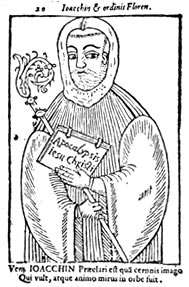
Image: A 15th century depiction of Joachim of Fiore.
Saturday, March 15, 2008
Albanian armed forces -- a knife that turns in the hand?
A recent report on Al Jazeera inspired this post.
In order to join NATO, Albania has been restructuring and decommissioning many of its existing military resources. Some of these are amazingly old, and a year ago inspired the following ridicule-via-YouTube-video (crude soundtrack):
But all those creaky weapons, which might have been close to useless were accompanied by a "crazy" amount of explosives, as the Albanian PM said:
And some of that "crazy" stuff just blew up:
Read more here at Al Jazeera.
Imagine how much stuff countries that are not Albania have lying around!
There's always money for this stuff.
In order to join NATO, Albania has been restructuring and decommissioning many of its existing military resources. Some of these are amazingly old, and a year ago inspired the following ridicule-via-YouTube-video (crude soundtrack):
But all those creaky weapons, which might have been close to useless were accompanied by a "crazy" amount of explosives, as the Albanian PM said:
"The problem of ammunition in Albania is one of the gravest, and a continuous threat," Berisha said. "There is a colossal, a crazy amount of them since 1945 until now."
And some of that "crazy" stuff just blew up:
Read more here at Al Jazeera.
Imagine how much stuff countries that are not Albania have lying around!
There's always money for this stuff.
Moon over Byzantium
 From this wonderful site. Click to find the moon and see the image in its full glory.
Mesterinde Karen Larsdatter's site
The Society for Creative Anachronism gets a lot of flak from scholars, some of it quite justified (ask an SCA member!), but in its ranks are a fair number of people who have spent 10, 20 or 30 years researching their particular interest from a re-enactor's or recreator's point of view, and these people sometimes know things no one else does.
Nowadays it's easier for such people to do research and make available the results. One of those people is Mesterinde Karen, who has put together structurally simple but very valuable pages showing representations of medieval objects. Will McLean spotted the ones showing tournament galleries and the barriers or fences that marked off listfields, and alerted me through his blog. But larsdatter.com seems to have much more. And it's searchable.
Image: Lancelot and Gawain as imagined in the early 15th century.
Afghan values
I am currently reading David Edwards' Before Taliban: Genealogies of the Afghan Jihad, which seeks to understand the politics of Afghanistan in the 1970s through 90s by following a number of individuals and analyzing how they expressed themselves and how effective their language was. I still haven't made up my mind about this book, but it has already given me much to think about.
Note Edwards' discussion of communist efforts to rally poor farmers and workers to the cause through marches and demonstrations (p. 70):
Edwards, p. 71:
Reading this material in the week when the Canadian parliament renewed its commitment to the NATO mission in Afghanistan, this not only made me more pessimistic about that mission, but made me wonder if there is going to be an Afghan mission to the rest of the world to spread some Afghan values. Any informed person can recite a list of unappealing aspects of Afghan society, but on some issues they may have a thing or two to teach others.
Further, this book makes the rinky-dink communist movement of the 1970s look contemptible and ridiculous (see photo on p. 73 and the accompanying explanation), except of course for all the damage it did. In the last quarter of the 20th century, poor countries around the world were afflicted with movements and egomaniacal leaders like Afghanistan's Tariki and Amin, all determined to make the population march with shiny shovels and chant in unison, and who was better off for it all? How long was the casualty list?
Note Edwards' discussion of communist efforts to rally poor farmers and workers to the cause through marches and demonstrations (p. 70):
...when recalling marches at which people were encouraged to shout such phrases as "Death to the Feudals" and "Death to American Imperialism," one should keep in mind the difference between the rhetoric of Marxist opposition and the dynamics of tribal opposition that heretofore had held sway through much of Afghanistan. In tribal culture, to boast that you intend to kill someone places you under the burden of that claim. Utterances have consequences, and for one to publicly promise to do that which one does not intend ultimately to do or which cannot be done makes one appear foolish and dishonorable. That is to say, if people do not realize that words have weight and use them carelessly, then they cannot be trusted, for they are clearly unaware of the implications of honor and, as such, are a danger to themselves and others.
Edwards, p. 71:
Another issue to consider is the government rallies themselves as a form of public performance... Most newspaper photographs of these events show groups of newly enfranchised farmers carrying shiny shovels and slogan-covered placards while standing or marching in parade-ground formation. However the government intended these performances to be perceived, local people generally viewed them as an embarrassment and a disgrace...such stock performance devices as the unison shouting of praise for the revolutionary party while marching in formation were viewed by people as acts of public humiliation that violated their sense of individual initiative and control.
Reading this material in the week when the Canadian parliament renewed its commitment to the NATO mission in Afghanistan, this not only made me more pessimistic about that mission, but made me wonder if there is going to be an Afghan mission to the rest of the world to spread some Afghan values. Any informed person can recite a list of unappealing aspects of Afghan society, but on some issues they may have a thing or two to teach others.
Further, this book makes the rinky-dink communist movement of the 1970s look contemptible and ridiculous (see photo on p. 73 and the accompanying explanation), except of course for all the damage it did. In the last quarter of the 20th century, poor countries around the world were afflicted with movements and egomaniacal leaders like Afghanistan's Tariki and Amin, all determined to make the population march with shiny shovels and chant in unison, and who was better off for it all? How long was the casualty list?
Old world and new world agricultural origins
Phil Paine has for years been a critic of most archaeological reconstructions of early human history, both older ones that emphasized large scale migrations to explain technological (agricultural) change and newer ones that explained agricultural innovation by very slow adoption practically farm-by-farm.
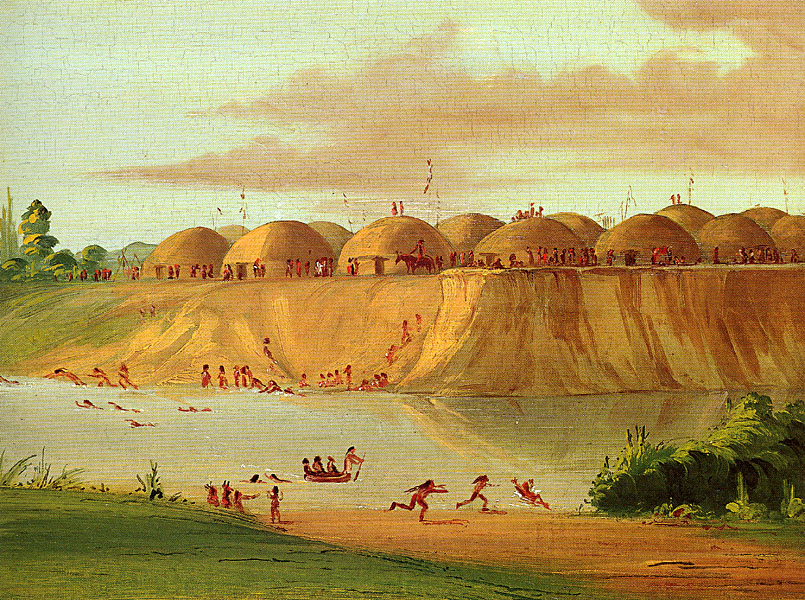
In this blog post, "I Called the New World to Redress the Balance of the Old"... A Final Word on the European Neolithic (under Friday, March 7, 2008), Phil suggests that since evidence about the "New World Neolithic" is much more available than that about the European Neolithic, perhaps that evidence can be used to rethink how ancient innovation and ancient economies worked in the Old World. In the process he tells an interesting story of the Three Affiliated Tribes, and zings the notions of "simple" and "complex" societies and the idea that prehistoric trade was only ceremonial gift-giving.
You really need to read the whole thing, but here's a big excerpt to spark your appetite:
When I look at this kind of large-scale trade network [on the Great Plains], what strikes me most dramatically is that sedentary agricultural people, prairie nomads, fishermen, and isolated bands of hunters all participated in the trade network on an equal basis, and trade was of economic importance to all of them. People could not, in fact, be automatically pegged to a specific category, and there is no evidence that particular modes of production constituted a fixed evolutionary sequence, or distinct “levels”. People who lived as mobile hunters in also operated large-scale copper mines that supplied customers as far away as Mexico. Other “nomadic” people set up large permanent fish weirs in order to sell the products to distant farming villages, though they could easily have lived comfortably off of hunting in their area. This did not in any way alter their self-identification with linguistic and cultural relations who did not do this. All these intricate variations lead me to conclude that the trade-networks long predate agriculture, and that agricultural villages expanded into areas, like the Upper Missouri, already well-known through trade and travel. The sites of villages were selected, I believe, because they were already known to be productive centers of fishing, harvesting wild prairie turnips, berry picking, and good places to drive herds of buffalo over bluffs. North America’s network of rivers was an effective system of highways that could carry goods and people swiftly over long distances, and this network was as familiar to everyone as English people are now familiar with the M4 and M6. Significant gaps between agricultural regions along the Missouri, as well as clear traditions of migration (the three Tribes each arrived from different directions) demonstrate that a slow-moving “wave-front” of agriculture was not how agriculture spread, at least in this part of the world. All the evidence points to agriculture being a practice that took advantage of an already extensive trade and transport network to establish itself at strategic nodes, which were already significant for fishing, specialized hunting, as pre-agricultural trading places, or for the availability of specialty products. The Three Tribes were as much concerned with the availability of suitable construction timber as they were with the fertility of the soil, when they placed or moved their villages, and it is not accidental that a major move created a new village called Like-a-Fishhook. The scale, complexity, and economic importance of long-distance trade networks has long been familiar stuff among New World archaeologists, but somehow, this has had only reluctant, and devalued influence on the theoretical framework of European prehistory. There, old habits that regard commerce as ignoble, travel as unnatural, pre-ordained stages as the essence of history, and hierarchy as the preferred ordering principle of society still shape attitudes toward the past. Such ideas, of course, influence New World archaeologists and historians as well, but apparently not quite so rigidly. So, what do these examples from , where we have some secure knowledge of social systems and economies, have to say to us when we contemplate Neolithic Europe, where we have none?
They can tell us nothing for certain, but they can give us a good idea of what was possible, and even what was most likely.
What seems most likely to me is that agriculture spread through Europe by plugging itself into an already-existing network of trade and travel.
Image: Life on the Upper Missouri some time ago (George Catlin, 1832).
Friday, March 14, 2008
A Master of Arts program in History...

... will be available at Nipissing University starting this September. It was announced in the University Senate meeting that the Ontario Council for Graduate Studies has approved our application, and as you can imagine we are very pleased here.
This is NU's first graduate program in the Faculty of Arts and Science.
Our four fields of concentration are Canadian History, European History, International History and Gender History.
If you think you might be interested, contact the History Department for more details.
Image: A medieval magister.
Tuesday, March 11, 2008
Todd Stubbs speaks in the History Department Seminar Series, May 12
A reminder that the History Department Seminar Series goes tomorrow (or, likely by the time you read this, today), Wednesday, Mar 12, 3:00 pm in H111. We welcome historian Todd Stubbs from Nipissing's Muskoka Campus, who will be giving a talk titled “Care and Culture, Time and Opportunity': Wage-Earning Men and the Income Franchise Debate in Toronto, 1866-1874,"For more information see: http://www.nipissingu.ca/history/events_06.aspRefreshments will be served.
Saturday, March 08, 2008
Inner Norwegian? Nay, real Canadian!

A brilliant little report from Toronto, which ten years ago had a mayor disgrace the city by panicking over snow.
If you are wondering, it's a lot less snowy up here in the Near North.
M 104 reprocessed

For an explanation of this "remix," see APoD.
And don't forget to click on the pic for an even more beautiful image.
The purpose of history
The anonymous author of Ahistoricality is reading Tosh's Historians on History, and picked this interesting quotation from Hugh Trevor-Roper:
Comments?
"The exact scientists are a kind of pre-Reformation clergy, and their function is to perform their miracles, to continue their Church, not to make themselves intelligible to laymen: for their control of the means of salvation and damnation makes the lay world so dependent on them that it will tolerate and subsidise them even without understanding. But the humane subjects are quite different from this. They have no direct scientific use; they owe their title to existence to the interest and comprehension of the laity; they exist primarily not for the training of professionals but for the education of laymen; and therefore if they once lose touch with the lay mind, they are rightly condemned to perish." -- H.R. Trevor-Roper, 'History: professional and lay' (1957), cited in Tosh, ed. Historians on History, p. 328-329.
Comments?
Tuesday, March 04, 2008
Roman games

Ancient Civilizations students who want to follow up on today's lecture on The Arena might want to look at this book in our collection: Gladiators and caesars : the power of spectacle in ancient Rome edited by Eckart Köhne and Cornelia Ewigleben.
It is well illustrated and has insights born from systematic re-enactment efforts.
Film clips from the Ben Hur chariot race sequences from 1925 and 1959 can be found at Youtube.com. Those must certainly count as re-enactments.
The Great Warming -- medieval climate change in Europe and the world

Brian Fagan has written a book called The Great Warming: Climate Change and the Rise and Fall of Civilizations, about the effect that the warming period between 800-1200 A.D. had on global living standards. There's a preview of his argument on NRO Radio. He also talks about fishing!
Thanks to Scott Nokes at Unlocked Wordhoard (again!).
Female gladiators
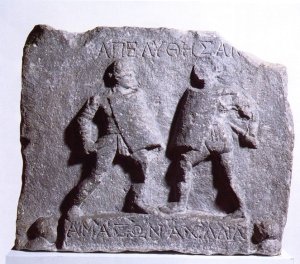
For students who can't wait for today's lecture on the Roman arena, why not have a look at this article on a possible grave find of a female gladiator discussed by Steven Murray in the Journal of Combative Sport?
Or a short article in Discover Magazine about archaeologist Steven Tuck's research into death in the arena?
Read both articles and come to lecture and you'll have a "Steven hat-trick."
Image: from the JCS article, two female gladiators, Amazon and Achillea.
The Palace of Westminster --developing before your very eyes!

A friendly contributer to the medieval history list Mediev-L has just alerted me to an online "film" of the development of the Palace of Westminster, the home of the UK Parliament and one of the most historical sites in Britain. Well worth taking some time with.
I'm not quite sure who is responsible for this site. It may be a commercial site and other such presentations may be available from the home page.
Monday, March 03, 2008
Opiate of the masses

Since one of my interests is the history of democracy, this cynical, long-perspectived post by IOZ caught my eye, not least for its striking title, a quotation from the Roman historian Livy: You know how to vanquish, Hannibal, but you do not know how to profit from victory.
Image: The elephants cross the Alps.
The Second Meditation on Dictatorship
Phil Paine continues his series of meditations on dictatorship and democracy here.
I think anyone with a serious interest in history should think about this statement:
And of course there's much more, including a call for action.
I think anyone with a serious interest in history should think about this statement:
I argue that there are no necessary or predestined “stages” in the organization of human society. Morally good and beneficial democratic social arrangements can be made at any time and in any place, by any group of people, large or small. Language, ethnicity, location, and degree of wealth are not structurally relevant to democratic practice, and democratic practice does not originate with, or “belong to” any particular cultural group. Similarly, dictatorship can occur in any human group. Immoral, diseased societies can be made at any time, in any place, by any group of people, large or small. Both possibilities always co-exist.
And of course there's much more, including a call for action.
Sunday, March 02, 2008
Memories of Hale-Bopp
 I waited most of my life waiting (and I was waiting) to see an impressive comet. Hale-Bopp from 1997 filled the bill. This photo taken over Italy is from Astronomy Picture of the Day.
Saturday, March 01, 2008

Subscribe to:
Posts (Atom)