Showing posts with label 14th century. Show all posts

Tuesday, September 14, 2021

Remember when I used to make fun of "the One True Century?"

More than a decade ago some of my friends in the Society for Creative Anachronism started using the phrase “one true century” in connection with the 14th century. They were re-enactors, and the characterization was based primarily on their love for the armor and the noble clothing of the period.

I had no quarrel with that; I’ve always liked that period myself. But the one-truness of that century spun my head. After all, that was the era of the plague, the HYW, and many other catastrophes, documented in that popular narrative history, Barbara Tuchman's A Distant Mirror; the Great Papal schism; dramatic commoners’ revolts, and more.

I have been working with a number of primary sources of the 14th century, and sure enough a very negative picture very often emerges. But more recently I’ve been inspired by other sources to rethink my feelings about “the one true century”. I subscribe to an e-mail list which publishes reviews of books from the whole range of medieval scholarship. A lot of these books are very specialized, or include articles that because of length may not be published elsewhere.

The reviewers, the authors, and the readers have a wealth of material to draw upon. Individual reviews may seem obscure, but taken together can make a big impression.

In particular, the large number of writings, say those devoted to theology, the development of clerical institutions, and so forth provide a rich picture of a century in which many things happened not all of them bad. Another example of the true century: I am sure that I am merely the millionth person to notice that Geoffrey Chaucer not only fought in the HYW but invented English literature. (OK, exaggeration.)

I am a bit embarrassed to find myself granting such legitimacy to “the One True Century.” After all, my first graduate course was one about the Avignon papacy (taught by Norman Zacour, bless him).

And of course we can easily find any century nearly impossible to classify: If you are old enough to remember it, try to find a good label for the twenieth century!

Monday, January 06, 2020

14th-century robots,.again

Every once in a long while I re-run one of the best posts from my blog.  And there are some really good ones.  This is surely of interest to those who missed it the first time.


In a book review by Aleks Pluskowski of Scott Lightsey's Manmade Marvels in Medieval Culture and Literature (New York: Palgrave, 2007), sent me free by the TMR service , I read the following:


Scott Lightsey's Manmade Marvels is a remarkable and unique work on a neglected aspect of late-medieval society. Lightsey reveals a world of artificers and technologists, of complex clockwork devices and colourful automata: a
world where supernatural, fantastic and exotic mirabilia were pulled from the imaginary realms of romance, and--literally--brought to life for the entertainment and exultation of war-fatigued courts.Since surviving examples of these machines are incredibly rare, Lightsey draws on literary and documentary sources, complemented bya range of artistic representations.


...His first case study of automata draws on the prologue to Piers Ploughman, which describes a mechanical angel that crowns Richard II during his public coronation in London. Here, Lightsey situates this marvel within a newly established culture of aristocratic visual display; a growing tendency towards luxurious ceremonial which would come to define the Ricardian court. Indeed, this clockwork coronation is seen as nothing less than formative for Richard's own attitude to the calculated display of
majesty.
I looked at a modern version of PP and I must admit that I can't see how the reader is supposed to know that it is a mechanical angel. I'll follow it up.

However, I have no doubt that this robotic messenger was possible, because as an undergraduate I read Huizinga's classic early-20th-century book, The Waning of the Middle Ages, where he talks about a lot of clockwork figures used in princely ceremonies. Yet I must admit that despite my early exposure to this fact, I've never integrated "mechanical men" into my visualization of the Middle Ages. I suspect that few of my readers have thought about Richard II as King of the Robots (a kind of dressier Dr. Doom?).
For years I've teased friends who think that the 14th century is the bee's knees of medieval history by saying, half-seriously, that the 14th century isn't the Middle Ages at all. Now I can say, "Dude, what about all those robots?"

2 comments:

  1. The mechanical angel at the coronation is described in Thomas Walsingham's history. I think Lightsey is assuming that Langland's angel is a reference to that, and Langland would expect his audience to make the connection
    Reply
  2. a kind of dressier Dr. Doom

    It's a few centuries too late, but may I recommend Neil Gaiman's 1602?
    Reply

Thursday, October 31, 2019

Gillingham on surrender and mercy in medieval warfare

 I just came across an article by John Gillingham, one of the best medieval military historians, where he argues that the laws and practices of war were not the same over the whole Middle Ages.  Note what he says about surrender and ransom:

But it is important to bear in mind the  exact title of  [Maurice]Keen’s book – The Laws of War in the Late Middle Ages – and   note that when he used phrases such as ‘in the middle ages,’ he was not in fact  thinking of  the whole period, only of its last two centuries  [i.e. the14th and 15th; Phase 2].The neglect of Phase One [up to about 1300] by historians of medieval war has not unnaturally led  to them taking a cynical view of chivalry.. [since many people, during Phase One including women and children, were not allowed to surrender, but were killed or enslaved].

But had they measured the treatment of women, children and the poor by soldiers in the so-called ‘age of chivalry’[ Phase  2] against    some  ideal  standard, but against the standards that  had been  regarded as acceptable and  honourable in all previous ages, they might have taken a different view.

Friday, August 10, 2018

Matt Gabriele scores!

I don't know how he managed it, but Matt Gabriele, a medieval historian at Virginia  Tech,is now writing a column for the business publication Forbes.  From my initial perusal, it looks like he interested in emphasizing the diversity of medieval culture.  See, for instance, his post on the Black Death  and the disappearance of the Norse colony in Greenland:

...The disappearance of the settlements might be further proof of just how transformative the Black Death really was for Europe. In a book published after his death in 1991, Prof. David Herlihy suggested in broad outlines the tremendous long-term cultural and intellectual changes brought about by the Black Death. Much of his conclusions have been challenged in recent years but Herlihy's genius was putting his finger on just how the massive scale of death changed the way people thought about themselves and their relationship to the world. Established authorities were questioned since they had no good answers to ending the plague. Social class was upended as economic and cultural communities struggled to replenish their ranks. If the settlement in Greenland left the island uninhabited for a century or more, this would support Herlihy's thesis about long-term change.
In other words, the findings of this research both challenges and confirms what medievalists have thought about their period for some time. In other words, as I've mentioned elsewhere, the research being done on the Middle Ages is exciting precisely because it oftentimes both confirms how much we already know about the period, while paradoxically reminding us of how much about the past there still is to discover.
I'll be curious as to how long this column continues.

Wednesday, July 18, 2018

The Good Duke, brought to you by the magazine Medieval Warfare


Medieval Warfare is a popular but substantial illustrated historical magazine published in Rotterdam every two months.  Today the most recent issue landed in my mailbox.  As usual, it is a beauty.  Could I be prejudiced by the fact that issue VIII.3 contains an article by me, The Good Duke: A Personal Golden Age of Chivalry?

Could be!

The article, like much of my writing over the last few years, uses the reputation of Duke Louis of Bourbon, a cousin of the French kings during the first half of the Hundred Years War, to explore what chivalry meant at that time.  I am especially interested in how the intense personal ties between princely warlords and their loyal followers made possible "chivalry."


Monday, April 23, 2018

Ibn Battuta and the Empire of Mali in Extra History


Extra History is a series of hisotrical animations (I guess you could call them that) on You Tube.  Currently EH is posting material on the 14th century Empire of Mali (roughly today's West African country of Mali) famous as one of the world's chief sources of gold, and the location of Timbuktu.  EH is following the travelogue of the footloose Islamic scholar Ibn Battuta, who, if you take him at his word, went from his birthplace  in Morocco all the way to China, beating for distance the somewhat later Marco Polo.

When I was still teaching I loved talking  about Ibn Battuta, whose account gives us a good idea of what Islam meant to people outside the Arabic and Persian-speaking areas of the Middle East.  Ibn Battuta had a rather harsh judgement on these relatively new converts.  Not up to snuff, he said. But you can also get an idea of the flexibility of Islam in this period, which allowed it to appeal to people who lived in the Sahara, on the Russian steppes, and the islands of the Intian Ocean, to name just a few.

This EH series is one of the best of the bunch.  See it here.

Image:  A mosque in Timbuktu. By Senani P at English Wikipedia, CC BY 2.5, https://commons.wikimedia.org/w/index.php?curid=1831543

I can't help but point out that Ibn Battuta's Saharan journey took place at exactly the time that the Combat of Thirty v. Thirty.

Friday, October 27, 2017

Who does this remind you of?


The French Duke of Bourbon spent much of the 1360s and 70s taking castles back from the English soldiers who had occupied them after defeating the French at Poitiers (1365).  The duke (known to his fans as "the Good Duke") established a reputation for both his warrior skills and his honorable behavior toward friend and foe.
.


In one incident the Good Duke was trying to undermine and capture the castle of Vertreuil (not so far from Poitiers) by challenging the most noble English member of the garrison to fight one-on-one in a mine (a tunnel dug as part of an attack on a strong point).  It turned out that there was no high-ranking Englishman present.  The commander was absent and his second-in-command, a man named Montferrand, did not even rank as a squire.  Montferrand took up the challenge, and found himself facing an impressive man-at-arms, who declined to give his name.  But soon the secret was out: the French, watching the fight in the mine, (which must have been rather short and shallow) cheered on their duke with cries of "Bourbon, Bourbon."  

Montferrand found himself in a quandry.  He was fighting someone who very much outranked him, and who might be inclined to execute him as a brigand once Vertreuil was taken.  ("English" soldiers in the Hundred Years War were often foreigners -- Bretons, Scots, Gascons with little standing in local society. They were hated by the French.)  Montferrand made a daring move by appealing to honor.  Montferrand said he would surrender Vertreuil to the Good Duke, if the duke would knight him.  The duke agreed and everyone was satisfied.  I'll tell the rest of the story another time.
But now that we are here, look at this passage, with the Good Duke
and Montferrand trading compliments:


Reynaud de Montferrand knelt before the duke and said to him, "My very redoubtable lord, I thank you most humbly for the benefits and honors which have come to me from you, to be a knight by the hand of so high and valiant a prince as you are; so it is an honor to me and all my lineage forever." The duke answered, "Sir Reynaud, chivalry is very strong in you for you are a valiant man of good lineage."
What does that bolded phrase remind you of?  And what does that say about the process of translation?

Image:  The castle of Vertrieul, after it was rebuilt in the 15th century.  Older castles in that part of France were rebuilt because they were destroyed in campaigns like the one described here.

Wednesday, August 02, 2017

Joan, the Fair Maid of Kent A Fourteenth-Century Princess and her World, by Anthony Goodman

I would like to read this book, maybe even own it. The publishers describe it this way.

"Anthony Goodman's brilliant yet accessible scholarship draws in the reader in the most entertaining and vibrant way. He was one of our greatest historians of the later medieval period, whose warm humanity shines forth in his writing. He has given us, as a parting gift, the definitive biography of an exceptional, intriguing woman. I cannot recommend it highly enough." ALISON WEIR

Joan Plantagenet (1328-1385), acclaimed in her youth as the "Fair Maid of Kent", became notorious for making both a clandestine and a bigamous marriage in her teens and, in her thirties, a scandalous marriage to her kinsman, Edward III's son and heir, Edward of Woodstock, the Black Prince. Despite these transgressions, she later became one of the most influential people in the realm and a highly respected source of stability. Her life provides a distinctive perspective of a noblewoman at the heart of affairs in fourteenth-century England, a period when the Crown, despite enjoying some striking triumphs, also faced a series of political and social crises which shook conventional expectations. Furthermore, her life adds depth to our understanding of a time when marriage began to be regarded not just as a dynastic arrangement but a contract freely entered into by a couple.

This accessibly written account of her life sets her in the full context of her world, and vividly portrays a spirited medieval woman who was determined to be mistress of her fate and to make a mark in challenging times.

Wednesday, July 19, 2017

The Green Count by Christian Cameron

I know two excellent writers of fiction, one being Robert Charles Wilson, the traveller of time, and Christian Cameron, the historical fictioneer.  I've talked about Wilson here recently, so now it is Christian's turn.

Fear not, Christian! I have nothing bad to say about you or your most recent book, The Green Count!


I am also not going to go into great detail about the virtues of Mr. Cameron.  They are two: he combines a tremendous knowledge of the periods he writes about with believable characterizations of people who lived in those periods.  This a necessary skill for anyone who wants to re-create the people of the past; even someone who does a mediocre job is doing something remarkable.  Mr. Cameron is no mediocrity, however.  He is a master.

Sunday, June 25, 2017

Progress on the Chronicle of the Good Duke

Followers of my work know that I have been translating the 15th-century chivalric bibliography The Chronicle of the Good Duke Louis of Bourbon for a good while now. (Gulp! since 2010!) I just finished my third run-through of the Chronicle this very morning. The next full run-through should be the concluding one!

Image: The French court of Charles VI in the time of Duke Louis!

Sunday, May 21, 2017

Fourteenth-century chivalry, as seen by various military men

People often think that in the later Middle Ages there was such a thing as "chivalric combat." What constituted "chivalric combat is not entirely clear to scholars today; indeed, it may have been unclear to knights and other men at arms in the Middle Ages.
Today I am posting a passage from the Chronicle of the Good Duke (written in 1429, describing here an incident of the 1390s) where some apparent disagreement about one point of "chivalry" is discussed. It is an account of the African crusade led by the Good Duke, in which he, or the author of the chronicle criticizes a famous French knight, Boucicaut the Younger. Boucicaut was known at this time for his strong desire to fight deeds of arms against anyone (of sufficient status) he could. Boucicaut travelled all over Europe while fulfilling this quest, and eventually attained such fame that he was made a marshal of France.
But I've always been rather dubious about Boucicaut's reputation. For one thing, he was the French commander in two of the worst French defeats of the Middle Ages, Nicopolis and Agincourt. Further, there is a lot of somewhat skeptical commentary about Boucicaut in the medieval sources. Have a look at this discussion of how Boucicaut, apparently taking his turn commanding the guards of the Crusaders' siege camp, got distracted from that routine assignment by the endemic skirmishing that took place throughout the siege and tried to arrange a challenge with the opposing Muslim forces.
Boucicaut was a chivalrous man who, through some interpreter, made a request in the skirmish where he was whether there was any Saracen who wished to combat him on foot or horse. They replied no. Then Sir Boucicaut said if they wished to perform arms 10 against 10 or 20 against 20 he and his company would be ready. So the Saracens responded no, not if the kings their lords did not want them to. When Boucicaut saw their refusal he said to them that he would fight them in a secure field, 20 Christians versus 40 of their Saracens.
As long as this conference lasted it was ordained that they should not make war on each other. With difficulties were these negotiators, Christian and Saracens, brought together, which astounded the duke of Bourbon, the Lord of Couci, the count d’Eu, the Souldich of Estrau, and the other barons, for the whole army ran to this assembly so that the Lord of Couci, the count d’Eu and others who saw the army taking leave of its senses said to the duke of Bourbon, “My Lord, the people run like beasts over there with Boucicault and they are not able to keep guard and it seems to us that if you do not order some to retreat, things will turn out badly for us.”
Then replied the duke of Bourbon: “I can’t then send a better message than one from me. I’ll go there myself.” So he asked for a mule he always had and it appeared good to the lords that he was not able to send a better message to make them retreat. So the duke mounted his mule left his tent and went off with the people of his household.
It was not long before more than 300 gentlemen were following him. The Saracens who saw that the duke of Bourbon whom they recognized by his coat of arms, came to join Sir Boucicaut with many men at arms, began strongly to retreat towards their tents, and Boucicaut and those with him to chase them. Boucicaut who saw the duke of Bourbon coming, gave himself over to pride and chased the Saracens more boldly and the duke of Bourbon with his company went after to bring about a retreat. When Boucicaut was at the tents, the Moorish kings and their Saracens put themselves in formation for battle outside their lodgings, and Boucicaut put himself in battle formation with his men, awaiting the duke of Bourbon and those who came with him. The duke of Bourbon caught up with those whom he wished to make retreat, and he very violently spoke to Boucicaut, concerning his great follies.
But the duke of Bourbon seeing that there was with him a good 2000 combatants following him, and seeing also the Saracens who had abandoned their camps and put themselves in battle order all outside, said, “My friends, since we see the lodgings of the Saracens abandoned, let us go by God and charge among their lodges and if the Saracens are worth anything they will come and defend them .” The duke forbade anyone should be so bold as to ignore his order nor think about pillage, but should fight forcefully and at the first sound of the trumpet which he would have sounded, everyone should pull back to his standard.
Then the duke of Bourbon first and the lords and the captains each in his place, with their men at arms and arbalestiers of Genoa charged among the tents of the Saracens, attacked all the lodgings and cut the ropes of the tents and set fire to the lodgings of straw and the duke of Bourbon remained for an hour in the middle of the Saracen lodgings with his standard of the belt of hope. During this the count d’Eu arrived with a good seven score combatants who came from the other side, by the shore, which made those who were already there very happy and joyous.
Because he was late, the count d'Eu said to the duke of Bourbon, “My Lord you see the finest thing one can see, and I thank God that I am found in your company, but for God’s sake, let’s go back, for it is evening and if the Saracens attack the lodgings there’s only the Lord of Couci with a few men, and a bunch of those are ill: so he will be completely lost.” So the duke of Bourbon said to the count d’Eu, “We will go there immediately, please God.”
Now imagine you are sitting at a campfire in a French siege camp in the 1390s. Someone says "Boucicaut is the greatest living knight." What might you say?

Thursday, May 11, 2017

A memorable time in the life of Jean de Chateaumorand

I love the Chronicle of the Good Duke.

The Chronicle is a biography of Duke Louis of Bourbon, who was a close relative of the French kings during the Hundred Years War. In 1429, when bad dukes had prostrated France before the English invaders, it became useful to remember what Good Dukes were like, and this text was commissioned. The writer was no genius, but he had access to an old French soldier, Jean de Chateaumorand, who fifty years earlier (!) had fought as part of Duke Louis' military household, and who remembered well what it was like in the Golden Age of Chivalry, which I have no doubt he thought the wars he fought next to the Good Duke were. I have been translating the Chronicle for a good long time, and I am almost done. As I review my translation, I keep running across passages that remind me of why I like this book. The Chateaumorand sections are particularly evocative. Here are a couple of passages that show the ups and downs of late 14th century warfare. We begin with a short notice of the death of Jean de Chateaumorand, bastard. The brother of the other Chateaumorand? Perhaps. But this tragedy did not overwhelm the memory of Jean the squire, who as banner-bearer for the Good Duke, played an important leadership role in the taking of the strategic castle of La Roche Senadoire, which was held by Englishmen who ravaged the countryside.
Chapter XXXII Then the duke went before Amburs, a very fine place, where there were a good 80 combatants, and on arrival he fought a big skirmish, for those inside came out, and there was a fine skirmish with lances and swords between the two sides; and there Sir Girart de Grantvau, a good man of his body, was wounded and Jean the bastard of Châteaumorand was killed. But in this skirmish there were /(95)taken eight men at arms from those of the fort who had more authority, and four killed; and the duke of Bourbon on the morrow had those eight led before him to have their heads cut off, if they did not surrender the place, and they were quite able to do it, for they had it under guard and preferred to live than to die in such a manner. So they surrendered Amburs to the duke of Bourbon, both their bodies and the place.

Inside of one hour the duke of Bourbon and his men made to leave and go to Tracros; and those men who he sent before encountered the English of Tracros, great adventurers who had come to defeatethem and were overthrown by the duke's men, who came in haste before the place, and it was late when they arrived there. That night the duke of Bourbon, who had come there, set the guard from the men of his household and said to Jean de Châteaumorand: 'Take my pennon, and go all around the place so that no one sallies out." He carried out his order, and that night had many a talk between the dukes people and those of the fort that they should surrender, or when they were taken they would be hanged by the neck because they were men of evil renown.

So they talked until Gourdinot warden of the Place surrendered to Jean de Châteaumorand, squire, who carried the pennon of the duke of Bourbon; and at this hour, which was not the day, it was announced to the duke, so it please him, the treaty which the men of his household had made; and he answered that it pleased him well, because he still had great deeds to do. The one who spoke about this to the duke was Châteaumorand, who asked him to be willing to give the movable goods in the fortress to the people of his household, which the duke did freely and that/(96) Gourdinot, who had surrendered to him, should remain his prisoner and this he granted to him. On the morrow Gourdinot and his men of Tracros, who were not but 16 men at arms, were all prisoners. Inside were 200 marks of silver, of which 100 were in chalices from churches which they had thoroughly robbed. So the duke said that he wished to have the chalices, and he would generously recompense the companions. The duke of Bourbon moved by pity sent the chalices to the city of Clermont and had it announced to all the churches which had lost their chalices, that someone should come to Clermont, and they would be given back, and it was done.

... Chapter XXXIII There the duke of Bourbon seeing his knights and the squires of his household and country, and all the men at arms, who were ready to undertake any risk, destroy the palisade and garrison and proceed in force triumphantly, was overjoyed. During this melee, the pennon of the duke of Bourbon continually carried by Jean de Châteaumorand passed through the breach in the palisade, with those who followed him. Then the English who saw this, did not know what to do, outside of retreating into the fort/(102) and while they retreated the pennon rushed forward with the valiant men; and in this retreat of the English, who ran away, there were killed and taken a good fourscore of the better men at arms from inside, for the captains, of whom in one of the two places Nolimbarbe retreated on the right-hand and the other on the left-hand which was stronger, led to retreat the captain Sir Robert Chennel, Jacques Bardenay, the son Sir Jehan Jouel, Thomelin Maulevrier, Sir Richard Credo, son of the mayor of London. While they retreated from certain lodgings which were high up, to go to their fort, the pennon of the duke of Bourbon and the people of his household charged them so close that as they entered the tower, the pennon of the duke of Bourbon rushed among them very well accompanied, so that those Englishman were not able to close the door of the tower, and so they surrendered to the one who carried the pennon of the duke of Bourbon. The prisoners who surrendered to him were Sir Robert Chennel, captain, and so that very strong place was delivered.

In this way the pennon of the duke of Bourbon with his companions namely Sir le Barrois, Bonnebault, Sir Gaulchier de Passac, the lord of Cordebeuf, the Borgne de Veaulce, Sir Odin de Rollat, Sir Phelippe Choppart, the lord of Billy, Jehan lord of Chaugy, Phelippe Berault, Michaille, the bastard of Glarains and five or six others of the household of the duke of Bourbon, with his pennon, headed over to one of the other /(103) towers where they found already before it a great party of people of Auvergne who were climbing up there, and the Lord of Montmorin who was a valiant knight, and who had a fine company, and Geraud, Lord of Laqueuilhe, accompanied by good people and who was a valiant man, the Lord de Lafayette and others who were advanced by the advice of the lords who had held very close to the English when they had arrived there so that the English could not flee.

But when the English saw the pennon of the duke of Bourbon approach them, the captain Nolimbarbe surrendered with all of his companions to the duke of Bourbon. So was La Roche Senadoire taken without a word of a lie.

Leaving there, the duke of Bourbon sent to Clermont six English captains to hold them as prisoners in the tower of Monnoye, about which the people of Clermont were very happy and joyful and the Duke and his people and those of Auvergne rode to Saint Angel, a place which had done much evil. They remained there a day, thinking to treat with them, but those in the castle did not want to listen. Then it was noticed that the abbey was covered by wooden shingles, thereupon they fired several incendiaries, so that it spread throughout its buildings, and all the English horses were burned up and some of their valets. The men at arms retreated into a tower that was there, where they had nothing to eat. It was impossible to take it by force, for it was very well built; in which attempt a young knight, whom the Duke of Bourbon loved well, was killed: Messire Jean de Digoine, who hailed from Clermont. In the end, those of the Tower surrendered to the Duke of Bourbon on the condition of keeping their lives. So the Duke vouchesafed them, sending Châteaumorand with his pennon to the tower, and each of the English came out with their weapons in hand.
Note how Jean -- who later on became quite an important man -- identifies himself with the Duke and the Duke's pennon. He still is enormously proud of his association with the Good Duke.

Image: This is NOT Jean de Chateaumorand with the Good Duke's pennon.

Thursday, May 04, 2017

Military humor of the 14th century: Robert Knowles

The Chronicle of the Good Duke:

The duke of Bourbon the Constable of France, Sir Bertrand and the marshal Sir Louis de Sancerre remained before Brest for 40 days. In that time it rained continually so hard that no one had ever seen so much rain fall, and in the country of the Breton Brittany there was no provision for horses, from which the lords had a great loss, and the same M Robert Knowles had nothing to eat in Brest except his horses, and spoke to a Constable of France about how he held himself discontent that he was not able to raise the siege which the duke of Bourbon, himself, and the marshal held before Brest where they had besieged him, but he counted it for little, because he knew that the horses and the army were much weakened by the rain and this he was consoled that the lords also had very little to eat; just like him and that he was not at all afraid of their assault. He sent a further message to the Constable: "You have made me eat my horses here this castle of Brest, as I made you eat yours at the siege of Rennes; and so go the changes of fortune and war."

Friday, February 10, 2017

Chivalry and the Ideals of Knighthood in France...by Craig Taylor

By coincidence I am reading this book for the second time, just as this review from the Medieval Review comes out.

I highly recommend the book. Craig Taylor is always good.

Taylor, Craig. Chivalry and the Ideals of Knighthood in France during the Hundred Years' War. Cambridge: Cambridge University Press, 2013. Pp. 345. £82.00(hb); £21.99(pb). ISBN: 978-1-107-04221-6.

Reviewed by Thomas K. Heebøll-Holm

University of Southern Denmark

thee@sdu.dk

The story of French chivalry and its miseries during the Hundred Years' War is an ever fascinating and puzzling one. With this book Craig Taylor breaks important ground by showing how much French knighthood in this period was shaped by and, in turn, shaped developments in the chivalrous ideology as well as by the changing military reality of the fourteenth and fifteenth centuries. While indebted to Maurice Keen's and Richard W. Kaeuper's studies of high and late medieval chivalry, Taylor refines these paragons' more general studies of medieval knighthood by concentrating on a specific time period and region, namely Valois France during the Hundred Years' War. France during this time period is especially fertile ground for such a study. Not only was it the epicenter of chivalry, but during the Hundred Years' War the French knighthood experienced a number of military catastrophes which forced French warriors and writers to critically examine and discuss the causes of these calamities and how one could remedy them. This debate is a treasure trove for historians looking to get a firmer and more nuanced picture of the muddled concept of late medieval chivalry. Indeed this concept is one of those that all think they know and consider to be simple, yet upon closer inspection find confusing, slippery and self-contradictory. It is an immensely demanding task that Taylor has undertaken. It is also one which he resolves splendidly.

Taylor approaches the topic by a combined study of the practice and ideology of knighthood as it appears in various types of late medieval narratives such as chansons de geste, biographies, didactic manuals and political, legal and moral treatises. Through nine chapters (including an introduction, a chapter on the texts and their context and a very brief conclusion) Taylor takes the reader through seven core values of French chivalry during the Hundred Years' War. These were honor, prowess, loyalty, courage, mercy, wisdom and prudence. While these have been separated for pedagogical reasons, Taylor immediately acknowledges that they were not isolated values, but should be seen as part of what I am tempted to call the chivalric kaleidoscope. They were interdependent and inseparable parts of a whole. However the weighing of the relative importance of the values changed with the individual writer's personal convictions and situation as well as his/her specific historical context.

In the introduction, Taylor presents and discusses the guidelines of his study. It is interesting to note that the late Middle Ages presents a new phenomenon in medieval literary production, namely that the knights themselves begin to write down their own experiences of chivalry and war. While this certainly does not remove the classic problem of to what degree medieval writing was dictated by genre conventions and socio-cultural expectations, it at least brings us closer to the military experience of the warriors, and Taylor's take on this problem is both prudent and thought provoking. These texts reflect not only practical changes in late medieval martial culture. They are also a goldmine for the historian as through them we gain access to the combatant's thoughts and recollections (flawed and biased as they may be) instead of having to rely on ecclesiastical middlemen who may have had neither interest in, or knowledge of the practical reality of knighthood. A topic which Taylor pays particular attention to is the medieval debate over chivalry and the right behavior of knights and men-at-arms. Essentially this debate came down to the difficult question of how to reconcile a proud military ethos and aggression with Christian values of humility, piety and salvation. Taylor makes the important remark that texts do not just mirror reality. They also have an influence of their own and thus enter a reciprocal relation with social reality, where texts form men and men write texts.

In the following chapter "Texts and contexts," Taylor concentrates more narrowly on the historical and literary context of the narrative sources analyzed in the book. Contrary to the practical and structural reasons for the French defeats as presented by modern military historians, contemporary writers argued that the reasons for the defeats were cowardice and moral laxity due to the corrupting effects of court life (among others). Consequently, they advocated for a reform of the mores of the knighthood especially by the adoption of the values and discipline of the Romans of antiquity. This emphasis on the Romans was, as Taylor shows, in no small part due to the fact that many writers implicitly or explicitly served royal Valois interests. To these kings, the Roman models of chivalry that focused on self-sacrificing loyal service to the sovereign and the commonweal were echoed in the military reforms from Charles V onwards--and vice-versa.

In chapter 2 Taylor deals with the central issue of chivalric honor. On the basis of philosophical, anthropological and historical theories of honor, Taylor produces a good and nuanced discussion which is firmly grounded in contemporary sources and contexts. In particular, the chapter contains thought provoking discussions of the relationship between masculinity and knightly honor and between honor and reputation. As Taylor shows, there was a continuous and reciprocal interplay between the chivalric values of society and those of writers of chivalric reform. He furthermore refreshingly argues that honor is not merely a societal tyranny of expectations and values. Rather, individuals knights can and do have agency. By their actions they entered a continuous (re-)negotiation of chivalric values with society.

Chapter 3 deals with what Richard W. Kaeuper has termed "the fundamental quality of knighthood," namely prowess. [1] As with honor, prowess is a difficult concept to grasp, not least because it, to a large extent, was propagated by writers with no personal experience of war. Moreover its portrayal of the brutality of war was dominated by genre over reality. Indeed, at the heart of prowess lay violence--just when used in the service of a higher cause (ideally crusades, but increasingly also in service of king and country), but criminal when used by lower orders against their superiors. Unfortunately most medieval war lay in the grey area between these two, and interestingly Taylor combines this discussion of right prowess with the one on loyalty. Here it seems that contemporary Frenchmen drew inspiration from Roman military ideals where the loyalty to commonweal and crown could discourage acts of vainglorious prowess as only actions against the common enemy ought to be considered as "true" honor conferring prowess.

The cousin of prowess, courage, is discussed in chapter 4. While written sources discuss these issues, they are difficult to use in historical analyses and they are very much dependent on conventions and literary stylings. Moreover they serve various practical issues such as encouraging group cohesion, leadership and discipline. In this chapter, Taylor touches upon the possibility of doing emotional history in regards to medieval warriors, but reaches the safe, if somewhat conservative conclusion, that emotions though characterized by universal triggers in their display of emotions are not human constants, but rather wholly shaped by society and culture. To this reviewer, this discussion is a bit lacking as Taylor flirts with but eventually shies away from the possibility of conducting emotional history on the basis of these sources. Though he acknowledges the promising prospects of studying the antonyms of courage, fear and cowardice, Taylor in the end resigns himself to a fleeting treatment of these two.

Chapters 5 and 6 deal with mercy. In chapter 5 the topic is mercy towards other soldiers while chapter 6 concerns mercy towards civilians and non-combatants. In regards to soldiers, Taylor provides an important corrective to the romantic notion that knights spared each other out of feelings of chivalry and nobility. Rather knightly mercy towards peers was the result of the prospect of rich ransom-money. Moreover, more lowly soldiers could not expect spared since they could not pay for their liberation and in fact were reviled by the nobility. In regards to civilians, treatment was also mostly dependent on social status. While theologians and priests celebrated restraint and mercy towards civilians, the fact remained that most medieval knights treated their social inferiors with disdain. Furthermore, structural problems lay behind the more general and continuous pillaging and ravaging of soldiers on civilians. Simply put, lack of pay caused soldiers to prey on civilians. Though the Valois kings repeatedly tried to enforce discipline in the royal armies, by 1450 Charles VII's Compagnies d'ordonnances were still reputed to be mostly manned by ruffians and pillagers.

Chapter 7 deals with the virtues of wisdom and prudence. In the research these virtues have traditionally been seen as the antithesis to knightly ones, yet Taylor admirably proves wrong. Chivalric culture in fact placed great emphasis on age, experience and prudence and many contemporary writers were openly critical of rashness and inexperience. Moreover, during the fourteenth and fifteenth centuries more and more French commanders collected written accounts of the experience of veteran warriors (contemporary as well as Roman) thereby suggesting a greater interest and emphasis amongst them for written advice. In regards to this, Taylor suggests that this rising interest was due to the defeats the French suffered in the Hundred Years' War. Interestingly, Taylor observes the same phenomenon in England in the 1440s when English reversals of fortune in earnest set in. This chapter is followed by a brief concluding chapter that sums up the book's major results.

This is an impressive book. One of its most important contributions is its demonstration of how inspiration from the Roman Empire was by no means an isolated Italian "renaissance" phenomenon. Throughout the book, Taylor demonstrates how these ideas came to the fore in France simultaneously with Italy and how they influenced and indeed pushed chivalric ideals from a more Arthurian, "feudal" model to a "republican" Roman one. Although imperial Rome had long been one of many ideals for the European knighthood (see for instance John of Salisbury's Policraticus), then the roving bands of routiers and self-serving knights in the late middle ages caused a yearning with many writers for this Roman republican ideal of fighting for the commonweal as the highest honor for a warrior. Another feat that Taylor should be lauded for is his insistence on treating the narrative source material in its historical context. This means that Taylor studies chivalry as a dynamic genre responding to current situations instead of a fossilized monolith--as it is all too often treated in research as well as in many popular presentations.

If I were to voice one criticism, it would be that, although Taylor discusses the complicated issue of routiers and their relationship with and role in chivalric ideology, his treatment of this issue is never quite to the satisfaction of this reviewer. While they on the one hand were part of the chivalric elite then at least a number of the English routier captains were indisputably of non-noble background--a fact that profoundly disturbed writers such as Jean le Bel and Geoffroi de Charny. However, this is a really minor issue.

In sum, this is a piece of impressive and lucid scholarship. It is well written and presents a refreshing discussion of chivalry, war, society and literature in late medieval France. Furthermore, it is also pedagogical. This reviewer has used the book with considerable success in his teaching. Thus not only do I recommend it for its research qualities, but also for its approach to a topic that is in fact much harder to grasp for students than they usually anticipate. This book ought to be consulted by anyone interested in late medieval chivalry in ideology as well as in practice.

-------- Note:

1. Richard W. Kaeuper Chivalry and Violence in Medieval Europe (Oxford: Oxford University Press, 1999), 130.

Thursday, January 26, 2017

Courtesy


 I have been talking recently to several people who share my interest in the chivalric virtues of courtesy and franchise.  My methodology has been pretty crude, largely restricted to looking at scholarly dictionaries in English and French, and reflecting on my own experiences of those languages (but mainly English).

It makes sense to me to trace courtesy back to "court" meaning an enclosed space, a farmyard or a courtyard.  The same word designates a judicial institution, so the court is an enclosed space under the control of some kind of superior authority.  Go back to that recent article on the British kingdom of Rheged and the reconstruction of its capital in northwestern England.  There is exactly one building in that royal settlement that is big enough to have a court(yard). 


Court can also mean the business that takes place in such a space, or the institutions that provide the context for legal business.   

But legal and political business are not the only things that take place in an enclosed space under superior authority.  The people who have such authority also have the wealth and prestige to support a distinct culture.  Says Froissart in his description of the court of Foix:

In short, everything considered, though I had before been in several courts of kings, dukes, princes, counts, and noble ladies, I was never at one which pleased me more, nor was I ever more delighted with feats of arms, than at this of the count de Foix. There were knights and squires to be seen in every chamber, hall and court, going backwards and forwards, and conversing on arms and amours. Every thing honourable was there to be found. All intelligence from distant countries was there to be learnt; for the gallantry of the count had brought visitors from all parts of the world. It was there I was informed of the greater part of those events which had happened in Spain, Portugal, Arragon, Navarre, England, Scotland, and on the borders of Languedoc; for I saw, during my residence, knights and squires arrive from every nation. I therefore made inquiries from them, or from the count himself, who cheerfully conversed with me.
 David M. Parry would have us think about court culture in connection with Trump.  Is America growing a court culture?  Ask Alexis de Tocqueville.  (Someone worth reading any time if you haven't done so already.)


`
If you like to play linguistics on the amateur level, get hold of the Oxford English Dictionary and read the many, many meanings that the word "cheer" has had over the centuries.  A good word to think about in connection with the 14th century.

Friday, January 06, 2017

Another review of my book, Deeds of Arms

I just ran across this review on the website of Academie Duello in Vancouver.
Book Review: “Deeds of Arms” by S. Muhlberger

Wes von Papineäu JUNE 19, 2015

CATEGORIES: ADULT SWORDPLAY, PROGRAMS, SWORD NEWS

TAGS: BOOK REVIEW DEEDS OF ARMS HUNDRED YEARS' WAR JOUSTING MEDIEVAL MUHLBERGER

“They are stories about stories.” [1]

It does my heart good when I hear competent people say that they’ve recreated the essence of some medieval martial art event to the best of their ability, because they followed the descriptions of medieval combat “exactly” from period texts.

It’s a good … start.

But what if the reference book is not completely correct about the event it describes? What if the author had written a version of the event he witnessed that was “flavoured” by a political or social leaning? What if he wrote of an event based on his interview of someone who had (allegedly) witnessed the event? And even if the author penned a totally neutral recollection of an event, did he truly understand the nuances of the combat that he was witnessing? (Think of when you as sword scholars see swordplay on television, and your “recollection” of what went on compared to that of your swordless peers).

This is the conundrum that the eminently qualified and respected medieval historian Muhlberger brings to our attention in well-documented and easy-to-read detail.

A Broad Overview

In the first half of the book, Muhlberger focusses on the period of the Hundred Years’ War following the battles of CrĂ©cy and Poitiers (1350-1400). Using period recollections of “deeds of arms” (conflicts fought by prearrangement and within agreed upon limits), Muhlberger explains how tales of combat came to be so important for 14th century French literature … and for the medieval man-at-arms’ “sense of self”. [2] More importantly for us, he goes on to describe just how period writings concerning these events were influenced by a great variety of political, social or personal influences on the writers during this period. (Apparently, even back then, authors expected to be paid for their original work. Who knew?) With the aid of this information, Muhlberger guides us to a more careful consideration of how we interpret what really happened in any particular mĂŞlĂ©e within the context of medieval politics and culture.

This is not a “fight book”, and it is not a history of historical duels; but it is a description of how period authors wrote about “deeds of arms”, and why the styles they used were fashionable.

The book is divided into sequentially supporting chapters, each of which I found could stand alone as independent studies in their own right.

Chapter-by-Chapter

First we learn of the risks undertaken by men-at-arms when one actually engages in physical combat, both in duels and war. (We do get a nod to select fight books here.) [3] The reader is introduced to the concept of “formal duels”, and extant variations on the theme.

Next, Muhlberger gets into the meat of his proposal with his examination of writings featuring the combat of “Thirty against Thirty” in 1351, examining in detail the confusion and discrepancies in recollection caused by passing time and the use of second hand accounts — and how sometimes the story of an event became more important that the actual event.

The chapter entitled “Will a Frenchman fight?” is most illuminating, demonstrating unequivocally that while the French Royal Army of 1380 was not famous for seeking battle, there were lots of French men-at-arms throughout the land ready to remind Englishmen that (to paraphrase a great film) “[their] mothers were hamsters and [their] fathers smelt of elderberries” … and were willing to back that challenge with one-on-one cold steel.

“Deeds of and Careers in Arms” describes how our protagonists built wealth and reputations during deeds of arms, and how the chroniclers of those deeds became our first “spin doctors”, worthy of employment in any modern PR company.

To finish, we are presented with period impressions of the four royal jousts conducted between the years of 1389 and 1390 during the “good peace” … though the intensity of combat during one tournament appeared to be equal to the combat seen in any war.

In Conclusion

A reading of Deeds of Arms would serve well anyone trying to recreate historical events in modern times. Any historical reference that a modern scholar may wish to use as “canon” is apt to be slanted in its representation of any past event — even if written with the very best of “neutral” intent and desire for accuracy. Read the old manuscripts, yes. But remember that when we are looking for guidance on how things happened in medieval times, a manuscript only tells us of one person’s recollection of “historical truth” and that any manuscript — regardless of its detail and “accuracy” — must be interpreted as part of a greater regional and situational historical record.

Read. Consider. Validate.

Sources

1. Muhlberger, Steven. Deeds of Arms – Formal Combats in the Late Fourteeth Century. (Highland Village Texas: Chivalry Bookshelf, 2005) 4.

2. Muhlberger. Deeds of Arms. 3.

3. Muhlberger. Deeds of Arms. 23.

Wednesday, October 05, 2016

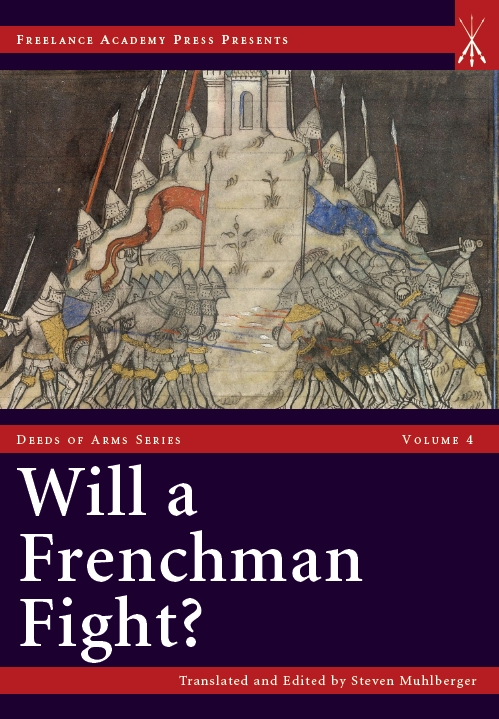
Review of Will a Frenchman Fight? ed. Steven Muhlberger Deeds of Arms, 4.

I'm grateful for this positive review but I wish the reviewer had said more about the main theme of the book, the often conflicting demands of military effectiveness and individual honor in the minds of men at arms of the time.
Muhlberger, Steven, ed. and trans. Will a Frenchman Fight?. Deeds of Arms, 4. Wheaton, IL: Freelance Academy Press, 2015. Pp. viii, 102. $24.95. ISBN: 978-1-937439-17-0.

Reviewed by Katherine Hodges-Kluck
University of Tennessee, Knoxville
kthomp41@vols.utk.edu
Will a Frenchman Fight? is Steven Muhlberger's third contribution to the Deeds of Arms Series. This sourcebook focuses on the great chevauchée, or raid, led by Thomas of Woodstock, first earl of Buckingham, through French territory in 1380-81. The book opens with an 18-page introduction, followed by selections of Froissart's Chroniques and Cabaret d'Orville's 1429 Chronicle of the Good Duke. As Muhlberger explains, Cabaret received his information from the French knight Jean de Châteaumorand, who recollected the events of his youth. Together, therefore, these chronicles provide two contemporary perspectives on the raid. The book concludes with a short bibliography for further reading.
The 1380-81 chevauchée was a response to duke of Brittany Jean de Montfort's call for aid after he was exiled for opposing the French king's attempts to exert royal jurisdiction over the ducal succession in Brittany. Will a Frenchman Fight? does an excellent job of highlighting the precarious situation which de Montfort faced. Out of favor with Charles V of France and charged with treason, the duke turned to the English for assistance, only to be thwarted by his own lords who refused to accept foreign support against their fellow countrymen. The introduction and primary sources in Will a Frenchman Fight? highlight these overlapping and frequently conflicting layers of leadership and allegiances, which in turn shaped France's military response to the rebellious de Montfort and his would-be English allies.
Muhlberger's introduction begins by outlining some of the major events of the four decades leading up to Buckingham's raid, including the Black Death, the English victory at Poitiers, the capture of the French king Jean II, and the Jacquerie rebellion. Muhlberger effectively demonstrates the economic pressures that shaped Edward III's and Parliament's military decisions on the one hand, and Charles V's struggles to "re-establish royal authority" in France on the other (5). The rest of the introduction then breaks down the sequence of events for the chevauchée and discusses the varied motivations of the French and English soldiers involved in it. The author assumes some basic knowledge of the first phase of the Hundred Years War, and the major players involved. It is not until midway through the introduction, for instance, that the reader learns that Buckingham is the "son of the King of England" (13), and only in the color plate of Buckingham's coat of arms in the middle of the book that the reader finds the earl's full name and titles.
The primary source section of the book presents the events of the chevauchée in chronological order, following the English on their march through enemy territory, their largely unsuccessful attempts to engage their enemy in battle during the winter months, and finally their retreat back to the coast. The primary texts have been thoughtfully selected to highlight the nuances of the complicated political, as well as tactical, situations posed by the English presence in France. As the book's title suggests, the sources shed light on "a variety of different kinds of combat and different motives for fighting" (3). In particular, they depict the tensions between 1) open pitched battles like those of Crécy and Poitiers, which favored the English; 2) the pragmatic but unpopular scorched-earth tactics employed by both the French and the English armies at the expense of the French populace; and 3) the desire of individual knights and squires on both sides of the conflict to demonstrate chivalric honor through individual combat.
The sources are divided into eight sections, throughout which chapter numbers and titles from the original texts are included as subheadings. Six of the sections are drawn from Froissart, while the remaining two (which are relatively short by comparison) are from Cabaret's chronicle. In the first section, titled "Buckingham's Campaign Begins," Froissart describes the exchange of ambassadors between Brittany and England, and Edward III's subsequent plans for an armed expedition into France. The chronicler discusses the deployment of troops, the effects of international alliances on events, and the capture of prisoners of war. The next section, "The Confrontation at Troyes," describes the skirmishes between French and English forces outside that city. The third section, "The Deeds of Arms at Toury and Marchenoir," follows the English army's travels into Brittany and the reception that the English received in various towns along the way, a reception that ranged from lukewarm to outright hostile. This section also includes Froissart's account of the death of Charles V. In "Buckingham in Brittany," Froissart shows the complicated political situation facing Jean de Montfort. He also describes the siege of Nantes and the coronation of the child king, Charles VI. The next passage, "The Siege of Nantes," is drawn from Cabaret's chronicle. It describes how the French defenders of the city used a variety of tactics to drive back and defeat the English besiegers. The next two selections, both titled "The Deeds of Arms at Vannes," give first Froissart's and then Cabaret's descriptions of individual combats between some of the knights and squires of the two armies. The final section, "Nicholas Clifford and Jean Boucinel," turns again to Froissart's text, outlining the peace concluded between Jean de Monfort and Charles VI, the English retreat out of Brittany, and an individual chivalric combat between Clifford and Boucinel.
While English translations of portions of Froissart's Chroniques have long been available, Cabaret's chronicle is less familiar to English readers, and this book makes a welcome contribution by including passages from it (though one wishes they were longer). Muhlberger's translations are clear and appealing to readers of all levels. This book should be a popular one for use in college classrooms, as it is accessible, attractive, affordable, and offers many topics of potential discussion.
The weaknesses of the book are largely structural. There is no index, and although Muhlberger defines specialized terms such as a outrance within the text (17), a glossary of such terms, as well as of important names, would make the book more user-friendly. Moreover, the two maps that the book reproduces (France at the Treaty of Brétigny in 1360 and at the death of Charles V in 1380), while in full color, are antiquated--one dates to 1877--and rather difficult to read. The book would benefit from a map that clearly plotted the route taken by the English army during the raid and the locations of important cities and skirmishes specifically mentioned in the text. It would also be useful to have in-text references to the images in the color plates at the center of the book.
Ultimately, this source reader presents a detailed view into an exciting yet lesser-known episode of the Hundred Years' War. Rather than placing attention on the famous battles like Crécy, Poitiers, and Agincourt, Will a Frenchman Fight? shows the more common side of war: one marked by short skirmishes, inconclusive raids, prolonged sieges, individual desire for honor, bad weather and disease, and the vicissitudes of fortune and politics.
******

Tuesday, May 17, 2016

The brutal men at arms of the Good Duke

Faithful readers and good friends know that I've been working for a while on a translation of the Chronicle of the Good Duke, a French biography of the Duke of Bourbon dating from about 1429. The events covered by the Chronicle are actually older than that. One of the most interesting things about this document is that it was written by a young person consulting with a prominent man at arms of the Duke of Bourbon's retinue, whose memory stretched back half a century and more. The man at arms was Jean de Châteaumorand, who understandably had a high opinion of his former master and his compatriots who fought the wars against the English back in the golden days of chivalry. In Châteaumorand's telling they were a pretty neat bunch and there were lots of good stories about their worthy deeds in the French wars and elsewhere. I currently have a collaborator on this project, Phil Paine, whose Middle French is much better than mine. He sent me up page of corrections recently that contained a very interesting story that shows the men at arms of the Good Duke in a less flattering light.
The Duke of Bourbon and the Poitevins left there, and they went before a place called le Faon, which was not encircled by trenches,where it would have water. And so the place was strongly assaulted, but it was not taken on that day, except only the lower courtyard, where many good men were wounded. For there was there a Franciscan who was wondrous at firing the arbelest, with which he killed four gentlemen, and he was said to be the finest arbelister in Poitou, and well provisioned [with amunition]. And on the next day, the Poitevins and Bourbonnois assailed the keep in a fierce and strong assault, and those within defended themselves, and the Franciscan let fire [again], but it was such an energetic effort that the fortress was taken, and many men killed within, save for the Franciscan-arbelester, who had removed his habit and fled to his monastery. And then the whole army asked “where is the Franciscan?”, and it was alleged that he was in the church, on his knees before the altar. And so Sir Jean de Roye hastened there, because the Franciscan had killed, by his shooting, one of his squires. And he took the Franciscan, along with his habit, and went to hang him from a tree, doing so circumspectly, so that the Duke did not know about it. And the Duke of Bourbon left le Faon.
Here we see a course of action approved by the entire army but which other people might see as disgraceful. The killing of the Franciscan might harm the Duke of Bourbon's reputation so Châteaumorand is careful to say that the Duke knew nothing about the hanging of the clerical Archer. Why might others disapproved? The telling of the tale makes it clear that the Franciscan was taken out of church and hanged. It looks to be that privileges of the clergy both in the case of the Archer and the church he was found in had been violated. Other observers could see this as an atrocity or a war crime. But John the Châteaumorand, Jean de Roye and the rest of the Army were angry and felt truly justified in hunting down and hanging the Archer. Very likely they saw the Archer as stepping outside of his role as a clergyman and taking on illegitimately the role of the combatant. He was trying to have things both ways, combatant and privileged noncombatant. The may be something more to it. It's well-known that men at arms did not see archers as their equals, even if they took part in combat as part of organized armies. It could be that Châteaumorand and his friends saw the archer as a low class sharpshooter who had no right to be so effective and kill their friends.