Showing posts with label Crusades. Show all posts

Sunday, February 10, 2019

No, clergy and laity didn't always see eye to eye in the Middle Ages


Godfrey of Bouillon is selected as ruler of Jerusalem in the wake of the First Crusade (no, he didn't get it from the Archangel Gabriel, whatever they thought in the 17th century); instead, a panel was struck to investigate the various candidates.


Sez William of Tyre:
This was done so that the electors might thus be more fully and more faithfully informed of the merits of the candidates. Those who were later very closely questioned under the required oath by the electors were forced to confess in secret the vices of their lords and likewise to enumerate their virtues, so that it might be made plain just what sort of men their lords were.

When the Duke's household were questioned among the others, they replied that, among all the Duke's actions, the one which most irritated his servants was this: that when he entered a church, even after the celebration of the liturgy had been finished, he could not be drawn out. Rather, be demanded of the priests and those who seemed experienced in such matters an account of each picture and statue. His associates, who were interested in other things, found this boring, even nauseating. Further, his meals, which had been prepared for a certain and appropriate hour, grew cold and most unappetizing because of these long and vexing delays.
The electors who heard these things said: "Blessed is the man to whom are ascribed as faults those traits which would be called virtues in another." At length, after consulting with one another and after many deliberations, they unanimously elected the lord Duke. They brought him to the Holy Sepulcher of the Lord most devoutly, chanting hymns and canticles.

Wednesday, July 19, 2017

The Green Count by Christian Cameron

I know two excellent writers of fiction, one being Robert Charles Wilson, the traveller of time, and Christian Cameron, the historical fictioneer.  I've talked about Wilson here recently, so now it is Christian's turn.

Fear not, Christian! I have nothing bad to say about you or your most recent book, The Green Count!


I am also not going to go into great detail about the virtues of Mr. Cameron.  They are two: he combines a tremendous knowledge of the periods he writes about with believable characterizations of people who lived in those periods.  This a necessary skill for anyone who wants to re-create the people of the past; even someone who does a mediocre job is doing something remarkable.  Mr. Cameron is no mediocrity, however.  He is a master.

Sunday, May 21, 2017

Fourteenth-century chivalry, as seen by various military men

People often think that in the later Middle Ages there was such a thing as "chivalric combat." What constituted "chivalric combat is not entirely clear to scholars today; indeed, it may have been unclear to knights and other men at arms in the Middle Ages.
Today I am posting a passage from the Chronicle of the Good Duke (written in 1429, describing here an incident of the 1390s) where some apparent disagreement about one point of "chivalry" is discussed. It is an account of the African crusade led by the Good Duke, in which he, or the author of the chronicle criticizes a famous French knight, Boucicaut the Younger. Boucicaut was known at this time for his strong desire to fight deeds of arms against anyone (of sufficient status) he could. Boucicaut travelled all over Europe while fulfilling this quest, and eventually attained such fame that he was made a marshal of France.
But I've always been rather dubious about Boucicaut's reputation. For one thing, he was the French commander in two of the worst French defeats of the Middle Ages, Nicopolis and Agincourt. Further, there is a lot of somewhat skeptical commentary about Boucicaut in the medieval sources. Have a look at this discussion of how Boucicaut, apparently taking his turn commanding the guards of the Crusaders' siege camp, got distracted from that routine assignment by the endemic skirmishing that took place throughout the siege and tried to arrange a challenge with the opposing Muslim forces.
Boucicaut was a chivalrous man who, through some interpreter, made a request in the skirmish where he was whether there was any Saracen who wished to combat him on foot or horse. They replied no. Then Sir Boucicaut said if they wished to perform arms 10 against 10 or 20 against 20 he and his company would be ready. So the Saracens responded no, not if the kings their lords did not want them to. When Boucicaut saw their refusal he said to them that he would fight them in a secure field, 20 Christians versus 40 of their Saracens.
As long as this conference lasted it was ordained that they should not make war on each other. With difficulties were these negotiators, Christian and Saracens, brought together, which astounded the duke of Bourbon, the Lord of Couci, the count d’Eu, the Souldich of Estrau, and the other barons, for the whole army ran to this assembly so that the Lord of Couci, the count d’Eu and others who saw the army taking leave of its senses said to the duke of Bourbon, “My Lord, the people run like beasts over there with Boucicault and they are not able to keep guard and it seems to us that if you do not order some to retreat, things will turn out badly for us.”
Then replied the duke of Bourbon: “I can’t then send a better message than one from me. I’ll go there myself.” So he asked for a mule he always had and it appeared good to the lords that he was not able to send a better message to make them retreat. So the duke mounted his mule left his tent and went off with the people of his household.
It was not long before more than 300 gentlemen were following him. The Saracens who saw that the duke of Bourbon whom they recognized by his coat of arms, came to join Sir Boucicaut with many men at arms, began strongly to retreat towards their tents, and Boucicaut and those with him to chase them. Boucicaut who saw the duke of Bourbon coming, gave himself over to pride and chased the Saracens more boldly and the duke of Bourbon with his company went after to bring about a retreat. When Boucicaut was at the tents, the Moorish kings and their Saracens put themselves in formation for battle outside their lodgings, and Boucicaut put himself in battle formation with his men, awaiting the duke of Bourbon and those who came with him. The duke of Bourbon caught up with those whom he wished to make retreat, and he very violently spoke to Boucicaut, concerning his great follies.
But the duke of Bourbon seeing that there was with him a good 2000 combatants following him, and seeing also the Saracens who had abandoned their camps and put themselves in battle order all outside, said, “My friends, since we see the lodgings of the Saracens abandoned, let us go by God and charge among their lodges and if the Saracens are worth anything they will come and defend them .” The duke forbade anyone should be so bold as to ignore his order nor think about pillage, but should fight forcefully and at the first sound of the trumpet which he would have sounded, everyone should pull back to his standard.
Then the duke of Bourbon first and the lords and the captains each in his place, with their men at arms and arbalestiers of Genoa charged among the tents of the Saracens, attacked all the lodgings and cut the ropes of the tents and set fire to the lodgings of straw and the duke of Bourbon remained for an hour in the middle of the Saracen lodgings with his standard of the belt of hope. During this the count d’Eu arrived with a good seven score combatants who came from the other side, by the shore, which made those who were already there very happy and joyous.
Because he was late, the count d'Eu said to the duke of Bourbon, “My Lord you see the finest thing one can see, and I thank God that I am found in your company, but for God’s sake, let’s go back, for it is evening and if the Saracens attack the lodgings there’s only the Lord of Couci with a few men, and a bunch of those are ill: so he will be completely lost.” So the duke of Bourbon said to the count d’Eu, “We will go there immediately, please God.”
Now imagine you are sitting at a campfire in a French siege camp in the 1390s. Someone says "Boucicaut is the greatest living knight." What might you say?

Thursday, January 07, 2016

The Race for Paradise: An Islamic History of the Crusades, by Paul M. Cobb


Cobb, Paul M. The Race for Paradise: An Islamic History of the Crusades. Oxford: Oxford University Press, 2014. Pp. 335. $31.95. ISBN: 978-0-19-935811-3.

Reviewed by Steven Muhlberger

Nipissing University (retired)

steve.muhlberger@gmail.com

I approached reviewing this book not as a specialist in the Crusades (I am not) but as someone who has taught the Crusades numerous times in the last thirty years in medieval and world history surveys, in a survey of Islamic civilization, and in an undergraduate course on Crusade and Jihad. I have had some experience of hunting for appropriate books that would help me explain the this period from the Muslim point of view, but not much luck in finding ones that are suitable in content and availability (and, yes, price).

The next time I teach that material, however, I will know where to go for a good discussion of what the Crusades looked like from the point of view of "the crusaded," to use Paul Cobb's phrase. I do not think there is any book on the market today as good as this one for showing the effects of the Crusades on the Muslim-ruled Middle East. It is a good solid narrative history that looks outwards from Syria and cities of the Dar-al-Islam ("the Abode of Islam") rather than at Jerusalem from France and Rome.

Paul Cobb comes to this material very well prepared to discuss events from the Islamic point of view. He has written on Abbasid Syria and post-Umayyad Spain, and both translated and written a monograph on Usama ibn Munqidh, whose Book of Contemplation has long been valued for its autobiographical reflections on Crusade-era Syria. Cobb is very familiar with the work of Muslim scholars and litterateurs and the cultural environment in which they worked.

And it is our good fortune that he has the ability to convey his understanding to non-specialists. Cobb has a gift for explaining. I was very impressed early on in the book with his explanation of the difference between Sunni and Shiite traditions in the Middle Ages, and similarly how well he explained the decentralized structure of political life in the era of the Seljuks, the Fatimids, the Ayyubids and the Ottomans. His discussion of the use of the word jihad in the period in question is, as it must be, careful and clear. The ability to introduce such basic matters to the reader is the most important test that a writer addressing a general audience faces. Cobb passes this test with flying colors.

The book is organized chronologically around military and political events with occasional diversions into historiographic questions or descriptions of cultural change. Cobb sticks very closely to his announced focus on Islamic history. Events and personalities that did not directly affect the Muslim world are deemphasized. The Fourth Crusade gets one paragraph. The role of the papacy, neglected by most Muslim writers, is hardly noted in the Race for Paradise. Frederick II, an active crusader and King of Sicily and as such the ruler over the Muslim minority on that island, gets much more coverage than his rival Innocent III, even though the pope in question was perhaps the most important architect of the Christian theory of holy war and its implementation. For this reader, familiar with the usual general accounts of the Crusades, it was a salutary exercise to follow along in Cobb's wake.

Cobb's performance as a narrative historian is not perfect. The same details that help him build a full and convincing picture of Islamic history sometimes feel like items in an unending catalogue of campaigns' battles, and political intrigues. But he is a far better and livelier writer than many scholars. Cobb's language is up-to-date and relaxed. He does not hesitate to break the unwritten rule that forbids scholars to use slang unless it is nearly a century old. On the other hand he does not overdo it by committing himself to phraseology that might prove to be entirely ephemeral.

Cobb's narrative history from the Islamic point of view is a very valuable resource. Yet he goes beyond this to discuss historiographical questions that are very much alive in the scholarly community, and also of interest to general readers who might pick up the book. He rejects the idea that Muslim observers had no appreciation for crusading as a unified phenomenon. He does believe that Christian religious motivations were hardly appreciated by most Muslims who discussed the aggression of the Franks. However, he argues that the dominant Muslim line of reasoning for the origins of the crusade was the fact that Franks were by nature an aggressive people. A number of Middle Eastern observers saw the wars of the Franks as an intensification of that inherent aggression. The attacks on Sicily and Muslim Spain after 1060 were for them an important prelude to the Jerusalem campaign of the 1090s. All of this Frankish aggression on a variety of fronts was of a piece. The unifying factor for these writers was the failure of the Muslim community with its many internal divisions to deal with this Frankish threat. It should be pointed out that just as Cobb's Muslim sources give the Sicilian and Spanish wars an important place in their analysis, so does Cobb emphasize those wars. The way he integrates the "western front" with the conflicts in the Middle East and Eastern Mediterranean is one of the best parts of his treatment.

Similarly, readers will find a very good discussion of the term jihad. Cobb believes that modern scholars sometimes overemphasize the contrast between greater or spiritual jihad and lesser or military jihad. Cobb argues that it is certainly the case that most discussions of jihad in the Crusading era referenced military activity against the infidel. But he also rejects the idea that jihad simply meant militarism. Jihad sprang from the duty of Muslims to "command the good and forbid the wrong." Whether that duty required a military response on the part of the faithful in any given case was a complicated question; the complications are very nicely handled in the book.

There is no full bibliography, but the "bibliographic sketch" and the endnotes provide quite adequate guidance for non-specialist readers.

To return to the Race for Paradise as a teaching resource. Will it be useful for students? This will depend on the exact goals of the course and how prominently the internal dynamics of the Muslim Middle East will be in it. Cobb's clear language and the book's very reasonable price make student use a real possibility. But Cobb's book certainly belongs on the bookshelf of anyone who teaches the Crusade, and on the shelves of every university library where the Crusades are taken seriously as part of the history curriculum.





Thursday, March 05, 2015

How Islamic is the Islamic State?

Fascinating article in the Atlantic by Graeme Wood. Its concluding passage:
Within the narrow bounds of its theology, the Islamic State hums with energy, even creativity. Outside those bounds, it could hardly be more arid and silent: a vision of life as obedience, order, and destiny. Musa Cerantonio and Anjem Choudary could mentally shift from contemplating mass death and eternal torture to discussing the virtues of Vietnamese coffee or treacly pastry, with apparent delight in each, yet to me it seemed that to embrace their views would be to see all the flavors of this world grow insipid compared with the vivid grotesqueries of the hereafter.
I could enjoy their company, as a guilty intellectual exercise, up to a point. In reviewing Mein Kampf in March 1940, George Orwell confessed that he had “never been able to dislike Hitler”; something about the man projected an underdog quality, even when his goals were cowardly or loathsome. “If he were killing a mouse he would know how to make it seem like a dragon.” The Islamic State’s partisans have much the same allure. They believe that they are personally involved in struggles beyond their own lives, and that merely to be swept up in the drama, on the side of righteousness, is a privilege and a pleasure—especially when it is also a burden.
Fascism, Orwell continued, is psychologically far sounder than any hedonistic conception of life … Whereas Socialism, and even capitalism in a more grudging way, have said to people “I offer you a good time,” Hitler has said to them, “I offer you struggle, danger, and death,” and as a result a whole nation flings itself at his feet … We ought not to underrate its emotional appeal.
Nor, in the case of the Islamic State, its religious or intellectual appeal. That the Islamic State holds the imminent fulfillment of prophecy as a matter of dogma at least tells us the mettle of our opponent. It is ready to cheer its own near-obliteration, and to remain confident, even when surrounded, that it will receive divine succor if it stays true to the Prophetic model. Ideological tools may convince some potential converts that the group’s message is false, and military tools can limit its horrors. But for an organization as impervious to persuasion as the Islamic State, few measures short of these will matter, and the war may be a long one, even if it doesn’t last until the end of time.

The psychology of the Islamic State as described here reminds me of the apocalyptic motivations of the promoters of and participants in the First Crusade.

Wednesday, February 18, 2015

The Crusades: defensive wars?

Recently experts on the Crusades have got a reasonable amount of press on whether the Crusades should be condemned or not. One statement made by several of them is that the Crusades were justifiable as defensive wars against Muslim aggression.

Iff you look at maps illustrating the course the Crusades, you usually will see a fairly clear back-and-forth boundary between Christian ruled countries and Muslim ruled countries.

Yet I have a hard time taking this argument all that seriously because I have my strong doubts that warriors in the 11th century, whatever the ethnic or religious background, cared whether or not a war was “offensive” or “defensive”.

If you look at the 11th century, the century that ended with the First Crusade, and you will find a large number of major wars that resulted in new rulers being imposed on the previous population, which sometimes practiced a different religion from the conquerors. Here is an incomplete list straight out of my head, done without referring to any reference works so there might be some mistakes. It is in roughly chronological order.


  • Conquest of England by Knut (Canute)
  •  Conquest of Norway by Canute
  •  Conquest of England by William
  •  Conquest of southern Italy and Sicily by various Normans
  • Conquest of Anatolia by the Seljuk Turks
  • Conquest of Central Spain by Castile
  • First Crusade


Similarities

  • It is extremely unlikely that any of the conquering armies saw themselves as ethnically or nationally unified. In some cases it is quite clear that they were ethnically heterogenous.
  • People were willing to travel long distances to take part in wars that might result in conquest. 
  • Also, it is pretty clear that warriors believed that if they were successful in their war they were entitled to all the wealth that they could confiscate, whether that might be lordship over wide territories for the highest ranking and most successful or whether it might be plunder, which just about everybody expected and hoped for.


Using this perspective, The First Crusade doesn’t seem to be all that different from the other wars listed here.

That doesn’t mean other reasons for wars were not present. William the Conqueror seems have considered himself to have been legitimately named as Edward the Confessor’s heir for the kingdom of England. Some of his followers may have gotten a bit of a thrill from fighting for the right of William to be King. But they did not go home after Hastings to sit around talking about how they had done the right thing. No, they got as much territory and profit out of William’s successful war as they possibly could. Also, the Pope did give William a papal banner to take to England as a sign of ecclesiastical support and a certain amount of religious justification was present in some of these other wars as well. Some people did go home after the first crusade and talk about how they done the right thing. But what plunder could be acquired was always part of the picture. It was a rare warrior – were there any? – who did not think that plunder was a legitimate source of profit in any war.

Visualizing these large groups of armed men roaming the countryside stealing stuff and conquering countries makes me sceptical that the big movements on the historical maps of the Crusades can be explained as “defensive wars.” Looking back over the larger sweep of history I wonder whether “defensive wars” were an important phenomenon in most people’s view of the world before the 20th century. Certainly professional warriors have tended to look at war as a normal part of life, not some terrible breakdown of society as many people feel today. Perhaps a dislike for war was stronger among non-warrior groups such as the peasantry or the clergy (especially monks) and of course large numbers of women. But among the people who led wars and fought wars, did they really think about offense or defence as an important category affecting their decision-making?


Thursday, September 05, 2013

Armies of Heaven, by Jay Rubenstein

This book presents itself as an argument that the first crusade was both inspired by apocalyptic thinking – the conviction that humans have entered a part of history where their actions take on cosmic significance – and also promoted that kind of thinking.

Jay Rubenstein's book does that, but the reader who expects an unwavering focus on apocalypticism may be disappointed. A great deal of Armies of Heaven is devoted to a rather detailed narrative history of the crusade. On the other hand, for a lot of readers this may be a virtue. Rubenstein does a good job of telling the basic story.

Recent scholarship has tended to focus on religious motivations for going on crusade, dismissing the idea that people went to Jerusalem for profit and self-advancement. Reading Rubenstein's book, devoted to the emergence of apocalypticism, has the perhaps paradoxical effect of showing that there was a real struggle between ordinary, greedy, ambitious warlordism and the more abstract motives of those most devoted to bringing on the final days. There are plenty of non-apocalyptic motives out there.

In an earlier blog post, I drew attention to the fact that Pope Innocent III in the early 13th century used the idea of crusading to attack any disobedient or unorthodox target, in Europe or in the Middle East. Somewhere in this book Rubenstein quotes people considerably earlier than Innocent saying much the same thing. "We have beaten the infidels in the Middle East, but have not yet been able to do something about the heretics and schismatics out this way."

You can hear Rubenstein being interviewed at New Books in History.

Friday, July 19, 2013

Insight re Crusade and Jihad

There were plenty of religious rivalries before 1096, and a great many were  Christian v Christian and       Muslim v Muslim. Like Syria or Iraq today.

Wednesday, May 22, 2013

The Battle Hymn of the First Crusade


People often have a hard time seeing how the ethos of the Crusades can be justified in the light of certain seemingly pacifistic statements attributed to Jesus Christ in the Gospels.

Why not think about this in a different way by looking at a religiously inspired song of a more recent time?

Comments welcome. Do you find this strange, exotic, and if so why? Is this part of your personal cultural heritage? If you thought it was before you read all of the stanzas, what do you think now?

Mine eyes have seen the glory of the coming of the Lord;
He is trampling out the vintage where the grapes of wrath are stored;
He hath loosed the fateful lightning of His terrible swift sword:
His truth is marching on.
(Chorus)
Glory, glory, hallelujah!
Glory, glory, hallelujah!
His truth is marching on.
I have seen Him in the watch-fires of a hundred circling camps,
They have builded Him an altar in the evening dews and damps;
I can read His righteous sentence by the dim and flaring lamps:
His day is marching on.
(Chorus)
Glory, glory, hallelujah!
His day is marching on.
I have read a fiery gospel writ in burnished rows of steel:
"As ye deal with my contemners, so with you my grace shall deal;
Let the Hero, born of woman, crush the serpent with his heel,
Since God is marching on.
(Chorus)
Glory, glory, hallelujah!
Since God is marching on.
He has sounded forth the trumpet that shall never call retreat;
He is sifting out the hearts of men before His judgment-seat:
Oh, be swift, my soul, to answer Him! be jubilant, my feet!
Our God is marching on.
(Chorus)
Glory, glory, hallelujah!
Our God is marching on.
In the beauty of the lilies Christ was born across the sea,
With a glory in His bosom that transfigures you and me.
As He died to make men holy, let us die to make men free,
While God is marching on.
(Chorus)
Glory, glory, hallelujah!
While God is marching on.
He is coming like the glory of the morning on the wave,
He is Wisdom to the mighty, He is Succour to the brave,
So the world shall be His footstool, and the soul of Time His slave,
Our God is marching on.
(Chorus)
Glory, glory, hallelujah!
Our God is marching on.

What does it mean that the soul of time will be His slave?

Wednesday, December 19, 2012

Reflections on Crusade and Jihad, 2012


Every time I teach the Crusade and Jihad course, I have a few new insights. Here are my insights for this year’s iteration.

The main one is the realization of a pretty obvious point. Christians and Muslims alike could go for centuries not worrying about who controlled the holy city of Jerusalem. Then they would go through phases where for some people at least that was the A#1 priority for a whole community. Thinking about this, I conclude that the crusading fervor or the jihadist fervor requires a whole new understanding of the present the past and the future. Someone wakes up one day and realizes that the world is going to hell in a handbasket, that things are uniquely bad right now, and that extreme measures are necessary to correct that bad trend. Or to put it another way, there is a unique opportunity to clean up the mess that this world currently finds itself in. There is no crusade or no jihad without that realization that normal time has come to an end and that the moment we are living in is somehow special.

Of course, not everybody in a given community goes along with the fervor when it catches hold. Some very good and influential scholarship has focused on the fact that unauthorized preaching of Crusades was seen as a danger to the social order – and of course if it was going to amount to anything, it would be a danger to the social order. It is easy to find oneself taking sides in this ancient debate. We have sources that praise jihadist leaders as being good Muslims, and we are sometimes too quick to grant them that status, and see the people who oppose them, other Muslim rulers who worried more about jihadists than Christians, as being selfish. Well, yes, but they were selfish because they were looking out for their own interests in normal times, and were quite skeptical of those who claimed that normal times and normal politics had come to an end. And I think most of us in the same situation would probably be equally selfish. Similarly Shepherd’s Crusades and Children’s Crusades and Peter the Hermit’s crusade were looked at with a great deal of skepticism. The claims made in connection with these movements were so sweeping that even people who in principle were in favor of reforming the Christian community and achieving great things as a result (who could be against that?) felt threatened.

Understanding the idea that some time, now, is a special time when different standards apply, is a key factor in understanding the Crusades or for that matter jihad.

On a related matter, I noticed when students commented on Ralph of Caen’s account of the discovery of the Holy Lance at Antioch, they tended to take Ralph’s side, in other words they believed that Peter who found the Lance was a phony, just like Ralph did. But Ralph was no neutral observer, and there is no reason to think that he didn’t believe in miraculous interventions that made the crusade possible. His argument is that Peter falsely claimed powers and heavenly connections that he didn’t have. He is not arguing for skepticism in general, he’s just – many years later – rubbishing Peter’s reputation to build up to Bohemond’s claim to be the great hero of the first crusade. In case anyone had forgotten. Yes indeed, God did make possible the taking of Jerusalem. But the special moment was not that moment where Peter found the Lance. It was some other moment, and the characteristic prudence and calculation of a good leader in normal times probably had a lot to do with it. Or so I guess, not having read all of Ralph’s work.

So I conclude with the thought that in some circumstances, there is the argument going on between various interested parties as to what kind of standards apply to the questions of the present. Are we in normal time, or are we in an exceptional moment with exceptional dangers and exceptional opportunities?

Saturday, December 01, 2012

Comment to a student in my Crusade and Jihad course

Me:
One other similarity between Christian crusaders and Muslim jihadists is that sometimes one or both of them were interested in Jerusalem and the holy land, and sometimes they were not. People could go for hundreds of years ignoring the fate of Jerusalem.

Friday, October 12, 2012

Some interesting medieval scholarship on the web, Crusaders take note

The always interesting  Jonathan Jarrett reminded me of some interesting material that has been posted to the web which might be of interest to people who like the Franks and the Frankish nobility or who are fascinated  by the motivations of the people who went on the First Crusade.


I was particularly interested in the second post, which is the next best thing to a scholarly article, because I have been reading student papers about the motives of crusaders. Jonathan Jarrett, takes the position that you just can't dismiss the fact that, expensive as the crusading expedition was likely to be, some of the pilgrims thought they might possibly become rich. Jonathan Riley – Smith, a leading contemporary interpreter of the First Crusade is well-known for his opposition to the idea that any sensible person could have gone to Jerusalem expecting riches. In my lectures on the First Crusade, I make the point that Frankish warriors/early Knights were in the habit of taking big risks, notably to their own bodies, in hopes of gains of various sorts, monetary and reputational. It is nice to see this point of view systematically developed in any sensible form. If any of my students are still interested in this problem, our library has a more detailed article by John France in the collection of articles by Thomas Madden. This collection is called, rather obscurely, The Crusades. Just so it won't be confused, no doubt, with any other collection of articles on the Crusades.

Sunday, May 27, 2012

The Crusades and the Christian World of the East: Rough Tolerance, by Christopher MacEvitt. Another good one

Christopher MacEvitt's book has a certain resemblance to Giancarlo Casale's book on Ottoman exploration. It's about an important, difficult subject; it goes against the prevailing wisdom; and it is based on difficult research in fragmentary sources.

MacEvitt presents  the prevailing wisdom  about relations between Western Christians settling in the holy land and the Eastern Christians who already lived there, thus:  as a case of colonial segregation. There are not a lot of sources that discuss the legal situation, how legal doctrines actually worked, or how Eastern and Western Christians interacted in daily life. The sources we do have come from the 13th century, after the restoration of the kingdom of Jerusalem following its destruction in the 1180s. MacEvitt has returned to the 12th century, and done his best to find the real story of daily life in charters and, in the north where Armenian documents exist in some numbers, chronicles, to see whether different Christian groups actually lived strictly segregated.

Well of course, he concludes that 13th century evidence gives a false picture of the earlier era. In contrast to the effort by churchmen and legislators to classify people by ecclesiastical and even Christological criteria, the early crusader states were characterized by an effort to obscure the dividing lines. Although there was a strong argument for giving priority to the person's ecclesiastical allegiance in legal and status matters, MacEvitt portrays a society where most people did not want to live in religiously-defined silos. They wanted to have a certain degree of freedom of association, and there was a consistent effort by documented individuals to make sure that they were not pinned down against their will. That does not mean that everybody loved everyone else or that some groups were not more important than others. That's the rough in "rough tolerance."

 Over the last year the situation in Syria has made me realize how very diverse the country is even now. Sometimes the divisions– religious divisions – between Syrians don't matter very much, and other times you are forced to pick a side, generally one chosen for you by unsympathetic neighbors.  And then you fight till everybody's tired of fighting, or one group establishes a short or long-term supremacy. It looks to me like during the crusading times, things were not that different.  Except in the 12th and 13th century, there was always some Frank or Turk or Egyptian or Byzantine showing up to claim the land and the holy places. But if you look back a century or so and realize that Syria not so long ago included Lebanon, Jordan, and Israel, then maybe that difference disappears, too.

Update:  can sectarianism be discussed in today's Syria?  Should it?  From Ehsani at Syria Comment:

This is what a Syrian commentator wrote on one of the social media outlets this morning:
“Anyone that mentions the name of sect or religion in Syria, in any context, and all those who incite sect or religion in Syria, in any context and all those who try to show a range as a victim and a look executioner in any context is a traitor to Syria and Syria is innocent of it. All intolerance for other than Syria is betrayal. Martyrs have one religion and one sect and that is Syria. Blood flowing on the soil of Syria have a single identity and that is the identity of Syria.”
كل من يذكر اسم طائفة أو دين في سوريا بأي سياق و كل من يحرض على طائفة أو دين في سوريا بأي سياق وكل من يحاول أن يظهر طائفة بمظهر الضحية و طائفة بمظهر الجلاد بأي سياق هو خائن لسوريا و سوريا بريئة منه فكل تعصب لغير سوريا قدس الأقداس خيانة.
للشهداء دين واحد و طائفة واحدة هي سوريا فالدماء التي تسيل على تراب سوريا لها هوية واحدة هي الهوية السورية
While it is hard to argue with pleas to ignore religious and sectarian tendencies that may incite more killings and hatred, ignoring the obvious demons we face does not strike me as a credible solution.
It should be obvious to all of us by now that fake stability is an unsustainable model that is unlikely to last for long. Societies cannot advance and prosper unless they openly face their demons and discuss their long held taboos.
I, for one, want every Syrian to openly discuss everything that ails our society. This covers the role of religion and sectarianism.

Image:  Not St. George; St. Sergios.

Saturday, December 03, 2011

Tuesday, October 18, 2011

The taking of Jerusalem, 1099


People often wonder how medieval Christians could have taken part in holy war, given Jesus's well-known pacifistic pronouncements.  Here are excerpts from a lecture I gave yesterday on the taking of Jerusalem, which ended in a massacre, which touches on the issue:
Here’s what Tyerman (page 31) says about a famous Christian account of the massacre: 

Raymond of Aguilers… who witnessed the fall of Jerusalem in 1099, described the ensuing massacre on the Temple Mount: "it is sufficient to relate that in the Temple of Solomon and the portico crusaders rode  in blood to the knees and bridles of their horses."  What ever the atrocities performed that day, Raymond was quoting Revelations 14:20 "and the winepress was trodden without the city and the blood came out of the winepress even to the horse bridles."

Comments? [No comments from students.]

Here are my comments.   Massacres of garrisons and the civil  population of fortifications and cities that had resisted for a long time were pretty common in medieval times.   According to the laws of war (or the customs of war) those who resisted, even if they were not armed and had no authority or say in the waging of war, brought the consequences of such resistance upon themselves.  It was kind of a no-win situation because people who surrendered too quickly to a threat of siege might invite the revenge of their rulers if the rulers won the war eventually.   But to focus on the other situation: we've already seen in this course that a siege was a hard task and a dangerous one even for the people outside.  I sometimes joke that it is no real joke that sieges came down to who caught dysentery first, the people outside in their squalid camps, or the people inside crowded together in bad conditions.   Besiegers died in significant numbers in a hard siege, and the numbers went up significantly if there were a number of unsuccessful assaults.  Besiegers became targets for missiles thrown at them from above, and insults meant to break the morale and boost morale on the other side.  When besiegers swarmed into a city through a gap in the walls or by the treachery of the tower commander, that they were not in a good mood all.  All the anger fear and hardship came together in a murderous rage and perhaps a sudden feeling of invulnerability.   Like hunters, they fell upon their prey, animate and inanimate.

Further remark is necessary in the case of Jerusalem, however.   Modern observers from the historically Christian environment often expressed wonder that the religion of peace and my kingdom is not of this world could have inspired warfare.   Forgetting entirely about Muslim and Jewish accounts of the slaughter of Jerusalem, we can see just from Christian accounts that not only did nominal Christians take part in mass murder like anyone else, they felt more justified in doing so in this case because they had scriptural authority behind them.  Those who took part and had read their Bible knew that this was God's will.
Two further points:
  1. Any important and popular religion contains a multitude of contradictory elements that can be used to justify all sorts of actions.
  2. People who study religion or are particularly pious or are opposed to some specific religion often act like a person or group can be completely characterized as "Christian" or "Muslim" or "Shiite" or whatever.  Not so.  Those Crusaders at Jerusalem liked to think of themselves as Christians, bound by the law of God, but also as warriors, subject to the customs of war. This should be obvious, but the way people talk, it clearly isn't.
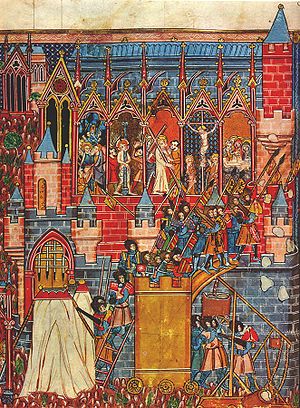
  Image:  A medieval illustration combines the taking of Jerusalem with the Crucifixion.

Saturday, September 24, 2011

Clash of civilizations time?

Since I am teaching both  Islamic Civilization and Crusade and Jihad this term, you can see how this piece, summarized from an Arabic source  in Syria Comment, could not help but draw my attention.
Why don’t the Christians in both Lebanon and Syria immigrate to Europe is allegedly what Sarkozy asked the Maronite religious leader on his recent visit to France.  According to the article, Christians had no place in the Middle East given the clash between Christianity and Islam.  The Maronite leader was shocked by what he heard which prompted the French leader to point to a document that cites how over three million Christians immigrated from Lebanon over the past 20 years and that the Middle East will face many problems in the future.
One wonders, but not very much, what the French president thinks about all those Muslims in France.

Monday, September 12, 2011

Imagine my surprise


In the first class meeting of my Crusade and Jihad course this morning, I said something like this:

You don't have to want to be a Christian crusader in the present, or even be a Christian, to have a vague positive feeling about those old holy wars.  For example, the recent movie Kingdom of Heaven by implication condemns some aspects of crusading, especially fanatics who go too far, but does not condemn crusading or Crusaders completely.  There are plenty of literary and film examples of this going back to Walter Scott in the early 19th century.  This results in the nostalgic feeling that somewhere sometime there was a worthy crusade pursued by sincere people who even if they made some mistakes had good hearts. 
Then I asked my students if they had any such nostalgic feeling.

Not one said they did.

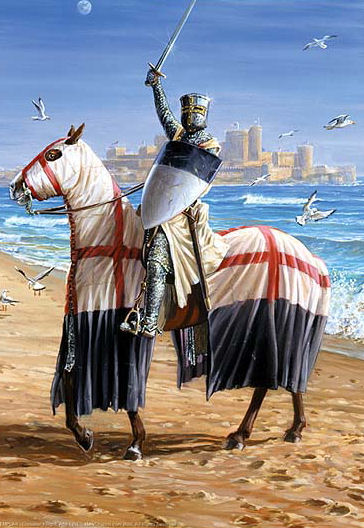
Image:  Richard Lionheart, North Bay seems to have fallen out of love with you...

Monday, July 25, 2011

Modern Medieval: (inflammatory) language has consequences

Crusading rhetoric, then and now.

Ideology

Boris Johnson in the Telegraph, on the Norwegian "Templar:"

It is not enough to say he is mad. Anders Breivik is patently mad: no one in their right mind would behave as he has done. Nor is it enough to say that he is evil. If the word evil has any meaning at all, then it must obviously apply to a man who can go to a lake island summer camp, call innocent young people to run towards him – and then shoot 85 of them with an automatic rifle.
We will never be satisfied with simple words like “mad” or “evil”, and for the days and weeks ahead we can expect exhaustive psychoanalysis of this dreary and supercilious 32-year-old sicko. We will summon and interview all the potential hobgoblins of his mind. With the help of the Norwegian investigators, we will try to understand how these demons persuaded him to engage in an act of such premeditated cruelty; and as our guide we will use the 1,500-page manifesto of hate that he (and possibly his accomplices) have posted on the internet.
It is in many ways a preposterous document, with its plan to revive the ancient order of the Knights Templar, with Breivik as “Justiciar Knight”. The idea is to mobilise an army of similar loathsome berks and to liberate Europe of immigrants by 2083. It seems that this is the 200th anniversary of the death of Karl Marx, whom Breivik blames for egalitarianism, feminism, multiculturalism and all manner of other things he dislikes. Breivik’s attempt at Mein Kampf is awash with Wikipedia-generated teenage ruminations about Gramsci, Adorno and Islam, and I must confess I have not slogged all the way through to the end.
But I have read enough to grasp the gist – and there is something both curious and troubling in his obsessions. He goes on and on about the EUSSR and “Eurabia”. He attacks multiculturalism as a “big lie”, and asserts that “political correctness now looms over Western European society like a colossus”. “Can the European Union be reformed?” he asks. “I doubt it. The EU is bound together by a self-serving class of bureaucrats who want to expand their budgets and power, despite the harm they do.” He claims that Europe has been systematically betrayed by mass immigration from Muslim countries, and that the method of this immigration has been concealed from the electorate. He cites a great many British commentators to make his points. Indeed, it is fascinating to see how rooted is this Norwegian extremist in the political discourse of the Anglosphere.
My friends, there is no easy way of saying this: a lot of what this evil nutcase says could be drawn from the blog-post threads that you will find in the media, especially the “conservative” media, in Britain. Some people will read his dismal expectorations and conclude that this inflammatory guff is what really drove him on. They will say that his barbarism was spurred by fury at the EUSSR and immigration, just as the murders of 9/11 were triggered by the various tenets of Islamic extremism.
It is certainly true that on the face of it he has much in common with some recent Islamic suicide bombers. He is disturbed by female emancipation, and thinks women would be better off in the home. He seems to be pretty down on homosexuality. Above all – and in this he strongly resembles an Islamist – he believes that his own religious leaders are deeply decadent and have deviated from orthodoxy. He is repelled, like so many Muslim terrorists, by anything that resembles the mingling of cultures.
People will say that we are looking at the mirror image, in fact, of an Islamic terrorist – a man driven by an identical but opposite ideological mania. There is certainly a symmetry here, and yet in both cases, Breivik and the Muslim bomber, I don’t think that ideology is really at the heart of the problem. Yesterday the television reporters found an acquaintance of his from Norway, a fellow called Ulav Andersson, who said that he had known Breivik pretty well. He was surprised by all the Knights of Templar stuff, because he had never really been religious, and he wasn’t aware that he had been interested in politics.
“He didn’t seem opinionated at all,” he said. He just became chippy and irritable, said Ulav Andersson, when some girl he had a crush on jilted him in favour of a man of Pakistani origin.
It wasn’t about immigration, or Eurabia, or the hadith, or the Eurocrats’ plot against the people. It wasn’t really about ideology or religion. It was all about him, and his feeling of inadequacy in relation to the female sex. The same point can be made (and has been made) about so many of the young Muslim terrorists. The fundamental reasons for their callous behaviour lie deep in their own sense of rejection and alienation. It is the ideology that gives them the ostensible cause, that potentiates the poison in their bloodstream, that gives them an excuse to dramatise the resentment that they feel in the most powerful way – and to kill.
There is an important lesson, therefore, in the case of Anders Breivik. He killed in the name of Christianity – and yet of course we don’t blame Christians or “Christendom”. Nor, by the same token, should we blame “Islam” for all acts of terror committed by young Muslim males. Sometimes there come along pathetic young men who have a sense of powerlessness and rejection, and take a terrible revenge on the world. Sometimes there are people who feel so weak that they need to kill in order to feel strong. They don’t need an ideology to behave as they do.
Michael Ryan had no ideology in Hungerford; Thomas Hamilton had no ideology in Dunblane. To try to advance any other explanation for their actions – to try to advance complicated “social” factors, or to examine the impact of multiculturalism in Scandinavia – is simply to play their self-important game. Anders Breivik may have constructed a portentous 1,500 page manifesto, but like so many others of his type he was essentially a narcissist and egomaniac who could not cope with being snubbed. We should spend less time thinking about him, and much more on the victims and their families.

But then read the comments...

Saturday, July 23, 2011

Crusader

The Norwegian terrorist considered himself a Knight Templar, thought "multiculturalists" were traitors, and expressed admiration for the effectiveness of al-Qaeda.

Another member of the "rivers of blood" gang. And oh so self-righteous with it.
z

Update: An older post on the rivers of blood gang.