Showing posts with label ancient resources. Show all posts

Sunday, August 07, 2016

The Loeb Classical Library saves civilization


The Loeb Classical Library is a bit over one hundred years old. It was meant to be useful to a wide group of readers -- each volume has not just the original text but also a facing translation into English. As you can imagine many people who had an excellent classical education scorned the project. The poet John Talbot is one of the defenders of the LCL:
I have a little apocalyptic fantasy that involves the collection of Loebs in my local library. It’s a complete set, from Homer’s rosy-fingered dawn to the twilight of Ammianus Marcellinus. The very sight of it is reassuringly tidy: all the sprawling energies of a thousand years of Greek and Roman thought and song, distilled and compacted into these snug matching volumes, the Greek bound in olive drab, the Latin in scarlet. Run your fingers over the spines. Here are The Classics.
Then comes a nuclear holocaust. My local library, like others around the world, is mostly pulverized, but an accident involving molten rubber preserves the case of Loebs intact within a sealed airtight cavity beneath the rubble. Centuries elapse and deposit their layers of sediment. Above ground, the descendants of the survivors plod on, speaking a crude version of English, and when their vestigial civilization is at last stable enough to permit cultivation of the liberal arts, their curiosity turns to the prior civilization, ours, whose evident sophistication is attested only in the occasionally exposed ruin, or in fragments of excavated texts. Of this second category, a half-page of Danielle Steele, the corner of a Dunkin’ Donuts advert, and the odd shred of Paradise Regained are all scrutinized, edited, and interpreted with equal zeal. The fragments are exasperating: they imply a vast literature, and behind it a teeming culture, all tantalizingly out of reach.
Until one day when excavation unseals that underground cavity, and for the first time in so many centuries, sunlight falls on those green and red spines. The whole Loeb Classical Library, dedicated to preserving whatever could be salvaged from an even earlier lost civilization, has itself survived intact. The excavators fall upon the cache and discover not only the English (which they can mostly make out, though it appears to them as remote as Chaucer to us) but also, to their astonishment, on the facing pages, two strange, even more ancient languages, one with an unfamiliar alphabet. Amid a storm of speculations it is posited that the English is the key to the other two tongues, and in time a latter-day Champollion steps forward and reconstructs the grammar of Latin and Greek. His successors, pioneer scholars of the recovered ancient languages, are at first awestruck—what are these voices speaking out of the dust?—and then electrified, as they begin to read and assimilate Homer and Sophocles and Lucretius and Augustine. These voices must be emulated; the standards are daunting but stimulating; though ancient, they point the way to something new. Academies are organized for teaching the new languages; young souls (they will become poets and historians and scientists) are once again smitten by the songs of Sappho and Catullus, the grave brilliance of Thucydides and Tacitus, the searching effervescence of Plato’s Socrates and Aristotle’s dogged earthbound inquisitiveness. The post-apocalyptic world shrugs off its torpor, hums with ideas and energy and hope. I suppose what I mean by all this is that it is good to know that the Loeb Classical Library is there, patiently waiting, in case any civilization (not least our own present one) should require a renaissance.

Saturday, January 03, 2009

Fifty ancient history blogs

One of the first e-mails I received this year was a notification that I was included on one listing of Top 50 Ancient History Blogs. Checking the list out I was surprised to see how few I'd run across, and how different they were from each other. So I say, have a look.

Friday, August 24, 2007

The Chronography of 354

I have mentioned here before Roger Pearse's public-spirited project to publish in translation as many late ancient and early Christian primary sources as he legally can. Roger is an Internet hero.

His most recent publication might be of interest to some readers: it's the kind of thing that you might never hear of unless you were a specialist in late ancient historiography (that's how I came across it first): The Chronography of 354.

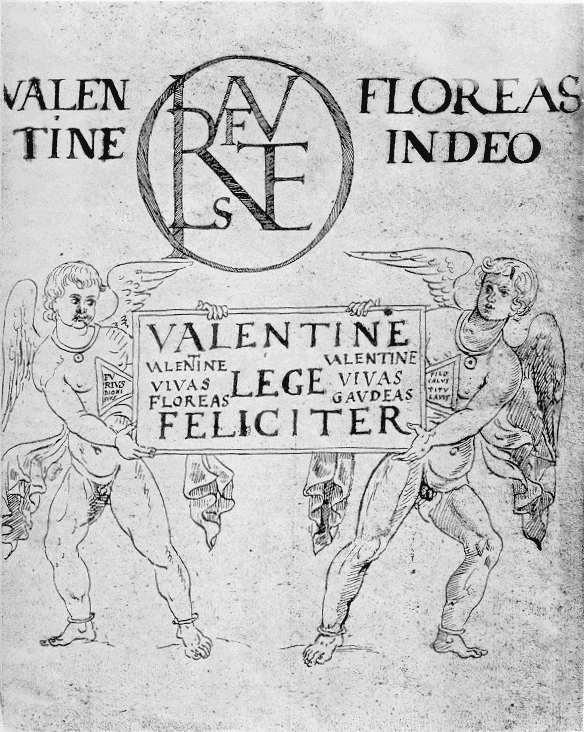
This work, which is unique is an almanac including various calendars and chronological lists commissioned by or presented to a man (presumably a man who lived in Rome) named Valentinus. The original, which no longer exists, was a real luxury product, including fancy calligraphy and lavish illustrations. (The illustration that you see above and the others preserved in various manuscripts are copies made in the Renaissance, a thousand years after the originals were made.)

What I found most interesting about the almanac when I first looked at it, is that it gave me a look at what aristocrats in mid-fourth-century Rome thought was important. Some of the material is Christian -- lists of bishops of Rome, lists of local martyrs -- but a lot of the visual material seems completely strange (pagan?) to my later eyes. A non-graphic example of surprising material can be seen in the Philocalian Calendar, part 6 of the Chronography, which gives all the official holidays, Senate meetings, good and bad luck days, observed in the city. Likewise part 16, the Chronicle of the City of Rome gives a summary of what local leaders might be expected to know of the history of the city and to a very limited extent, the empire. Have a look and see how much of this "Roman History" you've heard of!

Friday, May 18, 2007

Marutha of Maiperqat


Love that internet.

A public benefactor named Roger Pearse has for some time now been posting translations of works by the early "church fathers" (bishops, monks, and other early ecclesiastical writers).

Today I got a note that he's posted an unpublished account of the Council of Nicaea by the obscure writer Marutha of Maiperqat. The Council of Nicaea, A.D. 325, was one of those crucial moments when a diverse, amorphus movement, the Christian churches, tried to define itself as "the Church," by specifying what real Christians believed and condemning all others as heretics (people with false opinions instead of true faith).

Well, of course, this effort and later ones ended up splitting the Christian assemblies (original meaning of ecclesia or "church") into hostile alliances, especially in the Middle East and the Eastern Mediterranean. The Council of Nicaea, which was called and presided over by Constantine, also provided a precedent for imperial control of the churches and their doctrine (not that this was ever entirely successful).

Now, today, for the very first time ever, you can read one sectarian account of that event, one not widely available for many centuries.

This seems to be a good time to mention that Ramsay MacMullen, a well-known historian of the Roman empire, has published a book called Voting About God in Early Church Councils.
I can't wait to get hold of it.

Image:
The Church Fathers at Nicaea.